The Southern Point: Remember the Alamo!? Part 2
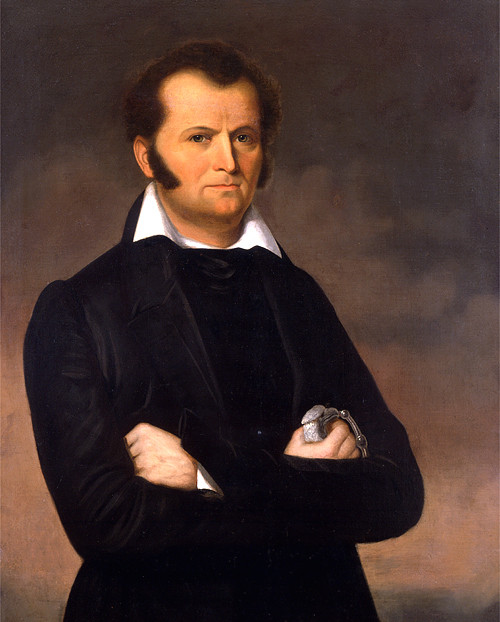
Big Jim Bowie
James Bowie is cast as an absolutely fearless, daring, and dangerous leader of men — his impulsive recklessness matched by his extraordinary ability to repeatedly overcome overwhelming odds to the astonishment of all involved. He was a man of big ideas and fortunes, and men naturally were attracted to his banner, whatever the endeavor, legal or illegal. As far as the fight at the Alamowent, however, he did not participate at all. He was deathly ill with typhoid fever and was shot, stabbed and killed while lying in his sickbed. Davissuggests that he may not have even been lucid when the Mexicans overran the compound (561). He had been sent to San Antonioby Sam Houston to collect whatever he could in the way of useful equipment and arms and then to blow up the compound because Houstonbelieved that it could not be held (493). When Bowiegot there, however, he thought it was strategically valuable as a stronghold for preventing the Mexican army from infiltrating further into Texas. On February 2, 1836, Bowie wrote Henry Smith, provisional governor of Texas, that “the salvation of Texas depends on keeping Bexar [San Antonio] out of the hands of the enemy. … We will rather die in these ditches, than give it up to the enemy. … It would be a waste of men to put our brave little band against thousands. … Again we call loud for relief” (500). Of course, they never got it.
What is important, in regards toBowieinTexas, is the role that he played leading up to theAlamo. On several occasions he had been at the forefront of the Texians’ fight for independence and yet he never held a formal military commission. Davis writes that “Ironically, the one Texian who … had seen more action in independent command then any other held no official rank whatever” (492). Read more