Featured Articles

Jewish–Hungarian Conflicts and Strategies in the Béla Kun Regime: a Review-Essay of “When Israel is King” (Part 2 of 5)

Go to Part 1.

5928 words

The restlessness of the Jews in Hungary, especially after the “emancipation” of 1867, took on increasingly radical forms because, while some of them saw a future in Zionism, others saw an opportunity not in the creation of Israel, but in the transformation of their host society according to their own needs. As a result, by the end of the nineteenth century, and especially in the early twentieth century, a number of subversive trends, defined in opposition to traditional Hungarian values and character, attracted Jews as a bloc. These included the psychoanalytic movement, Bolshevism, or so-called civic radicalism, with the Galileo Circle as one of its flagship movements, or in artistic areas, for example, the avant-garde Eights (Nyolcak; seven of the eight were Jewish). It was really just anti-traditionalism, thus to call it liberalism would be a mistake, since (as we have seen before and will see below) it had good connections to dictatorial and dogmatic Communism. It is not surprising, then, that the Bolsheviks of Béla Kun simply came to power with the help of such “Social Democrats” and Galileists.

In connection with the manifestation of liberal, or then patriotic, posturing among Jews, Győző Istóczy (1842–1915), a member of the Diet, explained in 1875 what was at stake decades before the Galileists presented themselves as progressive while working with the Bolsheviks: “The greatest self-mystification, therefore, is to believe seriously in the liberalism of the Jews. It is the caste-like element which, by its compact advance, crowds out and eradicates all foreign elements from all the spaces in which it has been able to establish itself—which, by its angular habits, erects an impenetrable Chinese wall between itself and the other elements, habits which, at the same time, express, in most cases, a deep contempt for other elements . . . which, claiming for itself the most extreme demands of tolerance, is itself the most intolerant element imaginable—and which uses liberalism as a means of turning its caste into an agrarian oligarchy” (Istóczy, 1904, 4–5). He added: “by waving the banners of liberalism and democracy, he entrenches himself in all circles where the interests of his caste are in view, and once warmed up in those circles, he begins the operation of driving out the foreign elements” (ibid., 9). Later, on March 11, 1880, he said: “it is my conviction that the Jews will only feign attachment to the Hungarian state spirit and the Hungarian nation as long as the Hungarian element in this country is supreme. Let us lose this, and Jewry will immediately turn its back on us, and even turn against us, as it turned its back and turned against us when the national cause was lost in 1849” (ibid., 80). He was boldly prophetic.

Hungary Transforms

The authors of When Israel Is King, the book at the heart of our present study, the Tharaud brothers, reach the Aster Revolution of 1918–1919 in their story: “Under the auspices of Count Karolyi, a National Council had been formed at Budapest, which claimed to have taken the place of the regular government. This council decided in a secret sitting that it would rid itself of the only man capable of opposing its designs,” and then, with József Pogány-Schwartz (1886–1938) in the lead, “they waited for a favorable opportunity. During the night from October 30th to the 31st, 1918, the revolution prepared by Karolyi and his friends broke out at Budapest” (Tharauds, 2024, 53–54). Pogány-Schwartz  (AKA, John Pepper, was an ethnically Jewish communist who later became an administrator of the Comintern in the USSR.

In connection with the shooting of Prime Minister István Tisza (1861–1918), the brothers mention that “[o]f the five ministers who had taken part in the Imperial Council of July 7th, 1914, he was the second to die by the hand of an assassin. Count Stürgkh, prime minister of Austria, had fallen before him, shot by [Friedrich] Adler, the socialist Jew. Russian Prime Minister Pyotr Stolypin (1862–1911) had a similarly Jewish assassin in 1911, in the person of the anarchist-socialist Dmitry Bogrov (1887–1911), and later the Tsarist Romanov family was executed under the command of the Jew Yakov Yurovsky (1878–1938). Although Tisza’s murderers were probably not Jewish, he was also carried away by a revolutionary fervor that was, to a great extent, Jewish.

In the meantime, a group of Bolsheviks was waiting in the wings, eager to take advantage of the “civic” class as a battering ram. As András Simor (1976, 23–24) outlines in his work, on March 24, 1918, a Hungarian Communist group was formed in Soviet Russia, working alongside the Central Committee of the Communist (Bolshevik) Party of Russia. The leaders were Béla Kun-Kohn, Tibor Szamuely-Szamueli, Ernő Pór-Perlstein and Endre Rudnyánszky. Through Farkas Lebovitz and Ernő Bresztovszky, Szamuely then established contacts with Ervin Szabó-Schlesinger, thus giving a foothold to Leninist Bolshevism in Hungary. The people named here were almost all Jews, with the probable exception of the Freemason Bresztovszky and Rudnyányszky. They had to wait a little longer for their time, but they had every reason to be optimistic, as the Tharaud brothers point out:

In this setting, the Russian revolution appeared as the dawn of that great evening which Israel has awaited for centuries. Tentative as it still was, Kerensky’s revolution opened up prodigious horizons for those Jewish imaginations, who only understand working at a gallop. With the knowledge they possessed, placed in direct contact with their Russian brothers by that long river of Judaism, which passing from Petrograd, by Bielostock, Vilna, and Lemberg, comes down to Budapest, they knew well that it was only a beginning, that the movement would not end there and that in the northern plains unheard-of upheavals were preparing, of which the effect, overflowing the Russian frontiers, would extend to the whole of Europe and upset the entire existing social order from top to bottom. At least, that was what they hoped. (Tharauds, 2024, 68)

The French brothers recall that Károlyi’s seizure of power (with Jews behind him) had carved a revolutionary crack in the Hungarian establishment, and they were already preparing to use this crack to tear down the walls completely: “The next day [late October] there began to appear on the walls enormous posters, imitated from Russia, which, under the Bolshevik regime, were to cover the whole town with bloodred color and with outrageous symbolism” (ibid., 79). Here the Jewish artist movement took its share of the responsibility for the visual part of Bolshevik propaganda, for example, by some of the members of the Nyolcak (Eights) group, of whom Bertalan Pór, Róbert Berény, Béla Czóbel, Dezső Orbán, Dezső Czigány, Lajos Tihanyi and Ödön Márffy were all Jews, the exception was only Károly Kernstok. The Kun regime supported the group, and had they had the time, they would presumably have included the Jewish group in their cultural policy (Rockenbauer, 2018); after all, they financially supported the Berény’s school which was committed to Bolshevism (Barki, 2018).
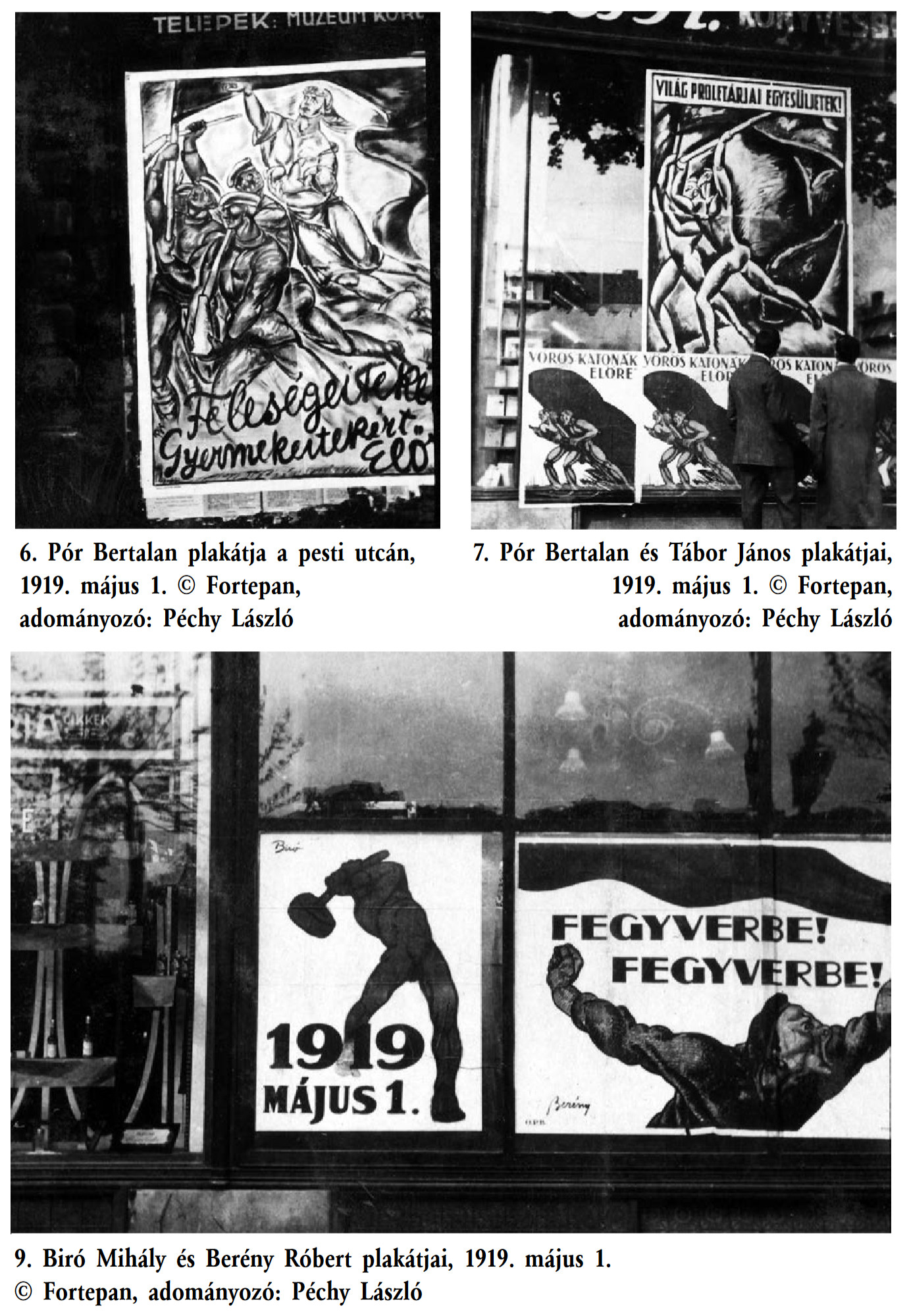
Posters of Bertalan Pór-Pollacsek, János Tábor-Taupert, Mihály Bíró-Weinberger and Róbert Berény-Bakofen for the Soviet Republic on May 1, 1919. (Published in Rockenbauer, 2018)

It took only a few months for the Bolshevik Jews to simply take the keys to the door of power from the “social democratic” and “civic” Jews without any specific struggle. As Dávid Ligeti (2019, 30) points out, “in essence, there was no turning back since November 1918: the Bolshevization of the country had already begun.” These Bolsheviks were in direct contact with the Soviets, and the government “became a satellite of the Moscow party centre in the strictest sense of the word,” Ligeti (ibid.). Ligeti  also emphasizes that this was foreign to Hungarians: “Without the social and economic crisis caused by the Great War, the establishment of the Soviet Republic would have been unthinkable. The majority of society was not Bolshevized. In fact, the new state power was based on a relatively narrow, mainly urban population. The fact that the regime wanted openly and completely to abolish the old social order met with open opposition, especially among the peasant classes, so it is no accident that the more important counter-revolutionary cores were established in the countryside.” (Ibid., 31) Traditional Hungarians, on the other hand, were the opposite of metropolitan, urban Jewry, broadly speaking.

The Tharauds touch upon this process also:

When they had finished drawing up this manifesto, Kéri [Kramer Pál] and Kunfi [Kohn Zsigmond] returned to Karolyi. He had with him his two special secretaries, Simonyi [Henri] and Oscar Gellert [Oszkár Gellért], both of them Jews. Whether it was due to the nonchalance of a great seigneur, or on account of a conscientious scruple, or a supreme regret for his loss of power, Karolyi did not himself put his signature at the foot of the document. Simonyi signed it for him. It was these four Jews who put an end to the Hungarian Republic and stifled the last efforts of Karolyi’s ambition. (Tharauds, 2024, 119)

Cécile Tormay described it as follows:

In the ceremonial hall of the Hungarian parliament, Lenin’s aide could comfortably unfurl the flag of Bolshevism, sound the alarm of social revolution and proclaim the coming of the world revolution, while outside in the Parliament Square, accompanied by Oszkár Jászi, Márton Lovászy and Dezső Bokányi announced to the people that the National Council had proclaimed a republic. Mihály Károlyi also gave a speech at the resting place, on the stone steps. And down on the square, Jenő Landler, Jakab Weltner, Manó Buchinger, Vilmos Böhm and Mór Preusz praised the Republic. … There was not a single Hungarian among them. And that was the confession of everything! Above, the mask: Mihály Károlyi, below, the real face: an alien race that made its dominance known. (Tormay, 1939, 182)

Lajos (internationally, Louis) Marschalkó (1903–1968), an expert on the influence of Jewry, reacts to Tormay’s comment in his classic work, Országhódítók: “And indeed, it was no longer Bolshevik, Socialist or Marxist rule, but alien racial rule over Hungarians,” and he adds:

Because what happens after March 21, 1919, is not Marxism, not Communism, but a new form of occupation on a “Socialist” basis. But the people who are carrying out this conquest, while proletarians from Dob Street, Nyíregyháza or Kolozsvár, but they are just as much Jews as Ferenc Chorin or József Szterényi. Yes! They will intern the “big Jew” as a hostage if they have to, but the aim is still domination of the Hungarian people. Not in the form of Capitalism, but in the form of “Socialist” world redemption. (Marschalkó, 1975, 180)

The March 21 resolution proclaiming the merger of Social Democrats and Communists was signed by Jenő Landler, Jakab Weltner, Zsigmond Kunfi, the above-mentioned József Pogány-Schwartz, and József Haubrich on behalf of the “democrats”—all Jews, except Haubrich, who is also said to have been a Jew, but it is not certain. The signatories representing the Communists were: Béla Kun, Béla Szántó, Béla Vágó, Ferencz Jancsik, Károly Vántus, Ede Chlepkó, Ernő Seidler, József Rabinovits (Böhm, 1923, 248–249). Jancsik was not Jewish, Vántus was rumored to be, but I know of no proof of this. According to this, of the 13 signatories 10 (perhaps 12) were Jewish—76.9% (or 92.3%). However, similar proportions are found not only for the signatories, but also for powerful establishment figures, as will be seen…

Ágnes Szokolszky (2016, 27. ) concludes that “[r]adical intellectuals, many of them of Jewish origin, were attracted to social reforms and became leaders in the liberal and the communist governments,” and that “Jewish involvement in the short-lived Hungarian Soviet Republic was significant: the great majority of people’s commissars (ministers of the communist government) were of Jewish descent — among them Jenő Varga, an economist and psychoanalyst, who was commissar of finance, and philosopher György [Georg] Lukács, who was commissar of culture.

Measures were taken with an iron fist, including  hostage taking from the civilian population and daily executions by revolutionary tribunals to prevent counterrevolutionary attempts.” The author also points out, in the context of the second Communist regime later, that “[t]he majority of the communist leaders, including the secret police, were of Jewish origin, including Mátyás Rákosi himself. On ground that the Jewish population was exempt from the infection of fascism, people of Jewish origin were trusted by the Rákosi regime and were often put in leading positions.” (Ibid., 38). (Rákosi was a prominent commissar in the Kun government and led the Hungarian government from 1947–1956).  The latter point is revealing, and it is worth recalling what Rákosi himself said in connection to this, for he believed that many Jews joined them not because of their commitment to the Communist principle, but rather because they wanted to gain power: “A new danger is the emergence of Jews who are returning home, who were previously in the workers’ regiments and are now returning home. They are pretending to be born anti-fascists, joining our party. Almost without exception, they have no idea of Communism, but they are intelligent, skillful and soon they are gaining a leading influence in the villages and small towns and in the police.” (quoted in Pünkösti, 1992, 215). Rákosi worries that this threatens the system, and complains that they are considered anti-Semitic because they sometimes expelled Jews who are not partisan enough, but what is important for us here is what this shows: power, not principle, is what drove many Jews.
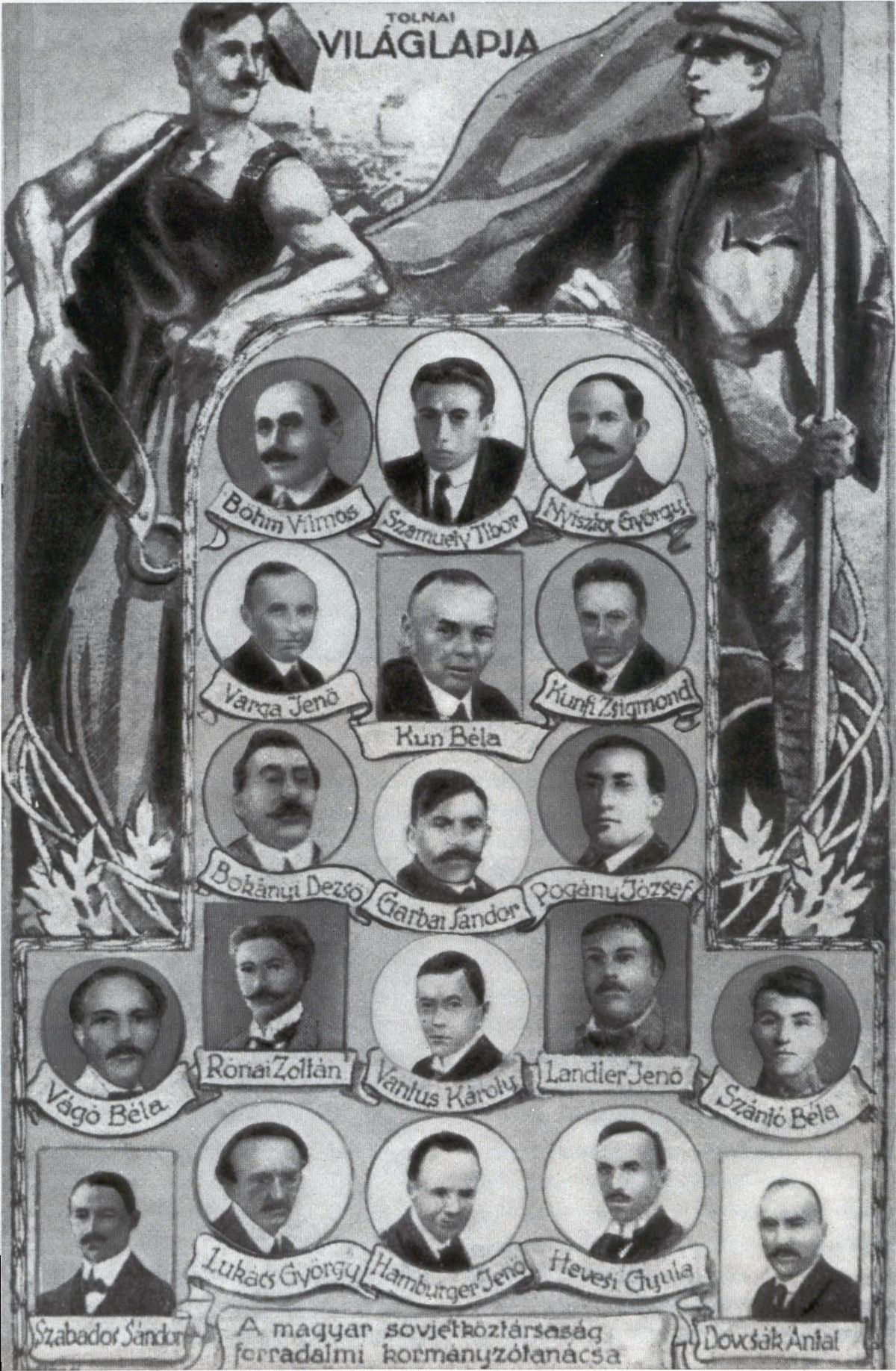
A newspaper celebrates the new “Hungarian” Bolshevik government, whose personnel kept changing, but in this installation, 14 of the 19 are Jews – 73.6% (gentiles: Garbai, Nyisztor, Vantus, Dovcsák, Bokányi)

The Tharauds (2024, 105) then portray Béla Kun: “sometime after Kerensky’s revolution he became a friend of the famous propagandist Radek, whose real name was Zobelsohn, now a great personage in the Ministry for Foreign Affairs at Moscow, and who was at that time employed to make Bolshevist propaganda among the prisoners.” They describe that Kun was sent to Hungary with money and other supplies to incite the revolution, and that Böhm and Kunfi later visited Kun in prison, after he was arrested: “Böhm and Kunfi went to visit Bela Kun and the other incarcerated Communist leaders in their place of arrest. Laszlo, Korvin-Klein, Rabinovitz, etc., were among the number, all Jews. They caused their friends to be appointed directors of the prison so that the prisoners presently found themselves in fact the masters.” (Ibid., 111) About the establishment of the Bolshevik government, the brothers also write:

Bela Kun conferred the presidency of it upon Alexander Garbaï, an entirely obscure personage, but who had, in Bela’s eyes, the advantage of being a Christian and so masking the Semitic character of this Communist movement. Of twenty-six commissaries, eighteen were Jews: an unwarrantable number, if one considers that there are only 1.5 million Jews among the twenty million inhabitants of Hungary. These eighteen men took the direction of the Bolshevist government into their own hands; the others were mere figureheads. (Ibid., 120)

They bitterly add that “[a]fter the dynasty of Arpad [Árpád], after St. Stephen [István] and his sons, after the Anjous, the Hunyadis, and the Hapsburgs, there was a king of Israel in Hungary today.” (Ibid.) But here we have hit on an important point: Garbai’s appointment was indeed made to be window dressing for an essentially Jewish regime—a common tactic in Jewish intellectual and political movements (MacDonald 1998/2002).

Sándor Garbai’s Compass for Posterity

Thus Sándor Garbai was chosen because he could comfortably fit behind the real leader. In the minutes of the Revolutionary Governing Council, at the beginning of the regime, Vilmos Böhm suggests, openly speculating, that three non-Jews should be appointed to the administration of the capital: Ágoston, Bokányi, and then “a third, an iron worker, should be appointed also; if we form this leadership in this way, we would have a body which is also Jew-free” (quoted in Imre & Szűcs, 1986, 277).

Sándor Garbai (1879–1947) was used only as a mask, and the originally social-democratic politician later looked back on the Bolshevik period rather bitterly. István Végső, a historian, examined the 1172 pages of memoirs written by the former Shabbos goy, who was living in France at the time, for a planned biography and compiled a selection of them a few years ago, focusing on his memories and comments about the Republic and Jews. As Végső (2021, 33) points out, “Garbai was already suspected of having anti-Semitic views between the two world wars. In addition to anti-intellectualism, Vilmos Böhm also sensed ’not without reason’ anti-Semitism in Garbai’s post-1919 manifestations,” and that “1918–1919 was a watershed period in Garbai’s thinking. Apart from a few cases, his thinking before 1918 clearly diverges from that after the Soviet Republic” (ibid.). Indeed, Végső also notes that “[i]n the text, prejudice not only appears but is a constant feature. Its anti-Communist and anti-Jewish sentiments are blatant in the context of the labour movement” (ibid., 44), so Garbai’s insight outlined below is automatically “anti-Semitic” according to the historian, even though it often expresses positive and concerned feelings towards Jewry. Presumably, without such value judgments the collection would not have been published. As Végső points out, “[i]n a good part of the world, political parties after 1945 clearly refrained from anti-Semitic statements, but Garbai’s attitude remained unchanged” (ibid.).

Finally, Végső describes how Garbai recalled why he was appointed President in 1919: “The Board of Governors moved to appoint the President of the Board of Governors. Béla Kun stood up and proposed me as chairman. The reason was that Garbai was a worker, non-Jewish, a social democrat, experienced in the presidency. We communists also support him.” (Quoted in ibid., 104) Later, Garbai notes: “After the Governing Council was formed, Kunfi objected to the fact that there were many Jews among the People’s Commissars. This, he said, gave a bad impression on the Hungarian community. This proportion should be reduced, because 20 of the 28 Commissars are Jews. Kunfi’s comment caused consternation, but the majority argued that this aspect could only be honored later. For the time being, let the work begin with those appointed” (ibid., 106). The majority therefore thought that the large number of Jews was not a problem and that the programme should go ahead. 105 years later, we now know the result of this.
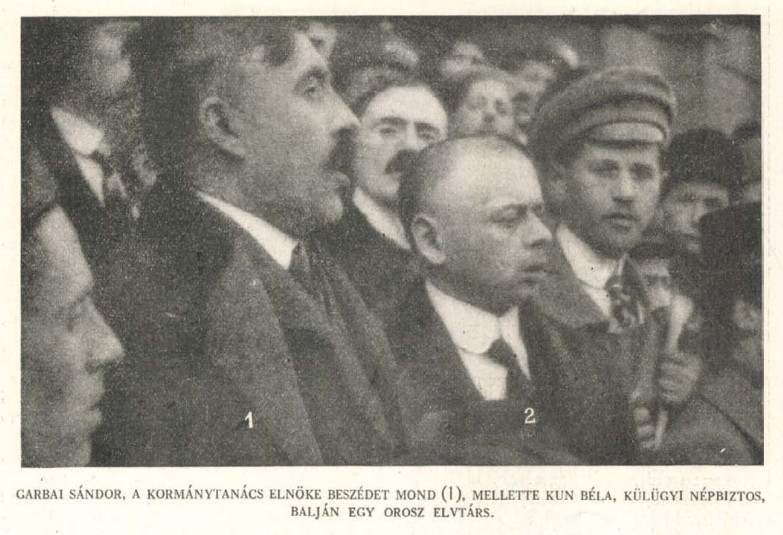
Sándor Garbai (1) with Béla Kun (2) on March 23, 1919.

Writing in Paris on April 6, 1946, Garbai recalls the first days of his regime, and in it the former president shares important observations with posterity:

In the evenings, we often went downstairs to the restaurant where we had dinner and watched the new functionaries who were looking after the cause of Hungary and the fate of the Hungarian people. I must confess, I was amazed at the mass of people that surged up and down the hall. Every day, nearly three hundred people gathered here, whom I hardly knew individually or collectively, although I individually knew the Budapest party functionaries in the Social Democratic Party. Of these people who swarmed here, 90% came from a group of young Jewish intellectuals who had set out to establish their careers with Visegrád Street Communist Party membership cards. I was struck by a shocking sight. I could not have imagined the extent of personal neglect, the unshaven, dirty, muddy looks that I witnessed here. The workers also appeared tired and shabby in the trusted men’s [i.e., Jews] seats, and yet there was something acceptable about them, something generalized, a willingness to be clean. They tried to keep themselves tidy and approach a human standard. The opposite happened. These people wanted to document their belonging to the proletariat by being dirty and neglected.

Béla Kun himself noticed this horse stable standard and loudly warned some of his followers that soap and razors were invented for the people.

My friend Henrik Kalmár and I discussed all aspects of this sad phenomenon. Kalmár told me that he has lived in the Hungária hotel from the beginning and sees this disgusting phenomenon every day. I am also Jewish, Kalmár said, I grew up in the Bratislava ghetto, but I am afraid of becoming an anti-Semite if this continues.

It’s good that it is not seen by others, only us. The mass rush to this power is to the detriment of the times and of the precious Jewish intelligentsia. It is absurd to believe that in a country like Hungary, where 63% are Catholic, 30% Reformed and 5% Jewish, this Jewish intelligentsia, which now sees the time as right to rise to power in the name of the worker, can remain in power. In this country, there was no obstacle to the Jews’ advancement. They could do whatever they wanted. They could be lawyers, doctors, teachers, engineers, industrialists, merchants, craftsmen and workers. But they could be no ruling class. There were few of them for that. The ruling class everywhere, and therefore also in our country, made up of the whole people, and it is against this law of evolution that the Jews now want to seize political power by means of revolution. I am afraid, said Kalmár, that many innocent Jews will pay the price for this hunger for power. For if this fails, an anti-Semitic wave will sweep the country the likes of which we have not seen before. (Ibid., 119–121)

Garbai then says to Kalmár: “The differences must disappear, because an undesirable situation could arise in which a life-and-death struggle between the Jewish and Hungarian intelligentsia would start, yes, in order to maintain their position of power. The effect of this will be that, instead of efforts to improve the situation of the working people, bloody battles will be fought under the slogans ’revolutionary’ and ’counter-revolutionary,’ to decide whether the Jewish or the Hungarian intelligentsia will lead the Hungarian people into the framework of the socialist world to come” (ibid.). All this is in line with the basic thesis of my analysis—although, it should be noted that Garbai wrote this 27 years after the events, so it is not known to what extent it is accurate. Nevertheless, it is in sync with the known past, and in the absence of contrary evidence, there is no good reason to doubt the memoirs of such an important figure. Equally disturbing—and very much in line with my thesis—is the following passage from April 20, 1946 (Paris):

Rabinovits also took over the leadership of the party’s agitator training school, where he enrolled young party members and trained them to carry out organizing tasks.

Party secretary István Farkas noticed that Rabinovits was only enrolling Jewish boys in the school, and questioned him. He said that if he did this knowingly, he would be forced to report to the party leadership because he could not take responsibility for this one-sidedness.

József Rabinovits told István Farkas, with peace of mind, that he was looking after the interests of the revolution when he did this. Only a Jew can be a reliable revolutionary, he said, because he does not belong to any existing organization. He has no national roots, his position is international. World revolution requires such men of international feeling as the Jews are. And the Hungarian proletarian dictatorship is an important link in the chain of the world revolution, and therefore this revolution can only carry out its historic task safely and irrevocably under the leadership of the Jews. Not otherwise. This is also the case in Russia. It must be the same here. (Ibid., 130; my emphasis)

Garbai then recalls how he complained about this to Rabinovits, considering this practice “dangerous” because it “places an excessive responsibility on the Jews.” He continued: “It would mean the emergence of a new ruling class under the aegis of international trust, from which all those who were born and live within a national framework and have national roots would fall out. Do not forget that the nationality of Jewry is in the accentuation of internationalism because the state of dispersion has made this necessary. But I also consider it necessary, in the interests of Jewry, that you do not follow this method, however tempting it may be. If the leadership of the workers’ movement is overrun by Jewry, it will lead to anti-Semitism” (ibid., 147).
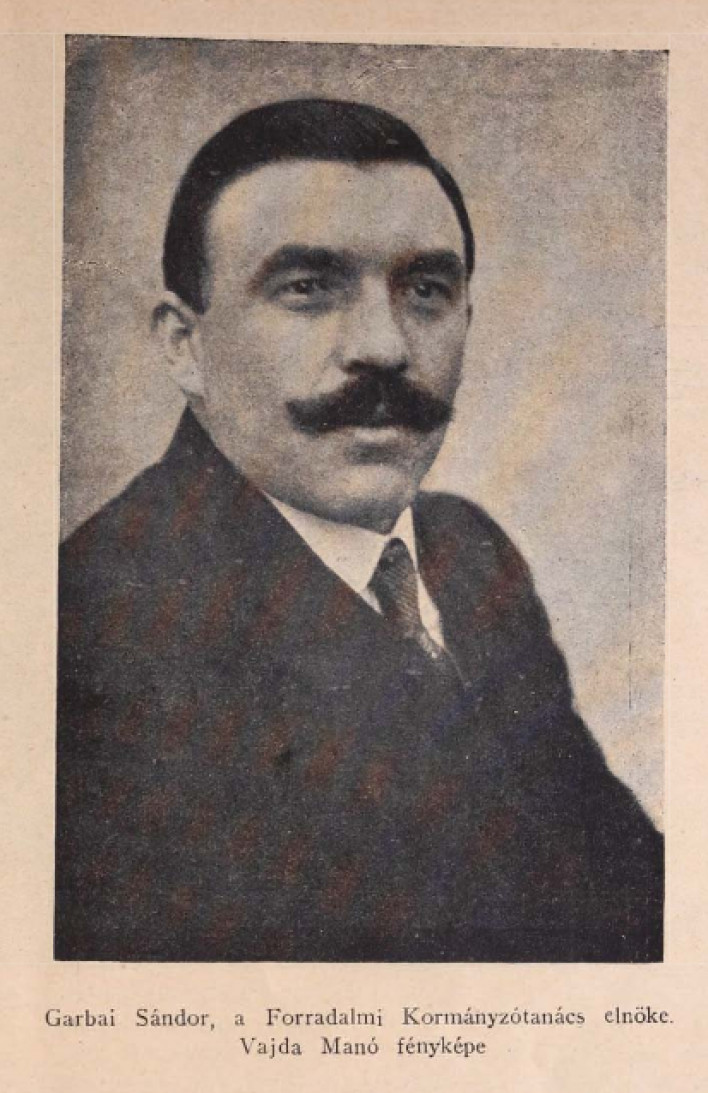
Sándor Garbai

Also in Paris, on August 10, 1946, Garbai once again spoke with stark clarity. Historians have been studying the topic for decades, but almost none of them have the courage to put the following obvious fact on paper in such a roundabout way. Rather, an elderly man who was soon to die had to:

It [the revolution] was for a theory [Bolshevism] whose components nobody knew, only the Jewish intelligentsia, the vanguard of the industrial workers, were enthusiastic about it, because they saw in it not only the success of the social revolution but also its own rise to power. It was the rise to power that was the main goal. This was manifested in the fact that the industrial workers were led to believe that they would come to power through change and that they would be the holders of power. The industrial workers, under the influence of party discipline, could not consider that after the change they would still have to do the work, often under worse conditions than before, but the administration of the state was taken over in the name of industrial workers by the Jewish intellectuals and they were the main beneficiaries of the revolution. And anyone who challenged their rights was a counter-revolutionary. The Jews, especially the young element of Jewry, strove with unprecedented tenacity to take power, and lost sight of the double revolutionary direction of the Hungarian Revolution, because of its distorted structure: the liberation of the industrial workers and the coming to power of the Jews, the country cannot bear, one will drag the other down with it, into the abyss, into ruin, into destruction. (Ibid., 216–217)

Garbai also illustrates the anti-Hungarian nature of the Judeo-Bolsheviks with Ignác Schulcz (1894–1954), in connection with his activism in Czechoslovakia:

But Ignác Schulcz demanded that his followers vote against the use of the Hungarian language. He put party discipline above the interests of the Hungarian minority. He didn’t even care that the Hungarian community boycotted the traitors of the Hungarian language, and Hungarian voters turned away from the Social Democratic Party. This anti-Hungarian Social Democratic policy could only develop alongside the Jewish mentality of the political line that Ignác Schulcz represented in the party. (Ibid., 234)

There are plenty more remarks like the above in István Végső’s collection. Garbai’s conclusions about the history he witnessed in the midst of the events are thus extremely devastating, especially as regards the role and attitude of the Jews. While the charge of ’bias’ may seem justified, the same can be said of all the protagonists of history (and of today’s analysts) to some extent. The diary entries, memoirs and manifestations of the protagonists of events are among the most important elements of historiography, but in Garbai’s case, according to mainstream historians, it all comes across as something esoteric and strange, the focus being on the author’s “prejudice,” rather than his “post-judgmental” experience, so to speak.

By contrast, Garbai’s style of writing, and his thoughts on paper, show a clear mind, his criticisms are logical and—as my analysis here is intended to show—entirely justified. Given the blatant extent to which the legally protected narrative of the so-called Jewish Holocaust is based on conjecture and circumstantial accounts (or statements made under pressure, perhaps torture), to brush off the insights of one of the most insightful and active participants in the events as the anti-Semitic grumblings of an old man is, from a historiographical point of view, brazenly arrogant. Perhaps the real bias should be found here (e.g., to accuse Jews of anti-Hungarianism and tribal ethnocentrism—as Garbai does—is anti-Semitism according to mainstream scholarship today, while to accuse Hungarians of anti-Jewishness and ethnocentric motives is the most natural thing to do). Be that as it may, while historians and pundits come and go, Garbai’s writings will remain a compass for posterity.

Bloodshed in the Countryside

In the case of Tibor Szamuely (1890–1919), the Tharaud brothers (2024, 140) give the following account: “He was one of three children of a Jewish family from Galicia that had emigrated into Hungary a short time before and had acquired some degree of affluence in one of the northern counties. He, like Pogany, Bela Kun, and the greater number of the commissaries of the people, belonged to the category of intellectually discontented men who considered that society did not sufficiently recompense their talents.” The nature of the executions is described as follows: “whence news was brought that the peasants had cut a telegraph wire, attacked some Red Guards, or refused to deliver up their cattle and corn. He arrived in the village surrounded by his leather-clad men, who held bombs in their hands. The peasants denounced by the local Soviets were brought one after another before this revolutionary tribunal, composed of a single judge, round whom were grouped Szamuely’s companions. He himself, seated on a chair, his legs crossed carelessly one over the other, and smoking a gold-tipped cigarette, joked and laughed.” (Ibid., 145).
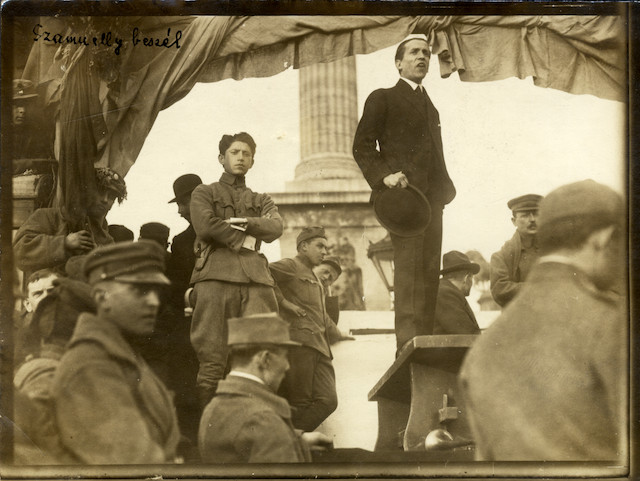
Tibor Szamuely speaks on recruitment day in Heroes’ Square

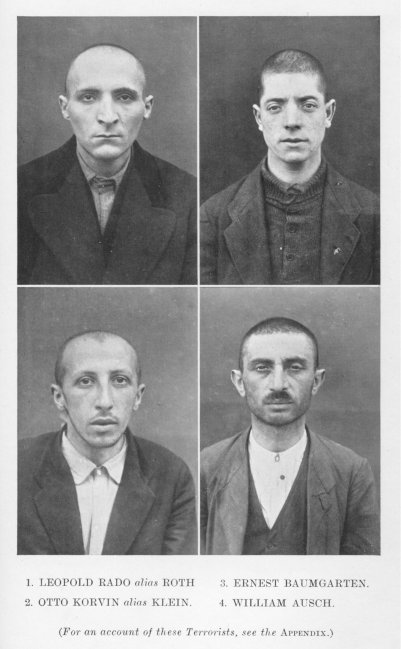
They also introduce Árpád Kohn-Kerekes (1896–1919), who was Szamuely’s partner in the killing spree and describe some of the executions, which were typically sadistic. Lajos Marschalkó also later quoted “the report of Imre Fehér, Colonel of the Red Army, sent by him to József Haubricht, the commander of the Italian army and the Italian military mission, on the actions of Samuelly’s [sic!] terrorists,” in which he said:

We accuse Samuelly and the terrorists of the following crimes: they have executed many innocent people in excess of their powers. The accused had no right to defend themselves and were executed without interrogation. Their procedure, which mocked any humanism of the slightest pretension, was as follows:

The terrorists, as soon as they arrived in a village, immediately rounded up and beat the male population. Samuelly selected 10 or 15, perhaps more, of them and, without saying a word to the unfortunates, handed them over to the Lenin Boys. The Lenin Boys, like wild animals, rushed at the unfortunate victims and began to beat them with rifles, hand grenades and stabbing them with blades. Blood gushed from the bodies of the men. A great many had their arms and waists broken, and then, standing them on chairs under a tree, they hung a rope around their necks and ordered them to kick the chair out from under them. If the unfortunate martyr was too frightened to do so, they stabbed him with knives until he was dead. (Quoted: Marschalkó, 1975, 182–183, Italics in original)

Marschalkó then refers to the work of the Tharauds: “We cannot take it amiss if Jenő Molnár [reporting the above] did not say what the Tharaud brothers later wrote, that it is so everywhere: ’Where Israel is king.’” (ibid., 188). Péter Konok describes the role of Lenin Boys in this way: “the official and semi-official terror groups (the term they themselves used) of the Soviet Republic were primarily focused on ’defending proletarian power.’ The aim was twofold: on the one hand, to ensure the Red Army’s effectiveness at the front and, on the other, to put down the growing counter-revolutionary rebellions and conspiracies in the rear. On April 21, the Revolutionary Governing Council set up the Committee Behind the Front, which also functioned as a tribunal” (Konok, 2010, 75). Its chairman was Szamuely, and “Political cases were handled by the Political Investigation Department of the People’s Commissariat for Internal Affairs headed by Ottó Korvin on the one hand, and by the Behind the Front Committee and the Court of Imprisonment, which were independent of it on the other” (ibid., 77). Dávid Ligeti (2019, 33–34) also recalls that “the case of György [Georg] Lukács, who ordered the shooting of eight people as a political commissar of the 5th Division at Poroszló on May 2, is well known.”
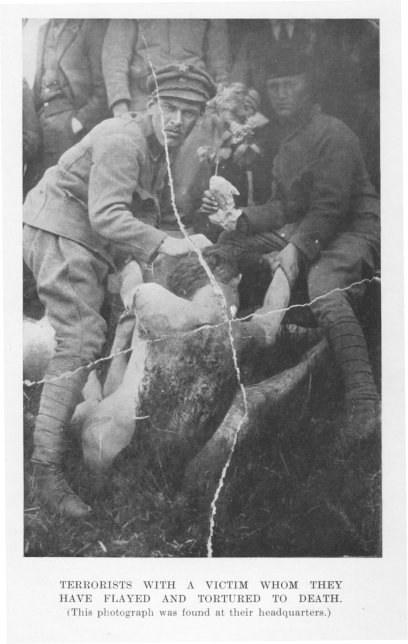
Photograph ripped to pieces and thrown away at a headquarters portraying some of the Lenin Boys with their victim (source: Tormay, 1923)

Ligeti also notes that “the role of the three-member panels in the imposition of death sentences was particularly perverse: here the victims had neither the possibility of appeal nor of effective legal defence” (ibid., 32). Szamuely and his associates also expropriated the property of the Hungarians after their massacres. Instead of leaving their property to the possible survivors, or distributing it among the poor, they transported hundreds of cows, bulls, oxen, pigs, sheep and poultry to Budapest by train, as reported in a telegram from Szamuely to Kun on June 10, 1919 (in: Bizony, 1919, 72).

The Bolshevik Jews believed that after Russia, and now Hungary, other countries would be swallowed up one country after another, so there was no such thing as too much cruelty. This belief is exemplified, for instance, in the official Bolshevik newspaper, the Vörös Ujság, issue of April 9, 1919, which wrote: “What is happening in Hungary today is, if possible, of even greater significance than the revolution of the Russian people. We are bringing the proletarian revolution to Western Europe.” (quoted: Chishova & Józsa, 1973, 221). Pravda, in Russian, on April 12, 1919, in its second issue, stated that “[t]he present events mean neither more nor less than that we are carrying the socialist revolution into the sphere of the proletariat of Western Europe, since we are convinced that the proletarian revolution will triumph only if the whole of Europe is on our side.” (Quoted: ibid., 225).

With all that behind us, next we will analyze the manifestation and role of identity, as well as ethnic character, further figures and data, and then misleading historical manipulations will also be answered.

Go to Part 3. 


References

Barki Gergely. „A proletárdiktatura jót tesz az egésségnek” – Berény Róbert, 1919. Enigma 25. évf. 94. sz. (2018.) 128–146.

Bizony László. A magyarországi bolsevizmus 133 napja. Leipzig–Wien: Verlag Waldheim-Eberle A. G., 1919.

Böhm Vilmos. Két forradalom tüzében: Októberi forradalom, proletárdiktatúra, ellenforradalom. Munich: Verlag für Kulturpolitik, 1923.

Chishova, Lyudmila; Józsa Antal (eds.). Orosz internacionalisták a magyar Tanácsköztársaságért. Budapest: Kossuth Könyvkiadó, 1973

MacDonald, Kevin. The Culture of Critique (AuthorHouse, 2002; orig. Pub. Praeger, 1998).

Imre Magda, and László Szűcs (eds.). A Forradalmi Kormányzótanács jegyzőkönyvei, 1919. No. XIII. Akadémiai Kiadó, 1986.

Istóczy Győző. Istóczy Győző országgyülési beszédei, inditványai és törvényjavaslatai 1872–1896. Budapest, 1904.

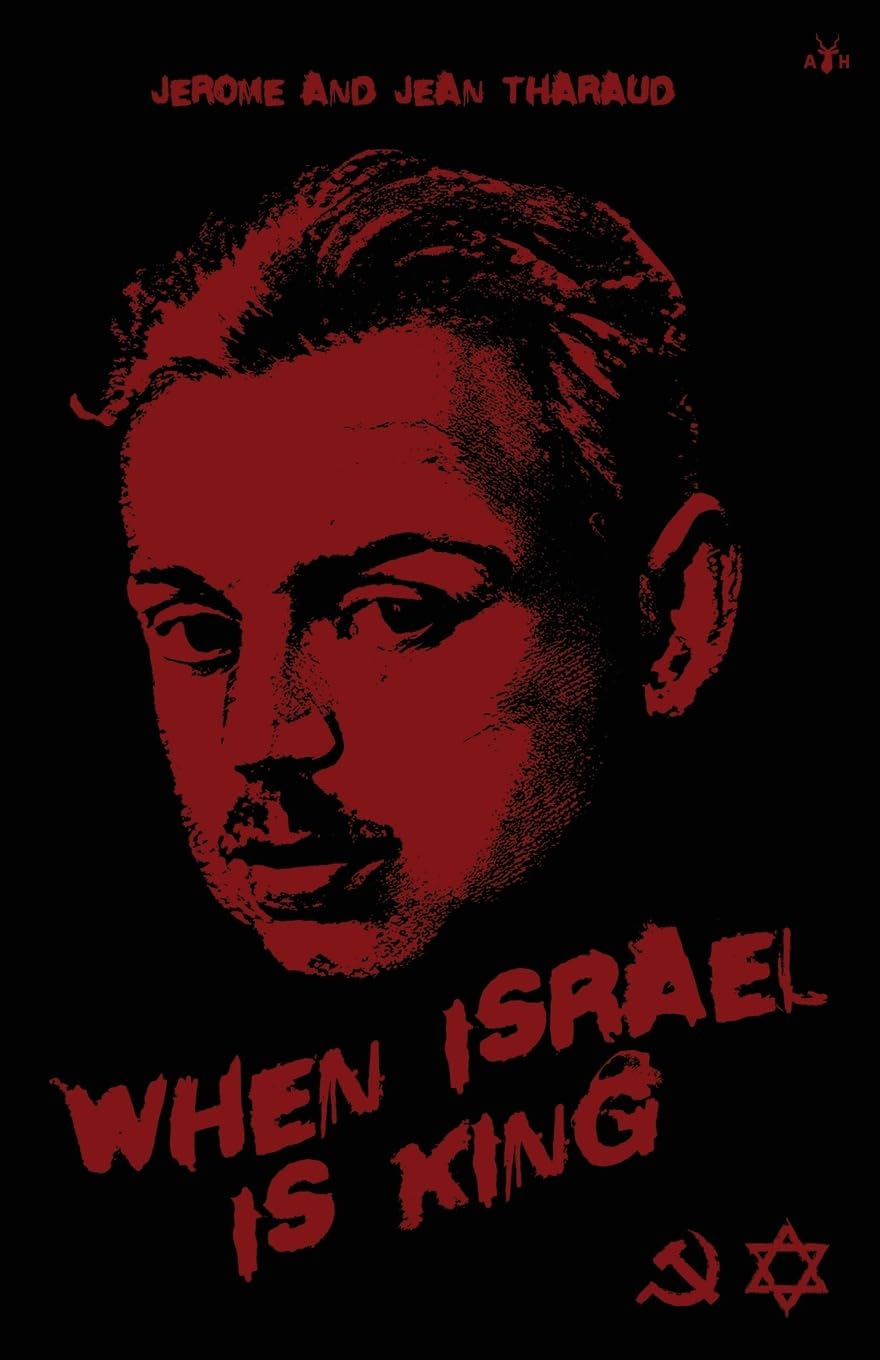
Jérôme Tharaud, Jean Tharaud. When Israel is King. Antelope Hill Publishing, 2024.

Konok Péter. “Az erőszak kérdései 1919–1920-ban. Vörösterror–fehérterror.” Múltunk – Politikatörténeti Folyóirat 55.3 (2010): 72–91.

Ligeti Dávid. “Hazánk első totális diktatúrája: a Tanácsköztársaság a centenárium fényében.” Somogy 47.2 (2019): 30–35.

Marschalkó Lajos. Országhódítók. Munich: Mikes Kelemen Kör, 1975.

Pünkösti Árpád. “Rákosi a hatalomért: 1945–1948.” Budapest: Európa Könyvkiadó, 1992.

Rockenbauer Zoltán. A Nyolcak és az aktivisták 1919-ben. Enigma 25. évf. 94. sz. (2018.) 80–101.

Simor András. Korvin Ottó: „…a Gondolat él…”. Budapest: Magvető, 1976.

Szokolszky, A. (2016). Hungarian Psychology in Context. Reclaiming the Past. Hungarian Studies, 30(1), 17–56.

Tormay Cécile. An Outlaw’s Diary. Revolution. London: Philip Allan & Co., 1923.

Tormay Cécile. Bujdosó könyv. Első kötet. Budapest: Singer és Wolfner Irodalmi Intézet Rt., 1939.

Végső István. Garbai Sándor a Tanácsköztársaságról és a zsidóságról. Budapest: Clio Intézet, 2021.


Jewish-Hungarian Conflicts and Strategies in the Béla Kun Regime: Szilárd Csonthegyi’s Review-Essay of “When Israel is King” (Part 1 of 5)

“An alien race has made its dominance known.”
Cécile Tormay

When Israel is King
Jérôme and Jean Tharaud
Antelope Hill Publishing, 2024; original French edition published: 1921

7200 words

It was on the 21st of March, 1919, that a group of Bolsheviks seized control of Hungary for an infamous 133 days. That was 105 years ago, as I’m writing this in April 2024—from a safe historical distance, one might think. That might be the case, indeed, if one is concerned about Bolshevism, but the story of the Magyarországi Tanácsköztársaság (known in English as the Hungarian Soviet Republic, or literally: Republic of Councils of Hungary), led by an almost entirely Jewish group, with Béla Kun (1886–1939) at its head, is not so much about Bolshevism, or Communism, as it is about Jews—about conflicting interests and the collision of worlds during an already tense period between this intense, ambitious minority group, and the host nation. Indeed, how different groups react to tension or conflict, especially when they live in the same space, is itself a key element of this story. Given this, the lessons we can learn from the story of the Kun regime are timeless, especially since Jewish influence—sometimes even “control,” to stick with that word—over our nations remains a reality, with its conflicts and tensions.

In recent years, the relatively young American publisher, Antelope Hill Publishing, seems to have made it its mission, besides their original releases, to translate or republish historical rarities, bringing older works back into public consciousness, rescuing them from the obscurity of neglect. One recent result of this noble mission is the new edition of a French book from 1921, with its 1924 English translation reformatted—a book about one dark spot in the past of Hungary. The original title of the work was Quand Israël est roi; now translated as When Israel is King (see the publisher’s page for the book, or on Amazon). The authors of the work are Jérôme and Jean Tharaud (henceforth: Tharauds), a pair of brothers who, being familiar with Hungary at the time, documented the story of the Soviet Republic with a foreigner’s eye. They seemingly are men with integrity, and they present the story to the reader with honesty—that is, without hiding the role of Jewish influence and the multifaceted problems stemming from it.

Today, the Tharaud brothers are regarded by mainstream scholarship merely as anti-Semites or racists. An excellent example of this is provided by French historian Michel Leymarie, who, in his article in the Jewish journal Archives Juives, runs through the literary output of the French brothers, from short stories to historical material, and details how they characterized Jews negatively—whether as isolated, religious primitivists, or as metropolitan, secular activists.

Leymarie does not feel the need to refute the statements and data of the brothers; he considers it sufficient to demonstrate, with the voice of moral indignation, that the brothers dared to write negatively about Jewry: “In April 1917, the elder of the two brothers wrote to his wife: ‘The Russian Revolution is largely a Jewish revolution. No one knows the question better than we do.’ Here the theme of Judeo-Bolshevism as well as anti-Semitic hatred that is not always immediately apparent to the reader, is explicitly revealed, even before When Israel is King” (Leymarie, 2006, 92). Leymarie therefore applies a very low standard to cast moral judgment, if even such a lukewarm remark falls into the category of hatred; but perhaps this is to be expected from a Jewish journal. While the Tharaud brothers sit in the moral dock of Jewish sensibility, we can find relief in the fact that even their critics do not target them with the weapon of refutation. In light of this, it is worth exploring how that Jewish regime of Hungary, which they called the “New Jerusalem,” was perceived by them.

The work was first published in Hungarian by Cécile Tormay (1875–1937), a well-known writer on the topic herself, in her journal Napkelet (Sunrise), whose issue of February 1, 1929, in an article by Sándor Eckhardt (1929, 214) refers to it in this way:

Tharaud’s colorful and exquisitely written book (Quand Israël est roi), which also appeared on the pages of this journal (Napkelet IV.), is the only exploration of the Hungarian revolutions written with an artist’s pen, which opened the eyes of the world and shed a bright light on events only vaguely known from newspaper reports. Then came the French translation of Cécile Tormay’s book, Bujdosó könyv (Le livre proscrit 1919 [The Banned Book 1919]), which rivaled Tharaud’s in popularity and contributed greatly to the clear picture of the Hungarian revolutions that was given to the world.

Reality as Taboo

Following that, only in 2003 did the work surface in Hungarian by translator and publisher Áron Mónus, presented in a conspiratorial manner—according to the publisher’s focus at the time—under the title Jewish Rule in Hungary Based on the Protocols of the Elders of Zion, but this work of the Frenchmen can be considered generally unknown. Not so the story of Tanácsköztársaság, the Republic of Councils, which the average Hungarian is somewhat familiar with—at least within the narrative frame of “Communism is a horrible dictatorship.”

Another important aspect of all this is the general Jewish–Hungarian conflict, which was rather evident in that period—in fact, from a long-term perspective, this aspect of Jewish activism is even more important considering that, while Bolshevism today is not a serious threat, the influence of Jewry persists to this day. Thus the continuing nature of this specific ethnic conflict of which the Kun regrenders the book’s theme timely. This continuing conflict has remained a taboo, however, as it was illustrated well by activist Jews a few years ago. Commemorating the 100th anniversary of Miklós Horthy (1868–1957) becoming the regent of Hungary, László Toroczkai, leader of the Our Homeland Movement—a populist-nationalist party—on March 1, 2020, remarked in his speech:

We have still not seen Jewish self-reflection, when this or that leader of their community, whether from left-liberals, or from religious communities, would address also why the destroyers of Hungary, the leaders of the Republic of Councils, were almost entirely people of Jewish descent, and until they don’t talk about this honestly, mentioning also positive examples, like Bernát Back, until then we can’t put this period of Hungarian history to rest. So let the Jewish leaders face this, too, then let them speak about what the responsibility of leaders of Jewish origin was in the Republic of Councils in bleeding Hungary out, disarming it, destroying it! Let them be honest! They should also try to face the past before we might want to build a home together.

Upon hearing this, Hungary’s Jewry did not feel the need to practice self-reflection; rather, its influential segment, the state-funded Tett és Védelem Alapítvány (TEV; Action and Defense Foundation), modeled after the ADL in the United States, or LICRA in France, connected to the extremist Chabad Lubavitch sect, and maintaining excellent connections to the government, described it as anti-Semitism and filed a criminal complaint. The leader of the “neo-Nazi” Our Homeland, they say, “passed the exam of the anti-Semitic hate-tropes from between the two world wars excellently,” and therefore he “must be held to account.” The party leader was reported for the crime of incitement against the community for “collective stigmatization of the Jews,” although Toroczkai also mentioned a positive example, so this is baseless in terms of objectivity. But the point here is not objectivity, of course. Rather it is a message to Hungarians, that their tribe can only be mentioned positively, or as victims; they will not tolerate such criticism.

The taboo is, indeed, about Jews, not the Republic of Councils itself—it’s enough to recall the documentary, made for television, by Alajos Chrudinák and Ferenc Kubinyi: ÁVO – The Communist Party’s Terror Organization (Ávósok – A kommunista párt terrorszervezete) from 1994, a film about the State Defense Department (Államvédelmi Osztály; ÁVO) belonging to the State Security Department (Államvédelmi Hatóság; ÁVH) under the 1947–1956 Communist regime of Mátyás Rákosi (Rosenfeld), whose high number of Jewish personnel the film did not avoid mentioning. As a result, Jewish groups started a campaign to have it placed on a blacklist. They succeeded easily: the program director, Mihály L. Kocsis, referred to the Holocaust and pressure from these groups, and notified the filmmakers of the decision, as documents show. The attitude, needless to say, remains the same ever since in the country, and critique of Jews—including their role in Communism—continues to stay in the shadows (only mentionable within a philosemitic framework, as we will see later). Illustrative of this, the news portal Kuruc.info, being openly critical of Jewish influence, has to be maintained anonymously from servers in foreign locations, with both left- and right-wing governments having attempted to shut it down already multiple times for “anti-Semitism” and “Holocaust denial”—red lines drawn according to Jewish interests.

When “Israel” was Already Fighting for Power

We learn at the start of the book from the Tharauds, that from 1899, Jérôme taught French in Budapest, and therefore he was not a stranger in Hungary. This is noticeable in the work, in which the authors regularly describe places, people, and scenery, as if with familiarity, whether in the capital or rural settings. Sympathy for Hungarians is easy to detect in the text. The Frenchman later returned home, so he could visit again after many years, traveling the country, chronicling the period of the Kun regime. The Tharauds describe the impressions of the average Hungarian: “these people, who came no one knew whence, barely tolerated, without civil rights or any other protection than the goodwill of the seigneur or the good nature of the peasants, despised as vagabonds by the settled population of the country, cursed as the executioners of Christ by the Magyars, who were deeply attached to their Christian traditions, were yet able by sheer intellectual force to impose their domination on the whole rural life of the country.” (Tharauds, 2024, 22–23) This intellectual force was, as we learn, speculation: “These Jews, who were called by their coreligionists themselves ’wild Jews,’ came either straight from Galicia or arrived in Pest after having made a stay in the villages of Upper Hungary, just sufficiently long to enable them to amass a little hoard, enough to act as a nest-egg with which to make their fortunes.” (Ibid., 26)

Győző Istóczy

About this situation, bolder Hungarians had already complained about in earlier times. This was the case with Győző Istóczy (1842–1915), founder of the National Anti-Semitic Party—and editor of the 12 röpirat (12 Pamphlets) journal that analyzed Jewish influence—and he did so in the Parliament itself, even, as a representative for 24 years. He introduced himself once as the person who, on April 8, 1875, “delivered the first anti-Semitic speech, which, in a parliament, including Europe’s other parliaments, was ever heard at all” (Istóczy, 1906, 7). In this speech he drew attention to Jews gaining more and more influence: “Jewry, which enjoys confidently calling, and considering, itself the fermenting leaven of civilized society, even though they resemble what today in the botanical language one calls ‘cuscuta,’ the parasitic plant, which, not being able to exist by itself, lives off of other plants until it destroys them eventually” (Istóczy, 1904, 9). Istóczy then offers a prediction of proletarianization of Hungarians: “it can mostly remove all obstacles from its way—and this attacking caste, by the accumulation of wealth, without adequate channels of return, in its hands, constitutes the factor which, by the ‘ad absurdum’ of the principles of national economy, which are at present generally in force, and by the daily increase of the wealth imbalance in important dimensions, creates legions of the proletariat, and thus threatens to produce social and public disasters of unforeseeable results, not far in the future” (ibid.). The representative’s words were bitterly proven true by posterity, as the story of the Tharauds’ book shows. Later, on January 22, 1883, Istóczy summarizes between-group conflict:

And, on the basis of equal rights in principle, the competition between the two most powerful political elements—the Hungarian and the Jewish—was set in motion. In the 16 years of this competition, from 1867 [emancipation] to the present day, the Jewish people can already be considered the winner. Why did the Jewish element, which is much smaller in number, emerge victorious? The explanation is very simple. It is because, while we Hungarians are divided into factions, divided into perpetual struggles, the Jews are pushing forward like a compact phalanx, and like a mighty wedge they have penetrated deeper and deeper into the ever-widening gaps of our state and social organization. (Ibid., 147)

We also learn from him the figures of Jewish expansion in the early twentieth century. This is important for our analysis because from this expanding Jewry will emerge the stratum which, due partially to its cultural and political influence, will gain total power, as we shall see. Istóczy:

In a pamphlet entitled “Jewish Landowners and Tenants in Hungary,” published in 1904, Géza Petrássevich showed statistically that 27½% of the Hungarian land under cultivation was already then in Jewish hands, either as freehold or leasehold. And the pan-Jewish intelligentsia is increasingly flooding into the fields of law, medicine, engineering, etc., pushing our people more and more out of them, not to mention the merchant world, industry, financial institutions, the press, etc. They, “the damned apostles of humanism,” while not beating us to death, … deprive us of the breath of life, of light, in short, of the means of subsistence. Under such circumstances, it is no wonder that hundreds of thousands of people emigrate from Hungary to America every year, and the emigrants are replaced by “harmful elements” from Galicia, Russia, Romania, and all over the world, as new conquerors and founders of the land. This emigration to America, which has been on an enormous scale for a decade or a decade and a half, is one of the sad consequences, among other causes, of the suppression of anti-Semitic political tendencies. …

Add to this their presence in our financial institutions and the field of commerce, and it is safe to say that the Jewish element, as a political factor, weighs at least 50% heavily in the balance of Hungarian political life; that is, the Jewish element, not to mention the mixed semi-Semitic element, which leads Hungarian politics and plays the role of the battering ram, paving the way, in the interests of pan-Judaism—I say, the Jewish element as a political factor, taking into account its amazing solidarity, is now a decisive factor in Hungarian politics (Istóczy, 1906, 15–16, 18)

Those who may have laughed at the time may not have laughed ten years later—such was the weight of this Jewish presence.

Without wishing to deviate from the period of our subject, it is perhaps worth recalling that the Jewish–Hungarian conflict has a long history, since in the Golden Bull legislation of 1222 we can already find the prohibition of Jews from financial transactions, as Gyula Kristó (1990, 436) summarizes: “In the Golden Bull of 1222, dissatisfaction against Ishmaelite and Jewish tenants was also voiced, and dressed up in the guise of xenophobia: ‘Chamberlains, mint-masters, salt officers and tax-collectors shall be the nobles of the country. Ishmaelites and Jews shall not be allowed.’” This was repeated in relation to Jews and Muslims “in the 1231 renewal, when it was stated: ‘No Jews or Saracens shall be appointed to the offices of mint, salt chamber and other public offices’ (1231:31). The treaty of Bereg of 1233, which prohibited the appointment of Jews and Saracens (Ishmaelites) to the heads of mint, salt offices, taxes, other public offices, and to any leading offices, and took measures concerning the conduct of Jews and Ishmaelites towards Christians” (ibid., 437).

It is not irrelevant for our present study that already at that time, the same complaints were made about Jews and Muslims that we also have today: the “Sarraceni” were frowned upon for their misconduct with Christian women, slavery and attempts to convert others, while for the Jews, their power-seeking activities were a sore point (Zsoldos, 2022, 8, 10–11). (For a narrated case in Poland of how Jews colluded to buy up grain, selling it to Poles at higher prices, making money on nothing, harming an already destitute peasantry [among other abuses], see my earlier study: Csonthegyi, 2019; or Stauter-Halsted, 2005).

Oszkár Jászi (1875–1957), the Jewish Freemason, social scientist, and professor, who later on played some roles in both revolutionary systems, and who will return in our study with several of his insightful observations, should for now be consulted in relation to the increasing Jewish power in Hungary during his time, and earlier. In his letter, written to the editor of the paper Világ, on June 14, 1912, he opines that it is “unfair” and “not sincere” to “not notice that this arriviste Jewry is the most loyal supporter of the feudal domination” (Jászi, 1991, 200). He’s clearer later: “it is also a scientific fact, that today’s Hungarian usury-Capitalism is at least 90% in the hands of Jews. And here under usury-capitalism I’m not speaking of, generally, rural retailer-usury, but of Hungarian Capitalism’s bastard-sprouts, the big, political, shady characters and their 100% businesses”; furthermore: “[t]his is the Jewry, that, for nobility and titles and state deliveries, fills the election coffers of every government” (ibid.). According to him, “there is no social formation more bigoted than ennobled Jewish women” [ibid.]— not relevant for our present study, but we can acknowledge his insight.

The Tharauds (2024, 102) also point to the inescapable phenomenon, outlined above, when they note that “a large part of the bourgeoisie was Jewish.” Researcher Tibor Péter Nagy, looking back to a much later period, analyzing the available Jewish and non-Jewish historical archives and relevant data, concludes that “[t]he 13% figure calculated from the above data shows that Jews, who made up 5% of the country’s population, were over-represented in the national elite by a factor of more than two and a half. This cannot simply be attributed to the higher education or urbanization of Jews” (Nagy, 2012, 213, emphasis in original). The author also points out that this Jewish presence grew rapidly over time (ibid., 219), especially in opinion-forming areas of influence. This is relevant to our present topic, since we arrived at the Kun regime through the young intellectuals, and then to the later emergence of numerus clausus legislation which aimed to restrict Jewish overrepresentation.

Nagy’s ratio ultimately had an effect. For instance, Kata Bohus (2022, 246) notes the following: “After World War I, many lost their jobs because of the layoffs in the successor states’ public services and the generally much smaller need for public administration staff in territorially reduced Hungary. When these former public servants then sought employment in liberal and intellectual professions, they found that those positions were by and large occupied by Jews, which fed this class’s antisemitism.” This is confirmed by prestigious Jewish scholar, Tom Keve (2018, 14–15):

[The Jews] in 1910 provided more than half the doctors, lawyers, journalists, and veterinarians, one third of all actors and pharmacists, and one fifth of all school teachers in Budapest. While a large proportion were employed in small business activities, such as shopkeepers and clerks, tradesmen or bank tellers, a rather small, but important fraction provided the financial elite of the country. These were Jewish families, many ennobled by Franz Joseph, who had grown wealthy as industrialists, merchants, or bankers.

Alien Press

Cécile Tormay, mentioned above, has indeed contributed significantly to the history of the subject under discussion, making it inadvisable to avoid her work. Her famous–infamous book, Bujdosó könyv (official English title being An Outlaw’s Diary), is written in a somewhat documentarian style. Her diary, day after day, recounts the events of those stormy months as they unfold—from the Aster Revolution of 1918 to the rise of the Bolsheviks, and all that these regimes entailed. How much of these entries are directly from those days, and how much of it was added later from recollections, is unclear, but the gaps were probably partly filled by poetic license. In her introduction, she asks the reader for leniency, in case she’s mistaken about something: “The errors are mirrors, too: mirroring the errors of that time” (Tormay, 1939, 7). Overall, the picture she paints is a picture that we also get from historiography, with all the wisdom of posterity, when we no longer have to rely on who stumbles into what, who talks to whom, what we see or hear, but can take our time to gather data or documents. Tormay’s work, while a raw and deeply passionate snapshot of a fascinating and heartbreaking period, also draws heavily on its author’s gift for atmospheric writing. Regarding 1918, Tormay recalls the alien nature of the events vividly, from the apparently shortened English version:

And while our enemies prepared with burning patriotism for the sublime effort, underhanded peace talk was heard in Hungary, and [Mihály] Károlyi [leader of the Aster Revolutino]—through his friends—acclaimed pacifism and internationalism. The Radical press was triumphant. Not content with attacking the alliance, it attacked that which was Hungarian as well. Nothing was sacred. It threw mud at [István] Tisza’s clean name. It derided all that was precious to the nation. Base calumnies were spread about the Queen. The overthrow of authority and of traditions are the necessary preliminaries to the destruction of a nation. (Tormay, 1923, 44)

Cécile Tormay

The Hungarian version of her text here continues with a condemnation of the press:

The radical press has created this terrible precondition with feverish haste. It accused, and it fomented suspicion and mistrust among the masses. It sowed inequality between Hungarian and Hungarian. It mocked what had been sacred to us for a thousand years. Those who could see, saw in wild pain, that it was not in the munitions factories of America, England or France, but with foreign money, here at home, in our own printing presses, in the radical press in Budapest, that the bullet that would fatally hit us, was being poured from small lead letters. (Tormay, 1939, 63)

Tormay thus makes a serious accusation about the responsibility of the domestic press. As we will see elsewhere in this study, the press was heavily Jewish at the time. The Jewish–Hungarian conflict is everywhere, and it is manifest here, too. Different aims, different needs, different characters and perspectives, and these sometimes set harsh hostilities aflame. This is also the basic thesis of my analysis. Tormay further illustrates this divide:

And one of the most important newspapers in Hungary writes of all this as if it were the accomplishment of long-cherished hopes, as if it rejoiced that “the past of a thousand years” had been buried! Not a word of sympathy, of consolation. Then something suddenly dawned on me: in this newspaper a victorious race was exulting over the fall of a defeated nation! [’race’ is in the original]! And the defeated, the insulted nation [race] was my own! … So they hated us as much as all that, they, who lived among us as if they were part of us. Why? What have we done to them? They were free, they were powerful, they fared better with us than in any other country. And yet they rejoiced that we should disappear in dishonour, in shame, in defeat. I threw the newspaper away—It was an enemy. (Tormay, 1923, 56)

Miklós Szabolcsi, in his retrospect, summarized this phenomenon as follows: “There is one sphere of intellectual life where one can observe a massive Jewish presence overtly: journalism. In this profession Jews constituted anywhere from thirty-eight to fifty percent of the membership.” What is important here is that for these Jews it was the “attractiveness and social authority of the mediating, communicative role,” i.e. its influence, that made it attractive (Szabolcsi, 2000, 136).

The Tharauds (2024, 65) also reflect on the Jewishness of the press: we learn that “I knew [Jászi] well in old days when he was following the university course.” Jászi, replacing fellow Jew Somló Bódog, was an important editor of Huszadik Század (Twentieth Century) for two decades, but the Tharauds mention an even bigger literary journal, Nyugat (West), which was edited by Ernő Osvát (Ezékiel Roth), and of course Hugó “Ignotus” Veigelsberg, also Jewish. Behind the latter journal, we can also find the influential Lajos Hatvany, about whom the Tharauds write that under his flag of modernism, the publication “had deliberately broken from all the intellectual and moral traditions which made pastoral and agricultural Hungary an ancient and noble country, to which men’s hearts attach themselves as do ours to our Provence. All the typical characters which, until yesterday, animated the works of the Magyar writers, have disappeared and been obliterated from their ephemeral literature” (ibid., 67). This “signal[ed] a perceived split between the nationalist, conservative, agricultural, Magyar countryside and the progressive, liberal, industrial, western-oriented, Jewish capital,” notes Keve (2018, 15), according to whom “[i]t would not be an exaggeration to say that Jews dominated the middle classes of the city [Budapest]” (ibid., 14). Keve remarks that “the shared background and shared problems of Jews formed a natural social bond, there was also simply the weight of numbers,” creating an alien block within the nation. This was also pointed out by the supposedly non-Jewish, Freemason Péter Ágoston (1874–1925), who, only two years later, would become a Commissar for Justice and Foreign Affairs in the Kun regime:

No matter how Jew-friendly one may be, one cannot forget that this [social] development has been unhealthy, and that its harmful effects are felt not only in the field of class division, but also in the cultural field, because a culture of foreign origin always needs a certain time to take root in a host people. In our case, the educated Jewish class is not yet rooted in the Hungarian people and its culture is not of this soil. (Ágoston, 1917, 126)

Analyzing the relationship between Jews and the left in Hungary, Philip Mendes confirms the above: “Jews constituted 70 per cent of Budapest journalists, and about half of Budapest lawyers, doctors and university students. This professional intelligentsia seems to have been particularly receptive to radical ideas. Jews were especially prominent in the communist movement. They comprised 31 of the 45 People’s Commissars, and overall about three-quarters of the 200 leading officials of the Hungarian Soviet Republic that lasted for 133 days in 1919.” (Mendes, 2014, 146–147) The author underlines that this was not specific to the Kun regime alone: “Jewish intellectuals continued to be over-represented in party membership, and five consecutive Communist Party Secretaries — Béla Kun, Jenő Landler, Zoltán Szántó, Mátyás Rákosi and Ernő Gerő — were Jewish.” (Ibid.) Between the two world wars, at least half of the party’s leaders were Jews, many Jews expected the party to protect them against “fascism” after the Second World War (i.e., they had Jewish motives), and their proportion of all party members was “far greater” than that of Hungarian society in general (ibid.).

Zoltán Bosnyák (1905–1952), a prominent researcher of Jews, provides detailed information on this topic in his study:

The census of 1930 found 1,515 journalists and editors in the whole of Torn-Hungary, of whom 480 were Jewish, which is to say, 31.7%, as already shown above. It is interesting to note that of the 480 Jewish journalists (not including the baptized), no less than 317, and excluding converts, about 300, that is, 62.5%, worked for the big newspapers in Budapest. The same can be said of only 271, or 26%, of the 1,035 non-Jewish journalists. We would like to draw the attention of our readers to the important fact that while the representation of Jews in the journalistic society of the whole country is only [?] 31.7%, the representation of Jews in the major newspapers in Budapest is 50–90%. (Bosnyák, 1937, 136)

Bosnyák does not fail to speak with his usual clarity when it comes to responsibility:

The greatest crime of this Jewish journalism in Budapest, for which it has still not been punished, was the deliberate and planned preparation of the 1918 scum-revolution. The destructive seeds of rebellion, treachery, disloyalty, disobedience of discipline, and dereliction of duty were sown by this press, both at the front and behind the front, openly or hidden between the lines. As an opponent, it was more dangerous than the other one we faced in the trenches, gun in hand. This opponent attacked us from within, and with spiritual weapons that poisoned our souls, paralyzed our wills and numbed our faith, against which hand grenades or machine guns were no match.

Two decades later, this press is still here today, still directing public opinion, judging the living and the dead, and adapting to changed circumstances, doing the same things it did twenty years ago. (Ibid., 132)

From Galileo to the Bolsheviks

The Tharauds had to work with understandable limitations at the time. As a consequence, their book is sometimes not very detailed. For example, we meet Ottó Korvin only on page 111, when he is already under arrest, visited by fellow Jews Kun and Kunfi. But Korvin’s involvement deserves more attention, as an important character, for he represents the psychologically intense, intelligent, strategist Jew—the subversive, the inciter. The Tharauds (2024, 124) later return to him, although at this time as “Otto Klein, who had changed his name for that of Corvin,” which is to say, Ottó Korvin—but yes, Klein originally. Korvin’s activism, which led to him getting arrested, leads us to another aspect of Jewish networking: that of the Galileo Circle (Galilei Kör) movement, with which he had a close relationship, and which played an important role in both the Aster Revolution, and the Kun regime. The Tharauds ponder “[f]rom whence did he come, this little hunch-backed, scrofulous Jew … From what underworld had he emerged into the light? No one at Budapest has ever been able to enlighten me on this matter” (ibid., 124–125). It is true that he was relatively obscure for outsiders at the time, but we’ve learned about him and his role since then. Had the Tharauds known about his background, the Circle would have surely made an appearance in their work. The story of the Galileists—as they were called—illuminates to us rather well how activist Jews are, to quote Kevin MacDonald, indeed flexible strategizers, as they wave the flag of progress and equality (in this case), using literature and poetry, but simultaneously contribute greatly to the construction of a murderous dictatorship. Whether propagating psychoanalysis or working underground with Soviet agents to destabilize Hungary for a revolution in those devastating and tense years, they found ways to agitate. A significant amount of details came to light about their activities only later, while we remember that the French brothers worked on this book shortly after the events of 1919.

The Galileo Circle was an association of atheist students who mostly called themselves progressive between 1908 and 1919. Mainstream historiography portrays them as open-minded liberals, opponents of dogmatism, autocracy, and militarism, but as we shall see, this image is quite inaccurate. When Jews like Bódog Somló, Róbert Braun, Oszkár Jászi and Gyula Pikler, who were trying to transform Hungarian society, founded the Hungarian Social Science Society in 1901, together with its associated journal, Világ (World), they helped to highlight the new “progressive” and “civic radical” line of sociology in Hungary, and then the Galileo Circle, a grouping of young people, was organised mainly around Pikler, but Ervin Szabó, also a Jew, was another prominent figure.

Historian Péter Csunderlik (2017, 143) points out: “Mátyás Rákosi, who was sentenced to prison under Horthy’s regime, also referred to the ‘children of poor Jews who went to university’ as a distinctive group of the Galileo Circle.” It is worth paying attention to Rákosi’s insight, because he was the secretary of the Circle at the time, thus an insider. In the group—which was also mocked by calling it the Galician Circle—Csunderlik’s presentation also shows a heavy over-representation of Jews. In September 1918, none other than Tibor Szamuely (1890–1919), who would later play a key role under Kun, wrote about the Galileists (whom he praises): “From the court-martial trials, the picture of the movement, lurking underground, fighting against all violence, which is beginning and preparing the revolution in Hungary, is becoming more and more clear. … The vanguard of Bolshevism in Hungary is these new men who are now lining up before the courts-martial…” (quoted in Simor, 1976, 24). Korvin’s role was important also according to other key figures from that time: “The indispensability of his activity was constantly felt by the proletariat in Hungary, without it becoming known and intimated to the masses,” recalled György (Georg) Lukács-Löwinger, who respected the man (quoted in ibid., 41). Indeed, the Galileists were active in helping the Bolsheviks gain power. A. G. Yustus (wife of Soviet agent Vladimir Bogdanovich Yustus, active in Hungary at the time), recalled an instance of their activism on March 11, 1958:

We found a connection to the Hungarian revolutionaries, the Galileo Circle, which distanced itself from the Mensheviks. This group included Ilona Duczyńska, Sugár (a chemical engineer), Ottó Korvin, Pál Gajdi, Csillag, the Blum couple (she a doctor, he a lawyer), and Comrade Svartyin. We organized an underground printing press in our apartment, where we printed leaflets with appeals to Hungarian and Russian soldiers.

In January 1918, the police arrested comrades Duczyńska and Sugár from the Galileo Circle, where they found printing material for the printing press. These documents were given to them by Comrade [Vladimir Alexandrovich] Urasov. (Quoted in Chishova & Józsa, 1973, 264)

It may be telling that, although one of those mentioned, Ilona Duczyńska, was not herself Jewish, her husband, Tivadar Sugár, was, as was her other husband, Károly Polányi. Urasov was a pro-Lenin agent in Moscow who aided and abetted the sabotage operations of the Galileists and was an organizer of Kun’s Communist Party of Hungary and the Vörös Ujság (Red Newspaper), he was also involved in the Lenin Boys, the terror group of Kun’s regime. Such were the people with whom these “free-thinking” and “anti-militarist,” enlightened people worked to help the Bolshevik terror unfold.

It is not surprising, then, that many Galileist Jews later took an active, sometimes leading, role, in the Soviet Republic: Ottó Korvin, József Pogány, György Lukács, Zsigmond Kunfi, Tivadar Sugár, Árpád Haász, or later Communist rulers such as Rákosi or József Révai, but the interconnections between “progressive” civic radicals, Galileists, and Bolsheviks, are so diverse that it is perhaps not worthwhile to produce a too long list of names here.

Embodying the subversive Jewish tendencies dominant at the time, Jenő Varga-Weisz should be singled out here as an illustration, since he was a member of both the Galileo Circle and the Hungarian Psychoanalytical Association, then later became the Commissar for Finance of the Soviet Republic. Csunderlik (2016, p. 2) notes in connection with the above: “The Galilei Circle did indeed produce a number of Communist Commissars, deputy Commissars and Commissariat functionaries, and two of the four assassination attempts against István Tisza were made by Galileists.” The author points out that “both among the civic radical intellectuals and among the Galileists, those of Jewish origin were strongly over-represented” (ibid, 4).

The “alien race” – some of those responsible for the Bolshevik terror, with Ottó Korvin among them (source: Tormay, 1923)

Already at that time, the journalist Ferenc Kemény (1919, 6) said of Bolshevik propaganda that “[o]nly the young ’radical intellectuals,’ the small group of the Galileo Circle—rotten by free-thinking clichés—greedily absorbed the teachings of Russian Communism, and from their ranks came the intellectual leaders and bureaucratic executors of Hungarian Bolshevism.”

The radicalism of the Galileists is worth underlining, because the group, sometimes presented in an almost romantic cloud of vapor, not only helped to bring bloody terror to the Hungarian people, but some of their members were inclined to kill, as we saw above with the assassination attempts on Prime Minister István Tisza (1861–1918), where it is worth pointing out that, in addition to Duczyńska (one of those who attempted, aided by Ervin Szabó), the Jew János Lékai was aided in this by, for example, Ottó Korvin, who himself planned to shoot Tisza with a revolver: he was waiting for him, but there was no suitable opportunity. Later, János Lékai, who had pulmonary disease, awaiting death, agreed to do the deed, so Korvin instructed him on how to use the gun and helped him get close to Tisza, but the gun failed (Simor, 1976, 31). Korvin’s activism aimed not only to transform Hungary politically, but also to change the character of the Hungarian people, as his close friend Klára Gellért Soósné (1968) wrote: “we must change the institutions—and the people.” Their program was, therefore, set.

Despite all this, mainstream historiography does not hesitate to glorify the Galileo Circle, as Péter Csuderlik himself does, portraying them as a group free of prejudice and fighting against all kinds of dogma, although their principles were apparently only applicable in the context of traditional Hungarian values, because they not only did not fight against Bolshevik dogmatism or militarism, they, in fact, helped it. Regardless of this, or perhaps precisely because of it, Csunderlik (2016, 14) presents them as one of the “most valuable Hungarian student associations.” (We’ll return to this young historian when it comes to downplaying Jewish responsibility.)

In light of the above, it is not surprising that the Tharaud brothers (2024, 26.) also noticed this kind of block-like networking of Jews: “The Jews, moreover, are so accustomed to living in close proximity to each other that even in prosperous times, even when they are free to live wherever they like, they gather where they feel each other’s elbows pressed into their sides and breathe in their own particular atmosphere.”

The fact that there is such a serious degree of overlap between civic radicals and Bolsheviks (especially in the case of leading characters) does not allow the honest researcher to regard them, like the Galileists, as genuine “progressives,” since it is their actions, not their poetic slogans, which must provide the basis for judgment. In the 1910s, Europe, including Hungary, was threatened not by “fascism,” or a “far-right“ dictatorship, but by the Bolshevism that was growing, with its revolutionary agitation in several countries. One would expect a sincere “progressive” movement against dogma and militarism to declare war on this militant manifestation of the new dogmatism, but no anti-Bolshevik wing of any kind emerged in their circles, let alone outright opposition. All this makes sense only if we accept, that in these movements it was the Jewish element that dominated, and that a Jewish goal, rather than any principle, was the decisive one—the goal being the overthrow of the traditional Hungarian (or elsewhere: Russian, German, etc.) system, and the establishment of a system in which the particular tastes of Jews, their character and needs—needs that clashed with those of the Hungarians—could be expressed with greater freedom, or in which they could gain more power. (The whys and hows of all this will be discussed in detail later on.) The same applies to the psychoanalytic movement, in which, although Sigmund Freud (1856–1939) or Sándor Ferenczi (1873–1933) were not Bolsheviks, they did not fight them either (Ferenczi accepted his professorship from the Kun regime), and in fact some psychoanalysts were rather important participants in the Bolshevik power structure. According to Oszkár Jászi (again), psychoanalysis was “the idol of Communist youth” (quoted in Erős, 2001, 65). It was not the Bolshevik system’s values that were pathologized even in its heyday. The focus remained on traditional ones. Goals, not principles.

Based on this foundation, it is the further sharpening of the edges of this Jewish–Hungarian conflict, and the radicalization of Jews, as they gained more influence that eventually led to massacres and dictatorship, that we will examine next.

Go to Part 2.


References

Ágoston Péter. A zsidók útja. Nagyváradi Társadalomtudományi Társaság, 1917.

Bohus Kata. “12. The Opposition of the Opposition: New Jewish Identities in the Illegal Underground Public Sphere in Late Communist Hungary”. Jewish Lives under Communism: New Perspectives, edited by Katerina Capková and Kamil Kijek, Ithaca, NY: Rutgers University Press, 2022, 236–252.

Bosnyák Zoltán. Magyarország elzsidósodása. Budapest, 1937.

Chishova, Lyudmila; Józsa Antal (eds.). Orosz internacionalisták a magyar Tanácsköztársaságért. Budapest: Kossuth Könyvkiadó, 1973

Csonthegyi Szilárd. Zsidó célkeresztben Lengyelország (II. rész) – az antiszemitizmus mint jogos önvédelem, és a holokauszt szent tehene [Poland in Jewish Crosshairs (Part II) — Anti-Semitism as Legitimate Self-Defence, and the Sacred Cow of the Holocaust]. Kuruc.info, November 7, 2019. https://kuruc.info/r/9/204663/ (Acessed: April 5, 2024)

Csunderlik Péter Tibor. A Galilei Kör (1908–1919) története és recepciótörténete. Eötvös Loránd Tudományegyetem Bölcsészettudományi Kar. Doktori Disszertáció tézisei. Budapest, 2016.

Csunderlik Péter. Radikálisok, szabadgondolkodók, ateisták – A Galilei Kör (1908–1919) története. Napvilág Kiadó, 2017.

Eckhardt Sándor. A magyar forradalmak világtörténelmi tanulságai. Napkelet 7. évf. 3. sz. Budapest: Magyar Irodalmi Társaság (1929. február 1.). 214–215.

Erős Ferenc. Analitikus szociálpszichológia. Budapest: Új Mandátum, 2001.

Istóczy Győző. A magyar antiszemitapárt megsemmisitése s ennek következményei. 2. bőv. kiad. Budapest, 1906.

Istóczy Győző. Istóczy Győző országgyülési beszédei, inditványai és törvényjavaslatai 1872–1896. Budapest, 1904.

Jászi Oszkár. Jászi Oszkár válogatott levelei. Budapest: Magvető Könyvkiadó, 1991.

Jérôme Tharaud, Jean Tharaud. When Israel is King. Antelope Hill Publishing, 2024.

Kemény Ferenc. „Kinek a bűne a magyarországi bolsevizmus. A politikai és történeti előzmények.” Magyar Politikai Könyvtár, 1. szám (1919).

Keve, Tom. Ferenczi’s Budapest. In: Dimitrijević, Aleksandar; Gabriele Cassulo; Jay Frankel: Ferenczi’s Influence on Contemporary Psychoanalytic Traditions: Lines of Development—Evolution of Theory and Practice Over the Decades. Routledge, 2018. 12–17.

Kristó Gyula. “Magyar öntudat és idegenellenesség az Árpád-kori Magyarországon. L’idée de la Pureté et de L’antagonisme Ethniques dans la Mentalité Hongroise Médiévale.” Irodalomtörténeti Közlemények. A magyar tudományos akadémia irodalomtudományi intézetének folyóirata 94.4 (1990): 425–443.

Leymarie, M. (2006). Les frères Tharaud: De l’ambiguïté du « filon juif » dans la littérature des années vingt. [The Tharaud Brothers: Anti-Semitism in the Literature of the 1920s.] Archives Juives, 39, 89–109.

Mendes, Philip. Jews and the Left: The Rise and Fall of a Political Alliance. Springer, 2014.

Miklós Szabolcsi. “From King David to the Computer: a Contribution to the Better Understanding of the Jewish Elements in Hungarian Cultural History.” Literatura 26.2 (2000): 133–141.

Nagy Péter Tibor. Zsidók a magyarországi reputációs elitben 1890–1930. In: Biró Zsuzsanna Hanna, Nagy Péter Tibor (eds.). Zsidóság – tradicionalitás és modernitás. Tisztelgő kötet Karády Viktor 75. születésnapja alkalmából. Budapest: Wesley János Lelkészképző Főiskola, 2012, 209–220.

Simor András. Korvin Ottó: „…a Gondolat él…”. Budapest: Magvető, 1976.

Soósné Gellért Klára, Dr.: Emlékeim Korvin Ottóról. Budapest folyóirat, 1968. (6. évfolyam) 11. szám, november.

Stauter-Halsted, Keely. Jews as Middleman Minorities in Rural Poland: Understanding the Galician Pogroms of 1898. In: Blobaum Robert (ed.), Antisemitism and Its Opponents in Modern Poland, 39–59. Ithaca, NY: Cornell University Press, 2005.

Tormay Cécile. An Outlaw’s Diary. Revolution. London: Philip Allan & Co., 1923.

Tormay Cécile. Bujdosó könyv. Első kötet. Budapest: Singer és Wolfner Irodalmi Intézet Rt., 1939.

Zsoldos Attila. “Az Aranybulla megújítása 1231-ben.” AETAS–Történettudományi folyóirat 2 (2022): 5-20.

Clown-Cults Big and Small: Transgenderism Is Evil But Unimportant Beside Trans-Westernism

The cracks are getting wider in the ugly and evil idol of transgenderism. A report has just been published in Britain pointing out some big flaws in the ideology that governs the “care” offered to confused children and adolescents. It’s added to the doubts increasingly being expressed about translunacy. For example, sixteen-year-olds aren’t allowed to smoke or drive in Britain. So why have some of them been allowed to take powerful “puberty-blocking” drugs that come with permanent mental and physical side-effects?

Not women: male perverts on a lesbian dating-site

It’s a good question and the clown-cult of transgenderism has no good answer. The report didn’t say that transgenderism is powered by the narcissism of a small group of sexually perverted men, but that conclusion is becoming more and more obvious to more and more people. The left has triumphed as it always does: by most harming those it claims to care about most. Transfriendly leftists are trampling on the rights and welfare of the sacred groups of women, lesbians, and homosexuals as they hasten to do the bidding of an unsacred group of straight men who have a fetish about pretending to be women. Transgenderism reeks of “male entitlement” and “male privilege,” but the hyper-sensitive noses of the mainstream left have failed, decade after decade, to catch a whiff of that.

Not a woman but a violent male narcissist: a smirking transwoman threatens real women

It’s hilarious from one perspective, but frightening from another. In Britain, the same evil and authoritarian clowns who accepted the lies and lunacies of transgenderism are poised to win a big majority in the next general election. The Labour party, founded to champion the White working-class, will enter government and continue its new tradition of waging war on the White working-class. Third-World immigration has soared to unprecedented levels under the so-called Conservative government. The economy is being wrecked and Britain, birthplace of the Industrial Revolution and colossus of world-history, is heading straight towards Third-World status. All that is only going to get worse under Labour.

Not White, not Western: some unelected non-White leaders of the White British Isles (happily, Leo Varadker is no longer Taoiseach of Ireland)
This is because there’s a much bigger and much more dangerous clown-cult than transgenderism. It’s what I call trans-Westernism, the lying lunacy that insists non-Whites and non-Christians can become full and authentic citizens of the West. But as with all leftism, there’s a lie even within the lie. Leftists preach equality and practice hierarchy. Transgenderism is based on the lie that men can become real women, but in fact leftists regard “transwomen” as superior to real women. Similarly, while leftists preach racial equality, they practise a hierarchy of race that places non-Whites at the top and Whites at the bottom. Trans-Westernism has gone from the lie that non-Whites belong in Britain to the even bigger lie that non-Whites created Britain:

A new ‘Diversity Built Britain’ coin to mark the profound contribution minority communities have made to the shared history of the United Kingdom will enter circulation next week [October 2020]. Around 2.5 million of the coins, which recognise and celebrate Britain’s diverse history, will be released on Monday. The coin features a geodome, which represents a community of connection and strength, with each section working together to build something greater. (“New ‘Diversity Built Britain’ coin unveiled by Rishi Sunak,” 17th October 2020)

Not White and not Western: the geeky Hindu Indian Rishi Sunak promotes the lying clown-cult of trans-Westernism

In reality, the “profound contribution” made by “minority communities” has been to eat White taxes and destroy White lives. But the clown-cult of trans-Westernism is based on inverting the truth and acting on the lie that trans-Westerners like Pakistani Muslims are superior to real White Westerners and entitled to behave as they please towards Whites. That’s why the British left have presided over decade after decade of Muslim rape-gangs and Muslim child-prostitution rings preying on White girls and women in staunch Labour constituencies like Rotherham and Rochdale. When we compare the harm done by trans-Westernism and transgenderism, it’s like comparing an atom-bomb with a firework. Lunatic transgender policies like placing “transwomen” in female spaces have resulted in a handful of women being raped and assaulted by predatory men. But the lunatic trans-Western policy of allowing non-Whites into White spaces has resulted in literally millions of rapes over the decades.

Trans-Westernism in action: Black fake Westerners are superior to real White Westerners
Not to mention a vast number of murders, woundings, beatings, and robberies, plus the massive transfer of White resources to non-Whites, the ethnic cleansing of Whites from cities and towns across the invaded West, and the degradation of life for millions of ordinary Whites in formerly clean and crime-free White spaces. But trans-Westerners don’t have to be low-IQ rapists and murderers to do great harm to Whites and the West. Indeed, in some ways they get more destructive and dangerous as they get more intelligent and less criminal. For example, the Quillette-anointed Richard Hanania is a trans-Westerner who can lie and manipulate much more effectively thanks to his high IQ and verbal skills. He doesn’t care about mass immigration because he doesn’t care about the West being destroyed if he can become part of the Jew-approved elite. When he was on the dark side at Counter Currents, he was trying to compensate for not being White or Western by opposing the anti-White and anti-Western Jewish agenda. Now he’s made his peace with the Jews and joined their war on the West. But that doesn’t make him a traitor: he can’t betray what he’s never been part of and never will be part of.

Westerner and trans-Westerner: Keith Woods with the devious and dishonest Arab-“American” Richard Hanania (compare Tricky Dicky with Roman caricature of a Jew)

As an individual, Hanania is much more harmful than non-White trans-Westerners like these:

A woman has been jailed for 11 years for killing a couple who had been standing up “twerking” in the back of her car moments before it crashed. Adele Okojie-Aidonojie, 23, had been drinking alcohol and driving at more than double the speed limit when her Mini Cooper convertible overturned in Battersea, south London.

Rida Boutjettif, 24, and Mary Macharia, 23, were flung from the vehicle. They died at the scene and a third passenger, Ben Sidibe, was injured. Following a trial at the Old Bailey, student Okojie-Aidonojie, from Bromley, was found guilty of two charges of causing death by dangerous driving and one of causing injury by dangerous driving.

Judge Richard Marks KC described her conduct as “sheer madness”, adding: “Especially [as] moments before the collision, your two passengers to your knowledge had been standing up dancing.” (“Speeding driver jailed for 11 years over death of twerking couple,” BBC News, 5th April 2024)

Twerk macht frei: the trans-Western Adele Okojie-Aidonojie


Low-IQ trans-Westerners degrade the West by their numbers; high-IQ trans-Westerners justify and assist the continuing invasion by low-IQ trans-Westerners. In combination, trans-Westerners are destroying the West. That’s why transgenderism has to be regarded as a minor problem set beside trans-Westernism. I admire leftists like J.K. Rowling for standing up to the small clown-cult of transgenderism. But she ignores the far greater harm done to women by the giant clown-cult of trans-Westernism. It’s as though she’s complaining about the common cold while cholera is raging.

Alas, when it comes to race, Rowling is still a leftist and still accepts the leftist idea of preaching equality and practising hierarchy. This hierarchy of race explains why Whites must submit to invasion of all kinds by non-Whites, from the literal invasion of their nations to the metaphorical invasion of their art and culture. At the same time as the report into transgenderism, we’ve had news about an exciting new casting in Shakespeare. The role of the beautiful teenaged heroine of Romeo and Juliet has been given to an ugly Black actress with a moustache. It’s utterly impossible for a Black Shakespearean role like Othello to be played by a White actor today. That would be “racist” and “inauthentic.” But all White roles are now open to non-Whites.

Juliet as Shakespeare meant her to be and Juliet as Clown-World wants her to be

The double standard is obvious, but that’s what the left delights in: naked displays of hypocritical power. The left also delights in the degradation of beauty and excellence. Juliet is famously compared to the sun in Shakespeare’s play: “But, soft! what light through yonder window breaks? / It is the east, and Juliet is the sun.”

In other words, she’s dazzlingly beautiful, a paragon of White beauty. By casting an ugly dark-skinned Black woman in the role, leftists make a mockery of Shakespeare’s greatest heroine and turn Romeo’s words into lies. Juliet will be compared to the sun while looking like a lunar eclipse.

But we mustn’t think that Clown-World has finished with Juliet or Cleopatra or other great Shakespearean roles for White women. The next step will be for the clown-cults of trans-Westernism and transgenderism to join forces and cast bearded Black transwomen in roles like those. As Vox Day sardonically points out, this kind of casting will be called “stunning and brave” when it’s nothing more than drearily predictable. Clown-World and its cults hate the Good, the Beautiful, and the True. Ugliness is much easier to achieve than beauty. Destruction is much easier than creation. And parasitism is much easier than production. Leftism makes the easy choice every time, but that weakens it even as it rises in power. The great White writer Shakespeare was a central influence on the great White writer J.R.R. Tolkien. Here’s some Tolkien to predict the future for leftism: “Oft evil will shall evil mar.”

The Iranian attack on Israel, and Prof. John Mearsheimer on Ukraine, Gaza and Israel as an albatross around America’s neck

In the video below, Prof. John Mearsheimer describes Israel as an albatross around America’s neck, as having attempted to get the U.S. into a war with Iran for long time, and as playing “very dangerous game” by bombing the Iranian embassy in Damascus. This was recorded before the Iranian retaliation.

So far at least, the Biden administration is staying away from direct confrontation with Iran, stating, according to the NYTimes, that Israel’s “successful defense against Iranian airstrikes constituted a major strategic victory that might not require another round of retaliation.” But there will be intense pressure to do so:

Emotions were running high among Israeli officials during phone calls with American partners late into the night, and the pressure to fire back was consequently strong. The U.S. officials, who spoke on the condition of anonymity to describe sensitive discussions, stressed that the decision was ultimately up to Israel. Israeli jets early Sunday hit structures in Lebanon controlled by Hezbollah after the Iranian-backed militia sent two explosive drones into Israel, but it was not clear how related that was to the Iranian airstrike.

And it’s no surprise that conservatives will blame Biden for his weakness:

That will generate criticism of Mr. Biden from conservatives, who quickly went public urging a powerful military reprisal against Iran — not only by Israel, but by the United States, as well. “We must move quickly and launch aggressive retaliatory strikes on Iran,” Senator Marsha Blackburn, Republican of Tennessee, said in a statement posted online.

Iran clearly doesn’t want this to escalate, as noted in my blog yesterday. But again, there can be little doubt that the entire motive for bombing the Iranian embassy is most reasonably interpreted as a desire by Israel to get into a war with Iran because they think they can win and they know that when push comes to shove, the U.S. will be on their side.

Even though Iran did little tangible damage, it signaled after Saturday night’s strike that it was ready to stand down — and clearly hoped to avoid direct engagement with the United States. “The matter can be deemed concluded,” the Iranian mission to the United Nations said in a statement. “However, should the Israeli regime make another mistake, Iran’s response will be considerably more severe. It is a conflict between Iran and the rogue Israeli regime, from which the U.S. MUST STAY AWAY!”

And this, suggesting that Iran had no intention of doing much more than saving face:

While the number of drones and missiles fired at Israel was extraordinary, it did not go unnoticed that Iran telegraphed its intentions to attack for more than a week and announced the launch of the drones hours before they actually reached Israeli territory, giving plenty of notice for defenses. Some analysts interpreted that as meaning that Iran wanted to put on a show of force to save face after the killing of its officers but did not want a full-fledged war with Israel or the United States.

The situation was reminiscent of when in 2020 President Donald J. Trump ordered an airstrike in Iraq to kill Maj. Gen. Qassim Suleimani, who led the powerful Quds Force of the Islamic Revolutionary Guards Corps. Iran retaliated by firing missiles at well-defended U.S. bases in Iraq with relatively little damage, though about 100 U.S. military personnel were wounded. It then sent a private message saying it was done. Mr. Trump chose not to retaliate, and fears of a cycle of escalation faded.

But Trump is not at all like the Israelis—he repeatedly advertised his non-interventionist stance during the 2016 campaign and resisted expanding U.S. involvement in Syria and tried to get U.S. troops out of Afghanistan. The Israelis on the other hand are extremely aggressive and would love to take out Iran and at least temporarily end their problems with Iran and the Arab world. As Alan Dershowitz said on Newsmax yesterday, Israel and the U.S. should not let this crisis go to waste but should topple the Iranian government—a result that would be greeted enthusiastically by Iranians. Haven’t we heard that before with Iraq, Syria, and Afghanistan?

Judge Napolitano interviews Prof. John Mearsheimer prior to the Iranian attack. The first 15 minutes are on Ukraine and Russia (“Ukraine can’t win’), and at ~15:20 Mearsheimer discusses Israel and Gaza (both Mearsheimer and Napolitano use “genocide” to describe what’s going on there).

Asymmetrical Warfare and the Russia-Ukraine War

On March 7, 2024, the United States Embassy in Moscow published a brief security alert warning American citizens to avoid concert halls and large gatherings as a terrorist attack by unnamed extremists in Moscow was at hand. The news release read as follows:

The Embassy is monitoring reports that extremists have imminent plans to target large gatherings in Moscow, to include concerts, and U.S. citizens should be advised to avoid large gatherings over the next 48 hours.

The warning further advised citizens to “avoid crowds”, “monitor local media for updates”, and “be aware of your surroundings”.

Even though nothing untoward happened in the days immediately following the ominous press release, it was eerily prescient nonetheless. On Friday March 22, gunmen stormed the Crocus concert hall in Moscow brandishing automatic weapons. They fired on the crowd. Security camera footage along with recordings captured on mobile phones rapidly found their way onto social media and into breaking news reports. Video showed frantic crowds in the concert venue fleeing, rushing down stairwells in a panic. Clips showed gunmen wielding weapons and firing into the crowd. Other cameras captured the concert venue ablaze with flames lambent throughout the building’s upper floors; dozens of ambulances with flashing lights gathered in the parking lot below. Footage from the attack was also taken by concertgoers on their smart phones from balconies and in the concert hall itself. In so much of the video, rapid fire shots can be heard as people panic, running pell-mell for the exit. It was chaotic.

Footage from the incident has been widely shared by different news agencies around the world. One video, released by Islamic State purported to show “exclusive scenes. . .of the bloody attack on Christians yesterday in the city of Krasnogorsk in Moscow.” It was deemed too violent to be posted in its entirety by the Daily Mail. According to the news story, one of the assailants yelled “Bring the machine gun. Kill them and have no mercy on them” while filming the mayhem. The very same video was shared by Live Leak Private on Telegram, in its uncensored version. The clip shows a gunman from the first-person perspective of a GoPro-type camera admonishing his fellow militant to open fire on victims at close range. The video shows the automatic weapon wielding assailant firing shots from his rifle. It then shows another terrorist slitting the throat of a wounded man.

Initial reports flooded in from dozens of different news outlets that reported Islamic State (IS) otherwise known as ISIS claimed responsibility for the attack. Preliminary casualty reports noted that approximately 60 people had been killed and 145 were injured by bullets, burns, and smoke inhalation. These initial numbers were amended upwards: as of March 27, Russia Today reported that 143 people died. Of the wounded, 83 people were still undergoing treatment and 40 had been released from hospital.

The neoconservatives that control United States foreign policy are attempting to goad Russia into a situation akin to the arms race of the 1980s, an arms race that the Soviet Union could not win. The warmongering neocons want an escalated conflict with Russia and are unabashed about using every means at their disposal to achieve that aim. The attack on the Crocus concert hall was just one of the “asymmetric” means hinted at by Victoria Nuland (who has recently resigned) in one of her recent speeches, which will be discussed below. There is mounting evidence that the terrorists were indeed working on behalf of the United States security apparatus — one of the nasty surprises adumbrated by Nuland. Essentially, they were wound up and set loose. The aforementioned warning published by the United States Embassy in Moscow was our first major hint. The expansionist designs of the heavily Jewish neoconservative movement in the United States have purposefully run headlong into a war with Vladamir Putin’s own imperial ambitions of an expanded Russia. Tragically, White ethnic Ukrainians and White ethnic Russians are caught in the middle of this vicious war of Imperial expansion. It is Empire versus Empire in an increasingly vicious proxy war.

It is very possible that Vladamir Putin allowed the attack to go ahead in order to justify an escalation of the conflict and to justify “mass mobilisation, strengthen domestic support for the Ukraine war, and make opposition to his rule even more difficult.” The Daily Mail reported on April 1, that Moscow was warned by Iran that a terrorist attack was imminent prior to the attack on the concert hall, but Moscow maintains that it received no prior alert. A report in the Kyiv Independent  has reported that the Russians are mobilizing in upwards of 30,000 troops per month. This is in conjunction with the military industrial output of the Russian state that is producing more munitions than Ukraine or the U.S. If anything is clear from this incident, it is that both sides have used it to justify an escalation of hostilities.

The term asymmetrical warfare can refer to conflict between belligerents where “relative military power, strategy, or tactics differ significantly.” The Russo-Ukrainian war is an example of this, as Russia’s military power is far superior to that of Ukraine which must rely heavily on outside support. Asymmetrical war is synonymous with other terms such as guerrilla warfare, insurgency, counterinsurgency, rebellion, terrorism, and counterterrorism. It is irregular warfare waged by combatants that are not conventional military forces. They often use the tactics common among weaker powers or transnational terrorist organizations against powerful militaries or states. By way of example, the ragtag militias of post-war Iraq or the black pajama-clad Vietcong, Taliban thugs or the AK-47 toting warlord gangs of Somalia spring to mind.

Moreover, asymmetrical tactics are often used clandestinely by powerful states to facilitate plausible deniability. Targeted assassinations, improvised explosive devices, bombings, the deliberate killing of civilians in public venues or even cyberattacks all can arguably fall within its purview. For instance the sabotage of Nord Stream pipelines in September 2022, the assassination of Alexander Dugin’s daughter, Darya Dugina, who was killed when her car exploded near Moscow in August 2022; and the assassination of pro-Kremlin blogger Vladlen Tatarsky who was killed in an explosion at a St. Petersburg café that sent 24 people innocent bystanders to the hospital in April 2023.

Under Secretary of State Victoria Nuland made a speech in commemoration of the two-year anniversary of Russia’s invasion of Ukraine war and hinted at the future use of underhanded tactics:

With the $60 billion supplemental that the Administration has requested of Congress, we can ensure Ukraine not only survives but thrives. [See Sen. J. D. Vance’s NYTimes op-ed for a rejoinder.]

With this support, in 2024, we can help ensure Ukraine can continue to fight, to build, to recover, and to reform.

With this money, Ukraine will be able to fight back in the East and accelerate the asymmetric warfare that his been most effective on the battlefield. And as I said in Kyiv three weeks ago, this supplemental funding will ensure Putin faces some nasty surprises on the battlefield this year.

Similarly, Pepe Escobar has outlined several points that speak to an American effort to use proxies against Russia. Escobar has provided a detailed timeline of events that point to the use of asymmetric warfare techniques by the United States that masquerade as terrorism.

The ephemeral prestige of empire is imperilled by a state of near constant warfare. The establishment of empires has also invariably cost millions of White lives. The same can be said for Russia’s imperial ambitions: if the Russian empire continues its war on Ukrainian soil, then it too will continue to bleed.

When two opposed great powers are actively seeking ways to escalate conflict — often in the most underhanded and violent ways possible — the results are devastating for the White soldiers and civilians caught in the middle. Ethnonationalism is the best vehicle for peace and stability, not misguided Imperial adventures presided over by a hostile ruling class.


The Economic and Social Costs of Direct and Indirect Kleptoparasitism by Blacks and Jews

Nature might abhor a vacuum, but it apparently loves an analogy—at least of the genetic and behavioral kind. That is, no matter how much humans may wish to be above and separate from the workings of the rest of the animal kingdom, they are constantly acting in ways analogous to those creatures they so look down upon. And as academia adores an intellectual vacuum—at least with respect to areas of study that run contrary to its ideology du jour—it is unfortunately up to those such as us on the Dissident Right to fill that empty space with useful work showing the true state of reality.

In that spirit I wish today to point out that the nature of White flight is essentially a case of kleptoparasitism of Whites by Blacks and Jews, with the former engaging in it directly and the latter doing so indirectly through the former. In this way, the relationship between Blacks and Jews in the housing market is what you might call symbioparasitism: that is, a case of different parasites engaged in symbiotic behavior with regard to each other that allows both to parasitize their mutual White host more effectively (and in fact it might be argued that Blacks could not parasitize Whites at all without the Jews, though the opposite is not the case). To be clear, this is not always the case, and there are numerous instances of Jews engaging in parasitic or even predatory behavior toward Blacks (think of the crooked ghetto merchants and payday lenders for an example of the former, and the Jews who engaged in the transatlantic slave trade and slave auctions for the latter); however for today my focus is the effects of White flight on the housing market and how these bring about win-wins for both Blacks and Jews and just plain loss for Whites, at least in the short term.

I say short term because, as we shall see, the White flight induced by the parasites has had the effect, in parallel with the effects that internal parasites from the natural world have on their hosts, of making the economic and social fabric far weaker than it otherwise would be. And as I’ll show in part two of this essay, this is also and even more glaringly the case with regard to the ’08 financial crash, the buildup to it, and its immediate aftermath—an instance of parasitism (both klepto- and otherwise) on a grand scale if ever there were one.

So let’s start with some quick background: what kleptoparasitism is and how White flight is prompted by Blacks and (indirectly) Jews. Kleptoparasitism occurs when an animal rather than outright killing and eating another (predation) or feeding off of it slowly over time (parasitism — think a leech or tick) merely steals all or part of the host’s food and/or shelter. Many otherwise predatory animals, including many apex predators, engage in this behavior: the bald eagle is known to snag prey, especially fish, from other, smaller birds, while lions are equally adept at muscling smaller predators, e.g., cheetahs and (unless they can mob the lions to stop them) hyenas, out of their rightful kills. In the case of cheetahs, even vultures can sometimes klepto a meal from them.

Why? How could a few birds, each smaller than the cat, scare it out of a meal?

Because while the cheetah’s speed is unmatched, it is engineered for it at the cost of strength and any other competitive advantage, so if it sustains even a minor injury it can kiss that speed goodbye and will likely starve to death. In all cases of kleptoparasitism, the victim feels that the costs of fighting the kleptoparasite outweigh the benefits—as with animals, as with humans, and in both cases, the klepto gets to enjoy a greater meal or home than would ordinarily be available to him, period, or one which might be available but only with much greater effort.

Now apply this to Blacks. If you look at an all-Black neighborhood such as virtually all of those making up Detroit proper, you get such an uncannily clear picture of what a postapocalyptic world would look like that you literally have movies of that genre being filmed there. Given that most denizens of such neighborhoods are likely approaching pure sub-Saharan ancestry—and having gone to college in Detroit and driven through such neighborhoods daily (and surprisingly, survived!), I can attest to this from personal experience—it would be surprising if they did not share, generally speaking, the IQ levels and habits of unmixed African natives: think South Africa (average IQ 69[1]) with its once-great infrastructure crumbling slowly to nothing from lack of maintenance. The current state of the fallen last White refuge, such as men living in shanties on the flat land that had housed railroads until the tracks were stolen and melted down for scrap are likely what Detroit would eventually deteriorate to without the non-Black–funded welfare state maintaining it on life support. Needless to say, just as a bear would have virtually no chance of chasing down a fleeing White-tailed deer on its own, most of these people would have no chance on their own of affording—or maintaining, assuming they had the thought to do so—a pleasant middle-class dwelling. But just as the ponderous bear would be able to snatch part of a deer carcass from the wolves that were able to chase it down, so these Blacks have stumbled upon a strategy (one which many of them are likely not consciously aware of) of snatching such homes from Whites able to build and maintain them.

To explain the basic mechanism of Blacks’ kleptoparasitism, just cross-reference Black stereotypes with the genetic similarity theory of J. Philippe Rushton, et al.: basically a few Blacks (very often of mixed race, such as Obama) are able to afford a house in a nice neighborhood; though these first ones are usually not outright criminals, they usually either have or have a much higher tolerance for the Black mannerisms and behaviors that Whites find intolerable (think poor property maintenance, screaming-across-the-street rather than face-to-face conversations, conduct generally cruder and more confrontational than Whites’, etc.), and so while not necessarily acting this way themselves, usually they have friends or relatives over who act this way; this then drives the Whites immediately adjacent out and makes more and more houses in the neighborhood available to be sold to Blacks at reduced prices in a cascading effect that ends only when the neighborhood is either all Black or retains only the few non-Black residents too old and/or too poor to flee. Thus the dark-hued kleptos achieve their middle-class dream which almost invariably deteriorates into the nightmare of their former neighborhoods—which then causes the smarter and more competent Blacks to flee to Whiter locales, and thus the cycle begins all over again.

Why don’t Whites develop strategies to fight this—as hyenas learn to use overwhelming numbers to mob lions that try to steal from them? Well, that’s where Jews come in.

As I said above, the relationship between Blacks and Jews is somewhat complex overall, as there are times that Jews play the part of parasite or predator to Blacks, but there are other instances in which Jews acting as parasites of their host society form a symbiotic relationship with parasitizing Blacks, and the case of White flight is one of them. Basically, Jews enable Black kleptoparasitism and in the process benefit from it by disabling Whites’ means of fighting Black kleptos. The Jews’ ability to do this, in turn, relied and still relies heavily on 1) their influence within the court system and 2) their control of the media and its influence on culture. The first is what allowed them to overcome the primary legal mechanism stopping Black kleptoparasitism: housing covenants, the documents which would bind neighborhood residents together in agreement not to sell their homes to Blacks and sometimes other minorities as well. These would prevent Blacks from gaining a foothold into White neighborhoods and then using their general behavior to drive Whites out. Using their allies—some, such as the Black nationalist Marcus Garvey (who found their offices run almost entirely by Jews with a few Blacks in token positions) would call them puppets—in the NAACP, Jews brought legal action against housing covenants and in the late 1940s they succeeded, rendering them toothless. That Jews were the primary movers and shakers behind the movement which culminated in the famous Supreme Court case Shelley v. Kraemer which held that “although racially restrictive real estate covenants are not void, a court cannot enforce them because this would constitute state action under the Fourteenth Amendment”[2] can be seen even in Wikipedia’s completely politically correct take on the case:

The United States Solicitor General, Philip Perlman, who argued in this case that the restrictive covenants were unconstitutional, had previously in 1925 as the city solicitor of Baltimore acted to support the city government’s segregation efforts. The U.S. Office of the Solicitor General filed, for the first time in a civil rights case, an amicus curiae (“friend of the court”) brief in support of the Shelleys. The Solicitor General’s brief filed on behalf of the United States government was written by four Jewish lawyers: Philip Elman, Oscar H. Davis, Hilbert P. Zarky, and Stanley M. Silverberg. However, the Solicitor General’s office chose to omit their names from the brief. Deputy Solicitor General Arnold Raum, who was also Jewish, stated that it was “bad enough that [Solicitor General Philip] Perlman’s name has to be there, to have one Jew’s name on it, but you have also put four more Jewish names on. That makes it look as if a bunch of Jewish lawyers in the Department of Justice put this out.”[3]

That Perlman was such a flip-flopping turncoat on the issue is hardly surprising, given Jews’ general tendency to play outsized roles on both sides of whatever racial or social conflicts they ferment or take part in, while benefitting themselves in all cases; in the case of White flight, this often did and still does involve Jewish use of Blacks as foot soldiers in their battles to acquire desirable real estate at artificially low prices. As Tobias Langdon pointed out in his essay “Bow Before Blackness: Non-Stop Black in Brave New Britain”:

After mass migration from the Caribbean began, a predatory Jewish landlord Peter Rachman (1919–62) made big profits in London by renting bad housing at high prices to Blacks who were unpopular as tenants because of their criminality, noise, and anti-social behavior. Indeed, Rachman used violent and noisy Blacks to drive White tenants out of houses he wanted to buy or convert into flats. Decades after Rachman’s heyday, another money-hungry Jew, Alex Langsam, is making more big profits from more non-White invaders. Langsam, who has been nicknamed the “Asylum King,” owns the sardonically named Britannia Hotels, which was “the worst hotel chain for ten years running, according to a survey conducted by consumer group Which” and which rakes in millions from government contracts for housing so-called “asylum seekers” from the corrupt, diseased, and violent Third World.[4]

Enoch Powell’s famous “Rivers of Blood” speech had made a similar observation fifty-five years earlier:

Eight years ago in a respectable street in Wolverhampton a house was sold to a Negro. Now only one White (a woman old-age pensioner) lives there. This is her story. She lost her husband and both her sons in the war. So she turned her seven-roomed house, her only asset, into a boarding house. She worked hard and did well, paid off her mortgage and began to put something by for her old age. Then the immigrants moved in. With growing fear, she saw one house after another taken over. The quiet street became a place of noise and confusion. Regretfully, her White tenants moved out. . . . Immigrant families have tried to rent rooms in her house, but she always refused. Her little store of money went, and after paying rates, she has less than £2 per week. . . . Immigrants have offered to buy her house — at a price which the prospective landlord would be able to recover from his tenants in weeks, or at most a few months. She is becoming afraid to go out. Windows are broken. She finds excreta pushed through her letter box. When she goes to the shops, she is followed by children, charming, wide-grinning piccaninnies. They cannot speak English, but one word they know. “Racialist,” they chant. When the new Race Relations Bill is passed, this woman is convinced she will go to prison. And is she so wrong? I begin to wonder.[5]

And as many of the writers on TOO have pointed out, Jews were virtually the entire driving force behind the push for hate crime legislation in the U.K. (to say nothing of elsewhere), eventually achieving their desire in the 1986 Public Order Act.

The cycle can even be artificially begun by what’s called blockbusting; more on which, below.

Having grown their Black golem to monstrous proportions and dismantled most of the strongest White-created barriers in its path, elite Jews then moved to unleash it and profit in every possible way from its path of destruction (rather like their Ukraine meddling, during which they funded Zelensky’s campaign plus the neo-Nazi Azov battalion then provoked Russia to war, all while making a mint via weapons sales by the U.S. military industrial complex, and now are preparing, via BlackRock and their other hedge funds, to profit from “rebuilding” it).

First of all, there was the case of William Levitt, the Jewish man often called “the father of suburbia” who became obscenely wealthy pushing mass production of housing in the suburbs to which Whites fled from the Blackening cities. Much is made of his alleged racism, with conventional historians’ main proof of it being his policy of building White-only neighborhoods, but this in all likelihood was done not from any hatred of Blacks or love of Whites but from purely strategic considerations: just as the Mongols knew that an enemy losing was far, far deadlier if it were trapped and forced to fight to the death, and so intentionally opened a phony path of escape (only to cut them down as they fled), so those in the banking sector (in which Jews were and are massively overrepresented) who would be financing Levitt’s building ventures and the loans of fleeing Whites must have known that if Whites knew that their new neighborhoods would be instantly open to those they fled from, they would stand and fight with everything they had; and given that Whites were still the overwhelming majority in the US at the time, in all likelihood they would have prevailed and put an end to the Jewish-Black klepto-alliance, if not pushed back even further against the Jews’ growing power. That they could put up a fight if they felt trapped was shown in 1966 in what became known as the “Chicago White People’s Uprising” in which homeowners forcibly stopped MLK, Jesse Jackson. and others from using their “open housing” protests to forcibly integrate their neighborhoods. While it had no measurable effect in the long run, it did show what Whites would do if provoked enough and felt themselves to have no easy exit (the “uprising” was mostly centered in poorer White neighborhoods which could not easily flee to suburbia). That occurred even before the housing battles that occurred later in 1966; Jews had never attempted to effectively end the suburban whitopias being built by Levitt et al. as they had with housing segregation and covenants. This is strong proof that they were interested in profit and power rather than “racial justice.”

And often they would not even wait for the process to occur naturally but speed it up in a process called blockbusting, described below by one of those ubiquitous Black online groups:

After intentionally placing an African American homeowner onto a block, speculators solicited White owners with tales of impending depreciation. Fearful residents often sold their homes to these speculators well below market value. As White residents began to flee in great numbers, other White residents sold their homes at even lower prices, thus further depressing housing prices in a self-fulfilling prophecy.

Middle class African Americans, who were otherwise denied access to previously all-White neighborhoods, were now offered admittance at artificially inflated prices set by the speculators.  A 1970 report released by a Baltimore group called “the Activists” concluded that the average markup in neighborhoods experiencing racial change ranged from 80% to 100% higher than in racially homogeneous areas and that these inflated prices comprised a “Black tax” imposed on African American would-be homebuyers.  Given the bleak housing options these buyers faced, many had no other choice and paid the inflated costs.

In keeping with the general intellectual caliber of such sites, much of the article’s argument is economically illiterate nonsense: Since refusing to sell homes to Blacks has been illegal for some time, if Blacks could truly afford to pay an 80% or higher markup on homes in White neighborhoods, they would have swarmed en masse without any real estate market crooks doing anything (or for that matter, they would have simply maintained the existing homes and therefore raised the general safety and home upkeep caliber in their own neighborhoods), therefore, the “racially homogeneous areas” the article uses as a base must be the run-down, crime-ridden Black neighborhoods in which a house that would be worth one-hundred grand in a decent location can be bought for twenty-thousand or less. Such stupidity aside however, the article does manage to convey the truth that there was a conscious push to drive Whites out of their former enclaves using Blacks as foot soldiers. Such discussions of blockbusting of course leave the real estate “speculators” as a shadowy, vague group, but given that these are the current top 8 US real estate investors (which, of course is no different than real estate speculators) . . .

1) Donald Bren (Jewish)

2) Stephen Ross (Jewish)

3) Sun Hongbin (Chinese)

4) Leonard Stern (Jewish)

5) Neil Bluhm (Jewish)

6) Igor Olenicoff (White, in a double sense, Russian)

7) Jeff Greene (Jewish)

8) Sam Zell (Jewish)

. . . and given the racial makeup of the renter class who took over when White homeowners fled (as Dr. Kevin MacDonald pointed out in “Jews Embarrassed by Jews: Slumlords—and Goldman Sachs,” Jews are horrifically overrepresented among big-city slumlords), it’s extremely unlikely that those mysterious speculators from the early days of White flight were all country club, WASP types. (And, of course, once the Blacks had the inner cities mostly to themselves the relationship switched from symbioparasitism to pure, one-sided parasitism as Jews took on the roles of slumlord, ghetto merchant, etc.)

Such was the near-total victory for the Jewish-Black kleptoparasite; but as I’ve said, it was a somewhat Pyrrhic one, as it greatly weakened the host nation at large—the wealth of which fed and continues to feed the parasites—and enervated its military might, which is all that’s standing between the State of Israel and a severe defeat by its Moslem neighbors.

Part of the weakening is socioeconomic: as Robert Putnam pointed out in his book Bowling Alone: The Collapse and Revival of American Community, lack of social capital leads to both greater social tension and misery and economic inefficiency. And as a 2019 meta-analysis[6] found, “[There is] a statistically significant negative relationship between ethnic diversity and social trust across all [87] studies.” Hence, the society-wide loss of cohesion (which was, ironically, stronger during mandated separation) — combined with anti-discrimination laws and the workplace tensions and inefficiencies they inevitably lead to — weaken productivity and hence wealth generation across the board, to the detriment of all races.

Then there is the long-term genoeconomic weakening, which is even deadlier. We may sum this one up in a syllogism: A nation’s standard of living (leaving aside natural resources and wealth gained from borrowing or conquest) is dependent upon its capital per capita.

The amount of capital a nation can produce and use per capita is dependent on the percent of the population that’s of STEM-level IQ and has low enough time preference to generate good savings.

Whites have much lower average time preference and much higher average IQ than Blacks.

Therefore, the higher the ratio of Whites to Blacks in a nation (other things being equal), the higher its standard of living will be.

When you force Whites to spend all their money on fleeing from Blacks, you turn them from savers to borrowers; you also ensure that they’ll be able to afford to raise fewer children, meaning fewer STEM types in the future in both an absolute and relative sense—doubly so if you tax them in order to subsidize reproduction by the dumbest, most irresponsible Blacks.

Hence, why if you think the Jewish/Black kleptoparasitism racket is even a zero-sum game, you are unaware of what’s really going on.

(In part two of this series, I examine the events leading up to the ’08 market crash, the crash itself, and its aftermath from this angle. As we’ll see, the whole thing is best understood as a case of Jewish-Black-Mestizo kleptoparasitism on a grand scale.)


[1] 1. “IQ: Intelligence Quotient by Country,” Worlddata.info, accessed April 4, 2024, https://www.worlddata.info/iq-by-country.php.

[2] 1. “Shelley v. Kraemer, 334 U.S. 1 (1948),” Justia Law, accessed April 4, 2024, https://supreme.justia.com/cases/federal/us/334/1/.

[3] 1. “Shelley v. Kraemer,” Wikipedia, February 25, 2024, https://en.m.wikipedia.org/wiki/Shelley_v._Kraemer.

[4] 1. Tobias Langdon, “Tobias Langdon,” The Occidental Observer, July 8, 2023, https://www.theoccidentalobserver.net/2023/07/08/bow-before-Blackness-non-stop-Black-in-brave-new-britain/.

[5] 1. Enoch Powell, “Wordpress,” Enoch Powell’s “Rivers of Blood” Speech, accessed April 4, 2024, https://anth1001.wordpress.com/wp-content/uploads/2014/04/enoch-powell_speech.pdf.

[6] 1. Peter Thisted Dinesen, Merlin Schaeffer, and Kim Mannemar Sonderskov, (PDF) Ethnic Diversity and Social Trust: A Narrative and Meta-Analytical Review, accessed April 10, 2024, https://www.researchgate.net/publication/335924797_Ethnic_Diversity_and_Social_Trust_A_Narrative_and_Meta-Analytical_Review.


We Shouldn’t Call Them “Woke,” We Should Call Them “Mutants”

Have you ever noticed how physically unattractive Woke people tend to be? Both the males and females are relatively ugly and the males are relatively short and physically weak. Both are clearly high in mental illness. It’s almost like there’s something genetically wrong with them.

Well, your eyes don’t deceive you.  Some fascinating new evidence has come to light that left wing people are, to put it bluntly, more likely to be mutants (something which is almost always a bad thing in evolutionary terms) than right-wing people. It has been presented by a young researcher, a computer scientist called Joseph Bronski. He has provided us with compelling new evidence for a point I have been exploring for many years.

Under the harsh Darwinian conditions that were prevalent until the Industrial Revolution, there was a strong selection pressure to be genetically physically and mentally healthy. There was also strong selection pressure to be group-oriented: pro-social, mentally stable and high in impulse control. Groups that were too low in these internally cooperative traits would be destroyed by those that were higher in them. Individuals that were too low in them would be killed by the group. Consequently all of these traits became bundled together. Supporting this, Zakharin and Bates found that 66 percent of the variation in being generally group-oriented results from genetic differences [Testing heritability of moral foundations: Common pathway models support strong heritability for the five moral foundations, By M. Zakharin and T. Bates, European Journal of Personality, 2023].

Moreover, studies have shown that left-wing people value individually-oriented moral foundations such as harm avoidance and equality over the group-oriented foundations of in-group loyalty and obedience to authority that are valued by conservatives. Accordingly, the moral judgments of leftists are self-interested. Their purpose is to help less talented individuals, such as themselves, ascend the hierarchy of the group [Liberals and Conservatives Rely on Different Sets of Moral Foundations, By J. Graham, J. Haidt and B. Nosek, Personality Processes and Individual Differences, 2009]. The above-cited Zakharin and Bates (2023) found that 49 percent of the variation in individualizing morality was due to genetic variation.

So, taken together, we should not be surprised that people who are less group-oriented and more individualizing are higher in “mutational load” than right-wing people. We were selected to be highly group-oriented and they are a movement away from this. They are more likely to be the descendants of those who would have died as children under a harsher evolutionary regime, in which child mortality was as much as 50 percent, as opposed to less than 1 percent in Western countries today [Is Child Death the Crucible of Human Evolution? By T. Volk and J. Atkinson, Journal of Social, Evolutionary, and Cultural Psychology, 2008].

In my recent book Breeding the Human Herd: Eugenics, Dysgenics and the Future of the Species, I bring together the growing body of evidence that leftism is associated with elevated genetic sickness. Compared to conservatives, liberals have less attractive and less symmetrical faces, liberal males are physically shorter and liberal males are less muscular. These traits imply a poor immune system, due to high mutational load, which has prevented them from maintaining a symmetrical phenotype, reaching their maximum height or accruing muscle because, with a poor immune system, they must invest disproportionately more of their bio-energetic resources in fighting off disease.

As I also note in the book, leftists are also higher in mental illnesses (such as depression) which are strongly genetic, and they are more likely to be atheists—atheism strongly crosses over with leftism; moreover, they are more likely to be left-handed, which implies a significantly asymmetrical brain. The heritability of political viewpoint, as I have discussed in my book The Past is a Future Country: The Coming Conservative Demographic Revolution, can be relatively high, so this strongly implies that leftism is partly a function of mutational load.

However, it is true that an element of these relationships could be environmental. Perhaps having these kinds of traits makes people feel excluded or inferior. This makes them bitter about the world, which makes them want to tear down all of its power structures and traditions, causing them to be attracted to leftism in a kind of a symbiotic relationship. What is needed is hard proof that the relationship is genetically mediated. This is exactly what Joseph Bronski appears to have demonstrated.

In a study in the journal Open Psych entitled “Evidence for a Paternal Age Effect on Leftism,” Bronski achieves something that is both important and beautifully simple. He shows that older fathers are not more likely than younger fathers to be left-wing but that the fathers of left-wing children tend to be older. The correlation between paternal age and leftism was relatively weak but it was highly significant statistically, that is, vanishingly unlikely to be a fluke. This finding is vital because as men age they produce more and more de novo mutations in their sperm, meaning that the older your father is the less genetically healthy you are likely to be, on average. The fact that older fathers are not more likely to be left-wing yet they are more likely to produce offspring who are left-wing effectively demonstrates that being left-wing is a function of mutation; a function of poor genetic fitness.

In another study, as yet unpublished and available on Bronski’s website, he argues something that even I—who tends to be sympathetic to genetic explanations—found surprising: The rise in leftism in the West over the last century can be almost entirely explained by rising mutational load; the rise, in other words, of mutants. In The Past is a Future Country: The Coming Conservative Demographic Revolution, I argue that rising mutational load is part of the explanation. It led to more and more selfish, individually-oriented people until a tipping point was reached, probably around 1963, causing society to rapidly become left-wing. I aver that a big part of this was environmental. Once the shift began to occur, the more intelligent—i.e., those better at sensing the general mood and better able to conform to it and see the benefits of so-doing—began competitively signalling leftism, causing a kind of runway individualism.

However, in his paper “On Evolutionary Pressure and General Leftism,” Bronski argues that the rise in leftism can be mainly, not just partly, explained by genetic changes in the population. In effect, he notes that there are two competing pressures: conservatives tending to have more children and a rise a mutation, which can be quantified. As Bronski summarises:

Using a narrow-sense heritability estimate of 0.6, we find a selection pressure of 0.076 SDs per generation in the conservative direction. We . . .  compute the mutational pressure as 0.22 SDs in the leftist direction. We find that the sum of these two pressures adequately explains the change in general leftism per generation over that last 70 years (0.15 SD per generation in the leftist direction), indicating that Western political change is solely due to evolutionary pressure. Per Bayesian analysis, there is a 95% chance, given this data, that 70% or more of the observed shift in leftism is due solely to evolutionary pressure, namely mutational pressure.

If this seems extreme, Bronski attempts to allay such a reaction in his Open Psych study, discussed earlier:

It is theoretically plausible that mutational pressure could produce some or all of the leftward shift of the last several generations in the US and other Western nations . . . If the mutational pressure on leftism were 1 in 20, and leftism were treated as binary, then mutational pressure would convert 5% of would-be non-leftists each generation.

If Bronski is right, and his data appears to be sound, the implication is clear: growing leftism is overwhelmingly a function the growth of genetically unfit mutants. You will not fight its growth by critiquing illogical Woke arguments.