Aristotle: The Biopolitics of the Citizen-State, Part 3

Population Policies and Eugenics

The Spartan sage Lycurgus instituted Greece’s most ambitious population policies.

True to his communitarian foundations, Aristotle argues that population policies — notably concerning immigration, naturalization, and reproduction — are a fundamental element of statecraft and ought to be determined by what serves the interests of the society as a whole. Aristotle observes very lucidly: “The prime factor necessary, in the equipment of a city, is the human material; and this involves us in considering the quality, as well as quantity” (1325b33). The city is defined not by mere geography, but above all by the population. Therefore: “To determine the size of a city — to settle how large it can properly be, and whether it ought to consist of the members of several races — is a duty incumbent on the statesman” (1276a24). The statesman then has a duty to decide who is fit to be a citizen and to ensure the biological reproduction and quality of the citizens, thus perpetuating the city.

In line with Aristotle’s imagined foundation of the city as an extended family, the Greeks typically granted citizenship according to rules of descent. Aristotle observes: “For practical purposes, it is usual to define a citizen as one ‘born of citizen parents on both sides,’ and not on the father’s or mother’s side only; but sometimes this requirement is carried still farther back, to the length of two, three, or more stages of ancestry” (1275b22). Aristotle also defines a city in part by the possibility of intermarriage among its members. Naturalized citizens are clearly considered exceptional, Aristotle deeming them citizens “in some special sense” (1274b38).

The ancient Greeks were obsessed with their ancestry and lineage, following aristocratic and hereditarian assumptions. Aristotle says that “good birth, for a people and a state, is to be indigenous or ancient and to have distinguished founders with many descendants distinguished in matters that excite envy” (Rhetoric, 1.5).[8] Following the widespread Greek assumptions that both nature and nurture mattered, he writes that “it is likely that good sons will come from good fathers and that the appropriately raised will be of the appropriate sort” (Rhetoric, 1.9). Aristotle furthermore lists shared blood as one of the forms of friendship, an eminently adaptive view: “The species of friendship are companionship, intimacy, consanguinity, and so on” (Rhetoric, 2.4). Read more

Aristotle: The Biopolitics of the Citizen-State, Part 2

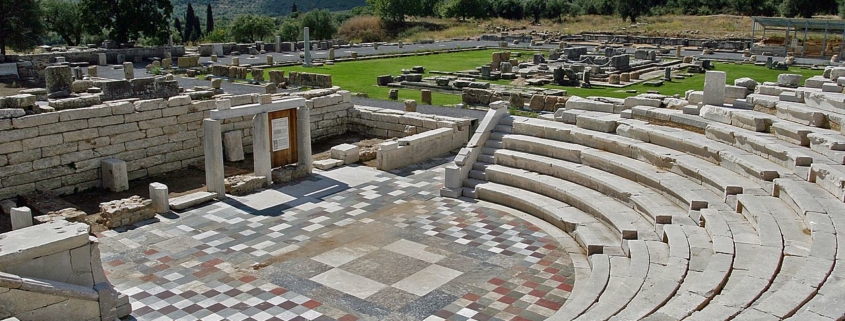
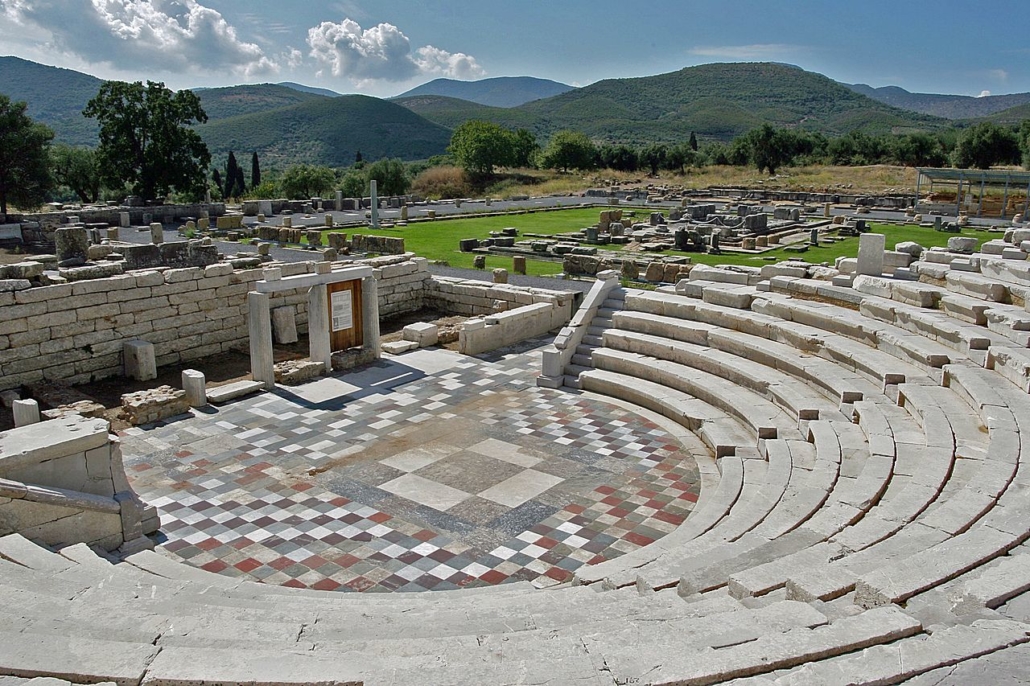
The ekklesiasterion, or assembly meeting place, of Messene, where civic debates were held

Aristotle’s Republic of Virtue

From these biopolitical premises, Aristotle wholeheartedly agreed with the communitarian ethos which the Greeks took for granted. As the philosopher explains: “the goodness of every part must be considered with reference to the goodness of the whole” (1260b8) and “a whole is never intended by nature to be inferior to a part” (1288a15). Indeed, Aristotle’s definition of a community-centered notion of justice may well be incomprehensible to many moderns: “The good in the sphere of politics is justice; and justice consists in what tends to promote the common interest” (1282b14). How many political discussions today — whether about abortion, gay marriage, immigration, economic policy, or whatever — refer to the common good rather than to solipsistic arguments about individual or sectoral ‘rights’ and ‘fairness’?

Aristotle is decidedly more ‘bourgeois’ and less spiritual than Plato. He has far less to say about the role of religion in the good society, this being practically an afterthought. He seems to hope for, at best, a stable and moderate regime, one respecting the interests of both rich and poor, founded upon an enlightened citizenry composed of independent landowners and responsible citizen-soldiers. But Aristotle also had an elevated notion of what politics should be about. In his own time, he contradicted those who believed that the state exists only as a kind of contract between individuals, meant only to guarantee their security or to enable them to chase after coin.

For Aristotle, man fulfills his nature as a rational being through philosophical contemplation and active citizenship. But only a minority have the intellectual gifts necessary to do this, and furthermore, as a practical matter, the work of servile subalterns is necessary to secure the necessary leisure to pursue philosophy and politics. Hence, Aristotle notoriously endorses a doctrine of natural slavery: barbarians and the morally defective are incapable of freedom and hence are only fit to be slaves of better men, thus enabling the latter to fulfill our human potential. Natural slaves are those who, either as individuals or as entire peoples, are so poorly endowed in reason that they may only participate in it as the servants of superior men. Aristotle observes: “what difference, one may ask, is there between some men and the beasts?” (1281b15). The recognition of inequality, enabling the creation of a just community and hierarchy, is no less central to Aristotle’s ethics and politics than those of Plato. Read more

Aristotle: The Biopolitics of the Citizen-State, Part 1

The texts that have come down to us from Antiquity were written for a time and place very different from our own. Their very origins are often mysterious, and yet, their concerns often speak to us very directly. We do not even know how Aristotle’s Politics, his main political treatise, were edited. They appear to be the philosopher’s fossilized lecture notes, which he would have used when teaching in his Lyceum, or were perhaps drafted to enable students not present to read them privately.

By their nature, the Politics are an excellent introduction to ancient Greek political practice and philosophy, and one which can be fruitfully read even by young minds. Aristotle’s pedagogical method, presenting the apparent data (phainomena) and various opinions of learned men (endoxa) is particularly helpful: he provides an almost encyclopedic overview of the opposing viewpoints which were prevalent and of the practices of the various ancient city-states. We get a strong sense of the issues and debates which were already agitating our people. Aristotle’s insights concerning the nature of responsible citizenship and the dangers of excessive egalitarianism and diversity remain relevant to this day.

Aristotle’s political thought — at least in the surviving works — does not soar to the eugenic and spiritual heights of Plato. However, Aristotle’s moderate and pragmatic brand of politics is much more palatable to someone raised in modern liberalism, while at the same time being a better introduction to the communitarian and aristocratic political ethics of the ancient Greeks. What was really unique about the Greek experiment of the city-states was the practice of citizenship. Never before and rarely since, even within the Western world, has a substantial body of the people been so involved in their own collective self-government. We would be mistaken however in equating citizenship in the ancient polis with that of the republicanism of the Enlightenment, let alone of the postwar liberal democracies.

In his Nicomachean Ethics, a companion piece to the Politics dedicated to his son Nicomachus, Aristotle argues that we should have as much respect for unreflective views won from practical experience as for abstract arguments: “we ought to attend to the undemonstrated sayings and opinions of experienced and older people or of people of practical wisdom not less than to demonstrations; for experience has given them an eye they see aright” (6.11). Aristotle’s politics can in fact be considered somewhat conventional for an upper-class Greek[1] — arguing for a moderate regime based on law and a sizable middle-class of citizen-soldiers. However, as we shall see, he also rationalizes traditional Greek politics in biological terms with novel scientific foundations and philosophical ends.

Aristotle embraced the ethnocentric, communitarian, and virile traditions of the Greek polis. For the Greeks, the ideal of citizenship did not mean guaranteeing a set of arbitrary “inalienable rights” as ends in themselves or the privilege of simply doing as one pleased. Rather, they believed that the good of the individual necessarily depended upon the good of the whole, to which all had to sacrifice when necessary. Citizenship meant not rights, but participation in the setting and enforcement of duties. As Aristotle eloquently puts it, citizenship is “to rule and be ruled in turn.” In the Greek city-state, this meant varying degrees of participation in the Assembly, the courts, and political and military offices. For Aristotle, as for the Greeks in general, citizenship was incompatible with egalitarian excess, decadence, and effeminacy.

In considering the possible structures of government discussed by Aristotle, we ought to bear in mind the sheer diversity of Greek polities scattered around the Mediterranean: the commercial-democratic imperial metropolis of Athens, the agrarian and austere military aristocracy of Sparta, the multiethnic tyranny of Syracuse, traditional monarchies, the democratic federations of Boeotia and Arcadia, tribal confederacies . . . the Ancients were certainly far more tolerant of diversity in forms of government than postwar Moderns are.

The Greek city-state could indeed be extremely intrusive. By modern liberal standards, it was not just authoritarian but “totalitarian”[2] — not recognizing a private life wholly free from politics and seeing the state as having a decisive role in the formation of culture. Aristotle himself recognized that law and culture were thoroughly intertwined, as “laws resting on unwritten custom are even more sovereign, and concerned with issues of still more sovereign importance, than written laws” (1287a32). The state’s role included the definition and enforcement of positive cultural norms and customs. Economic, family, and religious life could be sharply regulated, so that all would acquire healthy habits promoting the common good. The polis’s unique system of government was possible because of the smallness and familiarity of the city — generally not numbering more than 50,000 people, with far less citizens. The citizens were bound together by ties of kinship, personally knew the leading politicians directly, and participated on a day-to-day basis in civic life, whether as jurors, assemblymen, or soldiers. For Aristotle, therefore, citizenship would not be possible if the whole Peloponnesian peninsula were a single state or indeed if the supercity of Babylon were a republic.

In practice, ancient Greek politics was defined by choosing office-holders, deciding on policies, and holding trials, as well as the more-or-less amicable debates surrounding these. Depending on the kind of regime, hereditary kings, elected councils, or even the entire citizenry gathered in assembly would decide on such matters. In domestic affairs, the state would regulate and supervise the marketplace, countryside, and marriages, as well  as expenditures on public works, the organization of military forces on land and sea, and immigration policy. They would also define the legally-recognized classes of citizens, and censor or promote various forms of culture. The more ambitious cities, such as Sparta, would seek to regulate reproduction, systematically educate the youth, and organize the citizens’ common meals, gymnastics, and military training.

In foreign affairs, the state would decide on war and peace, the formation of alliances or confederations, economic embargoes, whether to subsidize allies, how to treat conquered enemies (enslavement or extermination), the establishment of puppet regimes, and overseas colonization. The stakes were high: failure to maintain goodwill among citizens often led to gruesome civil wars and conquest by invaders, including fellow Greeks, who could be as cruel as they pleased. The polis as a system of government was a demanding one which was eventually surpassed by the great universal empires. Nonetheless, the polis  served the Greeks well for centuries, enabling their expansion across the Mediterranean; it was an unprecedented experiment in self-government. The polis allowed for an astonishing diversity of forms of governments and corresponding achievements, from the martial prowess and stability of Sparta to the economic, political, and cultural dynamism of Athens. Read more

Fifty Years of Apocalyptic Global Warming Predictions and Why People Believe Them, Part 2

Go to Part 1.

Scientists have known for some time that their predictive models of global warming were at increasing odds with the data. More recently, they have begun to pinpoint some of the faulty assumptions in the models used to make projections (not observations) of global warming. One example of this type of correction is a 2018 article published in the prestigious journal, Science.

Nitrogen availability is a central controller of terrestrial plant growth and, thereby, of the carbon cycle and global climate change. It has been widely assumed that the atmosphere is the main source of terrestrial nitrogen input. Surprisingly, Houlton et al. now show that bedrock is just as large a nitrogen source across major sectors of the global terrestrial environment.

Climate scientists have long known that plants offset some of the effects of climate change by absorbing and storing CO2. But they assumed that the ability to plants to perform this function was limited because the availability of nitrogen in the atmosphere was limited. As an earlier 2003 study published in Science stated, “there will not be enough nitrogen available to sustain the high carbon uptake scenarios.”

But this idea that the only source of nitrogen for plant life came from the air has been refuted in a more recent article, also in Science. Now we know that there are vast storehouses of nitrogen in the planet’s bedrock that plants can also feed on. In light of these findings, Ronald Amundson, a soil biogeochemist at the University of California at Berkeley, told Chemical and Engineering News that “If there is more nitrogen there than expected, then the constraints on plant growth in a high-CO2 world may not be as great as we think.”

With more nitrogen available, plant life might be able to absorb more CO2 than climate scientists have been estimating. This  “has the potential to change all projections related to climate change,” because there could be more carbon storage on land and less in the atmosphere than the models assume.

For interested readers, a series of articles on this topic reveal other evidence of weaknesses in climate models used to predict future warming. These models failed to predict a decade-long pause in global temperatures. Nor have various calamities that were supposed to have occurred by now materialized. And a recent paper published in another prestigious scientific journal, Nature, has also concluded that the planet is less sensitive to increases in CO2 than the computer models assume.

Of course the sky is falling, but maybe not as fast as is being predicted by the left-wing media. Beware of self-serving socialist projections based on outdated computer models, or sometimes just nothing at all. The notorious AOC and her ilk can get away with unprecedented levels of ignorance given the current state of American journalism as long as the errors are in the left direction. But any curious citizen can look back at what previous “experts” claimed was supposed to happen over the past half century and confirm just how erroneous and exaggerated their claims have been all along. Read more

Earth Day, 2019: Fifty Years of Apocalyptic Global Warming Predictions and Why People Believe Them, Part 1


Two of the most important problems that the so-called Green New Deal will attempt to solve at the cost of incalculable trillions are global warming and its consequences, including drought, famine, floods and massive starvation. You may recall that Obama in his 2015 State of the Union speech declared that the greatest threat facing us was neither terrorism nor ISIS. It wasn’t nuclear weapons in rogue states either. “No challenge  poses a greater threat to future generations than climate change,” said Obama.

His entire administration including Vice President Joe Biden, and Secretary of State John Kerry, frequently repeated the claim that climate change was the greatest threat facing the world. It was a sentiment Obama stressed again during an Earth Day trip to the Florida Everglades where he said, “This is not a problem for another generation. It has serious implications for the way we live right now”.

More recently, presidential hopefuls like Beto O’Rourke, along with most Democrat candidates, declared their zealous support for the Green New Deal in forecasting that the world will end in 12 years if nothing is done. “This is the final chance, the scientists are absolutely unanimous on this — that we have no more than 12 years to take incredibly bold action on this crisis. Not to be melodramatic, but the future of the world depends on us right now here where we are.”

This leads to the question I pose in this brief, data-driven, essay: What kind of track record do the politicians and their experts have in their climate predictions? After all, some of these predictions were made 10, 20 or even 50 years ago. Can’t we now look back at their predictions and begin to hold them accountable?

As others have done, I have chosen to begin with the first Earth Day “Celebration” in 1970. Now who can be against Earth Day? It’s a charming idea, and I have been an enthusiastic supporter since my college days in Ann Arbor, when we celebrated the event on the campus of the University of Michigan.

Here’s what the experts were saying almost a half century ago on Earth Day, 1970:

  1. “Civilization will end within 15 or 30 years unless immediate action is taken against problems facing mankind.”
    Harvard biologist George Wald
  1. “It is already too late to avoid mass starvation,”
    Denis Hayes, Chief organizer for Earth Day
  1. “We are in an environmental crisis which threatens the survival of this nation, and of the world as a suitable place of human
    abitation.”
    Washington University biologist Barry Commoner
  1. “Population will inevitably and completely outstrip whatever small increases in food supplies we make. The death rate will increase until at least 100–200 million people per year will be starving to death during the next ten years. … Most of the people who are going to die in the greatest cataclysm in the history of man have already been born. … [By 1975] some experts feel that food shortages will have escalated the present level of world hunger and starvation into famines of unbelievable proportions. Other experts, more optimistic, think the ultimate food-population collision will not occur until the decade of the 1980s.
    Stanford University biologist Paul Ehrlich
  1. “Demographers agree almost unanimously on the following grim timetable: by 1975 widespread famines will begin in India; these will spread by 1990 to include all of India, Pakistan, China and the Near East, Africa. By the year 2000, or conceivably sooner, South and Central America will exist under famine conditions …. By the year 2000, thirty years from now, the entire world, with the exception of Western Europe, North America, and Australia, will be in famine.
    North Texas State University professor Peter Gunter
  1. “In a decade, urban dwellers will have to wear gas masks to survive air pollution… by 1985 air pollution will have reduced the amount of sunlight reaching earth by one half.”
    — Life magazine
  2. “At the present rate of nitrogen buildup, it’s only a matter of time before light will be filtered out of the atmosphere and none of our land will be usable. … By the year 2000, if present trends continue, we will be using up crude oil at such a rate … that there won’t be any more crude oil. You’ll drive up to the pump and say, ‘Fill ‘er up, buddy,’ and he’ll say, ‘I am very sorry, there isn’t any. … The world has been chilling sharply for about twenty years. If present trends continue, the world will be about four degrees colder for the global mean temperature in 1990, but eleven degrees colder in the year 2000. This is about twice what it would take to put us into an ice age.”
    — Kenneth Watt

Read more

Black Crime and Its Jewish Apologists

The English county of Kent has a proud history when it comes to invasions. It’s said that the people of Kent adopted the motto Invicta (“Undefeated”) following the Norman invasion of England, because the spirited resistance of its Anglo-Saxon peasantry deterred the Normans from attempting to gain full control over the east of the county. Once London was reached, the Normans ignored most of East Kent, due mainly to the fact this cohesive community of peasants attacked them at every opportunity. Kent then became a semi-autonomous County Palatine under William the Conqueror’s half-brother, Odo of Bayeux, with special powers otherwise reserved for the unruly counties bordering Wales and Scotland. It’s now almost one thousand years since the brave resistance of the Kentish peasants and, in the interval, something rotten, something deeply diseased, seems to have entered the psyche and culture of this most traditional English county. Just a few days ago, the area once described by Henry VIII as the “Garden of England” became the Mogadishu of England as scores of whooping Africans clashed in vehicles, and poured through the streets with machetes. The fact that blade-wielding Africans now stalk where the all-conquering Normans once feared to tread is just a lesser symptom of the general decline of modern Britain under multiculturalism, and the nation’s ongoing descent into a maelstrom of Black violence and Muslim sexual sadism.

The Garden of England, 2019

According to Merriam-Webster, the phrase “a stab in the dark” refers to “a guess that is based on very little or no information or evidence.” The British mainstream media is currently stabbing in the dark about why there have recently been so many literal stabs in the dark – because England, and London in particular, is currently experiencing another of its spasmodic outbreaks of what has been euphemistically called “knife crime.” “Knife crime” in Britain, like “gun crime” in the United States, is a phrase loaded with a racial meaning that everyone strenuously avoids admitting the existence of. According to the BBC, out of 44 British police forces that have submitted statistics, 42 have recorded a rise in knife crime since 2011. In London, the national “knife crime” capital, it was found that “young black and minority ethnic teenage boys and men were disproportionately affected, as both victims and perpetrators.” In one of the most horrific incidents of recent weeks, a crazed Ugandan, Jason Kakaire, went on a vicious stabbing spree that saw four apparently random and unprovoked stabbings in 14 hours, including one attack that severed the spinal column of one on the victims, resulting in permanent paralysis. You will search in vain for an image of Kakaire, who has been described by the media merely as having “short dark hair, light facial hair, and a grey tracksuit.” Only his last name, almost exclusive to Uganda, gives away the fact these crimes are part of the broader pattern of African violence in the new, vibrant, England.

The media-government-academic rhetorical “stab in the dark” about the causes behind this pattern is multifaceted. Each proposed guess about the causes of Black criminality is linked to the others only via mutual avoidance of “knife crime’s” biological, racial imperatives. Superficial discussions about “Black culture,” gangsta rap, and absent fathers feature to some extent at the fringes of the mainstream, but never in a way that asks why, wherever Blacks come to live, and no matter how much money and support they are given, they invariably and repeatedly regress to the same pattern of broken families, violent crime laced with extreme brutality, primitive gang cultures, dismissal from schools, unemployment, and extremely low socio-economic achievement. Read more

A Philosopher Falls: How Roger Scruton Was Toppled by the Usual Suspects

This is an anti-Semitic sentence. And so is this. And this one too. How do I know? Because they’re written in English, the language of Chaucer, Shakespeare and Dickens. Those stale pale males were all anti-Semites, therefore English is an anti-Semitic language and all sentences written in English are implicitly seething with bigotry and hate. QED.

Combatting Corbyn

The logic couldn’t be clearer and many people look forward to the day when it can be deployed against anyone whom the Jewish community disapproves of. For example, Jews in Britain have been trying to topple the Labour leader Jeremy Corbyn for years. They want a decent politician to take his place, someone who will, like Tony Blair and Theresa May, obey Jewish orders without question and support Israel without limit.

But so far Jews haven’t managed to topple Corbyn. Again and again they’ve produced what is, to them, incontrovertible proof of his anti-Semitism. Dismayingly, ordinary Labour members have refused to accept it. Imagine how much easier it will be when English is declared an inherently anti-Semitic language. Corbyn will instantly be guilty of spewing anti-Jewish hate in countless speeches, media interviews and newspaper columns during his entire political career. He won’t simply be toppled as Labour leader: he’ll be locked up for life as a fully certified anti-Semite.

Defining anti-Semitism as they please

And let’s have no nonsense about Jews and their allies using English themselves. That’s completely irrelevant. As the contrite and humbled leftist Billy Bragg pointed out after he fell from grace with Jews: “I failed to recognise the right of the Jewish community to decide for themselves what does and doesn’t constitute racism [against them]. It’s the Macpherson principle, and I made a very insensitive response to someone’s question that implied that I knew better than the Jewish community about what is and isn’t [anti-Semitic]. … It denied them the right to decide what is a racist attack on their community, and that’s wrong and I apologise for it.”

By “Macpherson principle,” Bragg means the principle set out by the judge Sir William Macpherson in the enquiry into the martyrdom of the Black teenager Stephen Lawrence: “The definition of a ‘racist incident’ will now include incidents categorised in policing terms both as crimes and non-crimes. It will now encompass ‘any incident which is perceived to be racist by the victim or any other person’.” Accordingly, if Jews say something is anti-Semitic, it is anti-Semitic – no ifs, ands or buts. And if Jews choose to say that Jeremy Corbyn is anti-Semitic because he speaks English, then no-one should argue with them. If anyone does argue, then that person too is anti-Semitic. It couldn’t be simpler: Jews can define anti-Semitism however they please and against whomsoever they please.

A classic anti-Semitic trope

This brings me to the right-wing philosopher Sir Roger Scruton. In “The Value of Victimhood,” I described how he had been condemned as an anti-Semite in November 2018. After he was appointed as an advisor on architecture to the Conservative government, his leftist enemies went digging for dirt to use against him and uncovered a speech he had made in Hungary some years before. He had criticized George Soros and said that “Many of the Budapest intelligentsia are Jewish, and form part of the extensive networks around the Soros empire.” Labour MPs like Luciana Berger, a heroine of the Jewish community, declared that Scruton was obviously an anti-Semite. George Soros is Jewish and Scruton had criticized Soros for being powerful and influential. Such criticism is a classic “anti-Semitic trope,” therefore Scruton is an anti-Semite and the truth of Soros’s power and influence is irrelevant. Having deployed this logic, Berger and her allies demanded that Scruton be dismissed from his role serving the Conservative government.

Luciana Berger is denouncing you!

Jews in Britain “overwhelmingly back” that government, but did any Conservative-supporting Jews spring to Scruton’s defence and denounce Berger for her dishonesty? Of course not. Fake accusations of anti-Semitism are standard practice in Jewish culture and no-one wanted to weaken their effect by criticizing Berger. Nor did Scruton criticize her or condemn other Jews for accepting her dishonesty. Instead, he indignantly denied that he was anti-Semitic in any way, thereby accepting the general legitimacy of the charge and merely rejecting its particular application to him. This denial was enough and he managed to maintain his role as advisor. Read more