
Featured Articles

Transgenderism as a PC ideology

Introduction

Transgenderism can be seen as a politically correct ideology along with feminism, anti-racism and the others. The main things it has in common with them are a hatred and denial of nature and an impertinent urge to overcome it.

Feminism against nature

Feminists’ hatred and denial of nature are seen in their refusal to accept that the sexes are simply different. On the contrary, they say, they are essentially the same. Anything a man can do, a woman can, and so on. They back this up not by pointing to facts but with a taboo against saying the opposite. Like the exponents of every politically correct ideology, they have a special attack word for dissenters. In fact, they have two. Should you have the temerity to ignore the taboo, you will be called a sexist or a misogynist.

For some reason these techniques persuade many that what feminists say is true. Equally importantly, they silence those who are not persuaded, leaving feminists a clear field.

With no dissent to be heard, feminists proceed to ask why the sexes are in different circumstances. Why are women rarely found in leadership positions, they wonder, when the idea that men are more likely to compete for such positions and more suited to them is just a myth? Men must be keeping women down.

Feminists reason that to undo this injustice society must be reshaped to look as it would have done had they been correct, with women in half of all leadership positions. If the principle of equal treatment must be disregarded to achieve this, so be it. Thus, having denied nature, they seek to overcome it, or to give the appearance of having overcome it, at no matter what cost to society.

But then, having filled half the leadership positions in a certain field with women, they ask themselves why they should stop there. Why leave the other half to the oppressor? So they carry on, resulting in a fact such as that in 2018 almost every top position concerning the British police was occupied by a woman. This included London’s senior officer (Cressida Dick), the Director General of the National Crime Agency (Lynne Owens), the head of the National Police Chiefs’ Council (Sarah Thornton), the chair of the College of Policing (Shirley Pearce), the president of the Police Superintendents Association (Irene Curtis) and the chair of the Independent Police Complaints Commission (Anne Owers).[1]

About the only exceptions were the chief constables outside London, of whom by 2020 still only two out of 46 were female. Yet just eighteen months later there were fifteen female chief constables.[2] It is surprising even that as many as thirteen chief constables retired in so short a period. For them all to have been succeeded by women was proof indeed that women can not only do anything men can do but are likely to be able to do it considerably better. Or perhaps it just proved that if no man is on the shortlist, a woman will get the job.

Anti-racism against nature

Anti-racism proceeds just like feminism except that this time it is the races that are supposedly the same. The doctrine of essential racial equality might not appear to be true, but we must assent to it for it too is protected by a taboo. Point to a difference between the races, however evident, and anti-racism’s attack word will be attached to you: you will be called a racist. Again, with any dissent from its basic proposition stifled, we are asked to explain the fact that the races are in different circumstances, the only available explanation being that Whites have been oppressing Blacks. And again, the solution is not the removal of the discrimination but its reversal. Blacks must be favoured over Whites.

Thus feminism and anti-racism use the same playbook. They both employ the idea of essential equality to deny nature before seeking to reshape it to fit their Procrustean bed. Is it too tall? Chop its feet off! Too short? Put it on the rack!

Transgenderism against nature

That transgenderism hates nature and refuses to submit to it is obvious. It finds the most basic fact of life — that nature makes us male or female — too much to bear. What if I didn’t want to be male? Did nature think of that? It is time it learned that if I choose to become a woman I will jolly well do it.

How? Well, first I am going to adopt a philosophy that tells me that whatever I say is true: the philosophy of word magic. I will call myself a woman, which will make me one. Just in case, I will then embark on a lifelong course of cross-sex hormones and undergo innumerable surgical procedures that will make me resemble a woman or at least make me look a lot more like one than I do now.

What is more, I will get my medical insurance to pay for all this on the basis that my dissatisfaction with my sex is a psychiatric condition. At the same time, I will insist that I have no psychiatric condition but am simply an example of normal human variation. Then everyone will see that I am as much a woman as any woman and that there is nothing wrong with me. It was nature that got it wrong. As I might put it: “I was born with the wrong genitals. … I had a birth defect that I got sorted with surgery and medication”.[3] How incompetent of nature to give me that birth defect! How wrong nature was if it didn’t think I could get it sorted with surgery and medication! It must be feeling pretty silly now.

Punishments for thinkers

No politically correct ideology can tolerate considered thought, as we see in the case of transgenderism in some events from the last few years. In 2019 the contract of a woman named Maya Forstater was not renewed after she tweeted that “transgender women” were men.[4] When she contested what was in effect her sacking, the judge ruled against her, finding that her opinion was not compatible with human dignity.[5]

In the midst of this, J.K. Rowling spoke up for her, saying that biological sex existed. For this she received a “barrage of criticism”, yet she refused to apologise, said the news outlet RT in wonderment.[6] Six months later she mocked an NGO for using the phrase “people who menstruate”, asking whether there had not once been a single word for such people, which she seemed to remember had begun with “w”. This brought another “avalanche” of denunciation down on her, with someone tweeting that her words were “causing unimaginable pain”. Well, of course they were! How can a transgender person be expected to encounter a cryptic reference to the word “woman” without suffering unimaginable pain? Another commenter called J.K. Rowling a hate-filled weirdo.

In October 2021 Cambridge University’s Students Union issued a guide to spotting “Terfs”, these being feminists who think that there are two sexes and that one cannot switch from one to the other.[7] Predictably, the guide indulged in projection, referring to “Terf ideology” as though it were the views of Terfs that were  ideological rather than its own. It stated that Terfs had a “deep hatred for trans women”, when it was the guide that was spreading hatred, of Terfs. It alleged that Terfs had links to the far right, when there is nothing political about their position, in contrast to the far-left position of the guide.[8]

The same week, activists at Sussex University launched a campaign to get a philosophy professor fired. Kathleen Stock had asked whether a person’s gender identity could have more social significance than their sex and had doubted whether men should be allowed in women’s changing rooms. Students put up posters saying “IT’S NOT A DEBATE. IT’S NOT FEMINISM. … IT’S JUST TRANSPHOBIA … FIRE KATHLEEN STOCK.” She received death threats and was advised not to go on campus without bodyguards. Her union offered her no support but expressed “solidarity” with “trans and nonbinary communities”. Two weeks later she resigned.

What was noticeable about her defenders was their feebleness. The commentator Paul Embery said that she had merely defended the principle of biological sex and women’s right to single-sex spaces. Women’s concerns about having men in their changing rooms were perfectly legitimate. Transgender activists were trying to get everyone to take their view, he said. But biological sex is not a principle to which one might adhere or not; it is a basic fact of life, and women’s right to women-only changing rooms should be beyond dispute. Instead of saying that transgender activists were trying to get others to take their view, as though it were a view that could deserve respect, Paul Embery should have said that they were trying to get people to affirm a lie.[9] A philosopher named Arif Ahmed stated that Kathleen Stock’s persecution was making it impossible for “one side of a very important public policy debate” to speak. Apparently we had reached the point where the efforts of men to get into women’s changing rooms counted as a contribution to an important debate.

Transgender language rules

No PC ideology can leave the language alone, for unless interfered with, it has a way of reflecting reality. A previous article gave some examples of linguistic engineering aimed at abolishing sex–related words and the associated concepts with them. To give a few more examples, in 2023 Oxfam published an Inclusive Language Guide that illustrated its “commitment to gender justice”, defined as “full equality between women and men (including trans men and women) as well as non-binary people”.[10]

According to the guide, we must not speak of husbands or wives but must call them partners or spouses, nor must we use the words “mother” or “father”, which would assume “the adoption of gendered roles by transgender parents”. We must be aware that patriarchal systems perpetuate sexist and hierarchical power relations and legitimise “discrimination against and exclusion of women and gender non-conforming people”. Moreover, we must be aware that the word “people” itself, although it might not seem to specify a sex, can still express a bias because “in the context of a world based on patriarchal systems, ‘people’ is often misunderstood as only referring to men”. If we must talk about “people”, therefore, we should do it in a way that makes the word “as inclusive as possible”.

When it comes to personal pronouns, the guide tells us not to assume that it is correct to “describe someone as ‘he’ or ‘she’ based on their name or physical appearance”. The person might prefer to be called “they” or “ze”.

Like the British Medical Association (referred to in the previous article), Oxfam advises against using the term “expectant mother”. Not only does the expression “reinforce gender stereotypes”; the woman might not wish to continue her pregnancy. It does allow that pregnant people are women, however, although if we stress this fact we might be excluding “gender non-binary, trans men, or gender non-conforming people”.

The words “transgendered” and “transsexual” must be avoided in case someone referred to in this way doesn’t like it. “In a society that upholds the human rights to equality, freedom of expression, privacy and self-determination, we must respect how people wish to be referred to.” We must take an approach that “actively includes transgender people”. Ideally, “a trans-inclusive approach will identify the ways that trans people are specifically impacted by discrimination”. Presumably, then, rather than calling transgender people transgender, we should call them victims of discrimination in various ways that we will proceed to specify, who might be mistakenly referred to as transgender by the unenlightened.

Transgenderism against science

From the postmodern philosophy that gives it its belief in word magic, transgenderism also gets its belief in the priority of subjectivity over objectivity. But since it exists in a society that values science, it must do as other politically correct ideologies do and pretend that its dogmas are scientific, as when claiming that the evidence “strongly suggests” that gender identity is “usually established … by the age of two to three”;[11] that “the expression of transgender identity … is a healthy, appropriate and typical aspect of human development”;[12] or that “From a medical perspective, the appropriate determinant of sex is gender identity”. The last comment was made by a professor at Duke University School of Medicine, who meant that the best way for a doctor to establish a person’s sex is by asking them. “It is counter to medical science”, she continued, “to use chromosomes, hormones, internal reproductive organs, external genitalia, or secondary sex characteristics to override gender identity for purposes of classifying someone as male or female”.[13]

Of course, deception itself is characteristic of political correctness, on which subject it might be worth pointing out that a politically correct statement is necessarily untrue. This is because true statements, meaning empirically correct ones, can look after themselves. Only statements that are empirically incorrect need to be made correct politically.

Transgenderism and childism

A little-mentioned ideology of political correctness is childism, which transgenderism does not so much resemble as incorporate. Childism inverts the natural order by transferring the authority of adults to children, as seen one day in 1998 when BBC Radio 4’s Woman’s Hour looked at the question of what to do with the children in the summer holidays. It didn’t ask parents for their ideas but asked a panel of children. Already in the 1970s Kahlil Gibran’s book The Prophet (1923) was popular, mainly for its advice to parents: “You may strive to be like [your children], but seek not to make them like you”. This gave rise to the idea that adults have more to learn from children than children have to learn from adults.

The children’s author Cressida Cowell expressed her childism when she wrote in 2020 that children “are the most creative people in the world”, raising the question of why Pope Julius II commissioned Michelangelo to paint the ceiling of the Sistine Chapel when he could have got a better result by commissioning a child. Cressida Cowell hoped that children’s “magical powers of creativity, intelligence and empathy” would make them “come up with solutions to the political and scientific challenges facing the world” — not as adults, mark you, when they would have lost their magical powers, but now, as children.

But childism had reached its apogee the year before, when an assembly of world leaders asked a child to tell them what to do. This was at the United Nations Climate Action Summit in New York, which Greta Thunberg, aged sixteen, was invited to address. Rising to her role as leader of leaders, the pigtailed adolescent expressed her advice by asking her audience how they dared to do this or that.

The natural complement of treating children like adults is to treat adults like children. This is the essence of “dumbing down”, which first appeared in the 1990s. Many adults responded by starting not only to talk and think like children but also to dress like them, going about in track suits that resembled romper suits. The infantilisation of adults has continued ever since.

Transgenderism incorporates childism by telling teachers not to talk to transgender children but to listen to them, and not to lead them but to follow. Thus in 2014, East Sussex County Council Children’s Services issued the following guidance to teachers: “Listen to the [transgender] child … and wherever possible follow their lead and preferences”.[14] Similarly, an American campaigning organisation says that “the most important thing we can do is listen to what our [transgender] children are telling us”.[15] Adults should learn from children, thinks Diane Ehrensaft, director of mental health at the Child and Adolescent Gender Center at Benioff Children’s Hospital at the University of California, San Francisco. Children are “our best teachers”.[16] The logical conclusion of this will see groups of grown-ups filing into the classroom to be instructed by infants wearing mortarboards.

Transgenderism requires doctors to accept not only a transgender child’s self-diagnosis but also its prescribed course of treatment. Medical professionals do as they are told for fear of their patients declaring themselves unsatisfied with the service they have received or accusing them of “transphobia”.[17]

Conclusion

If one views political correctness as a collection of ideologies, then transgenderism is just one of these. All tend to the destruction of our societies and culture; most pit themselves against nature. This suggests that their originators are conducting a war against God, for to say that something is as it is by nature is only to say that that is the way God made it. The rebels’ chosen battlefield is the West, where political correctness is mainly found. White people are their particular enemies on earth. If they can defeat us here, they will take themselves to have defeated God. At least, that is one way of looking at the situation.


[1] The Director of Public Prosecutions was also a woman: Alison Saunders, who was found to have been suppressing evidence of men’s innocence in rape cases.

[2] History Debunked, July 8th 2021, “Women in command; female leaders in the police and army”, https://www.youtube.com/watch?v=1i6pBj6dYMw. Including Wales, after another six months there were 19 out 49 (Telegraph, Jan. 9th 2023, “Record 40 per cent of chief constables are now women amid anti-misogyny drive”, https://www.telegraph.co.uk/news/2023/01/09/record-40-per-cent-chief-constables-now-women-amid-anti-misogyny/).

[3] This was a man calling himself Bethany Black in conversation with Helen Lewis (New Statesman, Sept. 13th 2013, “What makes you a man or a woman anyway?” https://www.newstatesman.com/politics/feminism/2013/09/battle-over-gender-what-makes-you-man-or-woman-anyway).

[4] Maya Forstater made her comments, not while at work, during a discussion of possible reforms to the Gender Recognition Act.

[5] Her appeal, heard in 2021, found that her position was “worthy of respect in a democratic society”.

[6] RT.  Jun 7th 2020. “‘There used to be a word for people who menstruate’: JK Rowling gets denounced as transphobe AGAIN”. https://www.rt.com/news/491077-rowling-trans-women-row/.

[7] Telegraph, Oct. 13th 2021, “Cambridge University ‘Terf-spotting’ guide condemned as a ‘witch-finder’s charter’”, reproduced at https://ovarit.com/o/GenderCritical/45570/cambridge-university-terf-spotting-guide-condemned-as-a-witch-finders-charter.

[8] MailOnline, “Cambridge Students’ Union publishes pro-trans guide claiming that being a woman is not just down to ‘biological sex’ — and accuses feminists opposing such views as being linked to ‘far right’”, https://www.dailymail.co.uk/news/article-10087849/Cambridge-SU-publishes-pro-trans-guide-claiming-woman-not-just-biological-sex.html.

[9] GB News, Oct. 17th 2021, “Kathleen Stock: Paul Embery says abuse of academic after alleged ‘transphobic’ remark is ‘appalling’”, https://www.youtube.com/watch?v=WY4b1atncaY.

[10] For an overview of the guide, see Oxfam, March 2023, “Inclusive Language Guide”, https://policy-practice.oxfam.org/resources/inclusive-language-guide-621487/. For the guide itself see https://oxfamilibrary.openrepository.com/bitstream/handle/10546/621487/tk-inclusive-language-guide-130323-en.pdf?sequence=4.

[11] Ryan T. Anderson, 2019 (2018), When Harry Became Sally, New York: Encounter Books. 2019, ibid., pp. 32-33.

[12] Ryan Anderson 2019, ibid., p. 38.

[13] Ryan Anderson 2019, ibid., p. 30.

[14] East Sussex County Council Children’s Services, Oct. 2014, “Trans* Inclusion Schools Toolkit”, https://czone.eastsussex.gov.uk/media/2480/trans-toolkit.pdf (file no longer there).

[15] PFLAG, quoted by Ryan Anderson 2019, op. cit., p. 35.

[16] Quoted by Ryan Anderson 2019, ibid., pp 35-36.

[17] The Heritage Foundation, March 28th 2019, “The Medical Harms of Hormonal and Surgical Interventions for Gender Dysphoric Children”, https://www.youtube.com/watch?v=bnP_WoeNuwA.
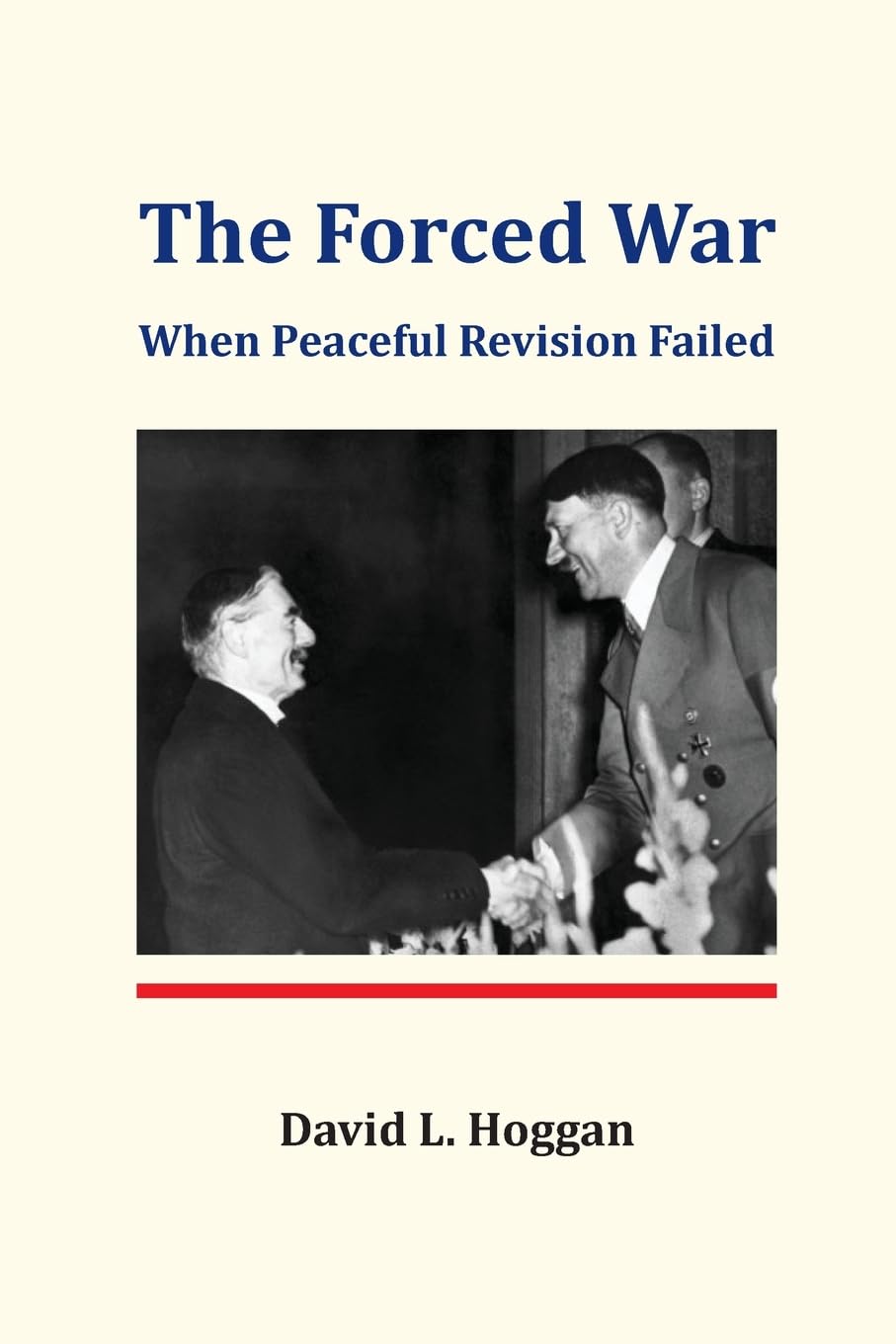

The Forced War, a Review, Part 3 of 3

Go to Part 1
Go to Part 2 

The Optimism of Adolf Hitler

The common thread linking most if not all of Adolf Hitler’s actions and statements throughout The Forced War is ethnocentrism. He harbored a deep identification with the German people, and, to a lesser extent, an appreciation of distinct, non-German (or non-Aryan) European peoples. From the beginning, Hitler sought to undo the injustices to the German people committed by the framers of the Treaty of Versailles. This meant that in 1933 over ten million ethnic Germans in the political nation-states of Czechoslovakia, Austria, Poland, and Lithuania had been robbed of self-determination and were made to suffer foreign rule. Aside from shepherding Germany’s economic recovery during the Great Depression and reestablishing Germany’s status as a great power, bringing these people back into the Reich where they belonged (and in most cases wanted to be) was of paramount importance to Hitler.

But Hitler sought to do this peacefully and by stepping on as few toes as possible. In The Forced War, Hoggan allows for the historical record to speak for itself in order to exonerate Hitler from the charge that he wished to conquer the world. The Sudeten Germans, the Germans in Austria and Poland, and in Memel, which was seized by Lithuania in 1920 in violation of the League of Nations, did suffer oppression and indignities as second-class citizens under hostile rule. Hitler was addressing a pressing problem for his people, and had no interest in incorporating outgroup members such as Poles, Czech, and Slovaks under his rule. He said this numerous times. Is this what a power-mad conqueror would say?

Further, in January 1937, Hitler had instructed Marshal Hermann Göring to insist to Polish Minister of Foreign Affairs Beck that Germany had no designs on the Polish Corridor or any other part of Poland for that matter, and would not form an alliance with the Soviet Union as Germany had done in 1922 in Rapallo, Italy. In return he had hoped for similar concessions from the Poles (such as Danzig, which was not even officially part of Poland). Now, either this was a wise move or it wasn’t, given how the Poles were not being honest and were abusing their German minority. Either way, it makes the reader ask if Hitler’s behavior was consistent with that of a modern-day Genghis Khan.

Nearly every time Hitler’s name appears on the page (which is often), Hoggan forces us to ask such questions. And every time, it gets harder and harder to answer in a manner harmonious with the accepted narrative, which paints Hitler as evil and insane.

If there are any criticisms of Hitler lurking in The Forced War, they are exceedingly mild—praise by faint damnation, if you will. Yes, Hitler underestimated the military capabilities of the Soviet Union. Then again, so did almost everybody in Western and Central Europe. After all the bloody purges and terror famines of the 1930s, who could have envisioned the Red Army as the colossus it turned out to be? Hoggan has a few choice things to say about some of Hitler’s diplomats as well, especially Hans Moltke, German ambassador to Poland.

Hoggan’s most consistent criticism, however, deals with Hitler’s character. Der Führer was optimistic almost to the point of naïveté. He didn’t realize until it was too late that Lord Halifax was a snake in the grass intent upon encircling Germany. He also didn’t realize that Józef Beck had been an enemy all along and never once negotiated in good faith over Danzig. Hitler, in Hoggan’s view, simply assumed that everyone wanted peace as much as he did. This is why he instructed Göring not to haggle with the Poles over Teschen. This is why he renounced German claims to territory in France, Denmark, Italy, and Poland. This is why he continually suppressed stories of Polish anti-German atrocities in the German press. This is why he made the Poles a very generous offer in return for Danzig. This is why he instructed Danzig Senate President Artur Greiser to capitulate to the August 4 Polish ultimatum, which threatened to starve the city. This is why mere days before the invasion of Poland, he halted all military operations when there appeared a glimmer of hope that the Poles might negotiate after all. This is why he never stopped trying until the moment Poland made her belligerent intentions clear by fully mobilizing.

Here are the terms Hitler offered the Poles:

Germany would request Poland to permit her to annex Danzig. She would ask permission to construct a superhighway and a railroad to East Prussia. Lipski was assured that these carefully circumscribed suggestions represented the total of German requests from Poland.

It was clear that there had to be a quid pro quo basis for negotiation and Germany was prepared to offer many concessions. Poland would be granted a permanent free port in Danzig and the right to build her own highway and railroad to the port. The entire Danzig area would be a permanent free market for Polish goods on which no German customs duties would be levied. Germany would take the unprecedented step of recognizing and guaranteeing the existing German-Polish frontier, including the 1922 boundary in Upper Silesia.

Sadly, Beck preferred subterfuge, inflated national prestige, and a disastrous war over solving the Danzig crisis and acquiring a steadfast ally against the Soviet Union, of whom the Poles were rightfully wary. He also unwittingly preferred being a pawn in Lord Halifax’s grand scheme for crushing Germany, and being ruthlessly sacrificed in the process. Not realizing this caused Hitler and his government to waste time and resources being more conciliatory towards Poland than they should have been. With 20/20 hindsight, Hoggan avers that Hitler’s diplomatic efforts in the days leading up to the invasion, earnest as they were, “left very little to be desired.”

Hoggan assesses this melancholy situation quite well:

Hitler had stressed with unerring aim the importance of the British attitude toward Germany. His optimism about avoiding an Anglo-German war would have been justified to a greater extent had German-Polish relations been as solid and friendly as Hitler had indicated. Hitler was not aware of the extent to which Great Britain had fostered an anti-German policy in Poland, and he had been misled by the friendly attitude of Beck at Berchtesgaden. Hitler was disappointed by the failure of the Ribbentrop mission to Warsaw, but he remained confident that the Poles could be induced to cooperate, if they were handled with tact and patience. Hitler had made a formidable attempt to convince the foreign groups hostile toward Germany that another World War would be a disaster. It is surprising that it was necessary, after the experience of World War I, to expend so much eloquence to make such an obvious point, and it is depressing to note that the war enthusiasts of Great Britain were impervious to every such eloquent argument.

Still, Hitler never wanted war, and in an April 1939 Reichstag speech declared that despite his deep admiration for Britain, “love cannot be provided from one side if it is not received from the other.” On the eve of the invasion, he wrote to the Duke of Windsor, who was living in France at the time, “you may rest assured that my attitude toward Britain and my desire to avoid another war between our peoples remain unchanged.”

Astonishing things for a German patriot like Hitler to say a mere 20 years after Britain had helped starve to death 800,000 German children and old people during the Allied Hunger Blockade of the First World War. Even after the invasion, Hitler stated he would stop all military action if only the Poles would finally negotiate.

If only.

The Absence of Jews

There are many fascinating aspects of this crucial history not discussed at length in this review—most notably, Hoggan’s evaluation of the historical and ideological backdrop to the events of the late 1930s, his thorough coverage of the Czech crisis, his biting appraisal of Franklin Delano Roosevelt’s ignorance and cynicism, his tart dismissals of rival mainstream historians such as Martin Gilbert, Richard Gott, and William Shirer, and his moving depiction of French Foreign Minister Bonnet and his government’s slow, tragic, and entirely unnecessary capitulation to Lord Halifax.

But one curious aspect of The Forced War must be discussed to make this review complete for today’s dissidents and revisionists: Hoggan pretty much kept the Jews of out of it. On balance, there is barely a whiff of counter-Semitism in the entire book. Yes, he characterizes William Bullitt as a warmonger, but he ignores his Jewish roots and at best construes him as a junior partner to Lord Halifax. Nor does he mention that Gilbert and Gott were Jewish, while he does mention the Jewish roots of historians Lewis B. Namier and T.L. Jarman whom he finds more able and honest. There are also a small number of Jews or half-Jews who turn up from time to time to enflame the war hysteria in Britain and the United States, such as “tory warmonger” Leopold Amery. But one must go to Wikipedia and not David Hoggan to discover this.

The closest Hoggan gets to taking a stand regarding the Jews is his evenhanded (some would say approving) estimation of Hitler’s Jewish policy, as exemplified by the following two passages:

Hitler believed that the policy of granting full legal and political equality to the Jews, which had been adopted in Germany and Great Britain during the previous century, had been a great mistake for Germany. He believed that inter-marriage between Germans and Jews harmed the German people and should be discontinued. He shared the conviction of Roman Dmowski in Poland that the Jews were harmful in the economic and cultural spheres. He also believed that the Jewish influence on German politics had weakened Germany. Hitler worked for the day when there would be no more Jewish subjects in Germany, just as Abraham Lincoln in his last years had worked for an exodus of Negroes from America.

. . . and . . .

He charged that the Jews had monopolized the leading positions in German life, but he wanted his own people in those positions. He desired German civilization to remain German and not to become Jewish. Foreign spokesmen often claimed that Germany was driving away her most valuable cultural asset, and Hitler hoped that they were sufficiently grateful that Germany was making this asset available to them. He knew that there was ample room in the world for Jewish settlement, but he believed that it was time to discard the idea that the Jews had the right to exploit every other nation in the world. He urged the Jewish people to form a balanced community of their own, or to face an unpredictable crisis.

Of course, I am not in a position to challenge Hoggan’s neutrality on this issue. According to two Jewish sources I have read, Benjamin Ginsburg’s How the Jews Defeated Hitler and Edwin Black’s The Transfer Agreement, influential anti-German Jews did warmonger throughout the 1930s and did have a tremendous impact upon the events leading up to the war. Yet this makes almost no appearance in The Forced War. For one thing, Hoggan outclasses both Ginsburg and Black as a historian. For breadth and depth of information as well as scholarly objectivity there really is no comparison. So that must be taken into consideration.

Secondly, I spotted some glaring inconsistencies between The Forced War and these two other sources. In The Transfer Agreement Black strongly implies that the outrage of Polish Jews over Hitler’s ascension to power is what drove Polish intransigence when dealing with Germany. Hoggan, on the other hand, stresses Polish “cruel and audacious” anti-Semitism—which was stronger than Hitler’s—and lays this intransigence squarely at the feet of Beck and his subordinates. The Jews, according to Hoggan, had nothing to do with it. Ginsburg, on the other hand, paints Roosevelt as a great ally and benefactor of the Jews who was greatly influenced by Jews in his administration such as Felix Frankfurter, Henry Morgenthau, and Samuel Cohen. Yet Hoggan insists that Jews had little to no influence on Roosevelt’s anti-German belligerence, and that FDR had “no strong pro-Jewish feelings.” Germany’s Jewish policies never amounted to more than a pretext for FDR; as evidence, Hoggan demonstrates how Jews were treated worse in Poland than in Germany.

Considerable attention was given to the problem of encouraging Jewish emigration from Germany in the years from 1933 to 1938, but far more Jews departed from Poland than from Germany during these years. An average 100,000 Jews were emigrating from Poland each year compared to 25–28,000 Jews leaving Germany annually. From September 1933 to November 1938 a special economic agreement (Havarah agreement) enabled German Jews to transfer their assets to Palestine, and the German authorities were far more liberal in this respect than Poland. There were also special arrangements for wealthy Jews in Germany to contribute to the emigration of others by capital transfers to various places. 170,000 Jews had left Germany by November 9, 1938, compared to approximately 575,000 who had departed from Poland during the same years. It was noted that thousands of Jews who left Germany in 1933 returned to the country after 1934, and that scarcely any of the Polish Jews returned to Poland during the same period.

If it was all about the Jews for FDR, then why not support war against Poland, or stay out of the fight altogether?

I don’t know who is correct about this, but I suspect there are elements of truth on both sides. History, as we all as know, can be quite messy, and historians have been known to grind axes. While Ginsburg and Black can be criticized for their anti-German biases, the same can be said for Hoggan’s apparent pro-German bias. In any case, Hoggan’s work is valuable in that he discusses the devastating harm that White gentiles can undoubtedly do to themselves. Such analysis can help prevent or limit future blunders as well as understanding the Jewish Question can.

There is, however, one personage in The Forced War who does challenge Hoggan, and Hoggan, to his credit, gives him ample airtime—even as he dismisses him outright. It seems that nearly every time Polish Ambassador Jerzy Potocki’s name appears on the page, he’s blaming the Jews for something:

Potocki overestimated the Jewish question because of his own intense prejudices against the Jews, which were shared by the entire Polish leadership. He was highly critical of the American Jews. He believed that Jewish influence on American culture and public opinion, which he regarded as unquestionably preponderant, was producing a rapid decline of intellectual standards in the United States. He reported to Warsaw again and again that American public opinion was merely the product of Jewish machinations.

Hoggan states further that . . .

Potocki continued to exaggerate the importance of the Jews in American policy, and he ridiculed prominent American Jews, who claimed that they were “desirous of being representative of ‘true Americanism’,” but were, “in point of fact, linked with international Jewry by ties incapable of being torn asunder.” He complained that the Jews hid their Jewish internationalism in a false nationalism, and “succeeded in dividing the world into two warlike camps.”

Far be it for this reviewer to give greater weight to Potocki’s position on the Jews than Hoggan’s. But considering all the scholarship and revelations of the post-Soviet period, which include the crucial works of Aleksandr Solzhenitsyn, Kevin MacDonald, Andrew Joyce, Ron Unz, Brenton Sanderson, and Igor Shafarevich (among others), as well as the fact that Potocki’s analysis accords very closely with those of Jewish writers like Ginsburg and Black, one cannot help but suspect that David Hoggan may have had a bit of a blind spot when it came to the Jews.

Conclusion

David Hoggan’s The Forced War is an invaluable work of history and a crucial touchstone for modern dissidents. Appreciating the justice and truth behind the German perspective during the Second World War is the first step we all must take to have a balanced and accurate understanding, not only of history, but of the crippling ideological conformity of our own times—which springs directly from the smoldering ruins of 1945 Berlin and the Nuremburg Trials which followed.

But the book’s own story is fascinating as well.

First published in West Germany in 1961 under the title Der erzwungene Krieg, the book engendered much hostility in the press and from establishment scholars, who dubbed it a work of “right-wing extremism.” According to historian Kurt Glaser, this was due less to the few errors Hoggan had committed and more to his “heresy against the creed of historical orthodoxy.” Naturally, patriotic German citizens, especially those who had lived through the war, praised Hoggan. His popularity was such that the German edition of The Forced War went through over a dozen printings of more than 50,000 copies.

Efforts to publish an English-language edition stalled due to disputes between Hoggan and publisher Devin-Adair. Eventually, the Institute for Historical Review obtained the rights to the book. But disaster struck in 1984. As IHR director Mark Weber explains in his Foreword to the 2023 edition:

But a devastating arson attack on the IHR’s offices in July 1984, which destroyed the book’s layout and proof sheets, art work and other key files, delayed publication several more years. (No one was ever arrested for the crime. Only years later did law enforcement authorities reveal that the perpetrators had been activists of the “Jewish Defense League,” an organization identified by the FBI as a major terrorist group.)

Fortunately, IHR persevered with The Forced War. This book should be read carefully and with great urgency by as wide an audience as possible. As pure history, it is as entertaining as it is enlightening. The sheer breadth of Hoggan’s scholarship makes us ask important questions and inspires high confidence in his thesis. Any atrocities, actual or purported, committed by the Germans during the Second World War must be counterbalanced by the wealth of exonerating evidence found in The Forced War. And none of this diminishes the irony that a work which scrupulously shielded Jews from blame had nearly been done in by them forty years later.

The Forced War, a Review, Part 2 of 3

Go to Part 1.

Hoggan asserts early in The Forced War that Lord Halifax, despite nominally being the British foreign secretary, in fact controlled British foreign policy on the European continent—not Prime Minister Neville Chamberlain. Further, Halifax from the beginning had contempt for Hitler’s revisionist aims for the German people, who were clearly wronged by the 1919 Treaty of Versailles. In a March 1938 meeting with German ambassador Joachim von Ribbentrop, Halifax inaptly compared the Anschluss—the peaceful reincorporation of the ethnically German people of Austria into the Reich—to a hypothetical British declaration of war against Belgium.

The fact that Austria had been part of Germany for more than one thousand years, and that the legislators of Austria had voted to join Germany after World War I, carried no weight with him. Consequently, he did not recognize the Anschluss as an act of liberation for the Austrian people from a hated puppet regime.

During the leadup to Germany’s annexation of the Sudetenland in Czechoslovakia in autumn 1938, the official British attitude began to shift against Germany and in favor of the far more oppressive and murderous Soviet regime. William Strang of the British Foreign Office justified this when stating that, unlike Nazism, Communism “springs, however remotely, from a moral idea, the idea namely that man shall not be exploited by man for his own personal profit.” This mistake—of taking Communists at their word rather than their deed—would be repeated often by Halifax, who saw the greater danger in an ascendent Germany which hadn’t killed millions during peacetime than in an ascendent Soviet Union, which had. In August 1938, Halifax . . .

 . . . assured the Poles that Great Britain was interested in supporting them to prevent changes at Danzig. It was evident to the Poles that this volte face was an indication of British determination to organize a coalition against Germany at some date after the Czech crisis, and that, in the British mind, Poland would be very useful in forming such a front.

In the fall of 1938, Strang had also invented a false rumor about Hitler’s bellicose designs on Poland in order to undermine any rapport forming between the two nations. But it wasn’t just Poland. Hoggan recounts how Halifax sought to prevent peaceful relations between Germany and France, Italy, and Czechoslovakia as well. This with the full knowledge—as recorded in his discussion with American ambassador Joseph Kennedy in October 1938—that Hitler did not desire war against England. Yet, throughout 1938 Halifax and Chamberlain pushed for the production of thousands of long-range heavy bombers with the singular intent of bombing German civilian targets.

Further, it wasn’t just Strang who was spreading false rumors. In a second conversation with Kennedy, Halifax

. . . painted a somber picture of Hitler’s attitude toward Great Britain . . . and he also gave Kennedy a great quantity of unreliable information about Hitler’s alleged attitudes toward a number of current continental problems. A few weeks later he claimed to Kennedy that Hitler was consumed by passionate hatred of England, and that he had a plan to tear the Soviet Union to pieces in the Spring of 1939. The purpose of these deceptive tactics was obvious. Halifax was exercising his diplomatic talents in preparation for a British attack on Germany. He was also indulging in the easy task of adding fuel to the dislike of the American leaders for Germany.

Halifax’s strange concern for the welfare of the Soviet Union befuddled Italian Premier Benito Mussolini enough to make him question its wisdom in direct conversation with Chamberlain during the British Prime Minister’s January 1939 visit to Rome. Il Duce believed, quite rightly, that the fall of Communism would be a good thing for the Russian people. Chamberlain apparently disagreed and used much of his time in Italy to intimidate the Italians into not siding with Hitler in the event of war.

After incessant rumormongering about the warlike ambitions of Hitler during the Czech crisis (and ignoring that Poland had also invaded Czechoslovakia and acquired the district of Teschen during this time), Halifax privately admitted to British ambassador Neville Henderson in early 1939 that “. . . rumors and scares have died down, and it is not plain that the German Government are planning mischief in any particular quarter.” This, Halifax noted, amounted to “a negative improvement of the situation.” Reacting to Halifax’s disappointment over Hitler’s ability to acquire territory peacefully, Hoggan wryly notes that:

[t]he British were ruling over millions of alien peoples throughout the world on the strength of naked conquest. It was evident that the British leaders failed to appreciate Hitler’s ability to solve difficult problems without bloodshed. Apparently they preferred their own methods. Halifax told German Ambassador Dirksen on March 15, 1939, that he could understand Hitler’s taste for bloodless victories, but he promised the German diplomat that Hitler would be forced to shed blood the next time.

This was around the time when Halifax prepared a speech for Chamberlain in which the Prime Minister declared fallaciously that Hitler intended to conquer the world. Also around this time, Halifax hatched what became known as the “Tilea hoax” in which Virgil Tilea, an unscrupulous Romanian minister in London was effectively bribed to spread lies that Hitler intended to “seize control of the entire Romanian economy.” Shortly after, Halifax brazenly used this hoax as an excuse to court the Soviets to join an anti-German alliance.

Fortunately, the hysteria caused by Tilea died down fairly quickly, but the tensions over Danzig lingered. After the war, Halifax advisor Sir Samuel Hoare admitted that Halifax had needed a pretext to oppose Germany other than the nonexistent need for a defensive front, and that Poland and her claims on Danzig were it. Strang himself admitted that any good argument against embroiling Europe in a war over Poland would have fallen on deaf ears in Halifax’s cabinet, since “our people had made up our minds.”

If this is not evidence of Halifax’s desire for war against Germany, I don’t know what is.

The Chauvinism of Józef Beck

As fantastic as it seems, the vast web of deceit spun by such a powerful individual as Lord Halifax would not have sunk Europe into a self-destructive war had it not been for the obstinacy and ego of Polish Minister of Foreign Affairs Józef Beck.

Hoggan begins The Forced War with a discussion of the various strains of Polish nationalism during the interwar period. What set Beck’s predecessor Józef Piłsudski apart from other thought leaders of the time was his contention that Poland was potentially a great power and still needed to develop into one. This sought a happy medium between national pride and realism. After the First World War, Poland was in fact not a great power, but a middling one, which had the trappings of greatness—at least in a geographic sense—thrust upon her by the Treaty of Versailles. Piłsudski seemed to recognize this and pursued a comparatively prudent foreign policy vis-à-vis Germany during his tenure as de facto head of state. From 1933 to 1935, he planned for preemptive war against a still-disarmed Germany, even to the point of sending a warship to disembark Polish soldiers into Danzig in March 1933 (a little over a month after Hitler’s ascension to power) and concentrating troops in what’s known as the Polish Corridor, the strip of land separating northern Germany from East Prussia. Sensing the growing strength of Germany and questionable support from the other continental powers, however, his last policy decision before his death was not to oppose Hitler’s move to defy the Treaty in March 1935.

Piłsudski protégé Józef Beck, however, lacked this good sense and resisted all of Hitler’s attempts at rapprochement over Danzig once he felt he had the British blank check in his back pocket. In his mind, Poland was already a great power, which needn’t be pushed around by Germany like Austria and Czechoslovakia had been. Beck also did little as his people, from the government on down, oppressed, intimidated, and at times brutalized their German minority. In The Forced War Hoggan describes many of the insults and outrages leveled at Germany and Germans by the Poles from 1933 to 1939—to say nothing of Beck’s outright diplomatic betrayal of Germany—to the point of justifying Hitler’s eventual invasion.

When Hitler announced the remilitarization of the Rhineland in March 1936, Beck’s first move was to promise the French he’d invade Germany if the French declared war. While at the time Danzig was under the shaky authority of the League of Nations—which meant that legally Poland had as much claim to the city as Germany did—Beck had sent Colonel Marjan Chodacki to Danzig to publicly announce Polish designs to absorb the city. In the meantime, Poland exercised punitive economic measures (such as excessive excise taxes) against the German Danzigers, prompting them to want to be reunited with Germany all the more.

By 1938, tension had been built up to a point where incidents of violence played an increasingly prominent role. Meetings of protest, more frequently than otherwise about imaginary wrongs, were organized by pressure groups in surrounding Polish towns. They invariably ended with cries of: “We want to march on Danzig!” and with the murderous slogan: “Kill the Hitlerites!”

And it did not end with Danzig. The one million-plus Germans in Poland had to deal with various forms of prejudicial discrimination, including a hostile press, mass arrests, boycotts, land appropriations, and the “de-Germanization measures of Polish frontier ordinances.” Beck refused to lift a finger to stop any of this.

Another thorn in the sensitive paw of Poland was their being excluded from the Munich conference in September 1938. Beck saw this as a slight and held a grudge over it for a long time. Nevertheless, shortly after discussing conditions under which Poland would attack Germany, he had the unmitigated gall to ask German ambassador Hans Moltke for German support in the event of a Soviet invasion from the east. Hitler, still optimistic for peace, complied.

The following paragraphs exemplifies Hoggan’s assessment of the complications plaguing German-Polish relations in 1938:

Hitler had difficulty at this time in preventing a major German-Polish crisis because of the brutal treatment of Germans by the Polish occupation authorities in the Teschen district. Most of the German leaders believed that the Poles had claimed too much German ethnic territory in the vicinity of Teschen. Marshal Göring had advised State Secretary Weizsäcker that the territory beyond Teschen, along the southeastern German Silesian frontier, should not go to Poland unless Poland agreed to support the return of Danzig to Germany. He favored acquiring the territory for Germany or retaining it for Czecho-Slovakia, if the Poles refused. The German Foreign Office experts were inclined to agree with Göring and it was decided to make an effort to keep the Poles out of the industrial center of Witkowitz, and out of poverty-stricken little Oderberg near the source of the Oder River. Göring was closely interrogated by Weizsäcker concerning all of his recent conversations with Polish representatives.

Polish Ambassador Lipski was angry when he discovered the attitude of the German Foreign Office in the Oderberg question. He insisted to Ernst Wörmann, the head of the Political Division in the German Foreign Office, that both Hitler and Göring had promised this strategic town to Poland. Wörmann, who was familiar with Göring’s attitude, refused to believe this and he reminded Lipski that Oderberg was preponderantly German. Lipski refused to be impressed. He warned Wörmann that an official report on this conversation would complicate German-Polish relations, and he added that he would write Beck a private letter about it. Copies of official reports went to President Moscicki, and through him to other Polish leaders. The implication was clear. Poland was determined to make a stand on the Oderberg issue.

Hoggan also makes it clear that throughout 1938 and until March 1939 (when he was confident of British support) Beck had instructed Lipski to dissemble before the Germans when it came to Danzig; he never for a moment intended to negotiate in earnest over it. Then, on March 20, Beck partially mobilized the Polish army and threatened Germany with war to prevent Danzig from falling into German hands. Plans for invading Germany were distributed among the armed forces. Meanwhile, Hitler made no military response at all.

Hoggan notes how the ego and insecurity of Beck played into this decision. He had made his move prior to signing the Anglo-Polish agreement because he did not want to seem like a pawn of the British. If anything, the deluded minister was harboring dreams of conquest, having once admitted to Ribbentrop that he hoped one day to retake Kiev and reach the Black Sea. By May, he was declaring that Germany was the deadly enemy of Poland. On August 4, his government issued an ultimatum which threatened to starve Danzig and seize it from League control. Also in August, it was revealed in the Polish press that “Polish units were constantly crossing the German frontier to destroy German military installations and to carry confiscated German military equipment into Poland.” Polish forces illegally occupied several Danzig installations, fought directly with Danzigers, and fired upon three German passenger planes as well.

The final straw was Beck’s termination of all negotiation over Danzig and the full mobilization of Poland’s armed forces by end of August.

If there is one shortcoming of the Forced War it is Hoggan’s slightly less than conclusive coverage of the “brutal treatment of Germans” by the Poles. He mentions it often, but too often delves into it without hard numbers, which could be useful for dissidents today. Perhaps the numbers were not available to him?

Here is some of what Hoggan does offer:

  • “A wave of persecution against the Germans living in Poland culminated in ‘Black Palm Sunday’ at Lodz on April 9, 1933. German property was damaged, and local Germans suffered beatings and humiliations.”
  • In a September 1938 report on the impact of the Anschluss in Poland, Ambassador Moltke noted that “an increasing number of Germans were being sentenced to prison by Polish courts for such alleged remarks as ‘the Führer would have to straighten things out here,’ or ‘it would soon be Poland’s turn.’”
  • In early October 1938, “. . . the Poles began to wage a virtual undeclared war against the German inhabitants of the Teschen region.” This included forcing German parents to send their children to Polish schools, threatening German-Polish professionals with unemployment if they did not conduct business in Polish, freezing German bank assets, arbitrary dismissals of German workers, and reducing pensions and state salaries of German Poles.
  • In February 1939, the Polish government confiscated approximately 32,000 hectares of land (~79,000 acres) from its German citizens under a new law which did not penalize Polish landowners nearly as much. Hoggan believes that this law was “a convenient instrument to produce impoverishment among the Germans.”
  • By the time of Germany’s invasion of Poland in September, Hoggan states that “many thousands” of German Poles (whom he refers to as “helpless hostages”) were killed in Poland as a result of the anti-German hysteria enveloping the country. There were increased cases of mutilation, torture, and mass arrests. Germans were being forcefully deported from the German frontier and marched towards the Polish interior. Massacres of Germans took place after the invasion as well.

Perhaps in hindsight one can say it was a blunder for Adolf Hitler to order the invasion of Poland. Based on the overabundance of evidence, however, one cannot say it was an unreasonable course of action. If anything, The Forced War prompts us to ask what took Hitler so long to do it.

Go to Part 3.

“The Forced War,” a Review, Part 1 of 3

A re-formatted and expanded new edition is now available, in both hardcover and softcover, from the Institute for Historical Review.

The Forced War (hardcover and softcover)
David Hoggan
Institute for Historical Review, 1989/2023

The conflict between Warsaw and Berlin became the pretext in 1939 for the implementation of the antiquated English balance of power policy. This produced a senseless war of destruction against Germany. As it turned out, each Allied soldier of the West was fighting unwittingly for the expansion of Bolshevism, and he was simultaneously undermining the security of every Western nation. Never were so many sacrifices made for a cause so ignoble.
— David Hoggan, The Forced War

INTRODUCTION

The best litmus tests for today’s Dissident Right should include only one question: did the right side win the Second World War in Europe?

If you answer yes, most likely you’re not a dissident. If you answer no, most likely you are. In this case, degrees don’t matter—neither does intent. One can profess the saint-like innocence of the Nazis in the face of their genocidal enemies, or one can cop to all the atrocities ascribed to the Nazis and support them anyway. Dissident. On the other hand, one can carefully weigh the actions of both sides and conclude that the Nazis were slightly more in the right than the Allies. Doesn’t matter. Dissident.

To be sure, similar questions about similar wars can become similar litmus tests. Soviet citizens who believed the Whites should have beaten the Reds in the Russian Civil War were one example. Present-day Southern Nationalists who believed the wrong side won the American Civil War are another. But the most meaningful question involves the Second World War because that conflict was the most destructive, affected the most people, and has had the profoundest impact on Western Civilization.

Thus, to be a dissident one most likely needs a level of historical understanding that goes far deeper (although not necessarily broader) than that of the average educated person. David Hoggan’s 1961 work The Forced War: When Peaceful Revision Failed provides this historical understanding so comprehensively that it should be nearly impossible for anyone to subscribe to his thesis and not wind up a dissident.

The Forced War effectively offers the German point of view during the lead up to the Second World War. More specifically, it demonstrates the paucity of good reasons (and indeed the plethora of bad reasons) why England and Poland in particular resisted Adolf Hitler’s dogged attempts to peacefully revise the map of central Europe. Hitler’s purpose was to right the wrongs of the Treaty of Versailles, and in so doing serve the legitimate interests of the German people. The Forced War concerns itself only with the events culminating in Germany’s invasion of Poland, which can be seen as a conflict separate from the worldwide conflagration which followed.

The story amounts to a series of decisions and actions made by men in Berlin, London, and Warsaw, with Rome, Washington, Moscow, Prague, and Paris acting more or less from the sidelines. One action impacts another and another, and so on. In a sense, The Forced War is a broader and deeper version of A.J.P. Taylor’s landmark 1961 volume The Origins of the Second World War, which Hoggan references often. Both these works refuse to demonize Adolf Hitler and the Nazis (or psychoanalyze them into insanity). Instead they show them as rational, ethnonationalist fascists who, to be sure, made mistakes, but more often than not got things right and had justice on their side. Much is made in both works of Hitler’s peaceful revision of central Europe during the 1930s.

While Taylor reserves some space for moral criticisms of Hitler, Hoggan offers nearly none. Instead, he focuses on the one person whom he believes was most to blame in unnecessarily bringing about the most destructive war in history: British Foreign Secretary Lord Halifax. Described by Hoggan as “one of the most self-assured, ruthless, clever, and sanctimoniously self-righteous diplomats the world has ever seen,” Halifax emerges from the pages of The Forced War as the villain par excellence of the twentieth century and beyond. As the dominant personality in Prime Minister Neville Chamberlain’s government, he seemed to have harbored a malignant hatred for Germans and for Germany. He was also dead set upon war as soon as Hitler began expanding his nation’s borders and influence on the continent, starting with the Anschluss of Austria in March 1938. War, Halifax felt, was inevitable, which justified every underhanded tactic he employed to goad Germany and Poland into it. Indeed, if Hoggan’s analysis is even partially correct, it is nothing less than a travesty that Halifax is not being vilified the way Hitler continues to be 80 years after the war.

Of course, one man’s hatred would not have amounted to much had the European map not been muddled by the Treaty of Versailles in 1919. The treaty violated everything we know about nationalism and rearranged borders to make them both ethnically inorganic and ultimately unworkable. The sorest point, of course, turned out to be the majority-German Free City of Danzig, which was now surrounded by Polish territory and under the tenuous control of the League of Nations. Hitler dearly wanted to reincorporate it into the Reich:

The ultimate treaty terms gave Poland much more than she deserved, and much more than she should have requested. Most of West Prussia, which had a German majority at the last census, was surrendered to Poland without plebiscite, and later the richest industrial section of Upper Silesia was given to Poland despite the fact that the Poles lost the plebiscite there. The creation of a League protectorate for the national German community of Danzig was a disastrous move; a free harbor for Poland in a Danzig under German rule would have been far more equitable. The chief errors of the treaty included the creation of the Corridor, the creation of the so-called Free City of Danzig, and the cession of part of Upper Silesia to Poland. These errors were made for the benefit of Poland and to the disadvantage of Germany, but they were detrimental to both Germany and Poland. An enduring peace in the German-Polish borderlands was impossible to achieve within the context of these terms.

Sadly, Polish Foreign Minister Józef Beck seemed to take these gifts a little too much to heart. According to Hoggan, Beck was swayed by the false notion that the regions the Versailles Treaty had grafted onto Poland had always belonged to Poland—despite their German majorities and centuries-long German presence. This led him to defend these acquisitions at all costs, despite Hitler’s generous offers and attempts at peaceful revision. Of course, it would have been suicidal for Beck to do this alone, since by the time Germany had re-armed in 1935, Poland had approximately half of Germany’s population, was less industrialized, and would have stood no chance against her in a war. It was only due to promises of military support from Halifax in the event of a German invasion that Beck felt brazen enough to defy Hitler.

Polish defiance of Hitler on the Danzig question did not occur until the British leaders had launched a vigorous encirclement policy designed to throttle the German Reich. It is very unlikely that the Polish leaders would have defied Hitler had they not expected British support. The Polish leaders had received assurances ever since September 1938 that the British leaders would support them against Hitler at Danzig.

Another, albeit secondary, element of the story is how US president Franklin Delano Roosevelt and his warmongering half-Jewish ambassador William Bullitt lurked in the background, constantly making the political atmosphere favorable for war against Germany—but as discreetly as possible since the American public had no appetite for a second forceful intervention in Europe. As early as November 7, 1937 FDR had declared to the French Chargé d’Affaires Jules Henry that he was interested in overthrowing Hitler.

A year later, the Polish diplomat in Washington Jerzy Potocki reported that Bullitt had informed him that

. . . President Roosevelt was determined to bring America into the next European war. Bullitt explained to Potocki at great length that he enjoyed the special confidence of President Roosevelt. Bullitt predicted that a long war would soon break out in Europe, and “of Germany and her Chancellor, Adolf Hitler, he spoke with extreme vehemence and with bitter hatred.” He suggested that the war might last six years, and he advocated that it should be fought to a point where Germany could never recover.

Potocki did not share the enthusiasm of Bullitt and Roosevelt for war and destruction. He asked how such a war might arise, since it seemed exceedingly unlikely that Germany would attack Great Britain or France. Bullitt suggested that a war might break out between Germany and some other Power, and that the Western Powers would intervene in such a war. Bullitt considered an eventual Soviet-German war inevitable, and he predicted that Germany, after an enervating war in Russia, would capitulate to the Western Powers. He assured Potocki that the United States would participate in this war, if Great Britain and France made the first move.

As would be expected, The Forced War dives into a great many diplomatic and political details of the late 1930s. Not every tit in the book leads to a tat, but most do, demonstrating the veritable gym floor of diplomatic dominoes which was in place at the time. Hoggan thankfully keeps historical encounters and correspondence as brief, punchy, and to-the-point as possible, and with very few tangents. This allows him to pack his book with enough day-by-day and down-to-the-minute detail to make it a real page turner. Two-thirds of the way through this 320,000 word history (that’s nearly Don Quixote length, by the way), Hoggan is still discussing the events from mid-August, 1939. This means he dedicated about one-third of his magnum opus to the final two weeks before the German invasion of Poland.

This is an eventful book, to say the least. And it’s good stuff too—the scheming, the backstabbing, the heroics, the cold feet, and the histrionics are all there. So are all the lies and blunders. Some of this amounts to fallible human beings practicing politics as usual (such as Italy’s dithering support for Germany in August 1939), but much amounts to what Hoggan ascribes to foul play. And the prime perpetrator was the Halifax-Beck-Roosevelt tripartite, which forced the war upon an comparatively innocent Nazi Germany.

What follows in parts 2 and 3 of this review is less an evaluation of the entirety of The Forced War than a presentation of the evidence which supports Hoggan’s thesis—evidence which will prove invaluable to the dissident case today. This evidence falls into three categories:

  1. Lord Halifax deviously manipulated both Poland and Germany into war.
  2. Poland deserved to be invaded by refusing to negotiate over Danzig and by abusing her German minority.
  3. Hitler wanted peace and sincerely cared about the German people.

Go to Part 2.

False diagnosis: A response to “Are We All One In Christ Jesus?”

It is not only Pierre Simon’s “Are We All One In Christ Jesus?”, not only the numerous texts that I have familiarized myself with while reading articles conveying a similar message as that expressed by Pierre Simon, but also my talks with people from Western Europe that compelled me to eventually voice my opinion on, or rather objection to the contents of the that post, or rather: to talk common sense. The article I am adducing establishes a diagnosis that boils down to three theses: [1] Jews invented Christianity for the purpose of subjugating the White man; [2] in due time, Christianity spread like wild fire and weakened the White race; [3] Marxism, the Frankfurt School along with psychoanalysis are present-day versions of Christianity and their task is to further enslave the White race psychologically.

I, too, once came across Marcus Eli Ravage’s revelations and for a moment I felt like I was offered a key to understanding social and historical reality. For a moment, because somehow reading the likes of Marcus Eli Ravage I try not to drop my guard. Hey, I thought: they designed a grand scheme against us — the White race — a successful, effective scheme and now all of a sudden it pleases them to tell it as it is? Whatever for? Hey! I thought: that’s the spotlight that I am supposed to follow, the spotlight that will distract my attention from what is being concocted in the shadows, but I am not the one to fall for it. Rather, I will consider historical record, resort to common sense and I will eventually see through Marcus Eli Ravage and company. They want me to discard Christianity — of all people: they — and I should oblige them? My!

It just does not stand to reason that an obscure sect, at an obscured place was capable of designing a plot to overturn the order of things in Europe and then in North America in… two thousand years’ time! The argument that the Roman Empire adopted Christianity and died as a consequence because the new religion weakened this otherwise powerful body politic is like the argument I hear from some Russians that the Soviet Union was capable of not only surviving but also outdoing the West but for the few traitors ensconced within the Communist Party of the USSR. And what about the Eastern Empire which lasted until 1453?

Christianity served Europe and the White race roughly for the following two millennia. There was no trace whatsoever of a weakening of Europe’s nations because of that faith: Christians would wage wars among themselves, then they would conquer the whole world and keep it in subjugation. The religious missionary zeal was one of the components driving Europeans to explore other continents. When I read medieval chronicles, I observe fascinating things in this respect. Was it not the Christian religious fervour that made the White race conquer the Holy Land and reclaim the Iberian Peninsula? Where do we find the cult of the weak, the meek, the helpless, the submissive when we come to think about chivalrous orders, about the Knights Templar, the Knights Hospitaller or the Teutonic Knights? About the military Orders of Calatrava and Alcántara? About their castles rather than monasteries, about their battles rather than alms-giving, about their wars rather than missions? Where was this meekness, this submissiveness, this passivity?

It is a fascinating experience to read medieval chronicles. I mean for instance those left by the Teutonic Knights,[2] where page after page after page is devoted to justifying warfare and military action, with all arguments being rooted … in the Bible and substantiated with meticulous quotations. It is an eye-opening experience when you read the greatest Polish chronicler Jan Długosz,[3] a Christian priest himself(!), and you have him evaluating this or that prince as weak, passive and idle because the prince … waged too few wars! Also, the same chronicler goes to great lengths to give an account of the many wars between the Order of the Teutonic Knights and the Kingdom of Poland, and you will never ever catch him preaching morality to the tune that war is evil while peace is always the preferable option. Never ever. To make things all the more — weird? fascinating? bizarre? eye-opening (make your choice) — with both belligerents being deeply Christian, the Polish nation venerated the Mother of God (Poland’s first national-cum-military medieval hymn or national anthem was devoted to her) and despite that fact fought tooth and claw against the Teutonic Order, whose full name reads: the Order of Brothers of the German House of Saint Mary in Jerusalem. The aforementioned chronicler preaches absolutely no morality that might be occasioned by the fact that Mary’s worshippers killed Mary’s worshippers. Men are praised by him for their manliness, and the chronicler never comes upon the idea of reminding the reader of the principle of turning to the enemy the other cheek.

As for Jews designing and then weaponizing Christianity for their own purposes: The historical record reveals that the stronger the (Catholic) Church was, the weaker were the Jews. The latter were not admitted to Christian society. The Fourth Lateran Council under Pope Innocent III mandated that Jews wear a distinguishing dress, and barred them from holding office to prevent them from exercising power over Christians, that is, for all practical purposes over White Europeans. The latter-day Inquisition instituted by the Catholic Church, as is commonly known to the readership of the Occidental Observer, served much the same purpose of barring Jews from office should their conversion to Christianity be insincere. Even later, when the Church split, with its Protestant part undergoing a measure of Judaization, Martin Luther is known to have strongly inveighed against the Jews. What about interconfessional marriages between Christian and Jews? Unimaginable for either party. And even in 1910 the Church under Pope Pius X reiterated its historical stance on the Jews—that Jews had killed Christ and that there were real economic conflicts of interest between Jews and Christians, noting “the trade rivalry which caused Christians to accuse the Jews of sharp practice, and to resent their clipping of the coinage, their usury, etc.; the patriotic susceptibilities of the particular nations in the midst of which the Jews have usually formed a foreign element, and to the respective interests of which their devotion has not always been beyond suspicion.

If all this — read Christianity — was the ingenious socio-political invention of Saint Paul that was supposed to advance Jewish interests among Whites, then I do not know what the worst might be.

The rot occurred later and came from a different source. Just as the faith steeled the will power of White Europeans (just as another kind of faith steels the resistance of present-day Muslims), the lack thereof made it flaccid. The Protestant movement was the first serious hit: it encouraged Christians to doubt their beliefs, their firmness, their conviction of possessing the whole truth; it allowed the profane to touch the sacred. Then came the Enlightenment and the French Revolution, and stripped some of the Europeans of the Christian faith while weakening it in the others. Though this epochal change took place in France, its effects rippled across the continent. Spiritually weakened, deprived of its immune system, with no one to wage wars against ideological heretics and with no one having the power of anathema (which is ineffective vis-á-vis disbelievers), the White European race fell easy prey to an ideological assault mounted by the out-group. Socialism or communism with their ideology of equal distribution of goods and their fraternity of men can be viewed as warped Christianity, while Marxian and Freudian ideologies with the class struggle of the former and the rebellion against morality in the case of the latter were Christianity’s antithesis, where no meekness, no turning the other cheek was advocated, but defiance, disobedience and mutiny: forces that disrupt societal cohesiveness.

So long as Christianity held sway over Europe, Europeans ruled the world; the moment Marxism in the broadest sense of the term replaced it, Europeans began their epic retreat from all previously held positions. The faith that they had professed for almost two millennia was either ruthlessly extirpated (Stalinist USSR) or infiltrated and turned upside down or inside out (Trotskyist West): those who have become disbelievers or agnostics or atheists began to follow the tenets of the Frankfurt School and the like, while those who still cling to the faith of their ancestors are fed the faith that has been imbibed with new content. Academically and theologically debilitated modern believers will have Scripture interpreted for them by non-believers and will buy into such interpretation without reservation. If even Pope Paul VI is said to have been influenced by no less a figure than Saul Alinsky (Rules for Radicals, with the author’s infamous dedication of the book to Lucifer), then there you have it! And activist Jews were certainly not passive participants in this process.

At this juncture the reader will have noticed that something just does not add up. It was the ethnic likes of Marcus Eli Ravage who in Soviet Russia and concurrently in the West were hellbent on eradicating or distorting the Christian message; but hang on: if Christianity was devised by their ethnic predecessors to fool the European anthropological type, if the Christian religion advanced Jewish interests, then why do away with it? Why did Marcus Eli Ravage want the Christian (post-)believers to abandon even the remnants of their faith if the faith was such an effective tool of duping the White man for centuries in the hands of his tribesmen? Something just does not add up.


[1] The author’s name is pronounced /YAH-tsek SHEL-lah/.

[2] Peter of Dusburg, Chronicon terrae Prussiae.

[3] Jan Długosz (/yahn DWOO-gawsh/), Annales seu cronici incliti regni Poloniae. The English reader may read large excerpts of the chronicle in The Annals of Jan Dlugosz.

“Rasputin: A Tool of the Jews”: Excerpts from Dr. Rudolf Kummer’s “Rasputin: Ein Werkzeug der Juden,” Part 2 of 2

Go to Part 1.

Ch. 18: Rasputin as a representative of Jewish interests

In his attempts to help his new friends Rasputin was faced everywhere with the resistance of influential personalities as well as the anti-Jewish attitude of the ministers. He therefore turned to Simanovich with the request to name people who could inform him in detail on the situation of the Jews in Russia. These people Simanovich could naturally place at his disposal immediately from his own chancellery and Rasputin was informed and instructed in a very one-sided manner in favor of the Jews.

Now the time had also come to enlist Rasputin into the great support action that Simanovich had raised for his racial comrades. For numerous matters could not be accomplished without the cooperation of Rasputin.

The special concern of Simanovich was at first for the Jewish youth.

That is, the Russian government allowed Jews into high schools and universities only in a very limited number in order to reserve these educational places primarily for the sons and daughters of the Russian people. To obtain exceptions was for Jews, up to then, very difficult and cost a lot of money.

Here Simanovich considered it urgent to bring about relief for the Jews:

I was daily stormed by telegraph, letters, as well as orally, to work for the Jewish youth who were hindered in their educational aspirations by the current determinations.

These petitions for acceptance in the state educational institutions came from all of Russia to Simanovich, who up to then had fulfilled them as far as he was able to do. But Simanovich had not been able to accomplish very much. Perhaps he had succeeded in effecting an exception now and then in individual cases, but it was impossible for him to implement the entry of Jews to institutions of higher education in large numbers.

Here only Rasputin could help. But it is characteristic of the Jewish presumption and arrogance that Simanovich, after forcing of the starets into the Jewish front, took charge of him independently.

He produced in large quantities blank recommendation letters of Rasputin to influential personalities of the court, to Petersburg professors, and senior priests which he then handed out to his protégés in cases of need.

But Simanovich took care to see that these possibilities of academic study for Jews were used in the greatest numbers. Suddenly Jews started appearing in hordes who wished to be permitted to study at the university or at the high schools of Petersburg. Simanovich provided them all with Rasputin’s recommendation letters and took them personally to the relevant ministers to whom he lied that the Tsarina herself had advocated the visits of these Jews. Then Simanovich reports boastfully:

My wards were then accepted regardless of the firmly established quota.

The baseness of this manner of acting lies especially in the fact that the Tsarina did not have any idea in general of this misuse of her name and that, on the other hand, however, the apparent intervention of the Tsarina on behalf of these Jews provoked justified rage among the genuine Russians, and their hatred of the German-origin Tsarina only rose.

For, large sections of the Russian people saw in the Jews only traitors, spies and shirkers.

But Simanovich achieved three things through this underhand manner of acting:

  • first, that his racial comrades were allowed to the eagerly desired studies;
  • secondly, that the respectability of the Tsarina and, therewith, of the Tsar was considerably reduced among patriotic Russians;
  • thirdly, that Rasputin was, on account of his intervention for the Jews, hated in Petersburg but as a result he was so much more tightly chained to him.

How obedient Rasputin had already become is proved by the following significant statement of Simanovich:

The letters of Rasputin which he wrote according to my dictation ran roughly the following way: ‘Dear Minister, Mama (that is, the Tsarina) wishes that these Jewish scholars study in their homeland so that they do not need to go abroad where they become revolutionaries; they should remain at home. Grigori.’

Did any minister still have the possibility of doubting the genuineness of the wording of the letter of the favoite of the imperial couple? The result was that innumerable Jews received entry into the universities in all of Russia.

But Simanovich did not stop at these successes, he went all out.

His next efforts were directed at removing the restrictions of the right of residence of the Jews in Russia. For, it was in general forbidden to the Jews in Russia to dwell in Petersburg or Moscow or to undertake commercial travels outside the district allotted to them.

These restrictions naturally prevented the Jews from being able to extend their businesses as they pleased or to engage in free professions. For precisely the big cities were the goal of innumerable Jews. Thus Simanovich was besieged with petitions to bring about a right of settlement in these cities. But even here the cunning Jew knew what to do.

For the realisation of these innumerable petitions, he set up a big special organization with its own office. Thanks to the support of Rasputin and thanks to his own relations with commercial entities he pushed through everything so that he could write:

I provided the residence permit to all Jews without exception who approached me.

But how did he go about it?

Indeed there was one possibility for the Jews to settle everywhere: the right of settlement had been granted to Jewish handicraftsmen to settle everywhere where they wished to practice their handicraft. However, they had to fulfil one condition: every Jew who wished to make use of this right had to undergo a test which however, according to the assertions of Simanovich, offered no special difficulties.

Here therefore was a possibility of disguising Jews as handicraftsmen and smuggling them in even when they were not handicraftsmen. This possibility therefore Simanovich exploited fully. Simanovich writes in his book:

I took pains to gain a firm entrance into the relevant Petersburg chamber of commerce and exerted a decisive influence in the election of the board. My candidates were always elected and were then my faithful collaborators.

The residence permit I provided not only to people who really engaged in a handicraft but also to those who had no idea of the handicraft on which they were tested. They were entered into the register as journeymen. I myself, as a jeweller, could have journeymen and made full use of this right even though I had no workshop in Petersburg. In my flat there was an empty room with many workbenches but nobody ever worked here. My so-called journeymen engaged in all sorts of businesses, only not in jewellery handicraft. There were actors, teachers, singers and writers among them.

In especially difficult cases, however, Simanovich turned to the following method:

Sometimes however it occurred that the petitioner had no formal justification for a move to Petersburg. Then I had two petitions for a residence permit in Petersburg sent to him telegraphically, one to me, the other to the city captain of Petersburg and then telegraphed the petitioner: “You are informed that until further notice you are assigned to the chancellery of the city captain.” This procedure was resorted to by the city captain especially when, in difficult cases, it was a question of circumventing the restriction of a residence permit. The Jews supposedly assigned to the chancellery of the city captain could live in Petersburg with their families without hindrance.

In this way hundreds of Jews obtained the possibility of settling in Petersburg, conducting their businesses and setting up their all-subverting activity. The forerunners of the future Jewish racial rule could in this manner gather together gradually and prepare their subversive activity.

But difficult cases of Jewish petitioners were at first handed over to Rasputin himself. Jews sought his support especially when they had come into conflict with police or military authorities. He helped here too whenever it was possible.

The changed attitude towards Jewry emerged also clearly from the treatment of the petitioners in his chancellery. The Jewish poison began to work increasingly on him. On this Simanovich reports triumphantly:

If there were generals, he (Rasputin) declared contemptuously to them: ‘My dear generals, you are used to being received first everywhere. But here there are Jews without rights, I shall first do what is necessary for them. Jews, come! I wish to do everything for you!’

Then the Jews were entrusted to me. I had to undertake the required steps for them in Rasputin’s name.

After the Jews Rasputin turned to the other petitioners and only at the end of the reception did he inquire what the generals’ request was.

One sees from this how the Jews had already succeeded in separating Rasputin from his racial comrades and in slowly killing his racial consciousness.

Even these facts naturally contributed to further heightening the aversion of large circles of the Russian population to the starets.

On the other hand, Simanovich took care to see now that Rasputin could indulge his passions fully; for it was important to him to keep the starets in a good mood. He raised easily with the help of his Jewish friends the enormous amounts of money that his drunken revelries and his friendships with prostitutes consumed

He promoted wherever he could the craving for status and the aversion of the starets to the Russian aristocracy as well as to the other ruling strata of Russia. With scornful delight therefore the Jew describes Rasputin’s behavior with regard to the above-mentioned circles:

He conducted himself in the aristocratic salons with incredible insolence and nonchalance. It was a strange spectacle when Russian princesses, countesses, famous actresses, powerful ministers and worthies swarmed around the drunken peasant. He treated them like lackeys and servant maids. On the least provocation he scolded the aristocratic ladies in the most obscene manner such as would hardly have found approval in the stables. … Towards the society ladies and girls he conducted himself with the utmost shamelessness and the presence of the husbands or mothers did not disturb him in the least. His gestures themselves would have offended even a prostitute. Nevertheless it happened rarely that people showed that they were hurt by him. They feared and therefore flattered him.

If, on the other hand, it was a question of the desires of a Jewess, then Simanovich himself took care, as a racial comrade, to see that the starets could not approach her too closely but that, on the other hand, her desires were fulfilled. Especially significant here is the case of the Jewess Lippert.

The Jewish doctor Lippert had, like hundreds of thousands of other Russian citizens, become a German prisoner of war. But, whereas the wives of all the other prisoners of war who had no protection had to wait patiently for the return home of their husbands, the Jewess Lippert — a relative of the Jewish wife of the former Russian Prime Minister Count Witte — turned to the Jew Simanovich with a request to effect the exchange of her husband for the release of a German prisoner of war.

Simanovich directed her to Rasputin, who immediately received the Jewess in the presence of his private secretary. In spite of his initial resistance, Rasputin allowed himself then to be persuaded to deliver to the Jewess the following letter to the Minister of Foreign Affairs, Sasonov, the well-known opponent of the starets: “Dear friend, help the man languishing in German war captivity! Approve two Germans and demand one Russian! God will help in the rescue of our countrymen. Nowych[1] Rasputin.”

Mrs. Lippert handed over this letter personally to the Minister but received only an evasive reply. But when, after a week, no final decision had been taken by the minister, Mrs. Lippert turned once again to Rasputin, who gave her the following new letter: “Listen, minister. I sent you a hussy, you have said god knows what to her. Let that pass, do it, then everything will be alright. If not, I will give you a punch in the ribs, I will relate it to the dear man and you will flee. Rasputin.”

The words, “I will relate it to the dear man” mean, according to Simanovich, that Rasputin intended to inform the Tsar directly of the case.

Mrs. Lippert handed over this letter also personally to the Minister Sasonov. Enraged by Rasputin’s shameless letter, Sasonov shouted out: “Should I be pleased with such letters from an adventurer like Rasputin? If you were not a lady, I would simply throw you out.”

Thereupon the Jewess demanded the letters back. But the minister at first refused this request. Trusting in the aid of Rasputin, who had made her affair his own, the Jewess threatened the minister that she would go directly to Rasputin and relate to him the course of the conversation.

Regarding the continuation of the conversation Simanovich reports in full awareness of the Jewish triumph:

Sasonov became embarrassed. “Well, let’s leave it,” he said after some hesitation, “I was beside myself. Please do not make a fuss of it. Tell Father Grigori that it was only a joke of mine.

“In my opinion,” remarked Mrs. Lippert, “it would be better if you would call Rasputin now.” The quick change in Sasonov’s voice did not escape her. “You know that he changes ministers like gloves.”

She picked up the telephone, called Rasputin’s house, and requested him to come to the phone. Then she gave the receiver to the minister.

“You send me such a remarkable letter, Grigori Yefimovich,” said Sasonov, “Are you angry with me?” “Why?,” replied Rasputin. “I don’t care. You have hurt me. Don’t contradict me, we wish to be friends.” The discussion concluded after some clarifying information with the conciliatory remark of Rasputin’s: “I shall be friends with you; I have not yet written such letters to anybody.”

After a fortnight, the Jew Lippert was already in Petersburg whereas innumerable Russian prisoners of war who had been listed in advance had to wait in vain for the handling of their exchange request. Once again Jewry had won and produced the proof of what a powerful position it had already obtained thanks to the support of the Jew-enslaved Rasputin.

Rasputin had indeed once again asserted his will but, on the other hand, created new ruthless enemies for himself.

The influence on his Jewish secretary became greater every day so that adventurous rumors formed themselves around him. It was soon thought that Simanovich had become the Minister for Jewish Affairs, and soon it was maintained that he was active as an agent of the American Jews.

But these rumours had a factual background. For, international Jewry considered that the appropriate moment had arrived to exploit the present distress of Russia — which was conditioned by the enormous blood sacrifice and the indescribable misery of the Russian people — and to extract from the unfortunate country far-reaching concessions to Jewry.

If the Jew Simanovich hides himself on this matter in strict silence, other sources however give sufficient information on these Jewish attempts at interference.

Ch. 32: Rasputin Plans a Revolution

When Rasputin finally came to the conviction that Tsar Nicholas II would remain true under all circumstances to his obligations towards the allied powers and would furthermore refuse to arrange a special peace with Germany, he took a desperate decision.

He spoke with his private secretary Simanovich, and declared that there was only one possibility left to initiate peace negotiations with Germany and this sole possibility was the unleashing of a revolution. “Only that would place Russia in a position to free itself of its obligations towards its allies.”

Rasputin considered the military and political situation of Russia to be so dark that he wished to force the Tsar under all circumstances to end the war. Indeed, Simanovich maintains that the Tsar knew of these preparations of a revolution and indeed promoted them.

But numerous other sources — for example, the Frenchmen Gilbert Maire[2] and Gabriel Gobron[3] — relate convincingly that Tsar Nicholas II had not been informed of this plan at all, but that Rasputin had planned to force the Tsar, after the success of the revolution, to the conclusion of a special peace.

Even the French and English ambassadors report in accord of the unconditional faithfulness of Tsar Nicholas II towards his allies. The English ambassador Buchanan even considered that “We never had a truer friend and ally than Tsar Nicholas.”

Sir Samuel Hoare wrote, “If he sacrificed his Russian friends, he never left his allied brothers-in-arms in the lurch.”

On the other hand, Simanovich is silent on the main reason that was for him decisive in promoting the revolution from above: the immediate resolution of the Jewish question in favor of Jewry. But we are informed of this fact by the Frenchman Gilbert Maire, who was excellently informed of the planned revolution.

According to his report, Rasputin had developed a political programme that had been decisively influenced, even elaborated, by Simanovich.

The programme had the following contents: 1. Conclusion of a separate peace; 2. A large-scale agrarian reform that aimed at the distribution of state- and church-landed property to the peasants and, indeed, first to those who had taken part in the war; and 3. The emancipation of the Russian Jews.

At the same time Gilbert Maire also mentions that Rasputin had, of all things, informed his deadly enemy Prince Yusupov[4] precisely of this plan. But this blind trust and imprudence accelerated his downfall to a great degree. For he had revealed to his enemy his most secret plans.

But Rasputin was of the opinion that the present situation was especially suited for the planned overthrow of the government. He held a detailed conference to which he had invited the Minister of the Interior Protopopov and the generals Khabalov, Globachev and Nikitin. It was decided to gather together reliable young soldiers and officers in Petersburg and, furthermore, on the streets of Petersburg food riots should be initiated through suitable selected people.

The soldiers will then scatter the people without difficulty. But we could inform our allies: We are faced with a revolution.

If this happened, nothing more would, in Rasputin’s opinion, stand in the way of a peace agreement. The old trade treaty with Germany would then be renewed and Poland recognized as an independent state. Russia would receive parts of East Galicia while the Baltic Sea provinces would be ceded to Germany.

But this plan was soon known in Petersburg. Simanovich thinks that the female agent of the member of parliament Guchkov, Laptinskaya, had eavesdropped on this discussion and written it down.

But while the preparations for this revolution were still being made Rasputin was murdered and the entire plan was thereby brought to an end.

Ch. 34: The End of Rasputin

Rasputin’s Jewish private secretary observed the further development of matters with the greatest concern, even though he had gradually reached the goal of his Jewish wishes. For, shortly before his death, Rasputin informed him that the Tsar had decided to take measures for the improvement of the situation of the Jews. The ministers had already received instructions to remove the restrictions on the residency rights of the Jews. Similarly, measures were introduced for the expansion of Jewish rights.

Even the Jewish delegates of Russia were informed of all these measures. Jewry could therefore be satisfied with their advocate Rasputin.

But the hatred against Rasputin in the leading strata of Russia was so great that Simanovich rightly had to worry about the life of the starets. His spies also soon brought him information regarding an assassination attempt that was being planned against Rasputin.

Simanovich indeed had always had excellent relations with the gaming clubs in Petersburg that were frequented by leading personalities. Through one of his spies who worked in the ‘Russian National Club’ he soon learned of the secret meetings in this club:

He reported that the well-known anti-Semitic member of parliament Purishkevich[5] acted as chairman there. Further, there took part in the proceedings the Grand Duke Dmitri Pavlovich, Count Tatischev, young Prince Felix Yusopov, the former Minister of the Interior Khvostov, the reactionary member of parliament Shulgin, and many young officers. My source did not know the names of the officers. All the time much was spoken about Rasputin in these proceedings. Now and then the names of the English ambassador Buchanan, the Tsar and the Tsarina were mentioned. Something secret was being planned, they spoke of somebody having to be thrown out.

Simanovich deduced from this report that a conspiracy against the Tsar and Rasputin was in process, in which Purishkevich was the leading man. He informed Rasputin immediately. Thereafter these meetings were continuously watched.

Simanovich received valuable information on the planned conspiracy through his colleague Evsey Buchstab and a doctor whose name he does not reveal. For, Purishkevich was being treated by this doctor. The latter skilfully turned the conversation during a treatment to Rasputin. Carelessly Purishkevich stated “that Rasputin would soon no longer dwell among the living. I wish to free the Russian people from Rasputin.” “You will see,” Purishkevich concluded, “what will happen in three days.”

Simanovich informed the starets immediately of this, asked him to inform the Tsarina and added: “The conspirators wish to first kill you, but then the imperial couple too would be next in line.”

But Simanovich worried rightly for his life since Purishkevich was also his deadly enemy. Filled with anxiety, therefore, he made the following proposal to Rasputin to save his life:

The Tsar must now separate himself from you. Only through this sacrifice can one forestall the revolution. If you are out of the way, all will calm down. You have raised the aristocracy and the entire nation against you. Tell Papa and Mama (that is, the Tsar and Tsarina) that they could give you a million English pounds; then both of us could leave Russia and settle down in Palestine. There we can live in peace. I am also seriously worried about my life. On account of you I now have very many enemies. But I want to live.

This proposal, which is taken verbatim from Simanovich’s book, reveals fully the true character of this Jew. In the moment of danger, he demands of Rasputin that he turn his back on his Russian homeland and have the Tsar gift him 20 million marks so that he and Simanovich can lead a peaceful life in Palestine.

And what a distortion of the facts does Simanovich indulge in! Who then had alienated Rasputin from the Russian people? None other than his Jewish secretary Simanovich, his secret advisor, in whom Rasputin confided on everything and whose advice he unfortunately followed only too often!

Rasputin was of course strongly affected by these warnings and proposals but rejected them trusting in his influence and his power.

In fact, an officer tried, immediately after this conversation, during a carousal, to shoot Rasputin. But fearlessly Rasputin looked the officer — who had already placed his revolver on him — in the eye, so that the latter lowered the revolver again and shot himself in the chest. This assassination attempt had failed and Rasputin considered himself fully secure in spite of all the warnings from around him.

But his death was already determined. The conspirators were in no way satisfied with this unsuccessful assassination attempt.

On the same day, Simanovich learned that Rasputin had been invited to a tea at a Grand Duke’s. Once again he warned Rasputin and made him aware of the danger. For, he feared that Rasputin would fall into the trap of Prince Yusupov and the Grand Duke Dmitri Pavlovich. But Rasputin threw all these warnings to the wind and said to his secretary: “Nobody can forbid me to go there. I shall wait here for the ‘little one.’ He will pick me up and we shall go together.”

Simanovich asked him who the “little one” was, but remarkably Rasputin did not betray his secret to him. Further attempts to hold him back he shrugged off brusquely.

Even the Tsarina and Vyrubova, who had been informed by Simanovich, warned him about invitations and requested him urgently to remain at home. All these warnings remained unsuccessful.

For the sake of security, the house was surrounded by agents of the political police, who had the order not to let Rasputin out of the house. But Rasputin cancelled even these security measures, gave them money, and asked them to go away because he wished to sleep. They went away and left Rasputin alone.

Around midnight, Rasputin called his secretary and informed him that, in spite of everything, he was going to the “little one.” At the same time, he promised that he would call him at 2 o’clock. Simanovich waited in vain for this call. At dawn he drove, full of ominous presentiments, to Rasputin’s house. The starets had not yet returned. In spite of all the warnings, he had run into death.

Simanovich’s investigations were soon successful. A police constable who had been on duty at the palace of Prince Yusupov gave him the following report:

An unknown man had given him fifty roubles and declared that he was Purishkevich, the member of the Duma, and had murdered Rasputin. “I have freed Russia from this monster,” Purishkevich stated. “He was a friend of the Germans and wanted peace. Now we can carry on the war. You should likewise be faithful to your fatherland and be silent.”

Further investigations revealed that Grand Duke Pavlovich and Prince Yusupov had taken part alongside Purishkevich, as well as some other personalities of the Russian high aristocracy.

Although Rasputin had been badly hit by many bullets, he did not die immediately. The conspirators then dragged the unconscious man into a car, drove to a place on the Neva chosen in advance because it was not frozen and threw him here into the water. After a long search the corpse was finally found there.

Rasputin was murdered in the night of 29–30 December 1916.

The Tsar, who was in his main office, was informed by telegram and returned immediately. Rasputin’s corpse was secretly buried in a chapel in Tsarskoye Selo in the presence of the Imperial family and Vyrubova. Rasputin’s death threw the entire Imperial family into the greatest grief and distress. The Tsar himself was convinced that Rasputin’s death would inevitably be followed by his downfall also. An important role was here played by Rasputin’s will, in which he had set down the following gloomy prophecy:

If I am killed by hired murderers and even by my brothers, Russian peasants, you the Russian Tsar do not need to fear anything. Stay on your throne and rule. And you, Russian Tsar, do not need have any worries regarding your children. They will rule Russia for centuries.

But if I am killed by boyars,[6] aristocrats, and they shed my blood, your hands are soiled with my blood and you will not wash your hands clean of the blood for 25 years. You will leave Russia. Brothers will rise against brothers and kill and chase one another, and in the course of 25 years there will no longer be any aristocracy in the country.

Tsar of the Russian lands, if you hear the church bells that announce to you that Grigori was murdered, you should know: If it was your relatives who accomplished the murder, then none of your family, that is, your children and relatives, will remain alive for more than two years, they will be killed by the Russian people.

But the Jew Simanovich had taken possession of the entire literary remains of Rasputin. He was therefore able to influence the Tsar and the Tsarina in an important way up to the outbreak of the Russian Revolution based on the supposed written instructions of Rasputin that were supposed to relate to personal matters. In this way even the dead Rasputin was exploited for Jewish goals until international Jewry threw the Tsar down from his throne.

But Simanovich succeeded, after varying fortunes, in leaving Russia, taking with him a large treasure of jewellery and copious amounts of money, for his mission in the service of international Jewry had been completely fulfilled.


[1] This seems to provide credibility to the claim made by some scholars that Rasputin’s surname was Nowych.

[2] Gilbert Maire, Raspoutine, Paris, 1934.

[3] Gabriel Gobron, Raspoutine et l’orgie Russe, Paris, 1930.

[4] Prince Felix Yusupov (1887-1967) was one of the principal conspirators in the murder of Rasputin. After the murder, the Tsarina wanted him and Grand Duke Dmitri Pavlovich to be shot but the Tsar sent Yusupov to his estate in Belgorod instead and the Grand Duke Pavlovich to the front in Persia. Yusupov wrote an account of the murder in La fin de Raspoutine (1927).

[5] Vladimir Purishkevich (1870-1920) was a monarchist, anti-Communist and anti-Semitic politician who helped to form the Black Hundreds and was one of the founders of the Union of the Russian People. He agreed to join Prince Yusupov’s conspiracy because he believed that Rasputin and the German Tsarina were hindering Russia’s chances of victory in the First World War.

[6] From Wikipedia: A boyar or bolyar was a member of the highest rank of the feudal nobility in many Eastern European states, including Kievan Rus, Bulgaria, Russia, Wallachia and Moldavia, and among Baltic Germans.

“Rasputin: A Tool of the Jews”: Excerpts from Dr. Rudolf Kummer’s “Rasputin: Ein Werkzeug der Juden,” Part 1 of 2

Excerpts from Dr. Rudolf Kummer’s Rasputin: Ein Werkzeug der Juden, 1939
Translated by Alexander Jacob

Rudolf Kummer (1896—1987) specialised in Oriental Studies at the University of Erlangen and worked in the Bayerische Staatsbibliothek from 1923 as a librarian. A firm nationalist, Kummer became a member of the Freikorps Epp in 1919 and took part in the overthrow of the short-lived Bavarian Soviet Republic. He joined the NSDAP in 1922 and the SS in 1931. In 1935, he was appointed undersecretary in the Reich Ministry for Science, Education and Public Instruction.

Kummer’s book on Rasputin and his Jewish private secretary Aron Simanovich is important for the revelations of the crucial role that Simanovich played in the last days of the Romanov monarchy. While much has been written on Rasputin and his influence on the Tsarist court, relatively little attention has been paid to the influence that Simanovich wielded on Rasputin in Petersburg. Kummer uses Simanovich’s own memoirs, translated into German as Rasputin der all-māchtige Bauer (1928),[1] to reveal how Simanovich, acting on behalf of international Jewry, manipulated Rasputin in the Tsarist court to obtain concessions for Russian Jewry. Simanovich was successful in his mission, even though Rasputin himself was murdered as a result of his interventions on behalf of the Jews — who were hated by the majority of the Russian aristocracy. Furthermore, Rasputin was, during the war, mainly concerned to achieve a peace that would reduce the bloody sacrifices that the peasantry had to make for the fatherland. This pacifist attitude and his close association with the German Tsarina — who became dependent on him when she noted the salutary effect he had on her haemophiliac son — were additional motivations for the aristocratic conspirators who murdered Rasputin.

However, in Kummer’s view, the Rasputin story is only an incidental effect of a larger political scheme planned by international Jewry for the emancipation of Russian Jewry — and the destruction of the Russian Empire. For, as Kummer puts it, “It was not Rasputin who was the secret, dark force that stood behind the Tsar and the Tsarina but Simanovich, Rasputin’s Jewish secretary, as the representative of the interests of the entire international Jewry.”

Ch. 3: Rasputin’s career

Grigori Yesimovich Rasputin was born in Pokrovskoye (Siberia), as the son of a farmer, on 7 July 1872. However, 1871 and even 1874 are also given as birthdates. About his youth there are no definite details to be conveyed, so much so that fantastic legends have been formed of the youth of this remarkable personality. It is reported that he was a good-natured boy eager for knowledge but very sensitive.

At the age of 20 he married a peasant girl from a neighboring village. The marriage was happy but was sorely saddened by the death of the first-born child, who died when six months old. Disturbed inwardly, he undertook a pilgrimage to the Verkhoturye monastery and devoted himself to a hermit who had a special reputation for saintliness. There he found his spiritual balance again and returned to his village, where he was again active for years as a farmer. During this time two daughters, Maria and Barbara, and his sole son Dmitri, were also born to him. Then suddenly there entered in Rasputin’s life a religious experience that caused him to undertake with a friend a pilgrimage that took him to Mt. Athos. He lived on alms and worked there in a monastery as a farmer.

Only after three years did he return to his hometown, where he pursued his usual work again. At the same time, he began to occupy himself with religious questions and set up a secret underground prayer room. Here the family members, and occasionally also guests from the neighbourhood, gathered together often for communal prayers, much to the displeasure of the local priests.

On these occasions Rasputin narrated his pilgrimage or he dealt with religious matters. Slowly, increasingly more people came to these prayers so that these gatherings had to be transferred to the house. Thus the first circle of Rasputin’s admirers was created.

After some time, he undertook also a longer pilgrimage that took him to Kyiv and Kazan.

In 1904, he was able to realise a long-cherished desire; he went to Petersburg in order to become acquainted with Father John of Kronstadt,[2] who was revered throughout Russia.

A few days after his arrival in Petersburg, Rasputin, with his pilgrim’s bag on his back, attended the religious service of this seer-priest. The church was full, remarkably many elegantly clothed ladies of Petersburg society were present, while Rasputin stood in one of the last rows. Towards the end of the religious service, John of Kronstadt suddenly stepped forward to his community, pointed to Rasputin and exclaimed to the other communion guests: ‘You are not worthy of taking part in the communion first — that humble pilgrim who stands behind you is worthy.’

Rasputin was immediately taken to the front and in this way made the acquaintance of this highly respected priest, who called him ‘one who is chosen by God’.

Therewith an event had occurred in Rasputin’s life that seems to have been of fundamental significance for his further development. The sympathy that had been made public of the most beloved priest of Russia for the fully unknown pilgrim from Siberia caused numerous followers of this John of Kronstadt to become interested in Rasputin and to want to make his acquaintance. Soon he acquired the reputation also of being able to heal sick people and of having secret powers at his disposal.

In his travel to Petersburg Rasputin became acquainted, in 1905, with the chaplain of the Tsarina, Archimandrite Theophanus, who acquainted him with Bishop Hermogenes of Saratov[3] and the monk Iliodor.[4] The latter was a very respected preacher of repentance and stood at the same time in the service of the political propaganda for the ‘Union of the Russian people’.[5] To his union — which was established in the time of the revolutionary Marxist turmoil that was a result of the lost war against Japan — belonged also numerous patriotic Russian priests.

Rasputin declared at that time often — as his daughter Maria states in her book[6] — that he sympathised with this political orientation. The ‘Union of Genuine Russian People’ had at that time undertaken a battle against Liberalism, Marxism and Jewry, who were the supporters of the Russian Revolution from 1905 to 1906.

Around this time, Rasputin also came into contact for the first time with courtly circles. However, here the sources diverge drastically. For example, Rasputin’s daughter maintains that Archimandrite Theophanus had introduced her father to Grand Duke Nikolai Nikolayevich,[7] the future Russian generalissimo — who was known for his tendency towards religious mysticism — and his wife, Grand Duchess Anastasia Nikolaevna. In their house Rasputin also came into contact with Grand Duke Peter Nikolaevich[8] and his wife, Grand Duchess Militza Nikolaevna. The two Grand Dukes were brothers while the above-mentioned Grand Duchesses were daughters of King Nikita of Montenegro.[9]

Rasputin’s private secretary, Simanovich, on the other hand, maintains that the two Grand Duchesses had made the acquaintance of Rasputin on the occasion of a pilgrimage to Kyiv.

But, whatever the case may have been, it is certain in any case that, through the mediation of these two Grand Duchesses, Rasputin was introduced to the Imperial couple.

How this meeting was initiated and what circumstances this meeting brought about deserves a detailed evaluation.

Ch. 6: The Jew Aron Simanovich

The most important source on Aron Simanovich is his own work Rasputin the All-Powerful Peasant. In light of the understanding of the racial question, this book gains substantially in significance — a fact that Simanovich did not foresee and indeed certainly did intend. For, his publication offers us the key to many at first inexplicable events in the Russian imperial court and among the Russian people.

Many personalities of the political life of that time in Russia have mentioned Simanovich briefly, others have preferred generally not to mention this Jewish man behind Rasputin. Whether this happened consciously or through lack of knowledge of the Jewish question or through fear of Jewry may be left undecided. For many Russian émigrés, who, for example, found a modest living in France, it would certainly have meant a great risk to provoke the power of Jewry through references to the Jewish man behind the miracle-worker at the court of the Tsar.

So Rasputin’s secret Jewish private secretary remained unknown for a long time/

But this state of affairs changed in one stroke when Simanovich, infused with the significance of his own personality and the feeling of triumph of his race, published the work mentioned above. Aron Simanovich, in his vanity and Jewish arrogance, talks bluntly about private matters and exposes the true goals of his earlier activity as private secretary of the influential peasant at the Tsarist court.

So these revelations are especially suited to provide a deep insight into the Jewish mentality and secret Jewish networks, into the profound hatred and Jewish contempt.

Therewith Simanovich has become precisely a model example for the Jewish modes of operation.

Aron Simanovich was born in 1872 and comes from Jewish circles that are not affluent. He trained as a jeweller and soon conducted a business of his own in Kyiv. In 1902, he decided to move to Petersburg since life in the provinces offered him too few prospects of profit.

For these reasons he used the favorable family relations that his wife’s family offered him. She came from a Jewish rural entrepreneurial family of which already many family members had settled in Petersburg thanks to the support of the minister Count Witte[10] and his wife, Countess Mathilde, the daughter of a Jewish businessman.

The way was immediately cleared for him and the establishment of the first commercial relations was made possible by these Jewish racial comrades. The first stage of his rise had been reached.

Life in the provinces, which he despised, was therewith terminated. On this period he writes full of scorn for the goyim:

There I had to, like other Jews, tolerate all possible harassments and humiliations directed at me. But that provided me also a wide experience in communication with police and other state officials. Already in the province I associated myself with numerous acquaintances in these circles and attained a certain mastery in the art of dealing with and bribing state officials. These experiences were of very great value for my future activity.

His business in Petersburg developed excellently, but alongside it he retained his subsidiary in Kyiv. His increased income enabled him to lead a life that he had longed for already for a long time. According to his own confession, he gladly, and often, frequented clubs and cabarets, the racecourses, in order to find acceptance in the so-called better social circles.

But the final goal remained to ruthlessly exploit these newly forged social relations in a commercial way. Simanovich reports on this:

Passion for gambling is, as is well-known, a power that easily unites men and causes social and national differences to be forgotten. The lust for pleasure makes those who have fallen victim to it not very choosy in their circle of acquaintances and in the way in which they procure means for their costly passions. I soon found myself at ease in this world and was able to exploit the relations established therein for the expansion of my commercial undertakings.

In this way he came into contact with different personalities of the imperial court, for example, with the princely brothers Wittgenstein who, as officers, belonged to the imperial bodyguard and, further, with the court steward of the Tsar, the Frenchman Poincet.

With Poincet he founded a gaming club that was disguised as a chess club. He enlisted there the two Wittgenstein princes who were in constant financial need.

Therewith he had made different influential personalities of the court obliged to him and came ever closer to his real goal of attaining influence and power. At the same time, he obtained a deeper insight into the daily life at court and the commercial ignorance and awkwardness of the courtly circle. He learnt who was in need of money and then tried to make the acquaintance of these personalities and offered to them his financial support in the form of loans. Alongside this he conducted also all sorts of other financial businesses with other people who similarly found themselves in financial distress. But whereas he collected his usurious interests ruthlessly from these people who were not very influential, he was careful with members of the courtly circle. From these he demanded significantly lower interest and did not harass these debtors in any way.

In this way he made personalities who occupied prominent social positions and who could therefore be of great significance to him dependent on him. At the same time, he informed them of his financial businesses and did not also forget to make them clients of his jewellery business.

Of great value to Simanovich was his acquaintance with the two above-mentioned Wittgenstein princes whom he had made fully dependent on him through their enrollment in his gaming club. Through their intermediation he now became acquainted with personalities who had direct access to the Tsar and the Tsarina and on whose acquaintance therefore the Jew Simanovich placed a special value.

These were the influential lady-in-wating of the Tsarina, Princess Orbeliani, the personal friend and lady-in-waiting of the Tsarina, Anna Vyrubova, as well as the ladies-in-waiting Miss Nikitina and Princess Astaman-Galizina.

In the same way, from the entourage of the Tsar he made the acquaintance of the Caucasian princes Ucha Dadiani and Alek Amilakvari as well as of the entire officer corps of the imperial bodyguard. Therewith he had at the same time obtained access to the imperial palace, and in a short time he knew the entire court personnel.

When the Russo-Japanese War broke out, he hurried to the theater of war, naturally not as a soldier but as the owner of a travelling casino. But this war enabled him to earn a lot of money through the exploitation of officers behind the frontlines or of officers on furlough from the front. In this way, in spite of the unfortunate course of the war for Russia, he returned a rich man to Petersburg, where, supported by his ill-gotten wealth, he conducted his jewellery trade and his usury businesses in a significantly expanded form.

He became more and more a money-lender for young Russian aristocrats who found themselves in financial need. His trade in precious stones with court circles increased constantly. About this Simanovich reports boastfully:

In Princess Orbeliani’s house thus I entered first before the ladies-in-waiting as a jeweller, salesman and a connoisseur of precious stones. Soon I became indispensable to them. My pockets were always filled with jewels. I succeeded in winning the trust and benevolence of persons in high positions and I was made privy to many secrets of courtly life. Soon I was on firm ground. My self-confidence grew, especially when I noticed that my relations with the court circles impressed many people. My requests and wishes found consideration in influential government circles. There were many who wished to please me and gladly rendered services to me. For my part I sought to be useful to these people.

Always the same image that the Jew offers in princely courts! At first he seeks to gain entry through sycophantic obsequiousness or hypocritical cajolery, then he forms bonds through small or large gifts, or directly through the corruption of influential personalities, in order to finally develop the acquaintance of the ruling princes.

In this way too did Simanovich proceed at the Russian court. Through Princess Orbeliani he became acquainted with the Tsarina Alexandra, who asked him for advice regarding some jewels. Later the Tsarina repeatedly gave him commissions which he carried out with special care. Therewith Simanovich had achieved his goal: he was now the ‘court jeweller’. But with genuine Jewish contempt he reports on his business then:

I knew her (that is, the Tsarina’s) frugality and set the prices of the jewels that she bought from me especially low. When she had bought something from me, she checked thereafter with the court jeweller Fabergé if the price was reasonable. If the court jeweller wondered at the low price, she was extraordinarily pleased. For me, naturally, the favor of the Empress was the main thing. Often she bought jewels on instalment payments. I gladly complied with her and thereby pleased her especially. Even persons from her circle wanted concessions from me in the purchase of jewels. They sought as far as possible to gain advantages through me and I gladly cooperated. My intention was indeed to make myself loved by the people and I succeeded in that. The same people then took care to show that they were grateful for my services.

All these contacts the Jew Simanovich had achieved even though anti-Semitism was predominant in the Russian court and in the then leading Russian circles! But the racial rejection of Jewry was fully unknown there. If a Jew or Jewess had himself or herself baptised, they were indeed acceptable at court! Besides, people were also of the opinion that there were ‘respectable Jews’ and the sinuous, cunning Jew Simanovich was included among these.

However, even the sphere of influence that Simanovich had picked out for himself especially suited his activity, which served only Jewish goals. The social life consumed enormous amounts of money, and corruption therefore penetrated the highest circles.

Internal policy was fully disunited and disjointed, political assassinations were the order of the day. Russia seemed already at that time to be marching towards an uncertain future since crass egoism ruled and all communal feeling was lacking.

Then there occurred in Simanovich’s life an event that allowed him to intervene with all force in the question of the entire Jewry in Russia.

In 1905, Simanovich learned that in Kyiv, where his family had remained, a Jewish pogrom had broken out. He travelled there immediately and found his shop plundered. His business manager and a number of his relatives had been killed. Even his life and that of his family were threatened. But he succeeded in fleeing. He travelled immediately with his family to Berlin to calm his fears.

Simanovich remained at that time for a long while in Berlin and took the decision to work for the emancipation of Jewry with all means.

When therefore he returned to Petersburg, he sought out Rasputin, with whom he had become acquainted, as mentioned above, already some years ago. He sought him out with the secret intention of using his already significant influence in court circles for Jewry. For, he had recognised how important precisely the influence of the starets[11] could be for him. He therefore pursued this acquaintance and met Rasputin often at Princess Orbeliani’s and at the lady-in-waiting Vyrubova’s. But only after Rasputin’s break with his earlier benefactors belonging to the Union of the Russian People did closer relations develop between the two men.

Ch. 7: Simanovich becomes Rasputin’s private secretary

In the first years of his Petersburg sojourn Rasputin lived only off the irregular contributions of the Tsar; for he had no sense at all for the financial side of life and did not like to occupy himself with financial matters. As a carefree man he cared very little about the future; his private life therefore proceeded without any order even though the imperial court took care of him.

But Simanovich had soon noticed Rasputin’s awkwardness in daily life matters. He therefore offered his help to the starets, which the latter gladly accepted. Simanovich therefore took charge of the care for his material welfare and Rasputin was glad that he was free of this care. Therewith the Jew had decisively stepped in. Rasputin showed that he was grateful to Simanovich for this help and in a short time the two became friends. On this Simanovich writes, in the chapter entitled ‘My friendship with Rasputin’, in the following manner:

Soon I became indispensable to him. I took care of all his small daily needs. My worldly experience and my knowledge of the conditions of the big city impressed him. I helped him to orient himself in Petersburg. Many things were naturally new and strange to him and he became used to turning to my advice in all his affairs. In this way I became his secretary, his administrator and his guardian. Finally, Rasputin did not take any serious step without my advice.  I was privy to all his affairs and secrets. If Rasputin became insubordinate, I often shouted at him and he behaved like a schoolboy who had broken something. Of this nothing was known in public; it was only known that through Rasputin I was able to obtain almost everything from the Tsar, the Tsarina, the ministers and the majority of the other power-holding persons.

It is important to bear in mind these confessions of the Jew Simanovich that he has written down in his book Rasputin, the All-Powerful Peasant, right at the beginning of his ‘friendship’ with Rasputin. For they fully expose the secret of the further activity of Rasputin at the Russian imperial court.

The Jewish secretary of Rasputin therewith admits quite openly that he had Rasputin unconditionally in his power so that the latter undertook no transaction of any significance without the advice of his secretary. Further, the Jew boastfully declares that he even triumphed over Rasputin’s will and forced his will upon him.

Is it still possible at all to speak here of the “all-powerful” or “omnipotent peasant”? No! Simanovich, who had clearly recognised the present and future significance of Rasputin for Jewry, had made use of the awkwardness of the starets in matters of daily life and made him constantly bound to himself. In this he had only one goal in mind: to employ the respect that Rasputin enjoyed with the imperial couple totally for the interests of Jewry.

However, it must be admitted that Simanovich went about it so skillfully that his decisive influence on Rasputin remained hidden to the public. But for that reason, it is our duty today to point more clearly to the unhealthy, subversive role of this Jew.

It was not Rasputin who was the secret, dark force that stood behind the Tsar and the Tsarina but Simanovich, Rasputin’s Jewish secretary, as the representative of the interests of the entirety of international Jewry.

That Simanovich did not become the advisor and secretary of Rasputin as a result of being accidentally approved by the Tsar is clear. He acted on higher orders.

When, after the collapse of the Tsarist regime, an investigative commission was set up, the former director of the entire police department declared, among other things, the following:

Simanovich did not hide his national Jewish mentality, granted help unselfishly to his religious comrades and sought to bring about a change in the government policy regarding the Jewish question.

At the beginning of his activity as Rasputin’s secretary, Simanovich naturally behaved very carefully. It was important however to slowly free Rasputin at first from his earlier advisors and friends so that he was fully dependent on his new private secretary. At first, therefore, Simanovich restricted himself to caring for Rasputin’s physical welfare and to facilitating his stay in Petersburg as much as possible.

Ch. 8: Rasputin’s lifestyle

If, in the first years of his stay in Petersburg, Rasputin had led a calm, regular life, he allowed himself to be induced to change later and to devote himself abundantly to wine. He found pleasure especially in strong madeira. This preference Simanovich supported in great measure. This is proven by, among others, the reports of the agents of the Russian secret police, the “okhrana,” who watched Rasputin constantly. Thus a detective for example reports in the following manner:

14 March. Simanovich, Rasputin’s secretary, came with a crate containing six bottles of wine, caviar and cheese.

But Simanovich also knew Rasputin’s preference for carousing, music, dance and especially for women. He writes on this apologetically: “A man of exuberant, passionate temperament, he needed strong, deeply stimulating experiences.”

In another place he reports:

Rasputin, himself a passionate libertine, stood in the best relations with all the well-known courtesans of the capital. The mistresses of the Grand Dukes, the ministers, the financial men, were friends with him. He knew therefore all the scandal stories, the relations of influential men, the nocturnal secrets of high society, and he was able to exploit this information for the expansion of his influence in high governmental circles. … The courtesans had at that time an especially great influence and pre-Revolutionary Petersburg manifested in this field by some most remarkable figures.

Often it occurred that Rasputin invited these female friends to nocturnal orgies in an elegant restaurant that consumed great amounts of money. For wine flowed here in streams and, furthermore, Rasputin gave gifts to all his female friends. As a rule, there was gypsy music played here and Rasputin, a passionate dancer, danced Russian dances.

The women present, however, used this favourable occasion either to extract money for themselves or to turn to Rasputin on behalf of their friends or relatives.

Simanovich knews these passions of his master only too well, indeed he promoted them, to make Rasputin ever more obedient and to increasingly enchain him to himself.

It is naturally clear that this lifestyle of the starets consumed enormous amounts of money. But these amounts Simanovich constantly procured. For, first of all, Simanovich had seen to it that, by order of the Tsar, 5000 roubles per month were allotted to Rasputin from the funds of the Ministry of the Interior; and secondly, he procured means from special sources about which he writes: “So I procured money for Rasputin from special sources that I will never betray in order not to harm religious comrades.”

So Jews primarily financed the carousels and orgies of Rasputin!

That Simanovich did not come off too badly socially through these services is clear. For, the circle of Rasputin grew ever larger, and his influence became increasingly greater, especially after another healing of the Tsarevich was ascribed to him in October 1912.

For, on a boat ride, the heir apparent pressed his thigh against the side of the boat and hurt himself. This caused a strong internal bleeding that threatened the boy’s life most seriously. A dangerous infection set in in the groin. His temperature rose constantly, so that the doctors treating him described the condition of the heir as hopeless.

From October 8, daily information was given to the press on the condition of the Tsarevich. At the same time, rogation services for his healing were held in all churches of the Russian Empire. But his condition became increasingly worse so that already people reckoned with Alexei’s death.

In her distress the Tsarina called for her friend Vyrubova and made her telegraph Rasputin, who was at that time in his home village. The telegram was sent on 12 October at 11.30 in the night, and reached Pokrovskoye the next day in the afternoon. Rasputin went immediately into his room and offered a prayer there. After an hour, he sent the Tsarina the following telegram: ‘Do not be perturbed; the illness is not so dangerous as it seems. The heir apparent will remain alive, the doctors should not frighten him.’

This answer reached the imperial couple on 14 October and, on the 15th, the temperature of the patient suddenly fell quite considerably. After two days there appeared already a decisive improvement in his health; the heir apparent was saved!

In November, the Tsar’s family returned to Petersburg.

In gratitude for the rescue of their son the royal couple ordered Rasputin too to Petersburg. Beyond that the Tsarina wished — since she was strongly convinced of the favorable influence of Rasputin on the health of the heir apparent — now for his constant presence at the imperial court.

Thereby the starets had made himself indispensable at the court. Even the information on his change of lifestyle that was brought to the imperial couple could not change anything. The Tsarina declared that they were malevolent calumnies and clung only so much more closely to the supposed saviour of her son, in whom she saw a saint.

But the rumour of this new healing of the Tsarevich spread with lightning speed and raised the respectability and the reputation of the starets uncommonly.

Ch. 16: Rasputin and the Jewish Question

Like every Russian, Rasputin at first shunned Jewry.  All the attempts of his Jewish secretary — whom he at first considered only as the administrator of his commercial interests — to interest him in Jewish affairs he dismissed with a certain inner aversion.

Moreover, he did not make any bones of his anti-Jewish attitude to Simanovich. He also related to him often that the Tsar complained about the Jews, that his ministers presented him detailed reports on the Jewish danger, instructed him on the subversive, corrupting activity of Jewry and the revolutionary movements of the Jewish youth.

In his judgement of Jewry, Rasputin at that time still stood under the influence of the Tsar and certain anti-Jewish circles at the imperial court and in the Russian Orthodox Church.

Simanovich observed this attitude of the starets with great anxiety and was therefore determined to make of the anti-Jewish Rasputin — slowly but surely — an advocate of the Jews. For, he required Rasputin’s help for the final accomplishment of his goals.

He was therefore determined to prevent by all means any public move on the part of Rasputin into the camp of the anti-Semites. He sought at first to gradually neutralise the influence of the Tsar and the Tsarina in this regard.

In this context, the following utterance of Simanovich is very remarkable:

The representatives of Jewish society, which was informed of this dangerous situation, were extremely afraid and made it my duty to do everything to prevent Rasputin’s conversion to anti-Semitism. We were completely clear about the fact that such a turn could have frightful consequences.

Furthermore, Rasputin was at the height of his power and repute at that time, while Nicholas II, at the same time, became a member of the ‘Union of the Russian people’ which instituted Jewish pogroms everywhere in Russia.

Simanovich had clearly recognised what was at stake and carried out with determination — supported by the leading Jewish circles of Russia — his efforts to win Rasputin for Jewry. Indeed, he would have been Rasputin’s private secretary in vain if he had not clearly recognised his characteristics and acted according to them. He therefore proceeded in a quite deliberate manner.

First, he brought Rasputin into contact with rich Jewish racial comrades, for example, with the Jewish millionaires Ginzburg, Soloveitchik, Manus and Kaminka.

Further, Simanovich was able to often arrange that the rich Jew Ginzburg visited Rasputin precisely when petitioners were present who could only be helped with money. Ginzburg readily had all his cash taken by Rasputin which the latter distributed immediately to the supplicants present with the words: “A rich man has come who wishes to distribute his money among the poor.”

On other occasions, Rasputin requested the rich Jews who were present to give a couple of hundred rubles to the poor. But, according to the declarations of Simanovich, Rasputin never asked for money from these Jewish millionaires for his own needs.

Furthermore, it made a great impression on Rasputin that, from this time on, through the mediation of Simanovich, he could send poor people to the aforementioned Jewish millionaires with a paper on which the concerned millionaire was requested to help the supplicant.

That these requests of Rasputin were fulfilled is obvious, for these instances of assistance were to convince Rasputin of the humanitarianism and readiness to help of Jewry with regard to indigent Russian people.

At the same time, another goal too was fulfilled: these Jewish alms-givers were publicized in all the Russian outlets as noble benefactors.

Since Simanovich knew further how easy it was to awaken feelings of compassion in Rasputin for poor and persecuted men, he strove to present especially blatant cases of Jewish supplicants to the starets himself. Therewith he succeeded in gradually awakening his compassion for the Jewish people.

Now the point had been reached when Simanovich could move to winning Rasputin decisively for Jewry.

The leading Jewish circles had, in the meantime, developed the most complete trust in Simanovich and commissioned him, on account of his relations with leading governmental circles, to solve the Jewish question in a comprehensive manner.

A series of meetings of the representatives of Russian Jewry with Simanovich took place and he was commissioned to “strive for and, if possible, implement the emancipation of the Jewish population.”

Simanovich’s liaison man in these contacts was the Jewish millionaire and war profiteer Moses Ginzburg, who had amassed his wealth during the Russo-Japanese War in Port Arthur.[12] But Simanovich now pressed forward to action since, in his opinion, the situation of the Jews aroused the greatest fears.

Simanovich reports with great pride on his dealings with his Jewish confidant Ginzburg. These discussions however are so indicative of the further modus operandi of Simanovich — who, since this time, considered himself, rightly, as the Jewish commissioner — that they are cited here verbatim from Simanovich’s book. Here Simanovich states:

Now the moment is favorable since we have excellent relations in St. Petersburg. We must exploit these relations not only for the improvement of the situation of the individual Jew but also in the interests of the entire Jewish population. Jewish society has decided to activate all their contacts, means and forces to implement the emancipation of the Jews. There will be no shortage of money. The Jews have decided to grant a large sum of money to anyone who would be supportive of them in their efforts. I could, if I brought about Jewish emancipation, become the richest man in Russia and, besides, my name would be entered in the Jewish ‘Pinkes’ (memorial books).[13]

“You have excellent contacts,” Ginsburg declared, “and you have entry into places that up to now were never accessible to Jews. Get the aid of Rasputin, with whom you have such good relations. Rasputin listens to you and the Tsar listens to Rasputin. It would be a shame to let go such a good opportunity. I have come to the conviction that Rasputin can accomplish everything that he wishes. He is capable of swaying all the ministers. We cannot tolerate that Nikolai Nikolaevich and his accomplices kill and plunder the unfortunate Jews in the field of war operations and that the Jews in all of Russia are severely oppressed. You will receive from us everything that you need for your goals. If you become a victim of your efforts then the entire Jewish people will go down with you.

This commission of the entire Jewry of Russia to Simanovich has provided clear light for our further investigation. From this time on, Rasputin’s secretary acts only as the representative of Jewry and his entire activity serves only Jewish interests.

Simanovich then promised the commissioner of the Russian Jews that he would dedicate himself entirely to the fight for the rights and the interests of the Jewish people and began at once to present proposals.

As the most urgent measure he proposed to arrange a meeting of the Jewish representatives with Rasputin so that the former could become acquainted at first hand with Rasputin’s attitude to the Jewish question. The proposal was accepted, Simanovich went to Rasputin and explained to him that all his Jewish acquaintances hoped for his support in the fight for the emancipation of the Jews. Rasputin said he was ready to appear at a meeting with the representatives of Jewry. But the participation in this meeting of the leading Jews of Russia was of crucial significance for Rasputin.


[1] This work has been translated into English by Delin Colón as Rasputin: The Memoirs of his Secretary, 2013.

[2] John of Kronstadt (1829—1909) was a Russian Orthodox archpriest and, after the Russian Revolution of 1905, a supporter of the monarchist, anti-Communist and anti-Jewish Black Hundreds movement as well as an honorary member of the ‘Union of the Russian people.

[3] Hermogenes (1858-1918) was Bishop of Saratov and Tsaritsyn in 1903 and, from 1917, Bishop of Tobolsk and Siberia. He was a supporter of the Black Hundreds and the Union of the Russian People. He befriended Rasputin when the latter visited Petersburg in 1905 but became estranged from him around 1911.

[4] Sergei Trufanov, the Hieromonk Iliodor (1880-1952), was a monk and priest of the Russian Orthodox Church who was defrocked in 1912. He published a biography of Rasputin called The Mad Monk of Russia: Life, Memoirs and Confessions of Sergei Mikhailovich Trufanoff (New York, 1918).

[5] The Union of the Russian People was a nationalist political party which lasted from 1905 to 1917. Its paramilitary forces were constituted by the Black Hundreds.

[6] Marie Raspoutine, Le roman de ma vie (Paris, 1930).

[7] Grand Duke Nikolai Nikolaevich (1856–1929) was a Russian general during the First World War and in 1924 was made the leader of the anti-Soviet monarchist movement in exile.

[8] Grand Duke Peter Nikolaevich (1864–1931) was, like his wife, interested in occult doctrines; the Grand Duchess Militza introduced, first, a French healer called Nizier Philippe to the Tsarina, and then Rasputin.

[9] Nikola I, Petrović-Njegoš (1841–1921) was the last monarch of Montenegro. Five of his daughters were married to princes and kings.

[10] Count Sergei Witte (1849–1915) was appointed the first Prime Minister of the Russian Empire in 1905 after the Russian Revolution of that year.

[11] Elder, a monastic leader of the Russian Orthodox Church.

[12] The Russo-Japanese War was fought during 1904 and 1905. The Battle of Port Arthur (Manchuria) In February 1904 marked the beginning of this war.

[13] A Memorbuch, or Memorial Book of the Jews, commemorates various Jewish martyrs and lists the countries in which Jews have  been persecuted.


