Featured Articles

Race and King of the Hill

King of the Hill was a popular animated sitcom series on Fox which ran from 1997 to 2010, created by former Simpsons writer Greg Daniels along with Mike Judge, the latter also known for comedy films like Idiocracy and Office Space. The show’s portrayal of race was conventional at the time, sometimes unflattering toward Whites, and even pro-immigration, but would be condemned as “racist” by the social justice mob of today. Not only was it not sufficiently flattering to non-Whites, but the series portrays small-town Whites in a relatively sympathetic way which would never be acceptable under contemporary rules of political correctness.

King of the Hill focuses on the Hill family, led by Hank, a proud salesman of propane and propane accessories. He and his wife Peggy, an incompetent substitute Spanish teacher, have a son named Bobby and have informally adopted their niece Luanne, both being generally good-natured but neither very bright.

Indeed, the ignorance and incompetence of many of the characters is a frequent subject of humor. Hank’s friend Bill, a dimwitted and divorced army barber, often beclowns himself. At one point he attempts to commit suicide, but is unsuccessful as he slams his head in a drawer, puts his head inside an electric stove, tries to drown himself in the toilet, and falls off the roof of a one-story building from which he meant to jump. He is even incompetent at stepping in front of traffic. Hank is more intelligent and less clownish than Bill, but still sometimes shows his naivete, such as when he unwittingly buys crack cocaine to use as fishing bait.

Bill is confused and saddened by Hank’s humor at his expense.

The show does not express the outright malice towards Whites which is becoming the norm today, but unfortunately is implicitly anti-White in some ways. The clearest such theme in the show involves Dale Gribble — a paranoid exterminator and one of Hank’s best friends — and his unfaithful wife. Nancy, a blonde White woman, has been having frequent sexual encounters for many years with John Redcorn, a Native American healer. In contrast with Dale, who is comically out of shape and cowardly, Redcorn is very muscular and stoic. At one point, Nancy is disgusted and ashamed by the fact that she has slept with Dale, rather than by her extramarital affair. A running joke in the series is that Dale, while often expressing paranoia about government conspiracies, never suspects the relationship between his wife and Redcorn. This is despite repeated hints, such as his “son” Joseph having strangely dark skin.

A White male character is thus portrayed as not only an undesirable mate but also a cuck at the hands of a non-White man, and too foolish to even be aware of it. Although no one explicitly makes an issue of Dale’s race, there is a general emasculation of White men in the series. None of the White male characters are as masculine as Redcorn, either physically or psychologically. Even Hank, though more authoritative than Dale, is emasculated; he is out of shape, horrified by any reference to sexuality, and had trouble conceiving due to his narrow urethra. At one point he even finds he has a low sperm count.

Outside of his adulterous relationship with Nancy, John Redcorn is portrayed as noble and wise. However, this is done in a way which would trigger censors to flag it as “racist stereotyping” today. He is always wearing Native American jewelry, and often when he speaks of his people’s traditions, it suddenly becomes windy so that his long hair is accentuated, while tribal music plays in the background.

John Redcorn is unmoved by Hank’s threat to “kick your ass” if he touches his wife inappropriately.

The other consistent racial theme in the series is the relationship between the Hills and their Southeast Asian immigrant neighbors. Kahn and Minh Souphanousinphone are from Laos, which as Kahn explains to Hank and friends’ bewilderment is neither China nor Japan, but a landlocked country between Thailand and Vietnam. Kahn often derides Hank and his family as “rednecks” or “hillbillies,” which is likely meant as a racial slur; he calls Hank “cracker” as well. The Hills, of course, being White and having conventional attitudes toward race, never attack the Souphanousinphones’ ancestry, but only express ignorance of their culture. Peggy at one point claims that according to their Buddhist faith, it does not much matter if their daughter dies because she will be reincarnated as “a grasshopper or a seahorse.”

The more conservative Hank does not like the boastful and manipulative Kahn, however, and at one point wishes he had never been let into the country. In one episode when the Hills are on a road trip to Mexico and they come to the fence at the border, Bobby asks if the Souphanousinphones came through the fence, and Hank responds that “Kahn applied the legal way; sometimes the system fails us.”

In the same episode, partly through Dale’s paranoia and incompetence, Hank is put in the position of sneaking back into the United States illegally. His White friend Dale abandons him after Hank helps him over the fence, but his Asian neighbor Kahn saves him by giving him his hand just as the border patrol is approaching, and the “camera” focuses on their clasped White and brown hands to emphasize their interracial cooperation. Kahn later taunts Hank, calling him the real immigrant and boasting of his own knowledge of the history of “my country,” meaning the US. The sequence seems to be designed not only to Americanize immigrants but even to romanticize illegal immigration.

Hank demonstrates a non-confrontational White response to his Asian neighbor’s obnoxious singing.

The Asian neighbors have named their daughter Kahn Jr., but she calls herself Connie. This and other facts point to her desire to assimilate into American culture. She briefly dates Bobby Hill, despite her parents’ desire that she date a particular high-status Asian boy.

Current-year pieties would suggest that Whites are particularly narcissistic and greedy, while other races are more noble. But the Souphanousinphones are more materialistic and status-seeking than the Hills, despite being nominally Buddhist. Along with both parents’ obsession with fitting in with other high-status Asians, Kahn boasts about how much money he makes and the luxuries he can afford. The more Westernized Connie, who born in the United States, is disgusted by this mindset.

The Laotian family would be considered an offensive caricature by producers today, and not only because of their unpleasant personality traits. Like Apu Nahasapeemapetilon in the Simpsons, who was recently cancelled for being a “racist” stereotype, the Souphanousinphones have an absurdly long surname. Kahn and Minh also have comically strong accents, despite living in the United States for at least 20 years according to Kahn. But one of the most interesting displays of their racial difference comes at the funeral of Buckley, Luanne’s boyfriend who died in an accidental explosion.

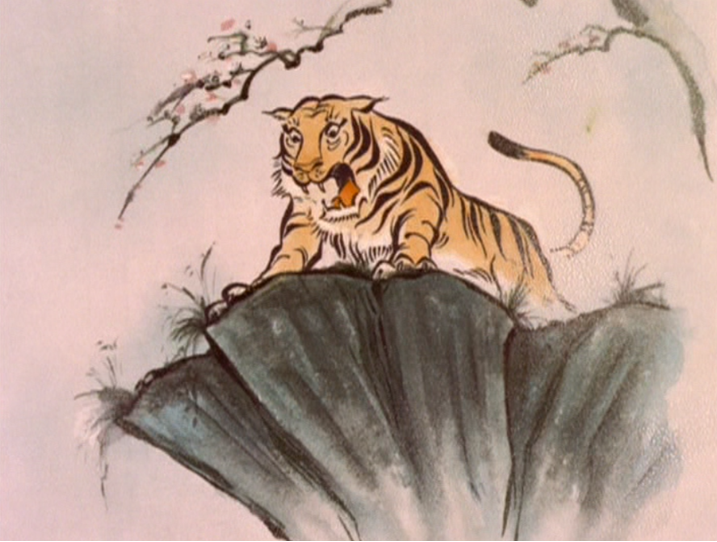
Few people are willing to speak about Buckley, as he was an unremarkable character. But Kahn decides to draw attention to himself by giving a speech in which he clownishly pretends to be very moved by Buckley’s death. In an even stronger accent than usual, he tells a Buddhist fable, which in contrast to the show’s usual animation is illustrated in the style of traditional East Asian paintings. The narrative follows a man being chased by a “ferocious tigah.” The man falls over a cliff, stops his fall by catching a protruding branch on the cliff face, but then sees a similar monster on the ground below. Knowing he is trapped and about to die, he reaches for a strawberry growing from the branch and finds it is “the most delicious strawberry he ever had.” This scene is cartoonishly exotic, like the caricatures of Asians in South Park. It would surely be considered “otherizing” and offensive stereotyping today.

A tiger menaces an Asian man in Kahn’s telling of a Buddhist parable.

Further emphasizing how unfamiliar the mindset of a supposedly assimilated immigrant is to native-born Americans, none of the Whites in the audience understand this parable about appreciating the small things in life, even in the presence of death. Hank initially misinterprets it as a joke and considers it inappropriate. He later repeats an Americanized version of it to Bobby, with Detroit Lions in place of tigers and Gatorade in place of the strawberry, but the younger Hill has a similar problem understanding the Asian wisdom, saying, “I get it — it’s funny.”

Bobby expresses what was then the standard attitude among Whites toward Asian culture; he is neither “xenophobic” nor a self-hating White who would distance himself from his own nation to identify with another. In one episode he becomes enamored with Taoism and quotes Lao Tzu, even getting Hank to accept the concept of wabi sabi, meaning the beauty of minor imperfections. In another episode, though, he affirms his attachment to a traditional American lifestyle. A group of Tibetan monks come to town, suspecting that Bobby is the reincarnation of their deceased master, Lama Sangluk. Their final test to confirm his status and grant him a new life as a monk is to show him a set of items and let him identify the one that belonged to Sangluk. Knowing that the monastic lifestyle does not allow girlfriends, he points to Connie’s reflection in a mirror, telling the Tibetans that he chooses her. Although the mirror belonged to Sangluk, the head monk interprets this as a choice for romance instead of a monk’s life, and Bobby continues as a regular White American rather than assimilating into Asian Buddhist culture.

On the other hand, Bobby expresses the common infatuation of White American youth with Black culture and has to be reminded of who he is. In one episode, Hank catches Bobby walking down the middle of the street, blocking traffic while listening to rap music. Bobby explains that the artist is Pimp Franklin and that “he don’t need your respect, ’cause he don’t pay no man no mind.” Hank angrily rejects this cultural enrichment and takes Bobby to the record store to find more race-appropriate music.

In another episode he becomes a fan of a crude Black comedian named Booda Sack, who often mocks White people. As an aspiring comedian himself, Bobby tries to emulate him and proposes joking about how the police are always pulling him over. Mr. Sack has to explain to him that “you’re not Black,” and invites him to perform at a local comedy club as soon as he can make jokes more in line with his own perspective as a White male. This leads him to make “offensive” racial jokes based on material he finds on a White nationalist website. The audience boos him, but Mr. Sack, rather than calling for him to be blacklisted or for his father to be fired as would be customary today, defends his right to free speech as an American tradition.

Thankfully, although Mr. Sack is ultimately depicted as a loyal American, the episode does not romanticize Black culture or imply that he is just like a middle-class White man under the skin. He is depicted as exceptionally loud and obnoxious, and his humor is simply lowbrow personal insults. He even practices his comedy at work, where he is expected to be acting as a driving instructor, and gets fired for offending too many clients. He had previously experienced a downturn in his comedy career for similarly offending people with his performance on a Black sitcom. His dark-skinned audience at the comedy club is not depicted as particularly civilized either. They are clearly baffled when he defends the tradition of freedom of speech, even though he explains it using appropriately colorful terminology.

In one episode, King of the Hill actually mocks the hysteria around “racism.” Hank’s dog Ladybird attacks a Black repairman named Mack who has come to fix the water heater, and the man accuses the dog of being racist. Hank invites Mack to stay for lunch to show that neither he nor the dog are racist, but Ladybird attacks him again. He takes Ladybird to a dog trainer and nervously explains her apparent prejudice, but the contemptuous trainer, who boasts that he has a Black girlfriend, explains that it is impossible for a dog to have such feelings; she must instead be responding to cues from a racist owner. The other people in the room glare at Hank disapprovingly, and after he fails a questionable online racism test, the local church congregation soon joins in scorning Hank as “racist,” even praying on his lawn for his soul.

Ultimately a White repairman comes to his house, and Ladybird attacks him as well. Hank realizes that the dog does not hate Blacks, but only repairmen, as he himself does. The episode ends with him laughing joyfully at the realization that he is not racist, unconcerned by the dog’s ongoing violence toward the repairman. Whether intentional or not, this is a fitting mockery of how the popular obsession with appearing “non-racist” takes precedence over addressing real-world problems such as violence.

Hank Hill and his neighbors Bill, Dale and Boomhauer drink beer by the side of the road.

Despite every White character being laughable to some degree, King of the Hill implies too much sympathy for the wrong people to fit with current-year social justice sensibilities. Even the lowest elements of White society are portrayed sympathetically. Luanne Platter, Hank and Peggy’s niece, is the product of the teen pregnancy of a violent and manipulative alcoholic named Leanne, and previously lived in a trailer. But Luanne herself is more wholesome than her mother, despite being dimwitted. She never displays any criminal tendencies beyond minor mischief, never abuses the Hills, and takes great pride in putting on a Christian puppet show.

The Hills are often shown to have wholesome family relationships, as when Bobby says to Hank at the end of one episode, “this is the best birthday ever, and you’re the best dad ever!” They also display an admirable ability to take joy in small things; when Bobby sees a new dryer which he misinterprets as his birthday present, he is so pleased that he literally embraces it.

The main characters in King of the Hill are ordinary gun-owning Whites in a red state who express vaguely conservative attitudes such as a general suspicion of government. As such, if they had existed in 2016, they might have voted for Trump. But they are never portrayed as the monsters such people would be in present-day entertainment media. We can only hope that during our lifetimes, anti-White trends in the mass media and wider culture will be reversed and it will again become normal to portray such people in a sympathetic light.

The German Aristocracy and National Socialism

Those who are acquainted with the many books and films produced recently about the 20 July 1944 plot to assassinate Hitler led by Count Claus Schenk von Stauffenberg may have the impression that the plot was a result of the aversion of the German aristocracy to the political ambitions of a commoner like Hitler. In fact, Stauffenberg’s failed attempt was only the last of a series of attempts to assassinate Hitler that originated from General Ludwig Beck (1880–1944). Beck was not an aristocrat but belonged to the officer class and resigned his post as Chief of Staff of the German Army in August 1938 mainly on account of his disagreement with Hitler’s aggressive foreign political aims.

The German aristocracy itself was incorporated into the National Socialist movement from the twenties on without much difficulty, even though some of the aristocratic National Socialists had to tolerate the contempt of peers who were opposed to the socialist aspects of Hitler’s government. According to Stephan Malinowski,[1] in all, about 300 noble families of the lower aristocracy based in Prussia contributed about 3,600 members to the National Socialist Party, and the number of adherents from the upper ruling families rose from 70 in the thirties to around 270 by 1945. Most of these were Prussian and Protestant rather than Bavarian and Catholic, since the Bavarian Catholic aristocrats were dedicated to the House of Wittelsbach, whose crown prince, Rupert of Bavaria, was firmly opposed to Hitler and was exiled in December 1939 to Italy while other members of his family were interned for some years in concentration camps.

It is true that Stauffenberg and some of his fellow conspirators in the 20 July plot were shocked by Hitler’s extreme persecution of the Jews, but it cannot be clearly said that all of the conspirators were impelled by philo-Semitic sentiments since the German aristocracy was, in general, anti-Semitic and anti-Marxist like Hitler himself. Count Wolf-Heinrich Helldorf (whose 1934 essay is presented here) was in fact a vigorous anti-Semite in the thirties[2] and may even have played a part in the organisation of the Kristallnach riots, though he eventually joined the conspirators led by Stauffenberg. That all the aristocratic National Socialists did not revolt against Hitler is also clear from the fact that the editor of the collection of essays here presented, Prince Friedrich-Christian of Schaumburg-Lippe, remained a proud National Socialist even after the war.

The following three extracts from the collection of nine essays by aristocratic National Socialists that was edited by Prince Friedrich-Christian of Schaumburg-Lippe, Wo war der Adel? (Where was the aristocracy?, Berlin: Zentralverlag, 1934), show that many of the aristocrats indeed welcomed the opportunity given to them by the National Socialist movement to renew their own aristocratic estate after it had been destroyed alongside the German monarchy in 1918. In turn, the elevated codes of conduct of the aristocrats as traditional rulers of the German domains helped to strengthen the chivalrous image that is often associated with the German military of the Third Reich. It is true, however, that the SS as developed by Himmler from 1929 came to represent the real elite formation of the Third Reich since it was originally created as a bodyguard for Hitler and expressed more directly the dedication to the Führer that was the hallmark of the entire Third Reich. The members of the old aristocracy were absorbed into the SS, as well as into the earlier SA, without much strain since the old and the new elites had in common a desire to renew Germany after its devastating defeat in World War I. One feature that may have been novel, however, about the involvement of the aristocrats in the National Socialist movement is the more socialist conception of themselves that they now manifested, no longer as superior leaders of an anonymous population of subjects but as close collaborators with the latter in the task of building a new German empire.

*   *   *

Count Bernhard von Solms-Laubach [1900–1938]
Director of the National Theatre,
Standartenführer[3]

The Aristocracy is dead – Long live the Aristocracy!

We do not wish to be sentimental, we admit openly that which everybody, however, already knows. That there is no aristocracy any longer in Germany that in its entirety is still capable of representing a clear ideal. The aristocracy is dead because it has killed itself. We stand before a sad remnant, before a burial mound that has been raised up with effort but without jewels, and unlamented, to which one has given the impressive name ‘German aristocratic society’.

And there was once a time when all the names had a strong resonance and an inner significance, when all the families had a calling in the nation, all the names and all the families  as they are neatly recorded today in peerage lists and Gotha pocketbooks[4] as though for museum purposes. There was a time when the German aristocracy was a living fact, when there was bound with the aristocratic name a sacred responsibility towards the people, when the German aristocracy was the bearer of a quite definite worldview, an idealistic worldview in which one’s own advantage could have no meaning compared to the duty to serve to the utmost the people, the country, the state and its representatives. Then the aristocrat stood naturally at the very front, as a spearhead, for the affairs of his people, ready to give up and sacrifice not only his life but also his possessions, if that might help. Everywhere in the Empire they were based in their residences and castles like the conscience of the people, watchmen and preachers, but always fighters for the existence of the Holy Roman Empire,  each alone for himself, bound to one another only through the common goal – and one who did not acknowledge this goal through fighting and sacrificing and made it his own was considered a traitor, an apostate. Germany owes its life to this aristocracy.

But if Germany had depended on the present-day aristocracy it would have died along with it. The aristocrats still dwell everywhere in the Reich in their residences and castles, but it is only due to the people that they are recognised as their conscience. They no longer watch over or preach and, if they fight, then it is in defence of their property or their vanity. Every aristocrat no longer stands by himself, today they are organised, but their organisation lacks any goal that rises beyond their selfish aims.  Anyone of them that acknowledges  the goal of his nation in fighting and sacrificing and internalises this is today a traitor, a renegade.

This all of us who, members of the German aristocracy based on our origin, were able to be incorporated into the National Socialist movement during the battle period must have experienced in a personal way to a sufficient degree. One should not today expunge the fact that we took up the fight in the movement under the express disapproval of our so-called peers, that we were fought and laughed at. If we felt it as obvious to fight when our nation is in the process of fighting for its life — perhaps because we were conscious of the responsibility and the duties transmitted to us from ancient times by our name, that is, because we belonged to the German aristocracy — the opinion of our aristocratic colleagues was the opposite, namely, that we became National Socialists in spite of belonging to the aristocracy. We were, considered from the intellectual viewpoint of the German aristocratic society, actually the traitors, the renegades, and would have been condemnable if we had not been granted extenuating circumstances on account of our idiocy. Besides, it was not in good taste. Politically one had to be a German nationalist, but that one was not a monarchist was an absurd thought. For the further pursuits of the really energetic there was available, besides, the Gentlemen’s Club and, for the others, country riding clubs and — one may perhaps add — leadership positions in the Stahlhelm.[5]

To express it briefly: the German aristocracy disgraced itself to death. It pathetically missed the last chance to prove its raison d’être. Here too exceptions confirm the rule. The question is hard and clear which the people today pose to you: Where were you aristocratic gentlemen when Germany perished? What did you do when the adversity became ever more unbearable? Where did you fight and what did you sacrifice? You thought of yourselves and how you could save yourselves! You thought of yourself and the welfare of your family and perhaps regretted the misery of the people, perhaps even found it depressing, but did nothing! Did nothing! And you dare to raise a claim even today to leadership?

The people have known you for long. I shall never be able to forget with what suspicion I was accepted into the National Socialist movement and in the SA on account of my name. With what mistrust the workers stood against me at first because they attributed to such a person everything bad rather than an honest National Socialist disposition. Remarkable how this mistrust, this suspicion accorded with the attitude of the aristocratic society members! National Socialist even though one is aristocratic. This contradiction signifies the self-esteem of the aristocracy and at the same time indicates its estimation among the people. Exclusivity, which arose from the obscurantism that was inclined to rest comfortably on the laurels of one’s ancestors and to skim off the cream of history as a traditionally born leader, the self-willed isolation, detached the aristocracy from the people and killed its instinct. The result: a great yesterday, a petty today and no tomorrow at all.

The people have become mature. The leaders and saviours have emerged from the people. Adolf Hitler arose from the soul of the people. You, aristocratic gentlemen, may bristle because that insults your vanity, because each of you in your opinion must be the leader, you might agitate and stir up trouble, as you still do today, but the aristocracy is dead, because you have killed it by your behaviour, your attitude, your selfishness. Besides, your inveighing too will cease. The aristocracy is dead and already there arises from the people a new aristocracy filled with the sacred duty of building up Germany. New names have once again a strong resonance and inner significance. A new elite has a new calling among the people. A new aristocracy rises again as the bearers of the idealistic worldview in which one’s own advantage cannot mean anything compared to the duty to serve the people, the country, the state and its representatives to the utmost. One who stands at the very front is the aristocrat!

The aristocracy is dead, long live the aristocracy!  We thank our Führer that, when the old failed, he gave and trained for the people his new aristocracy, for which it is no longer a matter of names and external appearances but which simply exists and fights.

*   *   *

Dr. Achim von Arnim [1881–1940],
Professor of Military Science, Technical University of Berlin,
SA Oberführer[6]

The German aristocracy belongs to Adolf Hitler

One can grow to be a National Socialist, but the disposition must indeed be inborn. Forms that are once internally imprinted begin to develop no matter how hard one tries to disperse them. As the son of a Prussian officer and a mother from Alsace, a certain dichotomy of temperament was allotted to me. Along with Prussian sobriety I possess enough imaginativeness and sprightliness to have a quick sympathetic understanding of new things.

My parents lived in various garrisons of the Imperial Guard and, like every officer’s son, I attended the high school. It was the nineties of the last century, in which the memory of the victorious wars of 1866[7] and 1870/1[8] was still alive. It seems to me that the German nation was brought too quickly to life through the success of Bismarckian politics. Wealth and splendour had fallen suddenly into the lap of our people, who had hitherto been modest and sober.  It thereby lost its spiritual equanimity.  The German, distinguished by his depth and his rich world of feeling, developed in the last 20 years of the century into a man of rational understanding and a materialist. The school offered no counterpoise. The teachers were not aware that they had to  conserve in the best sense the  tradition of German Humanism and the idealistic tendency of German Classicism. Of course there were among them men rich in ideas and pedagogically skilled, whose instruction I still remember with gladness.

In general, however, a  too copious information was transmitted to us and, specifically, without any political influence. I can especially not forget that, during my schooldays, no explanation of the political development of our nation was given to us. We learnt nothing about social and economic development, nothing  about the significance of the battles that began with the French Revolution, of the opposition to Liberalism at the beginning of the  previous century, of the dissemination of the mercantile spirit and of capitalism. To be sure, one occasionally heard frightful things about the  Social Democrats[9] — at the elections one was frightened by the increasing percentages of their mandate. I went to school for many years in Spandau, there there was a strong population of workers with whom  there was no connection at all. We high school students met only with our peers, and I always had the feeling that the boys of the  public school were  particularly rough  and uncouth.

But a slightly better insight was then given by my entry into the army.  In just a few months — and that is too short a time,  the prospective cadet was, when he left school,  consigned to the squads. I served in the First Regiment of the Imperial Guard and this had the best reserve troop from all of Prussia, tall blond men from the healthiest families of our nation. I had imagined the time in the ‘barrack room’ as something very unpleasant, as being  in the company of a number of coarse, immature and boorish fellows and still remember my surprise that this image did not correspond at all to the reality.  On the contrary, the  young soldiers with whom one lived  — 20 in a room — were actually, in their  moral constitution and habits, cleaner and more modest than the higher society with which I later socialised. It was also not difficult to find the right tone in communication, one just could not act like something better — and indeed one was not, for, as a scholar, one was not so familiar with the practical matters of life as the young soldiers. I then had similar good experiences as a young corporal. This first period as a soldier, which lasted only a short time, was a period of learning, perhaps not for the prospective officer but for the growing man. Nowadays, the young men, and even the women, come into contact more often, through the German Youth,[10] the  German Girls’ League,[11] the Hitler Youth and  community service, with all strata of the  working people. Thereby they develop a stable judgement and learn to have the necessary consideration in dealings with  men of different backgrounds.

The pre-war officer corps, which I entered a year and a half later, did not at all correspond to the caricature that was made of it at that time in the Liberal satirical papers and in the bourgeois world. There was alive, especially still in the older generations, the  sincerity and  loyalty of the  older generation that had fought the wars for unification. Fastidiousness in service, conscientiousness,  the  consciousness that one had to set an example through personal commitment, the feeling of responsibility for subordinates and even one of the necessity of a comradely relationship with them was totally alive.

But I became aware early of one thing, that this officer corps, not only in my regiment but everywhere else, represented an exceptional class that was, to a certain extent, separated by a glass wall from the life, activity and  feeling of the rest of the nation.  In it there lived on a portion of the eighteenth century. The officer was obligated to the warlord and felt himself bound only to him,  and, because reverence for the monarchy and devotion to its sustenance was his political morality, the officer believed that he did not need to worry about other political questions. It was the time when Germany stood at its absolute peak economically.  Everywhere great fortunes arose. One did not  know of any unemployment.  Every worker could hope that he could, through  his own industriousness and  economising, conduct his children to a higher profession. There existed therefore the total possibility that the upper strata would continually supplement itself from the people.

In reality, however, that took place only to a small degree. The institution of the ‘one-year service’[12] formed an absolute class border.  One who had taken this test — he did not even have to have served for a year —  belonged to the cultivated and higher strata, everybody else was a subaltern and belonged to the people. If we look back retrospectively at this period with Liberal eyes, we must ask ourselves how it was possible that Social Democracy rose so powerfully in a period  when everybody had a good income. From a materialistic standpoint there is no answer to that. But from the idealistic standpoint, it is a  question of the longing of a great part of our people who had reached adulthood in the course of the century for a national community, for a spiritual rapprochement with the so-called higher strata. Not all of us overlooked the role of the Jews in that period. But one who spoke of a Jewish danger was laughed at as a fantasist. If as a young man I had been invited to become a Freemason I would have accepted the invitation in the belief that one may find a rich spiritual life in this order. But this spiritual  life and this  understanding were lacking precisely in those classes with whom we officers socialised. The bureaucrats, owners of large landed properties and other highly placed persons with whom we socialised were duty-conscious and industrious but matter-of-fact men careful of their careers.  Only seldom did one find intellectually open-minded and  artistically inspired personalities.  The attitude to the  people was benevolent but derived from a feeling of  an obvious inborn social superiority. Manual work was considered as inferior compared to intellectual work, which we supposedly performed.

We would have been able to obtain stronger impressions  of the life and feeling of the people if there had existed the possibility of being instructed on worldview, political and social questions.  But who would give this instruction?  We officers were considered educators of the youth entrusted to us and doubtless did our best. Indeed, in the education for the soldier’s profession and war, performance was at an optimum. But the worldview education which we had to impart through our instruction had to be a failure because we ourselves lacked the necessary knowledge. It was indeed so, as the Führer said: before the period of service nobody cared about the young man, and after his service period neither.  One knew hardly anything about the Marxist organisations and the trade unions.  Their intensive propaganda work was hidden from us.

Then there came the war and very close contact with all strata of the population on the front in cohabitation, for weeks, in damp trenches and in basic accommodation. I definitely believe that not only I but all the older officers of the front felt that we had a close sense of bonding with comrades of all service grades and that in moments of danger it did not matter if one wore the epaulets of an officer or a corporal’s cross or a lance-corporal’s button. To all those who felt in this way the Revolution,[13] with the sudden revolt of the soldiers against the officers, was then a bitter disappointment. One recognised soon that it was not the good elements of our squad that became mutineers and deserters but young elements that had been poisoned in their hometowns and were inexperienced, who had to suffer the bitter deprivations of the wartime in the last years and had perceived the affliction in their homeland. With no defenses, they were exposed to the influence of Red propaganda. The revolution period separated the men. The major part of the officer corps and the members of the former higher classes were starkly against the revolution and its manifestations. These men saw only the ugly external images and wished to hide from the knowledge that here a people who had been misguided strove for a better social status through a semi-conscious longing. They should not at that time have separated themselves in this way from the people but followed the path that Adolf Hitler did, attempting from the start to give the people what it strove for and to combat what was pernicious.

While most of the officers, also demoralised, had to take up the difficult battle for survival and persevered in their rejection of the social questions, I remained for a while vacillating and searching. Finally ,thrown in the country, I found myself one day, in 1925, a District Leader of the Stahlhelm. One had heard something of Adolf Hitler and his movement in Munich only through the Putsch. It is astonishing and hardly believable today how little one knew, here in the country in the east, of the National Socialists. I saw my duty as saving the small town workers, and especially the rural workers, in my district, filled with estates and small cities, from Marxism. These were strata of the population into which the Red organisation had not yet penetrated fully. The Stahlhelm had inscribed on its shield the spirit of the soldiers of the front, that is, the community of the comrades in the trenches. With lorries and bands we drove through the country, held speeches in every village — whereby there was also a ‘beer movement’ — and founded everywhere local groups of the Stahlhelm. Even the landowners and — what was not always very easy — the agricultural bureaucrats were won over to our ideas and, in this way, we succeeded in the beginning in achieving something that was of course not even closely as well-thought out, but similarly felt, as what Adolf Hitler strove for.

If later, after a seven-year activity as Stahlhelm leader, I turned my back on the organisation, I must give the reasons for that without wishing to hurt the former comrades of the Stahlhelm who had been won over to our cause. There had entered a certain torpidity in my feelings on account of the faltering politics of the federal leadership, which had to wriggle through with difficulty between a more conservative and military orientation and a social orientation, and, in the meantime, National Socialism had arisen among us. In all villages and small towns there were Brown departments, and the Stahlhelm people were the proof that these were really more active, that, in neighbouring Berlin, hard battles for rule were fought in the Red quarters, that a strong atmosphere of intellectual tension emanated from the Hitler movement and that a good and clearly orientated press helped the movement to move forward. The Stahlhelm found itself at a dead end since it did not want to fight in a parliamentary way and did not have the power to rise to power with arms. Finally the social question also seemed to me to fade somewhat. The workers won over by me and bound to me for a long time expressed many doubts about the goals of the Stahlhelm. They seemed to them as if they were all about a movement in favour of the old ruling classes.

So finally there was a certain discord because I freely acknowledged my view which favoured National Socialism, and that led to my exit from the organisation, which made some sensation at that time, when the SA was prohibited. There followed a period of bitter hostilities on the part of former friends and comrades. But I can only say that I have not regretted my step one day and have seen during my career in the SA so much that was elevating and invigorating that it seems to me a good fortune to be able to continue to experience the present times. If the Prussian aristocracy for the most part showed at first little understanding of the way that I took that must be explained by its strong adherence to the Prussian tradition. The feeling of rulership cultivated through the generations, especially of the rural aristocracy, perhaps made it difficult to find a way to our people the way we in the SA did. But I think that the conviction must seize some earlier, others later, but hopefully all one day, that another way than the one that our Führer has taken is not passable for our German people. If we wish to come through victoriously in the tremendous fight for survival that we must still undertake in order to sustain our nation, given our unfortunate international situation and our unequal mixture of races, it will happen only if all the strata of our sorely tested people march together with complete trust, and that is possible only in National Socialism.

Berlin, 15 January ,1934.

*   *   *

Count Wolf-Heinrich von Helldorf [1896–1944]
Police Commissioner of Potsdam
Gruppenführer[14]

The Aristocracy and National Socialism

The entire public and private life in Germany today is influenced in a decisive manner by National Socialism. Everything that was ready and willing to cooperate in the building up of the nation is gathered under the sign of the swastika. We have to regretfully acknowledge that the bearers of old aristocratic names are involved to an extremely small degree in authoritative positions in this work of construction within the movement and in the state. This fact is especially surprising considering that the NSDAP has declared not once but many times that it would reach out its hand for the purpose of cooperative work to anybody who would place himself at its disposal unconditionally. The reasons that led to this superior aloofness of the aristocracy should be investigated here, and I think that we will reach a conclusion most easily if we review once again the political development in our nation during and after the war and, in this way, examine the attitude of the aristocracy to the National Socialist idea.

The ruling and state-governing classes in the Bismarckian empire were the officer and bureaucratic classes. Aristocratic officers and bureaucrats stood here in a preferred and leading position. When Germany decided in 1914 on the fateful four-year long armed conflict and the Prussian German army marched in the glow of its centuries-old military culture to the defence of the homeland and carried the war to hostile countries, the Prussian German aristocracy, following the old tradition, occupied a leading position within this national army. This army fought and won in the battlefields of the whole world and, at its head, fought and bled the German aristocracy. Once again, before the great collapse of the monarchy and the aristocracy, those fit for military service from the aristocratic families were conscious of their proudest privilege sanctified by tradition: they died a heroic death in a natural fulfilment of duty.

If, later, people repeatedly and rightly pointed to the total inaction of individual families and members of the German aristocracy, one must, on the other hand, rightly acknowledge and ascertain that no class in Germany took part in this four-year long conflict with such an enormous sacrifice of blood and death as the aristocracy and declare that the best of us have fallen.

In the political leadership of the German nation in the pre-war and war years the aristocracy did not live up to its duties. The aristocracy and the people no longer understood each other. The aristocracy no longer spoke the language of the people and thus it failed, detached and separated from the people, both in internal and in external politics. In the foreign policy of that time, which was especially strongly influenced by the aristocracy and unfortunately also by Jewry, there was no politician or statesman who rose even a little above the average level. After the enormous blood sacrifice of the international conflict, the aristocracy seemed to have exhausted its last strength, which had been kindled in its old families even during the war. Only a few of us confronted the mutineers of 1918 vigorously. The throne and altar were abandoned, the Kaiser empire crumbled, and with it the aristocracy.

The history of the revolution is at the same time the history of the collapse and disintegration of the German aristocracy. The heroes of yesterday, the pillars of support of throne and altar, soon became spineless servants of a state that could be created only after the strongest supports of this state had bowed down before traitors and mutineers. When the red flags of the revolt fluttered and the mobs raged in the streets, they of course complained and protested but they forgot to fight, and found the required justifications for everything that they did and were not sparing in declarations dripping with patriotism. The majority of the aristocracy accepted the situation as it was. The majority of the aristocracy came to terms with the Weimar Republic. For the majority of the aristocracy and especially for the older generation it was still only a matter of a lesser evil that one had to put up with, in order not to lose everything. On major patriotic festival days the uniforms of the old regiment were brought out now and then to keep up tradition, one gave pleasant speeches at war associations and expressed the hope that God would indeed grant us better times once again. None of us wanted battle itself. Indeed it was much more convenient to be promised peace and order from the Weimar Republic and, for that reason, to change one’s attitude a little. It is worth mentioning that, in this period, Jewish families with and without noble surnames played the principal role in the aristocracy. Everything pressed round the golden calf and one was able to note, for example, with trembling fear, in Berlin society in the years 1924–1925, that degenerate aristocrats were tolerated guests in rich Jewish families, that all the so-called good houses were open to a notorious criminal like, for example, the Jewish state secretary Weismann.[15] In general, one who disseminated propaganda for the ‘Realpolitik’ of the ‘statesman’ Gustav Stresemann,[16] eulogising with many fine speeches in cities and the state, was valued as a specially intelligent aristocratic comrade. One put up with everything, even the worst phenomena of the time, and even the German aristocratic association, as a socio-economic organisation of the aristocracy, was in no way directive but satisfied itself merely with transferring external forms of the past to the republican present.

The aristocracy organised itself after 1918 chiefly in the German National People’s Party[17] and the Stahlhelm and, in the battle years, both groups virtuously did everything that was in their power to make life bitter for us few National Socialists from the aristocracy and to mock and denigrate us and our battle for the German nation. The first great election assembly will always remain in my mind in which I was to appear in Halle for the first time in my life, in 1924, as a speaker for the National Socialist Freedom Party. In front of an overflowing assembly that absorbed with enthusiasm the programmatic representation of the National Socialist battle goals there spoke, after me, as a respondent, the party secretary of the German National People’s Party, and also the Stahlhelm leader in Halle, Senior Lieutenant Düsterberg,[18] and a war-blinded Communist. While the performances of the latter were completely moderate, Mr. Düsterberg, who, as is well-known, is Jewish, used the opportunity to oppose the young freedom movement in the harshest way.  Even at that time I was amazed by the blind hatred that filled this man but did not know that the formerly active officer of the military staff was Jewish.

Therewith I come to the saddest chapter in the history of the German aristocracy of the present. We stand before the shocking fact that that part of the population that, according to blood, race and a centuries-long tradition, was called and, as we believe, is still called to present to its people statesmen and soldierly fighters in the great freedom fight that the National Socialist movement had conducted for 14 years stood aside without any understanding of the great changes that had occurred in the German national soul, retreated into a completely misunderstood aristocracy and, often not without justification, invited upon itself the hatred and the contempt of large masses of the people.

The aristocracy took part only to an extremely small degree in the powerful battle within the country under the leadership of Adolf Hitler. It must indeed be said clearly that the aristocracy, and especially the post-war generation, succumbed frightfully quickly to the influences of liberalism and democracy. The smaller part of it encapsulated itself in the seclusion of conservative or nationalist clubs and in professional associations conducted in a parliamentary political manner. The German national Stahlhelm leaders in the aristocracy laughed at us ‘reckless and immature young people’ when we stated clearly in public that we love our German people and hate its enemies. They thought it was not ‘chic’ to get into close discussions in national assemblies with KPD[19] and Reichsbanner[20] people. If we fought in national assemblies and in the street with fellow Germans filled with hatred they spoke of us as hooligan elements that had unfortunately not learnt to behave according to their ‘class’.

Even if one accepts and understands — for the reasons that I have presented at the beginning of this essay  — that the aristocracy in 1918 did not oppose any decisive resistance to Ebert,[21] Scheidemann[22] and Noske[23] with their mutineering hordes, the meagre participation of the aristocracy in the political battle of Adolf Hitler will always remain incomprehensible. It cannot be explained or excused by anything that a class that presented to the people through the centuries leaders, and not the worst, refused adherence to the man who set about, after the collapse of the old leadership in Germany, to educate new young leaders, who however demanded even from these young leaders that they had to prove their suitability and set for each of us strong endurance tests before the title ‘leader’ was granted to us.

After the aristocracy had been unable through its own strength to change the fate of its people, we must, in retrospect, regretfully state that, even in the last part of the development of German history, which stood under the sign of victorious National Socialism, it did not understand to put a stop to its inner disintegration and cooperate in the new formation of affairs with all its forces. This failure of a valuable and, insofar as it is a question of the landed aristocracy, racially superior and healthy section of the population, is so much more regretful in that the National Socialist movement built and conducted on aristocratic principles had to correspond completely to the inner constitution of the aristocracy. Just as among the ancient Germans the best person in terms of family, clan and tribe was the heir-apparent and became the leader, so also in the National Socialist movement the best person in terms of performance and blood is the leader. People may say of the aristocracy that it is in the process of committing serious mistakes that can never be remedied, both to itself and to coming generations. There is no doubt there is forming in National Socialism a new ruling class of the German nation.  If the aristocracy stands aside from this great aristocratic national movement, destiny will pass over it and then it would be better if it decided to discard its aristocratic titles which have becomes worthless.

The aristocracy stands at the turning point of its history. It is up to it to demonstrate, through its conduct in relation to National Socialism, that race and blood can overcome darkness and class conflict. If the aristocratic principle of the NSDAP according to which only one who fulfills special duties may claim special rights for himself penetrates the aristocracy of today, and if the aristocracy incorporates itself wholly and unconditionally in the great national community of Adolf Hitler, then the possibility will be offered to it even today of recovering its position in the German nation which has been strongly shaken by the events of the last 14 years. And then the proudest privilege of the aristocracy will remain that of offering its sons to the fatherland.


[1] Stephan Malinowski, Vom König zum Führer. Sozialer Niedergang und politische Radikalisierung im deutschen Adel zwischen Kaiserreich und NS-Staat, Berlin: Akademie Verlag, 2003.

[2] See, for example, Elke Fröhlich, Die Tagebücher von Joseph Goebbels, I, iii, p.470.

[3] The rank of an SS Standartenführer was equivalent to that of a colonel.

[4] The Almanach de Gotha was a standard directory of European nobility published from 1763 to 1944.

[5] The Stahlhelm was a league of ex-servicemen of the First World War that acted as a paramilitary force of the monarchist German National People’s Party (DNVP) from 1918 to 1935.

[6] A rank between colonel and brigadier-general.

[7] The Austro-Prussian war fought between the Austrian Empire and the Kingdom of Prussia.

[8] The Franco-Prussian war fought between the French Second Empire and the North German Confederation led by Prussia.

[9] The Sozialdemokratische Partei Deutschlands (SPD) was established in 1863 and Friedrich Ebert of the SPD became the first president of the Weimar Republic (1918-1933).

[10] The ‘Deutsches Jungvolk’ was the junior division of the ‘Hitler Jugend’, for boys aged 10 to 14.

[11] The ‘Bund Deutscher Mädel’ was the female youth organisation of the National Socialist party.

[12] A reference to the ‘Einjährig-Freiwillger’ volunteers of the Prussian army who, after a year’s service as volunteers, were made reserve officers.

[13] The German Revolution, or November Revolution, of 1918 was a mutiny of German sailors in Wilhelmshaven and Kiel that led to prolonged civil unrest in Germany that ended with the establishment of the parliamentary constitution of the Weimar Republic in August 1919.

[14] Section Commander.

[15] Robert Weismann (1869-1942) was state secretary for Prussia during the Weimar Republic.

[16] Gustav Stresemann (1878-1929) was a politician of the Weimar Republic who served as Foreign Minister and, briefly, Chancellor.

[17] The Deutschnationale Volkspartei (DNVP) was a nationalist and monarchist conservative party of the Weimar period which rejected the Weimar Constitution and the Treaty of Versailles.

[18] Theodor Duesterberg (1875-1950) was a staunchly anti-Semitic leader of the Stahlhelm who was discovered in 1932 to have partly Jewish ancestry. He consequently resigned from the Stahlhelm in 1933.

[19] The Kommunistische Partei Deutschlands, founded by Rosa Luxemburg and Karl Liebknecht, was a major political party of the Weimar Republic. It was banned in West Germany in 1956.

[20] The Reichsbanner was an organisation of the Weimar Republic devoted to upholding parliamentary democracy in Germany.

[21] Friedrich Ebert (1871-1925) was a member of the SPD and first president of the Weimar Republic.

[22] Philipp Scheidemann (1865-1939) was a member of the SPD who served as Chancellor of the Weimar Republic between February and June 1919.

[23] Gustav Noske (1868-1946), of the SPD, was Minister of Defence of the Weimar Republic between 1919 and 1920.


Kevin MacDonald: Is The Family Cut-Off From Kinship The Basis of Western Individualism as well as Liberalism? Chapter 4 of Individualism and the Western Liberal Tradition4

Have you spent countless hours searching for the origins of individualism in the philosophical treatises of the Western Canon? Reading Kevin MacDonald’s Individualism and the Western Liberal Tradition may make you think this was wasted time: the origins of individualism lie in the pedestrian world of family life. Individualism is not an idea, a concept, or a philosophical insight, but, as explained in Part 3 of my extended review of MacDonald’s book, its essence lies in “the cutting off” of the Western family “from the wider kinship group”. And this cutting off was started by illiterate northern European hunter gatherers during the last glacial age in the Upper Paleolithic and Mesolithic periods. In chapter four, the subject of this article, MacDonald continues his analysis of the “familial basis of European individualism” in response to those who argue that this family was a by-product of individual family ownership in the Middle Ages.

In what follows I will bring out the salient features of MacDonald’s argument, how incredibly different was the Western family, while raising questions about the degree to which we can reduce the essence of Western individualism to family patterns. I will use MacDonald’s argument that Sweden stands as the most extreme case of the Western individualist family to suggest that there are other key principles of individualism which are actually absent in current Sweden. A key principle of the liberal ideal is the realization of the variety of individual personalities, along with institutions that encourage such variety, unpopular opinions and the freedom to advocate them openly without reprisals. By this criteria, it is hard to identify Sweden as a liberal nation notwithstanding its individualist family patterns.

Individualistic Families in the Middle Ages

There has long been “a consensus among historians of the family that the family structure of northwest Europe is unique.” The consensus is no longer, as MacDonald notes, that this family was a by-product of modern capitalism; it is that Europe’s peculiar family patterns were already observable in medieval times. We have seen in Part 3 of my analysis of MacDonald’s book that he goes “back to prehistory” to  explain the primordial “evolutionary/biological” basis of this family. In chapter four, which we are currently examining, he attempts to refute the consensus argument that the Western individualist family sprang out of the manorial system of northwest Europe where land ownership was centered on singular family holdings rather than on kinship groups.

Without getting into MacDonald’s careful argument against the manorial thesis, his counter-argument is that “there were already strong tendencies toward individualism” among north-western hunter-gatherer-derived Europeans and Indo-European-derived cultures. Since there is no direct evidence of genetic selection in prehistoric times of these family patterns, MacDonald accentuates instead how the genetic findings he adumbrated in chapters one to three (regarding strong individualist tendencies among northwest hunter-gatherer Europeans and Indo-Europeans) parallel the well attested existence in Europe of “extreme individualist” families in the northwest, “moderate individualist” families in north-central Europe, and “moderate collectivist” families in the south where more collectivist Anatolian farmers settled.
In other words, the areas in Europe with “extreme individualist” families tend to be the ones that came under the heavy influence of the “egalitarian individualism” of northwest hunter-gatherers (Scandinavia). The ones with “moderate individualism” tend to be the ones heavily influenced by the aristocratic individualism of Indo-Europeans, along with some Nordic egalitarianism influences, namely, France, Germany, Austria, Netherlands, Switzerland. The ones with “moderate collectivism,” where kinship ties remained relatively strong in family patterns, tend to be the ones heavily influenced by collectivist Anatolian farmers, namely Italy, Greece, and Spain, though MacDonald observes a moderate collectivism in eastern Europe and Russia as well.
The protypical “extreme individualist” family is characterized by seven key characteristics:
  • monogamous marriages
  • marriages at a relatively older age than the married teenage girls we see in non-western world
  • similar age of husbands and wives
  • a relatively high proportion of unmarried individuals (women in particular)
  • household settlement independently of parents and extended families
  • rather than marrying a close kin or cousin, exogamy prevailed
  • marriage based on individual choice and romance rather than arranged
While I was aware of the consensus literature contrasting Western and Eastern family patterns, MacDonald’s thesis goes well beyond in its evolutionary/biological perspective and its persistent focus on how this family was cut off from extended family kinship networks, and how this separation is the foundational basis of Western individualism. Individualism is not a theory but a deeply seated behavioral inclination among Whites. This counters the naive conservative supposition that individualism can be exported to the rest of the world and assimilated by cousin-marrying Muslims in Europe.

Because MacDonald presses this incredible contrast between Western and non-Western family patterns, he sometimes uses expressions which may give the misleading impression that, for him, the Western family was “cut-off” altogether from kinship networks. But his point is that there were substantial differences in degree of kinship connections, and that these differences existed within Europe as well. It is not a matter of absence or presence of kinship networks. This becomes clearer in the next chapter, as we will see, when he acknowledges in full the additional, and indispensable, “cultural” role of the Catholic Church in the Middle Ages in breaking down to a higher degree extended kinship networks and thus reinforcing the individualist tendencies already present.

It may come as a surprise, and it is a big contrast between the West and the Rest, that the choosing of marriage partners in the West, more so than elsewhere, was based on “warmth and affection, and physical appearance”. “Close relationships based on affection and love…became universally seen [by the 18th century] as the appropriate basis for monogamous marriage in all social classes” including the aristocracy. I am sure there is a strong correlation between these family patterns and the fact that Europeans were responsible for the best romance novels ever written. Only in the West do we find such novels as Jane Austen’s Pride and Prejudice, Gustave Flaubert’s Madame Bovary, Emily Bronte’s Wuthering Heights, E.M. Forster’s A Room with a View, Margaret Mitchell’s Gone with the Wind, William Shakespeare’s Romeo and Juliet, Marguerite Duval’s The Lover, D.H. Lawrence’s Lady Chatterley’s Lover, Goethe’s The Sorrows of Young Werther.

Is Contemporary Sweden “Individualist” and “Liberal”?

Who is more individualistic and liberal, the feminist or the nationalist?
In a closing section, “State-Supported Extreme Individualism in Scandinavia”, MacDonald addresses the paradoxical convergence in Sweden of a socialist state “supporting egalitarianism…as necessary precisely for achieving individualist autonomy”. It would misleading, he observes, to describe Sweden as a communitarian culture since the function of its socialist state is “precisely” intended to afford greater equality of opportunity to the greatest number of individuals by giving them access to health, education, high wages, and good jobs. Nordic societies generally score very high in “emancipatory self-expression” because the socialist state has afforded the greatest number of individuals the economic wherewithal for self-creation, the ability to develop educationally and physically. Likewise the state has solidified the ability of Swedes to have the most individualistic family patterns by freeing parents from child rearing tasks — not by  discouraging high investment on children, but by helping families with child care and thereby giving couples more time to express themselves creatively as individuals rather than being burdened too many hours with mothering roles.
This freeing of Swedes from all the remaining collective components of the family has indeed entailed a questioning of the notion that there are “fathers” and “mothers”. Families are “voluntary associations” or contracts between private individuals that may come in multiple forms. There are no deep biological differences between boys and girls. Swedes are “free” to decide which gender (among a growing number of possibilities) they prefer to be identified with, rather than being boxed, as feminists like to say, into a “male-female binary.” MacDonald does not get too much into the downside of individualism at this point in his book other than to mention Sweden’s high levels of divorce, lack of filial attachments, sexual promiscuity and drugs — alongside a political culture that discourages any strong attachment to Sweden’s ethnic identity.
As insightful as MacDonald’s emphasis on family patterns is to our understanding of the nature and dynamics of Western individualism, I wonder whether he is pushing too far the argument that Sweden today is “on the extreme end of individualism” based primarily on the criteria that this nation has exhibited, and continues to exhibit, “the most individualist family patterns in all of Europe”. I wonder whether Sweden can be classified as an individualist society given the extremely conformist culture it has engendered. We call Nordics “radical liberals” but they are not liberals anymore, since very little independent thinking and dissent is permitted against politically correct values enforced by the state without dialogue.

It is not as if MacDonald does not recognize the presence of moral communities which regulate the beliefs of its members and limit dissent in the West. As we will see later, this is a key component of MacDonald’s thesis: the very same cultures that minimized in-group kinship ties engendered powerful moral communities to sustain their individual egalitarian behaviors in opprobrium to individuals who did not play by these rules. But if we agree that there is more to liberalism than individualistic families, and that allowing for the realization of the variety of individual personalities and freedom of expression are essential traits, it may be a stretch to call Western societies today, the same ones that prohibit any criticism of diversity, liberal. Expression of one’s inner potentialities and highest talents, in competition with others and against pre-reflective norms, is central to the liberal ideal of freedom.

Although some socialistic measures such as equality of opportunity are consistent with liberal thinking, the egalitarian ideal is not. The fundamental drawback of socialism is that it opposes human variety and divisions, the reality of human conflict and disagreement. Socialism seeks harmonious, well-satisfied citizens well-attended by a nanny state within an ordered whole in a state of happy coexistence. But a cardinal principle of Western liberal thought has been that variety, the right to think for yourself, and to strive in a state of competition with others, is good, for it awakens human talents, allows for individual creativity, and discourages indolence and passivity. Sweden however is striving for egalitarian conformity and uniformity of thought.

While equality before the law, equality of individual rights, including the socialization of education and health care, is consistent with liberal thinking, there is an internal logic within the egalitarian ideal that runs against individualism. The end of egalitarianism is to make all individuals as alike as possible in their attainments, their thoughts, and their standing in society. As John Stuart Mill said, the chief goal of a free society should be the expansion of the expression of individuality, which requires competition of ideas, liberty of opinion, a free press, right of free assembly — the very same traits that are being denied in Sweden and the West at large. Just because we are witnessing in the West indulgent self-expression, disdain for marriage, narcissistic behaviors, breakdown of family patterns for the sake of personal greed and narcissism, it does not mean that Sweden has not become an authoritarian state that is anti-liberal and anti-individualistic.

The West may well be in the worst of all possible worlds, a very weak ethnic identity, breakdown of family relations, confused gender identities, regulated by a nanny state with everyone behaving increasingly alike in their conformity to diversity and lack of individual daring and originality against PC controls.

The Egalitarian Individualism of HG Nordic Europeans and the Origins of WEIRD Whites: Chapter 3 of Individualism and the Western Liberal Tradition

The essence of liberalism is individualism, and the primordial evolutionary fact of individualism is the “the cutting off from the wider kinship group”, and the origins of this cutting off can be traced back to northern hunter gatherers in Europe during the last glacial age in the Upper Paleolithic and Mesolithic periods. This argument becomes transparent in chapter three of Kevin MacDonald’s Individualism and the Western Liberal Tradition, which is the subject of Part 3 of my analysis of this book. Here are Parts 1 and 2.

The furthest back historians have gone to explain the origins of Western liberal civilization is Ancient Greece. I traced the uniqueness of this civilization back to the prehistorical Indo-Europeans during the period between 4500 BC to 2500 BC. It makes sense for MacDonald, an evolutionary psychologist, to go back in time as early as possible to determine when Europeans may have been selected for those traits he considers to be crucial for the evolution of Western uniqueness. He argues that “egalitarian individualism” has been a crucial characteristic of the West along with the aristocratic individualism of Indo-Europeans, which “dovetailed significantly” with the egalitarianism of the H-Gs they “encountered in northwest Europe” from about 2500 BC.

MacDonald observes that, as members of the same Homo sapiens species, all humans have common biological adaptations, but they do “differ in degree in adaptations” depending on environments, and these differences can generate “major differences” between cultures. Under the “harsh evolutionary pressures of the Ice Age,”  there would have been more pressures to live in small groups and in relative social isolation, rather than to form “extended kinship networks and collectivist groups” competing in close proximity for resources. There were selective pressures for males to provision simple households or nuclear families characterized by monogamy, exogamy, and bilateral kinship, because the ecology and availability of resources could not have selected for large polygynous families. This was in contrast to Near Eastern regions with their long fertile rivers supporting “large tribal groups based on extended kinship relations”. The strategy pursuit by northern Europeans was quite successful, enabling them to develop complex hunting gathering cultures during the Mesolithic era for a long time, 15,000 to 5,000, delaying the advance of farming which was slowly spreading into central and north Europe after Anatolian farmers settled in various parts of southern Europe starting 8000ybp.

Mesolithic cultures in Europe did consist of larger bands of hunter-gatherers due to their more efficient exploitation of resources and improved stone age tools, but  lacking any “stable resource” that could be controlled by an extended lineage group, their residences remained seasonally occupied by relatively small families living in a state of egalitarian monogamy and without one extended family superimposing itself over the others by controlling fertile and stable land areas. In northern Europe, families “were periodically forced to split up into smaller, more family-based groups”. These smaller groups were forced to interact both with related families and with “non-kin and strangers” also moving around from season to season. These interactions were not regulated by kinship norms but instead led to emphasis on “trust and maintaining a good reputation within the larger non-kinship based  group”.

These evolutionary selected behaviors characterized by small families, exogamous and monogamous marriages, and relations based on trust with outsiders, were the primordial ground out of which Western individualism emerged.

In the Near East complex hunting gathering societies soon evolved into agrarian villages controlled by lineage groups in charge of stable resources. I would add, as Jared Diamond observed, that most of the animals and plants susceptible to domestication were found in the Near East, which encouraged or made it easier to develop farming villages with plentiful resources controlled by the stronger kinship groups. Whereas monogamy and exogamy persisted in the West, in the East the tendency was for marrying relatives, even first cousins.

The European practice of marrying outside the extended family meant that marriage was more likely “based on personal attraction”, which meant that there was selection for physical attractiveness, strength, health and personality, in contrast to the East where marriage was arranged within the extended family. Love and intimacy between wife and husband, including greater affection and nurturance of children, MacDonald observes, were a salient trait of Europeans. Whites invented romance, in contrast, for example, to Semitic marriages where marriages were intended to solidify kinship ties, arranged by elders, with love and romance having a far lesser role.

Joseph Henrich on WEIRD Europeans

In the last pages of this chapter, MacDonald shows in quick succession how his evolutionary perspective can effectively explain the origins of the WEIRD traits Joseph Henrich and his colleagues detected among Western individuals. I should explain a bit Henrich’s argument since MacDonald assumes prior knowledge. For Henrich, humans do not have the same cognitive apparatus, the Western mind is more analytic, it separates things from each other, it focuses on what makes objects different rather than seeing objects only in relation to what’s around it. We can’t talk about “the human mind” as such, “human nature” and “human psychology,” because the Western mind is structured differently and perceives reality differently, thinks differently about fairness, cooperation, and judges what is right and wrong differently.

Henrich does not express himself in these blunt terms, but for the sake of immediate clarity, his basic argument about WEIRD people is that they see themselves as individuals rather than as members of collective ingroups. Their individualism is the difference that underlies all the other differences. It is the difference that explains why WEIRD people are less attached to extended families, tribal units, religious groups and even nation states. Because WEIRD people judge others as individuals, they are willing to extend their trust to outsiders, to people from other ethnic backgrounds and nationalities. They are more inclined to be fair to outsiders, judging them on the basis of impersonal standards rather than standards that only serve the interests of their ingroup. WEIRD people are less conformist, more reliant on their own individual judgments and capacities, willing to reason about issues without following the prescribed norms and answers mandated from collective authorities. In the non-Western world, trust is circumscribed within one’s ingroup rather than extended to individuals from outgroups.

The key to the individualism of WEIRD people is their lack of kinship ties. The most important norms and institutions humans have developed to regulate their social behavior revolve around kin groups, which are networks of individuals connected by blood ties, extended families and clans. Humans are born into these kin groups; their survival, identity, status and obligations within society, as well as their sense of right and wrong, who and when they should marry, where they should live, who owns the land and how property should be inherited, are determined by the norms of the kin group.

Given the importance of kinship networks in determining whether people are “normal” or WEIRD, Henrich set out to find what factors may have led to the breakdown of kinship networks in the West. His conclusion was that the Catholic Church was responsible for the “demolition” of kinship networks and the rise of WEIRD people.

The Catholic Church, he says, promoted individualism through the prohibition of cousin marriages, polygyny by powerful males (which weakened kinship households consisting of closely related families) coupled with the Church’s promotion of monogamy and nuclear families. This encouraged the rise of many voluntary associations in the West outside kinship ties, guilds, universities, monasteries, chartered towns. This creating competition for members between voluntary associations combined with rising impersonal markets in which individuals interacted with strangers and learned how to trust each other in the conduct of business ventures.

It is worth reminding ourselves that the traits Henrich identifies as WEIRD have been highlighted by past sociologists and historians. Emile Durkheim, Herbert Spencer, Ferdinand Tönnies, along with “modernization theorists” in the 1950s and 1960s, all drew clear contrasts, in varying ways, between i) traditional communities (including Europe before the modern era) with their kinship, rigid sanctions, ascription, collectivism, low mobility, obedience, loyalty, and ii) modern (Western) societies with their voluntary contracts, autonomy of private organizations, achievement orientation, inventiveness, free markets. Nevertheless, Henrich should be appreciated for his excellent research, which “synthesizes experimental and analytical tools drawn from behavioral economics and psychology with in-depth quantitative ethnography”.

Although some may argue that MacDonald does not have direct genetic evidence demonstrating that crucial elements of these WEIRD traits were selected in hunting and gathering times, we will see in our examination of Chapter 4 that he does bring up solid findings on the family structure of Europe showing a gradation in family relations, very early on in its history, from an “extreme individualism” in the northwest Europe, where the family was cut off from extended kinship networks, to a “moderate individualism” in central Europe, to a “moderate collectivism” in south and eastern Europe. It stands to reason that an evolutionary psychologist would want to dig far back in time to identify possible environmental conditions that may have selected for individualism, in light of the fact that these traits tend to be exhibited so early in Europe’s history, rather than assume, as Henrich seems to do, that the psychology of human across the planet was identical before individualistic traits made their entry into history with the “demolition” of kinship networks in the medieval era by the Catholic Church.

Henrich likes to insist that his arguments emphasize the “co-evolution” of biological and sociological factors — both natural and cultural selection of genes, not just how people learn and transmit culture but, in his words, “how culture shaped our species genetic evolution, including our physiology, anatomy and psychology”. But if he really is interested in “co-evolution,” why does he avoid thinking about the possibility of deeper psychological-genetic changes among Europeans, rather arguing that the Catholic Church imposed new norms on a psychological profile that was identical across the world? How can the “fundamental aspects” of the “psychology, motivation, and behavior” of Europeans were transformed suddenly in the Middle Ages without any prior genetic dispositions?

MacDonald acknowledges that humans create cultures that select “for different mutations and ultimately for different traits”, which is why he takes seriously the unique culture created by northern European hunters and gatherers before he considers (as we will see in our examination of later chapters) the important role the Catholic Church played in reinforcing the breakdown of kinship networks.
MacDonald observes that, because northern Europeans evolved in the context of small families interacting with outsiders, they were selected to think morally beyond their own kin group about how best to cooperate with strangers, in which breach of trust was shunned and maintaining one’s reputation as honest was important for future dealings. In contrast, the larger kinship groups of the East restricted cooperation with outsiders, and thus felt less pressure to nurture moral principles that would extend beyond their group or that would involve altruistic attitudes towards outsiders. In the East, morality was defined mostly in terms of the needs of the in-group, but northern Europeans began a tradition of moral thinking that would apply to humans generally.
MacDonald hints that the northern environment resulted in the selection of traits for spatial and mechanical ability, a tendency toward analytical thinking, which involves “thinking of oneself as independent” in contrast to the East where thinking remained “linked to thinking of oneself as interdependent with other people”. I will return to this incredibly important point when MacDonald picks it up again in Chapter 9 when dealing with “individualism as a precursor of science”.

A fair criticism, which I am sure MacDonald would welcome, is that much research is still required in support of the thesis that northwestern European h-g cultures were characterized by a bilateral kinship system, nuclear families, exogamous and monogamous marriages, individual choice in marriage and a relatively high position of women. Our side barely has any scholars willing to study European uniqueness, and zero interest if such research is initiated by white identitarians. I think it is a very promising line of research. I wish there was research as well about how the peculiarities of the European environment — its incredible ecological diversity, numerous rivers of all sizes, mountains, variations in temperatures, the longest coastlines in the world, the most seas, the most beautiful landscapes — may have selected for higher analytical abilities and aesthetic sensibilities.

Andrew Joyce’s podcast: Talmud and Taboo

Editor’s note: No surprise, but Spreaker just terminated AJ’s podcast. Stay tuned.

Andrew Joyce has undertaken to do a podcast series, Talmud and Taboo. Enjoy!

https://www.spreaker.com/user/12735720/welcome-to-the-jq

On Getting Control in Your Life

“Who controls the past controls the future; who controls the present controls the past.”  

This writing begins with a meditation on the quote above, the slogan of the authoritarian, repressive Party in George Orwell’s dystopian novel, Nineteen Eighty-Four, often referred to as 1984, published in 1949.  I’ll let the process take me wherever it does.   I’m not working from an outline.

The word “control” is used four times in the 1984 quote, so it makes sense to define it for the purposes of this exploration.

In this context, control denotes an outcome, or influence.  You have control of something when you make things different than they were before in ways you favor, and only then.  You aren’t in control just because you have the top job and can call the shots, and have everything thought out and have your plans all drawn up and can marshal sound and persuasive arguments for what you want to happen.  You’re in control when you actually get the results you seek: in the way people think and behave, in the way things operate.  By this definition, if you didn’t alter the world, you didn’t control it.  You may be an informed and insightful and wise person, and dedicated and hard-working and articulate and courageous and morally upright, and have the very best intentions, but, as they say in sports, you have to put numbers on the board—hit home runs and strike people out—actually produce, to be in control.

Looking at control as a tangible outcome surfaces three other considerations: power, authority, and intention.  Put together in the right way, these three phenomena produce control.

Power has to do with capability, skill.  You have the personal wherewithal to get the controlling job done.  You’re smart enough, you know enough, you are strategic enough, you’re healthy enough, you’re diligent enough, and you’re resilient enough to make things happen.  You have the ability to hit home runs. That’s not to say you will hit home runs—control something—but you are capable of it, you have the potential.  (Writing that last sentence, I was reminded of what a college football coach told me when I was doing research on successful coaches in my university work.  “Potential,” he confided, “is what I lose with.”)

Authority gets at being in a position, or slot, where you have the green light to make what you want to happen actually occur.   You might be able to chatter away cleverly on social media all day long, but if you aren’t in a place in the scheme of things where people have to take you seriously, your only move might be to heat up a frozen pizza and play “Call of Duty” until bedtime.

Intention has to do with no-kidding commitment, resolve.  Intention is a way of experiencing your mind and body with regard to accomplishing something so that it’s not just a good idea or goal or hope.  It’s something that, dammit, I WILL GET DONE!  I’m not omnipotent, but if I don’t get the results I’m going for, it’s not going to be for a lack of trying.  I’m giving this everything I’ve got.  I intend to make this picture in my head a concrete reality.

How about, right now, taking stock of yourself.  With reference to race, the focus of this magazine, and everything else in your life, how are you doing?

What do you control?  Name it.

How powerful—capable, strong, effective—are you?

How much authority do you have; what are you mandated to make happen?

What do you, for real, intend to accomplish right now?

*   *   *

The opposite of anything worth our attention is invariably also worth our attention.  Similarly, the opposite of anything of value is very likely also of value.  (If you are interested in this kind of thing, I’m working with the Jungian—psychologist Carl Jung—concept of enantiodromia.)  In this case, looking at public control (society, culture, politics, history), which is the focus of Orwell’s book, should remind us to look at private control (health, work, relationships, fulfilment, happiness).  The public and private are complementary, interactive concerns; each affects the other.   What is going on around public control has an impact on what is going on with private control, and vice versa.   As we consider how the “Party” in our time controls public realities, let’s keep in mind that, right now, you and I are controlling, or failing to control, ourselves and our circumstances, and that those are not independent, mutually exclusive, occurrences.  All to say, if you want to control the larger world, one way to go about that is to achieve control in your smaller, personal world.

I’ll add a moral standard to the idea of control.  It not just getting any things done, it’s getting good things done—worthwhile things, decent things.  Now in old age, I can attest to the fact that there’s a time in your life when you are aware that it’s the end and you ask and answer the question, what good did I accomplish in my life?  Depending on the answer to that question, you either experience gratification and peace or despair and regret.

In 1984, the Party depicted the past—history—in a way that supported its current goals and programs.   The Party knew that if the past is viewed by the citizenry as idyllic and inspirational, it will support efforts that continue and build upon it.  If, alternatively, the past is considered nightmarish and evil, people will seek to create new, better circumstances.  The Party portrayed the past as a time of misery and slavery and injustice, and since it was all people heard, it became the accepted Truth.  The Party effectively sold itself as the force that would rectify those historical injustices, and people deferred to it and felt compelled to support its programs.  Sound familiar?

Is there a real-life counterpart to the fictional Party in America in 2020?   (I’m a culture-bound American.  I’ll let non-Americans judge whether anything I write has applicability to their circumstance.)  Yes, there is.  It’s people who in one way or another are in the communication business: they get facts and ideas and values and images across to the masses.  I’m thinking of people in news and entertainment, politicians, educators at all levels, prominent internet figures, clergy, and the owners and managers of companies like YouTube, Twitter, Facebook, and Google.  To understand control, you need to take into account who’s doing the talking (broadly defined) in the main arena of the society and culture and who’s stopping people from talking.

What kind of talk are the talkers talking?  Basically, they are telling stories; another way to put it, they are setting out narratives.  A story, or narrative, says this happened and then this happened and then this happened, and this is what the story is all about.

An example:

In 2014, an 18-year-old black Ferguson, Missouri resident, Michael Brown, was shot and killed by white police officer Darren Wilson.   It was national headline news for months.  The consensus perception was that this was a racist cop-killing of a young innocent black.

However, on November 24th of that year, a grand jury chose not to indict Officer Wilson.  The evidence and testimony the grand jury had reviewed in the process of coming to its decision was released to the public. It put Brown in a very unfavorable light: riveting testimony from Wilson describing his struggle with a 6’4’’, 280-pound assailant bent on killing him; pictures of Wilson’s facial bruises from Brown’s punches; evidence of marihuana in Brown’s blood and urine, which could have caused impairment in his judgment; the incompatibility of the forensic evidence with eye witness accounts that had played time and again in media reports describing Brown being shot in the back by Wilson or with his hands up attempting to surrender, along with eye witness accounts that squared point-by-point with both the forensic evidence and Wilson’s version of what had occurred.

The grand jury’s finding and the newly-released evidence had no impact—zero—on the those who had decided early on that this was an instance of racially motivated police misconduct and part of the larger problem of racial injustice in America.  These people didn’t speak to this new information, they didn’t refute it or explain it away, and they certainly didn’t incorporate it into how they looked at the case.   The talking heads on CNN and the writers in The New York Times never missed a beat: racism!  Rioting and looting erupted in cities across the U.S.

What accounted for this phenomenon?  I’ve decided that a big part of the answer to that question was the way people come to know things.  The word for that process is epistemology.

There are three main epistemologies.

One is to draw conclusions based on concrete reality: what’s right in front of you, what you can discern with your senses, and from detailed accounts of what others have discerned with their senses.  It could be called the empirical, or scientific, method of coming to the truth about something.

Another way of knowing is to use your mind: to carefully consider various positions and arguments and employ reason and logic to come to conclusions about what is true.

The third epistemology is to understand and reach conclusions on the basis of how something fits into a narrative, or story, you have accepted as a valid one.  This epistemology, I believe, was operative in the people who ignored the facts of the Michael Brown case.  They plugged what happened in Ferguson into a story that had been told them by the talkers.

The story went like this: From the earliest days of America, black people have been oppressed by white people.  A big part of that oppression has been the discriminatory and abusive conduct of racist white police officers in urban black communities, especially toward young black men.  It’s a huge problem in this country and something has to be done about it.

A simple story, or tale–no complications, no ambiguities, easy to understand.  Something comes up, say a cop-killing in Missouri.  What does it mean, you ask yourself?  Where does it fit in the scheme of things?  What went on down there in Missouri?  What should be done about it?  The story answers all that for you in a flash.  You’ve got it wired.

Narrative-based epistemologies serve some people’s interests very well.   If reality and logic don’t make your case, a story might do the job.  Let’s say you want to explain black pathologies as coming from something other than their own limitations.  Or MSNBC signs your checks.  Or you’re a politician with a large liberal or black constituency.  Or you want to put on display the one skill you’ve got going for you, running wild and destroying and stealing and setting fire to what other people have created, and get attention and praise to boot.  There is nothing that goes on in the world, including a plague—like the one we’re supposedly having right now—that doesn’t scratch somebody’s back.

Also, narratives don’t require any heavy lifting.  Mucking around in reality and working things through in your mind can get complicated and confusing and turn up qualifications and contingencies, and that can lead to uncertainty, and that can be unpleasant   Poring over grand jury records or reading books and thinking things through from this angle and this other one can give you a headache and insomnia.  Who needs all that work?  Better to fit what happened into a story and get on with eating dinner and watching HBO.  After spending a career studying human behavior as a university academic, I regret to have to report that much of human behavior can be attributed to laziness.   Narratives are a gift to the lazy.

Another upside of narratives is that if you buy into the currently fashionable ones, life goes smoothly for you.  You will be considered in the know and one of the heroes in life’s drama, and that’ll make you feel good about yourself.  People will like you and want you around.  You’ll get good grades and recommendations and awards and jobs and promotions, and romantic interests will invite you to stay a while to “talk” at the end of the evening.

Of course, the obvious parallel to the Michael Brown incident six years ago as this is written is the death in Minneapolis of George Floyd while in the custody of police.  Déjà vu all over again.  Plug the incident into the narrative and let the ranting and finger-pointing and rioting begin.  My daughter is a sophomore in high school on the west coast.   Shortly after the Floyd incident came an oh-so-sincere, pedantic email message from the principal of her school addressed to parents and students deploring the tragic death of George Floyd “and countless others at the hands of the police,” and the “systematic racism that exists in this country.”   This woman knew for a fact what went on 1,500 miles away in Minneapolis and what is going on generally from coast to coast.  I strongly suspect that what she knew about the “countlessness” of that incident and systematic racism (another airy, vague story we’ve all had drilled into us), as my mother use to say, you could put in your eye.  Even though I’m sure she didn’t realize it, she was reciting stories she had been told.   Something else I am sad to report is that it is next to impossible to overstate the gullibility and malleability of the mass public.

On the other hand, my daughter’s principal still has a job.  The high school principal in Windsor, Vermont, the state where I live, dared to contradict the Black Lives Matters story (saints, all of them).  She wrote a social media post criticizing the “coercive behavior” of Black Lives Matter activists.  She expressed her opinion that people shouldn’t be “made to choose the black race over the human race.”  Her school board immediately—as in knee jerk—called her “ignorant and prejudiced” and put her on leave and—speaking of coercion—said they would get rid of her permanently.  Never kid yourself that agreeing with today’s Party stories is an option.  Freedom of speech, you say?  Due process, you say?  Come on.

*   *   *

So, what follows from what I’ve laid out so far?  A lot of things obviously.  I’ve chosen in the space I have available here to focus my attention on you sitting there reading this right now.  You.  With the ideal of living a life characterized by a reasonable amount of control over yourself and your world as the frame of reference, I’ll offer some advice for your consideration.  Realistically, if you are young you will be better able to make use of it than if you are old.  As life goes along, our energy and options steadily diminish.  At some point, they become all but non-existent, and at some point, we become completely non-existent.  But however old you are, you still have some time left.  See if anything I offer is helpful in spending it wisely and well.

As I think about it, that’s my first observation or piece of advice: the only currency that really matters in life is time.  You and I have just so much of it.  We “spend” it however we do, and it is never replenished, and someday—we’re not certain when—it runs out.  Life comes down to how we spend our allotted time.  The challenge is to spend it judiciously and not get to the end of our lives with the painful realization that so many old people have to live with: “I’ve wasted my life.”

The second piece of advice: develop what Ernest Hemingway called “a built-in, shockproof, shit detector.”  This writing has focused on stories that people use to control other people.  The obvious point in that explication was that one way to control the world is get yourself in a position—like behind a university lectern–to tell compelling, easy-to-understand stories.  But there’s that “the opposite of a good thing is also a good thing” idea to keep in mind: one way to get control in your life is to become effective at critically analyzing the stories coming at you.  An inelegant way to put it, à la Hemingway, get good at detecting shit.  And give no story’s, no story-teller’s, shit a pass.  It’s easy enough to detect the shit in the “racist police” narrative.   But look for shit on this site too, including in what you are getting from me right now.  Most often, the spreaders of shit think they are spewing daisies, but it can still be shit–or probably more accurately, daisies with a lot of shit mixed in.

Distinguish between being inside and outside in society.  By inside, I mean you are part of the action, you’re doing it, not watching it and commenting on it.  You’re not over in on the side complaining or amusing yourself or hurting yourself or waiting around hoping somebody will make it all better for you.  By inside, I don’t just mean you are in news and entertainment or a politician or an educator or writer, as it may have come across in the first section.  To me, you’re inside if you are a skilled electrician or own a successful Ford dealership or do a good job of selling cars, or are a committed doctor or a nurse, or effectively manage a McDonald’s franchise, or are a dedicated parent.  My advice is to do what you can to get on the inside.  That’s where the control is.  That’s where the self-respect and gratification and happiness are

In this highly politicized, cancel culture, don’t set yourself up for demonization and marginalization and exclusion.  Be savvy.  Watch what you say on the internet and social media or in an email; if you wouldn’t welcome it being the headline in the newspaper, keep it to yourself.  Be extremely careful how you identify yourself.   There are people around who themselves keep their identities hidden telling you to go public as a far right-winger; it’ll be great, they say.  It makes me cringe.  Look at the fates of people who have gone that route—trashed, fired, relegated to pariah status, on the outside looking in for the rest of their lives.

Play the game that’s on the table.  And what’s the game?  Hard work.  Personal responsibility.  Good grades.  Degrees.  Credentials.  Positive recommendations.  Being respectful and kind to people.  A track record of busting your behind to do the job—any job—you been assigned the very best you can.  No scandals.  My life has brought me into contact with Asians and it’s been eye-opening for me.   They don’t whine or feel sorry for themselves or march with banners or ask anybody for special favors.  They couldn’t care less what you call them; they know damn well who they are, and they are not inferior to you.  They aren’t cynics or wise-asses.  They are sincere and focused on getting good things done and feeling good about themselves as a consequence.  They use family and mutual aid and schooling and they get degrees in fields that pay good money, and they look out for their wives and children.  As far as I’m concerned, there’s more to be learned from them than Lil Wayne.

Hone your instrument.  Your instrument is your body and mind and personal character.   I came out of poverty and a tough home situation.  I realized that I was coming from way back in society and that if I was going to make something out of my life, I had to be like a boxer in training for the big fight.  I couldn’t afford to bring myself down even one degree with drugs and alcohol.  In my day it wasn’t opioids, but you wouldn’t have had to save me from that scourge.  It doesn’t take a genius—which for sure is not me—to see that one thing leads to another in life.  I had a job as a janitor and I was there clear-eyed with my hair combed earlier in the morning than I had to be and swept the hell out of those floors.  One of the best memories I have in my long life is when I was told that I did a really good job cleaning a very dirty recreation room I had been assigned to clean; I used that as a foundation to move forward and upward.  I had trouble looking at people and I was shaky and put myself down and I didn’t pronounce words properly.  I worked on it.  I practiced looking at people by maintaining eye contact with the newscasters on television, and I practiced speaking as they did.  When I was around people, I silently reminded myself to be “calm, confident, in charge.”  I noticed that people who made it in life didn’t numb themselves out with television and watching strangers play with a ball (now it’s video games).  They did things—they read good books, they hunted and fished and hiked, they worked in the garden.  All of that—I mean it—helped give me get control in my life.

Work on being intentional.    Have intentions you can put into words and imagine in your mind’s eye being realized.  Keep commitments you make to yourself.  When you say you are going to do something, do it.  Don’t let reasons and excuses replace results.  You learn anything by practicing, and it doesn’t have to be something big.  If you say you’re getting up at six tomorrow morning, you’re up at six.  Small successes lead to big successes; see the connection.

Become like a top-rank boxer.  I assume you are reading this magazine because you care about the fate of white people.  If you’re going to make anything of consequence happen in this area, be in control of anything in this area, you’re going to have to become a ring warrior.  I did boxing writing in my younger years and was around top boxers.  They were in super condition.  They were tough as leather and could take a punch.  They didn’t just cover up and stay on the defense.  They counterpunched, viciously.   They went on the attack full-out, nothing held back, and they took your head off.  They were battered and scarred, but they were proud and honorable men.

The “Extraordinary Successful” Aristocratic Individualism of Indo-Europeans – Chapter 2 of Individualism

Editor’s note: This is Part 2 of Prof. Duchesne’s commentary on Individualism and the Western Liberal Tradition.

Part 2 of my detailed examination of Kevin MacDonald’s Individualism and the Western Liberal Tradition: Evolutionary Origins, History, and Prospects For the Future (2019), examines his emphasis in chapter two on the aristocratic individualism of Indo-Europeans. In Part 1 I covered MacDonald’s argument in chapter one that Europe’s founding peoples consisted of three population groups:

  1. Western Hunter-Gatherers (WHGs) who were descendants of Upper Paleolithic peoples who arrived into Europe some 45000 years ago,
  2. Early Farmers (EFs) who migrated from Anatolia into Europe starting 8000 years ago, and
  3. Indo-Europeans (I-Es) who arrived from present-day Ukraine about 4500 years ago.

Using MacDonald’s argument, I emphasized how these three populations came to constitute the ancestral White race from which multiple European ethnic groups descended.

The task MacDonald sets for himself in chapter two is a most difficult one. He sets out to argue that the most important cultural trait of Europeans has been their individualism, that this trait was already palpable in prehistoric times among WHGs and I-Es, that it is possible to offer a biologically based explanation for the emergence of this individualism, and that this individualism was a key component of the “extraordinary success” of Europeans. How can one employ a biological approach to explain individualistic behaviors that seem to defy a basic principle of evolutionary psychology — that members of kin groups, individuals related by blood and extended family ties, are far more inclined to support their own kin, to marry and associate with individuals who are genetically close to them, than to associate with members of outgroups? It is also the case that the concept of “group selection”, to which MacDonald subscribes, says indeed that groups with strong in-group kinship relationships are more likely to be successful than groups in which kinship ties are less extended and individuals have more room to form social relations outside their kin group.

Evolutionary psychologists prefer models that explain group behavior in animals and humans generally. They also prefer to talk about cultural universals — behavioral patterns, psychological traits, and institutions that are common to all human cultures worldwide. When they encounter unusual cultural behaviors, they look to the ways in which different environmental settings may have resulted in genetically unique behaviors, or to the ways in which relatively autonomous cultural contexts may have promoted or inhibited certain common biological tendencies.

MacDonald combines these two approaches to argue that the individualism of Europeans is a genetically based behavior that was naturally selected by the unique environmental pressures of northwest Europe. However, it is only in reference to the egalitarian individualism of northwestern hunter gatherers, which is the subject of chapter three, that MacDonald tries to explain how this egalitarian individualism was genetically selected. He takes it as a given in chapter two that the I-Es were selected for their own type of aristocratic individualism, without linking this individualism to environmental pressures in the Pontic steppes. In Part 3 we will bring up his argument about how Europe’s egalitarian individualism was naturally selected.

Cultural Peculiarities of Indo-Europeans

MacDonald refers often to my book, The Uniqueness of Western Civilization, in his analysis of the culture of Indo-Europeans, while putting a stronger and clearer emphasis on the way kinship was “de-emphasized” within the central institution of the Männerbund, or the warrior brotherhood of the I-Es. These warrior bands, as I also observed in Uniqueness, were organized primarily for warfare, which was the main way aristocrats found a livelihood consistent with their status as warriors, opportunities to accumulate resources and followers, and a chance to attain heroic renown among peers. Membership was open to any aristocratic warrior willing to enter into a contractual agreement with the leader of a warband, with the greatest spoils and influence going to those who exhibited the greatest military talents. In other words, these war bands were open to individuals on the basis of talent, rather than “on the basis of closeness of kinship”.

My emphasis in Uniqueness  was less on the looser kinship ties of I-Es than on the “aristocratic egalitarianism” that characterized the contractual ties between warriors — how the leader, even when he was seen as a king, was “first among equals” rather than a despotic ruler. MacDonald emphasizes both this aristocratic trait and the ways in which I-Es established social relations outside kinship ties.

I-Es were aristocratic in the true sense of the word: men who gained their reputation through the performance of honorable deeds, proud of their freedom and unwilling to act in a subservient manner in front of any ruler. In addition to, or as part of the Männerbund, “guest-host relationships (beyond kinship) where everyone had mutual obligations of hospitality”, and where “outsiders could be incorporated as individuals with rights and protections,” were common among these aristocrats. By the time the Yamnaya migrated into Europe some 4500 years ago, they had developed a highly mobile pastoral economy coupled with the riding of horses and the development of wagons, in the same vein as they initiated a “secondary products revolution” in which animals were used in multiple ways beyond plain farming, for meat, dairy products, leather, transport and riding. This diet, together with the open steppe environment, where multiple peoples competed intensively to support a pastoral economy requiring large expanses of land, encouraged a highly militaristic culture. Indo-Europeans became a most successful expansionary people: Currently 46% of the world’s population speaks an Indo-European language as a first language, which is the highest proportion of any language family.

Egtved Girl wears a well-preserved woollen outfit and a bronze belt plate which symbolises the sun – a well-travelled woman at the dawn of the Celtic Urnfield culture who found herself visiting Denmark.
MacDonald could have clarified for readers unfamiliar with evolutionary theories of marriage and family that when he writes about “an  aristocratic elite not bound by kinship,” or about how ties between aristocrats “transcended the kinship group,” he is not denying the importance of blood ties between extended I-E family members and extended I-E families grouped into clans. He observes that marriages occurred within clans and that punishments and other disputes were decided in terms of kinship customs. The difference is that I-Es developed social ties above their kin relations that “tended to break down strong kinship bonds”.  While the strong kinship cultures of the East were characterized by arranged marriages within the extended family, and political-military ties were heavily infused by kin customary relations, among the Corded Ware culture that grew out of the Yamnaya one finds exogamy or marriage outside the extended family or with females “non-local in origin”, including the practice of monogamy. Exogamous marriages between I-E groupings, including the peoples they dominated, were a key component of their guest-host networks and a means to pull together military alliances and integrate new talent.

Individualism and Ethnocentrism Among Ancient Greeks

But it could be that MacDonald does assume that, in the degree to which Europeans created social ties outside kinship ties, it would have been inconsistent for them to retain kinship affinities and ethnocentric tendencies. He observes that “despite the individualism of the ancient Greeks, they also displayed [in their city-states] a greater tendency toward exclusionary (ethnocentric) tendencies than the Romans or the Germanic groups that came to dominate Europe after the fall of the Western Empire” (48).

The Greeks had a strong sense of belonging to a particular city-state, and this belonging was rooted in a sense of common ethnicity…The polis was thus…exclusionary (serving only citizens, typically defined by blood)…Greek patriotism based on religious beliefs and a sense of blood kinship was in practice very much focused on the individual city, making those interests absolutely supreme, with little consideration for imperial subjects, allies, or fellow Greeks in general (48-49).

I don’t think it should surprise us that despite their individualism the Greeks had a conception of citizenship defined by kinship. I would argue, rather, that it was precisely their individualistic detachment from narrow clannish ties that allowed the Greeks to develop a new, wider and more effective, form of collective ethnic identity at the level of the city state. Citizenship politics was introduced in Greece in the seventh century BC as a challenge to the divisive clan and tribal identities of the past. A citizen in a Greek city-state was an adult male resident individual with a free status, able to vote, hold public office, and own property. Bringing unity of purpose among city residents, a general will to action to communities long divided along class and kinship lines, was the aim behind the identification of all free males as equal members of the city-state.

As I argued in “The Greek-Roman Invention of Civic Identity Versus the Current Demotion of European Ethnicity“:

We should praise the ancient Greeks for being the first historical people to invent the abstract concept of citizenship, a civic identity not dependent on birth, wealth, or tribal kinship, but based on laws common to all citizens. The Greeks were the first Westerners to be politically self-conscious in separating the principles of state organization and political discourse from those of kinship organization, religious affairs, and the interests of kings or particular aristocratic elites. The concept of citizenship transcended any one class but referred equally to all the free members of a city-state. This does not mean the Greeks promoted a concept of civic identity regardless of their lineage and ethnic origin […] The Greeks…retained a strong sense of being a people with shared bloodlines as well as shared culture, language, mythology, ancestors, and traditional texts.

City-states were indispensable to forge a stronger unity among city residents away from the endless squabbling of clannish aristocratic men, for the sake of harmony, the ‘middle’ good order. To this end, the ancient Greeks enforced a set of laws (nomoi) that applied equally to all citizens, de-emphasizing both kinship ties and differences between classes — which brings me to another point I may elaborate in more detain in another post: the aristocratic individualism of I-Es contained a democratizing impulse.

In the creation of city-states, and the subsequent democratization of these polities, particularly in Athens, we see an egalitarian impulse emerging out of the aristocratic war band and the prior aristocratic governments of ancient Greece when a council of aristocratic elders, without input from the lowers classes, was in charge. It is not that the old aristocratic values were devalued; rather, these values trickled downwards to some degree. The defense of the city, and warfare generally, would no longer be reserved for privileged aristocrats but would become the responsibility of hoplite armies manned by free farmers. Heroic excellence in warfare would no longer consist in the individual feats of aristocrats but in the capacity of individual hoplites to fight in unison and never abandon their comrades in arms.

Solon

The democratization of the city-states from Solon (b. 630 BC) to Cleisthenes (b. 570 BC) to Pericles (495–429 BC), the creation of popular assemblies, were associated with the adoption of hoplite warfare, starting in the mid-seventh century, the abolition of debt slavery, the securing of property rights by small landowners, and the creation of an all-embracing legal code. This unity of purpose was taken to its logical conclusion in the ideal city state imagined by the character of Socrates in Plato’s Republic, “Our aim in founding the city was not to give especial happiness to one class, but as far as possible to the city as a whole”.

Individualism and Ethnocentrism Among Romans

The ethnocentrism of the Greeks beyond their city-states should also be recognized. The ancient Greeks came to envision themselves as part of a wider Panhellenic world in which they perceived themselves as ethnically distinct precisely in lieu of their individualistic spirit, which they consciously contrasted to the “slavish” spirit of the Asians. As Lynette Mitchell observes in Panhellenism and the Barbarian in Archaic and Classical Greece (2007), “there was in antiquity a sense of Panhellenism”. Panhellenism was “closely associated with Greek identity”. While this unity was ideological, rather than politically actual, weakened by endless quarrels between city-states, the Greeks contrasted their citizen politics with the despotic government of the Persians.

Europeans, however, would have to wait for the Romans to start witnessing a strong common identity beyond the city.

The same pattern from an aristocratic form of rule towards citizenship politics was replicated in Roman Italy, followed by the creation of an actual, and more encompassing, form of collective identity. MacDonald analyzes very effectively how the aristocratic individualist ethos of Indo-Europeans shaped the course and structure of politics throughout the Roman Republican era in an Appendix to Chapter 2. Even though an individualist ethos prevailed in Rome, we should not be surprised by the observation that, for the early Romans, “family was everything” and that “affection and charity were…restricted within the boundaries of the family.” We should not be surprised either that “there were also wider groupings” shaped by strong kinship ties, and that “cities developed when several of these larger groupings (tribes) came together and established common worship,” and that Roman cities were not “associations of individuals”, which is a modern phenomenon.

We must look for this aristocratic individualist ethos in the “non-despotic government” the Romans created, their republican institutions. This was a government in which aristocratic patrician families contested and shared power in the senate, which would eventually expand to include representative bodies, tribunes, for non-aristocratic plebeians with wealth, towards a separation of powers, between the senate of the patricians and the tribunes of the plebs, along with two consults from each body elected with executive power. The I-E aptitude for openness and social mobility was reflected in the rise of plebeian tribunes and the eventual acceptance of marriage between patricians and plebs. It was also reflected in the gradual incorporation of non-Romans, or Italians, into Roman political institutions. As MacDonald writes,

Instead of completely destroying the elites of conquered peoples, Rome often absorbed them, granting them at first partial, and later full, citizenship. The result was to bind ‘the diverse Italian peoples into a single nation'” (80).

Unlike the Greeks who restricted citizenship to free born city inhabitants, the Romans extended their citizenship across the Italian peninsula, after the Social War (91–88 BC), and across the Empire, when the entire free population of the Empire was granted citizenship in AD 212. MacDonald believes that this openness beyond Rome and beyond Italian ethnicity “resulted in Rome losing its ethnic homogeneity” (84). He cites Tenney Frank’s argument (1916) that Rome’s decline was a product of losing its vital racial identity as Italians become mixed with very heavy doses of “Oriental blood in their veins”. He believes that the Roman I-E strategy of incorporating talent into their groupings worked so long as “the incorporated peoples were closely related to the original founding stock”.

I am not sure if by “closely related” MacDonald means only the Latins; in any case, I see the forging of all Italians “into a single nation” as a very successful group evolutionary strategy in Rome’s expansionary drive against intense competition from multiple cultures and civilizations in the Mediterranean world. Similarly to the Greeks, the Roman-Italians retained a very strong sense of ethnic national identity throughout their history.

It is important to keep in mind that Italian citizenship came very late in Roman history, some five centuries after Rome began to rise. We should avoid conceding any points to the erroneous and politically motivated claim by multiculturalists that the Roman Empire was a legally sanctioned “multiracial state” after citizenship was granted to free citizens in the Empire. This is another common trope used by cultural Marxists to create an image of the West as a civilization long working towards the creation of a universal race-mixed humanity.  Philippe Nemo, under a chapter titled, “Invention of Universal Law in the Multiethnic Roman State,” want us to think that “the Romans revolutionized our understanding of man and the human person” in promulgating citizenship regardless of ethnicity. But I agree with the Israeli nationalist Azar Gat that ethnicity remained a very important marker for ancient empires generally, no less an important component of their makeup than domination by social elites over a tax-paying peasantry or slave force. “Almost universally they were either overtly or tacitly the empires of a particular people or ethnos.”

It should be added that Romans/Latins were so reluctant to grant citizenship to outsiders that it took a full-scale civil war, the Social War, for them to do so, even though Italians generally had long been fighting on their side helping them create the empire. Gat neglects to mention that all the residents of Italy (except the Etruscans, whose status as an Indo-European people remains uncertain) were members of the European genetic family. Let’s not forget how late in Rome’s history, AD 212, the free population of the empire was given citizenship status, and that the acquisition of citizenship came in graduated levels with promises of further rights with increased assimilation. Right until the end, not all citizens had the same rights, with Romans and Italians generally enjoying a higher status.Moreover, as Gat recognizes, Romanization was largely successful in the Western half of the empire, in Italy, Gaul, and Iberia, all of which were Indo-European in race, whereas the Eastern Empire consisted of an upper Hellenistic crust combined with a mass of Mesopotamian, Egyptian, Judaic, Persian, and Assyrian peoples following their ancient ways, virtually untouched by Roman culture. The process of Romanization and expansion of citizenship was effective only in the Western (Indo-European) half of the Empire, where the inhabitants were White; whereas in the East it had superficial effects, although the Jews who promoted Christianity were “Hellenistic” Jews. This is the conclusion reached in Warwick Ball’s book, Rome in the East (2000). Roman rule in the regions of Syria, Jordan, and northern Iraq was “a story of the East more than of the West.” Similarly, George Mousourakis writes of “a single nation and uniform culture” developing only in the Italian Peninsula as a result of the extension of citizenship, or the Romanization of Italian residents. Perhaps we can also question Tenney Frank’s argument about the heavy presence of Oriental blood in Italy. According to David Noy, free overseas immigrants in Rome — never mind the Italian peninsula at large — might have made up 5% of the population at the height of the empire, which is not to deny Orientalist elements among the enslaved population.

For these reasons, I would hesitate to say that the I-E strategy of openness dissolved the natural ethnocentrism of Italians and Europeans generally. Their aristocratic individualism should be seen as a more efficient and rational ethnocentric strategy re-directed towards a higher level of national and racial unity, without diluting in-group feelings at the family level. It was only at the level of clans and tribes that the Greeks and the Romans diluted in-group kinship tendencies when it came to the conduct of political affairs. In Rome, the Senate worked as a political body mediating the influence of families in politics, not eliminating kinship patron-client relations at the level of families, but minimizing their impact at the level of politics. The Senate was a political institution within which elected members (backed by their extended families and patron-client connections) acted in the name of Rome even as they competed intensively with each other for the spoils of office holding.

It has indeed become clearer to me, after thinking about MacDonald’s contrast between kinship oriented and individualist cultures, why the East was entrapped to despotic forms of government. Rather than viewing this government as a purely ideological choice, it can be argued that the prevalence of despotism in the East was due to the prevalence of kinship ties in the running of governments and the consequent inability of Eastern elites to think about higher forms of identity in the way the Greeks and Romans did. Eastern empires were highly nepotistic, with rulers using the state to expand their kinship networks, favoring relatives while behaving in a predatory way against rival ethnic-tribal groups, without a sense of city-state or national unity, and without the ability to generate loyalty among inhabitants or members belonging to other kinship groups. The historian Jacob Burckhardt once observed about the Muslim caliphates that “despite an occasionally very lively feeling for one’s home region which attaches to localities and customs, there is an utter lack of patriotism, i.e., enthusiasm for the totality of a people or a state (there is not even a word for ‘patriotism’)”. Burckhardt does not say anything about kinship, but it seems reasonable to infer that the strong kinship ties that prevailed in the East made it very difficult to forge a common identity beyond these ties.

What ultimately allowed the Romans to defeat the Semitic Carthaginian empire, thereby securing the continuation of Western civilization, was their ability, in the words of Victor Davis Hanson, to “improve upon the Greek ideal of civic government through its unique idea of nationhood and its attendant corollary of allowing autonomy to its Latin-speaking allies, with both full and partial citizenship to residents of other Italian communities”. This form of civic identity among Italians was the main reason Rome was able, as MacDonald observes, “to command 730,000 infantry and 72,7000 cavalrymen when it entered the First Punic War” and to sustain major defeats in the early stages of the Second Punic War without losing the loyalty of its Italian allies and the ability to marshal huge armies.

We will see in our review of future chapters that what I have said above is not inconsistent with MacDonald’s thesis but relies on his own observations that a fundamental by-product of individualism is the formation of ingroups that are based on reputation and moral norms rather than on kinship. We will see that the same Christian Europe that pushed further the breakdown of kin-based clans, cousin marriage and polygamy, created a powerful moral community across Europe: Christendom. The point I am making now is that we should also see the ancient Greek city-states and the idea of Romanitas (or Romanness) as attempts to forge broader ingroup unities without relying solely on kinship relations. It is no accident that Europe would eventually give birth to the formation of the most powerful nation-states in the world, capable of fighting ferociously with each other while dominating the disorganized, clannish, despotic non-White world.