Featured Articles

A Race War Prophecy

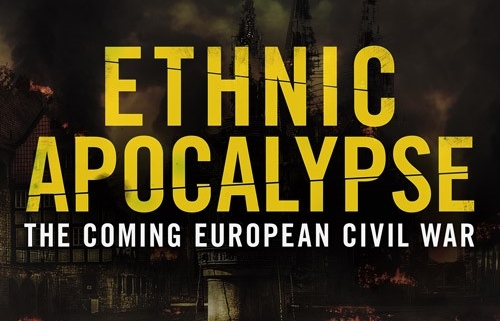
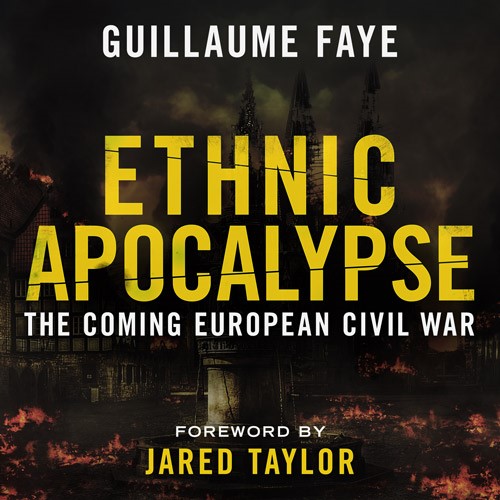
Ethnic Apocalypse: The Coming European Civil War
Guillaume Faye
Arktos, 2019.

“A confrontation has become indispensable if we are to resolve the problem, remediate the situation and free ourselves.”

                                                         Guillaume Faye, Ethnic Apocalypse

The celebrated French far-Right intellectual Guillaume Faye passed away in March, after a long battle with cancer, but not before leaving us a literary parting shot that deserves to be a bestseller. In his final book, Faye explores the demographic, cultural, political, and military degradation of France, drawing sobering lessons for the West as a whole. The book makes a number of stark and terrifying predictions that, when all current trends are taken into consideration, have an overwhelming probability of coming to fruition. Foremost among these predictions is that the West is now almost certainly destined to convulse with a savage and intense civil war (both civil and internal, both religious and racial) without parallel in the history of mankind. With all the dark candour one might expect from a dying man with nothing else to lose, Ethnic Apocalypse, or as it was published in French Guerre civile raciale (A Racial Civil War), is perhaps the most brutally frank, bitterly scathing, and searingly honest accounts of the current trajectory of the multicultural West that I’ve ever come across. The reader searches the text for euphemism, finding none. There are no evasions here; no duplicity in nomenclature. Faye doesn’t speak of cultural differences, or religious incompatibilities. He has little time for talk of assimilation and integration. The problem, he declares, “is neither ideological nor even religious in nature, but, in fact, anthropological. And so is the solution. The coming war will involve people who have nothing to say to one another and who should never have been made to live together.”[1] A little over 50 years after Enoch Powell’s ‘Rivers of Blood’ speech, Faye’s book is both a nod to Powell’s prescience, and a chronicle of the nascent ebbs and waves of a crimson tide that now seems fated to engulf us all. Read more

White-Latino Relations in America’s Southwest: Why a Paradox of Race Relations Is a Sign of Growing Political Polarization

Last year’s midterm election results were hardly unusual for a party holding the presidency. Similar electoral setbacks had occurred during the presidencies of Bill Clinton and Barack Obama. But this one was portrayed as if it were somehow unique — an explicit rejection of President Trump’s nationalist and anti-immigration policies.

For some, the electoral losses in Orange County, California were particularly galling. “You want to see the future? Look no further than the demographic death spiral in the place once considered a cornerstone of the party,” wrote one GOP strategist.

In a state that had once launched the careers of Ronald Reagan and Richard Nixon, Republicans had fought the rising tide of demographic change and were crushed, they said. Now the GOP was repeating the same mistake on the national stage.

Such arguments are not new. They have long been a staple of establishment Republicans who support the corporate open borders agenda. They also represent a fundamental misunderstanding what is happening in the American Southwest.

California, New Mexico, and the region’s other states are not trending left solely (or even primarily) because of Republican intransigence on immigration. They are trending left because of larger socioeconomic trends and migratory patterns that may lead to America’s eventual dissolution.

The Southwest Paradox

For any close observer of race relations, the politics of California and the Southwest must be puzzling. Extensive research on the 2016 election found close links between White attitudes toward race and immigration and support for Donald Trump. Other research has found a similar link between these attitudes and greater awareness of demographic change, with close physical proximity to Latinos playing an important contributing role.

Given the breadth of this evidence, recent general election results in America’s Southwest seem incomprehensible. These states — defined for our purposes as including California, Nevada, Arizona, New Mexico, Colorado, and Texas — all have large and growing Latino populations, but their White populations have responded not by shifting right, but to the left.
Some observers, such as Ron Unz of The Unz Review, have noted this unexpected trend in race relations and concluded that those who argue that increased diversity will eventually tear the country apart are simply wrong. According to Unz, the Dissident Right has erred by treating White-Latino relations as if they are the same as White-Black relations. There is ample evidence that proximity to Blacks has produced a significant backlash among Whites in places like the old South, but there appears to be less evidence of a similar backlash to Latinos. Unz attributes this difference, at least in part, to lower Latino crime rates and greater mutual understanding once Whites get to know their Latino neighbors better.

“With such a large fraction of our immigrant population living in states displaying such negligible levels of nativist rancor,” he wrote, “the likelihood that today’s immigration controversy at the national level will produce any long-lasting negative consequences seems very low to me.”

Is Unz right? Will America’s Latino population simply follow in the footsteps of previous generations of immigrants by assimilating and contributing to America’s culture and growth? Are the Dissident Right’s fears irrational and unfounded, as the left and corporate elite keep assuring us?

The answer is no. The extensive research on this subject is not wrong. The Southwest Paradox is merely an artifact of larger socioeconomic forces.

Solving the Paradox

To understand why, first consider a related paradox. If one were to closely examine White voting patterns across the United States, it would be natural to assume — consistent with the experimental research — that Whites who live in highly diverse neighborhoods would be more likely to react negatively and become more conservative. But this is not true. Whites who live in diverse neighborhoods are not more conservative than other Whites, they are usually more liberal. The primary reason for this is uncomplicated: White flight.

The research on White flight has shown a common recurring pattern. When minorities first move into a White neighborhood, the reaction among Whites is only mildly negative at first, but after diversity rises above a certain tipping point — believed to be around 25 percent for Latinos — White flight begins in earnest. In general, the Whites who move first are the most ethnocentric and/or most likely to be adversely affected (often families with children). Their departure causes the neighborhood to become less White, which in turn causes more Whites to leave (and others to avoid moving in). This process produces a cascading effect that usually transforms the neighborhood within a few years.

After this process has played out, such neighborhoods will often retain a small White population, but it is usually one that is more tolerant of diversity or more able to protect itself through higher housing prices, gated communities, and private schools. The pattern is similar for Whites in gentrifying urban neighborhoods. In each case, the demographic profile of such Whites is fairly consistent — they tend to be disproportionately liberal, single, and childless. Depending on the neighborhood, they often have higher incomes and are more likely to have a college degree. These are the Whites who are responsible for the seemingly paradoxical result of Whites living in more diverse neighborhoods being more liberal.

The political effects of White flight and gentrification are reasonably well understood, but it is becoming increasingly clear that interstate migration is playing a similar role. This phenomenon was first noted in the popular press by Bill Bishop, author of an influential book on the subject called The Big Sort, which attributed much the nation’s growing political divide to differences in where we choose to live. Although Bishop’s methodology was criticized, his conclusions were substantially confirmed by other academic research. The only real disagreements were not over whether it was happening, but why.

Some, like Richard Florida, have focused on the migratory patterns of college-educated Whites — specifically what he calls the “creative class” — who are disproportionately moving to a select number of cosmopolitan regions and states for economic reasons. Others have cited the departure of more conservative working-class Whites from these same areas, often because of rising costs of living. Still others have highlighted more explicitly political reasons or other lifestyle choices that produce the same net effect.

Whatever the reasons (probably a combination of the above), the resulting demographics look a lot like those produced by White flight. Just like the Whites who live in more diverse neighborhoods, the Whites who live in more cosmopolitan cities and states tend to be more liberal, better educated, less religious, and disproportionately unmarried and childless. Nearly every state in America’s Southwest exhibits these same traits.
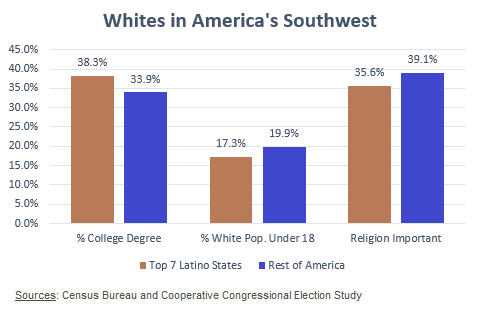
These demographic changes have helped nudge southwestern states to the left, but the trend has also been reinforced by another recent political development. The “Great Awokening,” a sharp left turn in the racial attitudes of college-educated White liberals over the past few years, has further accelerated the leftward drift of Whites living in the nation’s more cosmopolitan regions.

Given this increase in White wokeness, a final contributor is noteworthy for its implied hypocrisy. Despite the Southwest’s purported reputation for benign White-Latino relations, these states rank among the most segregated in the country. Racial segregation is growing not just in more conservative places like suburban Dallas, but also liberal cities like Los Angeles and the San Francisco Bay Area. According to a study by UCLA’s Civil Rights Project, the two states where Latinos are least likely to attend a majority White public school are liberal New Mexico and California respectively.

The Impact of Latinos on White Voting

Taken together, these trends suggest that the liberalism of America’s Southwest is not due to more amicable relations between its White and Latino populations. Instead, they are the accidental byproduct of larger social factors that have offset and concealed the negative effects.

To confirm this hypothesis, we turn to a large, publicly available survey data set housed at Harvard called the Cooperative Congressional Election Study (CCES). This survey was administered to over 60,000 individuals in 2016, over half of whom voted and were White. Each survey respondent was also geo-coded, which allows the incorporation of state, county, and local (zip code) variables such as local levels of diversity and other demographics from the Census Bureau.

The full multivariate regression results can be found at the bottom of this article, but the top-line results are straightforward. In general, after controlling for a wide variety of other factors such as gender, marriage, religion, and education, the analysis finds that Whites who live in more diverse states were more likely to vote for Donald Trump, with proximity to Latinos having roughly half the impact of proximity to Blacks. (The effects of living close to Asians and Native Americans were statistically insignificant).

These effects are not uniform, however.  As suggested by similar studies, Whites who live in heavily diverse zip codes (Black or Latino) tend to be more liberal and were thus more likely to vote against Trump. By contrast, Whites who lived outside of heavily Latino neighborhoods, either elsewhere in the same county or the same state, were more conservative and more likely to vote for Trump. These results demonstrate the variable effects of White flight.

Altogether, the combined effects — state, county, and zip code — shifted the White vote toward Trump by about one percent for every 6 percentage points of Latinos in a state’s population. In California, for example, where Latinos comprised 38% of the population in 2016, the model estimates that White Californians shifted right by about 6 percent from where they otherwise would have been based on their education and other demographic factors.

Importantly, however, these are average effects. A more detailed state-level analysis shows that in the Whitest states there were no county or state-level effects. The impact was strictly local, with growing local Latino populations causing Whites to become more conservative, a common pre-White flight result.

At the other end of the demographic spectrum in heavily Latino states, state level pro-Trump effects do not appear until a state’s Latino population approaches 20 percent. They peak at 30 percent (Arizona), and begin to decline after that (Texas, California, and New Mexico). This suggests that states with the largest Latino populations are starting to experience the same liberalizing White flight effects that are found in the nation’s most diverse zip codes.

The analysis also sheds light on why the politics of America’s Southwest are so different from the similarly diverse South. Whites in the South are conservative in part because of the presence of large Black populations, but they are also more conservative because their White populations are much more religiously conservative.

The migration patterns that helped make California and the Southwest more liberal are also having the reverse effect in the South. States like Alabama and Mississippi draw relatively few college-educated White liberals from elsewhere in the country. Unsurprisingly, the few exceptions to this rule (places like Atlanta or North Carolina’s Research Triangle) have politics that more closely resemble the Southwest.

Two Americas

If our analysis stopped here, the conclusions would be only mildly interesting. Yes, the seemingly benign White-Latino race relations in the Southwest are largely illusory, the incidental byproduct of larger interstate migration patterns, but so what? The politics of these states are still trending left, no matter what the cause. How does this change the conclusion that Trumpism is a losing political proposition in the long run?

The answer can be found by stepping back from a narrow examination of trends in the Southwest and instead looking at the nation as a whole. The Whites who flee or avoid moving to these states have not disappeared into the ether. They have simply chosen to live elsewhere and, in the process, made the rest of the nation more conservative.

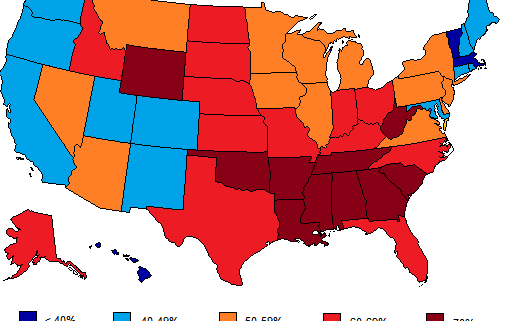
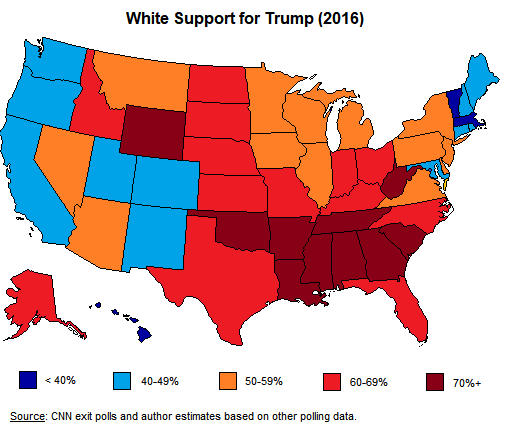
The following map shows White voting trends from 2000 to 2016, two comparable election years when the GOP won the presidency but narrowly lost the popular vote. As expected, the map shows Whites in the Southwest and on the West Coast trending left over this period. But it also shows Whites in much of the rest of the country shifting to the right. This rightward trend includes the midwestern states that helped elect Donald Trump. It also shows a substantial rightward shift even in the liberal Northeast, where Whites in states like New Jersey, New York, and much of New England have also been moving sharply to the right.
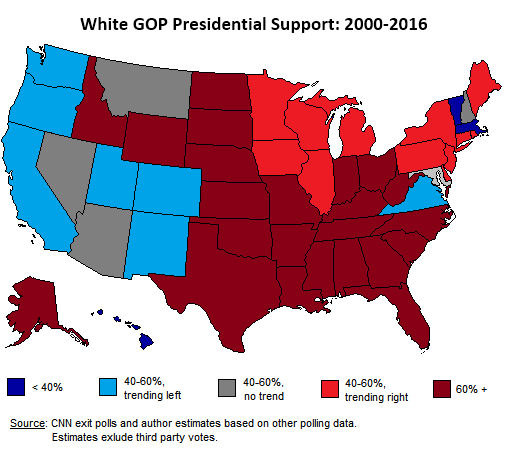
This is a story that one almost never hears from the mainstream media. There are countless articles concern trolling the GOP for its losses in more diverse states like California, but there is almost nothing written about the rightward drift of the rest of White America.

These trends are two sides of the same coin and they point to a very different conclusion. This is not the story of Republicans or the Dissident Right waging a losing demographic battle. It is the story of a nation that is slowly, but inexorably, becoming more divided along racial and geographic lines. (See The Racial Realignment of American Politics).

To anyone even vaguely familiar with the larger literature on ethnic conflict, this pattern is completely predictable. The fact that there is not even a hint of the dangers in the mainstream media despite obvious lessons from conflicts in Yugoslavia, Rwanda, and Darfur only demonstrates the establishment’s control over the media narrative. The warning lights are flashing red all around us — and we are flying directly into the coming storm.

Patrick McDermott is a political analyst in Washington, DC.

Labour’s Fictitious Anti-Semitism Problem

A supposed problem

According to much of the British media, Labour has had an ‘anti-Semitism problem’ since Jeremy Corbyn became leader in 2015. The more impartial headlines call it a controversy or a set of claims. Corbyn critics speak of a crisis while his supporters complain of a witch-hunt.

As with any claim of anti-Semitism, the accusers refer to one or both of two things: that the party is racist towards some or all Jews, or that it is critical of Israel, the world’s only Jewish state, in ways that it would not be of any other country.

Why use that term?

For Labour to be racist toward Jews would be strange. One would think that such a tendency would alienate the Jews deeply embedded and strongly over-represented within Corbyn’s Labour. Three of the four founders of the Corbyn-backing Momentum organisation — John Lansmann (no stranger to denouncing people for racism), Adam Klug and James Schneider — are Jewish, as are prominent Corbynist activists like Max Shanly. Several organisations supporting Labour, especially since Corbyn became leader, are Jewish, such as Jewish Voice for Labour and Jewdas. None of these, nor any of the many signatories to public letters supporting Corbyn against his critics, seem to have found any troubling signs that they are in fact supporting a party that quietly despises them and all their kind, whether defined by faith, ancestry or anything else. Several Jewish leftists, not unconcerned with racism against their own group, have examined the claims in good faith and at great length and found no particular problem in Labour [1]. Soon after the controversy first ‘erupted’ (though we can fairly doubt its spontaneity) following a re-tweet by Labour MP Naz Shah in 2016, Jamie Stern-Weiner wrote an article exhaustively demonstrating the alacrity with which the party excluded those who showed actual racial antipathy [2].

Nor is Labour’s opposition to Israel based on the country’s Jewishness. In a book claiming to explain ‘The Left’s Jewish Problem’ but actually almost entirely concerned with leftist opposition to the Israeli state, Dave Rich of the Community Security Trust showed clearly enough why leftists like Corbyn oppose Israel — because they see it as an outpost of Western imperialism and capitalism which oppresses, displaces and kills Palestinian Arabs who, until the last century, had dominated the region for centuries. The leftist position is consistent with their worldview, and that worldview is not founded on racial hatred.

If they were only referring to racism against Jews, opponents of anti-Semitism would use a more rational term like Judeophobia or anti-Jewishness. But those who defend Israel know that they are defending actions which they would reject if carried out by other, genuinely Western states and thus find it politically useful to use one term, ‘anti-Semitism’, which enables them to conflate criticism of the state with attacks on the people it claims to represent. [3] Read more

Human Pre-History and the Making of the Races, Part 2: Genetic Distances

Confirmation by modern genetic studies of the traditional racial classification categories

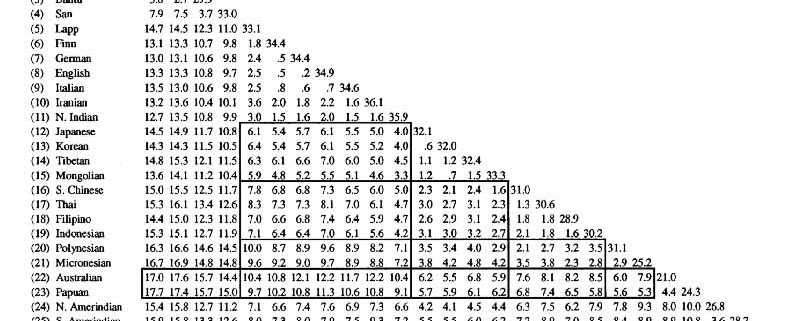
What are the percentages of genetic differences between the human races, indicating their relationships? Perhaps the best global scale study to date on this subject is still that of Masatoshi Nei and Arun K. Roychoudhury from Evolutionary Relationships of Human Populations on a Global Scale (1993). Subsequent studies, which have included increasing numbers of alleles but have usually been regional rather than global in scale, have been consistent with Nei and Roychoudhury’s results. The following table (Fig. 1 below) of estimates of genetic differences between human populations is from their study.

Read more

Human Pre-History and the Making of the Races, Part 1

Since the 1950 UNESCO Statement on Race there has been an increasing tendency to claim, based on Boasian anthropology and in promotion of a multiracialist agenda, that the human races are “socially constructed” and their existence is not supported by science, meaning not biologically and genetically real. This essay is an account, consistent with current scientific knowledge, of how the human races we know historically and today were really constructed.

The human species is blessed with great variety and diversity. Its rich diversity resulted from its global distribution, which caused the different populations of humanity to be geographically separated and thus reproductively isolated. Reproductive isolation enabled divergence — the process of divergent evolution — to occur, causing the isolated populations to evolve in different directions, developing their own distinct ensembles of genetic traits and characteristics.

Divergent evolution is the process by which new life forms are created by the division and separation of life into different branches. Human evolution has seen its share of divergent branching. The generic name commonly used to refer to the genetically different populations—that share a common biological ancestry that distinguishes them from other populations — is race. But in the human species, as in any species enjoying a great degree of variety, the constant branching and dividing that characterize the process of divergent evolution have created many different divisions, each of which possesses a genetic signature which distinguishes it from other divisions at the same level. For purposes of taxonomic accuracy each of these levels should have its own specific name and definition. The first or highest level is the species, and it is simply and objectively defined as including all those populations which are capable of interbreeding with each other and producing fully fertile offspring. The term race is commonly used to refer to a branch or division of the species possessing genetically transmitted physical traits (e.g., skin color) which distinguish it from other branches or divisions of the same level. Adding to this definition, it will here also be defined as including only those persons who are capable of reproduction with each other without alteration of the racially-distinctive genetic traits of either parent stock; that is, the genetically transmitted traits which distinguish a race from other divisions at the same level (i.e., other races) should not be diminished or lost by reproduction within the race. If racially-distinctive traits are lost or diminished by within-group reproduction then the population group is at a level of division too broad and inclusive to be accurately defined as a race. If it is too narrow to be defined as a species, as it does not include all those populations capable of interbreeding, then it is at a level between race and species, which will here be referred to as a subspecies. Read more

“Become other than White”: Ireland and Radical Jewish Activism

“Five Jews came from over sea with gifts to Tairdelbach [King of Munster], and they were sent back again over sea.”
           Annals of Inisfallen, 1079 A.D.

“I propose an interrogation of how the Irish nation can become other than white (Christian and settled), by privileging the voices of the racialised, and subverting state immigration, but also integration, policies.”
Ronit Lentin (Israeli academic), From racial state to racist state: Ireland on the eve of the citizenship referendum, 2007.

Prelude

Tairdelbach of Munster (Turlough O’Brien 1009–86), who was, by 1079, effectively the High King of Ireland, probably holds the world record for the fastest expulsion of Jews. He dominated the Irish political scene, had crushed the Viking leadership of Dublin, and possessed “the standard of the King of the Saxons.” His son had even commenced raids into Wales and the British coast. Unfortunately, we can only surmise the nuances of the 70-year-old warlord’s reaction to the sudden arrival of a handful of gift-bearing Jews, because the Annals of Inisfallen are thin on detail. The delegation almost certainly originated in Normandy, where Jews thrived under a symbiotic financial relationship with William the Conqueror. William, of course, had introduced Jews to Anglo-Saxon England thirteen years before the approach to Tairdelbach, leaving open the possibility they could have travelled directly to Ireland from one of these new Jewish enclaves in England. In any event, it is almost certain that they arrived seeking permission to settle in Ireland’s urban centers, forge a relationship with the Irish elite (Tairdelbach himself), and engage in exploitative moneylending among the lower social orders. This was a pattern that had hitherto been witnessed throughout Europe. And yet Tairdelbach’s reaction was to reject the gifts and immediately expel the Jews. They would not be able to form a community in Ireland for several centuries.

It’s probably no coincidence that Tairdelbach was regarded in his lifetime as a good and Christian king. He enjoyed close relationships with the Irish church, and the church in England, and was patron to a number of religious figures and scholars. He was almost certainly a literate and educated man, and his decision to expel the Jewish delegation may have been based on a body of knowledge rather than mere instinct. Historians Aidan Beatty and Dan O’Brien comment on the expulsion:

No one in Ireland had ever seen a Jewish person prior to this incident, yet the visitors are unambiguously described as “five Jews” (coicer Iudaide) and the Irish people already have a word for Jews, Iudaide, a medieval Gaelic word that clearly has its roots in the languages of classical antiquity. But more than that paradox, there is also a certain kind of cultural knowledge at work here. The medieval Irish who gave such short shrift to these Jewish guests “know” something about Jews, or more accurately they think some things about Jews: they “know” that Jews are not trustworthy, that Jews bearing gifts are not to be taken into one’s care. And Jews are not suitable for residence in Ireland – they should be expelled from the country.[1]

The impression is therefore that Tairdelbach was a savvy and selfless leader, who sought the good of his people more than the good of his own short-term financial situation. Read more

The Ministry of Minority-Worship: Gay Rights and the Goals of Globohomo

The mark of a true prophet isn’t perfect accuracy, but powerful ideas. It’s impossible to foresee the future in every detail, but a true prophet should give us the ideas that explain what he doesn’t foresee. For example, in one way George Orwell got the future completely wrong in Nineteen Eighty-Four (1949). In his totalitarian surveillance state, the Party harshly punishes “sexcrime,” which includes “all sexual misdeeds whatever [including] homosexuality and other perversions.”

Raising the rainbow

So homosexuality is a perversion and a serious crime on Airstrip One, the name Orwell gave to the British Isles. But what do the real British find in their own surveillance state in the 21st century? They find that homosexuality is actively celebrated by the thought-police. The cyber-snoopers at GCHQ (Government Communication Head-Quarters) are “the most extremist and invasive in the West,” according to Glenn Greenwald. In 2014, the cyber-snoopers “raised the rainbow flag on the GCHQ flagpole in Cheltenham for the first time to show all our staff that we value our Lesbian, Gay, Bisexual and Transgender (LGBT) colleagues and are a modern organisation that does not tolerate discrimination in any form.” That last claim is true in one way: GCHQ doesn’t discriminate in its invasion of privacy. It siphons up everything it can on everyone it can, collaborating with the American National Security Agency (NSA) and Israeli cyber-snoopers like Unit 8200. The NSA too actively celebrates homosexuality: in June 2019, which is Gay Pride Month “in much of the US,” it “posted a photo on Twitter of its secretive Maryland headquarters in rainbow colors,” boasting that: “At NSA, talented individuals of all backgrounds, contribute to something bigger than themselves: national security. #PrideMonth.”

Raising the rainbow at the NSA (above) and GCHQ (below)

Orwell didn’t foresee the celebration of homosexuality by totalitarians, but he did explain it. Totalitarian ideologies live by lies and contradiction. For example, the slave-state of North Korea, ruled by a hereditary dictatorship, proclaims itself a Democratic People’s Republic when it is neither democratic, popular, nor a republic. In Nineteen Eighty-Four, Orwell wrote of how “the names of the four Ministries by which [the oppressed population is] governed exhibit a sort of impudence in their deliberate reversal of the facts. The Ministry of Peace concerns itself with war, the Ministry of Truth with lies, the Ministry of Love with torture and the Ministry of Plenty with starvation. These contradictions are not accidental, nor do they result from ordinary hypocrisy; they are deliberate exercises in doublethink.” Read more