Featured Articles

The tyranny of the courts: The case of Omar Khadr

Trump supporters are still reeling from the ability of the courts to paralyze his presidency. This is due to a thoroughly biased courts and legal system, filled with liberal lawyers and judges — churned out by ideologically corrupt law schools and universities — who arrogantly impose their tyranny. They sanctimoniously trot out the holy Constitution to say that Trumps’ executive orders are ‘”unconstitutional,” which simply means that liberals disagree with them. They invoke the Constitution as though it were a law of physics: unambiguous, objectively and eternally true. Any reader will know that the constitution is a joke, whose interpretation can change radically depending on who sits on the bench or who tilts the ideological balance of the Supreme Court.

A recent story from Canada puts this in its plainest terms. It is the case of Omar Khadr, a former Al Qaeda fighter who sued the Canadian government for “conspiring with the U.S. in abusing his rights.” The Canadian government recently decided to settle with Khadr for over 10 million Canadian dollars (over 8 million U.S. dollars), although it is entirely mysterious what the responsibility of the Canadian government actually is.

‘Canadian’ Omar Khadr was captured in Afghanistan in 2002 while fighting with the Taliban. (source: Wikipedia)

Here is the story: Khadr is a Canadian citizen and Al Qaeda fighter who was captured in Afghanistan in 2002 during a firefight in which U.S. troops were injured and killed. He was then detained in Guantanamo for about ten years and pleaded guilty, among other things, to “murder in violation of the laws of war.” During that time, he was interrogated on a number of occasions by Canadian intelligence officers doing a normal job of collecting information on one of their citizens accused of terrorism, especially given the fact that he would eventually be transferred back to Canada.

In 2010, Canada’s Supreme Court ruled that these interrogations “offended the most basic Canadian standards of the treatment of detained youth suspects” and that the involvement of Canadian officials in the interrogations violated his rights under the Canadian Charter of Rights and Freedoms. This Charter is holy scripture in Canada, comparable to the U.S. Constitution or the Civil Rights Act of 1964. It is relentlessly invoked by Canadian liberal activists to justify their endless demands when it comes to protected groups like racial minorities or homosexuals.

This ruling is ludicrous: Khadr was detained by U.S. military authorities in Guantanamo and it is therefore very hard to blame the Canadian government for that. Moreover, videos of these interrogations exist and were even featured in a propaganda film made by human rights activists—called You Don’t Like the Truth: Four Days Inside Guantanamo—in 2010. This film contains nothing convincing: some of those boring and uneventful interrogations interspersed with interviews of Khadr’s lawyer, cellmates, relatives, and human rights activists complaining (sometimes rightfully) about the conditions of his detention in Guantanamo by U.S. military authorities. But the case for implicating the Canadian government and forcing taxpayers to make a multimillionaire of Khadr is as flimsy as it can be. The legal argument presented by Khadr’s lawyers is twisted and circumlocutory to an extent that only a member of a fashionable minority benefitting from the full support of the politically correct press, activist lawyers and biased courts could possibly sell it. Only the most conspiratorial liberal mind could see a responsibility lying with the Canadian government. Read more
Hypergamy, Affirmative Action and Today’s “Diverse” Workplace: The Replacement of White Males

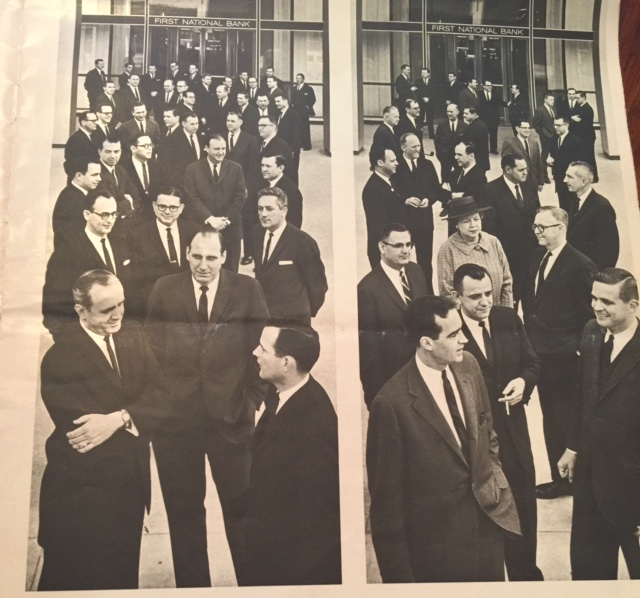
Going through boxes of old family records I came across a picture (see below), which was part of a Sunday supplement to the March 22, 1964 edition of Memphis’s local newspaper. The purpose of the supplement was to celebrate the grand opening of First Tennessee Bank’s new skyscraper headquarters on Madison Avenue in downtown Memphis.

The picture is the assembled managerial staff of the entire bank, including all of its branches. Note the lack of “minorities” and women. The photograph, taken at the main banking lobby of the new facility, looks like a casting call for the iconic 1950s era movie starring Gregory Peck, The Man in the Grey Flannel Suit. What struck me most about the picture was how times have changed. I currently bank at three different banks and out of the three there is only one White male working in a position visible to the public. All the rest are women and minorities — predominantly Black women, then Black men, and an occasional White woman. Back then, almost all the bank managers were White males. Today, almost none are.

What to make of this? Some might regard this as poetic justice, but the so-called Civil Rights Movement was sold to the American public on the premise that it was to eliminate discrimination and prejudice based on race. Are we to believe that no White males are better qualified for managerial positions than the current diverse managerial staff, or that no White males want those jobs? Obviously diversity doesn’t mean diversity at all, but rather the elimination of White males from the workplace. Read more

Fiftieth Anniversary of the Detroit Riot: Personal Observations and Evolutionary Analysis

Fifty years ago, a deadly urban riot began one hot summer night in my hometown of Detroit. It ignited around 3:30 a.m., when police arrested 85 patrons of an illegal after-hours bar in the midst of an all-Black neighborhood that had been all-White 15 or 20 years before.

When the mayhem ended six nights later, 43 people had been killed, 1,189 injured, 7,231 arrested, 2,509 stores had been looted or burned, 690 buildings were destroyed or had to be demolished, and 388 families were displaced.

Detroit’s Mayor at the time was Jerome Cavanagh, a young, bright and ambitious liberal. Elected with near-unanimous support of Black voters, he had aggressively launched anti-poverty programs to make the nation’s fifth largest municipality a model of the Great Society’s War on Poverty. (1).

The rapid migration of American Blacks between 1940 and 1965 from the mostly rural South to the big cities of the North, very quickly increased the Black population from less than 10% to over 30% at the time of the riot. That meant that Detroit, which had about 150,000 Black residents before World War II, had about 600,000 a generation later. In the 1960’s Detroit was dealing with a larger influx of Southern Blacks than all but Chicago and New York.

Conditions of Detroit’s Black Community Before the Riot

Politically correct revisionist historians and sociologists (many of whom are Black) like to portray Detroit’s riot of 1967 as the inevitable rebellion of a people victimized by White racism.  However to maintain this typical liberal view one must dismiss many well established facts that contradict the narrative. Read more

Anthropology’s Obsession with African Origins

There is renewed interest in the “Out of Africa” theory of human origins because of a study showing sub-Saharan Africans interbred with an extinct hominid species. This article, originally posted in January, 2014, provides other reasons for being skeptical of African origins and shows how the “Out of Africa” theory has been promoted partly for reasons of political correctness.

When did humans first become human?  The answer is far from simple, because the question assumes that sometime in the past, humans achieved modernity and were locked within an evolutionary loophole where natural selection no longer applies.  Despite the absurdity of this scenario, and in stark contrast to empirical data, it is widely believed that humans have not changed physically or mentally for the past 50,000 years or so.

After the discipline of anthropology was hijacked by Cultural Marxism and it became crimethink to observe average group differences, a preoccupation with tracing everything back to Africa developed.  Africa does have an outstanding archaeological record revealing many firsts: the first bipedal hominids, the first stone tools, and the first anatomically modern humans that looked roughly like we do today (a vertical forehead, round skull, flat face, and prominent chin).  But largely due to the anti-racist politicization of anthropology, the currently accepted evolutionary paradigm is that Africa was the source of an intellectual watershed event sometime between 100,000 to 50,000 years ago, and that it was only a matter of time before this new breed of clever Africans spread out and replaced all the dim-witted archaic human populations in the rest of the world, such as Neanderthals.  (As used here, the term ‘racist’ refers to views that race and racial differences are a legitimate variable in research on humans, with none of the usual negative connotations found  in the popular and scientific literature.) The concept of behavioral modernity as it has been applied to the Paleolithic seemingly arose out of the Cultural Marxist obsession with proving that Africans are just as good as, and even better than the evil racist nineteenth-century White scientists who dared to rank societies and point out that advanced civilization never developed in certain areas of the world, such as south of the Sahara.

The problem with this paradigm is that, using the same set of criteria proposed by those scholars pushing for an African origin for modern behavior, it seems to have originally appeared in Europe instead, when modern humans first arrived there and replaced Neanderthals.  Furthermore, the so-called modern behavior in the African Stone Age is not qualitatively different from that of Neanderthals, who were supposedly replaced by cognitively-advanced modern humans. Read more

The Egomaniacs’ Ball: Chutzpah, Ethnocentrism and the Separation Solution

“You can never be too rich or too thin.” That’s a memorable line from Wallis Simpson, the American divorcée who turned Edward VIII into an ex-king. It’s a self-aware joke about female psychology, but its humour also comes from the incongruity of the adjectives it uses. Wealth and weight are different kinds of variable. It’s easy for one human being to be thousands or even millions of times wealthier than another. And wealth can be negative in the form of debt.

The qualitative cliff

That doesn’t happen with weight, which varies in a much narrower range and never becomes negative. The fattest adult can’t be thousands of times heavier than the average adult and being too thin will prove fatal. If you look at the other ways in which we human beings vary, you can divide them into the wealth-like and the weight-like. Intelligence is like weight; political power is like wealth. When it comes to political power, Kim Jong-un of North Korea is a kind of power millionaire: he has supreme power over millions of people who possess almost no power at all. But the IQs of geniuses like Newton and Shakespeare probably weren’t even twice the average IQ of the populations they lived among, even though their influence has been millions of times greater than the average person’s.

It seems very difficult to raise intelligence substantially, whether we’re talking about groups or individuals. My own version of Wallis Simpson’s motto would be this: “You can never be too intelligent or too knowledgeable.” But knowledge is much easier to acquire than intelligence, unless the knowledge depends on intelligence. I’d like to be able to understand higher mathematics, for example, but I can’t: there’s a qualitative cliff and I stand at the foot of it gazing upward in frustrated wonder. There’s no pill I can take or brain-operation I can undergo that would enable me to climb that cliff. Intelligence isn’t yet pharmacologically or neurologically malleable.

“The process began with Jews…”

That isn’t true of other psychological variables. Brain injuries can alter personality, turning the law-abiding into criminals. There are drugs that will increase alertness or sweep reality away altogether in a flood of vivid hallucinations. There is no drug for IQ, but there are drugs for ego, like cocaine and alcohol. There are also ideologies for ego, like anti-racism, feminism, LGBTQ+ activism and other branches of liberalism in its corrupt modern form. But egotrophic1 ideologies weren’t discovered by chance in the way that cocaine and alcohol were: they were deliberately invented. They also reflect the innate egomania of a particular race, if this story is any guide: Read more

Putting Shylock to Shame: The Moneylender Portrayed as Hero

There is a certain threshold beyond which the sociopathy of a Jewish intellectual like Yaron Brook achieves an almost alien quality. It is one thing to be a sociopath; quite another to extoll the total untethering of the individual from any kind of higher morality as the greatest cause to which one can devote their life. Hearing Brook talk about how the Allied bombing campaign against Germany should serve as a guidepost for American foreign policy gives readers the feeling they’re in the presence of something not made of flesh, as in a recent meme that presents Mark Zuckerberg as Star Trek’s Data intent on collecting the personal information of users of Facebook in order to learn what it means to be human.

Brook outdoes himself in a piece entitled “The Morality of Moneylending: A Short History.” The title is misleading, since its author does not dispassionately present a history, but rather presents a historiography with Jews (from Shakespeare’s Shylock to California’s Michael Milken) depicted as misunderstood and falsely persecuted heroes who are unfairly punished for their enterprise, industry, and value creation (all contrary to economic, philosophical, and theological arguments that lambast “barren metal” and extol those things which hold an intrinsic value).

“It seems,” Brook starts his article, “that every generation has its Shylock—a despised financier blamed for the economic problems of his day. A couple of decades ago it was Michael Milken and his ‘junk’ bonds” (Brook). And just as Shylock and the other Venetian Jews were forced to live in ghettos, wear red caps, and endure myriad other slanders from ungrateful goyim (Al Pacino gets spit on quite a bit in Michael Radford’s 2004 adaptation of The Merchant of Venice), our modern-day persecuted bankers must endure similar slings and arrows such as “investigations, criminal prosecutions, and heavier regulations.”

The ethnic fear and loathing — Shylock’s “ancient grudge” (Shakespeare 362) which he “feeds fat” in the famous play’s aside — is front and center in Brook’s article, as he bemoans the fact that moneylenders have served as “the primary scapegoats for practically every economic problem.” His laundry list of slights includes having “their property confiscated to compensate their ‘victims’” [the scare quotes are Brook’s] as well as “pogroms and the vilification of the House of Rothschild” and the jailing of American financiers.

Brook would presumably have us glorify the Rothschilds, as did former inside trader Ivan Boesky, the son of Jewish immigrants who claimed he aspired to be a “latter-day Rothschild” (as noted in James B Stewart’s Den of Thieves, 226) and proceeded to do his best to make good on his ambition. Before the law eventually caught up with him, Ivan Boesky would engage in a series of insider trades that made him and a small cadre of fellow conspirators rich beyond dreams of avarice. In the aftermath of the era of merger mania and hostile takeovers he helped initiate, individual lives and companies were ruined, and trust in markets was eroded, if not shattered. Boesky of course has enjoyed a rather large pop culture footprint thanks to a speech given to a graduating class at the University of California in 1985, in which he assured the young audience that “Greed is all right.” That would eventually morph into the famous credo “Greed is good,” uttered by Michael Douglas in his Oscar-winning turn as Gordon Gekko in Oliver Stone’s Wall Street. Read more
The Jewish War on White Australia: The Anti-Defamation Commission and “Click Against Hate,” Part 4 of 4

Go to Part 1
Go to Part 2
Go to Part 3

EXCERPT 6: “Six million Jewish people”  

Brett Kaye: Right, who’s this guy I googled over here? This one.

Child: Is that supposed to be Osama bin Laden?

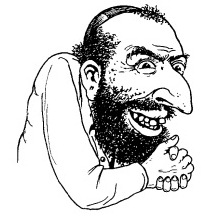
Brett Kaye: That’s a Jew. I typed in Jew and that’s what came up first. Now that was taken from, just to let you know, this was taken from a newspaper from Germany in the 1930s called Der Stürmer, that was the name of the newspaper, the voice, and what was happening in Germany in the 1930s? My history buffs in the room. Yes?

Child: Um they were killing Jews?

Brett Kaye: Not yet. They were almost killing Jews. Like who was rising to power? What was their name?

Children: Hitler

Brett Kaye: Between 1933 and 1939 Hitler rose to power …; in 1933 he became the Chancellor, in 1939 World War Two started [claps hands]. So during that time Hitler went on a campaign against Jews, against gypsies, against gay people, against black people, against people who didn’t believe in what Hitler said. And from 1939 to 1945 there was this huge war, as we know, World War Two, and during that time a lot of those people were killed. Six million Jewish people. My family for example. Most of them were killed. My great grandparents, my uncles, my aunts. My grandparents survived, and I’ll tell you something interesting. You talked about bystanders. My grandmother, who lived in Paris, she was saved during the war by a non-Jewish family who didn’t even know her. They hid her in their farm. She lived with the chickens actually. They hid her in the farm and she managed to survive there for three years, from the age of twelve until fifteen, until the war ended, and she came out and she lived. Just because a non-Jewish family chose to save the life of a little Jewish girl they didn’t even know. They weren’t bystanders. Even though they could have got absolutely and utterly in danger, their family and their parents, everybody would have been killed and punished, if they would have been discovered, hiding a Jewish family. Yet they chose to save my grandmother. And because of that here I am and my family’s here. Because of the goodness of somebody who chose to do the right thing. Read more