
Featured Articles

Review of Derek Penslar’s “Jews and the Military”

Jews and the Military: A History
Derek Penslar
Princeton University Press, 2013

“The rate of draft-dodging for the peasant population in the Pale of Settlement was 6%; for the Jews it was 34%. Jews evaded the law and misused the court system, even as they demanded special protection from the authorities.” Professor John Klier, Russians, Jews and the Pogroms of 1881–1882 [1] 
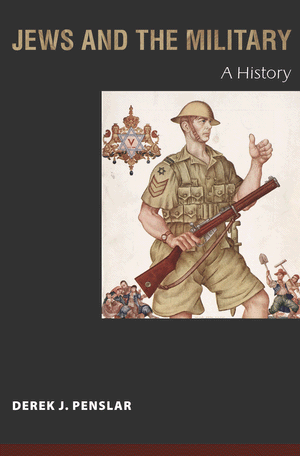
PenslarThe subject of Jewish attitudes to military service, particularly in the diaspora, has been a key interest of mine for some time. Since ancient times, military service has been regarded as the touchstone of true citizenship and patriotism and, to me at least, it seemed the perfect backdrop against which Jewish identity and its hierarchy of loyalties might be seen more clearly. Though never given truly comprehensive scholarly attention, there are countless brief references to Jewish attitudes and actions in taking up arms in works ranging from flagrant Jewish apologetic, to the productions of the racialist right. Most of these references pertain to accusations that Jews historically have shirked military service and often resorted to the most elaborate, and often ridiculous, methods in order to avoid doing “their share” in the defence of the nation-state.

More or less dissatisfied by much of the fare on offer from both sides, I was quite interested late last year to hear of the publication, by no less than Princeton University Press, of Derek Penslar’s Jews and the Military: A History — the jacket of which promised “the first comprehensive and comparative look at Jews’ involvement in the military and their attitudes toward war from the 1600s until the creation of the state of Israel in 1948.” Penslar promised to show “that although Jews have often been described as people who shun the army, in fact they have frequently been willing, even eager, to do military service.”


Read more

ADL: “Les théoriciens du complot blâment les Juifs pour les événements en Syrie”

Original appeared 26 septembre 2013; English version here 

La “respectable association de défense des droits civils” reprend sa vieille habitude. L’ADL me colle l’étiquette de “théoricien de la conspiration” pour avoir présenté des documents qui montrent le soutien général de la communauté juive organisée au principe d’une attaque militaire américaine contre la Syrie (“ADL: Les théoriciens du complot blâment les Juifs pour les événements en Syrie“). Il y a aussi l’affirmation que je suis un “extrémiste” —ce qui semble curieux, de la part d’une organisation qui prône l’immigration vers les États-Unis de dizaines de millions de personnes venant du monde entier.

Kevin McDonald, un professeur antisémite de psychologie à Long Beach, à l’Université d’État de Californie, a écrit sur L’Occidental Observer un article daté du 2 septembre affirmant que “Le contretemps [qui remet à plus tard l’action militaire en Syrie] donne au Lobby pro-israélien l’occasion d’intensifier ses efforts pour faire grimper les résultats des sondages et pour faire pression sur le Congrès. “

Depuis si longtemps que je suis sur leur liste des pires antisémites, on aurait espéré qu’ils apprennent au moins à écrire mon nom correctement. Leur article ne donne aucun lien vers l’article incriminé écrit par moi, si bien que le lecteur se retrouve seulement avec un nom mal orthographié et un lien vers la fiche écrite à mon sujet sur le propre site de l’ADL (où ils réussissent cette fois à bien écrire mon nom). D’ailleurs, ils ne donnent de lien pour aucun des articles ou vidéos produits par les “extrémistes marginaux et anti-sémites” dont le communiqué de presse de l’ADL dresse la liste — sans doute parce que l’ADL préfère que ses lecteurs ne voient pas ce qu’ils ont dit en réalité. Read more

Soutien général de la communauté juive organisée pour une intervention en Syrie

Original posted 6 septembre 2013; English version here

Patrick Cleburne, du blog VDARE, a écrit un article sympathique à propos de la corruption du Parti républicain par Sheldon Adelson (“Syrie: Pourquoi Boehner et Cantor prennent-ils leur base électorale et leur pays à rebrousse-poil ? Parce qu’ils sont atteints du syndrome ADD ! “). [NdT: ADD = Attention Deficit Disorder (Trouble de Déficit de l’Attention)]. Mais ici en fait, le syndrome ADD signifie Adelson Dollar Disorder. Cette expression désigne le penchant des politiciens républicains (Newt Gringrich en est le meilleur exemple) à se prosterner devant l’argent d’Adelson. Cet argent sert principalement à soutenir ceux qui en Israël se montrent les plus agressifs et les plus portés au nationalisme et au racialisme. Cleburne fait également remarquer qu’Adelson illustre parfaitement l’hypocrisie et les doubles standards qui gouvernent les politiques défendues d’une part pour Israël, où Adelson préconise une clôture frontalière inviolable et l’expulsion des clandestins, et d’autre part pour les États-Unis, où il préconise l’amnistie des clandestins, et aucune expulsion.

Une illusion dont se bercent souvent les Juifs est l’idée de “deux Juifs, trois opinions“ — c’est-à-dire l’idée que les Juifs ont toujours tendance à être en désaccord les uns avec les autres. Mais en fait, sur les questions cruciales telles qu’Israël, l’immigration, le multiculturalisme, et le christianisme sur la place publique, la communauté juive parle d’une seule (et très influente) voix. Cleburne signale un article de Bloomberg qui montre le large soutien juif à l’idée d’attaquer la Syrie. (“Soutien de cercles juifs à l’intervention en Syrie – Adelson, nouvel allié d’Obama“). Ce très large soutien est d’autant plus surprenant que, dans le reste de l’Amérique, le Congrès constate une “opposition record” à l’idée d’un raid aérien.

Les récents sondages montraient déjà le peu d’appétit du peuple américain pour une intervention militaire en Syrie. Un sondage publié mardi par le Pew Research Center estime qu’à peine 29% des Américains approuvent l’idée de raids aériens “suite aux témoignages selon lesquels le gouvernement syrien a utilisé des armes chimiques”. Et le même jour, un sondage Washington Post/ABC donnait un chiffre de 36% d’Américains favorables à des raids aériens. … Le député Alan Grayson (Démocrate de Floride), un opposant virulent aux frappes militaires contre le gouvernement syrien, a déclaré aux journalistes après le briefing de mardi dernier qu’un vote pour le recours à la force militaire en Syrie ne passerait pas. “La Chambre n’est pas d’accord, le peuple américain n’est pas d’accord. Ici, on écoute les électeurs”, a t-il déclaré. “Premièrement, l’opinion publique est totalement contre. Deuxièmement, l’opinion publique est violemment contre.” (“Selon les législateurs américains, les électeurs refusent l’intervention en Syrie – Une opposition plus forte que jamais“) Read more

Review of Paul Gottfried’s “Leo Strauss and the Conservative Movement in America,” Part 2

Part 1.

2. The “Lockean Founding” of the United States

Gottfried is apparently attracted to the anti-rationalist Burkean tradition of conservatism, which in effect claims that history is smarter than reason, therefore, we should take our guidance from historically evolved institutions and conventions rather than rational constructs. This form of conservatism is, of course, dismissed by the Straussians as “historicism.” Gottfried counters that the Straussians

seek to ignore . . . the ethnic and cultural preconditions for the creation of political orders. Straussians focus on those who invent regimes because they wish to present the construction of government as an open-ended, rationalist process. All children of the Enlightenment, once properly instructed, should be able to carry out this constructivist task, given enough support from the American government or American military. (pp. 3–4)

In the American context, historicist conservatism stresses the Anglo-Protestant identity of American culture and institutions. This leads to skepticism about the ability of American institutions to assimilate immigrants from around the globe and the possibility of exporting American institutions to the rest of the world.

Moreover, a historicist Anglo-Protestant American conservatism, no matter how “Judaizing” its fixation on the Old Testament, would still regard Jews as outsiders. Thus Straussians, like other Jewish intellectual movements, have promoted an abstract, “propositional” conception of American identity. Of course, Gottfried himself is a Jew, but perhaps he has the intellectual integrity to base his philosophy on his arguments rather than his ethnic interests

(Catholic Straussians are equally hostile to an Anglo-Protestant conception of America, but while Jewish Straussians have changed American politics to suit their interests, Catholic Straussians have gotten nothing for their services but an opportunity to vent spleen against modernity.) Read more

Review of Paul Gottfried’s “Leo Strauss and the Conservative Movement in America,” Part 1

Paul Edward Gottfried
Leo Strauss and the Conservative Movement in America: A Critical Appraisal
New York: Cambridge University Press, 2012

Paul Gottfried’s admirable book on Leo Strauss is an unusual and welcome critique from the Right.

Leo Strauss (1899–1973) was a German-born Jewish political theorist who moved to the United States in 1937. Strauss taught at the New School for Social Research in New York City before moving to the University of Chicago, where he was Robert Maynard Hutchins Distinguished Service Professor until his retirement in 1969. In the familiar pattern of Jewish intellectual movements as diverse of Psychoanalysis, Marxism, and Objectivism, Strauss was a charismatic teacher who founded a cultish school of thought, the Straussians, which continues to this day to spread his ideas and influence throughout academia, think tanks, the media, and the government.

The Straussians have not, however, gone unopposed. There are three basic kinds of critiques: (1) critiques from the Left, which range from paranoid, middlebrow, journalistic smears from such writers as Alan Wolfe, Nicholas Xenos, and John P. McCormick, to more scholarly critiques by such writers as Shadia Drury and Anne Norton, (2) scholarly critiques of the Straussian method and Straussian interpretations from philosophers and intellectual historians such as Hans-Georg Gadamer and Quentin Skinner, and (3) scholarly critiques from the Right.

As Gottfried points out, the Straussians tend only to engage their critics on the Left. This makes sense, since their Leftist critics raise the cultural visibility of the Straussian school. The critics are also easily defeated, which raises Straussian credibility as well. Like all debates within the parameters of Jewish hegemony, the partisans in the Strauss wars share a whole raft of assumptions which are never called into question. Thus these controversies look somewhat farcical and managed to those who reject liberalism and Jewish hegemony root and branch. Read more

Conversion to White Advocacy: The Social Nexus

Greg Johnson asked me to comment on my conversion to my present political views in his essay on William James’s ideas on religious conversion “The Psychology of Conversion” (December 17, 2013).  I agree with the general point that people who convert have already come to accept a new set of ideas, so that conversion for me was a matter of re-prioritizing beliefs already there. As an evolutionary biologist by training, I was open to the idea that the human mind was shaped by natural selection. I could see that in many ways, particularly in the area of sex differences. But when scientists like J. Philippe Rushton came out with data on race differences in IQ, I saw this work as subject to the same standards of scientific scholarship as any other.

I had long been aware that the opponents of sociobiology were often the same people who made hysterical, blatantly political pronouncements on race differences, and from my days as a graduate student, I was aware that the most prominent among them were Jews in elite academic positions—most notably, Stephen Jay Gould and Richard Lewontin. Much of this then became the focus of Chapter 2 of The Culture of Critique, which may be seen as a sort of intellectual, footnoted version of what started out as a gut level reaction to my surroundings and readings as a graduate student in the 1970s.

And at an even more basic level, an appreciation of the process of evolution makes one aware that the name of the game is competition between different gene pools—a basic idea underlying my writing on Judaism from an evolutionary perspective. Again, the same people who were trashing sociobiology and the science of race differences were creating an evolutionary biology of humans in which fitness (what Frank Salter labels “ethnic genetic interests”), particularly relative fitness between groups, didn’t matter at all. Quite frankly, I became very concerned about the future of the people from my gene pool—would we prosper in the future, or even survive at all. Going the way of the dinosaurs is more than an expression. Where are the Samaritans now? The decline of Whites and their culture is happening with breathtaking speed. As humans, we can decide not to play the evolutionary game. But if you don’t play, you lose. Animals instinctively play the game—they are engineered to do nothing else. But at this point and given the importance of culture for humans (the culture of White pathology), White people have to decide that the game is worth playing and that it is morally acceptable to play. Read more

Moshe Is Monitoring You: Duplicity, Double-Think and the Jewish Dream of a Communist Europe

Denis “The Slug” MacShane had a bad 2013. This veteran campaigner against anti-Semitism, a former Minister for Europe and policy advisor to Labour Friends of Israel, was charged with fraud in July and jailed shortly before Christmas (see here). But he must have been celebrating in March. Why? Because, like the journalist Nick Cohen and the lawyer Anthony Julius, he’s a staunch defender of free speech. In March, a university tribunal struck a strong blow for this vital freedom:

Lessons should be learned from this sorry saga. We greatly regret that the case was ever brought. At heart, it represents an impermissible attempt to achieve a political end by litigious means. It would be very unfortunate if an exercise of this sort were ever repeated … We are also troubled by the implications of the claim. Underlying it we sense a worrying disregard for pluralism, tolerance and freedom of expression. (See here)

Cohen, Julius and MacShane must have celebrated this ruling long into the night. When Cohen published a book defending free speech in 2012, Julius and MacShane wrote extravagantly positive reviews. Julius said the book deserved to stand beside “Milton’s Areopagitica and Mill’s On Liberty” (see here); MacShane saluted Cohen as heir to Voltaire and other “giants of the 18th century” (see here). That’s why they must have been so pleased by the university ruling in March. But what was the case about? Here are the details:

Denis MacShane, Friend of Free Speech

Denis MacShane, Friend of Free Speech

A Jewish academic who claimed the University and College Union’s policy on Palestine constituted harassment has been rebuked by an employment tribunal for misusing the legal process. Ronnie Fraser, a further education lecturer and founding director of Academic Friends of Israel, argued that the UCU [University and College Union] was institutionally anti-Semitic owing to motions passed in favour of a boycott of Israel.

Despite enlisting the services of Anthony Julius, best known as Diana, Princess of Wales’ divorce lawyer and a partner at Mishcon de Reya, all of his 10 claims of harassment have been “dismissed in their totality”. During the 20-day hearing in December, Mr Fraser called several witnesses to give evidence, including Howard Jacobson, the Booker Prize winning novelist, John Mann MP, the former MP Denis MacShane and numerous leading Jewish academics. …

The action is branded by tribunal panel members as “an impermissible attempt to achieve a political end by litigious means” and a case which showed a “worrying disregard for pluralism, tolerance and freedom of expression”. Scorn is also invoked for Mr Julius’s decision to pursue certain points, with complaints variously dismissed as “palpably groundless”, “obviously hopeless” and “devoid of any merit”. (Tribunal slams academic for bringing anti-Semitism case, Times Higher Education Supplement, 27th March 2013) Read more


