Featured Articles

The Trayvon Martin-George Zimmerman Affair: Previewed by Hollywood

Well, I’m waiting. I’m waiting for something to wake up White people all over the world, especially in America. I’ve thought before there was enough out there to do the job, but people’s survival instincts have yet to kick in. And now we have the Trayvon Martin-George Zimmerman affair.

I really thought this anti-White media propaganda campaign was a no-brainer, but my brother surprised me by piping up about how terrible it was that a White guy had shot this innocent black boy in cold blood. In other words, my brother had swallowed the media line hook, line and sinker.

What is so discouraging about this is that I’ve kept him informed over the years about racial realism and the real state of crime in America. Further, I’ve situated it in the context of a “culture of critique” explanation showing how ethnic warfare on Whites is being carried out in education, the government, courts, and most explicitly in the mass media. Read more

The Trayvon Martin-George Zimmerman Affair: Enter the SPLC (and CSULB) Thought Police

Mark Potok of the SPLC apparently thinks that my comments on the Trayvon Martin-George Zimmerman affair present an opportunity to at last get me fired from  my position at CSULB (“Anti-Semitic California Prof Now Attacking Black People with Lies“). (Good grief! What a title! Potok could have written headlines for The Daily Worker.) This latest effort is part of a long campaign against me, dating back to 2006; and yes, Virginia, the $PLC should be seen as a Jewish activist organization.

I have indeed appeared on the David Duke radio show in recent weeks and intend to do so in the future. The SPLC continues the tired practice of labeling Duke “the ex-Klansman”—the usual guilt by association argument. After watching David Duke’s videos and reading his writings, I decided that I agree with the vast majority of what he is saying. His main mantra that he repeats at the beginning of every radio show is that all peoples have a right to a homeland and to have sense of peoplehood—what Frank Salter terms “universal nationalism.” The problem, of course, is that only White people of European descent are enduring a suicidal wave of non-White immigration that will make them relatively powerless minorities in areas they have controlled for hundreds, and, in the case of Europe, many thousands of years.

As do I, Duke repeatedly calls attention to the hypocrisy involved in the mainstream Jewish community and activist organizations. In the Diaspora in the West they  advocate multiculturalism and massive non-White immigration, while steadfastly promoting Israel as a Jewish ethnostate where Jewish racialism is alive and well.

While people like Duke must live with the label of “ex-Klansman” in the mainstream media, supposedly reformed far left radicals and even terrorists like Bill Ayers are welcomed into polite society and have positions at prestigious universities.

In their attack on me, the SPLC exonerates Martin by noting that he had no juvenile criminal record. But let’s have a little common sense here. The Miami Herald (but not the New York Times or any other elite media)  (see “Multiple Suspensions Paint Complicated Portrait of Travvon Martin) reported that

the officer reported he found women’s jewelry and a screwdriver that he described as a “burglary tool,” according to a Miami-Dade Schools Police report obtained by The Miami Herald. Word of the incident came as the family’s lawyer acknowledged that the boy was suspended in February for getting caught with an empty bag with traces of marijuana, which he called “irrelevant” and an attempt to demonize a victim. Trayvon’s backpack contained 12 pieces of jewelry, in addition to a watch and a large flathead screwdriver, according to the report, which described silver wedding bands and earrings with diamonds. Trayvon was asked if the jewelry belonged to his family or a girlfriend. “Martin replied it’s not mine. A friend gave it to me,” he responded, according to the report. Trayvon declined to name the friend. Trayvon was not disciplined because of the discovery …

So you have a non-wealthy male high school student with a whole lot of valuable women’s  jewelry, no credible explanation of how he got it,  and what is described as a burglary tool in his backpack. I never said or wrote that he was convicted, but if you believe that Martin got the jewelry legitimately, I have a bridge I’d like to sell you. It’s certainly legitimate to bring this up when addressing the issue of media bias in how it has presented Trayvon Martin.   (Now a neighbor of Zimmerman is saying that all eight recent robberies in the housing complex were committed by “young black males.” Hmmm.)

The Conservative Revolution Then and Now: Junger and the European New Right

The conservative revolutionary writers, as with some of the European New Right commentary on them, are not the easiest writers to interpret, let alone use. Their writings nevertheless provide a necessary base for any effective socio-political action. As Vladimir Lenin wrote “Without a revolutionary theory, there can be no revolutionary movement”.  Besides the type of revolutionary bomb thrower, who goes out in a quick blaze of glory, there are many other useful types for the activist or revolutionary, as Tom Sunic noted:

Unfortunately, many self-proclaimed White racialists think they can fight the System by violent means. Jünger’s sovereign type of a nonconformist wisely watches from his watchtower and waits for the right moment before he strikes.

There is, as I noted previously, an element of self-serving ambivalence one discovers in Jünger’s writing, and I suspect this is true of other conservative revolutionary writers as well. However, his insights are still broadly admired by those familiar with his writing. Read more

The Southern Point: Remember the Alamo!? Part 3

William Barret Travis (“Buck”) is the revolutionary idealist of Davis’s book. The Alamoitself was his shining and penultimate moment as its doomed leader who refused to yield his position, thus dying in defense of it. As soon as the fighting began, Travis reportedly rushed out to the North wall and, leaning over the parapet, began blasting away with a double barreled shotgun. Almost instantly, he received a bullet through the forehead in response. He died without dropping his weapon. His final words were “Come on Boys, the Mexicans are upon us, and we’ll give them Hell!”(560).

His five years in Texas locate him at the vanguard of the revolutionary movement, going from lawyer all the way to lieutenant-colonel of a cavalry command that he never got to fully outfit (505). In fact, he had just been commissioned when he was sent to reinforce the Alamo command under J.C. Neill in January of 1836. He arrived with only 30 men and resented the assignment and the difficulty of soliciting volunteers until Neill left on February 11 due to a family illness and put Travis in charge. At that point, “he dropped all pressure to be relieved” (518).

Travis was the youngest of the three men, dying at the age of 26. He also had the best education, furnishing him with the wherewithal to promote the cause of Texas independence through his pen well before he took up the sword. His repeated passionate calls for reinforcements between February 24 and March 5 give us an eloquent and tragic glimpse into the heart of the conflict as well as a striking example of self-sacrificial bravery.

His road to Texasled directly from Claiborne, Alabamawhere he had failed in his initial professional pursuits. After being publicly humiliated by his mentor, James Dellet, in court in early 1831 for debts owed and quite possibly threatened with imprisonment by his creditors, Travis abandoned his wife and two children and headed to Texas, seeking a better fortune and promising to follow through for his family (204–5). He was only twenty years old at the time. Despite the fact that he had passed the bar after only one year of study, at the age of nineteen, had published his own newspaper, The Claiborne Herald, and by all accounts was a very hard worker and an honest man, he was unable to make a living there.Davis suggests that it may’ve just been a combination of a difficult economy and basic maturity issues (206). Alabama, at that time, may also just not have been a large enough stage. A friend commented that “he hungered and thirsted for fame — not the kind of fame which satisfies the ambition of the duelist and desperado, but the exalted fame which crowns the doer of great deeds in a good cause” (205). Read more

The Southern Point: Remember the Alamo!? Part 2

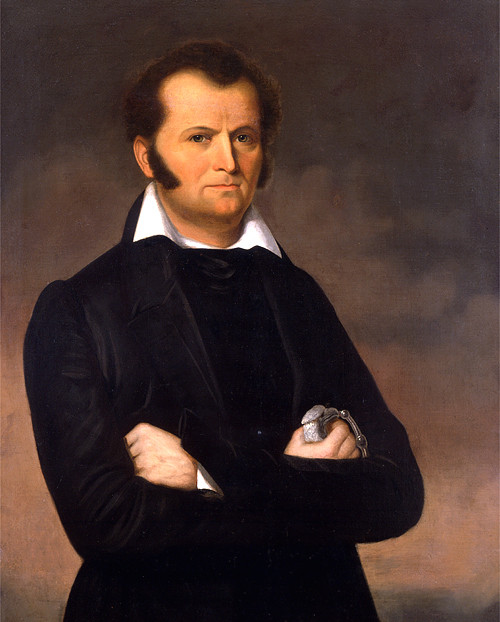
Big Jim Bowie

James Bowie is cast as an absolutely fearless, daring, and dangerous leader of men — his impulsive recklessness matched by his extraordinary ability to repeatedly overcome overwhelming odds to the astonishment of all involved. He was a man of big ideas and fortunes, and men naturally were attracted to his banner, whatever the endeavor, legal or illegal. As far as the fight at the Alamowent, however, he did not participate at all. He was deathly ill with typhoid fever and was shot, stabbed and killed while lying in his sickbed. Davissuggests that he may not have even been lucid when the Mexicans overran the compound (561). He had been sent to San Antonioby Sam Houston to collect whatever he could in the way of useful equipment and arms and then to blow up the compound because Houstonbelieved that it could not be held (493). When Bowiegot there, however, he thought it was strategically valuable as a stronghold for preventing the Mexican army from infiltrating further into Texas. On February 2, 1836, Bowie wrote Henry Smith, provisional governor of Texas, that “the salvation of Texas depends on keeping Bexar [San Antonio] out of the hands of the enemy. … We will rather die in these ditches, than give it up to the enemy. … It would be a waste of men to put our brave little band against thousands. … Again we call loud for relief” (500). Of course, they never got it.

What is important, in regards toBowieinTexas, is the role that he played leading up to theAlamo. On several occasions he had been at the forefront of the Texians’ fight for independence and yet he never held a formal military commission. Davis writes that “Ironically, the one Texian who … had seen more action in independent command then any other held no official rank whatever” (492). Read more

The Southern Point: Remember the Alamo!? Part 1

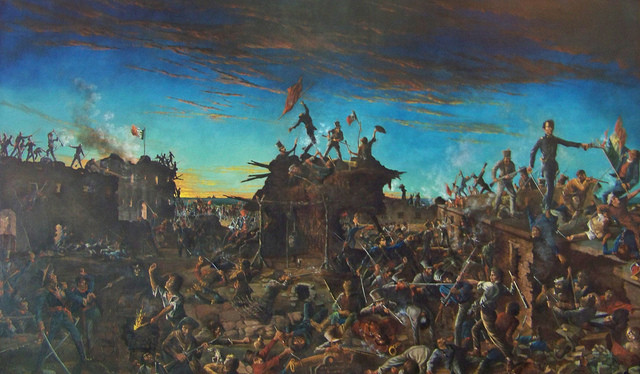
Dawn at the Alamo, Henry Arthur McArdle (1905)

The corn-shuckings and square dances, the fiddles,
The barrels of gin and whiskey, the jerked venison,
Juicy bear meat, hot corn pone, molasses,
And the girls giggling in corners — those are the things
That make life merry. But there came a time
When I neglected them all, and we made merry
(My Betsey and I) at a different kind of party,
Playing with powder and ball at the Alamo
I regret nothing, not even the lies and jokes
I told in Congress. But what is this I hear?
Tennesseans, have you forgotten the songs
Of Old Zip Coon and Turkey in the Straw?

from The Tall Men, Donald Davidson

It never occurred to me that the phrase “go ahead” actually had a history in the lexicon of authentic Americanisms. It was just a thing one said, especially if someone nearby was expressing hesitation or anxiety about an imminent course of action and was in need of a little encouragement. “Go ahead and jump!” or “Go ahead and do it! I dare ya…” etc.  The phrase has a tale behind it.

“Go ahead” was actually coined in the 1830s by none other than David Crockett. Over time, it became his personal motto and even turned into a national sensation, as Crockett was a well-known celebrity—a famous frontiersman turned charismatic populist. The phrase was synonymous with a rough yet laid back, direct, transparent, active, open and moral approach to life, for which Crockett was the ultimate symbol. The way he finally framed it was “Be always sure you’re right — THEN GO AHEAD.” But usually it was reduced to just “go ahead.” Read more

The Liberal Rule of Law and the National Socialist Rule of Law

Introduction

What follows below is my translation of a short chapter (Ch. 40) from Otto Koellreutter’s book Der nationalsozialistische Rechtsstaat (1938) (The Rule of Law in National Socialist State). Koellreutter was professor and dean of law at the University of Munich from 1933–1945. Along with Carl Schmitt, he was one of the prominent legal scholars in National Socialist Germany. He was also a NS party member (see Peter Caldwell’s article, “National Socialism and Constitutional Law : Carl Schmitt, Otto Koellreutter, and the debate over the nature of the Nazi state, 1933–1937”).

The translated chapter from his book is interesting in so far as it sheds a different light on the semantic and legal manipulations of words such as “the rule of law,” “totality,” “total state,” “absolutism” — words and concepts which have obtained a radically different meaning in the Liberal System of today. The author, however, writes favorably about the liberal experiment in 19th-century Europe and suggests that Liberalism, during that epoch, helped create the modern nation-state, including modern Germany. The author points, however, to the dated nature of Liberalism in comparison to National Socialism, which is seen by him as the best answer to the 20th-century crisis of modernity. Read more