
General

Jewish “Conservatives” Urge Obama to Move on “Comprehensive Immigration Reform”

Support for open borders spans the Jewish political spectrum, from the far left to the neoconservative right. So it’s no surprise that Jewish  “conservatives” are urging support for Obama’s upcoming “comprehensive immigration reform.”

A former Jewish speechwriter for President George W. Bush, Noam Neusner, urges Obama to push for one more “big legislative ambition: immigration reform.” Neusner, writing in the Forward,  makes the following bizarre argument: “Here’s hoping that Jewish conservatives contribute to that debate. After all, we are uniquely qualified to do so. Not because we’re Jews, but because we are immigrants from our own people.”

Let’s see. American Jews have always been liberal. So Jews like Neusner “immigrated” to the world of neoconservatism and that means they should support real immigration.

Rather than relying on an argument that is really nothing more than a bad pun, how about this simpler interpretation: Like other Jewish neocons, Neusner is a liberal who will make any argument, no matter how ridiculous, to support his very unconservative desire to see America transformed in a way that conforms to Jewish interests. Jewish Republicans like Neusner are also noteworthy for supporting that other current big liberal initiative, gay marriage. As Sam Francis wrote some time ago,

What neoconservatives really dislike about their “allies” among traditional conservatives is simply the fact that the conservatives are conservatives at all—that they support “this notion of a Christian civilization,” as Midge Decter put it, that they oppose mass immigration, that they criticize Martin Luther King and reject the racial dispossession of white Western culture, that they support or approve of Joe McCarthy, that they entertain doubts or strong disagreement over American foreign policy in the Middle East, that they oppose reckless involvement in foreign wars and foreign entanglements, and that, in company with the Founding Fathers of the United States, they reject the concept of a pure democracy and the belief that the United States is or should evolve toward it. See here, p. 26.
Read more

The Political Cesspool’s interview with Congressman Walter Jones is causing a liberal meltdown

On last Saturday’s broadcast of The Political Cesspool Radio Program, we welcomed Congressman Walter Jones (R-NC) as a guest on the show, and the lunatic left’s Pavlovian saliva pumps are slowly coming up to speed.

This time, the attack was begun by the website of Mother Jones Magazine (no relation to Congressman Jones), a Socialist rag that has been home for editors, journalists, and other questionable characters that you won’t find at Baptist or Presbyterian Sunday services.

For more, see here.

The Olympic Idea, 2012

The meaning of the modern Olympic Games (1896 onwards) is written in the Olympic Charter, which stipulates that “The Olympic Games are competitions between athletes in individual or team events and not between countries” (Chapter 1, Article 6). In this article I wish to point out several issues regarding the friction between nationalism and the modern Olympic Games.

First of all the ancient Olympic Games were an expression of Greek nationalism as they were pan-Hellenic. The Greek world was divided into city-states which were either independent or had some form of self-government. Only Greek freemen were allowed to participate and the Games were held in the honor of  the Greek gods, because they were believed to reside on Mount Olympus. Both criteria automaticly ruled out any possibility of foreign participation whatsoever, even as a spectator. Attending the Games was giving hommage to the Greek gods. Another striking feature of the ancient Games is that only the winners were showered with fame and honor. There was no notion of a second or even third place. The Games were a showcase of Greek pride and prowess.

The modern Olympic Games were first revived by Greek nationalists during the 19th century following the independence of Greece in 1832. It had again a pan-Hellenic character as Greeks from all over the Mediterranean were encouraged to join in. In 1890 the Frenchman Pierre de Coubertin found the International Olympic Committee (IOC) which managed to get the Olympic Games held in Athens in 1896 as an international event in which 14 European nations (or nations of European descent) participated. The Greek nationalist rationale that somebody was not a citizen of a state, but a member of a nation was upheld: Greeks from the Ottoman Empire were listed as Greek. Some people opted for Athens as a permanent city for the Olympics but this was overruled by the IOC. Since then, the Olympics are held every four years in different cities around the globe. Read more

Globalists and Neocons: Two potent forces opposing the Assad government in Syria

Writing in The Guardian, Charlie Skelton has produced a remarkable piece of journalism aimed at unearthing the connections among the Syrian opposition and their friends in high places in the West ( “The Syrian opposition: who’s doing the talking?“). The take home message is that there are two groups of non-Syrians who are promoting regime change: globalists and neocons—two powerful forces indeed. One can certainly understand that there would be disaffected Syrians—there are dissidents in every regime, and especially so in a society riven with religious and ethnic divisions with a government dominated by an ethnic and religious minority, the Alawites. But the ever greater success of the insurgency seems unlikely without powerful allies in the West.

Among the globalists, there is Bassma Kodmani of the Syrian National Council and her ties to the Bilderberg group and the Council on Foreign Relations (CFR), and in particular, the CFR’s US/Middle East Project headed by Brent Scowcroft. Skelton also notes that Zbigniew Brzezinski and Peter Sutherland are on the board of the US/MEP.

Sutherland is chairman of Goldman Sachs International and is a major player in the Bilderberg group. He is particularly loathsome character who, as “UN special representative on migration,” has been a strong advocate for the dissolution of all traces of European national identity based on a common peoplehood and a common culture  (“EU should ‘undermine national homogeneity’ says UN migration chief.“) Sutherland cynically argues that the EU must have high levels of migration  in order to care for an aging population, in the belief that that might be appealing to native Europeans. But it’s clear that he sees  multiculturalism and the dissolution of European cultural and ethnic identities as intrinsically positive goals. As indicated in the article, these goals are to be pursued even if the migrants take jobs from natives. Read more

What do Pat Buchanan, Kevin MacDonald, and Edmund Connelly have in common?

All three were featured during Saturday night’s rebroadcast of The Political Cesspool Radio Program!

Due to studio refurbishments that are taking place at our flagship radio station, we had to air a classic show featuring some of our “best of” interviews.

If you missed it during our regularly scheduled weekly broadcast time last weekend, feel free to revisit it (again) in the broadcast archives.

We will resume live production of TPC this coming Saturday, July 7.

Here’s is an hour by hour breakdown of the June 30 program:

Radio Show Hour 1

Guest: Edmund Connelly – We’re joined by Occidental Quarterly columnist and film expert Edmund Connelly right out of the gates this evening as we discuss the cinema arts and the dangerous and unnatural propaganda being forced upon us by the Hollywood movie studios (Originally broadcast on May 23, 2009)

Radio Show Hour 2

Guest: Kevin MacDonald – Dr. MacDonald, a tenured professor of psychology at California State University – Long Beach, returns to our show for one of the most gripping interviews we’ve ever conducted(Originally broadcast on June 20, 2009)

Radio Show Hour 3

Guest: Pat Buchanan – Pat rejoins us tonight to discuss his new book, Suicide of a Superpower (Originally broadcast on October 22, 2011)

Folks, our vast library of broadcast archives is littered with other treasures such as these. Please take the time to browse through our massive collection of previously aired shows!

Granting No Quarter: A Call for the Disavowal of the Racism and Christophobia of Noam Chomsky

Recently, a group of pro-Palestinian activists signed a letter condemning Gilad Atzmon (Granting No Quarter: A Call for the Disavowal of the Racism and Antisemitism of Gilad Atzmon). The letter states in part:

Atzmon’s politics rest on one main overriding assertion that serves as springboard for vicious attacks on anyone who disagrees with his obsession with “Jewishness”. He claims that all Jewish politics is “tribal,” and essentially, Zionist. Zionism, to Atzmon, is not a settler-colonial project, but a trans-historical “Jewish” one, part and parcel of defining one’s self as a Jew. Therefore, he claims, one cannot self-describe as a Jew and also do work in solidarity with Palestine, because to identify as a Jew is to be a Zionist. We could not disagree more. Indeed, we believe Atzmon’s argument is itself Zionist because it agrees with the ideology of Zionism and Israel that the only way to be a Jew is to be a Zionist.

This inspired me to write the following letter on another Jewish, pro-Palestinian activist, Noam Chomsky. It is an exercise in analogy, based on the ideas and phrasing of the anti-Atzmon letter:

For many years now, Noam Chomsky has taken on the self-appointed task of defining for the Palestinian movement the nature of our struggle, and the philosophy underpinning it. He has done so through his various blogs and Internet outlets, in speeches, and in articles.

With this letter, we call for the disavowal of Chomsky by fellow Palestinian organizers, as well as Palestine solidarity activists, and allies of the Palestinian people, and note the dangers of supporting Chomsky’s political work and writings and providing any platforms for their dissemination. We do so as Palestinian organizers and activists, working across continents, campaigns, and ideological positions.

Chomsky’s politics rest on one main overriding assertion that serves as springboard for vicious attacks on anyone who disagrees with his obsession with his Jewishness. He claims that all European Christian politics are racist. To Chomsky, the existence of European Christians, whether in their homelands in Europe, in the United States, Canada or Australia, is not a normal human historical project, but a trans-historical racist one, part and parcel of defining one’s self as a White. Therefore, he claims, one cannot self-describe as a White or Christian and also do work in solidarity with Palestine, because to identify as a White or a Christian is to be a racist. We could not disagree more. Indeed, we believe Chomsky’s argument is itself racist because it agrees with the ideology of Zionism and Israel that the only way to be White or a Christian is to be a racist. Read more

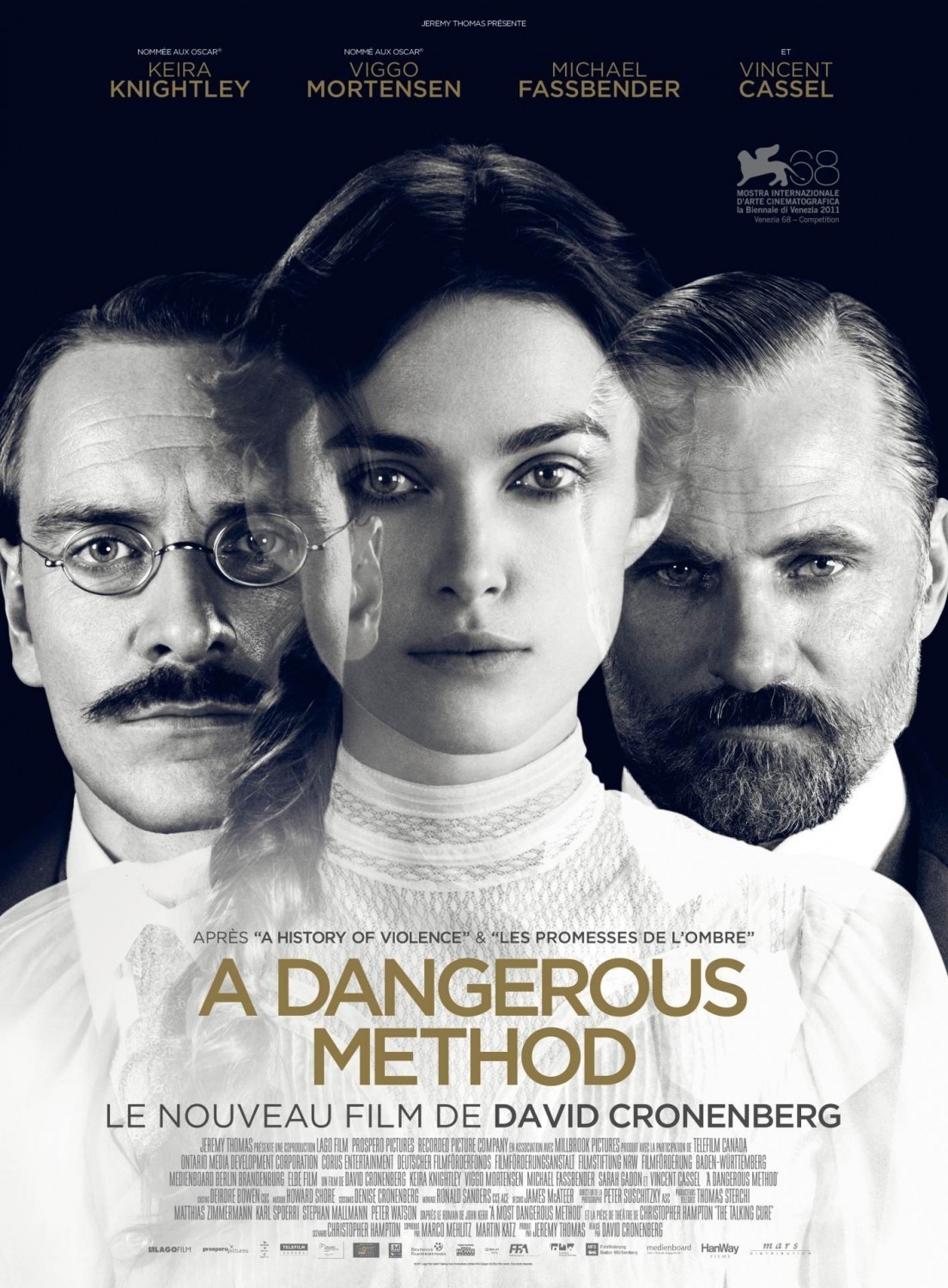
A Dangerous Method

David Cronenberg’s latest movie gives us his view of the relationship between Sigmund Freud and his pupil, Carl Jung, and even more centrally it tells the story of the affair between Jung and his patient, Sabina Spielrein.  It is set in Vienna in the early years of the 20th century.

The battle between Freud and Jung is fairly well known.  Jung was the heir apparent of the psychoanalytic dynasty founded by Freud.  But he began to go astray because Freud demanded a strictly sexual explanation for all neurosis.  Jung wanted to incorporate more; he rejected the orthodoxy.

For Freud everything boiled down to sex.  All conflicts in the psyche were rooted in early sexual experiences.  Jung challenged this core concept, telling Sabina that there must be “another hinge to the universe.”  In the words of Sabina, Jung did not want his patients to simply understand why they were the way they were but to become whom they might have been.

Jung is an idealist but Freud sees him as a threat to psychoanalysis because of what he considers his mysticism and mumbo-jumbo.   He dismisses Jung’s approach as simply replacing one delusion with another.  You then have to ask yourself why he chose Jung to carry on his work.  The usual explanation is because he needed a non-Jew to cross the bridge to the European society in which he lived, as the world of psychoanalysis was understood at the time to be Jewish.  Read more



