
Vaccine Passports, White Terror and Political Control: Who’s Behind It. And Why?
“A registry of immunization will be needed with names entered after immunization is completed. Adequate immunization may require more than a single vaccination, and the durability of protection by different vaccines may vary and may require periodic booster immunizations. Thus, immunized persons will need to receive expiration date-stamped certification cards, which should be issued to all who are immunized in the country, whether here legally or not. True, conscientious objectors could refuse. There are no such alternatives for vaccination. Do not honor religious objections. Do not allow objections for personal preference. Vaccine refusers could lose tax credits or be denied nonessential government benefits. Health insurers could levy higher premiums for those who by refusing immunization place themselves and others at risk, as is the case for smokers. Private businesses could refuse to employ or serve unvaccinated individuals. Schools could refuse to allow unimmunized children to attend classes. Public and commercial transit companies — airlines, trains and buses — could exclude refusers. Public and private auditoriums could require evidence of immunization for entry.” Dr. Michael Lederman, Maxwell J. Mehlman and Dr. Stuart Youngner, Case Western Reserve University (USA Today, August, 2020)
In my last article, I wrote about the Presidential Commission on the Supreme Court, and how it is led by and composed of a small, tightly linked personal faction of mostly Jewish academic law professors who are ideologically aligned on the progressive Left. Rather than a public commission, it is more of a private trust. It seeks to transform the Supreme Court into a legislative body that reliably behaves in majority support for progressive Left programs. Those programs include a portfolio of changes to, or the bypassing of, the Constitution, and its protections against excessive government intrusion into private life. It also includes the ratification of new laws involving the full panoply of biosecurity, including mandated “vaccines” and numerous restrictions on congregation, travel, and even political affiliation. It also seeks to codify any resistance to a passport system as “terror,” and especially to establish that conservatism and resistance among Whites are fundamental threats to government and society in general. Below, I describe as a follow-up, the nature of the parties behind the larger Covid security program, of which the Presidential Commission is merely a necessary part of its implementation.
The Covid biosecurity program is a large, complex system that is made up of many special interests in what is a coordinated syndicate or network. Most of its members are fairly visible and readily identifiable: large pharmaceutical firms and their investors; newer bio-engineering ventures and their hedge fund backers; big technology firms looking to capture new markets in biosecurity, data collection and management, or testing, tracing, tracking and bio-ID systems; and naturally, the intelligence and defense establishment.
But some are less obvious. They are cloaked within larger interest groups, and careful to remain within the confines of institutional authority symbols such as universities, research firms, media, so-called expert health organizations, and of course, the government. The country’s network of college and university campuses is also a key component of the “Covidianism” construct that has created entire new cognitive and behavioral routines centered in a reinforced obedience to central authority, and the establishment of self-policing among peer groups in order to ensure group compliance with standardized expectations in the use of face masks, social distancing, and ultimately in the willingness to submit to experimental “vaccination.” Some young adults are calling their college campuses a “prison” and that comparison may be apt. Many university medical facilities have even become the “official” vaccination centers for their regions or communities, some using a “lottery” system, or soliciting the public to volunteer as experiment subjects. Some universities are using a “yield management” model by creating scarcity to manipulate demand.
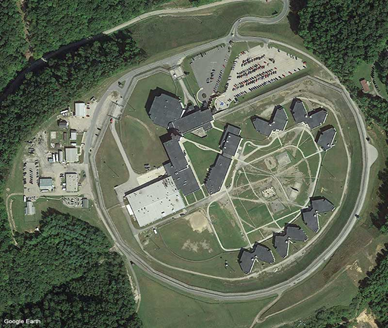
Aerial college campus view: “This feels like prison.” Universities are a perfect nation-wide networked camp system for processing, indoctrination, experimentation and bio-social engineering. Right: Harvard Law’s Cass Sunstein and former Obama Director of the Office of Information and Regulatory Affairs (OIRA) who asserts the necessity of “cognitive infiltration.”
The sudden almost explosive assault of emergency pandemic policy forced on the American public has all the hallmarks of official sanction and authority—the kinds of authority that the public responds to generally without too much questioning. And in the case of a personal health risk, there is typically a very strong self-protection response that almost guarantees a systematic public cooperation with centralized direction. The impression that all of us tend to have, is that the information that is produced and broadcast from these institutions of authority is a natural and responsible public service response to an emergency that fits credibly with their stated purpose and putative expertise. We assume that institutions like the C.D.C. (Center for Disease Control) or the W.H.O. (World Health Organization) are simply acting just as they are supposed to: as public agencies of protection and civil defense. They are seen as trusted humanitarian agencies, and it is assumed that they represent scientifically informed defense against large-scale disasters that are beyond the control of individuals, communities or even states.
But this is an incorrect assumption. The global health organizations are highly porous politically, they are utterly dependent on numerous sources of financial support, and most of all, they are fully in compliance with larger authority networks, including select governments, private foundations, and authority figures from the political-state sphere.
“The illegal we do immediately; the unconstitutional takes a little longer.” Concurrently timed with the first public ‘pandemic’ announcement by the CDC, Kissinger ran his World Order WSJ op-ed where he asserted “The Coronavirus Pandemic Will Forever Alter the World Order: The U.S. must protect its citizens from disease while starting the urgent work of planning for a new epoch.” The new order? It’s all about depopulating the countryside and moving to cities. “Empty half the earth of its inhabitants: It’s the only way to save the planet.”
These authority figures and symbols also appear natural or acceptable, or even necessary. They carry forward their credibility from government service, from the imprimatur of elite university research and from the power and influence of highly concentrated financial leverage. It is important to appreciate that the Covid memetic was decades in the making and didn’t just come out of nowhere. It has a long pedigree in special interest ambitions that find their confidence in a highly cultivated intellectual elitism that asserts a higher-order understanding of largescale and macroeconomic risk—its central animating cause is global warming, and nothing is more urgent than to attack directly the cause: human population. It naturally seeks institutional concentration and consolidation in order to realize its ambitions, but it is also animated by specific cultural beliefs and propensities.
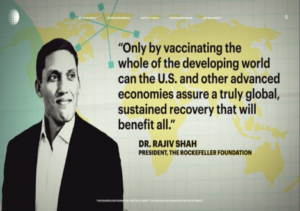
U.S. university research and the Rockefeller Foundation: “In many developed countries, enforced cooperation with a suite of new regulations and agreements slowly but steadily restored order.” The Rockefeller Foundation, Future Scenarios Report issued in 2010 on a virus pandemic simulation. Right: Sustainable = depopulation.
Through these large-scale institutional influences, their peer groups and counter-party organizations like universities take their direction, and follow their ideological objectives, even if those ideologies or objectives are not fully understood: what is important is to maintain a stable economic equilibrium, and foundations such as Rockefeller provide that equilibrium, and also hold out the threat of disfavor.
Ezekiel Emanuel as paradigmatic
A central adjunct to the foundation structure of influence and control, is the select, targeted and strategic placement of an “expertocracy” that is firmly embedded within the larger influence network and which straddles government, university and cultural components that are necessary to attain a reliable forward momentum and compliance with directives, policy, and advice. There are few individuals who manifest that role, more than Ezekiel Emanuel.
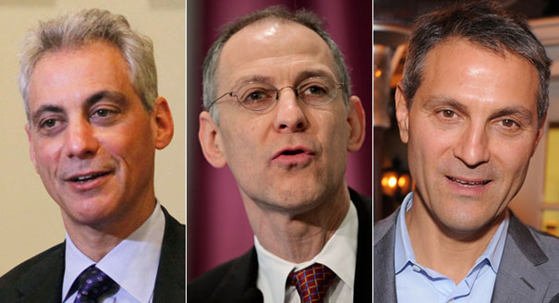
The Zionist brothers Emanuel: (Center): The University of Pennsylvania’s Ezekiel Emanuel, Biden-Harris Covid advisor: “Life after 75 is not worth living”; “Cases are surging. We need to maximize the number of inoculated students.
Ari Emanuel (right): working in politics and Hollywood;
Rahm Emanuel (left) “Never let a crisis go to waste” (or waste an opportunity to make one); the former Chicago Mayor’s Covid simulation operation: Crimson Contagion
But who exactly, is Ezekiel Emanuel? And why is he wielding concentrated influence in American domestic policy concerning health care, population control, and especially, a program of forced vaccination on young adults, primarily through the nation’s network of colleges and universities? To whom are his loyalties, and what are his objectives and larger allegiances?
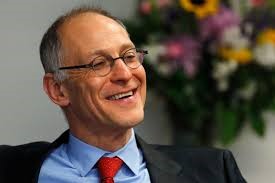
All smiles: Ezekiel says that “Doctors take the Hippocratic Oath too seriously.” White House Covid advisor, University of Pennsylvania’s Dr. Ezekiel Emanuel: “We need to maximize the number of inoculated students.”
When one digs a little deeper into Ezekiel Emanuel’s past, it may become a little clearer how his ethno-religious upbringing and indoctrination, led to his overall psychological profile: authoritarianism, control, and even malevolence toward other groups such that oppression or even extermination or genocide, are justified and normalized as state-level policy, but carefully configured within otherwise legitimately perceived institutions. In that regard it is a classic act of deception and terror that was specifically pursued by his Zionist father, also a doctor, and widely cited as a criminal terrorist with deep loyalties to Israel.
For many years, Dr. Emanuel benefitted by staying in the political shadow of his brother Rahm Emanuel, former congressman, Obama White House chief-of-staff, and Chicago mayor. Rahm also volunteered to work as a “fixer” in the IDF, like his father:
Rahm’s father Benjamin Emanuel served in the Irgun, a Jewish terrorist group that targeted British and Palestinian civilians — most famously with the King David Hotel bombing and the Deir Yassin massacre — to advance the goal of creating a Zionist state. This week, the elder Emanuel has not exactly assuaged doubts about his son’s pedigree. “Obviously, he will influence the president to be pro-Israel,” he told the Israel daily Maariv, “Why wouldn’t he be? What is he, an Arab?
Dr. Benjamin Emanuel brought up his three sons in a pro-Israel household. All three hold dual citizenships and in their careers have worked at least as much for Israel interests as they putatively have American ones, and were culturally groomed by their father to be Israel “power-brokers.” Ezekiel emerged onto the public scene as an advisor and “fixer” for Obama’s signature Affordable Heath Care Act. And while the Obama-Clinton presidential and policy continuity plan was temporarily interrupted by the Trump victory, he quietly consolidated his position at the University of Pennsylvania, and then re-emerged from the shadows with the roll-out of the 2020 Covid program. His model for U.S. biosecurity is indeed, the state of Israel under the continued authoritarian and Zionist operations of Benjamin Natanyahu, who is considered by many as among the world’s top global terrorist sponsors and operators. This instinct has been turned inward on his own people (including the Orthodox who may have recently suffered under a Netanyahu-organized operation). As an Israeli political dissident recently stated:
“We are being used as a model for the rest of the world. Many of us are calling this a new holocaust in our own country. You could not have created a bigger betrayal. This has nothing to do with a virus. It leaves behind the arguments of right and left, pro and anti, even religious designations, and asks of us: what are the most basic common denominators we share?” (Ilana Rachel Daniel, Israeli political activist on Israel’s current state authoritarian “Green Pass” system and its “purity test” of compliance to Covid regulations).
It is precisely Israel’s “Green Pass” system, its purity test construct, and Israel’s cybersecurity legislative bill that Emanuel is eyeing as a model for the U.S. Such a system not only serves a large syndication of commercial interests, but the state itself as a method of creating a “purified” two-tiered social system that is divided on political lines and rests on a permanent bio-state of control, tracking and even directed thought.
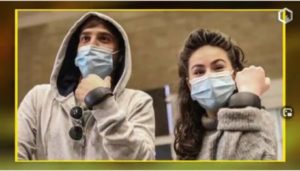

Israel’s Green Pass: Digital bands used for tracking people in Israel
The next step is the permeation of a transnational legal regime that, in effect, extends and consolidates the Israel model of biosecurity social, political and economic control, including through treaty agreements that specifically tie in the state of Israel as the constructive authority. In this way, by this mechanism, Israel has realized a “colonizing” tool that extends through the global health institutions, and from there penetrates state-specific government institutions through their respective agencies, bypassing legislative deliberation, and working around and through traditional federal government structures. The entire Covid “pharmakon” is permeated with Israel state and commercial interests, ideology, and political ambition. There is no other single concentration and magnitude of ethno-cultural interests, even those of China, that provide the intellectual “DNA” of this world order fantasy.
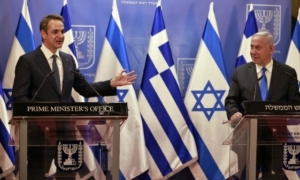 Israel, Greece sign ‘green passport’ travel deal for vaccinated citizens. Just the beginning?
Much of the institutional “leakage” that allows this ideology to thrive and permeate into Western societies, is through the higher education complex which to an unprecedented degree in American history, consists of Jewish and pro-Israel administrative leadership. A case in point is the University of Chicago, by many measurements, an epicenter of the Covid and Passport program. Its president, Robert Zimmer, has been a loyal devotee of Israel-first policy and ideology, using the university as a platform (even inviting IDF officers to “teach” undergraduates). He also has initiated joint ventures with Israel in molecular biology, and the Trustee chairman, Joseph Neubauer, is among the largest individual investors in Israeli weapons and related research (according to his Foundation public filings).
This by itself is not dispositive of a joint U.S.-Israel biosecurity program, but it does identify a representative element of the cooperative network between special interests in each country to a degree unlike any other such collaboration based on cultural, religious and geopolitical solidarity, one already formalized by the Global War on Terror that is centered in joint U.S.-Israel war prosecution. The new biosecurity regime is merely part of the war, now turned inward.
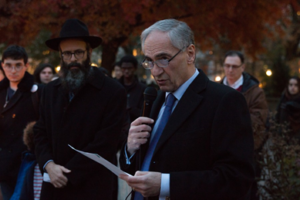
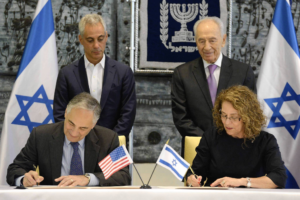
Zimmer, backed by the Pritzker, the Gates and Rockefeller Foundations and US Department of Defense (through its Argonne National Labs), pushes the growth of research in microbiology and virus “gain-of-function.” Left: Zimmer holding a campus candlelight midnight vigil for Jewish synagogues. Right, Chicago Mayor Rahm Emanuel and Israeli President Shimon Peres look on as University of Chicago President Robert J. Zimmer and Rivka Carmi, President of Ben-Gurion University of the Negev, sign an agreement establishing a collaborative research program. The signing ceremony took place at President Peres’ residence in Jerusalem. A civil science program, or are there Israeli geopolitical implications?(1)
The degree of such leakage has created a national security threat to the United States. While this has been cited before, the degree of systematic undermining of U.S. sovereignty may be unprecedented, including the degree to which it has been engineered and orchestrated under a virus pandemic pretext, and with that, a comprehensive assault on U.S. institutions, including religious organizations and, perhaps most systematically, through the education complex.
Human institutions are capable of carrying out programs in a systematic way, but they are entirely dependent on direction. They are easily “captured” (Gates is the largest investor in the W.H.O.), and once strategically invaded, they are obedient. The ideology stemming from ethno-religious and cooperative special interests, are the “code” that has activated the Covid program. China plays a unique role, but that is another story for another time.
V.S. Solovyev is a graduate of the University of Chicago and a former science, technology and defense consultant.
- There are other motivations for this project beyond strictly local academic ones, including hydration and broader strategic development of Israel’s Negev desert, done in conjunction with the Zuckerberg Institute and Ben Gurion University; that is, it is also an effective US export or technology-transfer project that obviously has national security implications (somewhat managed politically by the construction of the first permanent US military base in Israel’s Negev region which most of the public is not aware of). Molecular engineering also has inherent, specific applications in new weapons science (it is among the most aggressively pursued science and technology projects by the Pentagon) including in polymer and nanoscale technology, which partly explains support by US Department of Defense and UChicago-managed Argonne National Labs, and by Woods Hole, and the Katz Institute. It is not likely that any actual civilian uses will find applications in public hydration projects outside Israel in the larger Middle East desert zones; however molecular engineering can also be used for desertification with application to land conversion and demographic modification for the oil and gas industry, a key Israel ambition. As reported in public media, Zimmer had a “long-simmering interest in creating a joint partnership with an Israeli university” and remarked that this project has “potential applications far beyond local issues).




