The Shadow Over England: H.P. Lovecraft and the Conflict between Civilization and Savagery
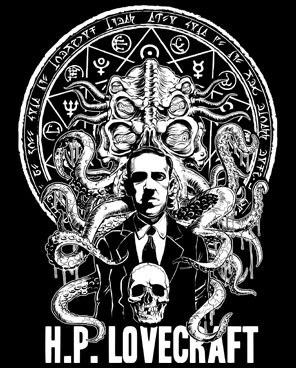
Howard Phillips Lovecraft, born 130 years ago on August 20 and dead only 46 years later, continues to be one of the most prominent American writers of horror fiction, and his ideas form a key part of popular culture. Along with fiction, rock music, and numerous films, at least 60 video games have shown the influence of his work. One reason for this is doubtless that the major themes of his “weird tales,” although superficially fantastic, were not so far from human realities which persist to this day.
Lovecraft’s work was undoubtedly influenced by his own personal experiences with mental health problems. When he was only two years old, his father, Winfield Scott Lovecraft, was institutionalized for mental problems apparently caused by syphilis, and five years later died in the institution. When Lovecraft was twenty-eight his mother Sarah Susan was committed to the same hospital and died there two years later. It has never been specified exactly what her condition was, although a neighbor recalled that she had spoken of seeing “weird and fantastic creatures.”
H. P. Lovecraft himself suffered from health problems which were never entirely understood. He was taken out of school several times in his youth, and at one point before graduating high school in 1908 he experienced what he described as a “nervous collapse.” He later wrote in a letter that he was still plagued by “intense headaches, insomnia, and general nervous weakness which prevents my continuous application to any thing.”
It is likely that he inherited a predisposition for mental illness from his mother. Considering this, it is easy to see how he developed an interest in some of the persistent themes in his work. Many of his characters lose their sanity, but mental illness is also analagous to two other connected themes in his work — inherited evils, which often persist over many generations and the conflict between civilization and savagery, both of which end in tragedy. Lovecraft’s focus on these themes can also be read as a comment on race and ethnicity. Although Lovecraft identified more with Anglo-Americans and the British than with the White race as a whole, his concerns were similar to many intellectuals of his generation concerned about immigration and culminating in the 1924 immigration restriction law. His concerns resonate with the racial tension experienced today by many White Americans and Europeans, who see their society as under long-term threat by backward outsiders.
These should be familiar to racially conscious readers today. Our society suffers from a multi-generational affliction which leads it to disregard the natural boundaries between groups of people. The results have already been tragic, eroding civilization and enabling barbarism.
“Facts Concerning the Late Arthur Jermyn and His Family” deals with a man whose ancestors have had an unusual appearance for several generations, as well as cases of insanity, severe disabilities and violence, including murder. Ultimately he discovers the cause — he is the descendant of a union between a man and an ape. The revelation drives him to suicide.
“The Rats in the Walls” deals with a man named Delapore who through a tragic fire is deprived of a sealed envelope from his father which was meant to inform him of a family secret. Three hundred years before, his ancestor Walter had murdered his entire immediate family; they had been so hated that he was able to escape punishment entirely. The cause of this crime, though, was still unknown.
The contemporary Delapore becomes curious about the house in which his ancestors lived and eventually leads a team of investigators into a hidden cavern beneath the cellar. He discovers that his ancestors had for centuries maintained an entire city of human cattle – people raised to be eaten. Some of them had even devolved to the point of walking on all fours. Walter’s crime, although it had led to the starvation of these people, had been excused because he had put a stop to the crimes of their masters.
Delapore is called into the darkness by the imagined sound of rats. He has increasingly strange and disjointed thoughts, and soon reverts to savagery. He attacks one of the party members and begins eating him, uttering a mix of human languages and gibberish, before being taken to an insane asylum. Those who take him away are heard whispering something about his “heredity,” as if he still carries a cannibal gene.
“The Dunwich Horror” deals with the two sons conceived by a monstrous alien creature, Yog-Sothoth, with a deformed human woman. One son, Wilbur, has grown to adulthood at more than twice the normal rate, and is widely shunned due to his animalistic appearance and terrible smell. His brother is invisible, but perpetually growing, feeding on live cattle until he fills the entire house in which he has been kept. It is implied that he even devours his mother. While attempting to break into a library to steal a magical spell book, Wilbur is killed by a guard dog; the animal is enraged by his strange odor. The invisible creature ultimately destroys the house and goes on a rampage, killing several families before being brought down through magical means.
All of the above deal with the degeneration of human beings to a more primitive level, and characterize the resulting barbarism as genetic. The Shadow Over Innsmouth, one of Lovecraft’s few book-length works, makes a similar point, but presents this as a deliberate attempt by an alien group to assimilate human beings into their society.
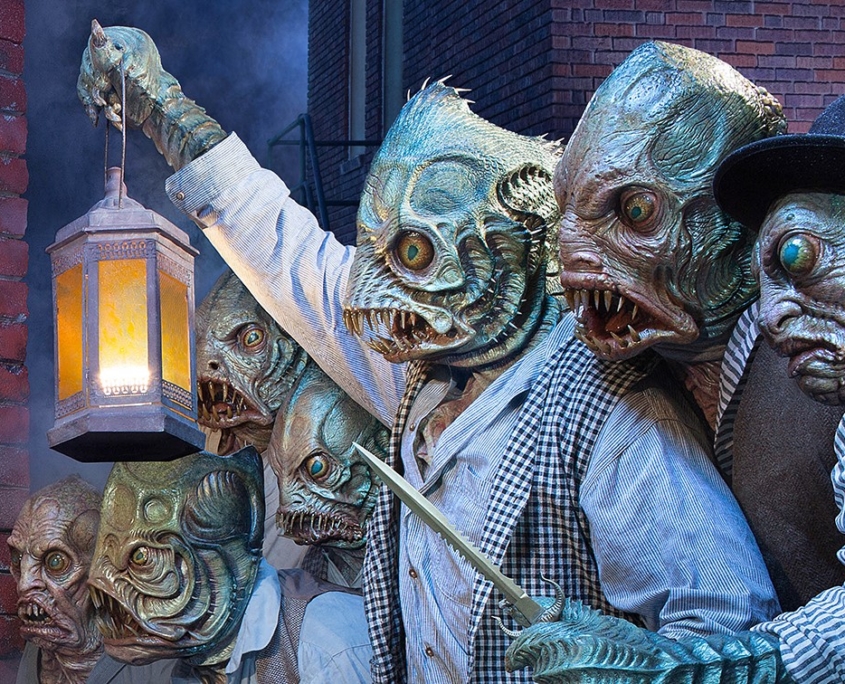
Innsmouth locals pursuing the main character in The Shadow Over Innsmouth (artist’s impression). Image credit: Joshua Hoffine, 2015.
Innsmouth is the fictional name given to a declining fishing village in Massachusetts. The narrator is on a visit to investigate his family history, but immediately finds something strange about the inhabitants. He ultimately learns that almost no one in the town is entirely human. His great-great-grandfather Obed Marsh established a cult which offered human sacrifices to a race of amphibious creatures known as the Deep Ones in exchange for delicious fish and exotic jewelry, which the impoverished town greatly desired. When the police arrested the cult members, the Deep Ones attacked the town and slaughtered much of the population, so the survivors agreed to continue the sacrifices. They also agreed to breed with the Deep Ones once they learned that this would make their descendants nearly immortal.
The result of this miscegenation is that, while usually born with a human appearance, the townspeople gradually change over the course of their lives to resemble the monstrous fish-like Deep Ones, and finally join them to live under the sea. The narrator ultimately realizes that the same is happening to him, as he is a descendant of Obed Marsh and a Deep One wife. His uncle Douglas had committed suicide to escape this fate, and he considers the same course of action. But like the townsfolk, he comes to accept his future under the sea, and even plans to bring his similarly transfigured cousin with him.
The Case of Charles Dexter Ward deals with a long-term curse perpetuated by those who are not physically alien, but only morally inhuman. Still, they manage to reach across many generations to bring disaster on the protagonist. It is the story of a young man by the same name who becomes obsessed with a distant ancestor by the name of Joseph Curwen. Curwen, unbeknownst to Ward, had committed many atrocities including torture and murder in a quest to resurrect the long-dead and extract information from them. Two other necromancers also worked with Curwen on this project and have somehow managed to survive through the intervening years until the time in which the story is set.
Before his own death, Curwen had made arrangements to magically influence subsequent generations so that one of his descendants would resurrect him. Curwen died in the eighteenth century, and Ward was born in the twentieth, but strangely the two look almost exactly alike. It is implied that Curwen meant for this to be the case.
Ward studies Curwen’s techniques, locates his remains, and manages to bring him back from the dead. Curwen, though, does not see eye-to-eye with Ward. The young man’s refusal to accept or participate in Curwen’s unethical methods soon leads to the elder necromancer murdering Ward and impersonating him to cover up the deed. The new “Ward” is so obviously out of place in the twentieth century that he is committed to a mental asylum.
The family doctor, who has been investigating the case, ultimately discovers the truth and confronts Curwen, using the necromancer’s own methods to return him to dust. During the course of his investigation, the doctor had accidentally resurrected an ancient enemy of Curwen’s. The latter’s co-conspirators are soon found dead themselves, and it is implied that this entity was responsible.
Even one of Lovecraft’s more fantastic themes, that of alien beings lying dormant for eons before awakening to menace mankind, is arguably another expression of the two themes already mentioned — civilization versus savagery and inherited evils. The threat the aliens pose is that of savagery overwhelming civilization, while much like the long-term genetic pollution in The Shadow Over Innsmouth, the threat persists unchanged, albeit in a dormant state, generation after generation.
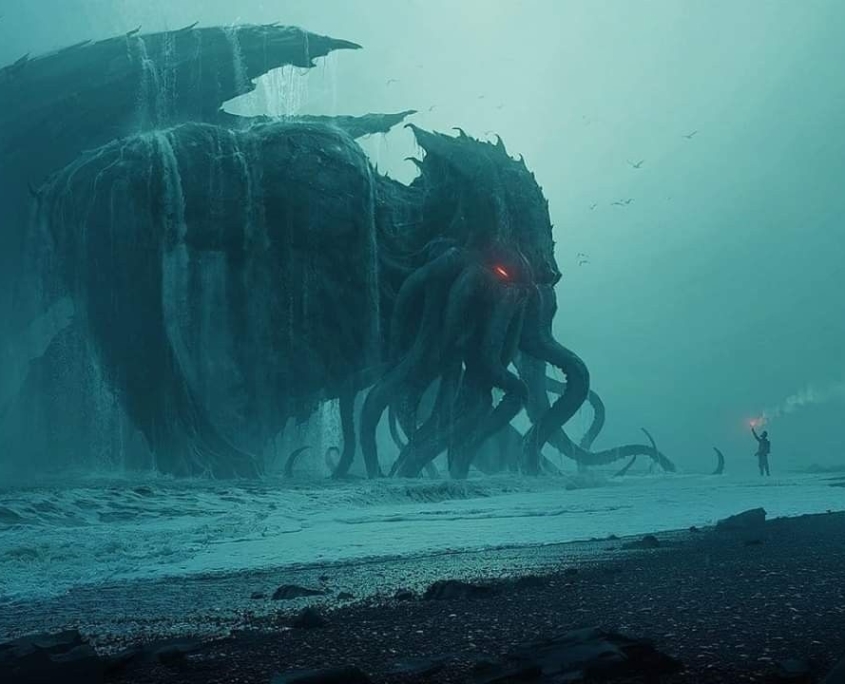
Cthulhu, priest-king of the Great Old Ones (artist’s impression). Image credit: Andree Wallin, 2019.
In “The Call of Cthulhu” we learn that millions of years before homo sapiens emerged, creatures called the Great Old Ones had come to Earth from elsewhere. For reasons unknown, they exist in a sort of suspended animation; although their minds continue to function, their bodies lie still in their houses in a city which has now sunk beneath the ocean. They have strange mental abilities, and have been able to influence the dreams of men, giving rise to many cults around the world who worship them and their priest-king Cthulhu. This influence over humanity began at the beginning of civilization, and even when the Great Old Ones have lost contact with them, the cults still pass on their strange traditions. Thus it is another example of a long-term inherited evil.
Many of the cultists are so primitive or deranged that they cannot speak, but, from a particularly communicative one, investigators learn that they anticipate a time when they will conduct rituals to awaken the Great Old Ones. At this point mankind will already be in a chaotic and degenerate state, and the aliens, being similarly amoral, will goad humanity on in its mindless violence and hedonism.
At the Mountains of Madness describes an intelligent race called the Elder Things or Old Ones who, like the Great Old Ones, populated the earth long before mankind appeared. Explorers in their former territory in Antarctica find what they believe to be ancient remains of the Elder Things, but learn at the cost of several explorers’ lives that some of the creatures are still alive. Like the Great Old Ones, they have been resting for millions of years, and cause problems for those who wake them up.
The Elder Things not only pose a threat to those who discover them, but represent Lovecraft’s main themes in another way. They had created a race of slaves called the shoggoths, who represent the threat of barbarism and chaos in contrast with the more civilized Elder Things. Even their physical form is chaotic, as they are like enormous amoebas, changing their shape at will. The shoggoths were originally mindless drones, but after millions of years, some developed independent thinking and rebelled against their masters, sparking a war. Ultimately the Elder Things defeated and re-subjugated the shoggoths, although many of their own race were killed in the process. But the shoggoths still pose a threat; the human explorers barely escape being killed by one such creature themselves.
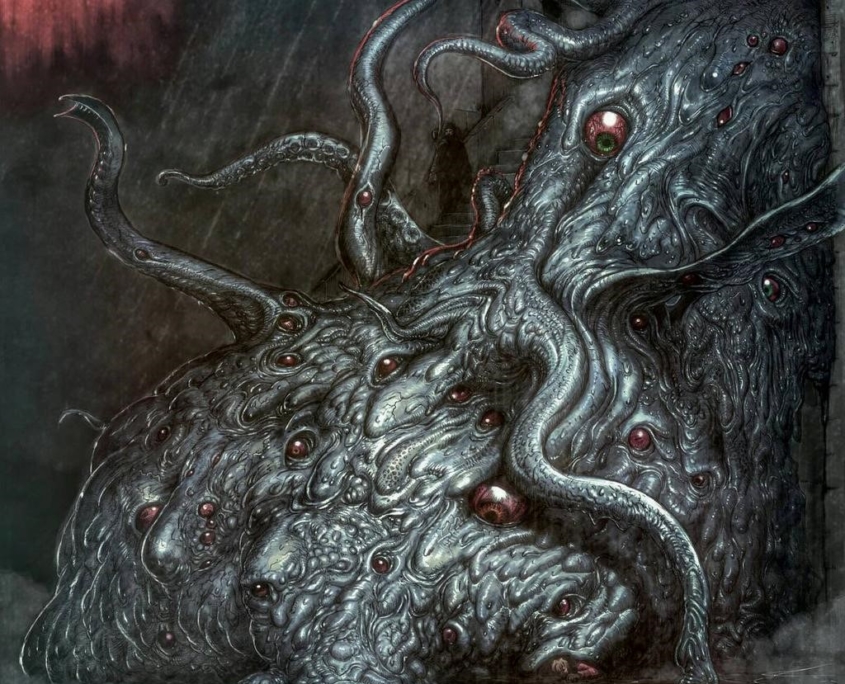
Shoggoth (artist’s depiction). Image credit: Nottsuo, 2016.
Beyond the psychological chaos and decay involved in degenerative conditions like syphilis and dementia, there are other real-world parallels with Lovecraft’s main themes. The most obvious is interracial marriage, now increasingly common, which Lovecraft found repellent and damaging to the gene pool. However, most people at the time shared his view, making the practice quite rare. A more pressing issue was the influence of other ethnic groups on Anglo-American culture.
Lovecraft was very attached to British culture, to the point of even rejecting American English. Partly due to the influence of various immigrant dialects on popular American speech, he considered contemporary trends in the language to be another case of uncivilized influences causing degeneration. He believed that his countrymen should write and speak as the British did, and expressed this view as president of the United Amateur Press Association. His father had held a similar view and affected a British accent, so that he was sometimes mistaken for an Englishman.
Lovecraft wrote during the first decades of the twentieth century, a time during which, as in the present day, immigration was a very prominent issue. Popular opposition to mass immigration was so high that it led to almost all immigration being cut off in 1924, particularly from Southern and Eastern Europe. Many immigrants around this time lived in informally segregated slums which harbored organized crime, and Lovecraft considered such people a barbarous threat to civilization. Today, similar feelings are evoked by “no-go zones” throughout Europe, where many people from alien cultures live without even a pretense of assimilation into the host society. Like the shoggoths, then and now, these unofficial outposts of foreign nations have been created and tolerated due to a desire for cheap labor and left-leaning votes, despite the risks they pose.
Shoggoths represent not only an uncivilized and potentially dangerous underclass, but the replacement of one group of people with others who are fundamentally different and can only imitate the original group’s culture superficially. In At the Mountains of Madness, the human explorers examine the carvings made on the walls of an area of a cavern inhabited by the Elder Things. They conclude that these were the product of a decadent civilization, but soon enter an adjacent area where the artwork is of a very different type. One explorer guesses that this new set of carvings was created after removing an earlier design, and they seem to be a parody of the others, created by tasteless and crude minds. The implication is that they were created by rebellious shoggoths who had invaded an area inhabited by the Elder Things, killed them, and replaced the original inhabitants’ art with their own mockery of it. These creatures had no culture of their own, nor even their own language, but could only manage a primitive imitation of that of their creators.
Of course, the peoples comprising the current replacement migration throughout the West do have cultures and languages of their own, and many would like these to replace those of the native people. They can superficially adopt their host country’s identity – for example, many of the offenders in the Rotherham rape gangs have British passports. But this is only a mockery of British identity, considering what they thought of British girls — members of an out-group to be victimized.
Even when newcomers to the West are not hostile, they are still fundamentally different from the native people, ethnically and culturally. Things like classical music or freedom of speech do not fit equally well in every nation around the world, but are an expression of the psychology of particular peoples. Even if they wished to, others could not carry on the same cultural traditions, whether aesthetic or political, in the same spirit. Only a decadent society, lacking a healthy sense of itself, would welcome them in large numbers. This was a common attitude in Lovecraft’s time, and is increasingly common today.
It is easy to point merely at the most sensational parallels to Lovecraft’s horror in the real world — our own people being preyed on by outsiders in a manner hardly more civilized than cannibalism, for instance. There is surely some kind of curse on our civilization, but the curse is not the atrocities we hear of in the news, but what lies at the root of them.
Everywhere in the West we see a loss of connection with our nation, race, and spirit – everything which would motivate us to set boundaries between ourselves and others and act in our own defense. In their place, we get cheap consumer goods and “diversity.” Lovecraft saw the beginnings of this, calling the modern era “one of frank decadence,” but would have been shocked to see how far it has now advanced. Some say that this is a genetic weakness of Western white people, and in any case many parents pass it down to their children. But our quality of life, and most importantly our spirit, depends on our ability to resist it.