Richard Lynn Recounts His Life
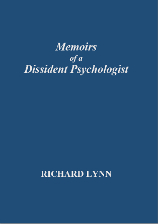
Memoirs of a Dissident Psychologist
Richard Lynn
London: Ulster Institute for Social Research, 2020
476 pages, £25
Richard Lynn, who turned 90 earlier this year, has published an account of his life and intellectual development, including portraits of some of the outstanding men he has known and worked with.
 Lynn’s father was Sydney Harland, the world’s leading expert on the genetics of cotton. His mother Marjorie was the daughter of William Freeman, Director of Agriculture at the Imperial College of Tropical Agriculture (now University of the West Indies) in Trinidad, another early researcher on plant genetics. Harland was, alas, married when they met in Trinidad, but Marjorie followed him to New York, where she conceived. The sight of homeless men in New York convinced her that capitalism was not working, and she became a lifelong communist. Harland concocted for her an imaginative story according to which she had married a mining engineer named Richard Lynn who had been tragically killed in a mining accident shortly after the wedding. With little except this story and her new political convictions, Marjorie returned to the UK in 1930 and settled in Hampstead, a suburb of London. On February 20, 1930, she gave birth to a son whom she named “Richard Lynn” as an expression of piety toward her lamented fictitious husband.
Richard Lynn had a mostly unremarkable childhood. When the war came, his mother sent him for his own safety to acquaintances at Ambleside in the Lake District of Northern England. He enjoyed the outdoor activities the area offered, following the course of the war on the wireless. “By the end of 1943,” he writes, “I was becoming increasingly conscious that my life at the Ambleside village school was on a slow track to no-where, and that if I was to make anything of my life I needed to get a decent education at a good school.”
By this time, his mother had moved to Bristol and there was little danger from the Luftwaffe. At his own request, Lynn rejoined his mother and applied to the Bristol Grammar School, the best in the city. He found that the entrance exam included many questions his schooling in Ambleside left him unable to answer. He performed well enough to gain admission, but was mortified to be assigned to the school’s “C stream,” for the dull boys. “I never worked harder than I did in that year,” he recalls, and the following year he was promoted to the A stream: “Once I had achieved this, I was content to rest on my laurels and coast along somewhere in the middle of the A stream.”
The young Lynn was no science nerd, being initially drawn more to history, literature, and classical music; the scientists in his family tree also seem on his account to have been men of broad interests. He writes that he was always attracted to “big ideas,” which the science classes at the Bristol Grammar School neglected in favor of minutiae. In biology class, e.g., the students were taught about stamens and pistils rather than the theory of evolution.
Partly from his mother’s influence, and partly from his own attraction to big ideas, Lynn joined the Young Communist League when he was fourteen. The YCL sponsored evening social hours, weekend bicycle trips, and summer camps where Lynn could join in the singing of communist songs: “It’s the same the whole world over, It’s the poor as gets the blame, It’s the rich as gets the pleasure, Ain’t it all a bleeding shame.” He learned how to answer objections to the faith:
For instance, when people objected that communist Russia only permitted one party, I was able to explain that capitalist countries needed two parties, one to represent the capitalists and one to represent the workers, but as communist societies have only one class, they only need one party.
Within about a year, Lynn developed doubts about what he was being taught at the YCL, though he continued with the organization for a time in order to enjoy the social benefits.
In England at this period, grammar school students were tested in nine academic subjects at the age of sixteen, an ordeal known as the School Certificate examination. Six months beforehand, they were given a practice version known as the “mocks.”
I had not done much work since I had got into the A stream and had a full social life with the Young Communists and I was not well prepared for these mocks. After they had been marked and the results put up on the board, I found that I had not done well. Our form master asked me to stay behind after school. “Now Lynn”, he said, “I don’t know what to make of you. You seem to be intelligent but your performance in the mocks has been most disappointing”. He asked me how much homework I did each night and I said about half an hour. He urged me to pull myself together and do at least three hours homework a night. He said he thought that if I applied myself I might get a scholarship to Oxford or Cambridge, but if I continued on this rake’s progress I would end up serving behind a counter.
Once again, the prospect of failure motivated Lynn to succeed: “I left the YCL, worked hard for the School Certificate examination, and managed to do quite creditably.”
In the summer of 1946, Lynn’s grandmother revealed to him the fictional nature of his supposed mining engineer father: “She said my father was a very clever but very immoral man, which sums him up pretty accurately.” The information came just in time: shortly thereafter, Lynn received a call from his half-sister Margaret to say their father Sydney Harlan was staying with her and would like to meet him:
I went round and met my father for the first time. He asked me about my political views and I said I was a socialist. He told me that he too had been a socialist at my age but that he was now a liberal. He gave me a copy of Wilfred Trotter’s Instincts of the Herd in Peace and War and told me it was an important psychological study, and suggested I might consider studying psychology. I read this book that proposed that people have an instinct to identify with the groups and follow them, that religion plays an important part in binding groups together, and this is one of the causes of wars. I found this very interesting and began to think about studying psychology.
Lynn still had two years of school to complete. During this time, he had to prepare to take the Higher School Certificate examination (now known as the A levels) in three or four different subjects in order to go on to university. He chose to concentrate primarily on History and English:
One of the main reasons I liked History and English Literature was that we were encouraged to make up our own minds about controversial issues. For instance, our history teacher asked us to consider which side was in the right in the English and American civil wars, or in the disputes in the nineteenth and twentieth centuries between laissez-faire capitalism and socialism. We were encouraged to think through these questions for ourselves. Similarly, in English literature the master would ask “Is Shakespeare any better than Pearl Buck, and if so, why?” I found all this much more interesting than science and mathematics which just entailed learning what was already well known.
In December 1947, Lynn was summoned to the headmaster’s study, where he anticipated a flogging for having violated some rule. Instead, the headmaster told him that King’s College at the University of Cambridge was offering examinations for three scholarships in English and History the following month, and encouraged Lynn to try for them.
So in January of 1948, Lynn took the train to Cambridge. He includes a little vignette of British postwar austerity:
The candidates were put up in the college and it was freezing cold. The bedrooms provided jugs of water and bowls for washing. One of the other candidates told me that in his room the water had frozen solid, but I told him that in mine the ice was only about a quarter of an inch thick and if he gave it a hard knock, he would probably strike water.
Lynn had to compete against about a hundred other boys, but was among the five invited to an oral interview. His headmaster at Bristol Grammar School had advised him, at this stage of the process, to “take an unconventional line in order to stand out from the crowd of conventional answers.” Lynn may have taken this too much to heart. Examined in recent history, he explained that Neville Chamberlain had been perfectly correct to appease Hitler at Munich, but wrong to declare war following the invasion of Poland, in view of Britain’s loss in the subsequent war. When the examiners asked him how he figured Britain had lost World War II, Lynn responded that they had fought to preserve the independence of Poland, but had ended up handing it over to Stalin along with the rest of Eastern Europe. At this point, recalls Lynn, his examiners lapsed into silence.
Although he might have been better advised to stick with what he had learned at the Young Communist League, the Dons were broadminded enough to pass the young know-it-all. Three days later he learned via telegram that he had been awarded a scholarship: “This news threw me into a state of hyper-manic euphoria whose intensity I had never experienced before or was never to experience again.”
Lynn began to consider what he would focus on at Cambridge:
I thought that history left a lot of questions unanswered such as why humans incessantly fight wars. I began to think that psychology might provide answers to some of these questions. I read a few psychology books to get a feel of the subject. One of these was William McDougall’s Introduction to Social Psychology which set out his theory of the instincts of aggression, home-making, social bonding and so on. I was quite favourably impressed, not realizing that all of this was passé. I began to think seriously about reading psychology when I went up to Cambridge, as my father had suggested when I met him two years earlier.
Lynn was so lacking in esprit de corps that he had found it impossible to care whether Bristol Grammar School won or lost its athletic contests against other schools. He was, therefore, an extremely poor fit for the armed services. Nevertheless, like all British 18-year-old boys at this time, he was conscripted in July 1948 and served until September of the following year. Despite his lack of enthusiasm, he was selected for officer training, where he made his first acquaintance with the Progressive Matrices intelligence test he would later use in research. Weapons training involved Boer-War-era bolt-action rifles with six bullets that had to be transferred from the magazine manually, making for a very slow rate of fire. By this time, the Red Army had Kalashnikov AK-47s which functioned like light, handheld machine guns.
We received instruction in leading an attack on an enemy position. The gist of this was that you led your men towards the enemy position while the enemy fired at you. If you were lucky, they missed and when you got near to their position you could shoot them at close range, or run at them and stick your bayonet into one of them. When I heard about this, I was not surprised about the enormous casualties in World War One.
Upon receiving his commission, Lynn was assigned to training raw recruits such as he himself had been seven months earlier. They were not an impressive lot:
The new conscripts had one session of learning to fire an air rifle. I was astonished to find that most of them found this very difficult and failed to hit the target at all. I found no difficulty in doing this because I had occasionally been to fair grounds and shot at targets. It was simply a matter of aligning the sights on the rifle against the target and pulling the trigger, and the bullet went into the bull’s eye or very close to it. I used to give them a demonstration of how it was done, and the sergeant would bring the target and show it to them with six neat little holes in the bull’s eye. The conscripts would gather round with exclamations of “Cor, blimey, look at the officer’s.”
As an officer, Lynn had a private room and leisure for reading and study. Besides tackling Dante’s Commedia in the original Italian, he made some time for psychology:
. . . including Galton’s Hereditary Genius, in which he argued that intelligence is a single entity, is largely hereditary, that high intelligence is required for civilisation and that in advanced civilisations the more intelligent individuals tend to have fewer children, with the result that the intelligence of the population declines and with it the quality of the civilisation. I found all this very interesting and it confirmed my intention to take psychology when I went up to Cambridge.
Lynn matriculated at King’s College, Cambridge, in October 1949, where he found it was not possible to read (or, in American English: “study”) psychology until the third year. In the meantime, he continued the study of history, which involved producing a weekly essay. Lynn found it a valuable exercise: “you had to grapple with a problem, structure an argument and write it up.”
Social life at Cambridge was centred largely on the college. After dinner several of us would usually gather in someone’s rooms (generally we had both a sitting room and a bedroom) where the host would make coffee and we would discuss the problems that young men always have and probably always will discuss – the meaning of life, politics, literature, history, war, pacifism, religion, and of course, sex and gossip.
Most of the students came from elite backgrounds and public schools like Eton, but nearly all were socialists of some sort.
A Christian fellow student attempted to convert Lynn, but he was too rationalistic to get the hang of religion:
I had read Francis Galton’s paper on the efficacy of prayer, which he tested by examining the longevity of kings and queens. He argued that many thousands of people pray for the life of kings and queens, so these should live longer than ordinary folk if prayer is effective. He found that this was not the case and concluded that prayer is ineffective.
Lynn found this demonstration dispositive.
King’s College was all male in those days, which fostered a highly competitive atmosphere:
Those who made their mark were designated “smart” and were elected to the elite societies and invited to the “smart” parties. Invitations to parties were issued by cards that students placed on their mantelshelf, where they were displayed like trophies. The number of cards you had on your mantelshelf was an index of how “smart” you were, so we were conscious of who was and who was not “smart”. The competition between the young men resembled that of young males in many animal species and primitive societies, where young males compete to be admitted to become full members of the adult group and are allowed access to women while those who fail are excluded. From the 1980s the Cambridge colleges admitted women and most of the inter-male competition has gone.
Lynn reports only meeting two girls during his entire seven years at Cambridge; one of these was Susan Maher, who would become his first wife.
I completed my history course at the end of academic year of 1951. I had enjoyed it, particularly the course on political theory where we had to master, among other writers, Plato and Adam Smith. Plato’s Republic was an introduction to the concept of a eugenic state in which people were bred for desirable qualities. I had already encountered this idea in Galton’s Hereditary Genius, which curiously makes no mention of Plato. I was intrigued with this idea and continued to think about it for many years.
Lynn found his socialist convictions no match for Adam Smith, the reading of whom “was a road to Damascus experience.”
Although I had enjoyed the history course, I was fundamentally dissatisfied with it because it was impossible to find the patterns that can be found in the sciences. History has been described as just one damn thing after another, and this did not suit my temperament. So I stuck to my resolve to take psychology for the rest of my degree.
Lynn enthusiastically began the formal study of psychology during the Autumn term of 1951: “Here, I thought, I would be on the frontier of a new and challenging science.” His early studies did not live up to these hopes. The head of the department was Sir Frederick Bartlett, a renowned and much-honored psychologist whose books Lynn found vapid and many of whose results were later found not to be replicable: “He had an impressive presence derived from a high opinion of his own self-importance. I thought his real gift was in producing an unending flow of words that sounded impressive but had virtually no content.”
Just as I realized at school that people are divided into conformists and dissidents, and that I was by nature a dissident, I soon found it was the same in the Cambridge psychology department. As usual, the conformists were the majority. These all thought Bartlett was a genius, and in their books and papers acknowledged their indebtedness to his inspiring work. [They] struck me as like one of those religious sects headed by a charismatic leader which believe that they alone have the truth and are saved, while everyone else is in ignorance and are damned. The people they hated most were those of the London school, represented at this time by Sir Cyril Burt and Hans Eysenck. They never tired of deriding this group. My father told me that Sir Cyril Burt was nominated for fellowship of the Royal Society from time to time, but Bartlett invariably blackballed him.
After many false starts, Lynn would eventually realize it was precisely with this group that he belonged. Arthur Jensen has described it in part as follows:
The London School is not really a school or even a doctrine or a theory. Rather, it is a general view of psychology as a natural science and a branch of biology. Its central concern is variability in human behavior. It is Darwinian in that it views both individual and group differences in certain classes of behavior as products of the evolutionary process. The neural basis of behavioral capacities is subject to these evolutionary mechanisms the same as other physical characteristics. It is quantitative in that it emphasizes the objective measurement and taxonomy of behavior.
In October 1951 there was a general election in Britain which the Conservatives won. Although still a Labour supporter at this point, Lynn did not think they had achieved much in six years of governing:
I did not think there was any improvement in the mines, railways and other industries that had been nationalized. There was no sign that the workers had become more satisfied now that they were no longer working for the profits of bosses and shareholders, as we had hoped, and they continued to strike for higher wages.
I was also concerned about the Commonwealth Citizens Act of 1948 which gave all Commonwealth citizens the right to come and live in Britain. As there were about a billion of these, I doubted whether this was sensible. When [it] was questioned in the House of Commons by a conservative, a Labour minister assured him that very few would actually come. A week or two after the act was passed the first immigrants from Jamaica arrived on the Empire Windrush.
By the time Lynn began his second year of study in psychology, Sir Frederick Bartlett had retired and been replaced by Oliver Zangwill. This man was the son of Jewish playwright Israel Zangwill, famous in the United States for popularizing the idea that America is, or should be, a “melting pot” in which various immigrant strains are fused into a new race. The younger Zangwill was an uncritical Freudian, dismissive of factor analysis, the concept of general intelligence, and any psychologist whose work featured them. Lynn recalls: “He once told me that whenever he was asked to referee any of Eysenck’s papers that had been submitted to a journal for publication he always recommended rejection on the grounds that Eysenck’s work was not valid psychology.”
The King’s College psychology department favored environmental explanations of both mental disorders and intelligence. The department’s intelligence expert was Alice Heim, who taught students that the low IQ of blacks in the US was attributable to discrimination. At other times she maintained that the relative contributions of genetics and environment to intelligence could not be assessed since they could not be separated. Lynn recalls: “I explained to her that Ronald Fisher, who had been the professor of genetics at Cambridge, had shown in 1918 that the genetic and environmental contributions to a trait could be quantified by analysis of variance, but I failed to get her to understand this.”
The lecturing staff in the Cambridge department struck me a pretty mediocre lot. [The lecturer on perception] was seriously addicted to both alcohol and cigarettes. He turned up at his morning lectures unshaven and reeking of alcohol, often hung over, and chain smoked throughout his delivery. He once turned up wearing two neckties. On another occasion he put a chalk between his lips, mistaking it for a cigarette, and tried to light it, slowly raising a match with his shaking hand.
Lynn’s negative view of the King’s College lecturers was not unusual:
It was generally considered at Cambridge that most lecturers were at best mediocre and that it was more effective to read books and articles than to attend lectures. I followed this consensus and read widely, and I discovered other kinds of psychology that were much more to my taste. I was attracted by the ethological work of Konrad Lorenz and Nicholas Tinbergen, which was just beginning to become known in Britain in the early 1950s. But my chief interest became the work on intelligence done at University College, London, inspired and endowed by Francis Galton and developed by Karl Pearson, Charles Spearman, Cyril Burt and Raymond Cattell, and extended to personality by Cattell and Hans Eysenck. . . . Both Burt and Raymond Cattell were concerned that the intelligence of the population was declining and proposed ways of quantifying this. I thought this was much more interesting and important than the experimental psychology that was being studied at Cambridge.
Lynn occasionally patronized a pub opposite King’s College known as The Eagle. Here he ran into Francis Crick and James Watson just as they were working on their celebrated discovery of the double helix structure of DNA:
This made immediate news as one of the greatest discoveries of the century for which they were awarded the Nobel Prize some years later. Shortly afterwards when I met Jim Watson again I asked him whether he thought one needed a very high IQ to make a discovery of such importance. He replied that he thought not, and that he believed his own IQ was not especially high, because when he was a student at the University of Chicago he was by no means the outstanding student of his year and that he found that mathematics did not come easily to him. He said he thought an obsessive interest with a problem combined with a fairly high IQ were the essential ingredients for a significant scientific discovery. I think he was right about this except perhaps for discoveries in physics for which a very high IQ is probably needed. Francis Crick was quite a party animal and on a few occasions he invited me to the parties he and his wife Odile gave at their pretty little house in Portugal Place. On one of these occasions I talked with him and James Watson about the probable decline of intelligence resulting from dysgenic fertility. They both agreed it was a serious problem. I found Francis Crick charming and amusing, and I found Jim Watson a touch hypomanic and I was not too surprised when on later occasions he made indiscreet remarks.




 Review of