Featured Articles

The Tory Parliamentary Struggle to Preserve English National Identity, 1753–1858, Parts I and II
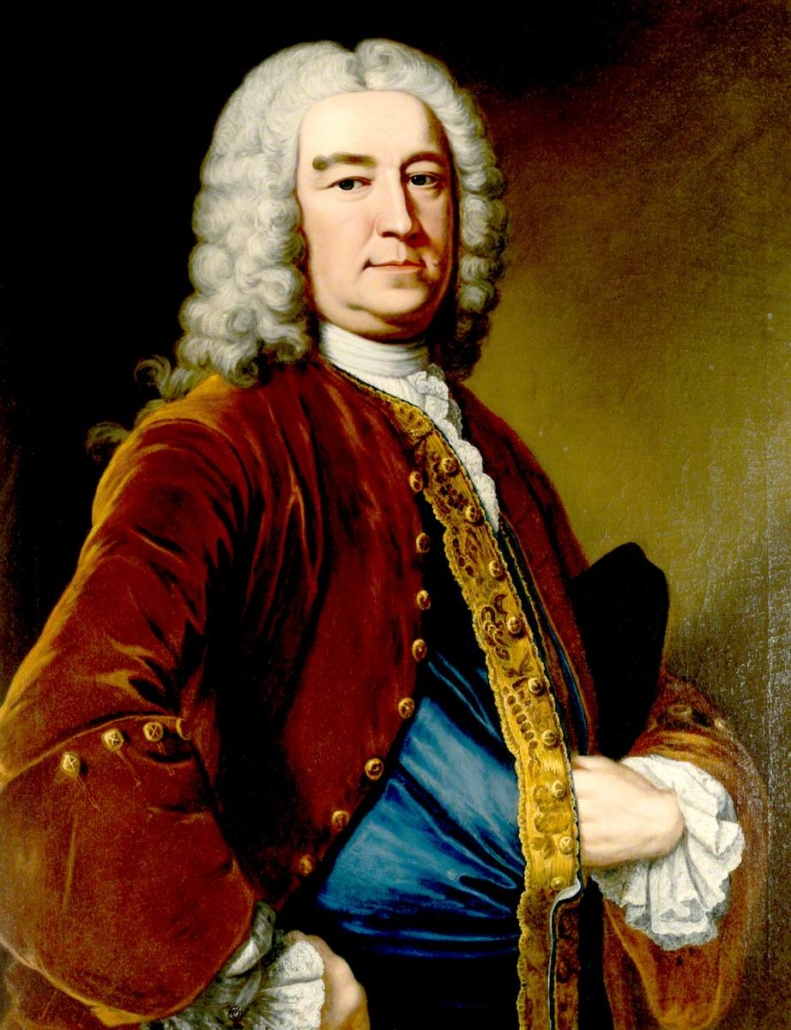


Henry Pelham (1694–1754), Whig Prime Minister who introduced the Jew Bill in Parliament in 1753

Part I: The English Common Law Basis of Tory Anti-Judaism

A legal case involving Robert Calvin, although seemingly unrelated, would play a key role in shaping attitudes and beliefs about Jews and Jewishness until the mid-nineteenth century. The plaintiff was born in Edinburgh, two years after the Union of the Crowns in 1603.  Some land was purchased on his behalf, to test whether his Scottish parentage was an impediment to ownership of English real property. However, it was promptly confiscated because, it was claimed, his birth had occurred outside the “ligeance” or dominion of the English Crown. This meant that Calvin, from an international perspective, was an alien. In 1608, the Lord Chancellor and justices of the Exchequer Chamber ruled in favor of the plaintiff, reasoning that since Scotland and England were ruled by the same monarchy, Calvin’s birth had actually occurred within the ligeance of King James I, making him a full subject with the same rights as an Englishman. The court concluded that he had been wrongfully dispossessed of the land.

The Elizabethan jurist Sir Edward Coke (1552–1634) used Calvin’s case to define the proper legal relationship between infidels and Christians:

All infidels are in law perpetui inimici, perpetual enemies (for the law presumes not that they will be converted, that being remota potentia, a remote possibility) for between them, as with the devils, whose subjects they be, and the Christian, there is perpetual hostility, and can be no peace.[1]

Since Jews were infidels, they were “perpetual enemies” subject to a plethora of civil and legal disabilities. In the First Part of the Institutes of the Lawes of England (1628), Coke wrote: “If the witness be an infidel, or infamous, or of non-sane memory, or not of discretion, or a party interested, or the like, he can be no good witness.”[2] This meant that Jews, because they were infidels, were not allowed to bear witness or testify in a court of law, even in cases of assault, robbery and murder. As far as English jurisprudence was concerned, the Jew was a legal non-entity.

Because Jews were perpetual enemies, certain interactions between Christians and Jews were punishable by death.  In the Institutes, Coke “found that by the ancient laws of England, that if any Christian man did marry with a woman that was a Jew, or a Christian woman that married with a Jew, it was a felony, and the party so offending should be burnt alive.”[3]

This was based on legislation recorded in the medieval Fleta, seu Commentarius juris anglicani (circa 1290):

Those who have connection with Jews and Jewesses or are guilty of bestiality or sodomy shall be buried alive in the ground, provided they be taken in the act and convicted by lawful and open testimony.[4]

In Coke’s opinion, Jewish-Christian relations were best governed by medieval common law, such as King Edward’s Statutum de Judaismo (1275) or the anonymous Fleta. His reverence for medieval law was based on an a posteriori approach to English jurisprudence. In his Reports, he wrote:

For any fundamental point of the ancient common law and customs of the realm, it is a maxim in policy, and a trial by experience, that the alteration of any of them is most dangerous for that which had been refined and perfected by all the wisest men in former succession of ages and proved and approved by continual experience to be good & profitable for the common wealth, cannot with great hazard and danger be altered or changed.[5]

The doctrine of the “Jew as perpetual enemy” remained on the books until the re-admission of the Jews in 1656. By that time, English jurists had begun to simply ignore it. It would be revived again by Tory parliamentarians in the eighteenth and nineteenth centuries.

In addition to the “perpetual enemies” doctrine, there was the “Christianity is law of the land” doctrine, also based on Coke’s legal analysis of Calvin’s case. The law of nature “which God at the time of creation of … man infused into his heart” was the “Moral Law,” which was, Coke said, “immutable,” existing “before any judicial or municipal law in the world.” This Christian “Moral Law” was a “part of the laws of England.”[6] Sir Matthew Hale, in the case of Rex v Taylor (1676), affirmed Coke’s position as the bedrock of English jurisprudence: “Christianity is parcel of the laws of England; and therefore to reproach the Christian religion is to speak in subversion of the law.”[7]

The “Christianity is law of the land” doctrine served as the legal justification for relegating Jews to second-class citizenship until 1858, when the Jew Lionel de Rothschild was allowed to take his seat in the House of Commons.

Part II: The Jews, the Whigs and the Tories, 1753

Jews were barred from full participation in English life because they rejected Christianity. They could only be “endenized by royal letters-patent” to become permanent residents; they could not become full subjects because parliamentary naturalization required taking the Eucharist. Compared to parliamentary naturalization, endenization had certain drawbacks. It was not retroactive, so if a Jew had been endenized after the birth of his children, they would not be able to inherit his property. The only advantage of endenization was that Jews were granted the right to participate in the lucrative colonial trade.

Endenized Jews, like other non-Anglican residents, “could not hold municipal office, be called to the bar, obtain a naval commission, take a degree in the two universities, vote, or be elected to parliament” (Rabin, 2006). Unlike other non-Anglican residents, endenized Jews were subject to additional restrictions. They could not participate in commerce on the same terms as other British subjects; they were not allowed to own real estate without parliamentary approval, nor were they allowed to become members of the most prominent West Indian trading companies. They were also compelled to pay alien customs duties on imported goods. These commercial disabilities hit the more commercially enterprising Jews very hard, disproportionately affecting the Sephardi community, rather than the Ashkenazi. The disproportionate impact stemmed from socioeconomic differences between Jewish ethnicities:

The Ashkenazim were poorer and tended to integrate less well; they accounted for most of the Jewish pedlars and small-dealers, and were associated in the English cultural imagination with the figure of the wandering Jew. … The Sephardim, by contrast, traded on a larger scale; wealthier and more politicised, they were arguably laxer about religious observances, shaved, and dressed in English fashions. (Latimer, 2015b)

Whether lending money to the Crown, to provision British troops and fight wars overseas, or hawking secondhand clothes in London’s slums, the Jews were disproportionately engaged in commercial and financial activity, just as they had been on the Continent. In London, the Sephardi Jewish community became so wealthy and influential they were able to successfully lobby the Whig government for naturalization. In 1753, Joseph Salvador, a prominent Sephardi Jew, convinced Henry Pelham’s Whigs to introduce the Jewish Naturalization Bill, or “Jew Bill” for short, in the House of Commons. The purpose of the bill was not to naturalize Anglo-Jewry, but to eliminate holy communion as a requirement for parliamentary naturalization, allowing Jews to participate in English commercial life as if they were full subjects of the British Empire.

The Jew Bill, drafted by Pelham and his brother, the Duke of Newcastle, was steered through Parliament as “a favor to some of the Sephardi mercantile elite who had been active in supporting the financial policies of the ministry and who had now solicited a favor from the government.”[8] Among the most prominent Jewish financial contributors was Samson Gideon, a Sephardi Jew who had loaned the Hanoverian Crown ₤1,700,000 (more than $2 billion in today’s dollars) to suppress the Jacobite Uprising of 1745 and establish order in the aftermath of the rebellion.

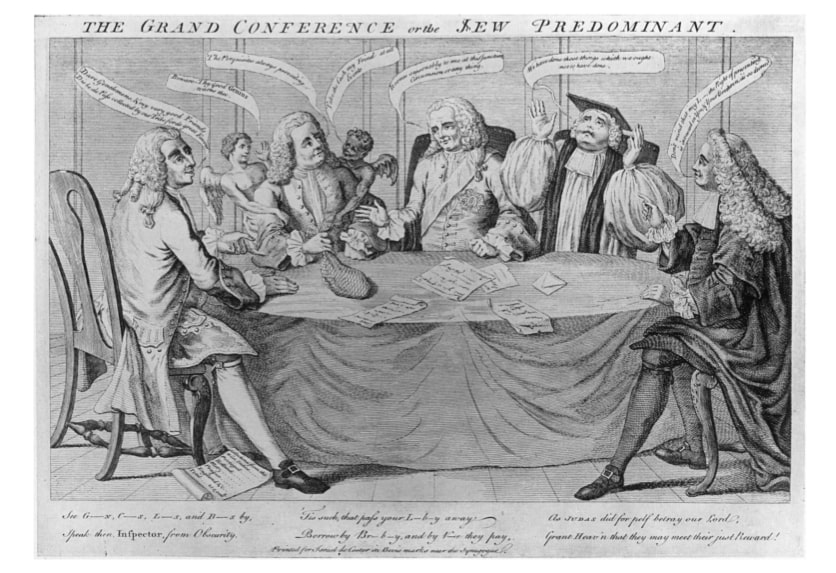
The English public believed that officials of Pelham’s ministry had received Jewish bribes in exchange for moving the Jew Bill through the Commons, a result of the government’s extensive financial dealings with Sephardi financiers and merchants. This belief was further disseminated by the anti-Jew Bill prints of 1753, where Jewish bribery of government was a common theme. In one such engraving, “The Grand Conference or the Jew Predominant,” Samson Gideon is shown bribing the Duke of Newcastle and Henry Pelham with a bag of gold in exchange for passage of the Jew Bill.
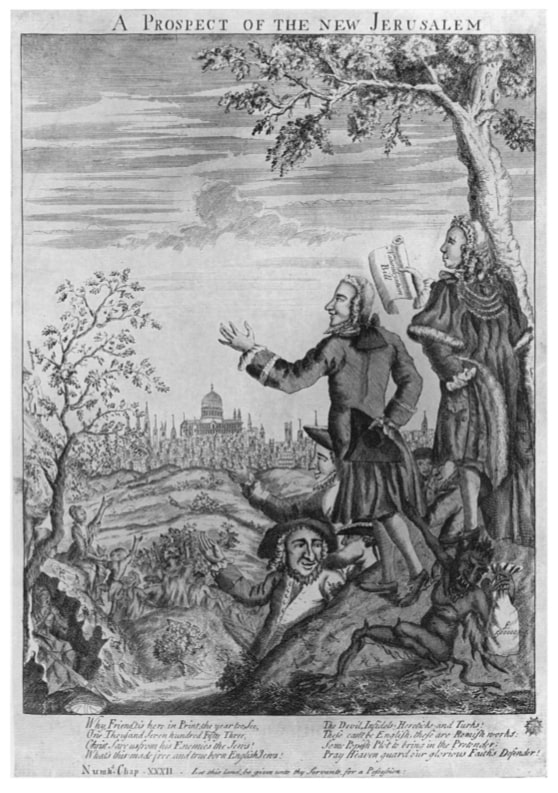
In another, “A prospect of the New Jerusalem,” the London Mayor, standing on a hill with municipal officials, holds a paper that says “Naturalization Bill”; in the immediate foreground is the devil with a bag marked ₤500,000. He points toward a group of Jews in the background, implying that the Jew Bill had been introduced in the Commons because of Jewish bribery. The widespread perception of Jewish financial meddling at the highest levels of government was, of course, grounded in solid fact.
Although the Jew Bill was a reward for Jewish financial assistance to the government, it inadvertently served the purpose of attracting more wealthy Jewish immigration to England. This allowed the Jewish financial elite to strengthen and consolidate its power and influence over the English Crown and economy, while threatening the ethnic cohesiveness and political stability of the English nation. Since the re-admission of the Jews, anti-Jewish laws—based on Lord Coke’s legal analysis of Calvin’s case—had been slowly relaxed to encourage more Jewish settlement. It was felt among Anglo-Saxon elites of the time that having Jewish merchants on English soil would help stimulate commerce and enrich the treasury.

In parliament, polarization reflected ideological differences between Whigs and Tories on the economic benefits of immigration. Thomas W. Perry writes:

In the 1750’s these orthodox opinions — exclusionist with regard to the whole economy, and restrictionist with regard to movement within it — were under attack, and so were all the more tenaciously held and alertly defended. The criticism came principally from a school of protoliberal pamphleteers who insisted that the economy would benefit both from an infusion of new blood, as it were, and from a freer internal circulation. The debate also had a political aspect, since most of these writers seem to have been Whig partisans, and since Henry Pelham was on record as favoring, at least in principle, not only a general naturalization but also ‘the repeal [of] every law, tending to establish a monopoly, in any quarter of the realm.’[9]       

Since the Tories prioritized nation over economy, they were staunch economic protectionists. As the proto-conservatives of the eighteenth and nineteenth centuries, they believed that restrictions on naturalization served the national interest because it protected natives from the demoralizing effects of foreign competition. In parliamentary debates, they focused on the potentially damaging effects of the Jew Bill on the English domestic and international economy. The Jews were considered especially dangerous because of their reputation for ruthlessness and lack of moral scruples in their financial dealings with non-Jews.

John Perceval, the second earl of Egmont, remained true to his Tory beliefs when, in a speech before the Commons, he dismissed Jewish naturalization as an economically harmful policy:

The trade of the Jews, as it appears by the oldest of our histories, and the earliest records both here and in other countries, was usury, brokerage, and jobbing, in a higher or a lower degree. By this traffic, in former ages, they distressed and ruined the Christian subjects in such numbers everywhere, as to draw down upon them from time to time the resentment of all nations, and in this traffic they have improved so far in this age, as now to ruin whole kingdoms instead of individuals, by aiding ministers to beggar the states they serve, by which traffic also they have greatly aided to plunge this nation into a debt of near eighty millions.

Lord Egmont said the Jews were a class of shady businessmen who had refused to engage in any “real commerce” or “honest trade of merchandize” since re-admission to England. This was understandable because, from the medieval period on, Jews were acknowledged by Europeans as a universal symbol of international financial corruption, a stereotype with more than a grain of truth to it. Contrary to the Whiggish belief that Jewish resettlement would economically benefit the of the kingdom, the potential Jewish contribution to English commercial life, in light of the historical record, was nugatory:

Since therefore the naturalization of the Jews tends to no important addition of property to this kingdom; to no possible increase in strength; to no improvement in manufactures; to no extension of the commerce of the kingdom; this bill can be no measure of utility, and cannot merit the sanction of this House.[10]

Sir John Barnard, a dissenting Whig, focused on the negative impact Jewish resettlement would have on native English productivity. He argued that Jews were a net fiscal drain on English society. Barnard demanded a permanent moratorium on all Jewish immigration because it would

in time render it impossible for any Christian to carry on any trade, either foreign or domestic, to advantage; Jews may become our only merchants, and our only shop-keepers. They will probably leave the laborious part of all manufactures and mechanical trades to the poor Christian, but they will be the paramount masters.[11]

Jewish economic control of the English economy was not the worst that could happen. According to Sir John Barnard, the Jews were a race of destroyers. Allowing Jews to compete on the same terms as Englishmen was tantamount to ethnic suicide:

It is madness, if not worse, to put … foreigners upon an equal footing with natives, because it only enables the former to take the bread, or part of the bread, out of the mouths of the latter, without increasing in the least the national trade or commerce.[12]

Notwithstanding the determined opposition of Tories and dissenting Whigs, the bill passed through both houses of Parliament, and was given royal assent by King George II. There was little dispute among MPs, since both houses were Whig-dominated. The Whigs, ideologically proto-liberal, were usually sympathetic to Jewish causes.

James Shapiro writes:

Insofar as Englishness was being reconstituted socially, politically, economically, and religiously at this time, the attempt to naturalize Jews—and thereby do away with that which distinguished Englishness from Jewishness—proved explosive.[13]

Passage of the Jew Bill was followed by a massive outcry among Tories; a wave of anti-Semitism, never before seen since the days of Edward I (r. 1272–1307), swept across England. The ferocity of this public reaction to Jewish naturalization was due, in part, to widespread perception of Jewish foreignness:

The non-Jewish world … viewed the Jews in their midst as a separate people, regarding even native-born, highly acculturated Jews as different in kind, marked off by a distinctive, irreducible essence or otherness that remained despite their adaptation to English conditions. In fact, the belief in Jewish distinctiveness was so embedded in popular consciousness that converted Jews, including the children of Jews baptized at birth, were commonly referred to as Jews.[14]

Through their attitudes and behavior, Jews reinforced English perceptions of their foreignness and clannishness that was based on kinship and thus independent of religious observance:

The mass of Jews … socialize[d] and marr[ied] within their own community, irrespective of their attachment to Jewish ritual and worship. Moreover, they continued to think of themselves as Jews first and foremost, as members of a distinct people, and not as Englishmen, even if they were native-born citizens who had known no other homeland. In this respect, they were no different from their ancestors, who had lived in conditions of much greater isolation from the surrounding society.[15] 

The emergence of English ethno-racial consciousness was a consequence of Jewish ethno-racial and cultural foreignness. Jews would maintain a fully articulated Jewish identity even when fighting for Jewish naturalization and, in the nineteenth century, “emancipation.”
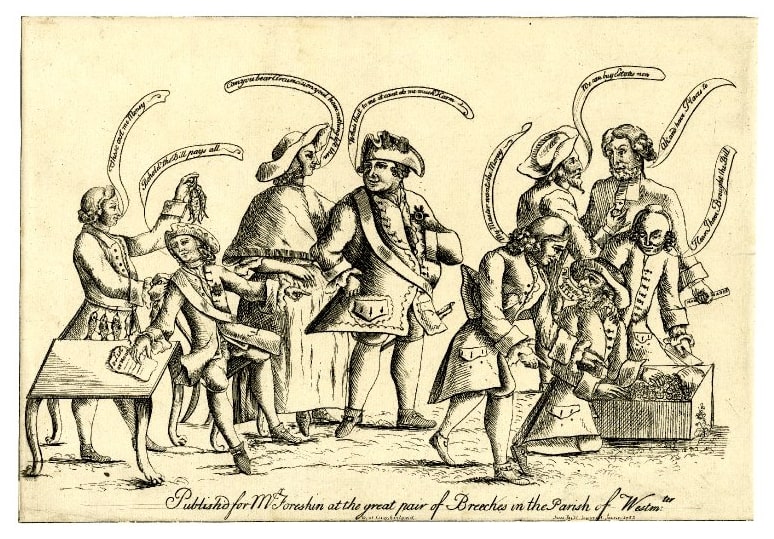
Publish’d for Mr Foreskin at the great pair of Breeches in the Parish of Westmter Satire on the Jewish Naturalization Act suggesting that the Duke of Cumberland is to be circumcised or castrated (1753)

Widespread perception of Jewish foreignness and self-identification served as fertile ground for the growth of extra-parliamentary opposition to Jewish naturalization. According to scholar Todd M. Endelman, the “agitation sparked by passage of the Jew Bill in 1753 functioned as a lightning rod for the articulation of nationalist sentiments at the time.”[16] Through pamphlets and newspaper editorials, ballads and songs, etchings and engravings, Tories were able to awaken a sense of English national pride in the common people, reminding them of the dangers of ethnic dilution and loss of Christian religious belief if Jews became Englishmen. Although Whigs would fret that Jews would remain an ethnically indigestible element on English soil, the Tories worried about the fragility of English ethnic identity and how easily it could be destroyed through assimilation of Jewry. As a verse of contemporary doggerel had concluded about passage of the Jew Bill:

Such actions as these most apparently shews,
That if the Jews are made English, the English are Jews.

Outside Parliament, Tory opponents relied on a combination of religious, patriotic, legal and economic arguments to convince the English public of the dangers of Jewish naturalization. Jonas Hanway, philanthropist and anti-Jewish pamphleteer, objected to Jewish naturalization because it was “as unnatural a mixture in the body politic, as bread and arsenic in the human body; and therefore such a mixture could produce no happiness, but, on the contrary, dishonor and reproach.”[17] The Jews were a dangerous foreign element—a poison—that destroyed everything it touched. Hanway further argued that because the Jews were a separate nation, guilty of “unparalleled iniquity,” such as “the national crime of crucifying the Lord of life,” their naturalization was undesirable.

In the anonymous pamphlet A Modest Apology for the Citizens and Merchants of London, who petitioned the House of Commons against Naturalizing the Jews, it was argued that Jews could never be naturalized because they were “Rebels against God” who were guilty of deicide.

“You know a Jew at first sight,” the author wrote:

Look at his eyes. Don’t you see a malignant blackness underneath them, which gives them such a cast, as bespeaks guilt and murder? You can never mistake a Jew by this mark, it throws such a dead, livid aspect over all his features, that he carries evidence enough in his face to convict him of being a crucifier.[18]

If the Jews were ever to become English citizens, the native English would share in the guilt of Christ’s murder, becoming “crucifiers” or “Christ-killers” themselves. Jewish naturalization would also subject the English people to divine wrath and punishment.

The High Church evangelical William Romaine wrote:

The Jews then in the Eye of the Common Law were always looked upon as Aliens – neither natural-born Subjects, nor capable of being naturalized – but perpetual Aliens, because there is no reasonable Ground to expect they will ever be converted, their Opposition to the Christian being as implacable as the Opposition of the Devil: For they are his Subjects, not Christ’s, and as Subjects to the Devil, they are in perpetual Hostility with Christ, so that there can be no peace between them and Christians.”[19] 

Jewish naturalization was impossible because of Lord Coke’s “perpetual enemies” doctrine. If Jews are the “avowed enemies of Christianity,” making them citizens would violate English law, since it was based on Christian principles. Romaine continued:

The Jews Murdered Christ, and would murder us if they had Power: They blaspheme Christ and his Religion; so that they are Murderers and Blasphemers Convict; and who ever heard of a natural-born Murderer, or a natural-born Blasphemer? For murdering and blaspheming Christ, God drove them out of the Holy Land, and made them Vagrants all over the Earth, and who ever heard of a natural-born Vagrant? Or a natural-born English-Foreign-Jew? i.e., a free Slave-born in the Liberty of Bondage. And yet however absurd this may seem, we have these Native Foreigners imported among us. We have Murderers, Crucifiers, Blasphemers, Vagrants all become natural-born Jew-Englishmen—in opposition to our History and Records—to our Constitution and Laws—to the Laws of God and to Reason and common Sense—which declare with one Voice, That no infidel Jew can be a free-born subject of our Christian society.[20]

The Jew Bill was to be rejected because the Jews were both Christ-killers and blasphemers. A “natural-born Jew-Englishman” was a contradiction in terms.

The Jews were not only “subjects of the Devil,” but were emblematic of the worst excesses of international finance. “Money is their idol. Money they most ardently worship.” If the essence of Judaism is money, then Jewish relations with non-Jews will always be economically predatory, just as they were during the days of King Edward I.

In Romaine’s discussion of Anglo-Jewish history, the Jewish “Money-Engine” figures prominently. The Jews successfully bribed William the Conqueror and Oliver Cromwell with their “ill-gotten Wealth”; seduced by the Jew’s “all-powerful Gold,” these English statesmen gave them carte blanche to grow rich through plunder of the nation’s inhabitants.

Beside the pamphleteers, there were the Tory newspapers that warned the English public of the dangers of Jewish naturalization. Foremost among these was the London Evening Post. In an editorial of May 17, 1753, a gentleman calling himself “Old England,” fearing the English would be “sold into Captivity under the Jews,” wrote:

This supposed Bill is nothing less than giving ourselves, our Liberty, Property, and Religion, into the Hands of the Jews. For it is an open, full invitation of the whole scatter’d Race to come and take Possession of all our Estates. For who knows not, that they have more Millions to spare than would purchase all our Island. … [I]f this Bill should pass, it is more than probable, that in Ten Years our Tenants may have Jewish Landlords, Two thirds of our Free holders be oblig’d to be circumcised, or vote as they are order’d. … God preserve us from Jewish Power!

In an article on the consequences of the Jew Bill, published June 23, 1753, an author asked rhetorically:

Doth not this give rise to a new interest in Great Britain, which never was known or heard of before? A Jewish landed interest? … will not dominion follow property? Or are our present managers in possession of a secret of frustrating the operation of this hitherto uncontested principle? Can they allow the Jews to purchase the half, or three parts, of the lands of the kingdom, and still withhold from them that weight and influence which is the consequence of property?

What would the distant future look like after passage of the Jew Bill, given that “dominion follows property”? The London Evening Post attempted to answer this question with the dystopian “News from One Hundred Years hence,” a satirical jibe at Pelham’s ministry. The year is 1853, England has been taken over by wealthy Jews, renamed Judea Nova and placed under the rule of the Sanhedrin. The Merchant of Venice is banned, “Galileans” are hunted down and shot on site, pork is illegal and naturalization of the few remaining Christians is now under debate.

The propaganda seems to have had real-world consequences. While the Jew Bill was law of the land: “Jewish peddlers were insulted and harassed in the streets and the murder of Jonas Levi in November of 1753 may have resulted from the passions sparked by the bill” (Rabin, 2006). Anti-Semitic polemicists portrayed Jews as money grubbing and cunning; they were traitorous foreign interlopers who were suspicious of outsiders. Newspapers all around the country ran story after story about what “ravenous, destroying Wolves,” “blasphemers and crucifiers” and “Children of the Devil” the Jews were. Because of the Jew Bill, patriotic Englishmen feared that:

Britain would be swamped with unscrupulous brokers, jobbers, and moneylenders, who would use their ill-gotten gains to acquire the estates of ruined landowners. Moreover, because dominion followed property, Jews would control Parliament (which would be re-named the Sanhedrin), convert St. Paul’s to a synagogue, circumcise their tenants, and perpetrate countless other anti-Christian crimes.[21]

Because of the widespread Tory-led opposition to the Jew Bill, Pelham’s Whigs were forced to repeal it in December of 1753. The status quo returned; Jewish immigration, which had been ongoing since Cromwell’s decision to re-admit the Jews in 1656, continued unabated.
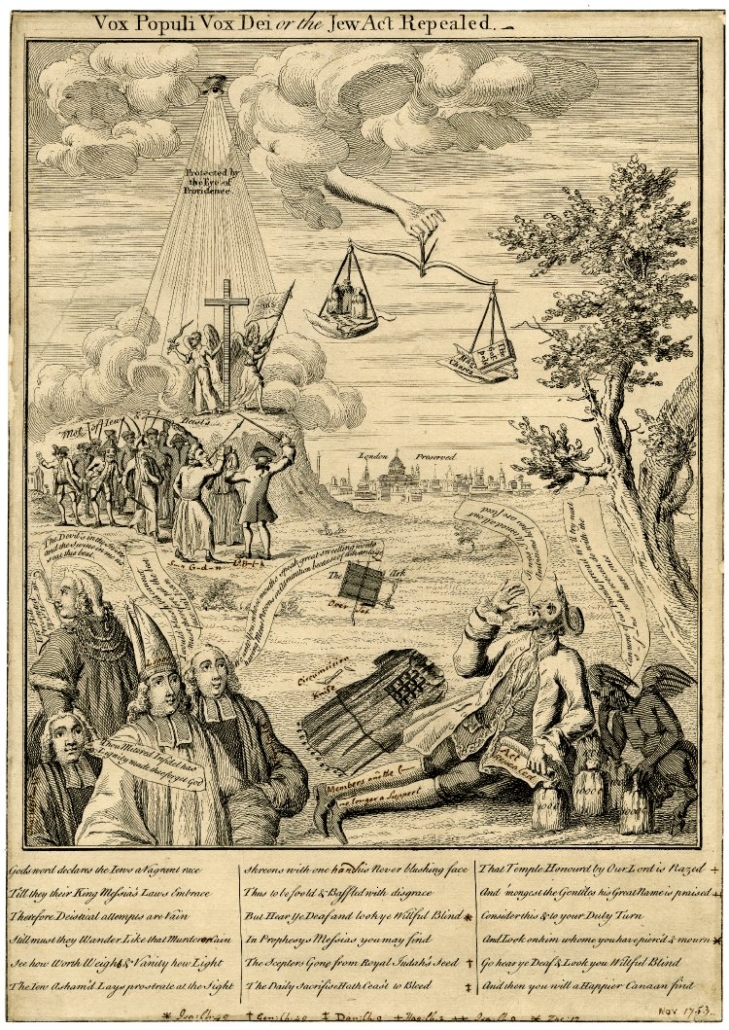
Vox Populi or the Jew Act Repealed (December, 1753)

The Jews pouring into England were now predominantly lower-class Ashkenazim from Central Europe, rather than the wealthy and cosmopolitan Sephardim of Spain and Portugal. This new influx stoked the fires of English anti-Semitism. The observations of German tourists in eighteenth-century Georgian England furnish us with a valuable source of information about contemporary Anglo-Jewry. Panikos Panayi writes:

Hostility … developed during the eighteenth century towards poor Jews. The German traveller Carl Philip Moritz wrote that ‘antipathy and prejudice against the Jews, I have noticed to be far more common here, than it is even with us, who certainly are not partial to them.’ Hostility focused particularly on the allegation that they played a large part in the peddling of stolen goods, which resulted in attacks upon them to the extent that ‘Jew-baiting became a sport.’ One German traveller wrote of ‘the general discontent of the nation occasioned by the German Jews, a class of men detested as the offscourings of humanity.’[22]

Mass immigration of Jews to England led to an increase in the national crime rate, with Jews among the most visible criminal elements of the London underground. Endelman writes:

Not many years after the controversy over the Jew Bill, Jewish criminal activity reached such a pitch that it became a matter of concern to the leaders of Anglo-Jewry. In the 1760s, the number of Jews sentenced to death or transportation at the Old Bailey jumped to thirty-five—almost double what it had been in the previous decade—and then in the 1770s it rose to sixty-five.[23]

The emigration of poverty-stricken, crime-prone Ashkenazim from Central Europe was reduced to a trickle during the French Revolutionary Wars of the 1790s, giving Ashkenazim in London and elsewhere time to assimilate Anglo-Saxon behavioral norms. By the 1820s, the Jews and their Whig allies would be ready to take on the Tories once again, but this time in the name of “Jewish emancipation,” an obvious misnomer. Compared to conditions on the Continent, the disabilities faced by Anglo-Jewry were mild, with Jews still having considerable upward mobility and freedom. In fact, English Jews were the envy of Central European Jewry, which is why so many immigrated to England during the latter half of the eighteenth century.


[1]     Seventh Part of Sir Edward Coke’s Reports, pg. 397

[2]     A readable edition of Coke upon Littleton by T. Coventry, 6b

[3]     Third Part, pg. 89

[4]     Vol.1, pg. 90

[5]     Fourth Part, pg. v, vi

[6]     Seventh Part, pg. 392

[7]     http://www.commonlii.org/uk/cases/EngR/1726/773.pdf

[8]     Endelman, 1999, pg. 59

[9]     1962, pp. 40-41

[10]   The Parliamentary History of England, From the Earliest Period to the Year 1803, 1813, Vol. XIV, pg. 1424

[11]   Ibid, pg. 1393

[12]   Ibid, pg. 1392

[13]   1999, pg. 196

[14]   Endelman, 2002, pg. 68

[15]   Ibid, pg. 67

[16]   2002, pg. 6

[17]   Letters Admonitory and Argumentative by Jonas Hanway (London, 1753), pg. 22

[18]   Perry, 1962, pg. 93

[19]   Ibid, pg. 10

[20]   An answer [by W. Romaine] to a pamphlet [by Philo-patriæ] entitled, Considerations on the bill to permit persons professing the Jewish religion to be naturalized, 1753, pp. 21-22

[21]   Endelman, 2002, pg. 75

[22]   1996, pg. 47

[23]   1999, pg. 196

WorldTruth.mx: The Best Pro-White Social Network You’ve Never Heard Of

In early September, after posting a link to my BitChute channel on the social networking site VK, I was contacted by one of the folks in my friends list, Michael James (no relation to this author), and asked to check-out a pro-White video-sharing network called WTVideo. After asking a few questions and finding out that the site was part of a group of social media platforms owned and operated by two men with strong pro-White sympathies (Michael being one of them), I decided to check it out. I joined the main site, WorldTruth.mx, introduced myself to Michael’s co-owner, Cozumel, and started posting. I liked what I saw, there was immediate feedback and a lot of interaction. So, after a few days I asked them if they’d like to do an interview to help get the word-out about their sites and explain what they are trying to do. Michael graciously accepted my invitation. We conducted this interview via email over an 18-day period beginning September 7, 2019.

Russell James: Sorry to be so late with this, but the tail-end of Hurricane Dorian is smacking northern New England right now, and we had a mini-emergency we had to deal with this morning.

Let’s get right into it, with the first question: To start, could you tell the readers a little about yourself?

Michael James: Basically, I am an average Joe is what some might think that would pass me by on the street or make casual small talk. Nothing could farther from the truth though; I work long hours on my IRL job and on my websites that promote freedom of speech even if I do not agree with that speech. I am divorced but have children that are grown now and I visit with them weekly.

RJ: How did you come to the conclusion that a social network that provided a platform for free speech was necessary?

MJ: Well, after seeing what other websites were doing to stifle any type of anti-establishment dissent for several years, I came to that conclusion, And that includes our video site as well, I personally have seen many times that “THEY” will deplatform or shadow ban people or groups that do not fit into the narrative they want projected which in my opinion is degeneracy.

RJ: What is your website and how does it work?

MJ: WorldTruth.MX (WT) is the website. We condone free speech, but I always tell people that we at WT do not protect someone from the consequences of that speech, so threats to staff or doxxing IRL is not tolerated. Perverse porn or underage porn is also not tolerated. We try to make the user experience pleasant for all members regardless of what country they come from. Read more

The Way Life Should Be? Vol. XIII: Ideological Stop-and-Frisk

Politicians largely serve at the pleasure of major corporate and financial interests and their Jewish backers.  Maine politicians are no exception, and many are deeply corrupt. As Mike Bond writes:

Some of America’s most corrupt politicians can be found in the windswept wilds of Maine. The Pine Tree State rates next-to-last in citizens’ trust of their legislators according to the Gallup Poll (April 4, 2014), and the Center for Public Integrity gives the state an F for corruption. Maine politicians appropriate taxpayer funds for their own companies, while governors pass legislation for huge energy projects which they then create companies to run. And energy companies write laws protecting their projects, laws that are obligingly passed verbatim by politicians who receive major payoffs from these companies. The Maine Center for Public Interest Reporting recently revealed that former state Senate President Justin Alfond introduced bills in the Senate written entirely by energy industry lawyers, after the industry awarded him with major donations to his Political Action Committee, funds which he then used to pay other Democrats so they would vote for him as state Senate President.

Senator Angus King has an atrocious record on immigration (as do his peers Representative Jared Golden, Senator Susan Collins, and Representative Chellie Pingree). I wonder who funds King? Well, some of the top donors throughout his career include JStreetPAC (the “pro-Israel” PAC which, “advocate[s] for policies that advance shared US and Israeli interests as well as Jewish and democratic values, leading to a two-state solution to the Israeli-Palestinian conflict”), as well as PACs representing and/or individuals affiliated with: Bernstein Shur, Unum, Bowdoin College, Northrop Grumman, Drummond Woodsum, Texas Instruments, Raytheon, Geiger, Jackson Labs, Lockheed Martin, Boeing, T-Mobile, Verrill Dana, Harvard University, Microsoft, TD Bank, Comcast, Google, LL Bean, Podesta Group, Bain Capital, Time Warner, Walmart, the Rosenthal Foundation, McKesson, Liberty Mutual, and Eliot Cutler LLC. You might remember our friend, the Jewish Eliot Cutler, Director and Senior Advisor to the Chairman and to the CEO at Thornburg Investment Management and former candidate for Maine’s governorship himself. The former partner at Akin Gump Strauss Hauer & Feld LLP is very pro-immigration and is deeply embedded in the “Woke Capital” axis presently destroying the country. In 2012, Angus King held a fundraising event with Michael Bloomberg, and has also received substantial funding from S. Donald Sussman’s Paloma Partners, LLC (more on them later).

We’ve gone over Jared Golden’s sources of funding in an earlier installment, but what of Collins, Pingree, and Governor Janet Mills? We do know Mills, like Portland Mayor Ethan Strimling and Congresswoman Pingree, received funding from EMILY’s List, a pro-abortion PAC founded by Ellen Malcolm. Other Mills donors include attorney Joe Bornstein, Justin Alfond, S. Donald Sussman, Ira Waldman of Cox, Castle & Nicholson LLP, Bernstein Shur, and LL Bean. Senator Collins’s major donors include PACs representing and/or individuals affiliated with: Goldman Sachs, the Blackstone Group, Marriott, Lockheed Martin, Raytheon, FedEx, Unum, Blue Cross/Blue Shield, the Cohen Group, Verizon, Kleinberg Kaplan et al, Lions Gate Entertainment, Liberty Mutual, New Balance, Boeing, Pfizer, Warner Media Group, MGM Resorts, Morgan Stanley, UPS, Bank of America, Aetna, AT&T, Walmart, Home Depot, AFLAC, General Electric, Hewlett-Packard, Northrop Grumman, General Dynamics, Berkshire Hathaway, Exxon Mobil, Microsoft, Visa, American Bankers Association, New York Life Insurance, MetLife, Citigroup, Cisco Systems, JP Morgan Chase, Target, Elliott Management, DLA Piper, Blank Rome LLP, MBNA Corp., Fidelity, and McDonald’s. Pingree, educated at the College of the Atlantic and the University of Southern Maine, has received substantial campaign donations either directly from or from PACs representing and/or individuals affiliated with: Goldman Sachs, General Dynamics, Unum, Harvard University, Berman & Simmons, the Rosenthal Group, Raytheon, Lockheed Martin, MoveOn.org, Boeing, Nancy Pelosi for Congress, the Sierra Club, Planned Parenthood, Diversified Communications, Farm Aid, Inc., Tishman Construction, Harvard University, Drummond Woodsum, the University of Maine, UPS, Texas Instruments, Prudential, Bernstein Shur, Joe Bornstein, Pfizer, Tides Foundation, and Caremi Partners.

An explosive report by the International Consortium of Investigative Journalists chronicled Les Wexner’s illicit dealings involving HSBC—a list including al-Qaeda members, Clinton Foundation donors, and Jewish financier S. Donald Sussman, ex-husband of Maine Democratic Congresswoman Chellie Pingree. Sussman’s Paloma Partners, LLC has donated over $236,000 to Pingree’s political campaigns and Pingree allegedly used Sussman’s private jet to attend campaign fundraisers, which is illegal. Pingree has also received over $100,000 from EMILY’s List and over $41,000 from JStreet.

Sussman has also donated large sums of money to EMILY’s List. In fact, he donated over $1.5 million to EMILY’s List in the 2018 election cycle alone. Angus King received $35,600 from Paloma Partners (on top of his almost $89,000 from JStreet), putting him in such company as Debbie Wasserman Schultz, Chuck Schumer, Kirsten Gillibrand, and…Chellie Pingree. Despite no longer being wed, Sussman seems to continue to be able to open the purse strings for the “progressive” Pingree. You may find it interesting that Pingree’s daughter, Hannah, was appointed to the newly-created post of Head of the Office of Innovation by Governor Mills.

Paloma Partners has also donated to Shenna Bellows, state senator and Executive Director of The Holocaust and Human Rights Center (introduced in Volume IV). Paloma Partners also fund Emerge Maine, an organization dedicated to “increase the number of Democratic women leaders from diverse backgrounds in public office through recruitment, training and providing a powerful network.” Emerge Maine also receives funding from Southern Maine Community College, Berman & Simmons, the University of Maine, the University of Southern Maine, Bates College, Drummond Woodsum, Golden Leadership Fund (Representative Golden’s organization), Bernstein Shur, and Time Warner. Sussman disperses funds widely over the state; in addition to the people and organizations we’ve just covered, he also finances or co-finances: the Maine People’s Alliance, along with George Soros; the pro-amnesty, pro-open borders Maine Center for Economic Policy; the Maine Democratic Party; Maine Equal Justice Partners (MEJP), notorious for suing the LePage administration because it stopped the flow of welfare to illegal aliens; State Victory Action (backers of Maine Governor Janet Mills), along with fellow Jewish billionaires Soros and Tom Steyer through his NextGen America; and Maine Women Together. S. Donald Sussman was also once the majority owner of MaineToday Media, effectively putting him in control of most of Maine’s largest newspapers (more on this next time). What better way to control the narrative than to control the media? The Jews learned this lesson a long time ago.

Sussman doesn’t just dispense funds through Paloma Partners, he also does so through tax haven loopholes by using his personal residence in the US Virgin Islands and shell companies like Simply Radiant in the British Virgin Islands.[1] Sussman, like many wealthy Jews, uses his largesse and his power to influence lawmakers to produce (or re-produce as the case may be) legislation that is advantageous to his co-ethno-religionists and key business and financial players—often one and the same. Returning to Mike Bond:

Hedge fund billionaire Donald Sussman, until recently the owner of most Maine newspapers, and the recipient of $200 million in taxpayer bailouts, was a major funder of an energy company now destroying Maine’s mountains, and whose previous Italian partners have been jailed in the largest Mafia bust in Italian history. His ex-wife, Maine Congresswoman Chellie Pingree, helped former Maine governor Angus King get a fraudulent $102 million taxpayer loan for energy projects he then made millions on, some of which he then used to buy his current seat in the US Senate.

Now entrenched, King and Pingree (and Mills and Strimling and Golden and Collins) are able to shape policy in Maine in such a way that the state has essentially become a playground for the rich. It is, on a much smaller scale, what has happened to countries like Ireland. In addition to tax loopholes and corporate tax breaks, many of these “philanthropic” organizations are tax-exempt, and charitable giving is also tax deductible. Add to this the fact that the government itself funds many of these organizations, and you have basically created the present situation whereby we pay for our own population replacement and subsidize massive corporate profits—all while buying their commercial products. It’s a sick joke.

Sussman is the perfect case study of the Jewish neo-liberal tycoon whose unscrupulousness most Whites would find appalling—if they actually believed it could, and does, happen here. Instead, it’s easy to retreat to “it’s the Democrats” or “it’s the Clintons,” and while in Sussman’s case both happen to be part of the picture, it is a woefully incomplete one to leave it at that. Look at the top donors so far in the 2020 election cycle—how many of them are Jewish? I’ll answer for you. Of the top 50 donors to 527’s and super-PACs, eight of the 36 Republicans are Jewish, and of the 14 Democrats, only one is not Jewish; moreover the top nine contributors to both liberals and conservatives are Jewish, with total contributions north of $62,ooo,000 and led by Tom Steyer’s $21,063,000. Though support for rogue state Israel is baked into the cake, explicit lobbies such as J Street and AIPAC are its visible icing, or the two pieces of foreign policy bread in this particular “kosher sandwich,” if you like. Philip Weiss writes:

J Street was for the Iran Deal, AIPAC was opposed. J Street was against S.1, the anti-boycott legislation passed by the Senate last week; AIPAC was for it. But to be clear, J Street opposes Boycott, Divestment and Sanctions (BDS) which [Ilhan] Omar supports. And J Street supports continued aid to Israel at the tune of $3.8 billion a year.[2]

On the one hand, the Jewish lobby demands America use its military to enact the Yinon Plan and shatter countries like Syria, and on the other they demand we open our doors to the same people we’ve been bombing into oblivion for Israel’s benefit. Stephanie Schriock, current president of EMILY’s List, had the following to say on the role of AIPAC in campaign fundraising:

Before you went to the Jewish community, you had a conversation with the lead AIPAC person in your state and they made it clear that you needed a paper on Israel. And so you called all of your friends who already had a paper on Israel — that was designed by AIPAC — and we made that your paper. This was before there was a campaign manager, or a policy director or a field director because you got to raise money before you do all of that. I have written more Israel papers than you can imagine. I’m from Montana. I barely knew where Israel was until I looked at a map, and the poor campaign manager would come in, or the policy director, and I’d be like, ‘Here is your paper on Israel. This is our policy.’ We’ve sent it all over the country because this is how we raise money. … This means that these candidates who were farmers, school teachers, or businesswomen, ended up having an Israel position.[3]

Just as is the case with liberals and conservatives in mainstream political discourse, it is the apparent opposition which is most damning. J Street exclusively funded Democrats (and the “Independent” Angus King), to the tune of over $4 million in the 2018 election cycle, whereas AIPAC tends to exert a greater, though not exclusive, influence on the Republicans. Although AIPAC does not technically contribute directly to political candidates, it does require its members to donate to the campaigns of certain candidates in order to receive exclusive membership benefits, and it is able to mobilize donors for their selected candidates. With respect to direct lobbying efforts, their 2018 expenses were in excess of $3.5 million—remarkably little when considering their clout, and likely an indication that politicians are self-censoring to avoid being targeted. The mission of both AIPAC and J Street (and their lesser-lights) is clear—protect Jewish interests and the state of Israel at all costs, even at the expense of American national security and civil liberties such as free speech. Regarding AIPAC, Peter Feld writes:

In 1988, at the Fairmont Hotel in San Francisco — yes, representing the Dukakis campaign at an AIPAC luncheon is a thing I have done in this life — I heard an AIPAC speaker boast unabashedly about AIPAC’s vast influence. In recent cycles, he said, AIPAC had punished enemies of Israel in Congress, like Senator Charles Percy of Illinois, who had lost his 1984 re-election after criticizing Israel’s settlements and Lebanon invasion[4]…It cannot be anti-Semitic to say that a lobby that spends large sums of money and boasts (at least to its own supporters) of its influence, is influential through money…Israel also exerts influence in the donations of wealthy individuals like Sheldon Adelson who has given the GOP a reported $100 million and was rewarded by Trump with the Jerusalem embassy move. It’s AIPAC, not the evangelicals, who made the Israel Anti-Boycott Act a legislative priority and got 292 House and 69 Senate cosponsors from both parties to place protecting Israel from criticism above their own constituents’ constitutional rights to free speech…It was AIPAC who helped force a different anti-BDS bill, S.1, to the Senate floor three times this winter in the midst of a government shutdown.

AIPAC and J Street are far from the only pro-Israel lobbies active in the United States, just the most prominent. The Center for Responsive Politics reports:

NorPAC, a nonpartisan PAC with the goal of supporting members and candidates who “demonstrate a genuine commitment to the strength, security, and survival of Israel,” spent more than $1.1 million in the 2018 cycle, with much of it going to Democrats…A variety of other groups other than AIPAC spend some money on lobbying, such as the Israeli-American Coalition for Action with $550,000…The group which spent the most on Republican candidates was the Republican Jewish Coalition which contributed $501,097 during the midterms. The group’s biggest contribution, $42,474, went to the campaign of Sen. Ted Cruz (R-Texas). On the Republican Jewish Coalition board is the largest individual donor from the 2018 cycle, Sheldon Adelson. Also holding a board seat is another big money donor, co-founder of Home Depot, Bernie Marcus.[5],[6]

Pro-Israeli foreign agents registered under the Foreign Agents Registration Act (FARA), which can include lobbyists working on behalf of the Israeli government, companies, political parties, and other organizations, spend tens of millions of dollars annually influencing American policy; the government of Israel has spent over $50 million since 2017, and other agencies such as the World Zionist Organization ($8.6 million in 2018) and the Jewish Agency for Israel ($7.4 million in 2017) have contributed an additional $33 million in that time frame, putting official—and I stress official—Israeli contacts third on the list of foreign entities that’ve spent the most in the United States over that time frame, almost double the amount spent by Russia.

While in Maine it is largely the Democrats who rely on out-of-state “dark money,” as evidenced above (see Susan Collins), this is not a partisan issue, nor is it just limited to PACs and Super-PACs. Corporations, banks, lobbyists, NGOs and other advocacy groups, defense contractors—all exert undue influence, nay, control, over our politics, and all are either under Jewish influence or are beneficiaries of Judeo-neo-liberalism. It is the money that is forever greasing the skids, but if that doesn’t work, there are others ways to ensure politicians remain compliant—just ask former Maine Senator and alleged Jeffrey Epstein sex ring participant George Mitchell.

Reposted with permission from The Anatomically Correct Banana.


[1] “Sussman’s firm, Paloma Partners, is a Simply Radiant shareholder, as are Paloma subsidiaries Golden Mountain Partners and Sunrise Partners, ICIJ data show. Paul Wolansky, a former managing director at the Paloma Partners, is listed as a Simply Radiant director. An individual named Harry S. Campbell is also listed as a director. He was previously a director of Cathay Investment Fund Ltd., in which Paloma is a major shareholder.” https://freebeacon.com/issues/offshore-tax-haven-leak-implicates-seven-figure-pro-clinton-donor/

[2] https://mondoweiss.net/2019/02/congressional-candidates-stephanie/

[3] https://mondoweiss.net/2016/04/forward-columnist-and-emilys-list-leader-relate-gigantic-shocking-role-of-jewish-democratic-donors/

[4] See also: Cynthia McKinney.

[5] https://www.opensecrets.org/news/2019/02/aipac-dont-contribute-which-pro-israel-groups-do/

[6] Bernie Marcus is also one of Turning Point USA’s primary financiers.


The Way Life Should Be? Vol. XII: LexisNestlé (Water under a Dilapidated Bridge)

As declining infrastructure and environmental degradation are part and parcel of neo-liberalism’s infinite growth model, it stands to reason that the most fundamental element of life—water—should eventually become commodified and privatized. This has already occurred to a frightening degree, though the process is not yet complete. We would do well to understand precisely what this entails and what methods are being used to achieve these ends.

With a market in excess of $19 billion in the US alone and a price point that’s nearly 2,000 times more expensive than tap water and four times more expensive than regular-grade gasoline, the market for bottled water is enormous, and its potential, if you’ll pardon the pun, is as of yet still largely untapped. It will not stay that way for long, though. According to a 2017 OECD policy paper, plans are already underway to create “a global public-private platform for knowledge exchange and effective engagement, collaboration, and action across governments and regulators in developed, emerging and developing economies, institutional investors, the private sector, international organisations, philanthropies, academia and civil society organisations.”[1]

This kind of hybrid action is not limited to just the OECD and its partners. According to the United Nations’ Agenda for Sustainable Development, the aim is for major multi-nationals to “collaborate with governments, UN bodies, NGOs, industry associations and other businesses to create more effective, enabling environments for achieving the Millennium Development Goals, on both international and national levels.” In addition to an accelerated wealth transfer from the First to the Third World to “bridge the infrastructure gap” and “combat climate change,” so-called “impediments to private investment in infrastructure” will be removed and “blended finance” will allow for public funds to underwrite projects where the profits will naturally accrue to the private sector.[2] In “neo-liberalese”:

Both public and private investment have key roles to play in infrastructure financing, including through development banks, development finance institutions and tools and mechanisms such as public-private partnerships, blended finance, which combines concessional public finance with non-concessional private finance and expertise from the public and private sector, special-purpose vehicles, non-recourse project financing, risk mitigation instruments and pooled funding structures. Blended finance instruments including public-private partnerships serve to lower investment-specific risks and incentivize additional private sector finance across key development sectors led by regional, national and subnational government policies and priorities for sustainable development…We encourage the use of innovative mechanisms and partnerships to encourage greater international private financial participation.[3]

As we’ve explored in other contexts, this vast matrix of organizations work in tandem or at least toward common ends through mutually-ensured profit-maximization schemes and social, political, and demographic transformation in whatever form will be most expedient. It is truly a global phenomenon:

Philanthropic funds often foster healthy information-sharing and cooperation among the organizations they support. They also often work on common problem-solving strategies with other kinds of donors. These include multilaterals such as the World Bank, the Global Fund, or the World Health Organization; bilaterals such as USAID and the UK’s Department for International Development (DFID); and large foundations, corporations, and significant individual donors.[4]

Many of the new philanthropic funds are funded by private equity and venture capitalists. New Profit, as just one example, is housed in the offices of Bain Capital (founding partner: Mitt Romney) and receives its funding from private equity professionals affiliated with Greylock, JP Morgan, and many other firms in addition to Bain Capital. These groups and individuals apply the private equity model to their philanthropy, which is reflected in a variety of ways (this will be explored more fully in the series’ final installment). In 2017, charitable assets in donor-advised funds reached an all-time high of $110 billion. Donor-advised assets have a growth rate of nearly 20 percent annually. In practical terms, let’s see what the profit-maximizing chain of events looks like with “charitable nonprofits” as the tip of the spear:

Splash, a relatively small nonprofit with revenues of about $3 million in 2017, that in 2018 received a green light for an investment of $20 million from the Children’s Investment Fund Foundation (CIFF), with a match of more than $12 million from city and state governments in Ethiopia and India, to dramatically expand its efforts to bring clean water to millions across the globe. Splash…was tackling an enormous problem (lack of clean water for people around the world); it was approaching that problem innovatively, using off-the-shelf technology employed by the most sophisticated corporations, such as McDonalds. For Splash, the big bet was designed to build something that local actors would then sustain. Eric Stowe, Splash’s founder and director, and his team pivoted to that longer-term vision and developed an investment concept with a clear and compelling goal: to provide clean water, sanitation, and hygiene to all public schools in two of the biggest megacities in the developing world. At the end of five years, Splash’s work in Kolkata, India, and Addis Ababa, Ethiopia, is expected to reach the point where local government and local private-sector actors, already well-established in those places, take it over.[5]

Now what happens when inevitable mismanagement from the local government causes regression to the mean? Well, those private sector actors are there to assume full control, and there are certainly plenty of bottled water companies out there to “supplement” cities suffering clean water crises with their products. We have seen the dire consequences here in the United States as a result of the demographic transformation of cities such as Flint, Michigan and Camden, New Jersey, and the consequent neglect, gross mismanagement, and corruption. These are reflections of a wider trend; since peaking in 1977 inflation-adjusted federal funding for water infrastructure has been cut 74 percent. On a per capita basis, that is an 82 percent drop. In 1977, the federal government spent almost $77 per person (in 2014 dollars) on water infrastructure, but by 2014 that support fell to slightly more than $14 per person.[6] As Alexis Bonogofsky reports:

According to the Environmental Protection Agency, the nation’s drinking water utilities need $384.2 billion in infrastructure investments over the next 20 years for thousands of miles of pipe as well as thousands of treatment plants and storage tanks to ensure the public health. Consequences of this inadequate investment have been seen in recent high-profile public health crises in Flint, Michigan, and the New Jersey public schools. Internationally, the UN finds that investment in public water systems and infrastructure is at an all-time low.[7]

The Trump administration has advanced plans to make it easier for private companies to control public water systems, including further cuts to federal funding for water protection; the administration’s plan “relies on a $100 billion fund incentivizing private sector involvement in public utilities to address aging pipes, aqueducts, and other critical pieces of hardware essential to the provision of drinking water.”[8] We already know what this looks like, and it is not pretty. From a 2018 exposé penned by Sharon Lerner and Leana Hosea:

Flint and Pittsburgh have many unfortunate parallels. Residents of both cities unknowingly drank water with high levels of the potent neurotoxin [lead], which has long-term health consequences. … The two lead crises have another important thing in common: a private water company named Veolia. The world’s largest supplier of water services, Veolia had contracts with both Flint and Pittsburgh around the time that lead levels rose in their drinking water. And in both places, Veolia wound up in legal disputes over its role in the crises. … The promise of saving money has been central to Veolia’s appeal to cash-strapped cities and towns struggling with water provision. That was certainly the case in Pittsburgh, where the water authority was facing more than $720 million in debt when it decided to contract with Veolia in 2012. The contract was based on Veolia’s “peer performance solutions” model, in which the company is paid based in part on how much it cuts costs.[9]

This has proven very lucrative for Veolia, which now has in excess of $30 billion in revenue and its stock price has increased more than 50 percent over the past half-decade. We also learn from Lerner and Hosea’s piece that, “At least some of those profits may be stowed in an offshore company Veolia set up in the Bahamas, according the Paradise Papers database.” Under Veolia’s oversight, residents’ water bills have steadily risen while the water quality has continued to decline. Controversy seems to follow Veolia wherever they’ve been contracted:

The company’s methods have also come under scrutiny outside the U.S., with controversies in CanadaFrance, and Gabon. In 2015, Romania’s anti-corruption agency launched an investigation into Veolia’s Romanian subsidiary, Apa Nova Bucuresti, and individual executives for allegedly running a multiyear, multimillion-euro bribery scheme in order to dramatically raise water rates.[10]

Though the crises caused by municipal degradation in Flint, Camden, and to a lesser extent Pittsburgh are in no small part the consequence of their demographic transformation, these kinds of systemic failures are not confined to cities and communities hammered by “diversity”—though that is certainly why they receive more media coverage than Martin County, Kentucky, for example. At nearly 94% white and entirely rural, Martin County is indicative of the deep neglect our non-metropolitan and –cosmopolitan communities suffer at the hands of a ruling class that hates them and wants them extinguished. Residents in Martin County have had to grapple with what has been described as “a catastrophically failing water system” compounded by water rates rising close to 50 percent, even though many residents have to purchase bottled water because the tap water is often undrinkable.

The continued failure—by design—at the municipal level both in public and private hands dovetails rather nicely with the privatization schemes of companies such as Nestlé that benefit from public disinvestment in water infrastructure, as the chairman of Nestlé Waters stated in 2009: “We believe tap infrastructure in the U.S. will continue to decline. … People will turn to filtration and bottled water for pure water needs.”[11] A recent Michigan State University study predicts over a third of Americans could be priced out of their municipal water supplies within the next half-decade as costs triple while the infrastructure continues to break down. The only alternatives will then be to turn to bottled water or find local natural springs that aren’t owned by these companies or other possible water sources; as 83% of Americans live in metropolitan areas and their suburbs and exurbs, finding clean natural sources of water will not be an easy task, to put it mildly. According to the United Nations, up to two-thirds of the world’s exploding population could be living under “stressed water conditions” by mid-next decade. Returning to Alexis Bonogofsky:

Internationally, bottled water consumption is estimated to have neared 70.4 billion gallons in 2013, according to data from the latest edition of Beverage Marketing’s report “The Global Bottled Water Market.” Consumption increased 6 percent in one year and is projected to grow. In fact, the International Bottled Water Association predicts the largest growth in bottled water to be in poor countries, where access to safe and clean water is not necessarily a given, and public water infrastructure is severely underfunded.[12]

Providing one case-in-point, Caroline Winter reports:

Failing infrastructure has already led to a near-total reliance on bottled water in parts of the world. Nestlé started selling Pure Life in Lahore, Pakistan, in 1998 to “provide a safe, quality water solution,” the company says. But locals wonder if the Swiss multinational is exacerbating the problem. “Twenty years ago, you could go anywhere in Lahore and get a glass of clean tap water for free,” says Ahmad Rafay Alam, an environmental lawyer in the country. “Now, everyone drinks bottled water…What Nestlé did is use a good marketing scheme to make tap water uncool and dangerous. It’s ubiquitous, like Kleenex. People will say, ‘Give me a bottle of Nestlé.’”…He adds that this change has taken the pressure off the government to fix its utilities, degrading the quality of Lahore’s supply.[13]

Nestlé has been anticipating and increasingly exploiting this situation for decades, controlling local springs and aquifers for their exclusive use. Other bottled water companies do the same. While people are literally dying from the water in Flint, a mere two hours down the road, Nestlé pays just $200 a year in municipal extraction fees to pump clean water and sell it at dramatically marked-up prices. Nestlé’s California water use increased by 19 percent during the major drought from 2011 to 2014. The company paid only $524 annually in permit fees to pump water from the San Bernardino National Forest—on a permit that was nearly thirty years expired, no less.

Nestlé generally seeks out areas with weak or antiquated water laws and regulations. In states like Maine and Texas, a law from the 1800s called “absolute capture” is still in effect. Absolute capture allows for landowners to use unlimited amounts of groundwater “captured” from said property. Nestlé will then appeal zoning resolutions and other restrictions to build massive facilities to extract the water, as in Fryeburg, Maine, where Nestlé’s Poland Spring line now has the means and the rights to extract water for the next twenty to forty-five years, perhaps longer.

Nestlé has sought to influence the political process at the state level in Maine as well, donating to such PACs as [Susan] Collins for Senator, Angus King for US Senate, Leading to a Balanced Maine, and the Alfond Business Community and Development. The Alfond Family, you’ll recall, are an extraordinarily wealthy Jewish family working to transform Maine both through their involvement in politics and through their many “philanthropic endeavors.” Nestlé/Poland Springs effectively has carte blanche in the state to buy up as many springs and aquifers as they can, privatizing what was once publically-accessible and what for many Mainers was their primary or secondary water source.[14] Water independence is part of the deeply self-reliant culture found in the state of Maine; 40 percent of Mainers drink private, unregulated well water as opposed to 86 percent of Americans who drink municipal water treated with fluoride, chlorine, and other chemicals. Furthermore, writes Winter:

Despite the Safe Drinking Water Act of 1974, compliance with harmful chemical restrictions isn’t monitored carefully, and most wastewater-treatment systems aren’t designed to remove hormones, antidepressants, and other drugs…77 million Americans are served by water systems that violate testing requirements or rules about contamination in drinking water, according to the Natural Resources Defense Council…[Bottled water] outpaced soda sales for the first time as drinkers continue to seek convenience and healthier options and worry about the safety of tap water after the high-profile contamination in Flint, Mich...Nestlé has come to dominate a controversial industry, spring by spring, often going into economically depressed municipalities with the promise of jobs and new infrastructure in exchange for tax breaks and access to a resource that’s scarce for millions. Where Nestlé encounters grass-roots resistance against its industrial-strength guzzling, it deploys lawyers; where it’s welcome, it can push the limits of that hospitality, sometimes with the acquiescence of state and local governments that are too cash-strapped or inept to say no.[15]

Nestlé will also sometimes buy water straight from a municipality with clean water, such as Fryeburg, and as Katy Kelleher writes, “sell it under its private labels, meaning that the same water flowing through faucets in Fryeburg for free is distributed in convenience and grocery stores throughout the country for around $1.99 a liter. One of those private labels is Poland Spring.”[16] If neither springs nor compliant municipalities with clean water are available, Nestlé is content to use common ground water from populated areas and pass it off as “fresh”; a recent lawsuit alleges Poland Spring bottles much of its water from ground water near petroleum pits, landfills, and densely-populated areas. In fact, per Kelleher, “Multiple lawsuits alleging mislabeling of water have been brought against Poland Spring over the past 20 years. A 2017 class-action lawsuit argued that ‘not one drop of Poland Spring Water emanates from a water source that complies with the FDA’s definition of spring water.’”[17]

Not that any of this comes as a surprise from a Nestlé that in the 1970s and 80s pressed a misinformation campaign on women across the Third World and aggressively marketed their infant formula—to be mixed with local water, which as we know is likely to be impure and/or polluted—as a superior alternative to breastfeeding. Nevertheless, the United Nations High Commissioner for Refugees (UNHCR) saw nothing wrong with entering into a partnership with Nestlé. In fact, in a darkly ironic turn:

In 2003, Nestlé began a partnership with the U.N. High Commissioner for Refugees (UNHCR) to address the water needs of 210,000 Somali refugees and local people in Eastern Ethiopia. The partnership was both financial and practical, including on-going technical assistance in the form of a Nestlé Waters hydrogeologist and water resources manager…During 2005, the process of handing over the long-term operation and maintenance of the system to local water authorities was commenced. … In November 2005, Nestlé became a founding member of BAFF, a coalition working to reduce vitamin and mineral deficiencies through food fortification. Nestlé is the world’s largest producer of manufactured foods fortified with micronutrients. Nestlé collaborated with NGOs, ENDA Tiers Monde, and the International Association for Maternal and Neonatal Health in Senegal to establish a number of local centers “to improve nutritional and hygiene status of mothers and their infants under 5 years of age.”[18]

The Nestlé Nutrition Duchess Club markets Nestlé products to children in countries such as Nigeria under the guise of humanitarian outreach in order to, “Meet basic needs such as nutrition, healthcare, water…through affordable products and services. Food and beverage companies can develop new products that combat nutritional deficiencies and are affordable to low-income families.”[19] Nestlé works with NGOs and governmental organizations in countries such as Turkey, Egypt, South Africa, and Malaysia to do something similar.[20] As we might expect, the unethical and probably lethal practices of Nestlé have not disqualified the company from “educating” Senegalese mothers on the very infant formula they’ll be purchasing in bulk—or subsidized to purchase in bulk in any case—for their average close to five children per mother. With its low average IQ, dearth of education,[21] and fecundity, Senegal makes for the perfect market, and these factors, along with what for succinctness’s sake we’ll call the “Jewish Question,” are key to understanding neo-liberalism. Recalling the marketing strategies used in Pakistan discussed earlier and understanding the just-aforementioned factors of the Senegalese and Third World peoples in general, Nestlé has endeavored to position itself as a major beneficiary of America’s continued demographic transformation and municipal services degradation:

According to a 2014 market research report, adults that consume large volumes of bottled water are more likely than average to be African American, and Latinos make up the key customer base for bottled water. Researchers from the Medical College of Wisconsin and the University of Wisconsin found that Latino and African-American parents were more likely to buy bottled water than white parents, and they are dishing out more money on bottled water primarily because of perceived health benefits. The bottled water industry markets to Latino immigrants…in part by exploiting bottled water as part of the immigrant “heritage” of coming from places with less access to clean drinking water. Nestlé Pure Life’s target audience is recent Latin-American immigrants, particularly mothers. In 2014, Nestlé spent over $5 million advertising Pure Life… and three-quarters of this spending ($3.8 million) went to Spanish-language television advertising.[22]

A recent Penn State study found that Black and Hispanic adults in the United States are half as likely as Whites to drink tap water and more than twice as likely to drink bottled water. Much of this is attributable to the state of municipal tap water in more “diverse” and urban environs, but the ability to market to these population groups more successfully is also a major factor. This may seem harsh, but disparities in intelligence and time preference do make Blacks and Browns better consumers, and a lower ability to engage in critical thinking makes these populations easier to manipulate and thus control. Despite the fluffy egalitarian propaganda that would force us to think otherwise, the ruling class understands this well—so well they’re party to mass genocide in order to produce a new hyper-consumerist, easily-controlled global serf class. It truly is a numbers game for them, and you can scarcely find anything more dehumanizing than that.

Reposted with permission from The Anatomically Correct Banana.


[1] http://www.oecd.org/water/Policy-Paper-Financing-Water-Investing-in-Sustainable-Growth.pdf

[2] From the OECD policy paper: “Blended finance is not an asset class, rather it uses a range of instruments to calibrate the risk-return profile of projects and to address other barriers to private investment…Challenges related to blending include the need for a good enabling investment environment, ensuring that development finance does not crowd out private finance and that the desired development outcomes are realised…Investments in water security compete with other sectors for financiers’ attention, driven primarily by the attractiveness of the risk-return profile. This depends on two factors: i) a stable revenue stream; and ii) how the range of risks related to water security investments are shared between public and private actors. Mobilising commercial finance, in particular domestic sources, need to be based on policy reforms of the water sector to promote efficiency gains, cost reduction and cost recovery, as well as improving the balance of tariffs and taxes as sources of finance.” Also from said paper, and of particular note to how the globalist entities view the project to commodify water and ultimately completely privatize it, with the state only useful in an interim stage as facilitator:

“[To date] water services are often under-priced, resulting in a poor record of cost recovery for water investments…Valuing water means recognising and considering all the diverse benefits derived from improvements in water management in terms of valued goods and services…It creates opportunities for converting the benefits from investments in water management into revenue streams, potentially improving the financial case for investment…Financial flows may benefit projects which are bankable, but may not maximise benefits for communities and the environment [my emphasis]…Mapping the flow of finance to water security investments can identify the ultimate sources of capital…The ‘Infrastructure Data Initiative’ was recently launched to address this need and support efforts to establish infrastructure as an asset class. This is a joint initiative by the OECD, the European Investment Bank, Global Infrastructure Hub, Long-term Infrastructure Investors Association and the Club of Long-Term Investors, which aims to create a centralised repository on historical long-term data on infrastructure (including water) at an asset level…This methodology should also explore the potential benefits from synergies emerging from interrelated projects and their impact on water resources. It would inform project preparation and selection by governments, development finance institutions and other partners.”


[3] https://sustainabledevelopment.un.org/frameworks/addisababaactionagenda

[4] https://ssir.org/articles/entry/reimagining_institutional_philanthropy

[5] https://ssir.org/articles/entry/becoming_big_bettable#sidebar1

[6] https://www.foodandwaterwatch.org/sites/default/files/rpt_1802_tbttbigwaterhustle-web.pdf

[7] https://truthout.org/articles/nestle-is-trying-to-break-us-a-pennsylvania-town-fights-predatory-water-extraction/

[8] https://theintercept.com/2018/05/20/pittsburgh-flint-veolia-privatization-public-water-systems-lead/

[9] Ibid.

[10] Ibid.

[11] https://www.foodandwaterwatch.org/news/nestle-and-others-cashing-us-water-infrastructure-crisis

[12] https://truthout.org/articles/nestle-is-trying-to-break-us-a-pennsylvania-town-fights-predatory-water-extraction/

[13] https://www.bloomberg.com/news/features/2017-09-21/nestl-makes-billions-bottling-water-it-pays-nearly-nothing-for

[14] To say nothing of the dramatic environmental impact: “Bottlers’ groundwater pumping operations can harm the local environment as well as natural resources that communities rely on for drinking water, farming, recreation and other uses. Groundwater sources are usually connected to surface waters, and when an aquifer is over-pumped, the water levels…can change. Large-scale groundwater extraction, such as for water bottling plants, could reduce the availability of local groundwater and surface water supplies to the detriment of the natural resources that depend on them. When bottled water companies extract groundwater sources, they not replenish what they take.” https://www.foodandwaterwatch.org/sites/default/files/rpt_1802_tbttbigwaterhustle-web.pdf

[15] Ibid.

[16] https://www.topic.com/wet-n-wild

[17] Ibid.

[18] https://www.nestle.com/sites/default/files/asset-library/documents/reports/csv%20reports/community%20and%20development/un_millennium_development_2005_2006_english.pdf

[19] Ibid.

[20] Nestlé, in conjunction with Project Head Start in townships around Pretoria, South Africa, “trains adult caregivers in adequate pre-school education to stimulate children, age 6 and under. Teaching materials as well as health and nutrition education are given to overcome negative effects of poor nutrition. Workshops and weekly training at the University include appropriate handling of HIV/AIDS cases in the pre-school environment (my emphasis) and treating of cuts and wounds”…Nestlé also provides funding for a dietician to give nutrition advice and help to “inner-city” HIV/AIDS patients in France.

[21] A corporation named Bridge International Academies (BIA) is opening for-profit schools across the Third World, where instructors in the Bridge schools teach a pre-scripted curriculum from a computer. Liberia is considering outsourcing its entire elementary program to BIA, which is funded by Bill Gates, Mark Zuckerberg, and a number of prominent interests from Wall Street.

[22] https://www.foodandwaterwatch.org/sites/default/files/rpt_1802_tbttbigwaterhustle-web.pdf

Anything to Stop Brexit: Churlish Attacks on a Noble Book

Jacob Rees-Mogg, The Victorians ( W.H.Allen, 2019)
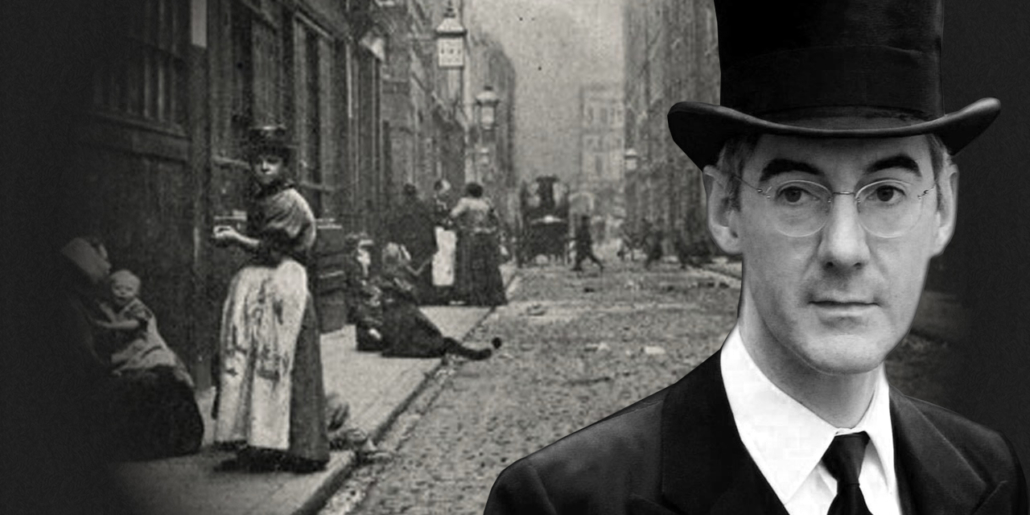

The author of this 440-page study of twelve “Titans who forged Britain” is a well-known right-wing conservative statesman, currently Leader of the House of Commons in the Boris Johnson Conservative government in the United Kingdom. Noted for his very traditional manner of self-presentation and his strong support for Brexit, Rees-Mogg was educated at Eton College and then read History at Trinity College, Oxford, after which he proceeded to a very successful career in finance before taking up his parliamentary career. He is a Catholic with six children and hails from Somerset in south-west England. The publication of this book was timed to coincide with the two hundredth anniversary of the birth of Queen Victoria.

Upon its appearance in May it was greeted with extraordinary hostility in some quarters. Dominic Sandbook described it as abysmal and soul-destroying. Writing in The Sunday Times he stated: “The book is terrible, so bad, so boring, so mind-bogglingly banal that if it had been written by anyone else it would never have been published.” In The Observer Kim Wagner wrote: “The book really belongs in the celebrity autobiography section of the bookstore. At best it can be seen as a curious artefact of the kind of sentimental jingoism and empire-nostalgia currently afflicting our country.” He called it “a sentimental vision of the past as the author wishes it had been,” resembling a series of “half-remembered anecdotes from a Boy’s Own story, or perhaps tales told by his nanny.”

In The Guardian Andrew Rawnsley commented that, while Rees-Mogg “claims an ambition to restore the reputation of this vivid period of history, all he achieves with this awful book is to make a shipwreck of his own pretensions as they are repeatedly dashed on the rocks of his incoherent thoughts before sinking under the dead weight of his lifeless language. … The only purpose of this dreadful pulp is to demonstrate why Britain’s past is no more safe in Jacob Rees-Mogg’s hands than its future.” A. N. Wilson in The Times wrote that the author’s effort was “anathema to anyone with an ounce of historical, or simply common, sense” and described the book as “a dozen clumsily written pompous schoolboy compositions” which amounted to “yet another bit of self-promotion by a highly motivated modern politician.” Also in The Guardian Kathryn Hughes commented: “In Parliament, Rees-Mogg is often referred to as ‘the honourable member for the 18th Century’, a nod to those funny clothes he wears, along with pretending not to know the name of any modern pop songs. What a shame, then, that he has not absorbed any of the intellectual and creative elegance that flourished during that period.” Simon Heffer in The Telegraph opined: “I find it hard to believe Rees-Mogg actually wrote this book or, if someone wrote it for him, allowed it to be published under his name. It is a complete turkey. … Parts of this appear to have been written by a baboon.”

Jacob Rees-Mogg 

Probably the most devastating assault of all came from master historian Richard J. Evans, famous ever since his role in the High Court defeat of David Irving’s defamation case against Deborah Lipstadt. In NewStatesmanAmerica he wrote: “To say that this is a selective reading of Victorian attitudes would be an understatement of huge proportions. … This is the view from inside the Westminster bubble. …The working class is entirely absent from this book, except as an object of upper-class philanthropy and the benevolence of politicians. … Rees Mogg’s perceptions are myopically rooted in the past. … The Victorians is written … in a plodding, laborious and barely readable style, completely lacking in humour, sophistication or polish as well as in every other literary quality. … The accolades distributed to Rees-Mogg’s subjects are framed in clichés that no half-way intelligent or discerning writer would dream of handing out. … Patriotic, enthusiastic and celebratory, The Victorians is the kind of history that Michael Gove, as education secretary, wanted to be promoted in the national history curriculum for schools, until he was forced to withdraw his proposals after a deluge of criticism and ridicule from the entire history profession. … This kind of colonial nostalgia exerts a baleful influence over the minds of Brexiteers today, who view the prospect of a ‘global Britain’, illusory though it is, as a kind of resurrection of the imperial glories of the Victorian era. … Rees-Mogg picks out of his source material only those aspects of his subjects’ lives that help him grind his political axe. … The Victorians is hopelessly inadequate as history, but it’s also too badly written, too pompous and too cliché-ridden in every sense to serve its real purpose as providing any kind of historical justification for Brexit. What’s most striking about the book is its naivety and simple-mindedness – qualities shared by the Brexiteers in full measure as they declare that nothing could be easier than leaving the EU.”

It is plain that this book has been met in many influential quarters with that “unmeasured vituperation” that John Stuart Mill noted of some political writing in his own time. The sort of malicious invective and sweeping exaggerations listed above clearly do much to de-authorise the writers’ attempted demolition, even if some of their observations may be true and some of their judgments may have merit. It’s time to consider the text itself to see what the real truth about it is. Read more

Borders for Us, Not for You: Higher Status in the Leftist Grievance Hierarchy Means You Can Invade Others’ Borders

Sex and race are, to the left, mere social constructs, abstract systems of delusion and injustice that can be overturned by human will and social engineering. It follows, then, that leftists will support and celebrate men who reject the social construct of sex and claim to be women. And leftists do support and celebrate such men.

Triumph of the Trannies

It also follows that leftists will support and celebrate Whites who reject the social construct of race and claim to be Blacks. But leftists don’t support and celebrate such Whites. Quite the contrary. While Bruce Jenner, a man claiming to be a woman, is worshipped and rewarded, Rachel Dolezal, a White claiming to be a Black, is ridiculed and punished. Steve Sailer and others have drawn attention to this contradiction, but I don’t think they’ve properly explained it. Why do leftists cheer when men cross the border between the sexes, but jeer when Whites try to cross the border between the races?

I pose those questions deliberately in that form to draw out the links between the left’s love of transgenderism and the left’s love of open borders. The Jewish libertarian Murray Rothbard (1926–95) described this aspect of leftist ideology very well in this passage of an otherwise long-winded and boring essay:

The egalitarian revolt against biological reality, as significant as it is, is only a subset of a deeper revolt: against the ontological structure of reality itself, against the “very organization of nature”; against the universe as such. At the heart of the egalitarian left is the pathological belief that there is no structure of reality; that all the world is a tabula rasa that can be changed at any moment in any desired direction by the mere exercise of human will — in short, that reality can be instantly transformed by the mere wish or whim of human beings. (Egalitarianism as a Revolt Against Nature, Modern Age, Fall 1973)

Rothbard was right in general about leftism, but failed to explain that highly significant exception: why does the “exercise of human will” allow Bruce Jenner and others to become women, but not allow Rachel Dolezal and others to become Blacks? Sex and race are both aspects of reality, but the left believes that only one of those aspects “can be instantly transformed by the mere wish or whim of human beings.” Why so? I would explain it by supplementing Rothbard’s explanation. Yes, he’s right when he says the left have a magical belief in the reality-transforming power of “human will,” but he doesn’t discuss what happens when there is a clash of wills.

The high and the low

Let’s look at transgenderism first. Men like Bruce Jenner and Jonathan Yaniv have “willed” that men can become women and must enjoy unrestricted access to all female spaces. At the same time, some women — the so-called Trans-Exclusionary Radical Feminists or TERFs — have “willed” that men can’t become women and must keep out of female spaces. There is a clash of wills that is settled, for the Left, by the status of the opposing sides. In leftist eyes, the men have higher status than the women, which is why the men’s will prevails and the women’s will is rejected. But hold on, you might be thinking: How can the men have higher status than the women in leftist eyes? It’s easy: the transgender men have cleverly aligned themselves not with men in general, who are indeed of lower status than women, but with homosexual men, who are of higher status than women.

Trangendered men are part of the “LBGTQ+ community,” which lifts them above women in the leftist hierarchy. Take Jonathan Yaniv, the perverted and probably Jewish male who claims to be a woman and has been suing female cosmeticians in Canada for refusing to wax his fully intact male genitals. If Yaniv spoke the truth, he would admit that he is a heterosexual male who seeks perverted sexual pleasure by passing himself off as a woman and receiving Brazilian waxes or entering female toilets to share tampon tips with under-age girls, etc. Obviously, then, Yaniv can’t admit the truth. Heterosexual men are wicked in leftist eyes and are well below women in the leftist hierarchy. Heterosexual men definitely cannot pass themselves off as women in pursuit of perverted sexual thrills.

Actual authentic lesbians

Yaniv and other “trans-women” must therefore align themselves with homosexuals to pass leftist purity-tests. As trans-women they claim to be members of a sexual minority, which triggers the leftist love of minority-worship. Indeed, Yaniv and some others go further than simply claiming to be women: they claim to be actual authentic lesbians. A pinned tweet at Yaniv’s Twitter account states that he is “One proud lesbian. I’ll never give up fighting for human rights equality. #LGBTQoftwitter.” Yaniv isn’t a lesbian, of course. Real lesbians — that is, real women who are sexually attracted to other real women — quite rightly reject fake lesbians like him, so the fake lesbians exploit leftist ideology again and accuse real lesbians of bigotry and hate.

Feminism has the concept of the “glass ceiling,” whereby women are unjustly prevented by sexist men from reaching the highest positions in politics, business and academia. Inspired by this, the fake lesbians have invented the concept of the “cotton ceiling,” whereby men like Yaniv are unjustly prevented by real lesbians from removing the underwear of said lesbians and having sex with them. Here is a trans-lesbian activist lecturing a sceptical TERF (i.e., Trans-Exclusionary Radical Feminist for those not up on the latest jargon) on the injustices of the cotton ceiling:

Trans women are female. When our female-ness and womanhood is denied, as you keep doing repeatedly, that is transphobic and transmisogynist. As I said earlier, all people’s desires are influenced by an intersection of cultural messages that determine those desires. Cultural messages that code trans women’s bodies as male are transphobic, and those messages influence people’s desires. So cis queer women who are attracted to other queer women may not view trans women as viable sexual partners because they have internalized the message that trans women are somehow male.

The comparison to what cis males say also makes no sense. What trans women are saying is that we are women, and thus should be considered women sexually, and thus be considered viable partners for women who are attracted to women. What cis males are saying is that queer women shouldn’t be exclusively attracted to women, which is completely different. (The Cotton Ceiling? Really?, Femonade blog, 13th March 2012)

It’s not “completely different,” of course. In both cases, people with penises are “saying” (and willing) that real lesbians should have sex with them. In both cases, real lesbians would be encountering the male genitals of real men. But the trans-activist believes in an act of verbal transubstantiation whereby a trans-lesbian possesses a “female penis” that, despite all appearances, is “completely different” to the nasty and objectionable penis of a “cis male.”

Aspects of religious psychology

I use the term “transubstantiation” deliberately. It’s a term from Catholic theology that refers to the supernatural process whereby wafers and wine transform into the flesh and blood of Christ during the celebration of Holy Eucharist by a priest. No physical or scientific test can detect this transformation and to all appearances the wafers and wine remain unchanged. But traditionalist Catholics will insist that the wafers and wine are now truly Christ’s flesh and blood. If you disagree, you’re probably safe nowadays but you wouldn’t have been in the past. It was very unwise to openly deny, let alone ridicule, transubstantiation in Catholic nations during the Middle Ages. And disagreements over the concept were central to the murderous hatreds of the Reformation. Those who believed in transubstantiation got very angry when it was denied.

This anger, which is part of the odium theologicum, is an important aspect of religious psychology, whether overt or covert — leftism can in fact be explained as a mutation of Christianity and Judaism. Overt and covert religions gain power by demanding belief in things that defy everyday reality, because such belief is difficult and requires a greater emotional investment. When we invest more in a belief, we have more incentive to protect it more strongly. And it is precisely because concepts like transubstantiation and the “female penis” are absurd that they are powerful. When we have an emotional investment in something we can’t prove, we react strongly when it is denied or ridiculed. That applies even more when we ourselves are subconsciously aware or afraid that our beliefs are baseless or false. Crushing external heresies can be a way of stilling internal doubts.

The “female penis” vs the “unisex brain”

And so religion and other forms of ideology can gain power by their contradictions and absurdities. However, in the clash between transgenderism and feminism, both sides believe in absurdities: the trannies insist on the concept of the female penis, just as the feminists insist on the concept of the “unisex brain,” namely, that there is no genuine difference between male and female brains. These two concepts are both biologically absurd: there is no such thing as a female penis, but there is such a thing as a female brain. However, if transgenderism and feminism are both powered by absurdities, why have trannies been winning the battle over the TERFs? Well, it’s partly because the trannies have the bigger, and therefore better, absurdities. For example, the “female penis” is an obvious absurdity, the “unisex brain” is much less so. Penises are out in the open, after all, whereas brains are hidden behind the skull.

And there is a continuum between a typically male brain and a typically female brain that doesn’t exist between male genitals and female genitals in the vast majority of cases. The psychological differences between men and women are a question of averages and tendencies, but the physical differences are generally stark and obvious (inter-sex individuals are rare). A certain group of trannies also have the stronger male will-to-power and love of battle, which is another reason they are winning the battle with lesbians. All this explains why the left supports and celebrates trannies as they cross the border between male and female. As a sexual minority, they have higher status than ordinary women. As a novel and exhibitionist sexual minority, they also have higher status than lesbians, who also have less will-to-power.

Better than Black

Indeed, as I pointed out in “Power to the Perverts!,” transgenderism has allowed some White heterosexual men to leap above the Black-Jewish lesbian feminist Linda Bellos in the leftist hierarchy. The White men are “transgender” and Bellos, although Black, is a TERF. In current leftism, transgender trumps TERF. Leftists therefore support the border-abolishing White men and not the border-erecting Black woman.

However, leftists would instantly support Bellos if those White men were claiming to be Black rather than female. Leftists want the border between male and female abolished, but not the border between Black and White. Why so? Again I would argue that higher and lower status settle the clash of wills. Rachel Dolezal “willed” that she was Black, while Blacks “willed” that she wasn’t. Dolezal was trying to abolish a border, Blacks were trying to maintain one, so a naïve reading of leftism would say that leftists should support “trans-racialists” like Dolezal just as they support transgenderists like Bruce Jenner. But leftists didn’t support Dolezal, and Blacks easily won the battle of wills. The border between Black and White stayed up, and Dolezal was ridiculed and punished, despite being more convincing as a Black than most transgenderists ever are as women.

High and low again

Why did this happen? Because Dolezal, as a White, had lower status than the Blacks whose territory she wanted to enter. When you have higher status, leftists allow you to control your borders. Their cry of “No borders, no nations!” only applies to those of low status. The Black nation is allowed to have borders against non-Black infiltrators, just as Israel is allowed to have borders against non-Jewish infiltrators. There was no way for Dolezal to align herself with a minority with higher status than the Blacks whose territory she wanted to enter. She had to pretend to be truly Black in a way that Bruce Jenner and Jonathan Yaniv don’t have to pretend to be truly women. And so Dolezal could be exposed as a fraud in a way that Jenner and Yaniv can’t.

Hey, haters: Karen White is a woman!

For example, a review of a film about Dolezal in the Guardian says that Dolezal “has become a pariah in Spokane, Washington” after she was exposed as having “appropriated blackness and then lied about it.” The film-reviewer, the stereotypically leftist non-White Arwa Mahdawi, says that this deception “seems like peak white privilege.” And that’s exactly what it is, in Mahdawi’s eyes: she thinks that the film “prioritizes a white woman’s feelings over the damage she has caused.” But what “damage” has Dolezal actually caused? None whatsoever by comparison with what transgender men have caused. In 2018 the heterosexual male David Thompson (born Stephen Terence Wood) already had “convictions for indecent assault, indecent exposure and gross indecency involving children, violence and dishonesty.” He was on remand for rape in a male jail, but claimed to be a woman called Karen White and was transferred to a female jail. He then sexually assaulted two real women. But Mahdawi would not say that White had “appropriated femaleness” and would not condemn his behaviour as “peak male privilege.” That would be transphobic!

Similarly, the Guardian has ignored the damage done by Jonathan Yaniv as he tries to destroy the livelihoods of real women by dragging them before a Human Rights Tribunal in British Colombia. And those real women are non-White. Why have Mahdawi and her anti-racist feminist sisters not leapt to their defence against the “male privilege” and “white privilege” of a White male predator? I think I’ve explained this above: it’s because transgender men like Yaniv, by aligning themselves with homosexuals, have won higher status than all ordinary women, even non-White ones. The men can therefore cross the border between male and female, while TERFs who try to defend the border are accused of hate and bigotry.

Parallels with mass immigration

This analysis obviously also applies to mass immigration by non-Whites into Western nations. To leftists, Whites have low status and therefore cannot maintain physical borders against non-Whites, who have high status. Nor can Whites maintain abstract borders of political identity. In leftist eyes, a Somali, Iraqi or Chinese who emigrates to Britain, America or France thereby becomes just as British, American or French as native Whites whose ancestors have lived there for centuries or millennia and who created the institutions, culture and history of those nations. Non-Whites can enter and occupy all White spaces, which is why we now have absurdities like Sir Lancelot, “The Most Gallant Knight,” being played by a Black actor:

A Black Sir Lancelot, courtesy of two Jews

Gallantry is not a Black concept — or a Jewish one. As the image above reveals, the Black Lancelot has been created and imposed on White audiences by the Jews Edward Kitsis and Adam Horowitz. This behaviour represents the later stages not simply of the culture of critique but also of a campaign of dissolution. Jews want to destroy all the borders and boundaries, physical, cultural and ideological, whereby Whites maintain their distinct identity and defend their own interests. That’s why Jews have long promoted the idea that America is a “nation of immigrants” and a “proposition nation” defined by ideas and ideology, not by the racial identity of its inhabitants.

In a way, characters like the Black Lancelot are a jeer of triumph over Whites, who are being told that they now no longer have the status or the power to maintain the borders of their own identity and culture. All White roles are now open to non-Whites, but non-White roles are closed to Whites. It would now be absolutely “unacceptable,” in leftist parlance, for a Black character like Othello to be played by a White. The Jewish role in this “appropriation” of White culture is obvious and was condemned by the late Larry Auster, himself a Jew, in his remarkably honest and clear-sighted article “Jews — The Archetypal Multiculturalists”:

Eastern European Jews, with their discontented, irrepressible temperament, were admitted as equals into a culture that had been formed by Anglo-Saxons and other northern European-origin people, with their pacific, self-controlled temperament. The former outsiders then proceeded to make their own sensibility the center of the culture, while diminishing and demonizing the Anglo-Saxon. … To seek to transform America into a Messianic project, to identify with the Other (whoever the Other may be) at the expense of the native majority, to deny to the native majority its ethnic identity while indulging in one’s own ethnic identity — this is not just a bad agenda, it is a Jewish agenda, and it is entirely moral for citizens of a free country to criticize it as such. (See Lawrence Auster on the Role of Jews in Disestablishing White, Christian America, The Occidental Observer, 13th March 2013)

Auster also condemns the “all-consuming narcissism” and “unmitigated, brazen arrogance” of Jews like the “attorney and law professor Alan Dershowitz.” Such Jews have conducted both the culture of critique and the campaign of dissolution, striving to throw down all borders and barriers with which Whites have defended their own interests and maintained their own identity. And that “all-consuming [Jewish] narcissism” and “arrogance” identified by Auster have never gone away. They have recently been on display in Open Borders: The Science and Ethics of Mass Immigration (2019), created by the Jewish economist Bryan Caplan and the Jewish illustrator Zach Weinersmith, who “make a bold case for unrestricted immigration in this fact-filled graphic non-fiction.”

Punims as propaganda: the cover of Open Borders by Jews Bryan Caplan and Zach Weinersmith

You could call the cover of the book “Peculiar Punims as Pro-Migration Propaganda” (punim is Yiddish for “face”). Drawn by Zach Weinersmith, the cover effectively presents migrants of all races as large-nosed Jews overseen by a similarly large-nosed Statue of Liberty. And Lady Liberty is displaying the “glory-hole gape” or “nümale grimace,” that is, the submissive open-mouthed grin identified by hate-thinkers like Chateau Heartiste and Men of the West as characteristic of low-testosterone leftist males (or soy-boys). I find the cover oddly disturbing and unpleasant. The peculiar punims are androgynous and abhuman, like those of robots or people drugged into compliance.

The nümale grimace

But although the diverse migrants to submissive America are presented as Jewish, that isn’t really how Jews regard non-Jewish migrants. Rabbi Laura Klausner-Janner, “Senior Rabbi” in British Reform Judaism and daughter of the alleged paederast Greville Janner, has claimed that “When Jewish people look at Calais migrants, we see ourselves.” But Rabbi Laura lived in Jerusalem for 15 years and knows perfectly well that Israel does not have open borders for “vulnerable and oppressed” non-Jews. Instead, it has firmly sealed borders equipped with very sturdy fences and very effective surveillance equipment.

It’s a question of high and low status again. As God’s Chosen People, Jews have the highest possible status and are therefore entitled to the best possible borders while being free to invade the spaces of all others. This accounts for phenomena like Jewish anti-White activist Tim Wise titling his book White Like Me and the common Twitter meme in which Jews claiming to be White loudly preach open borders and other liberal pieties that conform to Jewish interests and oppose the interests of Whites.

Likud celebrates the creation of Fortress Israel

And the borders maintained by Jews in Israel aren’t just physical. The poster above is read from right-to-left because it’s in Hebrew, the artificially revived language of the new Jewish nation. As I described in “Words as Weapons,” Hebrew and its script are barriers to entry by non-Jews and to penetration by foreign intelligence services. But Israeli intelligence finds no difficulty recruiting Jewish speakers of any important gentile language. The Jewish message to Whites is very simple: Borders for us, not for you. Leftists have the same message. And that’s why Bruce Jenner can become a woman, but Rachel Dolezal can’t become a Black.

The Way Life Should Be? Vol. XI: It’s All Happening

“The wage and employment rules have far-reaching, deleterious effects for workers and the US economy. H-1B workers are underpaid and placed in substandard working conditions, while US workers’ wages are depressed, and they lose out on job opportunities. Rather than fixing a market failure, the rules significantly distort the market and its price signals. It lowers incentives for workers and students to enter certain fields and reduces job mobility in sectors key to driving innovation in a regional economy. In sum, instead of fixing market failures, the H-1B program does just the opposite. It creates new market failures and exacerbates existing ones.”— Ron Hira and Bharath Gopalaswamy

“Under the new rules, employers experiencing a long-term need for a larger workforce could completely avoid the demands of the domestic labor market by serially employing H-2B workers to meet this long-term need. This would drag down wages and working conditions for workers in the industry or region as a whole. The combination of self-attestation, the elimination of the state workforce agencies, and the broadened definition of “temporary” will further depress wages in the industries in which the H-2B program operates, to the detriment of U.S. workers. And, because there is an endless supply of citizens of foreign countries willing to work in the United States … employers have little or no economic incentive to meet the economic demands of U.S. workers seeking a better wage.”—Associate General Counsel of the AFL-CIO, Lynne Rhinehart

“The financial sector has succeeded in depicting itself as part of the productive economy, yet for centuries banking was recognized as being parasitic. The essence of parasitism is not only to drain the host’s nourishment, but also to dull the host’s brain so that it does not recognize that the parasite is there.”—Michael Hudson

Labor’s share of income has continued to decline, and even in the corporate world, finance is an overgrown tumor. In 1985, the financial sector earned less than 16% of domestic corporate profits, whereas by the early 2000s it was over 40%. This is not coincidental, as the US continues to orient itself along a FIRE (finance, insurance, real estate) axis, which comprises the rent and interest paid by debtors and rent payers. As Gottfried Feder wrote, “Only labor is productive.” In a debt-driven economy, one predicated on an exponential growth model, extensive lines of credit, and the creation of new markets both in terms of consumers and goods and services, the entire apparatus is increasingly being built on a house of cards. The economy is basically a Ponzi scheme, one where all of the benefits accrue to the top (wildly disproportionately Jewish) 1%. When we see things like the self-created housing shortage in Britain corresponding exactly to the number of immigrants who arrive every year, when “conservatives” scream about a 2% inflation rate from the Federal Reserve, when the entire globalist establishment decries tariffs and “nativism” in favor of “free trade” and open borders, it’s not difficult to see what the angle is here. Per Michael Hudson:

When we say “people worry” about inflation, it’s mainly bondholders that worry. The labor force benefitted from the inflation of the ‘50s, ‘60s and ‘70s (my note: which is also why the populist movement of the late-19th century, led by William Jennings Bryan, advocated a move away from the gold standard). What was rising most rapidly were wages. Bond prices fell steadily during these decades. Stocks simply moved sideways. Inflation usually helps the economy at large, but not the 1% if wages rise. So the 1% says that it is terrible. They advocate austerity and permanent deflation. And the media say that anything that doesn’t help the 1% is bad. But don’t believe it. When they say inflation is bad, deflation is good, what they mean is, more money for us 1% is good; we’re all for asset price inflation, we’re all for housing prices going up, and we’re all for our stock and bonds prices going up. We’re just against you workers getting more income.[1]

Now obviously inflation is to be differentiated from hyper-inflation—the kind that occurs when you steal Whites’ land and drive them out of the country, as happened in Rhodesia, and which is now set to commence in South Africa and probably Namibia in the near future. Cultivating Community in Portland tries to set up refugees from Africa with their own farms in Maine, which is a fool’s errand, considering over 60% of the arable land in Africa lies uncultivated, and when in Rhodesia, for example, the White farmers were dispossessed of their land, “the Breadbasket of Africa” fell apart so quickly its currency was insolvent within a few years and it went from a food exporter to a food importer. To top that off, Maine has notoriously acidic soil, so only a local and/or a truly expert farmer is going to get much out of the land. Therein lies the rub with regards to sustainability—only locals and/or people who are otherwise expert know their land or their oceans well enough to have good crop yields or catches that do not deplete resources and destroy the ecosystem. Neo-liberalism does not allow for that. What it does allow for in its exponential growth model is, as Hudson illuminates:

If the economy is growing, people want to employ more workers. If you hire more labor, wages go up. So the 1% always wants to keep unemployment high—it used to be called the reserve army of the unemployed. If you can keep unemployment high, then you prevent wages from rising. That’s what’s happened since the 1970s here. Real wages have not risen, but the price of the things that the 1% owns has risen — stocks, bonds, trophy art and things like that.[2]

This is precisely why, despite over one-third of eligible Americans not participating in the labor force and increasing automation making certain jobs redundant, immigration continues to rise. The infamous New York Times article about how Maine “needs” African immigrants includes a section where these newcomers are expected to become lumberjacks in the Great North Woods, which is curious, since, as a recent Washington Post piece notes, northern Maine has been “battered by the closure of its lumber mills.” Coinciding almost exactly with the opening of the immigration floodgates into America, beginning in the early 1970s, wages essentially remained stagnant in this country until recently, where by some indicators they are on the decline for the majority of American workers, which makes total sense. Similarly, the very conditions which drive away the young and suppress birthrates are of course never discussed; instead, we must import enough “diversity” to drive down wages, increase alienation and consumption, lower trust, and make cross-cultural communication and thus labor organizing impossible. This is despite the clear disingenuousness of the vested interests declaring a “labor shortage” in the third-most populous country in the world. As David Seminara:

Economists have found no evidence of a labor shortage in the occupational groups that constitute the bulk of H-2B employment. George W. Bush was a vocal advocate for guestworker programs. In 2004, Bush proposed a new guestworker program that, had it been enacted, would have tripled the number of visas issued to seasonal workers. On January 18, 2009, his administration published new regulations that significantly reduced oversight of the H-2B application process and extended the definition of “temporary” in the H-2B context from 10 months to up to three years. The H-2B visa was created in 1986 (the same year of Reagan’s illegal alien amnesty), as part of the Immigration Reform and Control Act, which split the H guestworker program into an H-2A visa for agricultural guestworkers, and an H-2B visa for non-agricultural guestworkers. The popularity of the H-2B program for temporary, seasonal, non-agricultural guestworkers has soared from just 15,706 visas issued in 1997 to an all-time high of 129,547 in 2007. American companies filed petitions to request nearly 300,000 H-2B workers in FY 2008. Use of the H-2B program has morphed from its original intent to help employers that need seasonal and/or temporary workers. The majority of the program’s current users are neither small nor seasonal employers, but rather mid- to large-sized companies and recruiters that petition for H-2Bs to work for 10 months out of the year, year after year. Many of the businesses filing H-2B petitions for foreign workers are “body shops” that have no actual “seasonal or temporary” need for labor. Body shops can petition for large numbers of workers and then essentially sell them off to companies that either could not get their own H-2B workers or did not know how to do so.[3]

This is very clearly not a partisan issue; the entire Establishment, political and private sector, is in total agreement that more non-White immigration is always beneficial. Whether the labor is “specialized”[4] or not is irrelevant. We’ve also discussed the transformative role H-2A visas play in Maine’s targeted demographic transformation, and now the United States has offered to triple the number of H-2A visas issued to Guatemalans “to reduce the pressure on the Southern border”—which will in no way incentivize more to come. This comes—like Reagan’s amnesty and the creation of the H-2B visa, the “invade the world, invite the world” ethos of the neo-conservatives, and so on—under a “conservative” regime. As Charles Eisenstein astutely observes:

In opposing redistributive policies, conservative governments seem to see concentration of wealth as a good thing. You might too, if you are wealthy, because concentration of wealth means more for you and less for everyone else. Hired help is cheaper. Your relative wealth, power, and privilege are greater. Governments serving the (short-term) interests of the wealthy therefore advocate the opposite of the aforementioned distributive policies: flat-rate income taxes, reduction of estate taxes, curtailment of social programs, privatized health care, and so forth.

From the US Chamber of Commerce on down, this is seen as a good thing indeed. The Maine State Chamber of Commerce has become a leading voice in supporting an increased role for immigrants in the workforce. Republicans are happy to do their part; Jewish Republican State Senator Roger Katz:

Sponsored LD 1492, an Act to Attract, Educate and Retain New Mainers to Strengthen the Workforce…The bill in its original form would have established a state office for “new Mainers” to carry “out responsibilities of the State relating to immigrants in and into the State.” The bill also would have funded a second immigrant welcome center for the state, located in Lewiston and modeled on Portland’s New Mainers Resource Center, which receives $75,000 a year in state funding. Katz’s bill included funding for vocational and workforce training and English-language training, too. All told, the projected 2018–19 costs were $825,000. …“What has changed (about the immigration issue) is that as our workforce challenges have grown—you are hearing an outcry from the business community,” says Katz. “Because we need more workers, the voices in the Maine Legislature have changed from the usual social justice advocates. They are now being joined by chambers of commerce and business men and women from around the state (my emphasis). That’s starting to really shift the attitude.”[5]

Rachel Peric, Jewish executive director of the Soros-backed immigration advocacy group Welcoming America, concurs, and she uses Baltim0re, Maryland as one example of an immigration success story. The Partnership for a New American Economy (discussed in a previous installment) and their financial backers and corporate partners—Google, Intel, Microsoft, United Fresh Produce Association, Jewish venture capitalist and Managing Director of the Foundry Group Brad Feld, the National Council of Farmer Cooperatives, American Farm Bureau Federation, the US Chamber of Commerce, American Immigration Lawyers Association, Pinterest, Society for Human Resource Management, the Council for Global Immigration, Western Growers, and eWIC—agree: think of the GDP growth! Also in agreement are Vaishali Mamgain of the University of Southern Maine and Karen Collins, formerly of Catholic Charities Maine Refugee and Immigration Services in Portland: it appears only “white supremacists” object to “policies to facilitate refugee resettlement in Maine.” According to David Brenerman, “a Democratic member of Portland’s City Council who is Jewish” and Chair of the Economic Development Committee, and Julie Sullivan, Senior Advisor to the City Manager:

Immigration is an important part of this city’s economic growth strategy and improving immigrant integration is critical to ensuring Portland’s work force and vitality… The Committee’s research and public input seem to point to creating an Office of Economic Opportunity and Immigrant Integration…to also improve economic opportunity for youth, people of color, and other disadvantaged populations… There would be a Director overseeing the Office, with a Program Manager implementing the Immigrant Integration efforts and a Program Manager implementing the Inclusion and Equity efforts focused on people of color…[plus] proactive, consistent and systematic outreach to employers to identify jobs that are difficult to fill and subsequent partnering with Portland Adult Education, Southern Maine Community College, and the University of Southern Maine to provide those skills…The Director would work on the more macro level issues and would convene partner organizations, build the intern/apprentice/mentor programs, oversee the data tool development, and link with funders.

Who would this matrix of partners and funders include? Among those proposed were: Catholic Charities Refugee and Immigration Services, Coastal Enterprises, Inc. (CEI), the University of Maine Law School, Immigrant Legal Advocacy Project (ILAP), Maine Access Immigrant Network (MAIN), Maine Equal Justice Partners, New Mainers Resource Center and Portland Adult Education, Pine Tree Legal Assistance (PTLA), and the State of Maine Office of Multicultural Affairs. PTLA receives funding from the Sam L. Cohen Foundation, the Harvard University Consumer Project, and the J.T. Gorman Foundation, among others.[6] One of the JT Gorman Foundation’s primary financiers is the Jewish Burton Sonenstein, and the Investment Committee Chair is Maggie Keohan, who “advises high net-worth individuals and institutional clients throughout New England from Goldman, Sachs & Co.’s office in Boston.”

Maine Business Immigration Coalition advocates for immigration “from a business and economic perspective,” though not without the essential ingredients of ersatz compassion and humanitarianism; its partner organizations include: Barber Foods, Ready Seafood, Coastal Enterprises, Inc. (CEI), MaineHealth, Maine State Chamber of Commerce, SIGCO, several seafood companies, and of course the Partnership for a New American Economy (NAE). Also partnered, in one of the great ironies of this whole affair, is the Portland Buy Local campaign. Ready Seafood:

One of Maine’s largest lobster-processing companies, now has a workforce of more than 200 in Portland and Scarborough that’s more than half foreign born. … Ready Seafood has now developed a pipeline for new workers, making the time-consuming task of recruitment easier. … Ben Waxman, co-owner of American Roots, the Westbrook clothing manufacturer, echoes Skoczenski’s comment about the importance of immigrants to his company’s survival, … To make it easier for businesses to connect with immigrants and to help coordinate services, the city of Portland created the Portland Office of Economic Opportunity in 2017. Run by Julia Trujillo, its mission is to help integrate immigrants into the economy so that businesses can connect with potential employees. … Skoczenski points to the office as the source of Ready Seafood’s recruitment success: “Julia is the only reason this program is working for us.”[7]

If all of these businesses thrive on cheap labor, well of course it makes sense for them to donate to so-called philanthropic organizations which advocate for “immigrants’ rights” and open borders—they do their dirty work without any direct accusations of “dirty money” and lobbying efforts.

What we know is that for both ideological and economic reasons Maine finds itself “suddenly” in the crosshairs of the globalist establishment. From Time to the New York Times to The Christian Science Monitor to the Huffington Post,[8] we are told in unison that Maine is too old, too White, and in dire need of Haitian nurses, Guatemalan blueberry rakers, Somali who-knows-what?, and all the rest of it. As this sudden media blitz is totally organic and definitely not coordinated at all, enter Jeff Bezos’s Washington Post stage left: In “‘This will be catastrophic’: Maine families face elder boom, worker shortage in preview of nation’s future,” written by Jeff Stein (you can’t make this stuff up), the neo-liberals show their hand to anyone paying attention:

Across Maine, families like the Flahertys are being hammered by two slow-moving demographic forces — the growth of the retirement population and a simultaneous decline in young workers — that have been exacerbated by a national worker shortage pushing up the cost of labor (my emphasis). … The disconnect between Maine’s aging population and its need for young workers to care for that population is expected to be mirrored in states throughout the country over the coming decade, demographic experts say. And that’s especially true in states with populations with fewer immigrants, who are disproportionately represented in many occupations serving the elderly…“As the oldest state, Maine is the tip of the spear — but it foreshadows what is to come for the entire country.” (my emphasis) … Experts say the nation will have to refashion its workforce …. The results of not doing so fast enough are already visible in Maine…Care workers in Maine were paid about $11.37 an hour in 2017, according to an AARP report, with a 2019 minimum wage of $11 an hour. …“Even Dunkin’ Donuts pays you more.”…The rising demand for care is occurring simultaneously with a dangerously low supply of workers…“There are simply just not enough people to go around,” [Mary Jane Richards, chief operating officer at North Country Associates] said. “We try to elevate our wages, but then the nearest facility brings theirs up.”[9]

Oh, the horror of having to pay workers a living wage! Also of note in this piece is the commentary by mass non-White immigration advocate and senior fellow in the Urban-Brookings Tax Policy Center at the Urban Institute Howard Gleckman. Gleckman is not Jewish.

Just kidding, of course he is! Gleckman makes the seemingly apropos-of-nothing argument that, “With climate change, towns get burned down, or people die in fires.” We’ve talked about climate alarmism before—in addition to the monetization of carbon emissions and the creation of a new financial market, “climate change” and open borders are synonymous—because “climate change causes migration,” we need to accept any and all (non-White) comers who will increase their consumption while we are expected to confine ourselves to matchbox-sized apartments, sterilize ourselves for the environment, and eat soy and maggot sausages, all while remaining great consumers in our own right, just in different ways, from the cradle to the grave.

Reposted with permission from The Anatomically Correct Banana.


[1] https://www.globalresearch.ca/the-slow-crash-the-shrinking-of-the-real-economy/5532131

[2] Ibid.

[3] https://cis.org/Dirty-Work-InSourcing-American-Jobs-H2B-Guestworkers

[4] In practice, virtually any white-collar occupation qualifies as a specialty occupation for the H-1B program. It is used by employers to fill a variety of occupations, from accountants to reporters to school teachers to salesmen to software developers. There is nothing particularly special about the ‘specialty occupations’ as defined in the H-1B program.” https://www.atlanticcouncil.org/images/publications/Reforming_US_High-Skilled_Guestworkers_Program.pdf

[5] https://pinetreewatch.org/help-wanted-the-immigrant-opportunity-immigrants-can-greatly-help-fill-maines-workforce/

[6] https://ptla.org/sites/default/files/2015%20Audited-Public.pdf

[7] https://pinetreewatch.org/help-wanted-the-immigrant-opportunity-maine-employers-look-to-immigrants-to-fill-severe-gap/

[8] The HuffPo article was written by Jewish filmmaker Yael Luttwak (also affiliated with the Maine Jewish Film Festival, catalogued in Volume V): “We need to show that diversity works. With one million immigrants making their home in the United States each year, it’s urgent that those who believe deeply in America and the notion of diversity as a core American value, find ways to push back against the rising tide of discrimination against “the other.” The challenge for all of us now is to look, state-by-state, at how our communities are responding to immigration, and find the good news stories that epitomize the value of immigration and the bridges that have been built between immigrant and non-immigrant communities. A good place to start is Maine—one of the whitest states in America. Since 2015, I along with our documentary filmmaking team, have been following a group of female students—some new immigrants— some not, in South Portland as they navigate life in a public school. I co-directed, along with [Jewish] Abigail Tannebaum Sharon, the new documentary, “Maine Girls” which just premiered at the 2017 Camden International Film Festival and is now on the festival circuit and picked up for distribution by Kanopy – follows immigrant girls from the Congo, Jamaica, Somalia and Vietnam. What’s inspiring about these girls is that, even in this anti-immigration environment, teenagers will be teenagers. Through hip hop, culture, and common experiences in a Maine public school, the American and immigrant girls develop trust—with the help of a school curriculum built around tolerance and acceptance who end up enriching life in South Portland.”

[9] https://www.washingtonpost.com/business/economy/this-will-be-catastrophic-maine-families-face-elder-boom-worker-shortage-in-preview-of-nations-future/2019/08/14/7cecafc6-bec1-11e9-b873-63ace636af08_story.html