Featured Articles

Pariah to Messiah: The Engineered Apotheosis of Baruch Spinoza, Part 1 of 3

Editor’s note: This is a classic article by Andrew Joyce published originally in March, 2013 on how Jewish academic activists created the image of Spinoza as a great philosopher and father of the Enlightenment. I interviewed Andrew Joyce on TOQLive on May 6, 2019. Great discussion! 


A recurring theme here at TOO has been the monitoring of ethnic networking in efforts to establish Jewish figures in positions of scientific, academic, artistic or cultural pre-eminence. Erudite studies by several writers, particularly Kevin Macdonald (a major theme of The Culture of Critique) and Brenton Sanderson, have shed light on individual cases (e.g., Boas, Freud, Trotsky, Rothko, Mahler) as well as the more generic processes involved in these efforts (e.g., promotion in the elite media and the academic world). Typically these efforts can be said to begin with the veneration by a group of Jews of a Jewish intellectual or artist, and is followed by the creation of an authoritarian cult-like aura around his or her personality. The process reaches its completion, in some cases after the death of the guru figure, in an aggressive Jewish marketing effort to convince society at large that this figure, together with his or her ideas, is or was of national or international—if not cosmic—significance. It is predominantly by this process that the notion of “Jewish Genius” is perpetuated. 

Although in some respects the pattern is slightly different in the case examined in this article, where the effort only began centuries after the death of its subject, I argue that the essence and goal of the campaign is consistent with previous cases. I explore what is arguably the most ambitious effort yet attempted to create a Jewish icon for the non-Jewish world. In this, the case of Baruch Spinoza, I will outline the history of the Jewish effort to place him at the very heart of the Enlightenment, and to crown him as nothing less than the founder of the modern West, and even of modern democracy itself.

Although I had been aware for some time of the Jewish emphasis on Spinoza as a prominent and significant Enlightenment figure, I only began to appreciate the scale and complexity of the Jewish effort to canonize him recently when Jonathan Israel’s 2001  Radical Enlightenment: Philosophy and the Making of Modernity, 1650–1750 was brought to my attention. In this extravagantly praised tome and its 2006 sequel Enlightenment Contested: Philosophy, Modernity, and the Emancipation of Man, 1670-1752,  Israel rejected strictly national interpretations of the Enlightenment, and argued that it was a single, highly integrated intellectual and cultural movement. At the centre of this single movement he posits the ideas of the 17th-century Jewish philosopher Baruch Spinoza, whom Israel argues we should view above Descartes, Hobbes, Locke, Voltaire, Newton and other non-Jews, as the source of modernity. In Israel’s words: Spinoza and Spinozism were “the intellectual backbone of the European Radical Enlightenment everywhere.”[1]

At least compared with the works of ethnic activists like Anthony Julius, Israel’s work is representative of a more subtle and sophisticated way of shaping ‘ways of seeing.’ Much of what he says is at least factually correct. In some cases his assertions are beyond dispute, and are liberally furnished with references to archival documentation. However, Israel’s basic thesis over-reaches the sum of its parts. While his work is meticulously researched, very detailed, and replete with copious amounts of primary and secondary source material, there remains significant doubt about the basic argument of the book — that the support of over seventy 18th-Enlightenment figures for modern democracy, separation of Church and State, freedom of expression, social justice, equality, fairness, and tolerance can be directly linked only to the ideas of Baruch Spinoza. 

The aim of this essay is not to explore the Enlightenment, nor even to directly challenge Israel’s theory of there being one single ‘Radical Enlightenment’. Instead, this essay simply and modestly aims to demonstrate that the effort to place Spinoza at the center of the Enlightenment is much older than the work of Jonathan Israel, and that it has been, and remains, a specifically Jewish effort. On a deeper level, I explore its mechanisms and the motivations underlying it. Read more
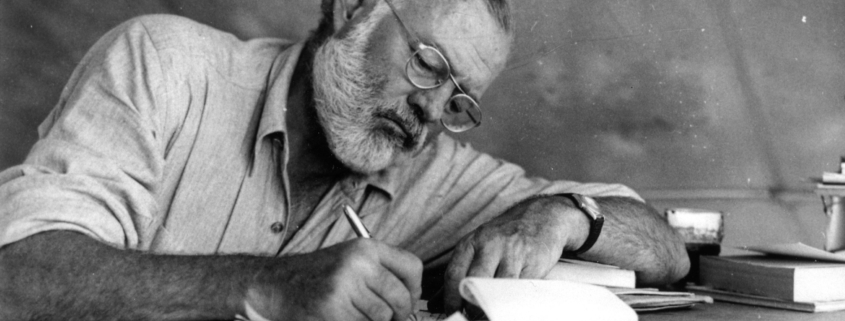
On Hemingway, Jews, and Masculinity


“Why not make the Jew a bounder in literature as well as in life? Do Jews always have to be so splendid in writing?”


Ernest Hemingway to Max Perkins, Dec. 21, 1926.

Having previously written about the early twentieth-century writers T. S. Eliot, Ezra Pound, and Robinson Jeffers, I felt it was high time that I addressed the work and thought of an altogether more controversial and ambiguous literary figure of the same period — the inimitable Ernest Hemingway. Hemingway may seem an odd choice to profile for a White advocacy site and, moreover, in his last and only appearance at The Occidental Observer, now some three years ago, he proved very controversial and divisive indeed. He was a supporter of the International Brigades during the Spanish Civil War, and, in For Whom the Bell Tolls, the novel based on his experiences in Spain, one senses that Hemingway is ventriloquizing when one of his characters responds to the question “Are you a Communist?” with the reply “No, I am an anti-fascist.” Most sensationally however, at least one 2017 text written by a former CIA officer has made the claim that Hemingway was recruited as a Soviet agent in 1940 by two of the top NKVD agents then operational in the United States — the Jew Jacob Golos and the Soviet Jewish spy king Abram Osipovich Einhorn. Both men had in turn provided leadership and support to the notorious spying cell run by Julius Rosenberg. Returning to the title of the last TOO article on the man, we have to once more ask who is the “real” Ernest Hemingway? Was he, as one critic responded to the last piece, “not a great White man”? Or is he, as Robert S. Griffin insists, “an exemplary white historical figure”?

The ambiguity, and even hostility, surrounding Hemingway is not without reason. Even setting aside the “enemy agent” accusations, Hemingway was, in several respects, intellectually of what might be termed ‘the Old Left,’ in the sense that he tended towards support for economic socialism, pursued ideological comradeship with blue collar workers and veterans, and had many friends with similar political tastes. His alcoholism, confrontational character, philandering, and final descent into mental illness and suicide could lead some to perceive the author as little more than a debauched degenerate. This behavior was in all likelihood rooted in genetic causes — and almost certainly reverberated flamboyantly in his son Gregory, an alcoholic transvestite who occasionally called himself Gloria, had surgery to create one “breast,” and finally died in the Miami-Dade Womens Detention Center a day after being arrested for indecent exposure.

In other respects, however, before his final decline, Hemingway was perhaps the quintessential, unreformed White rogue, a kind of throwback to the ancient, uncivilised Indo-European who defies strictly moralistic explanations. He was a rank individualist, antagonistic to all forms of authority and authoritarian government, Stalin’s included. Of course, his third wife, Martha Gellhorn, was Jewish, and yet he publicly explained his decision not to have children with her as being due to his aversion to having children with Jewish genes.1 He embraced the lifestyle of the masculine bon vivant, had a strong distaste for what he called “queers” “fairies” and “faggots,” enjoyed his experience observing colonialism in Africa, and loved nature and outdoor pursuits. On a more personal level, he wrote one of my favourite short novels, The Old Man and the Sea, a literary masterpiece on the themes of masculine endurance and stoicism, and influenced two of my favourite twentieth-century modernist writers, William Faulkner and Cormac McCarthy. Hemingway remains, if nothing else, as enigmatic as ever. As we are now just couple of years away from the 60th anniversary of his death, is there anything in Hemingway’s life and work that retains value for the White man of today? Read more

A Flat, Gray, Silent World: How PC and Minority-Worship Cripple the Intellect

One of the strangest and cleverest books I’ve ever read is Edwin A. Abbott’s Flatland, a Victorian fantasy first published in 1884. It’s about what happens when two worlds collide. One is our own three-dimensional world. The other is a literally two-dimensional world called Flatland, where there are only two dimensions to move in: north-south and east-west. There’s no up-down in Flatland, because there’s no third dimension.

They can’t think in 3D

The inhabitants of Flatland, known as Flatlanders, are living geometric shapes like triangles, squares and circles. They can perceive only in two dimensions and our three-dimensional world is impossible for them to imagine or understand. Flatlanders see a 3D object passing through their world as a series of infinitely thin slices, so to them a cube can look like a square or a triangle or even a hexagon, depending on how it’s orientated. And they can’t understand how human fingers, which look to them like a disconnected series of fleshy circles, can be part of a single, undivided hand.

In short, solidity baffles them. Abbott wanted his readers to see that we humans live in a Flatland of our own. After all, if 2D is flat to a 3D being, then 3D will be flat to a 4D being. Flatlanders can’t see or understand three dimensions of space and we can’t see or understand four. But Abbott wasn’t just writing a very clever mathematical fantasy: he was satirizing Victorian politics and culture. For example, the more sides Flatlanders have, the higher their status: triangles are lowly and circles are exalted. And so arbitrary geometry determines one’s position in life.

Forbidden to perceive reality

That’s a liberal idea, of course, but Flatland could easily be updated as a right-wing satire on the modern West. The point of an update would be this: We’re 3D, but we’re forbidden to think in 3D. Instead, we have to inhabit an intellectual Flatland, a flat, gray, silent world of political correctness and minority worship. Abbott’s original Flatlanders had hearing and colour vision, at least. We don’t have those things in our politics. When we look at the world, we have to turn most of our senses off and stop using reason and logic. We’re forbidden to see unity where it really exists, because the High Priests of PC tell us that phenomena like non-White failure and non-White genetics are entirely separate and unrelated. At the same time, we’re commanded to see unity where it doesn’t exist. “There’s Only One Race — the Human Race!” “Gender is a social construct!” “Whites and Non-Whites, Men and Women are entirely interchangeable!”

And some parts of the real world are strictly off-limits to us twenty-first-century Flatlanders in New Flatland. The Scruton affair, which I discussed in “A Philosopher Falls,” is a good example of how important and closely connected facts float off into an inaccessible hyper-realm. In early April 2019 Sir Roger Scruton, whom some call the greatest living conservative philosopher, was sacked from a government committee for the alleged thought-crimes of anti-Semitism, Islamophobia and racism. Scruton himself and his many supporters have continued to bewail the unfairness and injustice of what happened to him. As Scruton wrote in a neo-conservative and highly philo-Semitic magazine called Standpoint: “Heretics like me should not be silenced by mobs.” But Scruton isn’t a genuine heretic or free-thinker, because he’s writing from New Flatland and certain facts go entirely unmentioned in his article. He doesn’t refer to Jews or his own alleged anti-Semitism even once, let alone discuss the Board of Jewish Deputies and its direct role in his sacking. And what about Lord Finkelstein and Tom Tugendhat, two prominent Jewish “Conservatives” who immediately joined the left-wing “mob” and its heresy-hunt? Read more

Psychological Mechanisms and White Interests, Part 2

Go to Part 1.

Psychological Mechanisms that Work to Our Advantage

Implicit Whiteness. However, getting away from the Finnish example, there are also psychological mechanisms that are likely to create an increased sense of White identity and White interests in the years ahead. This should give us some hope for the future. The demographic transformation, in which it is obvious that White political power is declining as Whites head toward minority status, would by itself trigger defensive mechanisms of what I call implicit Whiteness which is the sense that one is White and behaving on the basis of being White without explicitly stating that you are White. For example, as White children get older, they increasingly choose Whites to be friends and associates in a mixed-race setting. Even though their explicit attitudes towards Blacks may be very positive, they feel more comfortable and have more rapport with other Whites. White parents move away from areas with a lot of non-Whites, especially Blacks and Latinos—a phenomenon known as White flight. When asked why they do so, they talk about seeking better schools. This may be true, but it covers up the reality that they don’t want their children in the same school as these non-Whites while shielding themselves from being called racists.

White people are the most individualistic people on earth — a topic central to my forthcoming book Western Individualism and the Liberal Tradition: Evolution, History, and Prospects for the Future. This means that we are less ethnocentric and less embedded in extended kinship networks that are so common in Africa and Asia. Individualists are less naturally ethnocentric, and the left has created a culture that punishes Whites for expressing ethnocentrism while encouraging non-Whites to be ethnocentric. Because the media is dominated by the left and because even the conservative media is terrified of appearing to advocate White interests, explicit messages that would encourage Whites to become angry and fearful about their future as a minority are rare. Indeed, the media rarely, if ever, mentions that Whites are well on their way to becoming a minority. And this for good reason: Whites in the United States and in Canada who are given explicit demographic projections of a time when Whites are no longer a majority tend to feel angry and fearful. They are also more likely to identify as Whites and have sympathy for other Whites.[1]

In other words, explicit messages indicating that one’s racial group is threatened are able to trigger ethnocentrism. This is especially important because many Whites live far from the areas of their countries undergoing the demographic shifts. Their day-to-day life of living in an essentially White environment hasn’t changed much while the population centers throughout the West—places like New York, Stockholm, London, and Paris are changed beyond all recognition from what they were 50 years ago. An obvious inference to be made is that pro-White activists should use explicit messages emphasizing these transformations. They should also note what is happening when Whites give up political control, as in South Africa, where many Whites live under siege conditions behind high walls and security systems, the government has endorsed programs that confiscate land from Whites and, crime, including particularly vicious murders of White farmers, is rampant. Read more

Psychological Mechanisms and White Interests, Part 1

Turku Castle

Editor’s note: This is a talk given at the Awakening Conference in Turku, Finland, April 6, 2019. 

There are obviously many challenges for White people in the West, starting with the fact that throughout the West the media and academic culture are absolutely dedicated to importing new peoples into lands traditionally dominated by people of European descent. In every case, this transformation has been a top-down phenomenon, as described mainly for the United States in my book The Culture of Critique, in the UK by Andrew Joyce, in Australia by Brenton Sanderson, and in Sweden by .M. Eckehart. By this, I mean that there was never a popular movement demanding more immigration anywhere in the West. In general, these changes occurred as a result of activism by specific groups—my view is that Jewish groups were critical in every case. These activists have had ties to elite institutions in the media, the academic world, powerful institutions like the EU, and the political process. The policies they advocated aimed at changing government policy in a context where there was no public discussion of the long-term effects this would have on native populations. And in every case, the mainstream media has had a record of promoting immigration and preventing discussion of the negative consequences, either now or in the future, to native populations. This is because, quite obviously, these changes do not benefit native populations. It’s one thing to import temporary workers for real economic needs.  It’s quite another thing to make them voting citizens, particularly when they typically have quite different interests in public policy on immigration and on the economic policies related to the availability of public goods like free healthcare, education, and welfare benefits. Most want free stuff. In the U.S., 63% of non-citizens and 50% of naturalized immigrants (i.e., the ones who become citizens) access welfare programs. The great majority of non-European immigrants have come from countries with lower IQ—a trait that is not easily influenced by changed environments. I would be interested in seeing a similar analysis for Finland.

The result of these shifts is that in most Western countries the traditionally dominant populations will be replaced within the lifetimes of many of the people who are alive today. In the United States, maybe even an old guy like me, White Americans are projected to become a minority at least by 2040 and likely sooner. Moreover, we are already at a tipping point because the Democrat Party, which is entirely in favour of replacing the White population, gets around 45% of its votes from non-Whites, so that even though many Whites have deserted the party in recent years, the growth of the non-White population combined with a still-significant number of Whites voting Democrat means that it will be impossible for Republicans to win national elections in the near future—indeed, as early as 2020. Add to that the fact that many Republicans favor high levels of immigration and because Pres. Trump has been unable or unwilling to fulfil his campaign promises; far too many Republicans are agents of big business and want to import cheap labor—and they are deathly afraid of being called a racist if they resist immigration. Illegal aliens now residing in the US have a huge incentive to have children because of birthright citizenship—people born here are citizens, so their parents can claim welfare and other financial support; again 63% are on welfare. It’s not surprising that they don’t want to leave. Read more

Aristotle: The Biopolitics of the Citizen-State, Part 4

Law versus Decadence

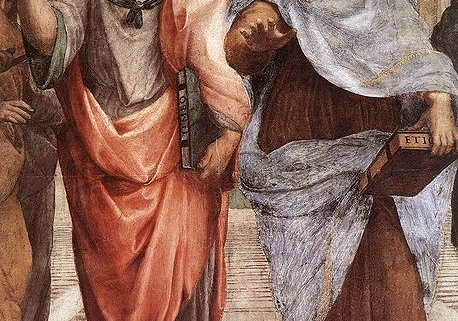
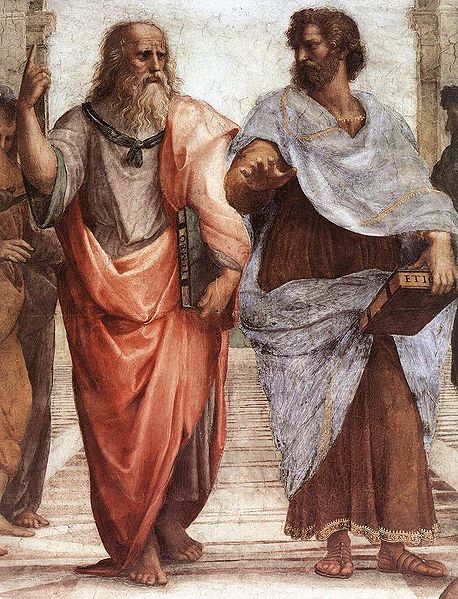
Like Plato (left), Aristotle hoped that an inspired lawgiver could establish an enduring good government.

A last concern of Aristotle’s which is of great relevance to our time is the prevention of decadence. For Aristotle, the good of the city is reflected in the virtue of the citizens. The citizens are educated and trained in virtue by adherence to the city’s largely-unchanging basic law, set in place by an inspired lawgiver. The question becomes: how can the law ensure that virtue is maintained in perpetuity?

There are no easy answers. Nations tend to be victims of their own successes. As Aristotle notes: “People are easily spoiled; and it is not all who can stand prosperity” (1308b10). He speaks at length on how Sparta’s morals were corrupted after that martial city defeated Athens and achieved hegemony in Greece as a result of the Peloponnesian War. According to Aristotle, adherence to Lycurgus’ law did not survive material wealth and the empowerment of women.

The Greeks were less prone to excessive individualism than the modern West has been, but they often ceded to the siren song of egalitarianism. Aristotle reports that many Greeks believed that if men were equal in some respect, such as being freeborn, they must be equal overall and certainly equally entitled to rule. Many took equality as a goal, leading them to seek to both make the citizens equal and to indiscriminately extend citizenship: “some thinkers [hold] that liberty is chiefly to be found in democracy and that the same goes for equality, this condition is most fully realized when all share, as far as possible, on the same terms in the constitution” (1291b30).

While Aristotle is indeed more ‘bourgeois’ than Plato, he too is contemptuous of egalitarian excesses, which manifest themselves in democratic extremism and selfish individualism. Aristotle, like Plato, argues at length that right equality or justice means that equals should be treated equally and unequals unequally (1287a1). And again, for him, justice means the interests of the community:

What is “right” should be understood as what is “equally right”; and what is “equally right” is what is for the benefit of the whole city and for the common good of its citizens. The citizen is, in general, one who shares in the civic life of ruling and being ruled in turn. (1283b27)

Aristotle notes that some democracies are so extreme that they actually undermine the existence of their own state, and hence do not survive as long as a moderate democracy. He writes with great eloquence on that “false conception of liberty” which has so often seduced our people:

In democracies of the type which is regarded as being peculiarly democratic the policy followed is the very reverse of their real interest. The reason for this is a false conception of liberty. There are two features which are generally held to define democracy. One of them is the sovereignty of the majority; the other is the liberty of individuals. Justice is assumed to consist in equality and equality in regarding the will of the masses as sovereign; liberty is assumed to consist in “doing what one likes.” The result of such a view is that, in these extreme democracies, each individual lives as he likes — or as Euripides says,

For any end he chances to desire.

This is a mean conception [of liberty]. To live by the rule of the constitution ought not to be regarded as slavery, but rather as salvation. (1310A12)

Is this not a very concise summation of the ills of modern liberalism? I would argue that the West was already severely infected by the 1930s, before metastasizing to an absurd degree from the 1960s onwards. Thus today, liberals express desire only for ‘equality’ and ‘solidarity,’ all the while destroying the very foundations for these ends through multiculturalism and open-borders, these being zealously imposed with disastrous short-sightedness. Read more

Aristotle: The Biopolitics of the Citizen-State, Part 3

Population Policies and Eugenics

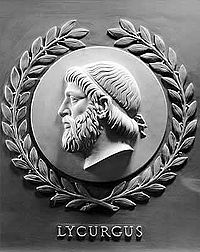
The Spartan sage Lycurgus instituted Greece’s most ambitious population policies.

True to his communitarian foundations, Aristotle argues that population policies — notably concerning immigration, naturalization, and reproduction — are a fundamental element of statecraft and ought to be determined by what serves the interests of the society as a whole. Aristotle observes very lucidly: “The prime factor necessary, in the equipment of a city, is the human material; and this involves us in considering the quality, as well as quantity” (1325b33). The city is defined not by mere geography, but above all by the population. Therefore: “To determine the size of a city — to settle how large it can properly be, and whether it ought to consist of the members of several races — is a duty incumbent on the statesman” (1276a24). The statesman then has a duty to decide who is fit to be a citizen and to ensure the biological reproduction and quality of the citizens, thus perpetuating the city.

In line with Aristotle’s imagined foundation of the city as an extended family, the Greeks typically granted citizenship according to rules of descent. Aristotle observes: “For practical purposes, it is usual to define a citizen as one ‘born of citizen parents on both sides,’ and not on the father’s or mother’s side only; but sometimes this requirement is carried still farther back, to the length of two, three, or more stages of ancestry” (1275b22). Aristotle also defines a city in part by the possibility of intermarriage among its members. Naturalized citizens are clearly considered exceptional, Aristotle deeming them citizens “in some special sense” (1274b38).

The ancient Greeks were obsessed with their ancestry and lineage, following aristocratic and hereditarian assumptions. Aristotle says that “good birth, for a people and a state, is to be indigenous or ancient and to have distinguished founders with many descendants distinguished in matters that excite envy” (Rhetoric, 1.5).[8] Following the widespread Greek assumptions that both nature and nurture mattered, he writes that “it is likely that good sons will come from good fathers and that the appropriately raised will be of the appropriate sort” (Rhetoric, 1.9). Aristotle furthermore lists shared blood as one of the forms of friendship, an eminently adaptive view: “The species of friendship are companionship, intimacy, consanguinity, and so on” (Rhetoric, 2.4). Read more