
Featured Articles

Richard Lynn, Cultural Marxism, and the War on Objective Science
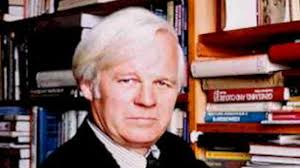
Richard Lynn is one of very few academics whose impact on their discipline is such that the field could scarcely be discussed without referring to him. In psychology, and particularly the study of intelligence, Lynn has carved out a dominant, innovative, and extraordinarily productive career spanning several decades. He remains prolific at age 87, and Washington Summit will soon publish what will surely be a future classic: Race Differences in Psychopathic Personality —- a volume that I have had the honor and great pleasure of editing. Lynn took his Ph.D. at the University of Cambridge and worked as lecturer in psychology at the University of Exeter, professor of psychology at the Economic and Social Research Institute, Dublin, and at the Ulster University. He has published in such journals as Nature, British Journal of Psychology, Journal of Biosocial Science, and Bulletin of the British Psychological Society, and has served on the editorial boards of Intelligence, Personality and Individual Differences, and Mankind Quarterly. On his retirement, and in recognition of his accomplishments and contributions, the title of professor emeritus was conferred on Lynn by Ulster University. During the last seven days, however, moves have been undertaken to strip Lynn of this title.

The reasons behind the move are symptomatic of the malaise hanging over much of the modern academic establishment, and are a reflection of the great unease with which this establishment has always greeted Lynn’s fearless research profile. There are few leftist sacred cows that Lynn hasn’t seen fit to hunt down. During the same decades that Cultural Marxism was extending its tentacles around the Academy, Lynn’s research argued the case for the existence of race and sex differences in intelligence, and in The Chosen People: A Study of Jewish Intelligence and Achievement (2011) Lynn crossed firmly into forbidden territory by offering an evidence-based study of the Jewish IQ. It remains the best available rebuttal to Sander Gilman’s work of Freudian apologetic pseudoscience Smart Jews: The Construction of the Image of Jewish Superior Intelligence (1996). It should be unsurprising that Lynn is also one of very few academics whose work caused a stir beyond the ivory tower. Coverage of Lynn’s work often featured in the BBC, a large number of high-circulation international newspapers and, perhaps inevitably, in the “extremist files” of the radical leftist Southern Poverty Law Center. Read more
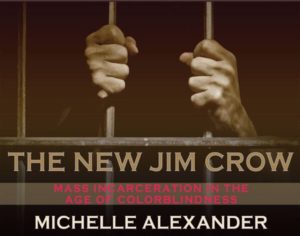
“The New Jim Crow” As Seen from the Right.

Michelle Alexander’s The New Jim Crow: Mass Incarceration in the Age of Colorblindness is a text I’ve come across many times over the years. In fact, I don’t know if there is a single time I have walked into a major bookstore and have not seen the book displayed in prominence on an end cap or center aisle table. I’ve encountered all the arguments made within the text over the years in articles, during debates, and in university classrooms as an undergraduate. Perhaps the significance of Alexander’s work is best assessed in the foreword by Cornel West: “The New Jim Crow is the secular bible for a new social movement in the early twenty-first-century America.” Although the data and arguments found within have been seen both before and after Alexander’s work, this is perhaps the most definitive and comprehensive work on the topic of Black crime and mass incarceration in America, as seen from the left.
The overarching premise is that mass incarceration, Jim Crow laws, and slavery have been the three primary measures adopted as public policy in the U.S. as a means to control the Black population. Several of Alexander’s contentions jumped off the page at me from the very beginning of the introduction, where she states that an essential goal of the Founding Fathers was to ensure citizenship to Blacks would be denied. In a way, I was thoroughly impressed, aghast even. I hear noxious phrases like “we are a nation of immigrants,” “America is for everybody,” and “this is a homeland for all,” almost daily, be it on social media, from politicians, the press, or in the media. And to see an author who has declared her goal is an “egalitarian democracy,” to be so honest, so frank, and so correct, is in many ways to be welcomed. Alexander displays from page one that she has a grasp of historical racialism as it pertains to the foundation of the U.S. and the Founders’ intentions. She finds this to be an unacceptable position, of course, but her admission that the U.S. was founded as a White nation is exceedingly rare nonetheless. Read more

William Pierce and Cosmotheism

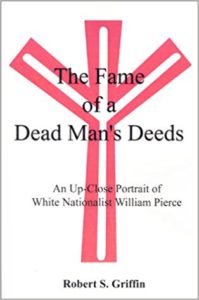
During the early 1970s, the late white activist Dr. William Pierce formulated a religious orientation he called Cosmotheism to provide the spiritual basis for the direction he was taking in his racial work.  Pierce had serious reservations about Christianity’s appropriateness for white people and wanted to offer an alternative to it.  The following material is drawn from my book on Pierce, The Fame of a Dead Man’s Deeds.
 *   *   *

“As I see it,” Pierce told me, “Christianity has a number of elements that are harmful to our people.   One of them is its egalitarianism.  You know: ‘the meek shall inherit the earth,’ ‘the last shall be first, and the first shall be last.’  It’s the whole Sermon-on-the-Mount idea of putting people down and pulling down those on the top of the heap regardless of how they got there.  It is a fundamental part of Christian doctrine, and I think it is detrimental to an ordered society.  When you look at Christianity you have to get beyond the requirements and rituals—you shall be baptized, you shall observe the marriage sacrament, and so forth—and see underlying things, like the egalitarian, Bolshevik message in this religion, which is really dangerous and has helped move us to this destructive democratic age.

“There is the universalistic message in Christianity, that we are all alike, that fundamentally there is no difference among people, that the only thing that counts is whether you are in or out of Jesus’ flock.  The ‘we are all one in Christ Jesus’ idea—man and woman, white and black, Greek and Jew.  We are all equal in the eyes of the Lord.  The truth of the matter is that we aren’t all one, and we are different from one another, and some individuals and cultures are better than others.  Anything that obscures that reality and its implications holds things back. Read more

Greek Biopolitics and Its Unfortunate Demise in Western Thinking

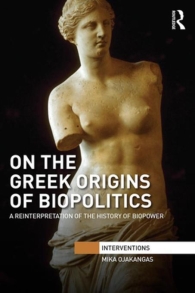
Mika Ojakangas, On the Origins of Greek Biopolitics: A Reinterpretation of the History of Biopower


London and New York: Routledge, 2016

Mika Ojakangas is a professor of political theory, teaching at the University of Jyväskylä in Finland. He has written a succinct and fairly comprehensive overview of ancient Greek thought on population policies and eugenics, or what he terms “biopolitics.” Ojakangas says:

In their books on politics, Plato and Aristotle do not only deal with all the central topics of biopolitics (sexual intercourse, marriage, pregnancy, childbirth, childcare, public health, education, birthrate, migration, immigration, economy, and so forth) from the political point of view, but for them these topics are the very keystone of politics and the art of government. At issue is not only a politics for which “the idea of governing people” is the leading idea but also a politics for which the question how “to organize life” (tou zên paraskeuên) (Plato, Statesman, 307e) is the most important question. (6)

The idea of regulating and cultivating human life, just as one would animal and plant life, is then not a Darwinian, eugenic, or Nazi modern innovation, but, as I have argued concerning Plato’s Republic, can be found in a highly developed form at the dawn of Western civilization. As Ojakangas says:

The idea of politics as control and regulation of the living in the name of the security, well-being and happiness of the state and its inhabitants is as old as Western political thought itself, originating in classical Greece. Greek political thought, as I will demonstrate in this book, is biopolitical to the bone. (1)

Greek thought had nothing to do with the modern obsessions with supposed “human rights” or “social contracts,” but took the good to mean the flourishing of the community, and of individuals as part of that community, as an actualization of the species’ potential: “In this biopolitical power-knowledge focusing on the living, to repeat, the point of departure is neither law, nor free will, nor a contract, or even a natural law, meaning an immutable moral rule. The point of departure is the natural life (phusis) of individuals and populations” (6). Okajangas notes: “for Plato and Aristotle politics was essentially biopolitics” (141). Read more

Marketing Miscegenation

Since “cutting the cable” several years ago, I have felt secure behind my own personal immigration wall, free of the barrage of marketing demands and political poltroons upon my time and money. During the Christmas holidays, however, I ventured onto the major networks (NBC, ABC, and CBS) with an external antenna affixed to the TV to satisfy my curiosity of what had been happening in the “real” world since my self-imposed exile.

My attention was immediately attracted to a commercial featuring the Paddington Bear. In the commercial a non-traditional looking Santa is aided by Paddington Brown in sorting Christmas presents for one particular family. At the end, all is well as Santa and Paddington peer through the window at the family enjoying opening presents under the tree in their living room.

The family was composed of the mother, who was an auburn-haired White woman, the father, who was Black, and their mixed-race children, a boy and a girl.

I was not shocked or even surprised at this portrayal of miscegenated merriment, as I naively assumed it was an isolated attempt by the commercial’s creator to appeal to two different segments of the consuming public with one commercial.

I was wrong.

As I continued to watch TV that day, it didn’t take long for the intrusive appeal of the commercials to outweigh that of the programs. There were simply so many of these commercials featuring mixed-race families and couples that I suspected something else was being presented. Read more

Let’s agree Trump is a racist (properly defined). Good for him!

The New York Times recently published an “op-ed” piece titled, “Trump is a Racist. Period.” by Charles Blow.

Charles Blow is an angry middle-aged Black man who writes a twice-weekly column for the Times. He’s divorced with three kids and openly bisexual. Mr Blow graduated Magna Cum Laude from Grambling.

Professionally, Mr Blow is definitely obsessed with “racism.” Which is pretty much the prerequisite for Black “op-ed” writers in major newspapers (scream “racism” and scream it loudly). Come to think of it, I can’t recall the last time I read an op-ed piece by a Black columnist that wasn’t in some way correlated with racism. The last one I remember was in the Dallas Morning News, in which the author theorized that high Black mortality rates were due to a combination of cruel treatment by White doctors and a lack of Black doctors. She even went so far as to blame the City of Dallas for not producing more Black doctors — all the direct result of systemic racism, of course, not the fact that a minimum of 120 IQ is needed to meet the intellectual requirements of an MD (85 is avg Black IQ).

If you review Mr Blow’s articles, the subject matter may change to some degree, but the premise is usually the same: “Racism” this. “White supremacy” that. Trump called Haiti a “shithole” and played golf on MLK day, so that proves once and for all that he’s a racist. Blah, blah, blah. Nothing of substance, only stale garrulity.

Even when Mr Blow’s commentary isn’t focused explicitly on “racism,” such as his recent piece regarding the Mueller investigation into Russia, there is still an implicit racial undertone. It’s seems as if he fantasizes about radical racism:

If this were Barack Obama, Tiki-torch-toting Nazis would have descended on the White House and burned it to the ground. Not only that, America’s racist folks masquerading as religious folks would have used Obama’s moral failing as proof of a black pathology.

However, my purpose isn’t to critique Mr Blow’s efforts at perfecting the art of literary victimhood, but rather his opinions. After all, freedom of speech is one of the pillars of “White supremacy.” Which, ironically enough, enables people like Mr Blow to publicly call the most powerful man in the world racial epithets on a daily basis. The fact is that if Mr Blow couldn’t write about “racism,” he wouldn’t have anything to write about. Read more

Who Was George Lincoln Rockwell?

George Lincoln Rockwell

I suppose most readers of this publication have heard of George Lincoln Rockwell (1918–1967), but some may not know much about him.  For those unfamiliar with Rockwell, perhaps this writing, drawn from my book on the late William Pierce, The Fame of a Dead Man’s Deeds, will provide a sense of him.

George Lincoln Rockwell was a tall, slim, dark-haired, good-looking fellow in his forties when, for a few years in the 1960s, he became a prominent figure in American life.  Rockwell billed himself as the Commander of the American Nazi Party, which he founded and headquartered at Arlington, Virginia, just outside of Washington, D.C.   He had twenty or so active participants in his organization, and a few hundred subscribed to his publications, Stormtrooper and The Rockwell Report.

Rockwell projected a dashing, rakish image with his corncob pipe, and tended to approach things with a showbiz touch.  His public rallies, with him surrounded by “stormtroopers” and American and Nazi flags and decked out like Hitler in a brown uniform and boots and a swastika armband greeting his audience with the Roman salute, had a theatrical and, to many, frightening quality.  In his speeches Rockwell railed against Jews for being behind communism and scheming to mongrelize the American racial stock by promoting racial integration and interbreeding with blacks.  He called for resettling American blacks in Africa in a new African state at public expense.

Rockwell was both serious and tongue-in-cheek.  In response to the freedom rides, as they were called, where civil rights activists rode buses in the South to integrate interstate bus travel, Rockwell and some of his fellow Nazis drove a “hate bus” through the South.  With reference to the strong Jewish presence among psychoanalysts and therapists, Rockwell put out a pamphlet that gave instructions on “how to combat the Jew mental health attack.”  And there was his booklet, “The Diary of Ann Fink.”

I came upon an audiotape of a Rockwell speech to a college audience in November of 1966.  The speech was given at Brown University in Providence, Rhode Island, where Rockwell had been a student before the outbreak of World War II.  I presume the audience was made up primarily of Brown students and faculty.

Rockwell’s speech took about an hour.  He had an upbeat manner and a rapid-fire speaking style reminiscent of a standup comic (“Let me tell you, ladies and gentleman . . .”).  There was a lightness and likeability about him: he wasn’t dark or harsh, although there were a few moments where he got a bit testy. Read more


