Featured Articles

Academic Censorship and Self–Censorship: Once upon a Time in the Land of the Free 

This is a short address given at the dinner, sponsored by the Propertarian Institute in NY, on September 26, after the earlier round table held at the New York University.

Allow me to say a few words about the media witch-hunt targeting now non-conformist intellectuals, including some of our friends here. Firstly, however, let me extend my greetings on behalf of our small party, the American Freedom Party, our Chairman Mr. William Johnson, and our colleagues who also helped organizing our round table.

Let me illustrate this new media witch-hunt in the West by drawing parallels with the former communist East. One of the big advantages of living in communism was the ability of its citizens to grasp quickly the main notion of the political: who is the foe and who is the friend. Even a simple citizen in the Soviet Union, or in the ex-communist Eastern Europe, knew very well that communism was a fraud. The official communist narrative about the upcoming paradise on earth sounded so surreal that it could not be taken seriously by anybody, including communist party bosses. By contrast, in the modern liberal West, and particularly in the US, the ruling class, but also a large number of citizens and academics, do believe in the same crypto-communist message, albeit wrapped up in different words and decorated with a different insignia. The imagery of the former muscled proletarian in Eastern Europe, carrying the hammer and the sickle, has been now replaced by a starving African or a Middle Eastern refugee and for good measure by a tolerance preaching homosexual, designed to induce lachrymose and self-denying feelings among their guilt-ridden White hosts. The repression of non-conformists and dissidents in the West is far more insidious than the repression in the former communist East. It is more subtle, less violent and its jargon, diffused in the mainstream media, academia and among politicians, is less polemical. Moreover, it doesn’t leave martyr’s blood behind — for the time being at least.

It is fundamentally wrong to study communism as an ideology only. Communism is first and foremost an anthropology which is nearest and dearest to the masses regardless of is dreadful consequences. Communism represents the true state of nature, ideal for mass multiracial and stateless societies of people with mediocre intelligence facing diminishing materiel resources and vanishing opportunities. The question arises: Why did then Communism fall part in the late 80s in Eastern Europe? Communism fell apart in the East because its much vaunted goals had already been better implemented in the West:  the welfare state, steady economic growth, and ethnic and racial quota system, known in the USA as “affirmative action.” All those big buzzwords, now legally taken for granted by many US citizens, were tested unsuccessfully in the ex-communist East. Also shut-up and criminalizing words like “Nazi,” “Fascist,” “ racist,” “anti- Semite,” which are now very popular in the American mainstream media and colleges, especially when smearing political opponents, were thrown around in the communist East on a daily basis against any potential trouble maker or a dissident.

It is wrong, however, to assume that citizens in former communist Eastern Europe were all starving for Western freedom, all of being ready to overthrow the communist system. Only a few did. It is also wrong to think that anticommunist dissidents were respected species enjoying mass popular support. They were shunned like a plague even by their family members. We can observe the same type of ostracism and self-censorship  among prominent White academics in the USA, not just on the official state level, but also within their own family and  at their work place.

Although being a frugal and violent system communism in Eastern Europe did offer citizens psychological security and economic predictability which citizen in the USA could have only dreamed about. What most citizens in the communist system craved for were mostly Western commodities and Western standard of living. Those individuals who were a threat to the fake and fragile consensus between the communist rulers and the communized ruled were generally despised and demonized as terrorists.

Where do we go from here? Our future actions will depend on a specific local circumstance. By now, however, we have at least the privilege of being able to decipher our main enemy. It is useless and counterproductive to point fingers at them and call their names. Instead, one must raise a very simple question in order to elicit a very simple answer. Who are the people who benefit most from the overuse of criminalizing words “racists,” “white supremacists” and “anti-Semites”? It is not difficult to make them out.  We know them well. Thanks for your attention.
Homage To The Post-First World: My Wanderings in Europe, Part 2

Budapest — Pest side, Hungary

I was walking with the nice Bulgarian girl I had met the day before.

We stepped over puddles and little rivers of piss. You try not to, but you can’t help but notice that the Pest side of the city smells like a giant urinal after 6 pm.  And it was gypsy Christmas the day before. Hungarians tossed all their unwanted junk into the streets and hordes of gypsies rummaged through the scrap, claiming what they wanted. Some of the gypsy men had bats to guard their junk. I learned that Gypsy law states that anything on the street automatically belongs to them, and they enforce that law.

All the junk still hadn’t been cleared yet, although we try not to pay attention to it and we laugh it off as best we can. We have already gotten used to the beggars and bums nestled in the doorways, under the scaffolding and on the corners of the streets. We block them out of our vision as well.

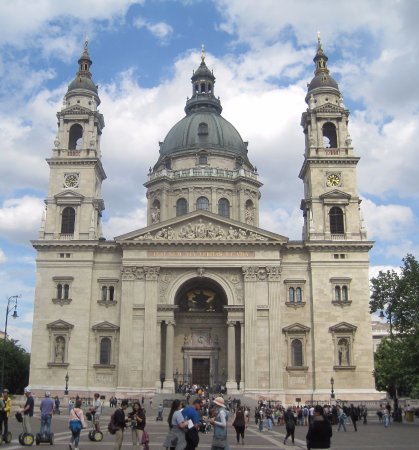
And then we reach the square in front of the famous Saint Stephen’s cathedral. There is a wine degustation going on that night, and there was one pretty much every night that week. It is picturesque and romantic.

Christmas lights suspended above, benches with White, soft and jolly Europeans in the middle.

Read more

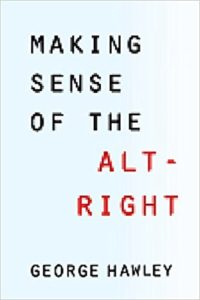
He Doth Opine: A Review of Making Sense of The Alt-Right by George Hawley

Making Sense of The Alt-Right
George Hawley
New York: Columbia University Press, 2017, 218 pp.

With any book, it helps to take into account who wrote it and who published it.   George Hawley is an assistant professor of political science at the University of Alabama.   Assistant professor is the lowest professor rank.   Hawley’s a young faculty member, in his early thirties by the looks of his picture with his young child on his website — just starting his academic career, or so he hopes. Assistant professor is probationary status.  At the end of six years typically, you are checked out by senior faculty and administrators and if you pass muster, you get promoted to associate professor and granted permanent status, or tenure, at the university.  If you don’t get tenured, it’s the help wanted ads over breakfast, so the stakes are extremely high for young Hawley.  (With tenure, there’s just one more promotion, and it can be anytime, or never, to full professor.)   A must for getting tenure is a good publication record — publish or perish is real — which means Hawley had to give the editors at Columbia University Press what they wanted or he was dead in the water.

All to say, don’t expect an assistant professor to take intellectual or professional risks—such as running up against the PC doctrine of today’s universities and academic presses; or to go much, if at all, beyond the boundaries of his (or, of course, her) academic discipline, political science in this case — integrating, say, history, philosophy, psychology, and/or literature into his considerations; or to produce mature scholarship so early in his career.  Do expect diligence, however—nobody works harder than an assistant professor.

In sum, I got what I expected from this book.  That means a 4, perhaps 5, on a 10 scale—not bad, but it could have been a lot better.   That acknowledged, this book was worth my time—in fact, I read it in a single setting.  Professor Hawley thinks clearly enough (for this stage of his working life), he writes reasonably well, and he obviously devoted much time and effort to this project.  I profited from his descriptions of what’s going on with the internet (the Alt-Right, he reports, is largely an internet phenomenon, much of it anonymous), about which I am clueless.   I also found helpful the distinction he draws between the Alt-Right and the “Alt-Lite.” Alt-Lites he mentions include Milo Yiannopoulos, Mike Cernovich, Joseph Paul Watson, and the only two women in the book, Ann Coulter and Laura Southern.    No Alt-Right women, such as Lana Lokteff of Red Ice Radio, in this presentation.   The quotes in the book from Hawley’s interviews, including those with Richard Spencer,  were very good, though you couldn’t prove it by me that he took in and worked with what these people actually said. Read more

Andrew Marantz: Retract your libelous statement

Journalist Andrew Marantz published an article on Mike Enoch (“Birth of a White Supremacist“) in the New Yorker in which he wrote the following:

In January, 2015, Enoch read “The Culture of Critique: An Evolutionary Analysis of Jewish Involvement in Twentieth-Century Intellectual and Political Movements,” by Kevin MacDonald, a former psychology professor at California State University, Long Beach. The book—published in 1998, heavily footnoted, and roundly debunked by mainstream social scientists—is a touchstone of contemporary intellectualized anti-Semitism. On “The Daily Shoah,” Enoch called it “important and devastating, something I urge everybody to read,” and then offered even higher praise: “It triggered me so hard.” From then on, he began to express his anti-Semitism more frankly. He sometimes spun his Northeastern upbringing as an advantage: having grown up around Jews, he understood the enemy. “You’ll talk to white Americans today, and they don’t actually know if someone’s Jewish or not,” he said. “I have very honed Jewdar. I can tell.”

The problem is the statement that CofC was “roundly debunked by mainstream social scientists.” This is false, and in saying it, Mr. Marantz has shown reckless disregard for the truth. His statement is libelous and I demanded on Twitter that he either support it or retract it.


Read more

Banned in America…A Sequel

Too White for Weimerica

I was pretty excited this morning. After weeks of preparation, and months of discussions, I was getting ready to leave Europe for the United States. My purpose of travel was a week of talks and co-operation with the leadership of the National Policy Institute, with a view to significantly expanding the output of Washington Summit Publishers. I was also looking forward to socializing with some old acquaintances, and forming new friendships and alliances. My last visit to the D.C. area, two years ago, was extremely memorable. One serendipitous moment that will always stay with me was watching a Congressional debate with Kevin MacDonald, as three Ultra-Orthodox Jews took their seats in the public gallery directly behind us. You couldn’t have scripted it better.

I was chuckling to myself this morning as I recalled that incident and, with my bags packed and beside the door, I went to grab some breakfast. As I started to eat, it occurred to me to quickly check my email before I set off for the airport. There were two new emails in my inbox, but one immediately caught my eye. It was from Customs and Border Protection, and the headline immediately made my heart sink. The last time I had heard of the phrase “Your ESTA status has changed” was in Chris Dulny’s post-Charlottesville video, during which he explained that immediately on returning to Sweden both he and Daniel Friberg had received just such an email indicating that their travel privileges to the United States had been revoked. I clicked on the provided link, entered my details, and there it was: “Travel Not Authorized.”

I’ve been travelling to the United States for more than ten years now, without issue. I’ve lived there for extended periods of time, and was planning to do so again in the near future. My children are U.S. citizens, descended on their mother’s side from the earliest settlers of South Carolina. The revocation of my travel authorization is therefore a deeply personal issue, as well as a social and professional one. Read more

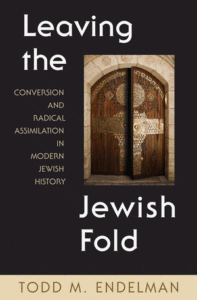
Review: Leaving the Jewish Fold: Conversion and Radical Assimilation in Modern Jewish History by Todd M. Endelman

Leaving the Jewish Fold: Conversion and Radical Assimilation in Modern Jewish History
Todd M. Endelman
Princeton University Press, 2015

“A Jewish question would still exist, even if every Jew were to turn his back on his religion and join one of our major churches.”
Karl Eugen Duehring, 1881

At the heart of the Jewish Question lies an extraordinary level of ethnocentrism. The tremendous capacity of Jews for mutual co-operation and the reinforcement of group identity is one of the behavioral markers that set them apart from most other human populations. This is the case even in comparisons with other populations that, like the Jews, have historically performed roles as ‘middle man minorities.’ Jewish ethnocentrism has thus deservedly been the major focus of attention when scholars or activists have decided to investigate Jewish group behavior. In general these investigations have rested on the obvious expressions of ethnocentrism — clannishness in business, Jewish endogamy, group political strategies, and the manifestation of Jewish group allegiance even in secular cultural contexts (‘Jews without Judaism’).
By contrast, the story of those Jews who ostensibly left both Judaism and their community, apparently cutting all ties with their ethnic group, has been little explored or discussed in explorations of Jewish ethnocentrism. This story is, however, an important one, and it becomes even more important in a contemporary context in which Jewish intermarriage, particularly in the United States, is reaching unprecedented levels.

Key to understanding Jewish ethnocentrism should be an assessment of its strength, not just in terms of its obvious successes and manifestations, but in terms of its failures — when did it fail, how often did it fail, and why? I chose to read Todd Endelman’s Leaving the Jewish Fold as part of my own deeper investigation into this issue — to probe the weaknesses of Judaism as a group evolutionary strategy for a future book project on that theme. However, rather than being surprised, I found that it largely confirmed my pre-existing theoretical framework. Endelman merely confirms that Jewish conversions to religions other than Judaism have historically been extremely rare and, despite the title of the book, the author provides very little evidence to suggest that the ‘assimilation’ undertaken by those Jews who ‘left the fold’ was radical, or even genuine. To use Endelman’s terminology, ‘drift and defection’ has always been a small, though passionately resisted phenomenon on the periphery of Jewish populations, serving paradoxically at times, like anti-Semitism, to reinforce group cohesion at the core. But in the overwhelmingly majority of cases an extremely high level of ethnocentrism is a constant feature of Jewish history.

The book is neither entertaining nor intellectually stimulating. Leaving the Jewish Fold is the third book by Endelman that I’ve read, following his Radical Assimilation in English Jewish History, 1656–1945 (1990) and The Jews of Britain, 1656 to 2000 (2002). His histories tend towards the type of overview perspective that can be useful when trying to get to grips with major events and personalities, but which lack insight or real interest even on a potentially oppositional level — his stances and arguments are often so weak (or non-existent) that they are difficult to detect. This makes his work slightly more factually correct than, for example, the work of the late ethnic activist Robert Wistrich, but ultimately less ‘fun’ to engage with or argue against. The fact that Endelman continues to be published by elite academic publishing houses like Princeton University Press should be regarded as a symptom of ongoing Jewish influence in Western academia [discussed further here] rather than being suggestive of the quality of his work. Like earlier examples of his work, Leaving the Jewish Fold is for the most part a collection of anecdotes and statistics, derived almost exclusively from published secondary sources, and often involving very little or no original research. The structure and narrative cohesion in this instance, where the material concerns Jews who ostensibly abandoned Jewish life, is haphazard and often confusing. As just one example, during his weak first chapter on the medieval period Endelman inexplicably plucks anecdotes from the eighteenth century. Read more

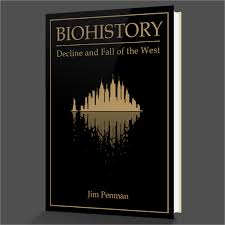
An Epigenetic Explanation for the Decline of the West

Jim Penman, Biohistory: Decline and Fall of the West (Newcastle: Cambridge Scholars Publishing), 2015, $5.92.

In 2009 I wrote an article outlining the emerging field of biohistory.[1] So when I came across a book written by Jim Penman entitled Biohistory: Decline of the West my interest was immediately piqued. Published in 2015, I wondered how the book had escaped my notice for two years. One reason might be that, although he holds a Ph.D. in history, Penman is an Australian businessman rather than an academic. This could explain why the book has not been reviewed by the customary American media.

My TOQ article was primarily a survey of some relevant historiography. I noted how various historians had incorporated human biology, and ecological influences such as climate, geography, diet, and disease, into their research while generally eschewing the significance of race. Penman also denies the importance of race, but he takes biohistory in a different direction with the use of epigenetics.

Epigenetics is a “new science which looks at the way on which genes are switched on or off by the environment” (9). It appears that “environmental influence turn up or down the activity of certain genes while not altering the DNA” (25). It is particularly significant that: “Epigenetic regulation seems to operate in an almost Lamarckian fashion . . . [and] can produce effects in gene expression that may echo over many generations.” [2]

Epigenetics has been described as evolution without Darwinism. It appears particularly important in determining temperament. Two significant epigenetic environmental factors are diet and stress. To greatly simplify things we can say that gluttony and ease produce weak men, who produce weak sons leading to decadence, and societal decline. This theory is not new, but epigenetics suggests that these changes are physiological and heritable, not just cultural. And it provides some scientific evidence to support this paradigm.

Penman’s thesis is engaging and epigenetics is gaining wide acceptance, but at times his presentation is overstated and reductionist. For example, historians and economists have been studying the Great Depression for decades. They disagree on the causes, but generally believe that, as with almost all major historical events, it was precipitated by a confluence of factors. In this case the lingering effects of World War I, policies pursued by major economies, as well as the mistaken beliefs of millions of economic actors. In contrast, Penman believes “the explanation of recession involves a change in the temperament of the general population” (141), and “that governments have little or no power to halt the underlying forces of economic and political change, because these forces are driven by changes in temperament” which are in turn shaped by epigenetics (153).  Certainly there is a psychological component within economic downturns as the terms “depression” and “panic” imply. But it is difficult to believe that epigenetic changes alone account for economic cycles.

Rather than being the key to understanding history epigenetics could prove to be another useful tool for analyzing human societies past and present. As mentioned above, the author’s goal is to develop a biological explanation of history sans race. He “takes particular issue with the idea that [cultural development] might be about race or genetic differences” (5). His interpretation of “biohistory takes issue with the idea that differences between peoples can be explained by genetics such as the idea that Europeans and East Asians are more intelligent” (8). Read more