Featured Articles

Jews and Gun Control: A Reprise

Editor’s note: The immediate reaction by the left, including Pres. Obama, to the shootings in Roseburg, Oregon was to demand greater gun control. This has now become a ritual after every multiple shooting. This article by Andrew Joyce originally appeared on August 2, 2014, but is re-posted because it discusses the role of Jews as a critical component of the coalition in favor of gutting the Second Amendment and places the Jewish role in historical context.  

The thorny issue of Jewish support for gun control has reared its head once more, this time in Washington State. The Jewish Federation of Greater Seattle has called for the resignation of Brian Judy, a National Rifle Association lobbyist who reportedly linked gun control to that untouchable icon of Jewish victimhood, the Holocaust. At a news conference at the Federation’s Seattle headquarters, President Keith Dvorchik said Judy should resign for connecting an anti-gun ballot initiative to policies pursued by Nazi Germany. Dvorchik further demanded the national office of the NRA “make clear that it rejects his ignorant and unproductive dialogue.”

Judy’s remarks first surfaced on the liberal blog Horsesass.org. An audio clip plays over a still image of a gathering and features Judy talking about Jews who support gun control. The remarks were made at a gathering in Silverdale opposing I-594, a measure on the ballot this fall that would further expand background checks for gun purchases. In the recording, Judy references Nick Hanauer, a Seattle Jew who has contributed more than $300,000 to an independent-expenditure group supporting I-594, in addition to an earlier $1 million pledge. Other significant funds have come from Jewish billionaire and former Microsoft CEO, Steve Ballmer who, along with his wife Connie, is a major contributor to the Hanauer-founded organization, Washington Alliance for Gun Responsibility. Hanauer wrote recently in Politico about how his family fled Nazi Germany. The speaker on the recording references Hanauer’s piece: “Now [Hanauer is] funding, he’s put half a million dollars, toward this policy, the same policy that led to his family getting run out of Germany by the Nazis. You know, it’s staggering to me, it’s just, you can’t make this stuff up. That these people, it’s like any Jewish people I meet who are anti-gun, I think, ‘Are you serious? Do you not remember what happened?’ And why did that happen? Because they registered guns and then they took them. Why did you have to flee to this country in the first place? Hello! Is anybody home here?” Read more
 “The Lobby-That-Doesn’t-Exist”: Politicians and Pundits on Jewish Influence in France

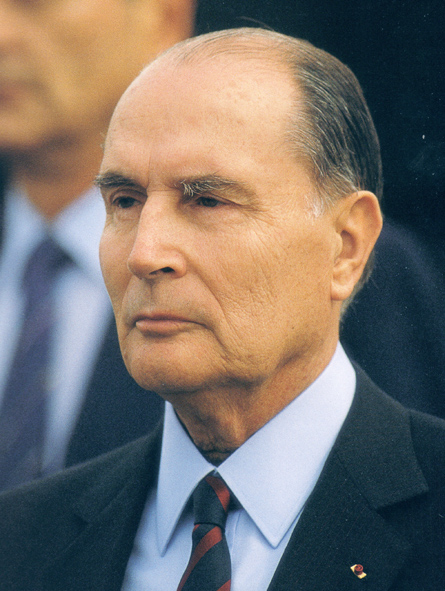
French President François Mitterrand spoke of “a powerful and harmful Jewish lobby”

French President François Mitterrand spoke of “a powerful and harmful Jewish lobby”

There are few things as difficult to talk about as Jewish elites and Jewish ethnocentrism (which, translated into left-wing parlance, could be termed “Jewish privilege” and “Jewish racism”). For the French case, Paul-Éric Blanrue (see my previous article on his work) usefully documents the numerous cases in which various prominent figures and journalists have spoken of Jewish ethnocentrism or “the Jewish lobby.”

Jewish influence is typically remarked upon by bragging activist Jews, by senior politicians near death, by uncritical commentators, or by critical commentators who, being swiftly punished, usually learn to keep quiet. The penalty for criticism – universal ostracism – is such that Blanrue speaks of “the-lobby-that-doesn’t-exist”: the lobby that everyone knows about and everyone knows must never be spoken about (lest they find themselves in the dock with Alain Soral and Dieudonné M’bala M’bala).

But prominent figures, even at the highest levels of the state, have spoken of Jewish power in France despite this threat. In 1995, President François Mitterrand, near the end of his life and on his last day in office, referred in private to “the powerful and harmful influence of the Jewish lobby in France.”[1] Mitterrand was specifically referring to the constant politico-media pressure that has made the Shoah “the official religion of the French Republic” (in the words of Jewish pundit Éric Zemmour[2]). Read more

P. J. O’Rourke on Ann Coulter: Not-So-Deep Thinking about Race, Anti-Semitism, etc.

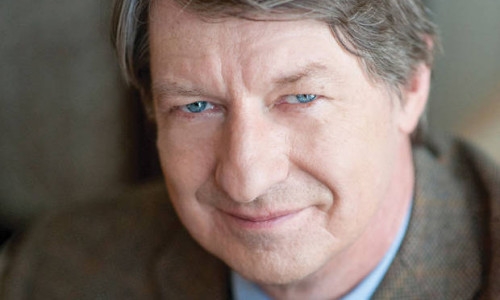
pj_orourke-620x412-620x372 (1)

I suppose I should cut P. J. O’Rourke some slack. Like him, I was once on the hippie-dippy left during the 60s, and I know it’s hard to get over that. But there are limits. His “She said what?” in the Weekly Standard is an important reminder of how far there is to go to have intelligent discussion of Jewish issues in the mainstream media. O’Rourke, who, it must be stipulated, is a very entertaining writer, wants to call himself a conservative. The sad reality is that he is just the sort of cuckservative who is welcome at The Weekly Standard. As James Fulford points out at VDARE, he has Utopian ideas on race, maintaining that Haitians immigrants are just as acceptable as the Irish — or perhaps even more so if they had to struggle to get here, because, after all, being aggressive enough to get here illegally means that you would be crime-free, have a high IQ, and not be assertive about demanding free stuff paid for by previous waves of White immigrants. Or maybe not.

The main point of this is to discuss O’Rourke’s ideas on Jews and anti-Semitism, but a few preliminaries are in order. He thinks that because the Indians got here first, that Europeans have no right to defend their conquest:

She’s from Connecticut and is very upset about immigrants. I am willing to lend a sympathetic ear to people from Connecticut who are very upset about immigrants, if they have a tribal casino.

But why stop at Native Americans? What about the tsunami of migrants entering European homelands? Would nativism and nationalism by native Europeans be okay?  But the same attitudes and forces welcoming the displacement of Europeans in the US are resulting in the displacement of Europeans from lands they have dominated for thousands of years. And we hear the same charges of “racism” and “Nazism” thrown at opponents of immigration in both Europe and the U.S. Focusing on the tribal casinos ignores  the problems facing European societies everywhere. Read more

The Paranoid German Mind: Counting Down to the Next War

Having lost, during and after World War II, over 9 million of its soldiers and civilians, Germany has had to wallow in expiation and self-abnegation.  Its present grotesque multicultural policy of Willkomenskultur (“welcoming culture” toward non-European migrants), openly heralded by Chancellor Angela Merkel and her government, is the direct result of the lost war. Germany’s role of an exemplary host country for millions of non-European migrants has been a major linchpin of its legal system over the last 70 years —  and by default for present day Central European countries subject today to floods of non-European migrants. The countries that were most loyal to National Socialist Germany in World War II, the contemporary Hungary, Croatia and to some extent Slovakia and Baltic countries further north, have similar self-denying dilemmas — due, on one  hand, to their historically friendly pro-German ties, and on the other, due to the obligatory rituals of antifascist mea culpas, as demanded by Brussels and Washington bureaucrats.  I have put together for TOO some excerpts from the chapter “Brainwashing the Germans” from my book Homo americanus: Child of the Postmodern Age, 2007 (foreword by Kevin MacDonald) (The second edition of this book is to be published by Washington  Summit Publishers). I guess some of those lines below might shed some light into extremely serious political developments in Europe today.

  *   *   *

In the aftermath of World War II, the role of Frankfurt School “scholars,” many of whom were of Jewish extraction, was decisive in shaping the new European cultural scene.  Scores of American left-leaning psychoanalysts — under the auspices of the Truman government — swarmed over Germany in an attempt to rectify not just the German mind but also to change the brains of all Europeans.  But there were also a considerable number of WASP Puritan-minded scholars and military men active in post-war Germany, such as Major General Robert A. McClure, the poet Archibald MacLeish, the political scientist Harold Laswell, the jurist Robert Jackson and the philosopher John Dewey, who had envisaged copying the American way of democracy into the European public scene. Read more

On Contemporary Opera and Wagner’s ‘Jewry in Music’

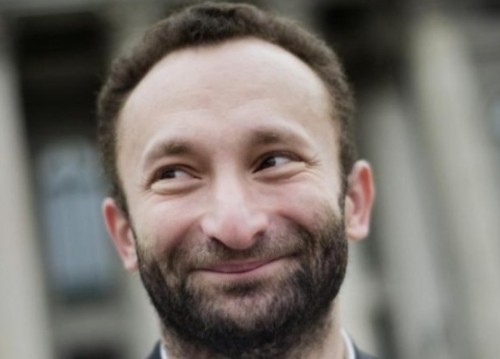
Kirill Petrenko: “a tiny gnome, a Jewish caricature.”

Kirill Petrenko: “a tiny gnome, a Jewish caricature.”

This month marks the 165th anniversary of the publication of Richard Wagner’s landmark essay ‘Das Judenthum in der Musik.’ Almost right on cue the opera scene, particularly in Berlin, has recently played host to a series of episodes that would have the Old Sorcerer spinning in his grave. Back in June Kirill Petrenko, a Siberian-born Jewish conductor, was appointed as music director to the Berlin Philharmonic beginning September 2018. Petrenko was no-one’s first choice. His name apparently came into the reckoning only after 124 orchestra members split down the middle in an all-day election on May 11, half of them voting for the German favourite Christian Thielemann and the other half for the young Latvian, Andris Nelsons. By nightfall, the players were steeped in conflict, forcing leaders to seek a third, compromise candidate. Petrenko, 43, in his second year as music director at Bavarian State Opera, privately signalled his disinterest in the job. However, when called with the election result, he accepted with ‘euphoria and joy’. As a result, he will be the first Jewish chief conductor of the Philharmonic.

Rather predictably, Petrenko’s appointment has been greeted with enthusiasm by Jewish critics and commentators eager to indulge in the usual effort to promote their co-ethnics as geniuses. In my 2013 analysis of the Spinoza cult, I pointed out that

a recurring theme here at TOO has been the monitoring of ethnic networking in efforts to establish Jewish figures in positions of scientific, academic, artistic or cultural pre-eminence. Erudite studies by several writers, particularly Kevin Macdonald (a major theme of The Culture of Critique) and Brenton Sanderson, have shed light on individual cases (e.g., Boas, Freud, Trotsky, Rothko, Mahler) as well as the more generic processes involved in these efforts (e.g., promotion in the elite media and the academic world). Typically these efforts can be said to begin with the veneration by a group of Jews of a Jewish intellectual or artist, and is followed by the creation of an authoritarian cult-like aura around his or her personality. The process reaches its completion, in some cases after the death of the guru figure, in an aggressive Jewish marketing effort to convince society at large that this figure, together with his or her ideas, is or was of national or international—if not cosmic—significance. It is predominantly by this process that the notion of “Jewish Genius” is perpetuated.

More specifically relevant to the Petrenko case, in 2011 TOO’s Brenton Sanderson wrote Why Mahler? Norman Lebrecht and the Construction of Jewish Genius.’ The piece explored the efforts of Jewish critic and author Norman Lebrecht to transform Mahler’s image “from that of a relatively minor figure in the history of classical music at mid-Twentieth Century, into the cultural icon of today.” Sanderson, commenting on Lebrecht’s Why Mahler?, writes that

The focus here is on alerting us to fact of Mahler’s towering genius, and how this genius was inextricably bound up with his identity as a Jew. Overlaying this, as ever, is the lachrymose vision of Mahler the saintly Jewish victim of gentile injustice. Lebrecht’s new book is another reminder of how Jewish intellectuals have used their privileged status as self-appointed gatekeepers of Western culture to advance their group interests through the way they conceptualize the respective artistic achievements of Jews and Europeans.

Given Sanderson’s comprehensive treatment of Lebrecht and his motivations, and the wider context of Jewish ethnic networking, I was unsurprised to see Lebrecht emerge as one of Petrenko’s earliest and most gushing admirers in the aftermath of the diminutive Jew’s election. According to Lebrecht, Petrenko is a “profound and experienced Wagnerian,” who “spares nothing in his musical passions and gives both musicians and audience the feeling that the music could not be performed in any other way.” Lebrecht assures us that Petrenko is “a genuine maestro.” Read more

Paul-Éric Blanrue and the Jews: From Celebration to Censorship

Paul-Eric Blanrue

Paul-Éric Blanrue

Paul-Éric Blanrue is a French writer whose most recent books have documented Jewish power networks in France, especially their relationship with the center-right under Nicolas Sarkozy and with the “far-right” Front National under the Le Pen family.[1] The thesis of these books, meticulously documented, is that Jewish influence in elite French political and cultural circles is enormous. Blanrue quotes countless French political leaders and commentators remarking upon this, but also shows how, if any are critical, they are swiftly punished.

Elite political and cultural power in France is thus distorted by Jewish perceived interests and ethnic biases, to the detriment of non-Jewish groups. The native French suffer demonization at the hands of a holocaust-centric memorial culture, the de facto exclusion of French nationalists from normal democratic politics, and the de jure censorship of indigenous European advocates, race-realists, and revisionists. Arabs and Muslims also suffer at home with a noxious combination of continued immigration and race-baiting, and abroad since at least 2007 with unconditional French support for Israel and the American Empire against the Palestinians, Libyans, and Syrians. Read more

Idi Amin and His Israeli Enablers

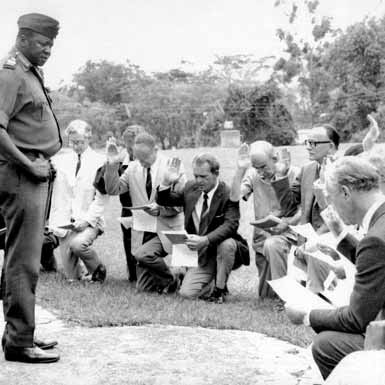
White diplomats bowing down to president Amin whilst reciting 'Oath of Allegiance' to him as a ruler of Uganda

White diplomats bowing down to president Amin whilst reciting ‘Oath of Allegiance’ to him as a ruler of Uganda

Although Idi Amin’s penchant for Scotland has been glamourized in Hollywood film (1), the incontrovertible role Israel played in the demagogue’s ascent to power has all but been omitted from the annals of history. Like Nelson Mandela, and other African leaders at the forefront of the continent’s de-colonization and liberation movements, Amin received much of his military training in Israel; first as a paratrooper with the IDF, then with Mossad and Israeli Secret Police.

Idi Amin Dada Oumee was President of Uganda from 25 January 1971 to 11 April 1979. His tenure in office is characterised by egregious human rights violations, repression of non-Muslims, sectarian violence, and the ethnic cleansing of Uganda’s minority populations. Amin oversaw the killing of hundreds of thousands of his countrymen, the nation’s Anglican archbishop, chief judge, and an assortment of political rivals, as well as wives and lovers — with whom he’s said to have sired more than five dozen children. In total, Amnesty International estimates Amin’s terror squads murdered more than half a million Ugandans during the mad dictator’s eight year reign of brutality.

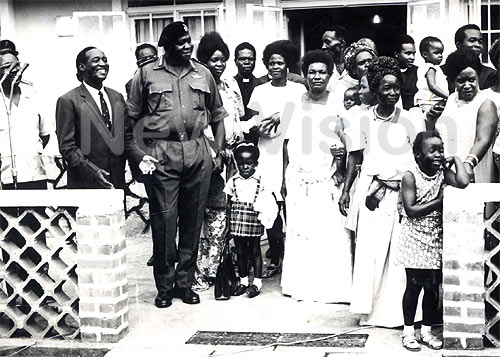
wives d

Amin, wives and children

Within 18 months of seizing control of the country, Amin declared an economic war on the nation’s non-indigenous population — a set of calamitous policies which included the expropriation of businesses and properties owned by Asians and Europeans and transfer of wealth to Amin and his Muslim cronies, or “mafuta mingi.” (2) Confiscating businesses, expropriating property, decimating infrastructure, ravaging Uganda’s national economy and killing anyone in his path are undeniable facets of Amin’s Black Nationalist historical legacy. What was concealed, however, was Amin’s link to Israel — a nation positioning itself to become the leader of a decolonised African superstate.

Read more