Featured Articles

How the Muslims got a “holocaust” of their own

Reconciliation is a two-way street but the Bosnian Muslims don’t seem to agree — they nearly tore the Serbian prime minister apart at the weekend when he attempted to pay his respects to those killed in Srebrenica in the civil war.

But there is always an upside, and the Srebernica massacre is paying dividends for Europe’s ruling elites two decades later. For in the cultural war, new ways of demonising Whites have to be continually rolled out.

Hence the gathering at Westminster Abbey last week when the British people were reminded that they too had to shoulder the burden of culpability for the massacre of Muslims in the Balkans in 1995.  Former government minister Paddy Ashdown said from the lectern “We could have prevented this horror. We chose not to.”

Who does he mean by “we”? That brutal Bosnian civil war was not short of atrocities on both sides. And what has that got to do with ordinary British people?  Read more
The Surveillance Society and Freedom-Curbing Legislation are nothing new…

Hermes
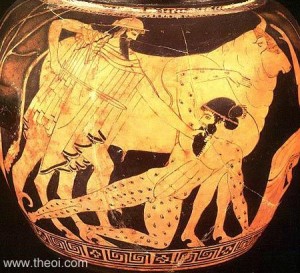
The God Hermes slaying the hundred-eyed monster Argus (figure on vase, c. 
5th B.C.)

Translated from the French by Tom Sunic

Q: Radar on the roads, security cameras at every street corner. One gets a big impression of being constantly under surveillance.  With the recently adopted law on intelligence gathering, how far can these freedom curbing measures still go?

A: The new law allows the installation of “black boxes” on internet networks and servers which operate with the technologies of “deep packet inspection” and which enable the monitoring of private conversations on the internet, as well as the interception and scanning of all communications the goal of which is to detect, by means of secretly kept algorithms, all “suspicious” words and every “unusual” behavior. This law also allows, without any need to seek court approval, the wiring up of homes, computer hacking in order to siphon off their contents, the use of portable “IMSI-catchers” (false antenna relays intercepting telephone calls in a specific perimeter), the “key loggers” (software for reading in real time what a person types on his keyboard), vehicle tagging, geolocation of people and objects, etc.

The “black boxes” also allow the analyses of all the “metadata “, that is to say, to keep track of all traces left behind by a person using the phone or the internet. Any data value, being proportional to the square of the data number to which it is connected, the growing collection of the “metadata” thus enables not only how to predict the behavior of a group of individuals with their specific characteristics, but also to prod into every aspect of citizens’ lives: their relationship, their mail, their social networking habits, their banking transactions, their travels, purchases, subscriptions, lifestyle, age, political views, etc. Read more

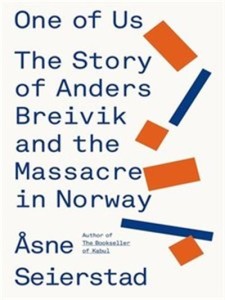
Not One of Us: Asne Seierstad’s book on Anders Breivik

one-us-story-anders-breivik-and-massacre-norwayA Brief Review of: Asne Seierstad, One of Us: The Story of Anders Breivik and the Massacre in Norway, Translated by Sahar Death (New York: Farrar, Straus and Giroux, 2015).

I recently finished reading One of Us, a book on Anders Breivik by the well-known Norwegian journalist and author Asne Seierstad. The book was published in Norway in 2013. The English language edition was released this spring. July 22nd marks the fourth anniversary of Breivik’s attacks, and the subject is topical due, in part, to the June rampage by Dylann Roof. There are significant similarities and differences between Breivik and Roof.

Everyone recalls the news reports of the 2011 attacks, but this book details Breivik’s life, the events of July 22nd, and his trial the following year. Assuming that Seierstad’s account is accurate — and despite some left-wing bias, it appears to be, this can be said about Breivik:

He was not a National Socialist, nor even a racialist. He supported Israel. He was a cultural Christian. Although he did not have a strong religious faith and rarely went to church, Christianity was important to his identity. He was anti-Islam. He considered himself a revolutionary conservative and an intellectual, not a warrior.

Read more

Churchill — When Britain Said No

When it comes to stirring oratory, few speeches have the power to quicken the pulse like Winston Churchill’s “We shall fight on the beaches…”  from  June, 1940. Generations of British schoolchildren have learned how that voice, crackling over the airwaves, helped galvanise the nation to new heights of endurance in the struggle against an all-powerful foe.

Churchill’s grand aristocratic tones summoned up the spirit of British defiance from across the centuries. So British schoolchildren are taught anyway — and you still come across grey-haired veterans of those days who vividly remember where they were when they heard it on the wireless.

Shame then, that it was all a bit of a fraud.  For the recorded version of the speech we are all familiar with, was not made until nine years later at his Chartwell country residence with the old boy rumbling into a microphone while sitting up in his bed. (The original speech in the House of Commons was not recorded — extracts were read out by newsreaders).

That is one of the milder revelations in a bunker-buster of a BBC television program called Churchill: When Britain Said No  which told the story of how the victorious war time premier was overwhelmingly rejected at the 1945 general election.

Predictably, the keepers of the flame are outraged. The Winston Churchill Industry in both the USA and Britain have expressed their disgust that such a program could have been broadcast. A “hatchet job” opined Lee Pollock, director of the Winston Churchill Center in Chicago. In an article in The Spectator  Mr Pollock wrote that “When Britain Said No  is so one-sided and hysterical that it actually does a disservice to the revisionist cause.” Churchill’s family, too, were enraged and condemned the program as “designed to belittle Churchill’s record.”

Read more

The SS Empire Windrush: The Jewish Origins of Multicultural Britain

‘Will you find out who is responsible for this extraordinary action?’
Oliver Stanley, M.P., June 1948.

The SS Empire Windrush holds a special place of infamy in the minds of British Nationalists. When the ship arrived at Tilbury docks from Jamaica in June 1948, carrying 417 Black immigrants, it represented more than just a turning point in the history of those ancient isles. In some respects it signalled the beginning of mass, organized non-White immigration into northwest Europe. Back in November, TOO published my research on the role of Jews in limiting free speech and manipulating ‘race relations’ in Britain in order to achieve Jewish goals and protect Jewish interests. I’ve recently been revisiting some of my past essays, delving deeper and expanding each of them in an effort that I hope will result in the publication of a book-length manuscript on aspects of Jewish influence. During this process, I’ve been particularly compelled to research further into the role of Jews in Britain’s immigration and racial questions. What I present in this essay is a survey of some interesting facts, which I hope to document and integrate further as my work on the volume proceeds.

One of the things that struck me most when I began looking into the origins of multicultural Britain was the hazy and confused background to the arrival of that notorious ship. First though, I might point out one of history’s bizarre ironies —  the vessel that would signal the end of racial homogeneity in Britain started life as a Nazi cruise liner. The ship began its career in 1930 as the MV Monte Rosa. Until the outbreak of war it was used as part of the German Kraft durch Freude (‘Strength through Joy’) program. ‘Strength through Joy’ enabled more than 25 million Germans of all classes to enjoy subsidized travel and numerous other leisure pursuits, thereby enhancing the sense of community and racial togetherness. Racial solidarity, rather than class position, was emphasized by drawing lots for the allocation of cabins on vessels like the Monte Rosa, rather than providing superior accommodation only for those who could afford a certain rate. Until the outbreak of war, the vessel was employed in conveying NSDAP members on South American cruises. In 1939 the ship was allocated for military purposes, acting as a troopship for the invasion of Norway in 1940. In 1944, the Monte Rosa served in the Baltic Sea, rescuing Germans trapped in Latvia, East Prussia and Danzig by the advance of the Red Army.

Read more

How it could happen: The candidacy of Donald Trump

We all rack our brains every day trying how to break through in a system that is completely stacked against us. How could it happen—a political movement that would ignite the imaginations of White America, depose the corrupt donor class in the Republican Party, and begin to really take the country back?

Right now, doing so is a huge uphill battle. The oppressive mainstream media environment is closed to obviously true messages that Whites have interests just like everybody else. Indeed, it is busy tearing down what’s left of traditional American culture. And despite the internet, the mainstream media, including outlets such as Fox News, continues to wield enormous power, and the vast majority of Americans, including educated Americans, accept its legitimacy and moral authority. Despite the First Amendment, we all know that there are a variety of very powerful social sanctions against anyone who contravenes the racial consensus.

Further, it is extremely difficult for a grass roots political process to gain traction in the U.S. where there are two entrenched political parties and winner-take-all elections, with no proportional representation. Political parties need money—big money, billionaire-type money, and they need highly recognizable names — neither of which is typically available to a grass roots movement. Such movements have a hard time getting traction or a sense of legitimacy, and it’s very difficult to get their word out, especially if it contravenes what our media elites want to hear.

But political celebrities have an enormous ability to shape public debate because the media cannot ignore them. The media can and will do all it can to destroy celebrities that err on the side of political incorrectness, but they can’t prevent the message from getting out. Read more

Liberal Cognitive Dissonance on South Africa

A peculiar thing happened while my liberal sister and I were driving near a Black area of Johannesburg on our way back to Pretoria from RO Tambo International airport — Anne expressed a palpable fear of being in proximity to the very people she’d championed less than two decades earlier.
My sister had not been back to South Africa for several years as she’d fled the country immediately after the fall of Apartheid. Like many wealthy liberals, she’d moved to Western Europe the moment the White-ruled government she loathed so much had been removed, and the ANC installed in its place.
I soon followed suit as literally everyone in my family, apart from my uncle, who’s since moved to Ghana for work, returned home to their countries of origin.
Within minutes of seeing predominantly Black faces carousing in the forecourts of the shanty town shebeens dotted along the M57 roadside — the sole toll-free highway connecting Joburg’s airport with Garsfontein, Pretoria, I began to realise my sister wasn’t exactly in her comfort zone.
“Do we have to drive through here?” She asked, as I turned and looked at her.
“It’s the only road to Garsfontein from Joburg airport.” I responded. “How else do you want us to get back to Aunty’s?”
“I don’t know. It just doesn’t seem like the sort of place we should be driving through.” My sister concluded, while nervously fumbling through her purse. (Anne is a staunch proponent of gun control in SA, the UK and US, so I doubted it was a pistol she was looking for.)
At first I wasn’t sure what to make of her request and conspicuous nervousness.

Read more