Featured Articles

The Tea Party and the GOP: Heading for Divorce

Writing in the Wall Street Journal, William A. Galston makes some points that reinforce the still expanding racial fault lines in America (“The Tea Party and the GOP Crackup“) noted in my previous post. The take home message is that there is a rift between (White) Tea Party Republican base representing traditional American conservative rural and small town values versus corporate America and the emerging non-White majority. As always the rhetoric does not explicitly mention race, but it’s looming in the background like the proverbial 800-lb. gorilla. Tea Party Republicans are in the Jacksonian tradition of American politics.

Jacksonians care … passionately about the Second Amendment …. They are suspicious of federal power, skeptical about do-gooding at home and abroad; they oppose federal taxes but favor benefits such as Social Security and Medicare that they regard as earned. Jacksonians are anti-elitist; they believe that the political and moral instincts of ordinary people are usually wiser than those of the experts ….

These Republicans believe that their country has been taken away from them. They are

aroused, angry and above all fearful, in full revolt against a new elite—backed by the new American demography—that threatens its interests and scorns its values.

That’s the crux of the problem in a nutshell. The new hostile elite that has been ascendant since the 1960s has solidified its power by importing a new people—people who want big government, high levels of government services, more immigrants that look like themselves, and who care nothing for the traditional people and culture of America.

Galston points out that most Tea Partiers think that minorities get too much attention from government; 65% view immigrants as a burden on the country. Contrary to elite opinion, they are better educated than the general population and are more likely to be middle class (50%) or upper-middle-class (15%). They are socially conservative on issues like gay marriage. Many are small businessmen who abhor high taxes and government regulation. They have strong economic reasons to oppose the current trend.

Galston concludes:

It’s no coincidence that the strengthening influence of the tea party is driving a wedge between corporate America and the Republican Party. It’s hard to see how the U.S. can govern itself unless corporate America pushes the Republican establishment to fight back against the tea party—or switches sides.

The problem is that corporate America is part of the hostile elite—with a globalist outlook, favoring policies that gut the US labor market and highly susceptible to lawsuits by activists and race hustlers if they deviate in the least from the path of righteousness as defined by the diversitycrats. They are not going to switch sides. Indeed, corporate America is a major employer of diversitycrats.

And so much of the really big corporate-derived money in the Republican party comes from ethnically motivated members of the hostile elite, like the Republican Jewish Coalition (which supports gay marriage and the immigration surge) and Sheldon Adelson in particular. According to ProPublica, Adelson donated at least $98 million and perhaps as much as $150 million to Republican candidates and causes in the last election cycle, mainly motivated by his obsession with Israel. This is the highest total for any individual in American history. But Adelson is no fan of anything remotely resembling Tea Party attitudes.  VDARE’s Patrick Cleburne notes that Adelson describes himself as a “social liberal” in favor of “socialized-type” health care. Definitely not a Tea Partier.

So we have one part of the Republican Party that is furious that their country is being taken away from them, while the other part—the one with most of the money—is actively involved in their dispossession.

This is not a marriage made in heaven. Again, the Tea Party Republicans are “aroused, angry and above all fearful.” In fact, it looks to me like fertile ground for an implicitly White third party. Republican votes, if not Republican money, come from its Tea Party base. A third party with such a Tea Party platform  may not win given that the hostile elite has imported a new electorate opposed to everything the Tea Party holds dear. But when it’s obvious that they can’t win, that’s what revolutions and secessions are made of.

Confissões de um ex-racista

Christian Miller: Confessions of a Former Racist, The Occidental Observer, 25 de março de 2011

Eu me arrependo de minha antiga heresia. Percebo o erro de minhas atitudes. Eu estava totalmente errado em acreditar que minha raça, a raça branca, tem um direito legítimo à identidade ou qualquer direito a promover seus interesses coletivos. Agora eu sei que, como branco, é meu dever ficar parado enquanto todas as outras raças se organizam e fazem lobbypor privilégios legais em bases raciais, redistribuições monetárias e subsídios e empregos por ação afirmativa. Eu peço desculpas por recuar diante da ideia de se distribuir dinheiro que  não se ganhou, respeito ou empregos com base na cor da pele de uma pessoa. Eu costumava chamar tais programas de “antibrancos”, injustos, inconstitucionais ou ilegais. Agora, eu entendo que eles são parte da “justiça social”, de que precisamos desesperadamente para corrigirmos as injustiças históricas cometidas pelos brancos contra os não-brancos.

Estou muito arrependido por acreditar que a raça é um modo útil de prever o comportamento de grupos. Eu estava totalmente errado em dizer que “a sociedade é uma construção racial” porque, desde então, percebi que a raça é em sua maior parte uma construção social. Todas as estatísticas raciais sobre a criminalidade, diferenças biológicas e variações comportamentais são meros instrumentos de propaganda de uma sociedade supremacista branca. [N. do T: este segundo link dá para uma versão em PDF do clássico  Raça, Evolução e Comportamento, do psicólogo canadense J. Philippe Rushton. Eis aqui uma versão abreviada do livro em português]. Quando o privilégio branco desaparecer, raças muito pouco bem-sucedidas, como os negros africanos e os aborígenes australianos, serão projetadas balisticamente rumo ao sucesso cultural, econômico, filosófico e científico em grande escala. Mas no momento, o privilégio branco faz com que outras raças (exceto os judeus e os norte-asiáticos) fracassem economicamente, cometam crimes bárbaros e violentos e fiquem estagnados como uma permanente classe inferior em qualquer sociedade que contenha brancos.

Mais

http://retrogradolusofono.blogspot.com.br/2013/10/christian-miller-confessions-of-former_6833.html

Implicit Whiteness Sightings: Shutting Down the Government and Talk of Secession

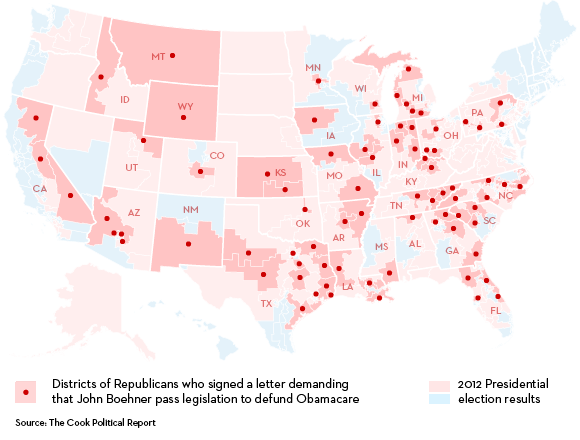
Always quick to spot a racial angle that they think will put White people in a bad light, there has been quite a bit of comment on the racial angle to the government shutdown/debt ceiling crisis. The New Yorker came up with “Where the GOP suicide caucus lives,” the point of which is that the Congresspeople who are shutting down the government are from rural areas where pretty much everyone is White. Here’s where the villains live:

congressdistricts_final-01

While the most salient demographic fact about America is that it is becoming more diverse, Republican districts actually became less diverse in 2012. According to figures compiled by The Cook Political Report’s David Wasserman, a leading expert on House demographics who provided me with most of the raw data I’ve used here, the average House Republican district became two percentage points more white in 2012.

The members of the suicide caucus live in a different America from the one that most political commentators describe when talking about how the country is transforming. The average suicide-caucus district is seventy-five per cent white, while the average House district is sixty-three per cent white. Latinos make up an average of nine per cent of suicide-district residents, while the over-all average is seventeen per cent. The districts also have slightly lower levels of education (twenty-five per cent of the population in suicide districts have college degrees, while that number is twenty-nine per cent for the average district). …

In short, these eighty members represent an America where the population is getting whiter, where there are few major cities, where Obama lost the last election in a landslide, and where the Republican Party is becoming more dominant and more popular. Meanwhile, in national politics, each of these trends is actually reversed. Read more

Verbal Venom: Biological Parallels for Western Pathologies

Stung Out to Die
Here’s a short and very old word: Wasp. Here’s a long and very new word: Neuroparasitology. Despite their differences, the two words go together very well. Neuroparasitology is the study of how parasites manipulate the brains of their hosts. Parasitic wasps are experts at this manipulation. For example, some inject paralysing toxins with their stings and create living larders for their offspring. Mason wasps lay eggs on paralysed caterpillars, then seal them into brood-chambers made of mud. The caterpillars are then eaten alive by the larvae that hatch from the eggs.

SONY DSC

Parasitic wasps induce this suicidal passivity with minute injections of neurotoxin, because tiny amounts of chemical can have huge effects on nervous systems. The way a caterpillar submits to being eaten alive is both grotesque and fascinating, but then parasitism is one of the most interesting aspects of biology. Like predators, parasites have spontaneously evolved again and again in the animal kingdom. There are parasitic mammals, birds, fish, insects and more: Think of vampire-bats, cuckoos, lampreys, mosquitoes and so on.

Each species of parasite exploits some particular aspect of its host’s biology. Wasps inject toxins that paralyse nerves; cuckoos lay camouflaged eggs that fool eyes and brains. But this raises a dangerous idea about Homo sapiens. It’s clear from biology that predation and parasitism evolve quickly and easily among animals. All birds have a common ancestor, but some birds, like eagles and shrikes, now prey on their relatives, while others, like cuckoos and skuas, now parasitize their relatives. So why can’t predation and parasitism have evolved among those animals known as human beings? Why can’t there be predatory or parasitic ideologies, professions and even races? Read more

The NPI Conference — After the Fall: The Future of Identity

*The National Policy Institutes 2013 Leadership Conference will be held at the Ronald Reagan Building in Washington, DC on October 26th, with related events on Friday 25th and Sunday 27th*. It is still time to register online at our website http://www.npiamerica.org/2013-conference.*http://www.npiamerica.org/2013-conference.*

 Though there’s much talk about “identity” in political debates these days, it’s not always clear what we are talking about. Is identity defined by Race? Language? Religion? Ethnicity? Nationhood?

The National Policy’s Institute (NPI)’s coming conference—After the Fall: the Future of Identity—will raise such questions and provide the audience with important perspectives.

While the entire Western world is facing similar and inter-related challenges nowadays—from mass non-European immigration to financial bankruptcy, from cultural debasement to social atomization—the identity of “the West” that is at stake is not clearly understood. Often, what is meant by “the West” is its neoconservative conception: liberal democracy, human rights, and cultural and religious pluralism. (Paul Gottfried has quipped that when neocons say “the West,” they seem to mean the Upper West Side.) Since this “West” doesn’t recognize race, or culture in the full sense of the word, it knows no border. It is all too often conflated with the Occident, which has a history of its own and is embodied by a particular people—the European people.

The “West” as defined by mainstream discourse is challenged by Third World immigrants today. They might be willing to benefit from the delights of a technologically advanced society, but for most of them, they keep seeing themselves as members of distinct cultures, with different and often competing interests. They rarely adhere to the liberal values that, we are supposed to believe, define our identity. Quite often, they can even outright reject them. Read more

Richard Dawkins and the Beltway Celebrity Culture

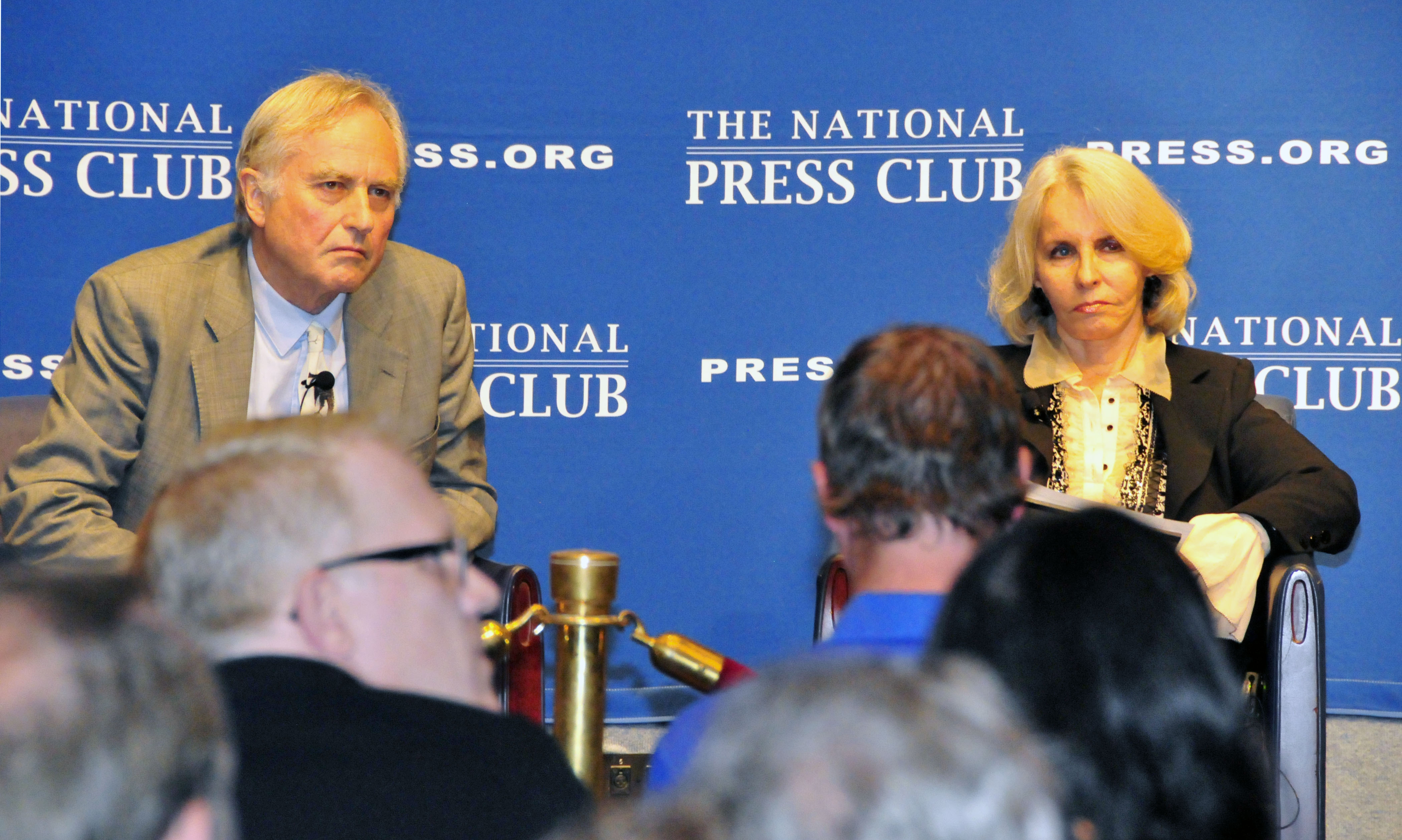
Richard Dawkins and #81277B

Book signing at the National Press Club hosted by Sally Quinn, the quintessential gossip columnist and D.C. socialite

Richard Dawkins has been making the rounds on the celebrity-author circuit with the release of his newly published memoir, An Appetite for Wonder, the first of a projected two-volume autobiography.

Dawkins addressed a standing-room only audience at the National Press Club in Washington, D.C., on September 30. The event’s host was Sally Quinn, who was once described as “the reigning queen of Washington dinner party culture.” Quinn has carved out a niche as the supreme hostess of the Georgetown salon, the keeper of the keys to the beltway’s celebrity circuit.

The 72-year-old socialite has attained celebrity status for who she is, not what she has accomplished. Quinn is the third wife of former Washington Post editor Ben Bradlee, who rocketed to fame during the Watergate scandal. Were it not for Nixon’s ill-fated cover-up, Bradlee and Quinn would have remained relatively obscure beltway figures as editor and spouse.

Her resume is quite thin. Quinn’s accomplishments include: graduating Smith College, getting hired at the Washington Post without any writing experience (Here is her reported job interview with Bradlee: “Can you show me something you’ve written?” asked Managing Editor Benjamin Bradlee. “I’ve never written anything,” admitted Quinn. Pause. “Well,” said Bradlee, “nobody’s perfect.”), failing to make it as a television news anchor on the CBS Morning News (leaving the program in six months), writing two books and various profiles for The Washington Post, and at 41 giving birth to a son. Read more

A indústria do Holocausto no Reino Unido

Francis Carr Begbie: The Holocaust Industry in the UK, The Occidental Observer, 5 de outubro de 2011
Tradução, links e comentário ao fim do postO Ocidental Lusófono
Her_Majesty_the_Queen_Lays_a_Wreath_at_the_Cenotaph_London_During_Remembrance_Sunday_Service_MOD_45152054-1
poppyEm meados da manhã do segundo domingo de novembro, os clarins soarão no Último Posto, no Cenotáfio Memorial de Guerra em Londres, e por dois minutos a Inglaterra ficará em silêncio. A simples dignidade do Domingo da Recordação, a rainha depositando uma coroa de flores, o silêncio enquanto uma canópia de flores de papoulas vermelhas cai sobre os veteranos e homens das forças-armadas em posição de sentido, tornam este um momento de tristeza quase impossível de suportar.

Embora o evento comemore todos os mortos de guerra britânicos e da Comunidade Britânica, ele tem suas raízes nas trincheiras da Primeira Guerra Mundial e em batalhas como a do Somme, na qual os britânicos sofreram 58 000 baixas, um terço mortos no primeiro dia. O silêncio marca a décima primeira hora do décimo primeiro dia, quando as armas silenciaram em 1918. O símbolo da ocasião é a flor de papoula vermelho-sangue, distribuída pela Legião Real Britânica e usada por milhões.
Não há símbolo mais sincero do sentimento tradicional na Grã-Bretanha do que a flor da papoula. E é por isto que duas recentes decisões de financiamento do governo revelaram uma mudança tão espantosa de prioridades culturais. A primeira foi uma recusa em financiar um projeto para o plantio de de papoulas em um campo da recordação para os mortos de guerra da Grã-Bretanha. O segundo foi uma promessa do Primeiro-Ministro de despejar mais dinheiro dos contribuintes na promoção da indústria do Holocausto, atualmente em grande expansão.