If you were worried that liberals would tone down the apocalyptic rhetoric about Donald Trump after Saturday’s assassination attempt — He’s an existential threat to democracy! a fascist! an aspiring dictator! an authoritarian! Hitler! — you can rest easy.
Apparently, the left has concluded that the best way to avoid political violence in the future is to ratchet up their dire warnings about the end of democracy presaged by a second Trump presidency. (That’s almost as good as their plan to lower deficits by spending more.)
Two days after the shooting, Vox announced in a headline, “Yes, it’s still fair to call Trump a threat to democracy.”
President Joe Biden agreed, telling NBC’s Lester Holt, “How do you talk about the threat to democracy, which is real, when [Trump] says things like he says.” (Otherwise, it was a great interview except that the president kept calling Lester “Bryant.” Amazingly, it’s necessary to add: That’s a joke.)
MSNBC’s Joy Reid called Trump “the greatest purveyor and promoter of political violence, really, since anyone can remember.” Pro tip for Biden defenders: Maybe don’t bring up people’s ability to remember things.
I’m not sure how to measure who the biggest “purveyor and promoter of political violence” is, but I can do a body count. And when it comes to political violence, the left beats the living daylights out of the right, so to speak.
Granted, we’re only 248 years into this experiment, but so far, every single shooting of a national politician in the U.S. has been committed by a person on the left — or someone even more deranged than a liberal.
A few would-be assassins were simply delusional nuts. Richard Lawrence, for example, was a house painter who thought he was King Richard III of England. He tried to shoot President Andrew Jackson because he thought the United States owed him money.
The rest were political activists who may have been crazy enough to be left-wingers but were not so crazy as to believe they were King Richard III.
Democrat, actor and peace activist John Wilkes Booth shot President Abraham Lincoln on April 14, 1865, because, as he explained in a letter to his family, he loved “peace more than life.” (But he really wanted to direct.)
Charles J. Guiteau, who shot President James Garfield in 1881, had a long relationship with a utopian commune, the Oneida Community, where free love and communal child-rearing were practiced — and this was before Hillary Clinton’s “It Takes a Village”!
Leon Czolgosz, who killed President William McKinley in 1901, was a socialist and anarchist inspired by socialist radical Emma Goldman.
Giuseppe Zangara plotted to kill both Republican President Herbert Hoover and President-elect Franklin Roosevelt, intending to assassinate “all capitalist presidents and kings.” He just missed Roosevelt, killing Chicago Mayor Anton Cermak instead.
Lee Harvey Oswald, who shot President John F. Kennedy on Nov. 22, 1963, was a stone-cold communist since reading Communist propaganda as a teenager. He moved to the USSR, and when his application for Soviet citizenship was denied, slit his wrists. He then moved with his Russian wife and child back to the U.S., planning to move to Cuba and biding his time passing out “Fair Play for Cuba” leaflets.
Inspired by Communist and Socialist Party literature, Oswald first tried to kill Maj. Gen. Edwin A. Walker, a John Bircher; then former Vice President Richard Nixon; and finally did kill President Kennedy — or so the mafia and the CIA would have us believe!
Upon his arrest, Oswald immediately called John Abt, lawyer for the American Communist Party, saying he wanted Abt to defend him so he could use the trial to showcase his Marxist beliefs.
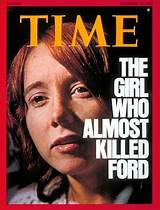
Lynette “Squeaky” Fromme, who shot at President Gerald Ford in 1975, was part of Charles Manson’s countercultural hippie cult. She pulled a gun on Ford because she was upset about the plight of the California redwood — which put her on the shortlist for a MacArthur “genius” grant. Sadly, a woman has to do twice as much as a man …
Seventeen days later, Sara Jane Moore tried to kill Ford because, she said, “the government had declared war on the left.”
(Remarkably, these two assassination attempts on her husband didn’t lead Betty Ford into any sort of self-destructive behavior, thank goodness!)
In the entire history of the nation, only two senators and two congressmen have been assassinated. Three of the four were killed by “progressives” for political reasons.
The first member of Congress to be assassinated was Republican James M. Hinds of Arkansas. He was killed in 1868 by secretary of the Democratic Committee of Monroe County George A. Clark.
Sen. Robert Kennedy was killed on June 5, 1968, by Sirhan Sirhan, a Palestinian extremist angry with Kennedy for his support of Israel. (Luckily, that was the last recorded incident of extremist political violence by a Palestinian ever since, as far as I know.)
The most recent assassination of a member of Congress was in 1978, when Rep. Leo Ryan was killed by members of Jim Jones’ left-wing cult in Guyana.
There are other, less homicidal comparisons to be made.
No conservative has ever run at a secretary of State, waving bloody hands in her face (Code Pink’s Desiree Anita Ali-Fairooz at Secretary of State Condoleezza Rice when she was testifying before Congress).
No conservative has ever hit a Democratic politician in the face with a stupid sign, or attacked him as he mowed his lawn, breaking his ribs. (GOP Senate candidate Rand Paul in 2010; and again Sen. Paul in 2017).
No conservative has ever sneaked into a Democratic National Convention and heckled the speaker (Obama bundler Jodie Evans at Sarah Palin during the 2008 Republican National Convention).
No conservative has ever shot up the Democratic congressional baseball team to protest a Democratic president, as a Trump-hating Bernie Sanders supporter did to Republicans in 2017 (James T. Hodgkinson, wounding five, Rep. Steve Scalise critically).
Before you start wailing about how we “almost lost our democracy on Jan. 6,” that was the only right-wing mob violence in U.S. history. And we’ll never hear the end of it. Your grandchildren will be in nursing homes and Jan. 6 will still be at the top of the news feed.
Pretty weak tea, compared to the epic violence exhibited the previous year by BLM protesters, ginned up by the police-hating media.
Jan. 6 carnage: One person died — protester Ashley Babbitt, who was killed in cold blood by a black Capitol Police officer for trespassing; and $2.7 million in property damage.
BLM carnage: 25 deaths, thousands of injured law enforcement officers, hundreds more hospitalized, $2 billion worth of property damage, and torched stores, neighborhoods and police precincts.
Liberals accusing the former president of inciting political violence is factually incorrect, deeply ironic and slightly silly. (Other than that, good point!) Trump needs to hear Biden’s thoughts on political violence like he needs another hole in the head.