General

Zelensky’s Sacked Top Aide ‘Escapes’ To Front-Line To ‘Hide’ From Corruption Investigators

For months, the U.S. has been split between the neocons clinging to fantasies of a battlefield reversal, and the rising bloc of realists (JD Vance et. al) who have finally accepted what the frontlines have shown for over a year, Russia has already won. Ukraine’s army is shattered, NATO’s ammunition reserves are exhausted, and American voters are done with a war that offers no victory and no strategy.

The realists now want a controlled, face-saving diplomatic exit, that locks in territorial losses quietly while Washington claims it “secured peace.” Zelensky has resisted every inch of this pivot because peace ends his power. And Yermak was the immovable pillar of that resistance, insulating Zelensky from any pressure to negotiate, the filter preventing unwanted messages from reaching the president. By purging him through a NABU raid, the U.S. has isolated Zelensky.

ZeroHedge: Zelensky’s Sacked Top Aide ‘Escapes’ To Front-Line To ‘Hide’ From Corruption Investigators

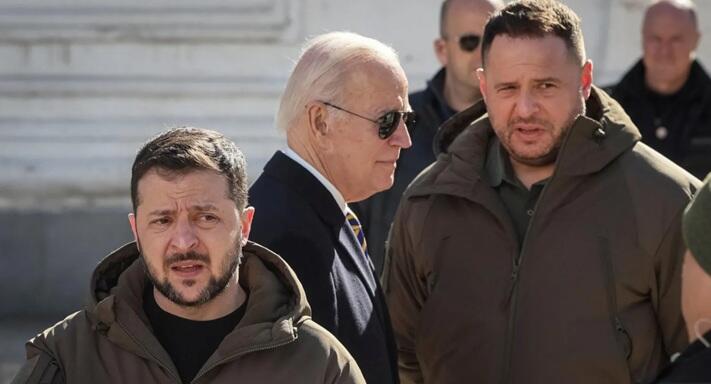
Andriy Yermak [who has a Jewish father: Wiki], the man who until just over 24 hours ago was Zelensky’s right hand man and the president’s top most powerful aid as chief of staff and Ukraine’s appointed chief negotiator with the US on the peace process, is going to the front lines, apparently to “fight”.

After his home and offices were raided by Ukraine’s anti-corruption investigators Friday related to the ongoing massive energy sector kickback scandal, Yermak announced by text message to The New York Post“I’m going to the front and am prepared for any reprisals.” He followed with, “I am an honest and decent person.”

The Post added further, “He then apologized if he no longer answers calls. He did not say when or how he intended to go to the frontlines of the war against Russia.”

He appears to still be rejecting allegations he was involved in the graft probe, centered on at least $100 million being siphoned off by corrupt Ukrainian officials amid a series of payoffs and kickbacks.

The narrative in his defense is being spun by the same NY Post report, which suggests this is all merely ‘political’ due largely to jealously and growing rivalries related to the enormous decision-making influence Yermak was coming to wield:

Despite his towering frame, you might not always have spotted him. Yet, wherever President Volodymyr Zelensky was, Yermak was often not far away.

As his chief of staff, Yermak wielded enormous power at the top of government and was even trusted to negotiate on Ukraine’s behalf at peace talks with the US.

But as his influence grew, so did public resentment of the power this unelected official held. His political career came to an abrupt end on Friday, hours after anti-corruption investigators raided his home in Kyiv.

But clearly his dramatic declaration of “going to the front lines” is meant to signal a sense of self-sacrificial patriotism and induce feelings of sympathy.

Oleksandr Dubinskyi, a rare and controversial oppositional lawmaker in Ukraine’s parliament who has long called for Zelensky’s impeachment, has a very different take based on his sources. He detailed in an X post a series of specific claims, the chief of which is that Yermak is ‘hiding’ from anti-corruption investigators:

I have learned where exactly he is going to “serve.”

Fact: Yermak, with his security detail, was brought to the location of commander nicknamed Madjar – one of the most media-prominent Ukrainian fighters, known for harsh Telegram rhetoric and the “Drone Wall” project. Unit commanders refuse to assign Yermak to their ranks.

He is physically present but has no tasks, no role, and no assigned position. Yermak is hiding from NABU anti-corruption investigations in a zone where detectives cannot serve him a notice of suspicion or court summons.

Separate detail: Madjar accepted Yermak only after a personal request from Zelensky. For Yermak, the front is not service. The front is a hideout. And it is interesting how people will meet Yermak – the man who organized the forced rounding-up of people in the streets of Ukraine.

Interestingly, when the teams of NABU and SAP agents searched his office on Friday, this was just meters away from President Zelensky’s own office.

As a reminder, Andrew Korybko recently opined that Yermak’s removal could prompt some progress in peace talks:

He’s Zelensky’s powerbroker so his downfall could undo the already shaky alliance between the armed forces, the oligarchs, the secret police, and parliament that keeps Zelensky in power, thus pressuring him into peace, especially if his warmongering grey cardinal is no longer pushing him to keep fighting.

One geopolitical source, known on X as The Islander, agrees: this is largely the result of the Trump administration finally bringing real pressure to bear on the Zelensky regime at a moment a clear, workable peace plan is on the table — which much to Kiev’s chagrin features territorial concessions in the Donbass and Crimea.

According to the lengthy analysis [emphasis ZH]:

The fall of Andriy Yermak – Zelensky’s fixer, enforcer, gatekeeper, and indispensable ally, isn’t a “corruption scandal.” It’s Washington slapping the table. NABU, the U.S.-trained attack dog of Ukrainian politics, didn’t raid the Presidential Office by accident.

It raided to remind Zelensky that the war isn’t his to command, the peace process isn’t his to veto, and the leash around Bankova Street is held in Washington, not Kiev and certainly not European chihuahuas. Because the real story isn’t Yermak’s resignation. The real story is the West turning on itself over how to end a war Russia has already won.

The fall of Andriy Yermak, Zelensky’s most loyal ally and the de facto power manager of Ukraine, is not a scandal. It is a strike from above. NABU, the U.S.-funded, U.S.-trained anti-corruption bureau, didn’t raid the home and office of Ukraine’s most powerful unelected official by coincidence. And in any other country, his resignation after a corruption raid would be a political scandal. In Ukraine, it’s a geopolitical detonation.

Yermak wasn’t just a chief of staff, he was the shadow architect of the regime, the man through whom every appointment, every oligarchic negotiation, every Western request, and every wartime decision had to pass. And the speed of his resignation makes clear this was less about corruption, and more about pressure — engineered, timed, and executed by the one actor that can pull such a lever, Washington.

For months, the U.S. has been split between the neocons clinging to fantasies of a battlefield reversal, and the rising bloc of realists (JD Vance et. al) who have finally accepted what the frontlines have shown for over a year, Russia has already won. Ukraine’s army is shattered, NATO’s ammunition reserves are exhausted, and American voters are done with a war that offers no victory and no strategy.

The realists now want a controlled, face-saving diplomatic exit, that locks in territorial losses quietly while Washington claims it “secured peace.” Zelensky has resisted every inch of this pivot because peace ends his power. And Yermak was the immovable pillar of that resistance, insulating Zelensky from any pressure to negotiate, the filter preventing unwanted messages from reaching the president. By purging him through a NABU raid, the U.S. has isolated Zelensky.

Meanwhile, the EU is panicking. European leaders fear peace more than war because peace forces accountability… why did they destroy their own industries, torch their energy security, plunge their economies into recession, and funnel hundreds of billions into corruption for a war Washington itself is now preparing to fold?

Brussels supported Zelensky unconditionally not out of conviction but out of sheer self-preservation. If the war ends, they must answer for the ruin they inflicted on their own populations. Europe needs perpetual conflict to postpone the political reckoning. Washington, by contrast, wants a face saving offramp. This is the real EU–US divide: Brussels wants to delay the inevitable, Washington wants to manage it, and Kiev wants to deny it. Only one of them has the power to dictate the timeline, and it isn’t Europe.

Moscow sees the Western fracture, senses the desperation, and understands its advantage. Putin’s message has been cold and consistent: either negotiations occur on terms that reflect the battlefield reality and address the root cause of the conflict, or Russia will continue grinding down NATO’s proxy forces until nothing remains to negotiate with.

For Russia, both paths lead to victory. Russia has no reason to rush, it is the West running out of time, weapons, unity, and credibility. And when European publics finally realize their leaders sacrificed prosperity, stability, industry, and geopolitical autonomy for a war that ended exactly where Moscow predicted it would, the political reckoning will be seismic. Yermak’s fall is not the end of an era, it marks the beginning of the collapse for the EU.

Already, President Zelensky has on Saturday announced a delegation headed by security council secretary Rustem Umerov was on its way to Washington continue talks on the Trump-proposed deal to end the war.

Umerov has been put in charge of the Ukrainian delegation at a moment Yermak is on the run toward the front lines. This is all happening very fast, and the White House can now more easily impose its will on an increasingly disunified and somewhat panicked Zelensky government.

Censorship of Israeli Media

Working under pressure, threats and censorship

As of November 28, 2025, 12:35 PM

Freedom of the press – that’s a thing of the past in Israel. This is the report of several journalists working in the country. Their work is accompanied by smear campaigns, hatred, and even death threats.

By Ivo Marusczyk, ARD Tel Aviv

 “Dissenting voices are to be silenced.” Reporters Without Borders has been leveling this accusation against the government of Israeli Prime Minister Benjamin Netanyahu for months. The prime minister strikes a similar tone to US President Donald Trump when speaking to journalists.

At a press conference, Netanyahu confronted a female journalist, saying: “You spread these lies all the time. Now listen to me. Listen to me. This is the truth, but you spread this lie every single day.”

Reporter reports on government smear campaign

Guy Peleg, an Israeli television reporter who exposed the Sde Teiman prison camp scandal, is particularly targeted. “The ruling party, Likud, has been waging a campaign against me, comparing me and my friend Amnon Abramovich to Nasrallah and Khamenei – the ‘modern Nazis.’ That’s how they described Netanyahu,” Peleg said.

The journalist had published the video on Channel 12, which shows the alleged mistreatment of Palestinian prisoners in a detention camp. It also serves as evidence for allegations that prisoners were raped there.

Threatening messages and death threats

And since then, the hostility has increased, with threats of violence becoming commonplace, Peleg reported in his radio show on station 103fm:

I don’t just receive one threatening message. I receive dozens of threatening messages, with explicit death threats. Let me read the latest message I received this morning: ‘Your only chance of survival is to resign from your job and leave the country. Otherwise, all that will remain of you will be a gravestone.’

Peleg sees these threats not only as hate messages from political dissidents, but as the result of a political campaign fueled by the government.

Soldiers threaten the ARD team sitting in a car in the West Bank
Minister Ben-Eliahu: Media not a “protected species”

The Israeli government has nothing but scorn for such accusations. Amichai Ben-Eliahu, the minister responsible for cultural heritage, told the state broadcaster Kan that Peleg should stop whining. He would simply be harassed. “The media shouldn’t think they are a specially protected species in the State of Israel. Anyone who incites hatred and participates in violating public order will have to pay the price. Wherever he goes, the word ‘shame’ should be written on his forehead,” Ben-Eliahu said.

There are further examples of Israel’s government attempting to control or even silence the media. Government agencies are officially prohibited from cooperating with Haaretz, the country’s most important left-liberal voice.

Israeli Communications Minister Shlomo Karhi accuses the Israeli media as a whole of acting in concert and blocking political projects of the right wing and the national-religious camp. He claims they are therefore partly responsible for the Hamas terrorist attack in October 2023. He said this in parliament in early November:

If the media had not been fully mobilized to promote refusal of reserve service and to incite ruthless resistance to judicial reform, such a division in the nation would not have occurred, enabling the enemy to seize the opportunity on October 7th.
Expressions of opinion are unwelcome.

The government intends to take action: Defense Minister Israel Katz plans to close Army Radio, one of the most listened-to radio stations in Israel. The reason given is its sometimes critical political reporting. Katz stated that Army Radio should not express opinions. The government also intends to cut the budget of the state television broadcaster KAN and ultimately privatize it – a move that will likely lead to its closure.

Not only because of these increasing attacks by the government, but also because of them, Reporters Without Borders now ranks Israel in the lower half of its press freedom ranking , in the unflattering position of 111 out of 180. Even behind countries like Chad, South Sudan or Haiti.

Dems: Follow Our Illegal Orders, Not Theirs

This thing about illegal orders could be trouble for them

If you’ve been buried in Jeffrey Epstein’s emails advising Harvard professors how to cheat on their wives, you may have missed the video put out by six Democratic lawmakers last week, somberly instructing members of the military to “refuse illegal orders” from the commander in chief, one Donald J. Trump.

At least I think that’s the point they were making. Here’s the gist of their public service announcement:

Sen. Mark Kelly, D-Ariz.: “Our laws are clear: You can refuse illegal orders.”

Rep. Jason Crow, D-Colo.: “You can refuse illegal orders.”

Rep. Chris Deluzio, D-Penn.: “You can refuse illegal orders.”

Rep. Maggie Goodlander, D-N.H.: “You can refuse illegal orders.”

I’ve watched it several times, listened to it backward, showed it to friends, and I think the subtle message they’re trying to convey is that members of the military can refuse illegal orders.

Trump and a slew of Republicans accused the six of sedition for encouraging troops to stop before following orders, mull over the directive, then decide whether, in their considered opinion, the order is “legal” or not. (Admittedly, Trump may have gone too far in suggesting all six should be put to death.)

Any normal person sees a video like this and thinks, There must be a problem if they’re doing PSAs about it!

The Democrats reacted with wide-eyed innocence. That’s the law! Are you saying troops should follow illegal orders? We even got the inevitable Holocaust comparison, with CNN’s Jake Tapper delivering this little sermon:

“The Nuremberg defense — this is the war crimes tribunal after World War II — was that these Nazis were only following orders, and the Nuremberg defense was resoundingly rejected in international law. Carrying out illegal orders is not a defense because you were being obedient.”

This is a classic Democratic cheeseball attack: Make baseless accusations while pretending not to be making baseless accusations.

Here are some other classics:

“Hate has no place here.”

Wait a minute. Are you talking to me?

“Stop racism!”

Who are you calling a racist?

Then-Sen. Kamala Harris grilling Brett Kavanaugh during his nomination hearing: “Be sure about your answer, sir.”

I guess his other answers were careless lies.

Needless to say, the lawmakers were unable to cite any illegal orders from Trump or anyone else in the military’s chain of command. (Nor, for the record, did Kamala produce any lie told by Kavanaugh.)

When pressed to name an illegal order, the not-terribly-bright Rep. Crow indignantly informed Fox News’ Martha McCallum that it was unreasonable to expect Democrats to be referring to anything at all. “Here’s a novel idea,” he said. “How about we actually prevent things from happening before they become a problem, right?”

I can think of millions of ways Democrats are breaking the law if I don’t need a single example.

But, unlike them, I do have examples of illegal orders issued by Democrats. Democratic presidents, Cabinet officials, mayors, governors and members of Congress have issued illegal orders that have been followed, or are being followed, even as we speak.

For example:

President Joe Biden ordered border patrol agents: Don’t do your job.

Mayors in blue cities around the country ordered (and are ordering) police: Don’t do your job.

Governors in “sanctuary” states are ordering law enforcement officers, voting officials, prison administrators, department of motor vehicles workers and others: Don’t do your job.

All of these employees also take oaths to faithfully perform their duties. Republicans should run the Democrats’ exact video — with the same termagants doing the hectoring — but with a new intro, directing the announcement to state government employees who are following illegal orders right now.

With any luck, Tapper will give us another lecture on the squalid inadequacy of the Nuremberg defense.

Apart from Democrats doing the exact thing they are falsely accusing Trump of, their smarmy video gives me some great ideas for other public service announcements.

Here’s one.

Despite the best efforts of liberal think tanks, charitable trusts and Michelle Obama, “food deserts” are a huge problem in this country, depriving mostly poor Black people of access to healthy food. The main cause of the problem is that grocery store chains simply can’t afford to locate in certain neighborhoods on account of the industrial-scale shoplifting.

Here is my proposed PSA, to be delivered by the CEOs of Walmart, Kroger, Costco, Publix, Target, Trader Joe’s, Whole Foods and Sam’s Club:

“Inner city residents: You have to pay for stuff. We know that’s something new for you, but it’s against the law to take items off the shelf and walk out without paying for them.”

Would anybody have a problem with that?

What? We’re just saying that it’s the LAW to pay before leaving a store. Are you guys in favor of shoplifting?

COPYRIGHT 2025 ANN COULTER

Alex Honnold, Free-Soloing, and a Christian View on Race

Alex Honnold 

Free Solo, instead, is largely about the intensity of knowing a person like [Alex] Honnold, of having someone so unusual in your life, and the ways in which he bewitches, excites, and frightens the people around him simply by doing his job.

Free Solo Is a Staggering Documentary About Extreme Climbing by David Sims, Atlantic Magazine (September 27, 2018)

I hate heights.

*        *        *        *

My fear of heights has increased with age — I do not recall it being an issue when I was younger. While I have no fear of commercial air travel, I have developed an intense fear of heights — even modest ones. It struck me a few years ago when I hiked Crowders Mountain near Charlotte, North Carolina with my family. I took the “easy” path of seemingly hundreds of trail rock steps to the 1,600-foot summit, which offers incredible views of the surrounding area. Upon reaching it, I took one look around and decided that the view itself was too much: I began to have something more than anxiety but less than a full-blown panic attack. I almost immediately (and embarrassedly) tucked tail and made haste to descend the mountain. There are even more embarrassing episodes of my fear of heights that I will not belabor here (like my anxiety on Ferris Wheels) but the nub of my fear appears to be when the place of height lacks adequate (at least to me) safety measures. In any event, I am certainly — and markedly — afraid of heights now.

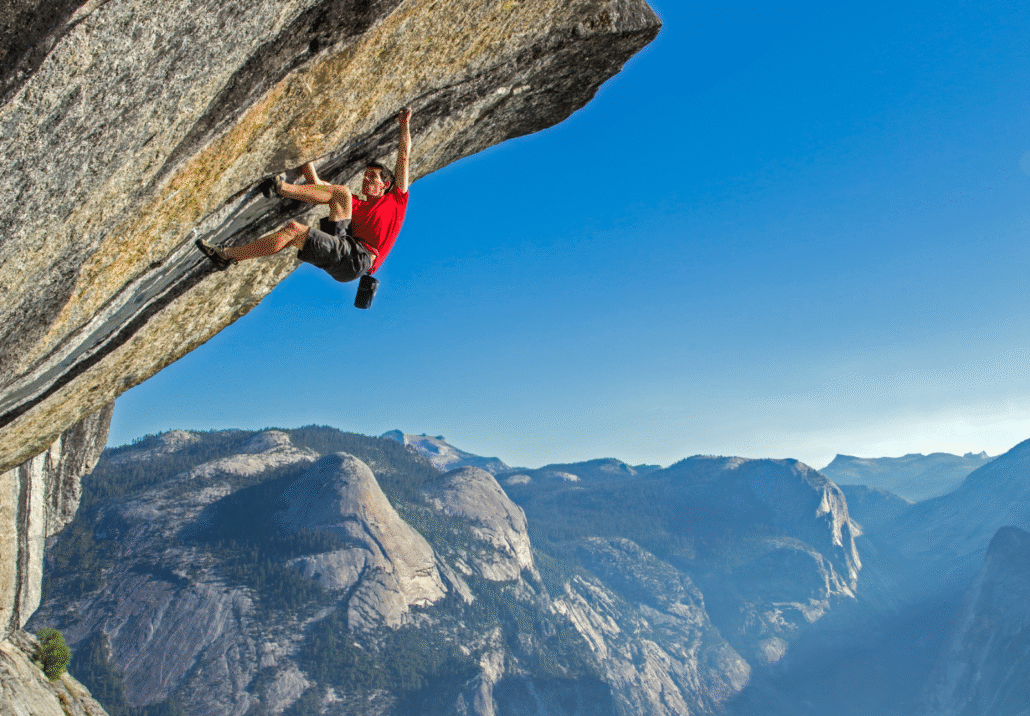
Understanding my fear of heights is important in understanding my reaction to the 2018 documentary Free Solo. Free Solo is not just a documentary about rock climbing in its most extreme form — it is an incredible journey in the psychological portrait of an obsessive type of Western man. The film follows professional rock climber Alex Honnold as he prepares to free solo El Capitan in Yosemite National Park. Free solo rock climbing is a form of climbing where the climber ascends without the use of ropes or protective gear, relying solely on their climbing shoes and chalk for grip. This style of climbing emphasizes the climber’s skill and mental fortitude, as any fall can result in serious injury or death. While extreme sports have become a fad of sorts in the last forty years — mostly individual sports that simultaneously push adrenaline and limits beyond measure — free solo rock climbing is perhaps the most extreme of them all.

El Capitan — or the El Cap — is a vertical rock formation in Yosemite National Park, on the north side of Yosemite Valley, near its western end. The granite monolith is about 3,000 feet from base to summit along its tallest face and is a world-celebrated location for big wall climbing. To see it — to see its almost flawless granite verticality — it is be stunned that anyone could climb even with the most prophylactic safety equipment let alone climb with none. Just looking at it gave me chills — it is that impressive. Alex Honnold was the first man ever to free solo this mountain — and this first was captured by Free Solo. It is never lost on the viewer (or at least this one) that this was easily a film that could have never seen the theaters had Honnold slipped to his death on camera. Watching him scale the face of El Cap is itself a marvel that he did not.

Three things stand about the work as a documentary. First, it is visually stunning. Any nature footage of Yosemite is bound to impress, and everything there seems almost prehistoric and larger than life. It is creation in its purest and most unadulterated form. The film captures this beauty and grandeur as well as any nature documentary has. The film zeroes in on Honnald’s climbing — and moves in, as it were, to the crevices, cracks, and depressions on the face of the mountain. Instead of the smooth appearance that El Cap has from a thousand feet away, it is a highly textured labyrinth of creases that the film highlights. Second, the film is a study into the mind of an extreme athlete — Honnold is a very unusual psychological specimen. The film does its best, albeit in very brief interludes, to offer some insight into the mind of a free soloist. Third, the documentary is drama-filled with ethical dilemmas and emotional strain. The people who assist and accompany Honnold on this journey — from his film crew to his fellow rock climbers who train with him; from his girlfriend to his mother — are struck by the problem of helping Honnold do something that is so incredibly dangerous on its face. That the filmmakers, who are Honnold’s longtime friends, might be filming contemporaneously his death is never lost on them. That his climbing companions may be training with him for the same is similarly difficult for them to process.

It is a mesmeric film — one that I was late, by seven years, seeing when it was first released. A close friend — someone who shares a similar personality, at least in some ways, to Alex Honnold — recommended the movie to me. Unlike me, this friend is someone who shares an affinity for extreme adventures. In a just a little bit different life, he could have been someone like Alex Honnold.
Alex Hannold at Yosemite

*        *        *        *

Free Solo was a documentary that was acclaimed by virtually everyone who saw it. It won the Academy Award for best documentary in 2018 — and, based upon my research, every major publication — of every conceivable stripe — seemingly had something (universally positive) to say about it. In an age in which heroes are a dead letter and in which religion is a tacky anachronism, Free Solo strikes a chord for a type of man who is alive in doing something extreme. No, really extreme. It is a perfect statement of secular religion, or, at least, a type of secular religion. Embodied within it is a type of secular holiness that bears a relation, albeit for different reasons, for the hard things done by men in ages past. Man, in the age without God, seeks his Zen in highly idiosyncratic ways but it is to be found, or so he thinks, if that way is authentic and radically his own. I cannot recall a character who exemplifies Zen in the secular sense more than Alex Honnold. To demonstrate how powerful this image is, I, as a man who is deeply committed to the most retrograde and traditional form of Catholicism, found myself mesmerized by him. I too am a creature of my age.

But enough has been written — more in fact — about the mind of the extreme athlete in Alex Honnold. While he is, to say the very least, an intriguing and mystifying human being, most of what has been written about his documentary would be, to the extent he cared, agreeable to him. There is something else that fascinated me about him — something I think he would find it much less fascinating but just as compelling to me. That is, Honnold as the archetype of the Western man — the European man. Let me unpack that: Honnold appears to have generic modern liberal sensibilities. He is a vegetarian and an environmentalist. His foundation is based upon environmental micro-investments for impoverished Third World communities. He grew up in California. He ostensibly is irreligious and shacks up with his girlfriend in his home (a van). Other than his habit for undertaking this extreme activity, he strikes me very much as a man with conventional California liberal beliefs and views. While I would not describe him as a “hippie,” he is seemingly comfortable in their midst and aping their worldview (when he is not thinking about rock climbing, which is evidently not very often). To say that he would disdain what I am going to write it is to put it mildly, yet it was what struck me after taking in the whole of who — and what — this man is.

Let me offer politically incorrect assumptions on several counts and digress for a moment from free soloing. To situate my comments and observation, something must be said of race. First, races exist — not as social constructs, but as durable biological categories. Moreover, various races differ on average in myriad ways. The traditional understanding of race, which is just another word for the biological term “sub-species,” historically subdivided people into five categories: Caucasian (White); Mongoloid (Asian); Negroid (Sub-Saharan African); Australoid (Aborigine); and Amerindian. If race were not such a dirty word, I am sure that greater precision in definitional terms would have developed. Obviously, race is not so rigid that its categories are impermeable, and the borders between groups give way to zones of racial and geographical clines but the general proposition holds that racial groups differ from one another in meaningful ways. While “race” is an objectionable word among Western elites, “population groups” is a more anodyne way of saying the same thing among contemporaries. The meaningful differences between groups are something that can be registered internally but rarely spoken of in so-called polite company. So, that East Asians, for example, generally have a higher intelligence (as measured by a range of intellectual assessments) is noticed but seldom mentioned. That Sub-Saharan Africans surpass other groups in a variety of athletic feats (mostly those that rely upon fast twitch muscles) is similarly noticed.

We are not allowed to mention racial differences, in part, because of the implications of these differences — especially in modern, pluralistic societies like those common in the post-Christian Western world. It is not deemed an acceptable thing to say, for example, that the primary reason that African Americans do not obtain proportional admission (without substantial assistance) as a group to America’s elite universities is because they are, on average, less intelligent than the average intelligence of the competitor groups in Whites (which is just shorthand for European) and East Asians. Likewise, it is similarly verboten to say that the reason why African Americans disproportionately populate American prisons (and therefore disproportionately engage in anti-social criminal activity) is that they generally have a greater average tendency towards anti-social behavior, or, put differently, have lesser levels, on average, of self-control. Explanations for social phenomenon such as these are considered outside of acceptable discourse, and, as such, other explanations for different outcomes among racial or population groups must be considered. If one understands this, it makes perfect sense why, in an era in which racial discrimination is heavily penalized socially and legally, that a concept like “systemic racism” is used to capture an alleged mythical explanation for different racial outcomes — one that has no basis — as opposed to the more obvious one that racial or genetic distinctions largely account for different outcomes.

It is understandable to me why some have deemed race beyond acceptable discourse. There is something unseemly about it — something that offends good manners. If we accept that which we see in front of us — that is, racial differences obviously exist — we sense that there is an unfairness to it because race is, after all, an immutable characteristic that seemingly divests people of agency. The determinism of race has an ugly side. It seems plausible to me that many might accept the reality of race but deny its legitimacy of inclusion in public discourse because to do so would allow the public to use race as a shorthand for intelligence, work ethics, or criminality. Exceptions to average outcomes of course exist, of course; perhaps the thinking is that to allow a greater room for race to be included in public discourse is to allow unfair racial discrimination to flourish and create a self-fulfilling cycle of divergent racial outcomes.

The objections to taking race seriously come from more than Western liberal elites: they also come from the minority of committed Christians in Western societies. Christianity, as the great universalizing force in world history, rejects tribal or racial identity as particularly instructive, let alone destiny-making, in determining whether any man can be saved. To admit racial differences is to call into question, at least superficially, whether that maxim is true in the main. If all men are essentially equal in dignity before God and Church, which is what Christianity posits, then can groups of men meaningfully differ in racial attributes that make effecting that dignity real? I have struggled with that question for many years now as a committed Catholic — my mind and soul want the essential dignity of all men to mean that all groups are of equal abilities and attributes. Parenthetically, beyond religion, is not the American ideal of meritocracy predicated on such an assumption? But, upon years of reflection upon it, there is nothing particularly offensive about racial group differences and the Christian premise of essential dignity of all men. To a finer point on it, Christians readily acknowledge that differences of ability, temperament, and intelligence exist among individual men. Indeed, it is obvious as the day is long. I may be smarter, more athletic, and more peaceful than some but there are many who are better than me in every one of those regards. These differences do not call into question the essential dignity of all men — they co-exist. I do not feel inferior when I am around someone who is my better in some or all regards because I am essentially the equal of any man.

That different families, kinship communities, and nations should have similar group-level differences likewise should not call into question the essential dignity of men. That races, as the outer ring of population distinctions, also have differences as a result likewise should not be offensive. But more to the point, a reconciliation must be cognizable because I believe that Christianity is true and the faith as it is will never contradict natural truths. If race — and racial differences — are true as a matter of nature (and the powerful cocktail of geography, genetics, and time that make racial differences plausible), then racial differences and Christianity must be reconcilable.

For my own part, my intellectual and spiritual reconciliation of race and religion comes with certain moral demands: first, Christianity requires for the group as much as the individual that we exercise a profound humility. All have fallen and therefore no man or no collection of men bound by kinship is permitted to glory in themselves — only in God. That means even if we acknowledge differences, the relative hierarchy of men in view of those differences, whatever they may be, is irrelevant to their dignity as men. East Asians, for example, are not better versions of human beings because they are, on average, smarter than the rest of the world. It is difficult for me to claim that denying, for example, this reality (East Asian intelligence) is itself a virtue. Second, Christians are duty-bound to treat both kin and stranger (which is another way to say those from within and without of our racial group) with the same human dignity. The missionary impulse to convert all nations, given to the Apostles by our Lord, carries with an implicit conviction that all nations are worthy to be saved. Race then may be real, but it never warrants, at least for the Christian, a belief in essential superiority or inferiority of one group versus another on the plane of human dignity. But nor does it require, in service of the notion of essential human dignity, that we deny the existence of differences that exist among individual men or groups of men. They exist and make up what we might term the hard landscape of human existence in this world.

Race then is not a social construct — it is a principle derived from biology and nature. Men tend not to use it as a social concept or organizing principle. Race becomes relevant, at least to me, as a proxy for civilization. If civilization is the outer limit of human social organization and race is the outer limit of group differences, it makes sense, and is indeed borne out, that different races make different civilizations. European civilization is different from East Asian civilization and so on. Obviously, religion plays an outsized influence on civilization but so do racial attributes. The West looks like it does — the people within it have the assumptions and customs that they do — because, in large part, it was created by a particular racial group (Whites) who themselves had collective abilities and temperaments that fit the civilization they created. The same is true for every other civilization.

I am a White (read: European) American who is comfortable in Western Civilization. One of the demeaning characteristics of the elitist crusade against race is that Whites like me are — ironically — told that our particular race and our particular civilization (Western) is uniquely depraved (which violates the seeming social canon that race does not exist as a category and, in any event, should never be used as a cudgel against people born into that non-existent category). I became racially-conscious later in life (at about the same time I discovered my fear of heights) because of the official racial bias and bile that poured forth from elitist circles upon me and my own. To distill this further, when I had the full complement of children that God would give me, I found the racial bias and animus against them far more offensive than it had ever been against me. If my racial consciousness is offensive, and I am sure it is, the people to be blamed are the militant “anti-racists” in positions of power that showered upon me and my own that we are somehow qualitatively worse human beings for being born White. I did not believe that was true for other races; I will not believe it about my own either.

If my racial consciousness was initiated through what was essentially a negation of the official elitist hostility towards Whites, my evolution has been a more nuanced view based upon the positives of belonging to this group and civilization. To put it differently, I may have started this path in protest of racism shown towards me, but I have ended it with an affinity towards my own. To be sure, this is not a matter of racial superiority (indeed, my religion will not countenance it), but it is a recognition that my people — that is, Whites — are reasonable in wanting the perpetuation of their civilization, which can only come if Whites perpetuate themselves as a group. Under conventional conversational mores, it is perfectly acceptable for an African-American to indicate his or her preference for a Black spouse or their children’s marriage to a Black man or woman; to swap out, however “White” for Black in that sentiment is to, evidently, ride with the Klan. In that sense, I have a strong preference that my White children marry others from my racial group. While Catholicism trumps race in terms of marriage for my children, race is something too in the way that I think about it. Perhaps nothing more offensive could be said by a White man today — the truth is that I care little for the opinion of the people who it would offend. I see now, in a way that I did not see before, that Whites add something special to the world that is worthy of perpetuation. And if I can indulge the thought a bit more, Whites are, as a group, an unusually empathetic group of people — a caring race — which is why, or so it seems to me, God chose them to be the main missionary engine of His Holy Church. There is a double irony there. Whites are depicted by Western elites and race hustlers as uniquely evil as a group — the truth is something far different. To be clear, Whites are not a “new” chosen people and other races have different gifts too that I do not deny. But my view is that my people — my extended kin in the form of Whites — have co-created a wonderful civilization that is laudable. It is something that I can say that I am proud of without any form of customary “White Guilt”. Indeed, I refuse that now.

So native Europeans — both in Europe and in the vast European diaspora — have much to be proud of in the accomplishments of their people and the civilization that they created. They have been on the forefront of virtually every civilizational advance — and what is more, they exported those advances. The Chinese, in particular, match Europeans in many regards in their civilizational greatness but as is well known, they famously built a wall around their civilization instead of sharing it. In any event, from virtually every field of human accomplishment, Europeans have done incredible things for which is more than acceptable to both take cognizance of — and be proud of — as a member of that group and civilization. The world, as it is, organizes itself in a model given to it by Europeans — in arts, sciences, technology, culture, and economics given to it also by Europeans. And the question remains, why did the world tilt in such a distinctively European way? While that is a complex question, it does strike me that there is something uniquely curious in Europeans — something restless and adventurous among them. In every endeavor of human searching, Europeans have been among the forefront of discovery. Why is that? Prof. Ricardo Duchesne’s Faustian Man.

In his own unique way, Alex Honnold is an exemplar of this intrepid racial type found among a class of Europeans who fueled Western Civilization’s greatness. To look at him is not to see any particular attribute of greatness — he is seemingly an ordinary man. But his inner drive is Herculean — it is positively Faustian. His desire for excellence is otherworldly. And what makes him so unique is there is almost no hint of vanity or gain — he undertakes this incredible effort only to satiate his innate inner need to do it. Europe has produced men like this in seemingly every generation, and they are the great men of their ages. They did it not for fame — not for money — not for acclaim but because their nature made them reach for something beyond them and focus upon it with a monomaniacal obtuseness that is incredible to behold. In Honnold, I saw Alexander the Great. I saw Julius Caeser. I saw Constantine. I saw Saint Augustine. I saw Charlemagne. I saw Richard the Lionhearted. I saw Jean Parisot de Valette. I saw Columbus. I saw Hernan Cortez. I saw Pizzaro. I saw Oliver Cromwell. I saw Jacques Cathelineau. I saw Napolean. I saw Ernest Shackleton. I could go on, but I won’t. There is fearlessness and restlessness in the greatest of my people that manifests itself in magnitude for nothing other than the greatness of the challenge and the iron will to see it through. And to those who would say that Christianity crimps Western man’s greatness, behold how many of our best men were devoted Christians. Christianity, notwithstanding whatever Frederich Nietzsche said, does not create men without chests. We have had many Christian European men much greater than Nietzsche to ever count.

Even though Alex Honnold, in his breezy California liberalism would balk at the comparison and the point, he is nonetheless prisoner to a legacy that runs through his blood. He is a man who would rather die than compromise. He is a man who seeks something impossible because it is impossible. That Christianity lost my people in the main means that it lost people of singular greatness like Alex Honnold. I may see things more clearly, and I think I do, but I will never touch the greatness of a man like him in this life. And it has little to do with rock climbing but everything to do with the spirit of a warrior willing to sacrifice — willing to not count the cost of the battle before fighting. Alex Honnold is great not because he free soloed El Cap, as incredible as that was, but because he both wanted to do it and was willing to suffer the privations that accompanied it until it was accomplished, or he died. And while he would disown me publicly for my racial acclaim, I am proud that he is of my own kind.

Oh, that the Church might gain men like him again and my civilization and people might rise again. That we may once more put that distinctive European proclivity towards greatness once again at the service of Holy Mother Church. When this greatness is married to grace — when this otherworldly resolve is fixed towards God — the world becomes a European project for Christ. Oh, that might it be again.

Saint Boniface, Pray for Us.

 

Corporate Media Ignores the Real Epstein Story (Israel) 

And yet, notably, not a single mainstream U.S. corporate media outlet has reported on Drop Site’s revelations and the definitive proof it provides that Epstein acted as an intelligence agent or asset for Israel. Their omission is unsurprising; even the House Democrat’s own selective window into Epstein’s world reveals the indispensable role those same corporate media institutions served shielding Epstein from scrutiny.

The American Conservative: Corporate Media Ignores the Real Epstein Story  

Many of the most important Epstein revelations have come not from the files released by House representatives just last week—and extensively covered by corporate press—but from independent media.

For starters, investigations into Epstein’s operations in the U.S. Virgin Islands and the political network that enabled and protected them have been systematically ignored or suppressed by corporate media. Documents uncovered by independent journalist Lee Fang showing that Albert Bryan Jr., the current governor of the Virgin Islands, used his office to advance Epstein’s interests for several years, lobbying for tax exemptions for Epstein’s businesses and pushed for waivers that allowed the convicted sex criminal to evade local sex offender laws.

Other recent reporting from Fang exposes U.S. Virgin Island’s non-voting delegate in Congress and MSNBC darling Stacey Plaskett’s deep ties to Epstein (and reveals her previous denials about those ties to be complete lies). Epstein not only raised money for Plaskett’s campaigns, but also introduced her to key Democratic donors in New York, helping secure early funding that jump-started her political career. More than that, from 2013–2014 Plaskett worked for Erika Kellerhals, Epstein’s tax attorney and personal adviser.

Plaskett’s close political relationship with Epstein was further exposed by the Washington Post, which published video and text messages showing Epstein coaching the delegate in real time during a congressional hearing for Michael Cohen—instructing Plaskett on what to ask Trump’s former lawyer.

What these new emails do not address are the questions with geopolitical implications: Was Jeffrey Epstein some sort of intelligence agent and, if so, which government or governments was he working for?

A recent investigative series from Drop Site News journalists Ryan Grim and Murtaza Hussain provide the clearest answers to those questions so far. Together, they extensively document Jeffrey Epstein’s ties to the Israeli government and its intelligence sphere, confirming his long-suspected key role as an international political fixer, often in service of Israeli interests.

For example, the outlet reveals how Epstein worked on behalf of Israel with Ehud Barak and the Mossad to open a covert backchannel to the Kremlin during the Syrian civil war, with the ultimate goal of removing Israel’s enemy Bashar al-Assad from power. Using his contacts, such as oligarch Viktor Vekselberg, Epstein secured a private audience for Barak to meet with Russia’s President Vladimir Putin in order to push for that outcome.

Additional reporting from Grim and Hussain exposes how Epstein and Barak operated as emissaries for Israel’s intelligence services in Cote d’Ivoire, using Epstein’s private network and Barak’s political status to broker meetings with foreign leaders to advance Israeli interests.

Prior to his West Africa trip, Barak commissioned an intelligence-style dossier from the private firm Ergo—a link I and journalist Jack Poulson exposed this summer—on Cote d’Ivoire’s President Alassane Ouattara’s inner circle and his country’s security apparatus. Barak later arranged a “non-security” pretext through his son-in-law’s medical-equipment company to mask the operation’s true purpose. After meeting Ouattara and senior officials in West Africa using that cover, Barak received a Signals Intelligence (SIGINT) blueprint from former Israeli intelligence chiefs to construct a nationwide cell phone and internet interception apparatus; that plan became the basis for a 2014 Israel–Cote d’Ivoire security and surveillance agreement.

Drop Site’s reporting demonstrates the operational role Epstein served in securing that deal for Israel, coordinating Barak’s meetings during the UN General Assembly that fall and connecting him directly to the Cote d’Ivoire president’s chief of staff.

Their investigations reveal how Epstein, working with Barak, routinely played that sort of operational role on behalf of Israel—for example, by helping it construct a similar security agreement with Mongolia.

Most recently, Grim and Hussain documented how Jeffrey Epstein hosted an Israeli military intelligence officer, Yoni Koren, at his East 71st Street estate on multiple occasions: once in February 2013, while Koren was serving as a senior aide to Barak, who was then Israel’s minister of defense; a second time, for two weeks, in October 2014; and again for ten days in September 2015.

As late as January 2013, Israeli media still described Koren as the Ministry of Defense’s bureau chief, and even after Barak’s retirement he continued acting as an informal conduit between Israeli and American intelligence circles—relaying messages to Israeli military intelligence (Aman), scouting cybersecurity firms for Epstein and Barak to invest in, and arranging high-level meetings through security officials such as former CIA and DOD chief of staff under Obama, Jeremy Bash.

Emails published by Drop Site reveal Epstein’s possible role in war profiteering. In one from 2014, Epstein wrote to Barak: “with civil unrest exploding in ukraine syria, somolia [sic], libya, and the desperation of those in power, isn’t this perfect for you,” to which Barak responded, “not simple to transform it into a cash flow.”

And yet, notably, not a single mainstream U.S. corporate media outlet has reported on Drop Site’s revelations and the definitive proof it provides that Epstein acted as an intelligence agent or asset for Israel. Their omission is unsurprising; even the House Democrat’s own selective window into Epstein’s world reveals the indispensable role those same corporate media institutions served shielding Epstein from scrutiny.

In an email from September 27, 2017, journalist Landon Thomas, at the time an international finance writer for The New York Times, tipped Epstein off about an investigation by former NYPD detective John Connolly. “He is digging around again,” Thomas wrote.

Emails also expose how author Michael Wolff helped Epstein coordinate his media strategy, advising him on how to best pressure Trump and exert leverage over him. In December 2015, Wolff warned Epstein that CNN planned to ask Trump about their relationship, suggesting to Epstein how he could best use the moment for “valuable PR and political currency.”

Wolff had also recorded hours of interviews with Epstein, most of which have never been made public. Former Trump strategist Steve Bannon, who features heavily in the latest Epstein emails released by House Democrats, likewise recorded more than 15 hours of interviews with Epstein—footage which, like Wolff’s, is in the public interest yet remains unreleased.

The revelations unearthed by Fang and Drop Site News—not the curated and redacted releases from congressional Democrats—have done more to expose Epstein’s real role in global affairs than any official investigation. If the Epstein files released this week prove anything, it is that independent media has rapidly emerged as the only institution capable of an honest analysis of power.

GOP voters stayed home because of Epstein and Israel

H/T Grace Chong, MBI X account @gc22gc

“BARIS: Talking to GOP voters in NJ and VA, the top reasons they did not vote were Epstein and Israel.”
Patrick Cleburne Punchline from 0:57. Although Barris scrambles to cover up, the responses were “Israel” not “Foreign Policy” or “Ukraine and Israel”.

So the top 2 reasons GOP voters stayed away were both Trump’s responses to aspects of Jewish behavior? (Epstein was financed by Leslie Wexner; at least plausible he was running a Mossad Honeypot.)
That’s remarkable.

Afrikaners: “Welcome to the most race-regulated country in the world”

Johannesburg this weekend will host the first G20 meeting on African soil. Protesters are using the moment to draw attention to domestic problems.

Listen to this article · 4:27 min Learn more
A billboard that is part of a campaign by The Solidarity Movement, a network of organizations representing Afrikaners, on display in Johannesburg ahead of the G20 Summit, on Wednesday.Credit…Joao Silva/The New York Times
As the largest city in South Africa prepares to welcome the heads of state of the world’s 20 wealthiest economies, a wide range of the nation’s citizens want to use the meeting to make their own voices heard.

Along a highway into the city, Johannesburg, an enormous orange banner appeared that was put up by members of the white Afrikaner minority: “Welcome to the most race-regulated country in the world,” it said, echoing claims made recently by President Trump.

Nearby, a group promoting women’s rights raised a very different billboard, featuring an image of a purple and black coffin: “Welcome to the country where women are only safe in a casket,” it said, referring to the staggering number of women who have been abused or murdered in the country.

Several groups, from frustrated college students to anti-immigration activists, are planning to hold protests and work stoppages this weekend, when Johannesburg hosts the first Group of 20 summit to be held in Africa.

While most South Africans have viewed Mr. Trump’s false claims [!!] of a white genocide in South Africa as an effort to sully their country’s image, they have had no qualms about seizing on the summit as a chance to air their domestic grievances.

Want to stay updated on what’s happening in South Africa? , and we’ll send our latest coverage to your inbox.

Many locals are vying to tell the arriving guests — and by extension, their own leaders — everything they believe is wrong with South Africa.

“The government is not paying enough attention,” said Sabrina Walter, the founder and executive director of Women for Change, which put up the billboard with the coffin. The group has also called on women and members of the L.G.B.T.Q. community to refuse to work or spend money when the heads of state are in town. “We have delegates from all over the world,” Ms. Walter said. “We need to get as much attention on this issue as possible now.”

For many South Africans, the summit is a source of pride, a recognition of their country’s status as the largest economy on the continent. But the nation is also among the world’s most unequal, struggling with high unemployment and crime and an inability to provide most of its more than 60 million citizens with necessities like water and electricity.

Image

Workers in vests and hats are next to a white concrete block, working with metal rods. A "G20 South Africa 2025" banner is in the background.
Workers on Wednesday at the NASREC Expo Centre in Johannesburg, where the G20 Summit will take place.Credit…Joao Silva/The New York Times

But the expensive effort has stirred resentment among some locals, who wonder why their government cannot keep the city so clean and functional all the time. G20 signage and street and traffic lights along the route to the summit’s site have been vandalized, prompting local officials to vow to prosecute those responsible.

Continues…