Western Culture

The Roman Variant of Indo-European Social Organization: Militarization, Aristocratic Government, and Openness to Conquered Peoples. Part 1

A Critical History of Early Rome:  From Prehistory to the First Punic War
Gary Forsythe
Berkeley: University of California Press, 2005 

Gary Forsythe, associate professor of history at Texas Tech University, has written a critical history of the early Roman republic — critical in the sense that he casts grave doubts about a considerable amount of the received wisdom of the period. Nevertheless, the picture that remains provides a most welcome portrait of a critically important variant of the Indo-European legacy that is so central to understanding the West. The picture presented is of Rome of the republic as intensely militarized, with a non-despotic aristocratic government. Roman society during this period (509BC–264BC) permitted upward mobility and was open to incorporating recently conquered peoples into the system, with full citizenship rights. This openness continued into the later republic and the empire. 

Indo-European Roots of Roman Civilization: The Military Ethos of Rome

Forsythe is well aware of the Indo-European roots of Roman culture. Essentially, the Mediterranean city-states established by I-E peoples were more settled, organized versions of basic I-E social organization based on mannerbunde. He describes “war bands” as common throughout the Greek, Roman, Celtic, and Germanic world, dedicated to raiding and fighting neighbors (i.e., the mannerbunde) (199). Leadership was based on military ability, followers sworn to fight to the death. In the early republic, aristocratic clans may well have been mannerbunde in the classic sense: the “current view,” which Forsythe is skeptical of, is that the battle of Cremera in 478 BC (a major Roman defeat at the hand of Veii, an Etruscan city, that occurred 30 years after the founding of the republic) was essentially undertaken by an aristocratic clan (the Fabians, who held consulships during the period) prior to the complete takeover by the state in organizing for war (200). In other words, at that time during the early republic, these clans operated with some independence from the Roman state.

Presumably reflecting this mannerbunde organization, patron-client relationships were very typical, with less wealthy people tied via reciprocal obligations to wealthy, powerful individuals. This is likely a holdover from Indo-European culture where war lords and their followers had mutual obligations. Forsythe notes that this mitigated social and economic disparities (216). One could be patron to another but also client to a wealthier individual. “Thus later Roman society was loosely bound together by a vast interlocking network of such relationships (216). Reflecting the non-despotic nature of Roman society (see below), patrons could be “accursed” for injustice against clients and thus either killed or ostracized.

A hallmark of Indo-European culture is that military glory is prized above all else. Thus Forsythe notes that around 311 BC, “Rome was a young and vigorous state headed by ambitious and energetic aristocrats, who were eager to utilize the state’s growing strength to enhance their own personal prestige and to further Rome’s influence and power” (307).

Various data … present the picture of a Roman aristocracy self-conscious of their power and that of the Roman state, ambitious for and reveling in military glory, and eager to advertise and catalogue their achievements for their contemporaries and posterity. … [Among aristocratic families, there was] a strong sense of family pride, tradition, and continuity. (340)

The Roman aristocracy was pervaded by a military ethos, according to which the greatest honor was won by victory in war, either by individual feats of valor or by commanding  successful military operations. This ethos was not only maintained but even fueled by the competitive rivalry which characterized the Roman elite.. … Many of Rome’s Italian allies likewise possessed a well-established military tradition, so that the profitability of successful warfare (slaves and booty) bound the Roman elite, the Roman adult male population, and Rome’s allies together into a common interest in waging wars. The Roman state was therefore configured to pursue an aggressive foreign policy marked by calculated risk taking, opportunism, and military intervention. Consequently during republican times there were few years in which Roman curule magistrates were not leading armies and conducting military operations. (286).

Read more

Rep. Steve King gets shamelessly racist — or not

Rep. Steve King (R-Iowa) caused a major liberal media meltdown by tweeting positively about anti-Islamic Dutch politician Geert Wilders and repeating his comments in an interview with CNN’s Chris Cuomo, “We Can’t Restore Our Civilization With Somebody Else’s Babies.

On the face of it, this sounds like a certain type of DNA — the DNA from our babies, not theirs — is a prerequisite for maintaining our civilization and culture. The horrors! Pass the smelling salts.

However, in explaining what he meant in a follow-up interview (where super liberal Cuomo states “[America is]known … as a bastion of diversity and it is an unqualified strength for us”), King makes it clear that he is all about cultural and genetic assimilation — that he opposes setting up of isolated ethnic/religious enclaves that remain isolated from the rest of society even after 2 or 3 generations. Indeed he looks forward to the day when all Americans look the same as a result of intermarriage, presumably some shade of brown, with genetically recessive blondness entirely eradicated. He is opposed to allowing people into the US (or Europe) who hate Western civilization, and he complains that the left is out to destroy Western civilization and “replace it with something entirely different.” He is unabashedly pro-Western civilization (“Western civilization is a superior civilization and we want to share it with everybody”), noting that the spread of Western civilization via the English language has been associated with increased personal freedom and higher standards of living.

Cuomo then presses the point, asking if Muslims, Jews, Christians, Italians, etc. are Americans, and asserting that “they are all equal … We don’t need babies from any one of those groups more than from any other of those groups.” Rep. King then seems to say that, although everyone is equal in the eyes of God and equal in the eyes of the law, not all groups contribute equally to society: “Certain individuals contribute more to society than others, and certain groups of people will do more on the productive side than other groups, that’s just a statistical fact.” Cuomo, being your standard liberal, says that these differences are entirely explained by differences in opportunity, whereas King puts the blame squarely on culture. But in any case, according to King, it has nothing to do with race: “It’s the culture, not the blood … it’s never been about race.” If children from other cultures were adopted into American homes (i.e., assimilated American homes), they would all grow up to be good Americans. Read more

Moralism and Moral Arguments in the War for Western Survival, Part 3

Part 1
Part 2

Is It Possible to Develop a Specifically Moral Argument for the White Past of Conquest and Slavery?

A second message is that in order to appeal to a wide range of Whites, we have to fashion an underlying moral message or at least have good rejoinders to the moral arguments of others. We already see that to some extent among conservatives who have nothing but scorn for the Alt Right. They emphasize the treatment of women and homosexuals in Muslim countries and refer to “radical Islamic terrorism” — implying that the terrorism has something to do with Islam (while avoiding the idea that jihad is central to Islam.  They will bring up the criminality and lack of labor participation of Middle Eastern and African immigrants. These are effective moral arguments because they argue for immoral, unfair effects on the traditional populations and culture.

But this doesn’t really get at the overriding moral argument that uniquely evil Whites are responsible for the actions of their ancestors in conquering land settled by others, slavery, etc. Of course, these accounts are carefully contextualized to ignore things like morally crusading Whites who uniquely ended slavery after a campaign based on empathy for far-away Africans. Whites ended slavery, passed Civil Rights, have funded endless uplift programs for Blacks, and twice elected a Black president — the liberal tradition so common among Northern Europeans aided and abetted in contemporary times by our hostile Jewish elite.

Also ignored are the characteristics of Whites and non-Whites that feed into current realities (e.g., IQ and personality differences, the Faustian soul of the West, etc.). Apart from the West, I have yet to hear of a movement opposed to slavery or anything else that worked by eliciting empathy. Appeals like this only work with Wersterners. These movements are a Western phenomenon and the media thrives on showing photos of suffering refugees and immigrants; “we need to help them,” never mind the short term and long term costs to our own people.

Pressing the guilt/empathy button doesn’t work in Africa or Asia despite the fact that huge swaths of humanity there (Arabs, Han Chinese, Bantu) have achieved their present territories as the result of the conquests of their ancestors. And slavery persisted in these areas long after it was abolished in the West. And even if these areas were prone to messages of guilt/empathy, you won’t see them there because these societies are not controlled by elites hostile to their traditional peoples and cultures of those areas.

One does not see Chinese people agonizing over the fact that the Han Chinese greatly expanded their territory at the expense of other peoples—a point brought out by Ricardo Duchesne in his groundbreaking The Uniqueness of Western Civilization. Nor does one see the Bantu peoples of Africa worrying about the ethics of displacing other African peoples as they spread far and wide from their homeland in Central Africa, including into South Africa where their treatment at the hands of White South Africans became Exhibit A for White evil during the apartheid era; nor do the Bantu-speaking peoples agonize about the widespread practice of slavery in Africa. Arabs do not apologize about their conquests in the name of Islam or their centuries-old role in slavery and the slave trade.

The lack of contextualization and the continual deluge of messages hostile to the White majority are good indications that the button pushing is an exercise in propaganda emanating from a hostile elite, enabled because of their control over the moral, intellectual, and political high ground. It’s not just emotional buttons that are pushed. Some of these memes are much more purely intellectual — a good example is the “race does not exist” meme, although I suppose many of these terms have emotional overtones as well because they are often linked in such a way that that they plug into the guilt mechanism. This means that they are addressed to  the higher brain centers which are able to exert substantial control over the more primitive (and self-preserving) lower brain centers responsible for things like ethnocentrism. Control of the  media and the academic high ground by the left means that Americans are bombarded by messages that enjoin them to inhibit their natural self-preserving tendencies and indeed, to feel guilt for them. These messages have also filtered down to churches and schools, so, unless they tune in to dissident media on the internet, Whites can spend their entire lives without hearing any contrary messages. It’s hard to overcome that.

Only Whites have been made to feel moral disgust at their own past of conquest and expansion. And only Whites—not all, to be sure, but a significant and important proportion—have felt moral outrage about slavery, to the point of banning it despite its material benefits to the society as a whole and to a great many individuals much more like themselves than the slaves they were freeing.

But this “everyone does it” is not really a moral argument, but rather an argument based on how we understand human nature and genetic self-interest, combined with showing that Whites uniquely developed moral arguments against the very things they were so good at—colonization and slavery. As an evolutionist, I am quite comfortable with these because they have been common throughout human history and again, Whites uniquely ended slavery. But the “anti-racist” answers that Whites have no moral claim to North America, Australia, and New Zealand, and that present-day Whites have “White privilege” as a result of the immoral actions of their ancestors. Of course, such an argument would not apply to Europe where we see the same phenomena of massive non-White immigration presented as a moral imperative.

So be it. Can Europeans make a moral argument to retain the lands they have controlled since the glaciers receded? Is longevity in a certain area a moral argument? I think not. But if it is, it would apply to every other people in one way or another, as Jared Taylor notes in a recent video. We would find that some native American groups displaced others, and we would talk about the Aztec empire and its subject peoples. Even the Hawaiians who came to the pristine islands eventually developed a society dominated by a particular chief that unified the islands at the expense of their close relatives holding power on the various islands but vicious fighting took place long before that between various islands. So then the White people take it over and suddenly we have a moral crisis. It’s what they call “selective prosecution.”

Fundamentally, if we take the ethical perspective that dominates the West today based on fairness and impartiality rooted ultimately in individualism and egalitarianism, we cannot make a specifically moral argument for White conquest. Such a perspective was foreign to the ancients who prized aristocratic values and were profoundly opposed to egalitarianism. In The Genealogy of Morals Nietzsche sketches this alternative morality — the morality of the strong versus the morality of the weak, the ethical world view of our Indo-European ancestors.

There is nothing strange about the fact that lambs bear a grudge towards large birds of prey: but that is no reason to blame the large birds of prey for carrying off the little lambs. And if the lambs say to each other, ‘These birds of prey are evil; and whoever is least like a bird of prey and most like its opposite, a lamb, – is good, isn’t he?’, then there is no reason to raise objections to this setting-up of an ideal beyond the fact that the birds of prey will view it somewhat derisively, and will perhaps say: ‘We don’t bear any grudge at all towards these good lambs, in fact we love them, nothing is tastier than a tender lamb.’ – It is just as absurd to ask strength not to express itself as strength, not to be a desire to overthrow, crush, become master, to be a thirst for enemies, resistance and triumphs, as it is to ask weakness to express itself as strength. (25–26)

The point of the left is to abolish any argument for retaining control of any territory for historically White countries—open borders for Whites and only for Whites. There are a variety of motives: hatred for Whites as ethnic competitors, monetary compensation (the massive infrastructure that incentives anti-White activism), and virtue signaling for many White SJW’s made possible because the control of  the media by the left has created a morally defined community opposed to the legitimate interests of Whites. Forget about ecological arguments—that bringing in 1 million plus immigrants yearly is an ecological disaster, forget about arguments from IQ, welfare dependency, criminality, not to mention the ethnic genetic interests of Whites. Forget about intellectual consistency — these people would be horrified at the thought that Korea or Nigeria ought to have displacement-level immigration. We are asked to ignore the evil effects of the racialization of politics and increasing political violence as non-Whites coalesce in the Democrat Party, the disuniting of society as community ties are destroyed, less willingness to contribute to public goods, etc.  These consequences of the invasion all have clear moral overtones and they support our interests because they have negative impact on people who cannot control the behavior of some of their ancestors.

Was it fair to the traditional White majority to bring in these millions of non-Whites given that the flood gates were opened by the 1965 immigration law presented dishonestly as having no effects on the ethnic balance of the country? Was it fair given that the arguments in favor of ending the bias toward Europe were the result of scientific fraud and developed by Jewish ethnic activists motivated by hatred toward the traditional White populations of the West?

Conclusion

In conclusion, I would love to be able to present a specifically moral argument within the current egalitarian zeitgeist for why it is morally okay for White people to take over North America at the expense of the natives. I can’t do that. Being susceptible to such moral arguments may well be part of our nature. But if so, we have to get over it. I suspect that the people in this room are quite proud of the accomplishments of our ancestors. And as an evolutionist, I have no problem with that.


Moralism and Moral Arguments in the War for Western Survival, Part 1

Obviously President Obama was a horrific president in pretty much every possible way. His domestic policies in particular have been anathema to the Alt Right — he would, after all, have loved to sign an immigration amnesty/surge bill into law. Nevertheless, couple of things he said in his farewell address made a lot of sense, although he probably wasn’t thinking about the Alt Right when he said them.

Obama said that too often people think of those who oppose them as not merely misguided but malevolent. This is a huge problem for the Alt Right. The very label is typically associated in the media with words like ‘Nazi,’ ‘White supremacist,’ and ‘racist’ — all of which have strong moral connotations after years of browbeating by the media.  These words produce psychological reflexes intended to preclude honest debate or any rational discussion of our ideas. And they have been very effective in doing just that.

During an interview with an NPR reporter, I mentioned that I hoped the phrase “White supremacist” would not be used in whatever eventually gets aired. The interviewer seemed surprised, thinking that “White supremacist” was a perfectly reasonable label to use, and defending his stance by claiming that some Alt Rightists have talked about Europeans as a superior and uniquely talented group. Depending on how an idea like that is phrased and conceptualized, I have no problem with it. We should have pride in the accomplishments of our European ancestors, as tabulated, for example, by Charles Murray.

But our desire to preserve a European identity and culture really has nothing to do with European talents, and I think pretty much everyone on the Alt Right is aware of this. We could be the most average or below average people on the planet but still have a legitimate interest in wanting to preserve our people and culture — and the territories needed for that. None of the people shouting about “White supremacists” would suppose that Africans should be supplanted from African states they control, no matter what their talents or lack thereof, and the same goes for Korea and every other country with a historical ethnic and cultural core. And of course, many of the same people comfortable with condemning “White supremacists” are quite content with Israel being a “Jewish state.”

But being called a White supremacist in today’s political climate has obvious moral implications (happily the phrase did not appear in the NPR interview). Such a person is not only misguided, he or she is malevolent. Such a person is consumed by hatred, anger and fear towards non-Whites, gays, women and the entire victim class pantheon, or so goes the stereotype And that’s the problem. Being cast as evil means you are outside the moral community. There’s no need to talk with you, no need to be fair, or even worry about your safety. You are like an outlaw in Old Norse society  —“a person [who] lost all of his or her civil rights and could be killed on sight without any legal repercussions.”

So the antifa at the November NPI conference felt entitled to beat up a cameraman, throw foul-smelling liquids at attendees, and break into a dinner venue. There have been other assaults, notably of Richard Spencer in January in Washington DC, but also in February at the UC-Berkeley riots. So we often hear “no free speech for fascists,” not only at antifa protests but in university classrooms, designed to shut down errant professors and students. College students showing sympathy for Donald Trump can be hounded into dropping out of school. We find students protesting having White philosophers on the curriculum. No need to discuss their ideas because they are dead White males and ipso facto a component of racial oppression. Read more

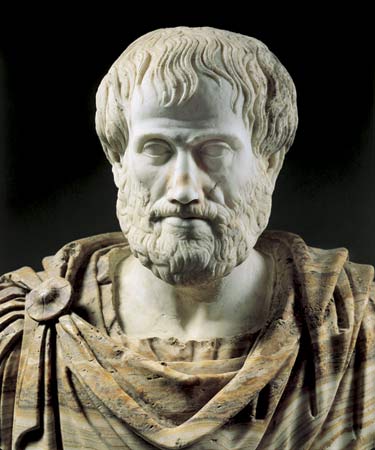
Aristotle on Immigration, Diversity, and Democracy

Aristotle (trans. Ernest Barker and R. F. Stalley), Politics (Oxford: Oxford University Press, 1995)

One measure of the intellectual and moral degeneration of the West over the last decades is the now near-total ignorance of the founding Classics of Western civilization, even among the so-called educated class. Those who remain in ignorance of what superior minds have thought before them are condemned to remain as children, at best reinventing the wheel, rather than standing upon the shoulders of giants.

While the Classics were clearly written for a time and place very different from our own, their concerns often speak to us very directly. Aristotle’s Politics, his main political treatise, is replete with comments concerning the dangers of diversity and egalitarianism. Aristotle’s political thought does not soar to the eugenic and spiritual heights of Plato’s utopia. However, Aristotle’s moderate and pragmatic brand of politics is much more palatable to someone raised in modern liberalism, while at the same time being a better introduction to the communitarian and aristocratic political ethics of the ancient Greeks.

Aristotle is greatly concerned with the preservation of civil peace in the city-state. One of the most common causes of “faction” and civil war, he says, was the unhappy consequences of unassimilated immigration and the consequent diversity. Aristotle’s prose is perfectly clear:

Heterogeneity of stocks may lead to faction – at any rate until they have had time to assimilate. A city cannot be constituted from any chance collection of people, or in any chance period of time. Most of the cities which have admitted settlers, either at the time of their foundation or later, have been troubled by faction. For example, the Achaeans joined with settlers from Troezen in founding Sybaris, but expelled them when their own numbers increased; and this involved their city in a curse. At Thurii the Sybarites quarreled with the other settlers who had joined them in its colonization; they demanded special privileges, on the ground that they were the owners of the territory, and were driven out of the colony. At Byzantium the later settlers were detected in a conspiracy against the original colonists, and were expelled by force; and a similar expulsion befell the exiles from Chios who were admitted to Antissa by the original colonists. At Zancle, on the other hand, the original colonists were themselves expelled by the Samians whom they admitted. At Apollonia, on the Black Sea, factional conflict was caused by the introduction of new settlers; at Syracuse the conferring of civic rights on aliens and mercenaries, at the end of the period of the tyrants, led to sedition and civil war; and at Amphipolis the original citizens, after admitting Chalcidian colonists, were nearly all expelled by the colonists they had admitted. (1303A13)

Thus, immigration of different peoples was a common source of conflict, often leading to civil war and concluding with the ethnic cleansing of either the native peoples or the invaders. Read more

The Wisdom of the Ancients, Part 3: Nature and Nurture; Socrates as Moral Exemplar for the Alt Right

Go to Part 1
Go to Part 2

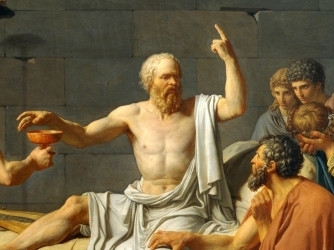
The Death of Socrates

  1. Self-Improvement: Nature and Nurture

Contrary to the currently fashionable egalitarian blank-slatist hysteria, the Greeks universally believed that an individual’s qualities were the fruits of nature and nurture. Even the sophist Protagoras, a thinker of democratic leanings and an educator of the people, argued: “Teaching requires natural endowments and training; one should begin to learn when one is young.”[1] The recognition of inborn human inequality in no way implied that the well-endowed should rest on their laurels. On the contrary, all humans should constantly work to maximize their potential through training and education.

The Greeks developed techniques for individuals to cope with and live well in the harsh world they inhabited. They were remarkably cognizant of the means available: good education, constant training, healthy habits, and socialization with good individuals. Through self-discipline and piety, reason could rule over emotions, pleasures and pains. The Greeks considered a life of belly-chasing, death-fearing, and comfort-clinging to be an evil, subhuman one, no better than that of the lower beasts. Politically, moral education of the citizens was considered practically the first duty of the state, to be achieved through training, culture, public religion, and laws.

None went further than the divine Plato in imagining what superhuman perfection might resemble. His ideal republic is a state effectively led by an enlightened and pious order of warrior-monks as a cognitive and moral elite drawn from the best of the whole people. This elite then systematically educates and trains itself, and to the extent possible the people, towards the good. But Plato goes further than most philosophers and follows the Spartan lawgiver Lycurgus in making genetic improvement of the population through good breeding a sacred moral imperative. This principle, while it follows quite naturally from humanity’s many successes in plant and animal breeding, is nonetheless remarkable given that Plato wrote long before the scientific facts about Darwinian evolution and genetic heredity were known. (Incidentally, I dare say that most of what science has since taught us on heredity reflects very favorably on Plato’s observations, concerns, and ideal.) Read more

The Wisdom of the Ancients, Part 2: Piety, Aristocratic Values and Necessary Inequality

Go to Part 1

  1.  Nature & the Gods: Sacred Laws

Greek thinkers often debated the nature of the gods and the universe itself — or nature — and their relationship with the laws. Many Greeks denounced their traditional stories about passionate and violent gods as impious. Some denounced their city’s laws as contrary to nature. The Greeks were typically Western in their willingness to question convention.

The Greeks almost universally believed that anyone who violated the will of the gods or nature, whether out of ignorance or contempt, would inevitably be ruined and destroyed as a result. In a quite literal sense then, to be impious or to do the unnatural meant for the Greeks to be engaging in maladaptive behavior. Homer’s capricious gods and the suffering of his heroes, who may have unknowingly offended a god, reflect the anxiousness of men, facing death and danger at every turn, to respect the inscrutable higher powers that hold sway over their lives.

This point is perhaps made most explicitly in one of Xenophon’s dialogues on the subject of incest:

Socrates: Those who transgress the laws laid down by the gods pay a penalty which no man can escape in the way that some transgressors of man-made laws escape paying the penalty, either by escaping detection or by the use of force.

Hippias: What penalty, Socrates, cannot be escaped by parents who copulate with their children or children who copulate with their parents?

Socrates: The greatest of all, I can tell you, what greater misfortune could happen to human beings in the procreation of their children than to procreate badly?[1]

The prohibition on incest is therefore a divine or natural law. This interdiction is a perfectly adaptive principle, even though the Ancients could know nothing about the genetic reasons for consanguineous diseases or inbreeding depression. In Xenophon’s dialogue, Hippias and Socrates observe two further customs besides incest which, being shared by (virtually) all human societies, likely reflect natural law: “among all peoples the first established custom is to worship gods” and “to honor parents.” I would argue both are fundamental adaptive principles. To honor one’s parents means to know one’s kin, to be in solidarity with them, and, to a certain extent, to inscribe ourselves in their wider plan. Elsewhere, Xenophon observes that a mother’s love for her own children is also a “natural law,”[2] which is self-evidently adaptive. Read more