Moral Communities and the Summer of George
The Summer of George is a paradigmatic example of a media-induced moral panic. A whole new, well-funded industry involving “racial sensitivity training” has sprung up where White people are systematically browbeaten into racial submission and abject guilt for the accomplishments of their ancestors. Such moral panics are, so far as I know, unique to the West and a key consequence of individualist culture. Try to imagine a moral panic in an African society. Or China. Or an Arab country. Not going to happen (counter-examples welcome).
My view is that the moral communities observed at the origins of Western history and surfacing recurrently in later centuries tapped into a pre-existing tendency among individualists to create such communities as a force for cohesion that does not rely on kinship relations. Particularly important since the seventeenth century have been the egalitarian moral communities based on a hunter-gatherer ethic whose evolutionary origins are discussed in Chapter 3 of Individualism and the Western Liberal Tradition (hereafter Individualism).
Egalitarianism is a notable trait of hunter-gatherer groups around the world. Such groups have mechanisms that prevent despotism and ensure reciprocity, with punishment ranging from physical harm to shunning and ostracism.[1] Christopher Boehm describes hunter-gatherer societies as moral communities in which women have a major role,[2] and the idea that Western cultures, particularly since the seventeenth century, are moral communities based on a hunter-gatherer egalitarian ethic will is a major theme of Individualism In such societies people are closely scrutinized to note deviations from social norms; violators are shunned, ridiculed, and ostracized. Decisions, including decisions to sanction a person, are by consensus. Adult males treat each other as equals.
Moral communities are pervasive throughout the institutional structures of the West; however, because of their widespread influence, moral communities are particularly noteworthy in the media and the academic world—both areas which have been dominated by a Jewish elite whose gradual rise to power increased greatly after World War II and came to dominate the culture of the West by the 1960s. For example, whereas mainstream social science had been relatively free of morally based ingroup-outgroup thinking prior to World War II, such thinking has had dramatic effects on the social sciences and humanities in later decades, to the point that academic departments and scholarly associations in these areas can be accurately characterized as “tribal moral communities” in the sense of Jonathan Haidt.[3] This is most obviously the case in areas such as social psychology, sociology, and ethnic and gender studies.
The result has been that academic research communities and the media rigorously police research and commentary that conflict with racial egalitarianism or promote the interests of European-derived peoples, and these attitudes have been internalized by a great many White people. Researchers such as Arthur Jensen, Richard Lynn, J. Philippe Rushton, and Ralph Scott who attempt to publish findings on race differences or on public policies related to race find themselves socially ostracized, and they quickly learn that there are steep barriers to publication in mainstream academic journals and no mainstream grant support for their research. Recently Bruce Gilley, a professor at Portland State University, had the audacity to publish an academic article titled “The Case for Colonialism” in which he “suggested that European colonies in the Third World were both beneficial and legitimate, as they generally increased the local standard of living and were often supported by a significant portion of the local population.” The moral (not factual) condemnations quickly followed, and his department is now doing all can to make life miserable for him despite “acknowledg[ing] Gilley’s professionalism: it alleges neither academic misconduct nor personal misconduct on his part but affirms the opposite.” The editor of the journal where the article was published “resigned his position out of fear for his physical safety.”
One wonders how Gilley’s article even got published. When scholarly articles contravening the sacred values of the tribe are submitted to academic journals, reviewers and editors usually become extremely “rigorous”— demanding more experimental controls and other changes in methodology. Such “scientific skepticism” regarding research that one dislikes for deeper reasons was a major theme of The Culture of Critique in discussions of the work of Franz Boas, Richard C. Lewontin, Stephen Jay Gould, and the Frankfurt School, to name a few.[4]
One result of this academic reign of terror has been that conservatives often self-select to go into other areas that are not so compromised, such as the hard sciences or computing; there is also active discrimination against conservative job candidates and Ph.D. applicants.[5] The system is therefore self-replicating.
Normal levels of wanting to be liked (not to mention pathological altruism) often involve a sense of self-righteousness, which can be translated as a sense of moral superiority that advertises one’s good reputation within a community defined, as prototypical European groups are, not by kinship but by conforming or exceeding the moral standards of the community. As noted above, such expressions of moralistic self-righteousness have a long history in Western societies and are very salient in contemporary political rhetoric.
It’s interesting that moral outrage, especially by males, acts as a cue to mate value in monogamous marriage that is a fundamental marker of Western social structure.[6] Since women want mates who fit into their moral community, men who signal moral outrage compatible with the values of that community are seen as good marriage prospects. One can imagine how this works on campus environments in the contemporary West where moral outrage directed at pretty much the entire Western past is de rigueur. Or in cities like Portland where, on Columbus Day, statues of Teddy Roosevelt and the sainted Abraham Lincoln (because he ordered the executions of 38 Indians after a Dakota uprising) were toppled by morally outraged antifa mobs.
An example of how self-righteous virtue signaling works at the highest levels of government can be seen in the comments of David Goodhart, a liberal journalist on migration:
There has been a huge gap between our ruling elite’s views and those of ordinary people on the street. This was brought home to me when dining at an Oxford college and the eminent person next to me, a very senior civil servant, said: ‘When I was at the Treasury, I argued for the most open door possible to immigration [because] I saw it as my job to maximise global welfare, not national welfare.’ I was even more surprised when the notion was endorsed by another guest, one of the most powerful television executives in the country. He, too, felt global welfare was paramount and that he had a greater obligation to someone in Burundi than to someone in Birmingham. … [The political class] failed to control the inflow … in the interests of existing citizens.[7]
An evolutionist can only marvel at the completely unhinged—pathological—altruism on display here, given that the people making these policies are presumably native White British themselves.
This overweening concern with people of different races living in far off lands at the expense of one’s own people was characteristic of many nineteenth-century English intellectuals, particularly those associated with Exeter Hall, who exhibited what Charles Dickens described as “platform sympathy for the Black and … platform indifference to our own countrymen.”[8] In his novel Bleak House, serialized in 1852–53, Dickens portrayed such sentiments in the character of Mrs. Jellyby, whose “handsome eyes had a curious habit of seeming to look a long way off. As if … they could see nothing nearer than Africa.”[9] Mrs. Jellyby neglected those around her, including her daughter, her thoughts directed instead towards the fictitious African possession of Borrioboola-Gha and her idealistic plans for its development.
It is well-known that massive non-White immigration has had negative effects most of all on the traditional, White working class of Western societies, while wealthier Whites can escape the problems brought about by immigration by moving to other neighborhoods—the phenomenon of White flight. They also tend to have jobs, such as in journalism, that have not been impacted by immigration, although visas for workers in technical areas are increasingly common. However, contemporary liberal-minded elites throughout the West are indifferent or even dismissive of the negative effects of immigration on the White working class in terms of lowered wages,[10] lessened community cohesion and involvement,[11] and deteriorating public schools. As noted, in Mrs. Jellyby’s case, this included neglecting her own children—also characteristic of contemporary liberals who typically fail to think seriously about the effects of mass non-White migration on the long-term prospects of their own children as a minority in a majority non-White society.
Such expressions of high-mindedness are attempts to fit into a moral community as defined by the media and accepted by their peers. Because the left dominates the moral high ground, expressing empathy for the native Whites, especially the White working class, makes anyone with such ideas into a moral pariah, as would advocating for their interests, with likely negative effects on career prospects. Indeed, expressions of White identity and especially having a sense of White interests have been condemned by establishment media and academic figures as illustrating the lowest form of moral depravity.
Of course, the motives involved in such cases may involve more than empathy for suffering others. While these elite Whites may feel genuine empathy for suffering others in foreign lands to the point of wanting to inundate the West with them, they are also in effect buttressing their status in the morally defined ingroup. They may even be attempting to be “more moral than thou”—competitive virtue signaling—by out-empathizing others in the group. And whether consciously or unconsciously, they may be aware of severe costs if they fail to conform to the norms of their moral community—as well as the benefits of conforming.
The conviction of self-righteousness characteristic of altruistic people need not be rational:
What feels like a conscious life-affirming moral choice—my life will have meaning if I help others—will be greatly influenced by the strength of an unconscious and involuntary mental sensation that tells me that this decision is “correct.” It will be this same feeling that will tell you the “rightness” of giving food to starving children in Somalia, doing every medical test imaginable on a clearly terminal patient … . It helps to see this feeling of knowing as analogous to other bodily sensations over which we have no direct control.[12]
In other words, the sensations of rightness and nobility act as psychological reflexes, and they are so pleasurable that people are inclined to seek them in their own right and without regard to facts or the long-run consequences to themselves.
Talk to an insistent know-it-all who refuses to consider contrary opinions and you get a palpable sense of how the feeling of knowing can create a mental state akin to addiction. … Imagine the profound effect of feeling certain that you have ultimate answers. … Relinquishing such strongly felt personal beliefs would require undoing or lessening major connections with the overwhelmingly seductive pleasure-reward circuitry. Think of such a shift of opinion as producing the same type of physiological changes as withdrawing from drugs, alcohol, or cigarettes.[13]
Feelings of moral righteousness may thus be pleasurable and lead to addiction. “Sanctimony, or a sense of righteous outrage, can feel so intense and delicious that many people actively seek to return to it, again and again.”[14]
The pleasure of knowing, with subjective certainty, that you are right and your opponents are deeply, despicably wrong. Or, that your method of helping others is so purely motivated and correct that all criticism can be dismissed with a shrug, along with any contradicting evidence.[15]
This type of sanctimoniousness is, of course, particularly common among the people labeled “Social Justice Warriors.” These are the people screaming “racist,” “misogynist,” “white supremacist,” etc. at any seeming violation of the norms of the moral communities of the left. And, because of the cultural hegemony of the left, such people can often be seen on social media (and in op-eds in the mainstream media) expressing their moral righteousness—a moral righteousness that fits with or extends the boundaries of the cultural left.
Another aspect of this is competitive altruism or competitive virtue signaling. Given that expressions of moral righteousness are typically communicated in a social setting and are aimed at solidifying or enhancing one’s reputation within a group, there may be competition for ever more extreme expressions of self-righteousness—even among people who are not biologically inclined to be prone to be warm and loving to others. Extreme expressions of moral righteousness are not only addicting, they may also raise one’s status in a social group, just as it’s common for religious people to express “holier than thou” sentiments. Strongly religious people compete to be most virtuous in their local church. On the left, we see vegan fanatics shunning vegans who even talk to people who eat meat or eat in restaurants where meat is served—even family members. I imagine there is a dynamic within antifa groups—the shock troops of the establishment’s views on race and migration—where people who do not condone violence or are unwilling to crack heads themselves are ostracized or at least have much less status.
The result is a “feed forward” process in which the poles of political discourse move ever farther apart, doubtless exacerbated by the contemporary fixation on social media. For example, well-publicized attacks on Confederate statues have quickly morphed into attacks on Thomas Jefferson, George Washington, and Christopher Columbus. Sympathy among liberals for granting amnesty to illegal immigrants has morphed into calls by prominent Democrats to abolish the Immigration and Customs Enforcement Agency (ICE), make border crossing legal, and give them health care, driver’s licenses, voting rights, and ultimately citizenship. Inviting anyone remotely associated with conservative ideas—much less the racialist Right—to give a talk at a college campus has morphed from a tolerated rarity to a context for angry protests, rioting, injuries to conservatives, and damage to property.
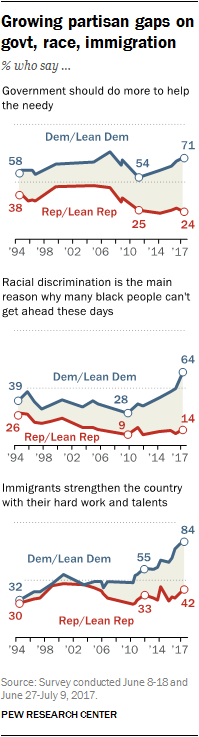
I suggest that this competitive virtue signaling is a major cause of the increasing polarization that we see in the United States and throughout the West in the age of social media. A Pew Research Center survey on changes in U.S. political culture from 1994–2017 found that the increasing divide between Republicans and Democrats, especially on immigration and race, was much more due to the median views of Democrats shifting left.[16]
Nevertheless, a theoretically similar phenomenon exists on the right as, for example, when individuals condemn others for being insufficiently militant or ideologically pure. However, because the left dominates the cultural landscape, such competitive virtue signaling has had most of its effects on the left as the median views of liberals shift to the left. Such competitive virtue signaling from both the left and the right is highly characteristic of the social dynamics of social media sites and journalism.
People on the right face the danger of “doxxing,” having their identity and personal information made public. Hosts of shows in the mainstream media may have to cope with losing sponsors and hence their livelihood; e.g., as of March, 2019, Fox News host Tucker Carlson had lost around 30 sponsors, mainly because of his comments on immigration.[17] Or people may fear losing their job as a result of a phone call to their place of employment by a self-described “civil rights” organization such as the Southern Poverty Law Center or the Anti-Defamation League. This may well be why it is the left that has become more extreme in recent decades, whereas far too many on the right attempt to mollify their leftist critics by knuckling under to their moral righteousness.
The cultural domination of the left has meant that certain views are off-limits for all but the most daring. Thus, media sites like Breitbart and The Daily Caller, while definitely to the right of the mainstream media, avoid explicit advocacy of White identity and interests. Such constraints are much less apparent on the left, with the result that the left continues to get more and more extreme in their views. As I write, views on immigration noted above and on abortion (making abortion legal up until or even shortly after birth) that used to be virtually non-existent among Democrats are increasingly being espoused by mainstream Democrat politicians and pundits. And because transgenderism has become a leftist cause, pre-pubertal children are now given hormone blockers, at times with disastrous results:
Prescribed puberty blockers by the Gender Identity Development Service as a teenager, the Manchester resident has been left with a male-sounding voice, body hair, a beard, no breasts, and unsure whether she will ever be able to have children.
A critical consequence of this is racial polarization. White Americans have been shifting toward the Republican Party—the last Democrat president to get a majority of White votes was Lyndon Johnson in 1964. In general, this is an expression of implicit Whiteness, as non-White groups coalesce in the Democratic Party. The point here is that such trends are likely to increase and polarization become more severe.
Civil war is definitely in the air and one can only imagine the violence that would greet the (at this juncture unlikely) re-election of Donald Trump. But, if Joe Biden wins, a great many Americans, seeing that the changes are happening at warp speed and that the Democrats are aiming at a permanent power via importing Democrat-voting non-Whites, packing the Supreme Court, ending the electoral college and two senators per state and the re(as they already have in states like California), will become disillusioned with the system—like the USSR toward the end of the Cold War. Again, civil war is in the air.
[1] Christopher H. Boehm, Hierarchy in the Forest: The Evolution of Egalitarian Behavior (Cambridge: Harvard University Press, 1999).
[2] Ibid., 8.
[3] Jonathan Haidt, “Post-partisan Social Psychology.” Presentation at the meetings of the Society for Personality and Social Psychology, San Antonio, TX, January 27, 2011.
http://people.stern.nyu.edu/jhaidt/postpartisan.html
[4] Kevin MacDonald, The Culture of Critique: An Evolutionary Analysis of Jewish Involvement in Twentieth-Century Intellectual and Political Movements (Westport, CT: Praeger, 1998; 2nd edition: Bloomington, IN: AuthorHouse, 2002), especially Chs. 2 and 6.
[5] Kevin MacDonald, “Why are Professors Liberals?,” The Occidental Quarterly 10, no. 2 (Summer, 2010): 57–79.
https://www.researchgate.net/publication/321716607_
[6] Mitch Brown et al., “Demonstrate Values: Behavioral Displays of Moral Outrage as a Cue to Long-Term Mate Potential,” unpublished ms, Fairleigh Dickinson University (2020).
[7] David Goodhart, “Why We on the Left Made an Epic Mistake on Immigration,” Daily Mail (March 22, 2013).
http://www.dailymail.co.uk/news/article-2297776/SATURDAY-ESSAY-Why-Left-epic-mistake-immigration.html
[8] Arthur A. Adrian, “Dickens on American Slavery: A Carlylean Slant,” PMLA: Journal of the Modern Languages Association of America 67, no. 4 (June 1952): 315–29, 329.
[9] Charles Dickens, Bleak House, Vol. 3 (London: Bradbury & Evans, 1853), 26.
https://books.google.com/books?id=KlsJAAAAQAAJ
[10] George J. Borjas, “The Analytics of the Wage Effect of Immigration,” Working Paper 14796 (March, 2009), National Bureau of Economic Research.
https://www.nber.org/papers/w14796.pdf
[11] Robert D. Putnam, “E Pluribus Unum: Diversity and Community in the Twenty-first Century,” Scandinavian Political Studies 3 (2007): 137–174; Salter, “The Biosocial Study of Ethnicity”; see also Frank Salter, “Germany’s Jeopardy,” You Tube (January 5, 2016).
[12] Robert A. Burton, “Pathological Certitude,” in Barbara Oakley, Ariel Knafo, Guruprasad Madhavan, and David Sloan Wilson (eds.), Pathological Altruism (New York: Oxford University Press, 2012): 131–37, 135.
[13] Ibid., 136.
[14] David Brin, “Self-addiction and Self-righteousness,” in Barbara Oakley, Ariel Knafo, Guruprasad Madhavan, and David Sloan Wilson (eds.), Pathological Altruism (New York: Oxford University Press, 2012): 77–84, 80.
[15] Ibid., 80.
[16] Pew Research Center, “The Partisan Divide on Political Values Grows Even Wider” (October 5, 2017).
https://www.people-press.org/2017/10/05/the-partisan-divide-on-political-values-grows-even-wider/
[17] Jeremy Barr, “Without Major Sponsors, Tucker Carlson’s Show Leans on Ads for Fox Programming,” The Hollywood Reporter (March 22, 2019).