Go to Part 1.
The Return of Sebastián Piñera
Another enormous sign of hope was the result of the 2017 presidential election, during which center-right candidate and former president Sebastián Piñera made law and order a central issue of his campaign. In debates and interviews, he regularly toted around a graph that neatly showed the issue of rising crime:
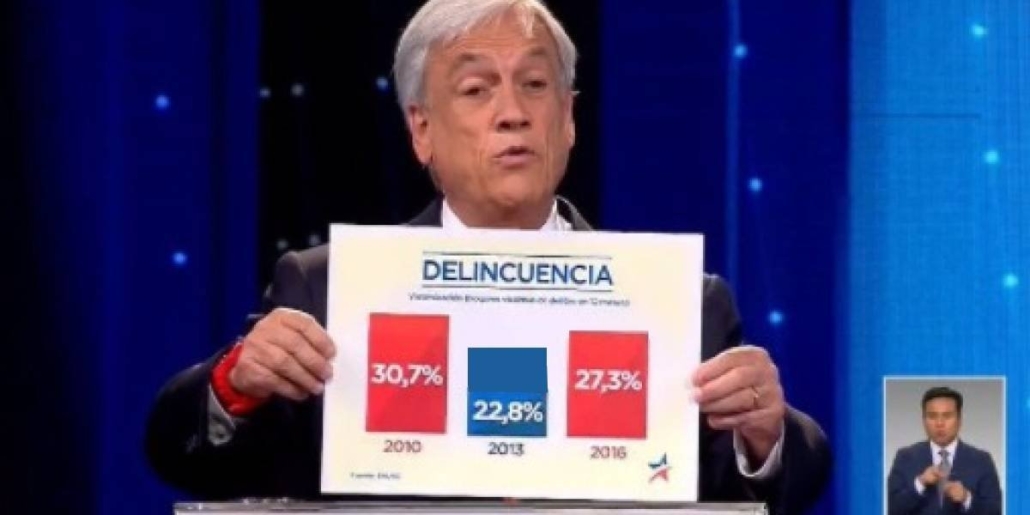
Mr. Piñera with his Nixonian bar charts.
Many members of the media mocked Mr. Piñera’s graph, and attempted to deconstruct it throughout his campaign.
Mr. Piñera promised to crack down not only on crime in general, but on illegal immigrants, drug traffickers, and human smugglers as well. Clearly aping President Trump, in 2016 Mr. Piñera said, “Chile should be open to receiving immigrants who contribute to our nation’s prosperity, but should absolutely close its borders to drug trafficking, crime, contraband, organized crime, and illegal immigration.” Doubling down, he went on to say, “Many of the criminal gangs in Chile today, such as those that specialize in identity theft, are made up of foreigners. This is a particularly grave situation for the areas [of Chile] where immigrants are a large percentage of the population.”
Chile’s presidential elections work like they do in France: if no candidate wins over 50 percent of the vote in the first round, there is a second runoff vote with only the top two vote-getters of the first round. In the first round of 2017, while there were only two right-wing candidates, there were six left-wing ones. This had the effect of forcing most of them to try and “out-left” the others. Two of the acid tests in this regard were the questions, asked by journalists and activists alike, “Is Venezuela today a dictatorship or a democracy?” and “Does what’s happening in the Araucania [where Amerindians have taken to destroying property owned by Whites, and sometimes even killing them] today constitute terrorism?” That last question was not just for the soundbite either—if labeled as terrorism, much sterner measures can be taken by the government to squelch it than they would be able to otherwise.
On the question regarding Venezuela, the leading left-wing candidate, Senator Alejandro Guillier (a former TV journalist), equivocated pathetically, saying “It is a regime that is no longer democratic,” but refusing to explicitly call it a dictatorship, and refusing say what Chilean-Venezuelan relations would look like under his Presidency. When asked about terrorism during a televised debate, he cucked. In a rambling response he conceded that the situation included “grave violence,” but not terrorism. He asked Chileans to think of the plight of the Araucanos as well, and suggested that the solution to the problem lies in more economic development targeted at Araucanos, along with more respect and understanding. Mr. Piñera, meanwhile, declared the violence and property destruction in Araucania terrorism, and condemned Venezuela’s current government unapologetically, even meeting with exiled Venezuelan officials publicly.
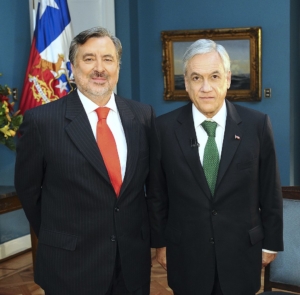
Alejandro Guillier and Sebastián Piñera
With so many candidates, nobody won over 50 percent of the vote in the first round, and both Mr. Piñera and Sen. Guillier went on to the second round—though Sen. Guillier was nearly bested by an opponent to his Left who made many promises about free college and student loan forgiveness. On election day, Mr. Piñera won by nearly ten points.
The regions most affected by immigration are the Metropolitana (“Metropolitan,” which is essentially just the massive capital city of Santiago), its two neighboring regions, and the regions that compose the northern third of Chile—especially Antofagasta. President Piñera carried all of these regions in the second round of voting, and all but one by a large margin. The Araucania went to President Piñera by the biggest margin of any region, with Sen. Guillier carrying only 37.6 percent of the vote there—only a bit higher than the percentage of the population that is Araucano. The two regions that neighbor Araucania went for Mr. Piñera by comfortable margins as well. Meanwhile, Sen. Guillier carried only the Whitest southern regions, all but untouched by immigration and Araucano violence terrorism, and the absentee vote, which is dominated by Leftists who fled Gen. Pinochet’s regime and never returned. (Source)
This all represents a marked change from the Sebastián Piñera of 2009–2014, during his first term as president. Back then, President Piñera was much more like Mitt Romney, and much less like Donald Trump. His talking points were all of a center-right “economism” bent, and he won the presidency in 2009 only narrowly, by three points, largely because the Left’s candidate was the decidedly uninspiring and mediocre former President Eduardo Frei Ruiz-Tagle. Mr. Piñera’s first time in office was in many ways a “lame duck” term from start to finish. He opposed the very popular social movement to make college more affordable, and his approval rating were regularly in the 20s and 30s—lower than Gen. Pinochet’s ever were. The Economist, which largely approved of his policies, even called him “inept” and noted that this opinion was “not confined to the opposition.” I lived in Chile for part of President Piñera’s first term, and it certainly felt like the entire country hated him. I myself always thought of him as something of a doofus, a Monopoly man without any sense of social grace or political tactics.
Yet only a few years later, after another scandal-ridden Leftist president, a wave of immigration, crime, and unrest in the Araucania, President Piñera returned to politics more as a Trumpian nationalist than a Romney-like Davos man. The results in his electoral fortunes and general popularity speak for themselves—and should serve as a lesson to the Right across the West. Having taken office only in March of this year, it is too early to tell if President Piñera will dedicate the necessary state resources, political capital, and moral courage needed to curb the immigration that candidate Piñera deplored. No matter what, he will certainly be better than Sen. Guillier, or any other Leftist, would have been. Again, like President Trump, President Piñera even shows little signs of racial consciousness here and there. During his first term as President of Chile, he once said, on camera, to the father of a small blonde child, “Congratulations, you’ve done a great thing, you’re bettering the race.”
Signs of Hope and Action Items
- The north and northeastern border should be militarized. More walls, more patrols, more checkpoints, and more soldiers would all do well. On top of illegal immigrants, plenty of illegal drugs pour through the northern border—so more security there hits two birds with one stone—just as with increased security on America’s southern border. From east to west, Chile is a very small country, so securing the borders that do not run alongside Argentina should be no great trouble—especially given Chile’s wealth and military prowess.
- Haitian immigration must be stopped, and recent Haitian arrivals should be incentivized to repatriate. Though still only superficially investigated, one of the main sources of the explosion of Haitian immigration is quite criminal. Haitians in Haiti are being sold, for a few hundred American dollars, fake letters from churches and charities promising housing and jobs. The Haitians then board flights for Chile, without knowing any Spanish, show these letters to customs agents, register as visitors, and disappear. The foremost company behind this is Latin American Wings, which for a time was bringing 100 Haitians to Chile a day. President Piñera should try and make things for this company as difficult as possible, while also investigating them and prosecuting them to the fullest extent of the law.
Though he been in office for less than a year, Mr. Piñera is already making good on his campaign’s tough talk. His administration has taken a number of different measures to make it harder for Haitians to come to—and then stay in—Chile. While I have no evidence for it, I also get the sense that there is someone in the new government who is effectively using backchannels and technicalities to slow immigration applications generally—much like what Stephen Miller is doing in the Trump White House. Regardless, President Piñera took office in April of 2018, and every month since then has seen more Haitians in Chile leave than arrive. [Argentina next best bet for Haitians as Chile tightens immigration controls, by Frances Jenner, Argentina Reports, September 4, 2018]
- Immigration from White and whitish countries should be given preferential treatment, under one guise or another.
- At present, Piñera is facilitating Venezuelan immigration. While Venezuelans may not be a good enthno-linguistic fit for the United States, they are a good fit for Chile. Importantly, though not as White as Chileans, they are much Whiter than most every other large source of migration to Chile in the last few years: Bolivia, Peru, and Colombia. A 2011 census (p. 15) broke the country down racially like this: 51.6 percent “dark,” (effectively: mestizos) 43.6 percent White, 2.9 percent Black, 1.2 percent “other,” and 0.7 percent mixed Black. In a separate question, the Amerindian population was put at 2.6 percent (p. 28)—presumably encompassing a majority of the other and mixed Black responses from the first breakdown, and a small part of the “dark” as well. My instincts tell me that of the Whites, perhaps a quarter are pure or nearly pure, and the rest are high yellow castizos; the “darks” I would estimate are about half castizo and half mestizo. On the whole, it is reasonable to assume Venezuelans represent an assimilable people. Especially since those fleeing today are largely composed of the upper, Whiter, professional classes. Their already increasing number have caused no noticeable problems. All the Venezuelans I have met in Chile have been polite, hard-working, and grateful to have left a nation committing suicide-by-Marxism. Solidarity with their struggle against that ideology should also be taken into account. Communism has brought more death and poverty to Latin America than any European imperial power, and Latin Americans should help one another in escaping and defeating it wherever it sneaks into power. Moreover, Venezuelan immigrants and their descendants will be sure to vote against Socialist and Communist candidates for decades to come—which will in turn limit future Leftist attempts to make Chile swarthier. There is also an element of fairness in allowing large numbers of Venezuelans to come: During Chile’s own chaotic period from 1970 until 1990, Venezuela took in an estimated 80,000 Chileans—including literary titan Isabel Allende. In fact, so many Chileans reached Venezuela that there is now a whole community of Venezuelan-Chileans there, including the beautiful actress Ana Karina Casanova.
- Argentina, though not as White as it used to be, is still much Whiter than Bolivia and Peru. Like Venezuela, there are economic pretenses for giving Argentina preferential immigration status that can serve as a mask for the racial reasons they should receive preferential status. Argentina and Chile, despite having a brotherly rivalry since their foundings that does occasionally heat up, also have much in common, and have traded waves of immigrants back and forth since the nineteenth century.
- Spain, the motherland, has also been in a considerable economic rut for a decade now—which is the reason why the flow of Spanish immigrants is already steady. Spain is also inarguably Whiter than Chile, so a large stream of immigrants from there would be a demographic and genetic plus for Chile, not just roughly neutral as with Venezuela and Argentina. Of great importance is that Venezuela, Argentina, and Spain have all had lengthy periods of great prosperity and cultural excellence. Their current hard times, which Chile has certainly had its fair share of (it was the country hardest hit by the Great Depression on the planet), are almost certainly temporary. They have the necessary genetic makeup to build and sustain modern and comfortable societies. There is no evidence this is the case for Peru, Bolivia, or Haiti.
- The current trickle of Chinese immigration should also be halted, largely for security reasons. China has designs on becoming a puppet master in Latin America to nearly the same extent as they do in Africa. The last thing Chile needs is a bright Asian fifth column in its military and intelligence agencies—as the US is steadily developing. Nor should Chile seek to set itself up with an alien Asian elite, as Peru accidentally did to itself.
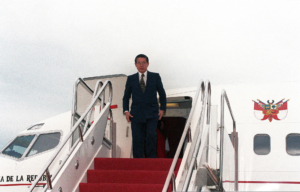 Alberto Fujimori, President from 1990 until 2000… of Peru.
- Legalize abortion. Chile’s Catholic heritage still has an enormous influence on its politics. Divorce was only legalized in 2004. In 2017, after years of titanic political struggle, Leftist President Michelle Bachelet managed to push a bill through Congress permitting abortion in cases of rape, inviability of the fetus, and when the mother’s life is threatened by the pregnancy. Chile should not stop there, however, because wherever abortion is fully legal and easily accessible, it is taken advantage of most by three groups of people: the young, the poor, and the non-White. In the United States, the most recent data shows that for every ten White women who get abortions, 18 Hispanic women and 27 Black women do. 45 percent of women getting abortions are under the age of 25, and 42 percent of women getting abortions live beneath the poverty line. As Patrick Le Brun put it in 2015:
Just as cigarette packs in some countries include an obligatory picture of organs ravaged by cancer, every time presidential candidate Senator Ted Cruz calls for the defunding of Planned Parenthood or Jeb Bush says that “I’m not sure we need half a billion dollars for women’s health issues” there ought to be an obligatory video of a welfare office filled with crying non-White babies. Even the dullest Cuckservative would be rattled out of his self-congratulatory moral signaling by that image and sound.
There is no reason to believe the demographic trends of abortion in America would not be largely the same in Chile. And since in Chile the lower classes are uniformly less White than the upper classes, the fact that poor women get abortions at substantially higher rates than wealthy women would make an even bigger eugenic impact in Chile than it does in large swathes of the United States. Moreover, although it sounds backwards, I suspect legalized abortion would increase the country’s birth rate. I have met dozens upon dozens of Chilean women who got knocked up in their teens or early twenties, and dropped all their life plans in order to abley raise their one child. At that age, doing so is such a drain on time and resources, and it makes it so much harder to find a serious romantic partner, that many of them never end up having another child. If instead they could get an abortion and move on with their lives, I suspect many of them would then go on to get married and have several children. High rates of teen pregnancy have plagued Chile for decades—as recently as 2009, 15 percent of new mothers were under the age of 19. Politicians are constantly coming up with silly plans to lessen this social problem (in 2014 one neighborhood in Santiago displayed a fake, 40 foot green condom to encourage teens to use contraception), but the most effective and obvious way would be to legalize abortion. President Piñera is certainly not going to make any attempt at doing this. But, if he halts immigration substantially, this will give Chile breathing room until a leftist President comes along and manages to greatly expand its legalization.
In Sum
From a strict purist Anglo-Nordic perspective, Chile is not an especially White nation. If you lumped together all the pure Amerindians, Asians, Middle Easterners, and Gypsies, the non-White population would be around 20 percent. Another ten percent are very dark mestizos. Perhaps ten percent is 95 percent White or more. The remaining 60 percent is castizo or mestizo. However, by the standards of Latin America, it is considered White—and objectively it is much Whiter than almost every other country in the region, which is evident in its many fine qualities. Chile is a great country. Though small and isolated, it has produced titans in the fields of literature, poetry, film, music, athletics, and economics. It has fought heroic wars and conquered and tamed some of the most difficult terrain on the planet: from the polar south, to the driest desert in the world in the north, to the Andes mountain range. Its historic people are physically beautiful, warm, well cultured, and impeccably literate. As with other international outposts of Europeans, from the Boers of South Africa, to the Anglos of Australia and New Zealand, to the confederados of Brazil, to the remnants of America’s historic majority still in the United States, they deserve to continue on, for themselves and their prosperity. The policy choices of the Piñera Presidency, and how vigorously those policies are enforced, may well determine their fate for the next century—let us pray they make the right choice.