“If there is hope, it lies in the proles.” That’s what the protagonist Winston Smith thinks in George Orwell’s dystopian satire Nineteen Eighty-Four (1949). Winston thinks that the proles — the oppressed and exploited workers — could shake off the tyranny of the ruling party like a “horse shaking off flies.” All they needed to do was become aware of the tyranny and of how it was oppressing them.
Reality is King
But Winston was wrong: they never would become aware and never would exert their strength. There was no hope in the proles. According to O’Brien, the high-IQ inquisitor who tortures Winston at the Ministry of Love, there is no hope at all. “The rule of the Party is for ever,” he tells Winston. Yet O’Brien too is wrong. The Party’s rule is based on the denial of objective reality and on the claim that “Nothing exists except through human consciousness.” But that claim isn’t right and sooner or later objective reality would intrude on the Party’s dreams of eternal omnipotence. In the final part of the novel, O’Brien scoffs at Winston’s belief that the stars are beyond the Party’s reach and control:
“What are the stars?” said O’Brien indifferently. “They are bits of fire a few kilometres away. We could reach them if we wanted to. Or we could blot them out. The earth is the centre of the universe. The sun and the stars go round it.” (Nineteen Eighty-Four, Part Three, chapter 3)
In reply to that, Winston could simply have said: “Tunguska.” It’s the earth that goes round the sun. So do lots of other things, like the space-rocks that periodically strike the earth’s surface or explode in the earth’s atmosphere. A space-rock exploded like that over the Siberian region of Tunguska in 1908. It was a very large and very powerful explosion, but the only casualties were pine-trees and reindeer. If the same explosion had happened over Moscow or London or Paris, the city would have been destroyed, millions of people would have died, and history would have taken an entirely different course. Sooner or later, in the world of Nineteen Eighty-Four, another space-rock would have ended the rule of the Party. It might have done so by destroying the human race, of course, but the point remains the same: human consciousness does not control external reality.
Neo-clown lunacy threatens us all
But did the human race get lucky with Tunguska? Perhaps not. Perhaps we got unlucky. If Moscow or London or Paris had been destroyed by that space-rock, we would have had a very sharp lesson in how dangerous the solar system is. And we would have begun working to avert the dangers decades earlier and with much more energy. So we might have had bases on the moon and Mars by now, and a fully working SpaceGuard program to detect and destroy incoming disasteroids. As it is, we don’t have those things and the next big space-rock could arrive tomorrow and wipe out an entire country or continent. Or it could end the human race.
And what about the dangers of nuclear war? Neo-clown lunacy over Ukraine and Taiwan may end in missiles flying and mankind falling back into the abyss of barbarism with no off-earth bases to save us. But how many people in Western politics care about asteroid-strikes and nuclear war? Far too few. Countless politicians and bureaucrats in Westminster or Washington would be able to tell you all about George Floyd and systemic racism, but very few would be able to tell you anything about the Tunguska event or about Vasili Arkhipov and Stanislav Petrov, the two lowly Russian individuals who saved the world from nuclear armageddon. Among the few who know and care about such things is a man who may be the most interesting British political figure of the past century or more. He may be the most important figure in British politics too.
An evil genius loathed by leftists
Who is he? He’s called Dominic Cummings (born 1971) and he’s highly intelligent, highly competent, and highly knowledgeable about important things. To British leftists, he’s the evil genius behind Brexit. Leftists loathe him, which is a very good sign that he’s on the side of the angels. Reading him has suggested to me a variant on that failed formula above. Winston Smith was wrong when he looked at the workers and the tyranny of the Party, then thought: “If there is hope, it lies in the proles.” But I may be right when I look at Dominic Cummings and the tyranny of Clown World, then think: “If there is hope, it lies in the paladins.”
A paladin is literally a “knight of the palace,” that is, a paragon of martial virtue and valor. But you can use “paladins” in an extended sense to mean a group with superior intellects and insights, a genuine and deserving elite who can take on and defeat the undeserving and oppressive elite that currently rules the West. In that sense, Dominic Cummings is a paladin who wants to recruit other paladins for what he calls the Startup Party. He wants to destroy the Conservative and Labour uniparty and Make Albion Great Again. And also sane again. Cummings has a superior intellect and doesn’t draw his insights from Marx or Freud or Foucault or any of the other word-web-spinners who dominate the dreams and direct the deeds of Clown World. No, he draws his insights from science and mathematics and from genuine achievers like Otto Bismarck and George Mueller, the engineer who reformed NASA and was central to putting man on the moon. Clown World is run by insane adolescents, but Cummings is a sane adult.
That’s why he learned to have such contempt for the bureaucrats and systems he encountered when he worked in government under Boris Johnson and the education minister Michael Gove. He’s put it like this at his fascinating and insightful Substack account: “One of the most fundamental things I’ve learned in 24 years’ involvement [in politics] is that almost nobody has any interest in general principles underlying success and failure, nor interest in execution/management, and although political people read a lot of history books it’s hard to see any learning.”
In short, British government is designed to fail. What matters to politicians and bureaucrats is their own power and prestige, not the efficient and effective performance of their duties to the British people. Cummings has frequently excoriated “Whitehall” — the official government bureaucracy — at his Substack. He knows that British democracy is a farce, because the parties are “all so similar they can’t imagine a political world where taxpayers’ money is treated with respect.” Here’s another devastating line: “HMT [Her/His Majesty’s Treasury] officials are interested in their control over Whitehall — not saving taxpayers’ money.” And another: “Many officials across Whitehall care far more about not being CCd in to an email than they do about millions of pounds being wasted or thousands of people’s lives being inconvenienced — the former is an insult to their status, while the latter is normal daily life.”
Clown World ♥ Open Borders
The same officials also care far more about “systemic racism” and “transgender rights” than they do about performing their duties and saving taxpayers’ money. That’s all part of why an advanced First-World nation like Britain can’t stop low-IQ non-Whites from primitive Third-World nations pouring across the English Channel in small boats. But I need to correct myself: it isn’t “can’t stop” the boats but “won’t stop” the boats. Clown World doesn’t want to stop the Third World invading the First World, because Clowns like Kamala Harris and Keir Starmer prefer parasitic non-Whites to productive Whites. Parasitic non-Whites don’t threaten the power of Clown World. On the contrary, they enhance it.
Dominic Cummings is very careful to avoid the topic of race in his public statements, but there’s no doubt that he knows and recognizes racial reality. During his second stint in government, he recruited as one of his advisors a highly intelligent and insightful White male called Andrew Sabisky. Then it emerged that Sabisky is a thought-criminal. He holds “repulsive” and “totally unacceptable” views on race. For example, he thinks that “politicians should pay attention to ‘very real racial differences in intelligence’ when designing the immigration system.” Sabisky is right in all his views, of course, but that’s precisely why he was driven out of government by what the Guardiandescribed as “fierce criticism across [the] political spectrum.”
“The old system will go crazy with hate”
In fact, he was criticized only by leftists and their cuckservative allies. He certainly wasn’t criticized by Dominic Cummings, who wanted to keep him as an advisor and must have been fully aware of Sabisky’s heretical views on race. Indeed, Cummings must share them. He’s just been more discreet than Sabisky about expressing those views. But Cummings isn’t discreet about criticizing the Conservatives for betraying voters on immigration:
We promised to take back control of the borders and LOWER the insane legal + illegal immigration rate while we built infrastructure — then the Tories sided with the Confederation of British Sex Criminal Rentiers (formerly known as the CBI [Confederation of British Industry]), opened the floodgates and refused to change the complex of laws that stops us building infrastructure ’cos immigration = GrOwTh’. (“#4 The Startup Party: Time to Build from September [2024] and replace the Tories?,” Dominic Cummings’ Substack, 11th August 2023)
Having seen the farce of British politics from the inside, Cummings has decided that reform is impossible and replacement inevitable. That’s why he wants to start what he has provisionally called the Startup Party to replace the Conservatives and Labour. Instead of insane adolescents wrecking the country, he wants sane adults repairing the country. And he thinks that the insane adolescents will work for their own replacement:
Imagine a party that a) mobilises some of the most talented people in the country and b) takes the voters’ side against the old parties and other old power structures operating on principles roughly like the above.
The old system will go crazy with hate. Tory-Labour rivalries will be mostly forgotten. They will unite in attacking this appalling new force. Danny Finkelstein and Owen Jones will sing a similar song!
Owen Jones is a self-righteous woke homosexual who writes for the Guardian. “Danny Finkelstein” is the little-known but highly important Daniel Finkelstein, a Vice President of the Jewish Leadership Council. He’s one of the Jews who controlled the previous Conservative government and ensured that it betrayed White voters on immigration. Finkelstein’s sister, Tamara Finkelstein, is a high-flying bureaucrat who is the “Joint Senior Sponsor of the Civil Service Jewish Network,” has supported Black Lives Matter (BLM) on an official government Twitter account, and has issued a stirring call to “fight racism.”
Tammy Finkelstein is definitely woke; Danny Finkelstein is supposedly conservative. In reality, Danny is just as anti-White and anti-Western as Tammy. Dominic Cummings will criticize Daniel Finkelstein only by name, not by race, but he must know about the central role of Jews in Clown World. It’s just that he can’t mention Jews or Jewish power. Doing that would turn the Startup Party into the Stillborn Party.
Cummings may never achieve his admirable ambitions, of course, but he isn’t the only stale pale male who wants to end the reign of Clown World. Elon Musk is another highly intelligent and highly competent White man who shares Cummings’ ambitions and antipathies. Musk wants to put men on Mars; Clown World wants to put men in women’s bathrooms. If there is hope, it lies in the paladins like Cummings and Musk. Not only in the paladins, of course, but all sane adults who read Cummings’ substack should be energized and inspired by what they find there.
Appendix: More Demonic Crimethink from Dominic Cummings
It is hard to avoid the conclusion that officials often prefer a process involving months of meetings and a long implementation timetable as this provides easy, no-pressure work long into the future. […]
Further, nobody is incentivised to solve problems fast. Ministers acquire a reputation for ‘wisdom’ simply by saying about everything ‘sounds very risky let’s not do that’ or ‘let’s add another two years to the timetable’. This limits the chances of embarrassment for the civil service but also means the problem is not solved. Officials are adept at psychologically reinforcing this, by praising ministers as ‘very wise’ whenever they demand delays and ‘very brave’ whenever they demand an aggressive timetable. The cost of going quickly is harder work by, and potential embarrassment for, officials; the costs of going slowly fall on the public. Who do you think weighs more in decisions taken confidentially in Whitehall, without the tradeoffs ever having to be crassly articulated?
The fundamental reason for Whitehall’s failure is management, not a lack of bureaucrats or money. As Colonel Boyd [the American military strategist] used to shout, ‘People, ideas, machines — in that order!’ In the DfE [Department of Education], we cut the department’s headcount by more than a third and halved running costs. We more than halved the press office, and cut 95 percent of the communication budget. Performance improved rapidly. It would improve further if the DfE were halved again. The fact that the former head of the civil service could unintentionally reveal such deep misunderstandings about the problems with Whitehall and the nature of management shows how serious the problems are.
Whatever happens in the [2024 British general] election, 99.99% of the same people will stay running the country as now, Starmer will have the same attitude to the civil service actually running the country as Cameron and Sunak, and the situation since 2010 will largely continue: The government does not control the government, doesn’t want to, and couldn’t if it tried… Cf. Francis Crick’s plea as Whitehall wrecked Intelligence 1946: ‘It’s no use reorganising with just the same old gang’. He was ignored and he left for Cambridge.
I urge subscribers to ignore the election. It will be almost entirely clowns jabbering things not-even-wrong interpreted by hacks who’ve never built anything valuable in their lives and are anti-expert on how power works, how communication works, and how high performance organisations are created. Noise about noise. All the budget numbers will be fake because of the massive black budget horror shows and corruption of the MOD. Starmer will be given these on yellow paper soon after he goes to No10 and he and others will say to themselves ‘un-fucking-believable’. Then, probably, punt-and-classify like Brown, Cameron, May, Boris, Truss, and Sunak. I’ve been talking to various people about what should be built after the 2010-24 clown show is over and the new clown show begins. […]
Recruit Ministers from outside parliament. I’ve done market research since 2004 on this. It’s very popular and an open goal. It’s also unarguably necessary if you’re trying to recruit the best people who, by definition, are almost all outside Parliament. The old parties won’t do this because their MPs would go insane (as Boris said to me in summer 2020 when I said we should do this to replace Hancock et al).
Open up the civil service so appointments are open to outside candidates by default with almost zero exceptions. This is also unarguably necessary if you’re trying to recruit the best people who, by definition, are almost all outside Whitehall. The permanent closed caste civil service as it now works is one of our greatest sources of fragility and failure.
We believe in controlling the borders, we will stop the ludicrous boats, we will cut illegal immigration to a tiny and irrelevant problem, we will ensure we actually know who enters/leaves our country
The people who think of themselves as the smart people in SW1 [the postcode that covers central government in London] regard it as literally impossible to ‘stop the boats’. This is, obviously, laughable. Many countries including us have dealt with 1000X harder problems — Pompei [i.e., Pompey the Great] famously cleared the sea of pirates in weeks, over 2,000 years before radio! I am 100% confident that the British state could stop the boats and it wouldn’t even be a serious test for a serious government — the problem is none of the old parties want to and would rather lose every election than really try (as Sunak is demonstrating). And because everybody in SW1 shares the view ‘it’s basically intractable’ and no other player will show anybody else up, they’ve all felt safe in not taking it seriously.
This problem is going to get worse and worse as environmental and political problems send more and more people, especially young men, from Africa and Asia into Europe. The EU is already knackered in dealing with this issue. It can’t handle it legally, operationally or politically. It already has serious problems with extreme/fascist parties. This will grow and grow. (NB. As I’ve said many times this was one of the core reasons for doing the referendum.) The sooner we grip this problem, the less force and disruption the solution will need — which is best for everyone. If we continue with the Tory-Labour approach, we will have millions more immigrants, many illegal, and it will get harder and harder to deal with and require more force and disruption.
Even if the old parties did suddenly try to take it seriously they couldn’t actually control our borders because they all believe in the European Convention of Human Rights and the Human Rights Act. As Sunak has unwittingly demonstrated. He let himself be persuaded of nonsense on boats. He chose to ignore those who pointed out that even if the Courts accepted his Bill (his best case scenario), his Bill did not give him the powers to actually stop the boats. No10 remains deluded on this and those who know it won’t tell Sunak he’s bogged it.
If you have any trust in the old system, it seems amazing that a smart PM could repeat what Cameron, May and Boris did — simultaneously a) promise to solve a problem, b) sort of choose to believe rubbish, sort of deep down know it’s rubbish, c) raise the salience of an issue they can’t solve because of their own laws, lawyers and courts, d) when the whole thing inevitably fails and the public is angry, start spinning that really it was a clever strategy to ‘set the issue up for the next election’. But when you understand Tory world is rotten it’s all natural, not ‘amazing’. […]
If you don’t care about controlling the borders you can already vote Tory or Labour.
The market opportunity is for a party that does care and can credibly act. You can only be credible if you are prepared to repeal the HRA [Human Rights Act] and end the jurisdiction of the Strasbourg Court, [which together:]
Make tough surveillance of terrorists impossible. I’ve had personal experience of Kafka-esque meetings after a terrorist incident when the police and intelligence services admit they could not keep convicted terrorists (never mind suspects) under surveillance because of the ECHR [European Court of Human Rights] / HRA [Human Rights Act]. There are many, many ludicrous ways in which security is undermined. Most of these are classified in order to stop MPs and public knowing. Officials know some of these stories are so insane that publicity would undermine support for the ECHR/HRA.
Create such Kafka-esque absurdities we sometimes have special forces call in drone strikes to whack people instead of arresting them because it weirdly makes more legal ‘sense’, given legal advice. Such cases are, obviously, kept very quiet like many other ways the intelligence services are affected. There are some truly jaw dropping examples that Sunak should make public but won’t — those of you who read the yellow paper on terrorists bringing legal action in London while on the run from JSOC will know the sort of thing I mean. Good for some rich human rights lawyers (some of whom should be disbarred), humiliating for any serious country. […]
Starmer will be confronted with a symbol of this [nuclear rot] on his first day as PM when he talks to the deep state about the submarines and his letter. And the Cabinet Secretary will say something like: PM, not for now but we will have to discuss some important aspects of this subject soon… And Starmer will read (on yellow paper above Strap 3) the detail of these horrific budgets. And he will face the same choice Boris and Sunak faced: go public, blame his predecessor and face openly the vast financial (and other implications) or classify, punt and continue the charade that means the continuing cannibalising of the open budgets by the broken black budgets and their black holes. (An interesting question that will signal power will be: is Sue Gray [a powerful woke bureaucrat] allowed in the room for the submarine chat or not?)
The original VL [Vote Leave campaign for Brexit] plan to transform the Tory Party is kaput. It would have been a different story if Boris-Carrie [Boris Johnson and his wife Carrie] had enjoyed themselves smashing champagne bottles off boats while VL ran No10 and used the 80 seat majority to do the VL plan. The country and party would look profoundly different. No HS2 [High-Speed Rail Link], no £35B down the toilet this Parliament alone, and so many things happening instead. The argument would be about the winners and losers rather than ‘why bother with Brexit then change nothing?’. Starmer would have been smashed to bits. Many MPs would have ‘retired’, new MPs recruited, and CCHQ [Conservative Central Head-Quarters] closed with an effectively new party reopening in the Midlands with an edge-of-the-art political machine. Such a transformation — using four years occupying No10 with an 80 majority, changing facts on the ground and demonstrating things rather than arguing about things — is not possible in Opposition using the rotten old Tory institution. Dramatically cutting taxes for working people is extremely different to promising to cut taxes after 14 years of putting them up. So our old plan is kaput. And it was a once-in-decades opportunity — election victory on a the biggest issue in politics for decades, the biggest government crisis since 1945, clear mandate and need for huge change in economy and government, a team with a plan, a civil service willing to do a deal on massive change instead of fighting it, a PM with very strong personal incentives to change a lot (objectively speaking, but it turned out he disagreed!), opposition in chaos. This combination is highly unlikely to recur ‘naturally’ for many decades.
Fundamental to our politics is the shift of talented people out of politics/government and the asymmetrical effects on those who oppose the Left/‘progressivism’. There is a vicious circle across the west that keeps almost all the most able people out of politics/government/public service. But the ‘progressive’ Left attracts a lot of smart people who believe in more centralised state power and want to exercise this power over others. People with the same IQ who strongly disagree with them are much less inclined to spend their time navigating low quality political hierarchies to capture centralised institutions (per above).
The old parties focus on the old SW1 game and the old media but can’t even get to 1968-America levels of sophistication in handling TV (cf. The Selling of the President), never mind advanced technologies. They’re so addicted to the 24/7 cycle of chaos (‘news’) they can never focus on anything that isn’t leading the news therefore they cannot drive hard changes or communicate effectively. […] And they demonstrably have no interest in building a government that can maintain focus and build fast while the leader is inevitably focused to some extent on the news — when we started building such a machine in summer 2020 (including a new communication machine) the Tories freaked out and couldn’t discuss it intelligently (though parts of the deep state supported us).
The market opportunity is for a party that optimises for voters.
The lack of Tory interest in economic policy and the fundamental long-term stagnation of productivity is prima facie baffling given … they are politicians supposedly trying to win elections! What’s the explanation? It’s a product of a more general problem — their focus is always on today’s media and their position in Insider coalition networks, NOT winning. This more general issue also explains other otherwise baffling things, like their total lack of interest in the MOD for 14 years, their total lack of interest in actual border control and so on. They still call themselves ‘the party of business’ and ‘the party of the national interest’ and ‘the party of the armed forces’, echoing the 1980s, but they aren’t actually interested any more in any of these things.
Both Labour and Tory are locked into a media ecosystem and legal ecosystem that supports a combination of, to simplify crudely, *ESG + DEI + nutty green + nutty progressivism + technology hate*. Apart from the awful political and cultural effects, this combination is also a disaster for productivity growth and a market opportunity for TSP.
Contra-Insiders, ‘not normal politicians’: on the side of taxpayers against the old parties, with voters against unions and the CBI, the local against Whitehall, with mothers against the violent, for women’s safety against the men-pretending-to-be-women.
https://www.theoccidentalobserver.net/wp-content/uploads/2018/06/TOO-Full-Logo-660x156-1.png00Tobias Langdonhttps://www.theoccidentalobserver.net/wp-content/uploads/2018/06/TOO-Full-Logo-660x156-1.pngTobias Langdon2024-10-16 07:14:472024-10-16 09:56:25The Demonic Crimethink of Dominic Cummings: Thoughts on the Most Interesting Man in British Politics
Mud, sand and sawdust. These simple things make excellent fuels for sophisticated modern engines. All reputable engineers will tell you so. Simply fill your tank and zoom away, enjoying vastly improved performance and mileage. There are just two conditions. First, you have to source the super-fuels in the Third World. It has to be Syrian mud or Moroccan sand or Pakistani sawdust. Second, you have to use the Third-World super-fuels in the First World. Strangely enough, if you try to run an engine on mud in Syria, your engine will stop working. But use the same mud in Germany and your engine will pulsate with power. Trust the experts!
Showered with gold
Well, I’ve just written utter nonsense, of course. No engineer has ever said that mud, sand or sawdust makes good fuel for any kind of engine. Engineers aren’t idiots. They deal in reality, not fantasy. No, the idiotic group that makes nonsensical claims about Third-World fuel isn’t engineers but economists. They’ve been claiming for decades that mass immigration from the Third World is absolutely vital for sophisticated modern economies in the First World. The stale pale frail West will collapse without the dynamism and vitality of youthful Syrians, Moroccans and Pakistanis. Strangely enough, those Third-Worlders don’t make the economies boom in their own homelands. But in the West, they will shower their lucky hosts with gold. Trust the experts!
That’s the message of economists. Their idiocy is matched only by their arrogance. In truth, if you fuel a Western economy with mud, you get blood, not gold. At the end of July 2024, Southport in England saw how readily Third-World mud turns into First-World blood. A Rwandan Black invaded a schoolgirls’ holiday club and began laboring with a large knife. The fruit of his labor was three dead little girls and more seriously injured. At the end of August 2024 Solingen in Germany saw mud and blood too. It was holding a Festival der Vielfalt, a festival of diversity. The highlight of the festival was provided by a Syrian Arab, who shouted “Allahu akbar!” and began laboring with another large knife. The fruit of his labor was uncannily similar: three dead adults and more seriously injured. The expert economists at the Financial Times (FT) reacted to the attack just as you would expect – with arrogance and idiocy. They zoomed in on what they regard as the real problem exposed by the slaughter in Solingen. Not stabby Syrians, but the evil and inbred far-right:
Germany’s real problem: not stabby Syrians, but wicked Whites on the far right (image from the Financial Times)
An expert called Henry Foy, the “FT’s Brussels Bureau Chief,” explained “Why Germany’s stabbing attack has rekindled EU’s far-right fears.” I’ll reproduce his words below. When you read them, note the blithe unconcern revealed by the sub-heading “Knife edge.” It’s a pun referring to the danger of Europe tipping over into xenophobia. Yes, the Financial Times is punning about the bloody and barbarous slaughter and wounding of ordinary German Whites. The paper’s editors and writers simply don’t care. The elite currently ruling with West regard the violent death of ordinary Whites as no problem at all. It’s the reaction to violent death that’s the problem. Here is Henry Foy’s article:
Why Germany’s stabbing attack has rekindled EU’s far-right fears
Today, I unpack what Germany’s response to a stabbing attack this weekend could mean for Europe. …
Knife edge
A fatal knife attack in Germany has convulsed the country’s politics ahead of regional elections this weekend — but is also worrying officials across the EU nervous about the rise of the far right and anti-immigration rhetoric.
Context: A Syrian man stabbed three people to death and injured eight more on Friday night in the west German city of Solingen. The attack has boosted already strong support for the far-right nationalist Alternative for Germany party ahead of elections in the states of Saxony and Thuringia this Sunday.
Yesterday, alongside promising to tighten Germany’s laws on weapons, Chancellor Olaf Scholz pledged to reduce the inflow of irregular migrants and increase deportations. That followed remarks by Björn Höcke, the AfD’s leader in Thuringia, who blamed the attack on what he called: “This multicultural experiment on our country.”
There are two major concerns for Brussels from the Solingen tragedy.
Short-term, it has rammed home the political dangers posed by a resurgent far right across Europe, just weeks after centrist parties celebrated what they saw as European election results that confirmed their dominance of the EU’s political stage.
Longer-term, many in Europe worry that a knee-jerk reaction in Germany — potentially including new border controls and possibly even checks on movement inside of the country — could prompt a rash of similar unilateral moves by other countries where anti-immigration politicians are popular.
That would undermine the core principles of the EU’s Schengen free movement area, and further strain a fundamental aspect of the bloc’s single market.
“We can’t react to this by slamming the door in the faces of people who are often themselves fleeing from Islamists,” said Kevin Kühnert, general secretary of Scholz’s Social Democrats party.
Three ordinary Whites have been bloodily slaughtered. Eight more have been wounded. Henry Foy glides past the deaths and woundings with a perfunctory reference to “tragedy.” He simply doesn’t care. When he speaks of “dangers,” he isn’t referring to stabby Syrians but to the “resurgent far right.” He’s also deeply concerned about a “knee-jerk reaction” in Germany that might “prompt a rash” of “unilateral moves” elsewhere in Europe. Note the medical marvel apparent in that mixed metaphor: a “knee-jerk” creates a “rash.” As George Orwell pointed out in his magisterial essay “Politics and the English Language” (1946), mixed metaphors prove that writers are not thinking and not seeing reality. Instead, they’re using what Orwell had earlier called “duckspeak.” It’s not language “in the true sense” but “noise uttered in unconsciousness, like the quacking of a duck.”
Not idiots, but evil
Foy is a duckspeaker, someone who quacks out orthodox opinions without any concern for reality, only for ideology. In his case, it’s the ideology of open borders. That’s why he quotes with approval the duckspeak of another open-border enthusiast: Kevin Kühnert, general secretary of the Social Democrats party. Kühnert said: “We can’t react to this by slamming the door in the faces of people who are often themselves fleeing from Islamists.” He too isn’t concerned about the slaughter and suffering of ordinary German Whites. No, the important thing is keeping the borders open. Kühnert wants Germany to protect people “fleeing from Islamists” by allowing Islamists to accompany those people to Germany. Is he an idiot like Henry Foy and the other experts at the Financial Times? Well, no. In truth Foy, Kühnert and company are evil, not idiots. It’s not their intelligence that’s faulty, it’s their ethics.
Jews’ views
That’s why they demonize the “far right” for not welcoming the slaughter and sex-crimes committed by Third-World invaders. It’s also why they censor their own lies. Recall that the stabby Syrian in Solingen set to work at a “festival of diversity.” That’s ironic, isn’t it? One moment Solingen is celebrating diversity, the next moment diversity is slaughtering Solingeners. Well, the Guardian decided that the irony was too rich for the delicate palates of its readers. As Mark Steyn pointed out: “The original Guardian headline referred to three dead ‘at diversity festival’ …but it was quickly revised to three dead merely at a ‘festival’.”
Not that Steyn himself is honest about the disaster of Third-Worlders invading the West. As I’ve often pointed out at the Occidental Observer, he refuses to admit the central role played by Jews in the invasion. So there’s more irony in the legal battle Steyn has fought against Michael E. Mann, a leading advocate of global warming. Steyn has shattered his health and lost huge sums of money trying in vain to defeat his sly and slippery opponent. Guess what? It turns out that the mendacious Michael Mann is a Jew. You can be certain that Mann is just as firmly in favor of open borders as he is opposed to global warming. After all, those are Jews’ views: even as Jews praise the flood of mud, they order Whites to fight the sky.
https://www.theoccidentalobserver.net/wp-content/uploads/2018/06/TOO-Full-Logo-660x156-1.png00Tobias Langdonhttps://www.theoccidentalobserver.net/wp-content/uploads/2018/06/TOO-Full-Logo-660x156-1.pngTobias Langdon2024-08-31 07:27:352024-08-31 07:27:35Mud and Blood: How to Super-Charge First-World Economies with Third-World Fuel
“The judge of today needs no such virtues. He is not the agent and exponent of justice, but its mere lackey.” L. Mencken
At time of writing, more than 1,000 people have been arrested in England for participation in riots sparked by the brutal murder of three children by an African. The riots have been described variously as “anti-migrant” or “anti-Muslim,” causing journalists and politicians on the Left to offer weak analyses of the disorder as being the irrational product of online misinformation and Islamophobic prejudice since the Southport murderer was born in the United Kingdom and was not, they insist, from a Muslim background. This is, however, a paradox of the Left’s own making since the riots are best understood as an expression of White working-class exasperation at the increasing pace of demographic change, at the increasing marginalisation and demonisation of the White working class in culture, and of White working-class suffering at the hands of non-White violence more generally. In every meaningful respect, these were race riots with a class subtext. In the English context, Islam and migration, especially in northern England, are merely useful and appropriate bywords for the broader category of racial displacement and for the undeniable sense of a native people under threat. The widespread unrest is a watershed not only because it marked the first major instance of White violence since the 2001 Oldham riots, but also because of how quickly it spread across England, even reaching Northern Ireland. The rapid spread of the riots illustrates that this was not an isolated reaction to an isolated incident, but a guttural nationwide release of anger and frustration that has been building for decades. No less important is the government and police response, ruthless and astonishingly efficient given the suffocating lethargy with which it usually responds to ethnic crime. If anything, the slick response to the riots has all the hallmarks of something long in preparation. Both the riots and the response to them have the feel of a turning point, for better or worse. For those on our side, what lessons can be learned?
Public Shaming and Show Trials
The instinctive, impulsive, reactive nature of the riots gave them an open character not seen in organised Leftist violence with its face coverings and Black Bloc. On the one hand, this was one of the factors leading to their successful and rapid spread. There was a contagious fearlessness to thousands of Whites erupting in rage without shame. Careful preparation for public disorder and civil disobedience, however, was almost non-existent, with the result that the vast majority of rioters were not wearing face coverings or nondescript clothing. Some, including a man wearing a St. George’s flag shirt, wore clothing that actually attracted attention and singled them out for identification. Coupled with a dedicated and fanatically persistent police investigation, which included the use of drones at riot locations, and the fact most of the violence occurred in broad daylight, easy identification thus facilitated a much higher than normal arrest count than would be expected for such chaotic events. While some rioters were arrested at the scene of disorder, a great many more were arrested days later following a process of identification.
One of the more remarkable features of the aftermath of the riots is the way in which police forces across Britain used these arrests for propaganda purposes. Shortly after the riots began to subside, police forces appeared to follow a pre-existing and coordinated playbook by issuing sinister warnings and slick, live-action arrest videos complete with dramatic music. Everywhere the message was the same: “We are coming for you, and your punishment will be severe.” Rotherham’s police chief announced, “If you were there, we are coming for you.” Sussex Police issued a statement saying “We will make you regret your actions.” The head of the Metropolitan police said “We will come after you.”
The most sinister aspect of this intimidation campaign was the universal messaging. This wasn’t a warning to criminals, but to everyone who had attended or even just observed the protests. In other words, the propaganda campaign was directed at every White person who felt moved to take to the streets in outrage. White anger itself was criminalised and stigmatised. Hundreds of mug shots were displayed by regional police forces across multiple social media platforms with gloating, threatening captions, often with the arrested persons street address included. Leftist accounts spammed the comments, gleefully hoping that the arrested persons would face violent retribution from non-White criminals in prison. The BBC offered a searchable “Faces of the Riots” database, containing the photo, name, and other information of almost every convicted rioter, ensuring that they have a stigma, if not a target, attached to them for life.
The sentencing of the rioters was also manifestly excessive, especially in light of the fact the British justice system has been notoriously soft on ethnic crime for decades, not least in the category of sex crimes. Without any sense of shame, the authorities bragged of imprisoning a man for almost two years for “shouting at a police dog” while on the other hand releasing rapists and child molestors to make room for White rioters in Britain’s overcrowded prison system. In the perverse value system of the new Britain, a product of Jewish-designed “race relations” laws produced in the 1960s and steadily evolving since then, White anger is the bigger threat and the more dangerous and devastating crime.
Legal Encroachment and Overreach
One development from the riots that has gained most attention is that Britain’s hate speech legislation seems to have entered a new phase of growth and expansion. No new laws have been passed, but the original legislation, especially the 1986 Public Order Act, was sufficiently vague that it has allowed for increasingly draconian interpretation as the culture evolves in a more anti-White direction and allows for stricter enforcement. Jonathan Bowden, speaking in the early 2000s, once said that speech was still relatively free in Britain provided that you didn’t use slurs and provided you didn’t advocate for anything criminal. And at the time he made these comments Bowden was broadly correct. It was perfectly possible to criticise immigration—and even races and racial characteristics—provided it was presented in an intellectual and reasonable manner. Convictions for hate speech were reserved either for movement figureheads such as John Tyndall or Nick Griffin, or else for skinhead groups printing provocative pamphlets.
The growth of social media, however, and its power in the realm of disseminating ideas, has made every White person a potential danger to the prevailing system. The response of the system has therefore been to regard every negative comment made by a White person as a dangerous act of “publishing,” therefore bringing that person under the 1986 Public Order Act which expressly targets anyone who “publishes or distributes written material which is threatening, abusive or insulting” with the intent or likelihood of “stirring up” racial hatred. What exactly constitutes “threatening, abusive, or insulting” words is obviously open to interpretation, and as Western culture has moved in a direction in which ethnic populations are afforded more and more sympathy and special privileges and protections, the interpretation of judges has increasingly moved towards protecting them from all criticism. UK judges and prosecutors are also “trained” in part by the Council of Europe’s “HELP course on Combating Hate Speech,” originally developed in 2015. The course provides all the usual propaganda, stigmatising White self-affirmation as a fundamental danger to minority populations everywhere.
The cumulative result of these developments has been that many of those arrested and publicly shamed in Britain in the wake of the Southport atrocity did nothing more than make comments on social media or, still less, merely repost what someone else had written. One wonders if we are not all that far from being arrested in such a situation simply for “liking” an “illegal” status update. Special task forces were established specifically for the purpose of trawling social media for “illegal” posting. Aggressive police officers were banging on doors across England within days, with some social media posters rapidly receiving prison sentences of more than three years for calling for mass deportations and saying they didn’t want their money going to foreigners who “rape our kids and get priority.” Cheshire Constabulary boasted online of a 55-year-old woman arrested “in connection with an inaccurate social media post,” a move that drew the attention of Elon Musk.
Displaying a staggering degree of ethnic solipsism, Jewish Guardian journalist Jonathan Freedland, who once wrote a novel fantasising about the assassination of a Trump-like President, bleated hysterically that the riots were a re-run of anti-Jewish riots in 1144 following the murder of William of Norwich and demanded that Elon Musk be arrested and brought to trial by English authorities. Freedland worries that Musk’s purchase of Twitter/X has brought about a resurgence in the Right, fretting that “posts including “the word ‘Jew’ had increased fivefold since before the ownership transfer.” God forbid anyone should mention the Jews. Freedland’s solution is that “schools should be teaching information hygiene,” a descriptor equally banal and terrifying since the subtext is clearly a form of brainwashing. Freedland wants “online safety legislation with teeth … if that means toughening up laws so new they are yet to be fully implemented, so be it.” Jews, as always, remain at the forefront of censorship, and even the massive over-reach currently seen under Britain’s speech laws are clearly not enough to satisfy Jewish insecurity and paranoia.
The System Monopoly on ‘Safety and Security’
Another lesson from the riots is that the State will maintain its monopoly on ‘safety and security’ at all costs. Ostensibly the State is guarantor of the safety of its citizens, or at least this is the unstated agreement made in Western European states where citizens do not have gun rights and surrender certain of their capabilities of self-defence to the State in the expectation that the laws and law enforcement offered by the State are capable of substituting self-defense with adequate social protections. These social protections are assumed to be effective, so that police forces can be called upon in emergencies, the justice system will punish crime in an effective and fair manner, and, finally, that the State itself has some kind of notional integrity in the form of controlled borders.
The problem in Western Europe is that the State demands a monopoly on ‘safety and security’ but has utterly failed to fulfil its responsibilities in return. It has taken more and more freedoms, but catastrophically and even proudly neglects the basic safety of those whose freedoms it has taken. Whites everywhere have been robbed and betrayed by this bait and switch. Britons have lost much of their ability for self-defence, and thanks to Jewish-devised race legislation they are actively hindered from defending themselves. In fact, they can’t even speak openly about defending themselves. The British people have to endure compromised borders and constant ethnic violence. As a result, they get to experience a form of second-class citizenship in their own justice system. As events in Southport show, they can’t even send their children to a dance class. Just days after the riots, presented in the media as the pinnacle of moral failings, a White man was stabbed in the neck on camera by an African while a motley of other ethnics joked and laughed. No sooner had the blood been washed from the street than eight stabbings occurred at the Notting Hill Carnival, Britain’s biggest festival of multiculturalism. Neither of these latter incidents were presented as a form of civilizational crisis. Instead they are tacitly assumed to be the necessary cost of living in a “vibrant”, “diverse”, multicultural society. Anyone protesting or speaking negatively about vibrancy and diversity must therefore be a monster, and should be silenced, put in prison, and tarnished for life.
The recent riots were an angry, messy attempt by elements of the British working class to grasp at some semblance of safety and security. And, as has happened so often in multiethnic contexts, this involved an attempt at “cleansing” certain areas occupied by a rival ethnic group or groups. The riots, to the extent that some of the violence was directed against the police, were also a form of retribution by the White working class against authorities which had failed and betrayed them. Leftists made much fun of videos of Britons throwing bins and other objects at police, but these were not just random acts of chaotic violence but the expression of genuine hurt and rage at an overwhelmingly White police force that had betrayed its own kind and turned its back in every meaningful way. White safety isn’t a concern in modern, multicultural Britain, and Whites have no right to protest when their own children are butchered by the imported tools of our hidden elites.
The Class Element and the Incentivization of the Left
Another lesson from the riots is that the White population in Britain is diverging strongly along class lines, with trendy metropolitan middle classes and those largely safe in the suburbs unable and unwilling to empathise with their ethnic kin swamped by migrants in Britain’s larger towns and slums. A common theme in social media commentary on the riots was a sneering condescension displayed by liberal, university-educated types against a class of Whites they view as ignorant, tasteless, boorish, and uncultured. This is summed up in the coining of the word “Gammon,” an even more sneering slur than ‘cracker,’ to describe a typical person from the White working class—gammon referring not only to the pale-pink complexion of those being scorned, but also in the assumption that gammon is a cheap, bland, and fatty meat that a “better” sort of person wouldn’t go for. For this kind of White liberal, “racism” is the resort of beer-swilling Little Englanders who enjoy an artery-clogging diet and whose antipathy to migrants is assumed to be irrational, primitive, piggish, and animalistic. The liberal middle classes have the luxury of thinking of themselves as enlightened, superior moral beings because the foreigners they tend to live and work alongside are at the higher end of the IQ and cultural scale.
In England’s post-industrial north, however, entire towns that once hosted the mining, cotton and linen industries have fallen first into decrepitude and then into mass swamping by millions of Pakistanis and other South Asians. Areas that once thrived with an industrious English working-class culture are now displaced by often predatory Asian communities and their gangs. Whites in these areas are scorned by the immigrant populations, and also by those Whites higher in the socio-economic scale, turning to a life on social welfare benefits, television and a mongrelised pop culture, and the petty amusements of cheap alcohol and football. The White working class is thus a despised caste in Britain, which explains in large part why the mass grooming and rape of girls from this group by Muslims went on for so long without a reaction, and why the stabbing of children from this group of “gammons” was not permitted to be protested, or even for the anger resulting from it to be understood. It has become fashionable to loathe the White working class, even in the midst of its suffering and its grief.
Deportation Discourse
The picture painted thus far is a depressing one indeed. It would seem that only negative lessons, and causes for despair, can be found in the aftermath of the riots. And yet, despite the overwhelming cultural and legal force brought against the riots, I believe there are enough glowing embers in the ashes to give rise to some positivity. The harsh penalties given to the rioters, far out of proportion to the weak justice handed out to ethnic criminals, did not go unnoticed. The hashtag #TwoTierKier quickly went viral, a reference to the fact Britain under Keir Starmer now has a two-tier justice system in which the English are punished far more harshly than those of foreign background. While snuffed out on social media, and forced into more convoluted expressions, there is also a palpable underground discourse which is moving more radically to the Right. Halfway solutions and considerations of moderate approaches are increasingly being abandoned. There is a real sense that “no-one is coming to help us,” and that sense of desperation and abandonment is itself liberating. Just a few days ago, The Telegraph posted an article titled “Britain needs a shock and awe campaign of mass deportations to tackle the illegal migrant crisis,” something that would have been unheard of a year ago. The phrase “mass deportations” taps into a growing discourse in Britain in which limiting immigration is acknowledged as being insufficient to rescue the nation from destruction. Only “mass deportations,” the removal of many millions of people of foreign origin, will restore Britain to a position of relative peace, security, and prosperity.
In a sense, Britain could be described as in a pre-revolutionary state of the kind witnessed in former Soviet countries before the “fall of the wall.” There is a superficial culture in which everyone knows what they should say and think, and there is a nervousness with new acquaintances about how much one can say to the other until one is sure that they aren’t “politically correct.” These social rules remain endemic in the workplace, under the watchful eyes of “human resources” apparatchiks who are incentivised to teach and enforce their “diversity and inclusion” dogmas. But underneath all this is the real Britain—astute, aware, and angry. They can’t imprison everyone, and the Saxon is beginning to hate.
https://www.theoccidentalobserver.net/wp-content/uploads/2018/06/TOO-Full-Logo-660x156-1.png00Marshall Yeatshttps://www.theoccidentalobserver.net/wp-content/uploads/2018/06/TOO-Full-Logo-660x156-1.pngMarshall Yeats2024-08-29 08:43:502024-08-30 05:54:28Lessons from the English Riots
August is traditionally a quiet month in the United Kingdom. The British go on their summer holidays, perversely leaving the country during the hottest month of the year to seek sunshine in foreign climes. Parliament goes into recess, and so no new laws are passed. Even the media take a break, the lack of newsworthy stories earning the month the nickname “the silly season”, reflecting the inane stories the media have to find to fill their newspapers and TV news programs.
But the sleepy eighth month, named for Augustus Caesar, occasionally acts strangely on the English, a people once famed for their rather dull nature. In August 2011, rioting spread across the country after a Black man was shot dead by police in London. Somewhat earlier, in August 1641, the first battle of the English Civil War (three wars, technically, within a decade) was fought at Nottingham. Today, August 2024 can take its place in the British calendar of civil unrest. But where the mainstream media have concentrated on the visuals of the recent riots, it is the political back-story that needs watching. The question is a simple one; how has a tenderfoot British government made such fast and efficient use of the riots for authoritarian political ends?
The riots have been well-documented globally; they are a distraction from the real story, that of political manipulation and the use of civil disturbance to change the law of the land. And this Machiavellian program is aimed squarely at the White population. When British Prime Minister Sir Keir Starmer addressed the nation after Black Lives Matter riots in 2020, his tone was conciliatory and apologetic, praising what he claimed was the ongoing Black fight against racism. His speech after this month’s riots is markedly different, beginning as it does with the following;
“I utterly condemn the far-Right thuggery we’ve seen this weekend”.
The phrase “far Right” is Britain’s equivalent to the Biden administration’s use of “white supremacy”, a meaningless smear by association I wrote about here at The Occidental Observer over two years ago. The organization which has set itself up as the moral arbiter of supposed White racism is HOPE Not Hate (HNH), an equivalent to America’s Southern Poverty Law Center and Anti-Defamation League. It is HNH who have popularized the phrase “far Right”, one the government has run with. They are also agents provocateurs, groundlessly alleging that a Muslim woman had had acid thrown at her from a car in the town of Cleveland during the rioting, a claim the local police immediately debunked.
But the temptation is still to blame government ineptitude rather than malevolent design. Before the general election on July 4, it was assumed that as Labour had made no substantive policy announcements, they therefore had no policies. They seemed to be campaigning solely on the fact that they weren’t the Conservatives, and simply would not be equipped to govern. Now, that accusation of under-preparedness looks naïve.
There is a perception that Labour’s authoritarian response to the riots is a result of panic, that they getting tough in order to appear in command. But the government appearing to make policy on the hoof is a grand deception, and this sudden roll-out of zealous and ethnicity-specific strong-arm tactics was in place all along. The riots were engineered and the results both predicted and used in a pre-determined way. The White British working class have been goaded for decades with the effects of immigration and the plainly preferential treatment often given to undocumented men. As in Ireland, the government pushed them once too often, albeit deliberately so.
The initial rioting in Southport, a suburb of Liverpool, was sparked by the murder of three young girls at a dance party on July 29, but there had been something of a prequel in the Harehills city district of Leeds on July 18. The difference between the police response to the latter riot and that of the ensuing and far more serious violence shows patterns which are already beginning to define Prime Minister Sir Keir Starmer’s fledgling government.
For once, the rumor on social media that the alleged killer was a newly arrived immigrant was genuine misinformation. The police withheld the attacker’s name for several days, by now a recognized signal that whoever the perpetrator was, he was not a white Englishman. The accused was in fact born in Wales — a fact endlessly repeated in the media — of Rwandan immigrant parents. But the fuse was lit, and a group which was composed of White Englishmen gathered outside a mosque in Southport, which they attacked. By Friday, riots had broken out in several major cities, and the weekend inevitably saw an escalation of hostilities. Then the police and the media came spectacularly to life in a way that had not accompanied the Harehills riot.
The Harehills disturbance began when an immigrant Romanian family became involved in a stand-off with social services officers who had come to take at least one of the family’s children into care. The ensuing riot attracted a crowd of mostly Muslim young men. The police have shown during pro-Palestine demonstrations that they are reluctant to police ethnic minorities, and when they finally arrived in Harehills, the crowd chased them out of the area. They did not return. When rioting subsequent to the Southport murders was instigated by White, English, working-class men, the style of policing changed completely. This represents a central pillar of what is already a new order; Two-tier policing.
The phrase “two-tier policing” was coined by ex-Conservative Home Secretary Suella Braverman. Her use of the phrase, in addition to using the term “invasion” to describe illegal immigration, led ultimately to her defenestration by her party. It used to require a sexual or financial scandal to end a politician’s career. Four words are sufficient today.
Two-tier policing is undeniably taking place in the UK, although that has not stopped governmental mouthpieces denying it. With the advent of citizen journalism, ordinary people whose media information used to come solely from the state-sanctioned, legacy press, are now able to watch the different policing styles employed against Muslims and the White working class. Starmer flatly denied that there is any two-tier policing, claiming that the British police act “without fear or favor”. This phrase was first used in 1829 by the founder of the British police, Sir Robert Peel, and in Starmer’s mouth it is demonstrably untrue. Tempers frayed when Sir Mark Rowley, Chief Commissioner of London’s Metropolitan Police Force, was asked by a reporter whether he would end two-tier policing. Rowley angrily snatched the microphone from the offending reporter’s hand.
Below is a 12-minute video by Mark Collett, of British political organization Patriotic Alternative (PA, who have been blocked from registering as an official party). It explains two-tier policing succinctly, and PA have been watched forensically for years, meaning that government lawyers will certainly have watched this short exposé. In other words, you know it’s true because if there was one slip-up, Collett would already be in jail. His message is simple; Whites are policed very differently from non-Whites.
And so, while the rioting itself dominates the media, political machinations are clicking into place behind the smokescreen. Labour are determined not to let this crisis go to waste, and they are using methods of control honed by the political class over the last quarter of a century, which links Tony Blair’s Labour government to Sir Keir Starmer’s.
The rioting has been extensive, but it is the damage done to the liberty of the citizenry that is significant. Prime Minister Starmer and his Home Secretary Yvette Cooper have, to use a phrase beloved of the political class, “been absolutely clear about this”. The current troubles are the fault of White, “far-Right” thugs. Starmer put into place instant retribution for rioters, 24-hour courts to process them despite a normally sluggish judicial process in Britain, and staggering prison sentences of up to ten years for involvement in disturbances, including online incitement. This is not a flustered government grasping at ad hoc policy. This has been a long time in the planning.
Central to this aggressive policy-making are arrest and punishment, and the weaker and more vulnerable those arrested, the better the deterrent. A 55-year-old woman was arrested on August 8 for posting a name believed to be that of the Southport killer, but which was in fact incorrect. Here is what Chief Superintendent Alison Ross of Cheshire Police had to say about the arrest:
It’s a stark reminder of the dangers of posting information on social media platforms without checking the accuracy. It also acts as a warning that we are all accountable for our actions, whether that be online or in person. [Italics added].
It looks as though Ms. Ross is saying that we are all responsible for our actions, but she is not. You won’t hear any mouthpiece of the British Left (which is what the police are) saying such a thing because a belief in personal agency is not in the ideological DNA of the Left, at least not when groups with protected characteristics are being arrested. What she is impressing on the specifically White British is that they are accountable, they can be held to account, even for repeating an inaccuracy. This is reminiscent of a government advertising poster during World War II, on which a fierce-looking army officer barks out the following; “Treat rumours like mistakes. Don’t repeat ‘em”.
Britain’s people are learning a political lesson. If government cannot control the narrative, and therefore the behavior (both physical and mental) of its citizens, it will increase its powers of detention and prime the judicial system towards heavier sentencing for the ethnic bloc of which it disapproves most, which is the White working class. People are already going to jail for their part in the rioting, the usually sluggish judicial system suddenly being given the equivalent of a jab with a cattle prod. There are similarities between what is happening to rioters in the UK and the so-called “insurrectionists” of the infamous January 6 walkabout in the US. But it ought to be pointed out that the British rioters really were rioting, whereas the Americans who still languish in jail over January 6 were guilty of little more than aggravated tourism.
While everyone is being distracted by the main events of the rioting, plus the government’s pulpit-pounding response, it is the activity off-stage and behind the scenes which gives genuine cause for concern. Aside from the flurry of legislation the government is implementing, consider what else Labour have done in their first month in power.
A Parliamentary Bill intended to restore free speech to university campuses has been abandoned, and not in its formative stages. The Higher Education (Freedom of Speech) Act 2023 received Royal assent in May of last year, and was therefore effectively law. It even had cross-party support. The Bill was summed up in a governmental report of June 1, 2023 as follows:
[The Act] delivers on the Government’s commitment to strengthen academic freedom and free speech in higher education, helping to protect the reputation of our universities as centres of academic freedom.
On July 26 this year, after three weeks of a Labour government, the Secretary of State for Education, Bridget Phillipson, wrote to colleagues to announce the new government’s intention to proceed no further with the Bill. Her report even allows the Bill to be repealed if constitutionally required for its annulment. The reason she gives, with reference to the academic freedom of speech the original Bill guaranteed, is that “I am aware that the Act would be burdensome on providers”.
In just over a year, in a nation that once led the world in higher education, academic freedom of speech has gone from being a championed priority to being a burden. And Labour are only just getting started.
Shortly before this eruption of dissidence, Starmer announced that there were “too many prisoners” in British jails, and began a program of early release. Once again, the line from Anthony Burgess’ novel A Clockwork Orange echoes. A British MP is discussing early release with a prison governor, and informs him that “soon we will be needing all our prison space for political prisoners”. Starmer had already announced that he will step up early release. But the British prison system has been described as on the brink of collapse in the media for as long as I can remember. Why the sudden desperate need for prison space?
Then there is legislation which was already draconian and which is now under review to increase the powers it grants government.
The Online Safety Bill (OSB) was controversial when it first passed into British law last year. It was marked by an almost total lack of a working definition for key operative phrases and terms such as “harm”, “hate speech”, “offence”, “racism”, and others. This lack of definition is a political tactic I called “usable ambiguity” in a piece on the Bill here. Lack of precise definition should be totally unacceptable where crime and punishment are concerned, but there are already moves to make rigid definition in the law a thing of the past, and we will see a lot more usable ambiguity as the truth is tinkered with. This is civil war at an epistemological level.
Now, the Muslim Mayor of London, Sadiq Khan, has stated that the OSB needs reviewing in the wake of the rioting specifically to address the confected problem of “misinformation”. Khan is an arrogant man but he has every right to be. As the highest-profile Muslim politician in the UK, he is relishing his new influence over the government. Keir Starmer has already made it clear that when Khan shouts “Jump!” Starmer merely needs to ask “how high?” Why else would a PM newly swept into power with a record-breaking mandate allow a bumptious London Mayor to inform big tech companies that, concerning online misinformation, “if they don’t sort their own house out, regulation is coming”.
Misinformation is what has exercised the Mayor, Elon Musk having taken a keen interest in the disturbances. Musk’s use of his platform, X, as a base from which to troll British politicians has incensed the political class. Musk has attacked Starmer from early in the rioting, and Starmer has responded rather bafflingly by having his Chief Commissioner of Police imply that Musk “will face the full force of the law” and possible subsequent arrest for his online comments. Whatever this government might lack, it is not braggadocio.
“England and Wales have long had very broad criminal offences that make it illegal to say something online that would often be legal offline,” says Michael Veale, associate professor in technology law at University College London. “Those communications offences are the tools that law enforcement usually reach for when dealing with specific cases like Musk’s, prosecuting thousands a year.” And some of those rules have been bolstered by the new Online Safety Act, which was passed into law in the last few months. But there’s a catch. “Even in the new act, these do not extend outside of the jurisdiction, meaning it would be hard to see how they could be used to target Musk,” says Veale. Independent
Before leading the Labour Party to victory, Starmer was the Director of Public Prosecutions (DPP), a powerful figure in the estate of the British judiciary. Strange that he and his Chief of Police should neglect to inform Mr. Musk which law he has broken, and what extradition agreements are in place with whatever country the world’s richest man is in today. The exchange offers a clue to wider ideological concerns. For the Left, criticism of Left-wing ideology is increasingly becoming equivalent to breaking the law. And Starmer genuinely is a creature of the Left.
The only MSM journalist to have spoken about Starmer’s past as a Pabloite (a hard-Left branch of Trotskyism) is the veteran Peter Hitchens, whose late brother Christopher was probably better known in the USA. Hitchens may be a gloomy curmudgeon, but he holds onto stories tenaciously, and is a lone voice in the wilderness of the British media for forewarning an unheeding nation about Starmer’s hard-Left provenance. But we are not seeing the triumph of the Left, but that of the political class.
I recently reviewed Peter Oborne’s seminal book on modern British politics, The Triumph of the Political Class,here at The Occidental Observer. The book was written in 2007 and describes the formation of a separate political class acting in their own self-interest, and to the ultimate detriment of the citizenry. A key point Oborne makes is that, in 2007, the political class was still learning how to control the people in an age of mass communication. In the interim, it has got a lot better at it. Starmer and his party were famously seen as having no policies going into the general election, leading critics to claim Labour in power would be inventing policy as they went along, merely improvising government. This isn’t credible. Five weeks into their new government, the Labour Party certainly has got policies, and I suspect they had them long before their election victory, when they were deemed unpalatable for public consumption. Now, with a huge mandate and a five-year-plan, a Labour Party supposedly unprepared for government looks very prepared indeed.
So, if this government is coming across as panicky and unprepared for power, I suggest that is something of a psy-op. Gross incompetence leading to the exacerbation of a problem is often metaphorically referred to as “putting out the fire with gasoline”. But what if you weren’t trying to put the fire out? What if your intention all along was to make it blaze ever hotter, even if it burns the house down? If the UK is going to hell in a handcart, the handcart doesn’t need to be built from scratch. It was finished long ago.
https://www.theoccidentalobserver.net/wp-content/uploads/2018/06/TOO-Full-Logo-660x156-1.png00Mark Gullickhttps://www.theoccidentalobserver.net/wp-content/uploads/2018/06/TOO-Full-Logo-660x156-1.pngMark Gullick2024-08-12 07:33:202024-08-12 07:33:20The Politics of the UK Riots
Our last article (The Litvinov School: On Who Betrayed Whom in 1938 – The Occidental Observer) concluded with the Munich settlement of September 1938. Peace was sustained for the time being; those who wanted war against Hitler’s Germany were embittered. Peace still had many advocates, and among them was the Prime Minister of Great Britain. The shared aims of communists, organised Jewry and Disraelite Tories could not be achieved while Neville Chamberlain was in power; thus he and the broader cause of peace had to be discredited and overthrown. Anti-fascism, aiming at regime change in Germany, required it first in Britain.
The defeat of ‘the appeasers’ entailed deceiving and frightening the public to destroy their faith in peace and normality. The alarm created over German rearmament and territorial revision, and the sense of a need to confront and humble ‘the dictators’, was often knowingly based on false sources, and the alarmists were seldom honest about their real motives. Winston Churchill routinely asserted inversions of reality. He predicted privately to his wife in December 1938 that “when Hitler moved again, probably in February or March, it would be against Poland”, to the east, yet he wanted ordinary Britons to fear a German attack westward. In neither direction was such a move planned. To the public, Churchill defended the Soviets in terms he thought would also condemn Germany:
“Soviet Russia… has never made the blunder of thinking the welfare of its people could be increased by looting its neighbours. However much one may disagree with its political and economic theories, it has hitherto shown no trace of the aggressive intentions which appear to inform the three partners of the so-called axis.”1
When, in October 1939, the Soviets did show such intentions and occupied eastern Poland, Churchill dropped this argument without explanation; when they conquered Latvia, Lithuania and Estonia in the summer of 1940, he made minimal and perfunctory protests.2
Tactical magnification
Since 1933, the demand for anti-German policies had been justified mainly by two methods. The first had been to purport Hitler’s eagerness to suddenly attack Britain from the air. Later a range of other countries were said to be threatened too. The second, seeded by Samuel Untermyer and Churchill, was to magnify the crimes of Hitler’s regime toward civilians. The mass of assaults on Jews and their property on the 9th and 10th of November 1938 (‘the night of broken glass’) provided an opportunity for the latter. According to a typical formulation,
“The event… was widely reported in the international press, which reacted with revulsion to what it had witnessed. It marked the moment at which Nazism could no longer be regarded as anything but a malign political force, the moment at which it lost any residual semblance of respectability as a grassroots political movement. The civilised world was outraged.”3
Much of the same press, and Churchill, were at that moment advocating an alliance between Britain and the Soviet Union; the Soviet regime, at the direct orders of its leadership, executed around a thousand people per day at the time. “The civilised world” could only justify turning a blind eye to a few of those, not all. It was true that, as the Times said, “No foreign propagandist bent upon blackening Germany before the world could outdo the tale of burnings and beatings, of blackguardly assaults on defenceless and innocent people, which disgraced that country yesterday.”4 That the Soviets’ vastly greater crimes could not “outdo” those of Hitler’s regime, though, owed to the shared assumptions of the Times and the rest of the “international press”, for whom, beneath all the rhetoric, Jewish interests were sacred.
Accusations of exterminatory intent on the part of Germany had been the stock in trade of the international Jewish alliance since the launch of their international boycott in May 1933. What Untermyer, the boycott’s main instigator, had baselessly predicted in 1933, Victor Rothschild, the third Baron Rothschild, asserted was underway in December 1938 at a meeting at Mansion House: “The slow murder of 600,000 people”, referring to German Jewry.5 The attacks of the previous month, an extraordinary event in Germany, had killed 91 Jews, implying that the odds of natural expiry for the rest of the 600,000 were much better than Lord Rothschild suggested. Such a rate of killing would have been enviable to any of Stalin’s ‘kulaks’ or ‘saboteurs’. That Rothschild’s meeting was at the same venue as those of the Russo-Jewish Committee in 1881 was fitting; for the purposes of “Jewish foreign policy”, Hitler was the new Tsar.6,7
Lord Rothschild at Mansion House in December 1938
Regardless of whose crimes were more heinous, Franklin Roosevelt had long since chosen his favourite Eurasian power, and like Churchill, he began to side with the Soviets overtly in November 1938. Roosevelt had in September told the British government, in strict secrecy and at conscious risk of impeachment, that he had planned the best means by which Britain could begin a war against Germany under “defensive” and “humanitarian” pretences that the USA could join without violating the Neutrality Act.8 According to Manfred Jonas, he congratulated Neville Chamberlain on avoiding war with the Munich Agreement in September, but after “[Hitler’s] announcement on 9 October that Germany’s western fortifications would be strengthened” and “anti-Jewish violence in Germany on 8–9 November”, he “became convinced that the Führer could not be appeased but needed to be stopped.” Roosevelt
“sought yet another $500,000,000 for defence spending in December 1938 and spoke of the need for an American air force of 10,000 aircraft with the capability to build 20,000 more each year. ‘For the first time since the Holy Alliance of 1818’, he told a meeting of his defence chiefs, the United States ‘faced the possibility of an attack on the Atlantic side of both the Northern and Southern hemispheres.”9
The defence funding Roosevelt sought was subject to oversight by the Senate Military Affairs Committee, which included several pro-neutrality senators. In late January 1939 Roosevelt invited all the members of the committee to the White House and, according to Donald Watt, “told them that in 1936 the US Government had learnt that Germany, Italy and Japan had reached agreement ‘to move simultaneously or to take turns’ in aggressive actions against other nations [and] they had ‘today — without any question whatever — what amounts to a defensive and offensive alliance’[.]” He then asserted that “The first line of America’s defence in the Pacific was the American Pacific islands” and that on the Atlantic side, America’s ‘first line of defence’ was all the countries of Europe except Germany and Italy, including “Russia” (which presumably covered Ukraine and other ‘Soviet republics’). Roosevelt thus sought to commit the USA to a foreign policy even more favourable to the Soviet cause than that of the Comintern and the Popular Front. Of his list of countries, several were under Soviet control within two years. Roosevelt made a show of indignance against their invasion of Finland and left it at that; as with Churchill, then and 25 years earlier, invocations of freedom, democracy or the rights of small nations were mere cant, and beside the extremity of the diplomatic commitments it entailed, Roosevelt’s policy was a response to an illusion, for as Watt says, “[t]here was no tripartite agreement [and] no concerted action between Berlin, Rome and Tokyo”.10
Unintelligence
Roosevelt appears to have selected intelligence sources according to their conformity with his pre-existing preferences. According to Watt, alongside other dubious sources, The Week was “a journal which seems to have served Roosevelt and the American Senate alike as a substitute for the intelligence service they had yet to create”.11The Week was produced by the Comintern propagandist Claud Cockburn, who received leaked information from Soviet collaborators like Churchill and Robert Vansittart and had many of the same sources as them, including NKVD agents Guy Burgess and Otto Katz (alias Andre Simon).12 Typically information was leaked to him by Vladimir Poliakoff, a Jewish immigrant from Russia and diplomatic correspondent for The Times.13
Both Vansittart and Reginald Leeper, comrades in the anti-German faction at the Foreign Office, developed close relationships with diplomatic correspondents of the major newspapers like Poliakoff. Where those papers’ editors were less eager about anti-fascism, correspondents were encouraged to bypass or negate the editorial line and were provided leaked information to use. Geoffrey Dawson, the editor of The Times, was friendly to Chamberlain and relatively averse to war with Germany. He was, as such, a natural target for Cockburn, who from 1937 published stories about ‘The Cliveden Set’, referring to a fictional version of a real social group centred on the Tory MP Nancy Astor and her husband Waldorf, who was the second Viscount Astor and owner of the Observer newspaper, and including Dawson, Lord Lothian (Philip Kerr), Lord Halifax (Edward Wood) and other upper-class political and media figures. British foreign policy was, in Cockburn’s portrayal, shaped to the demands of this group, whose loyalty was to ‘the Nazis’. Cockburn smugly described how the leftist press turned his invention into an apparent reality.14 The Astors and their friends were vilified and harassed.15
Claud Cockburn
Roosevelt chose to treat The Week as one of his most trusted intelligence sources and the Cliveden Set as real and influential.16 As Cockburn was known to be a liar and a fabricator of stories, Roosevelt probably selected his reporting for its usefulness in providing pretexts for anti-fascist policies, no matter how extreme or contrary to voters’ wishes they were.17 ‘Isolationists’ and ‘America firsters’ soon came to play a comparable role as the Cliveden Set in American politics: a threat whose activities made necessary ever more anti-German, pro-Soviet foreign policy and ever more authoritarian domestic measures. Most historians are less frank than Benjamin Ginsberg, who states that “[d]uring the late 1930s, Jews and the Roosevelt administration… became close allies” and had “a common set of enemies—right-wing, pro-German, and isolationist organizations”. He continues:
“In the years before World War II, the efforts of the Jewish community helped in a number of important ways to bring isolationism into disrepute and to turn American opinion against Germany. This, in turn, helped to make it possible for the Roosevelt administration to provide aid to Britain and the Soviet Union and to prepare the United States for war.”18
In Britain, the Anti-Nazi Council and the covert Focus group had been founded with an initial £50,000 from a “secret fund” provided by “leaders of anglo-Jewry” following a meeting at New Court, a residence and the central business premises of the Rothschild family and their financial operations.19 Churchill was invited to visit the USA in the winter of 1936-7 “to launch a parallel American Focus group by giving speeches to prominent figures in New York, Philadelphia and Chicago.” According to David Lough, “The visit was planned by a group of friends led by Jacob Landau, an Austrian-born Jewish journalist, founder of the Jewish Telegraphic Agency in London and New York. Churchill marked Landau’s letter ‘Secret’.” Along with the Soviet news agency TASS, the JTA became the main propagator of claims of German atrocities during the war.20 According to David Irving, Churchill was also approached confidentially by the American Jewish Committee, and “had given [his son] Randolph instructions to talk about it with [Bernard] Baruch, the wealthy financier.”21 Churchill’s invitation was cancelled as it was judged too likely to attract undesired publicity, but the American equivalent of the Focus proceeded. In early summer 1939, the Supreme Court judge and Jewish activist Felix Frankfurter visited Churchill. Frankfurter was one of Roosevelt’s “most respected advisers”, a co-founder of the militant American Jewish Congress and an associate of the American Jewish Committee. Speaking of the latter, Irving says that
“Shortly before Frankfurter’s visit to Mr Churchill … there had been meetings to discuss the most seemly manner of spending the $3-million propaganda fund raised by the AJC. … At a second secret meeting in Washington in April 1939, chaired this time by Frankfurter himself, he expressed alarm at the AJC’s ‘present secret and undercover methods’; such methods, he suggested, implied ‘a distrust of the very democracy in which, as Jews, we profess to believe.’
In his view they must either continue to use respectable front organisations — he instanced the Conference of Jews and Christians — or they must use only methods respectable enough to stand investigation.”
If the “undercover methods” were exposed, “‘what capital its enemies would make of such an attempt to mould public opinion in this country!’” After meeting Churchill, Frankfurter wrote that their talk “was one of the most exhilarating experiences I had in England — it made me feel more secure about the future.” He then “wrote to a fellow judge afterward that all his friends in Britain expected war.”22
Atlanticism
Ginsberg attributes the weakening and discrediting of American nationalists and anti-communists to “the relentless media and public information campaign” conducted by the Fight for Freedom Committee (FFF), the Century Group, the American Jewish Committee, the Anti-Defamation League of B’nai B’rith (ADL) and others.23 Ginsberg refers to the first two as a union of “Jews and members of the Eastern establishment”; both included the financier James Warburg, the founder and owner of Viking Press, Harold Guinzburg, the intelligence agent Allen Dulles and several Hollywood film producers including two of the Warner brothers. Allen Dulles was a leading member of the Council on Foreign Relations (CFR), an overtly elitist policy group also composed of Jews and Eastern establishment figures, which was created to lobby for global governance and the largest business interests under the name of ‘internationalism’.24 Ginsberg says that the FFF “worked closely with British intelligence services” under the name of British Security Co-ordination (BSC) which “found in the FFF a useful ally to help them discredit America First.” The BSC supplied “newspaper editors associated with the FFF” with material to justify denunciations of American patriots as traitors and Nazi agents. Ginsberg adds that “BSC also coordinated efforts with the FFF to disrupt America First rallies”, in which they were joined by Jewish gangsters and hired thugs under the leadership of Meyer Lansky.25 Lansky’s involvement came at the request of Nathan Perlman of the American Jewish Congress. Soviet intelligence also benefited. The Representative from New York, Samuel Dickstein, a Jewish immigrant from the Russian Empire and a Soviet agent, campaigned for, and then co-led, what became the House Committee on Un-American Activities, which “worked to harass and intimidate Bundists and other pro-German groups.”26 The NKVD paid him monthly. America’s two biggest broadcast networks, the Columbia Broadcasting System (CBS) and the National Broadcasting Company (NBC), “embodied the pro-British, anti-German alliance between America’s Jews and establishment Protestants.” CBS was owned by William Paley, a son of Jewish immigrants from Eastern Europe, and NBC was owned by the Radio Corporation of America (RCA), whose president was David Sarnoff, a Jewish immigrant from Minsk. Ginsberg adds that “their most important news broadcasters and journalists were such establishment figures as Edward R. Murrow and William Shirer.”28 Murrow was a protege of the arch-internationalist and director of the CFR, Stephen Duggan, and had already campaigned since 1933 for the Emergency Committee in Aid of Displaced Foreign Scholars which worked to import Jewish subversives and communists into the US from Germany. The New School for Social Research in New York was a base for many of the arrivals including the members of the Institute for Social Research, the so-called Frankfurt School. Murrow became the first European director of CBS in 1937, living in London and recruiting a network of radio correspondents around the continent who at first had diverse views but “forged a marked orthodoxy” against peace with Germany, allying with “similarly inclined members of the British elite.”29 As Nicholas Cull says,
“The American journalists knew that the crop of rogue British journalists, thinkers and politicians accumulating around such figures as [Anthony] Eden and the writer Robert Bruce Lockhart could provide them with stories and introductions to the ‘right people’, while the members of the emerging anti-appeasement bloc realized that American sympathy was the key to the future…”30
‘Atlanticism’ might be said to have had its birth in the First World War; if so, by the time Murrow rebased to London, it was an importunate teenager. Reginald Leeper, the fervently anti-German head of the Foreign Office news department, cultivated relationships at work and socially. Cull says that “Valuable work… happened under the auspices of internationalist bodies like the Royal Institute of International Affairs (Chatham House).” The RIIA was the British counterpart of the CFR, founded to work to similar purposes. “Murrow first visited London in 1935 as an officer of the International Institute of Education, and retained many internationalist links. Within months of his arrival in 1937 he had addressed the RIIA. Murrow also found eager hosts among pro-American British politicians and soon became an intimate of the emerging anti-Chamberlain circle.”31 That Lord Astor was chairman of the RIIA throughout this period appears not to have detracted from the Cliveden Set myth.
Cull describes the American radio networks as “[t]he only parties to emerge victorious from the Munich crisis” and says that “[t]he correspondents who covered the crisis — Ed Murrow, William Shirer and their colleagues — became household names across the United States.”32 The Soviets and their sympathisers could never have made ‘Munich’ a term for surrender and betrayal in the West; CBS and NBC did it for them. Britain and Europe were thereafter represented to ordinary Americans by a leftist-Jewish alliance representing a tiny, eccentric fraction of American opinion that shared the aims of the Focus. Tiny though it was, though, that fraction had the approval of the President, whereas in Britain the head of government remained an obstacle.
Edward R. Murrow
Like Churchill, their means of persuasion consisted primarily of repeated threats against the public. Pro-war British civil servants envisioned how much more they could achieve if Germany could be provoked to attack civilians, perhaps foreseeing what Churchill intended to do if he became head of government. Cull describes how the British Ambassador to the USA, Sir Ronald Lindsay, “appealed for a liberal broadcasting policy in wartime” because, in his words, “If America ever comes into a European war … it will be some violent emotional impulse which will provide the last and decisive thrust. Nothing would be so effective as the bombing of London, translated by air into the homes of America.”33 The existing censorship practices would have ruled out such broadcasts. It had been to Lindsay that Roosevelt, in September 1938, secretly described his plan for goading and luring Germany into attacking Britain.34
As Cull describes, the forming of the trans-Atlantic propaganda network was conscious and deliberate:
“[T]he propaganda planning in the wake of Munich underscored the importance of cooperation with like-minded Americans… The system that emerged blurred the line between British propaganda and American news reporting. … [I] t was a single effort for a single cause … an Anglo-American ‘special relationship of the mind’ was born.”35
Public broadcasting
The British Broadcasting Corporation, a state-controlled broadcasting monopoly, was the nearest equivalent in Britain to the CBS and NBC and had similarly Jewish origins.36 The BBC was founded in 1922 by a board of directors led by Godfrey Isaacs, the well-connected managing director of the Marconi company, supported by Hugo Hirsch of the (British) General Electric Company and advised by a Jewish immigrant from Russia, David Sarnoff, who worked at American Marconi and later, as mentioned, became president of the RCA. Isaacs and Sarnoff both sought dominance of the relevant technology patents for Marconi in the years preceding the founding of the BBC and RCA and used their dominance to impose a model of licence fees and monopoly provision in wireless broadcasting.
Sarnoff was the originator of the statement that ‘public broadcasting’ should inform, educate and entertain. This and the founding of the BBC in general is now widely attributed to John Reith, who was in fact appointed as the BBC’s first general manager by Isaacs’ board. William West describes Reith’s views as “normally of the left”, which appears borne out by the BBC’s history.37 In areas in which the BBC might influence the public on matters of foreign policy, it provided strongly leftist and pro-Jewish views. The Company was prohibited by law from broadcasting news until the evening and was required to use news reported by Reuters and three other wire service providers until 1934, when the BBC began to create its own reports. From 1936, BBC Television broadcast cinema newsreels from Gaumont and Movietone. Movietone was part of Wilhelm Fuchs’ Fox Corporation while Gaumont British was owned by Isidore Ostrer. Ostrer was, according to Nicholas Pronay and Philip Taylor, “the most skilful and clear-minded manipulator of the propaganda potential of the newsreel”; as Gaumont also produced films and owned many cinemas, the effect of his skills was amplified many times over. Fuchs and Ostrer were both descended of Jewish immigrants from the Russian Empire.38 The British film industry and cinemas were largely Jewish-owned through the 1920s and 30s.39
“When [the BBC] became a Corporation in 1927, many of the earlier restrictions on ‘controversial’ broadcasting were relaxed. Matheson invited influential and pugnacious figures from the world of politics to speak on air, including Winston Churchill and Harold Nicolson, as well as cultural figures like H. G. Wells and George Bernard Shaw.”41
Nicolson was not only a guest but the husband of Matheson’s lover, Vita Sackville-West. Beatrice and Sidney Webb were founding Fabians and leading apologists for the Soviet Union during its most tyrannical period. George Bernard Shaw, also a Fabian and Soviet sympathiser, was a strong proponent of racial mixing who cursed and derided ‘anti-Semites’ with the same anti-gentile canards used by The Times in 1882. H G Wells, another defender of the Soviets, was given BBC airtime specifically to advocate for a world state and the eradication of patriotism; the BBC’s own magazine, The Listener, praised Wells, and implicitly the producers who invited him, as men “who can see the future”. Matheson’s “pugnacious figures” also included the Marxist and Zionist Harold Laski (the brother of the head of the Board of Deputies of British Jews), the known Soviet agent E F Wise, the ‘Red Countess’ of Warwick, the Quaker and socialist Philip Noel-Baker, Winston Churchill, Ernest Bevin, the socialist E M Forster, the militant feminist Viscountess Rhondda, and John Maynard Keynes, Leonard Woolf and others of the subversive Bloomsbury Group.
Matheson’s contumacious personality had at first been accommodated at the BBC but became unacceptable to Reith, who has a reputation for having operated autocratically. When Reith, under scrutiny from elements of the press, tried to impose some restraint on Matheson’s pro-Soviet output, she resigned and was replaced with Charles Siepmann, a more judicious leftist. Matheson was then hired in 1939 in a more explicitly propagandistic role: “Director of the Joint Broadcasting Committee, a government-funded venture set up in 1939 which arranged for material about Britain to be broadcast by foreign radio stations.”42 The JBC worked secretly with Guy Burgess who represented MI6’s Section D. “Chamberlain began fighting his secret radio war through Radio Luxembourg and the Joint Broadcasting Committee after Munich” and “it was Burgess who did the work then also”, assisted by Paul Frischauer, a Jewish immigrant from Austria.43 The “radio war” initially consisted of illegally broadcasting Chamberlain speeches into Germany on Radio Luxembourg. West says that “these broadcasts had nothing to do with the BBC”, though the operations had much in common. Radio Luxembourg was owned by Isidore Ostrer and run by Eva Siewert, a Jewish lesbian and Soviet sympathiser.44
Isidore Ostrer
Burgess had been a BBC Talks producer under Siepmann; during the Sudetenland crisis of September 1938, he had been the producer responsible for planned anti-German speeches by Harold Nicolson which were cancelled under pressure from the Cabinet Office (loyal to Neville Chamberlain) and the Foreign Office (under Halifax who was still for peace at the time). Producing ostensibly non-political programmes about the countries of the Mediterranean, Burgess also collaborated with the Marxist academic E H Carr and tried to involve Winston Churchill, of whom he was “a keen supporter”, though the latter withdrew in anger at being asked to restrain his bellicosity.45 According to West, “the line followed by Burgess and E H Carr in the BBC’s Mediterranean series was close to [Anthony] Eden’s.”46 Eden, even more than Churchill, was the most prominent Tory supporter of alliance with the Soviet Union, and was particularly friendly to Maxim Litvinov, the Soviet foreign minister. Burgess, before being hired by the BBC at his third attempt, had been recruited to work for the Soviet NKVD by Arnold Deutsch, a cousin of Oscar Deutsch, the founder and owner of Odeon Cinemas and a referee for Arnold’s immigration application.47
It might be too cynical to suggest that Burgess’ resignation from the Communist Party of Great Britain and sham renunciation of communism in 1935 had been carried out at the BBC’s request, though the BBC hired David Aaronovitch during the Cold War in that way.48 At any rate, the compatibility of Burgess’s propaganda with the other output of the BBC is remarkable, and he only resigned, in November 1938, because the government, not the Corporation, thwarted his designs. According to West, “The BBC and its staff… took an essentially Communist line” at the time of the Spanish Civil War which was why “the more sinister activities of Burgess and his circle remained unremarked.”49 By 1941, when Burgess rejoined BBC Talks, the corporation was under the control of Churchill’s government and hired Burgess precisely because he was pro-Soviet. Only while Chamberlain was prime minister was the corporation a somewhat unwelcome place for traitors.
Conflict of philosophies
Simultaneously with politicians, the BBC and much of the press helped aggravate British-German relations. Nevile Henderson, the British ambassador in Berlin, perceived that “parliamentary belligerence was bringing war closer” and that the press was the primary enemy of peace. Maurice Cowling says that Henderson “sensed the situation he had long foreseen in which Jews, journalists and the London intelligentsia would envelop diplomacy in a ‘conflict of philosophies’ which had nothing to do with British interests.”50 Some of the press were pro-Soviet or at least pro-Jewish before Chamberlain became prime minister, and most others, with the fascist-sympathetic Daily Mail excepted, became so in stages over 1938 and 1939.
The leftist Manchester Guardian (now the Guardian) and the Manchester Evening News were under Zionist ownership since their purchase by C P Scott in 1907. Scott was an old friend of Churchill as well as of Chaim Weizmann whom he introduced to David Lloyd George. The Guardian was edited from 1932 to 1944 by W P Crozier, a fervent Zionist.51 Nationalism was promoted for the chosen people and prohibited to gentiles.
Cartoonists were often the most effective antagonists of Anglo-German relations in the press in the years preceding the war, the most prominent being the New Zealand-born leftist David Low of the Evening Standard. Daily Mirror cartoonist Philip Zecanovskya (‘Philip Zec’), son of a Jewish immigrant from Odessa, and Victor Weisz, an immigrant of Hungarian-Jewish descent, who drew for the News Chronicle, the Daily Mirror and the Evening Standard, were more dehumanising where Low was more mocking, but both approaches served to sway a section of the public to despise or dread the fascist leaders, while Stalin only incurred the cartoonists’ wrath when he made the pact with Hitler in 1939. Michael Foot, acting editor at the Standard from 1938 and one of the authors of Guilty Men in 1940, said later that “Low contributed more than any other single figure and as a result changed the atmosphere in the way people saw Hitler.” Neville Chamberlain, speaking to the Newspaper Society in May 1938, said that the anti-German cartoonists did “a great deal to embitter relations” and said that “[t]he bitter cartoons of Low of the Evening Standard have been a frequent source of complaint” by German diplomats, the German propaganda minister Josef Goebbels and Hitler himself.52 Lord Beaverbrook, owner of the Standard, continued to employ Low for his commercial value, occasionally but always temporarily constraining his output.
David Low praised Stalin with faint damnation
Beaverbrook had a mixture of sympathy for Hitler and anger at his regime’s actions. He was also a friend of Ivan Maisky, Robert Vansittart and Churchill, and had run the approving headline ‘Judea declares war on Germany’ in 1933. Churchill chose to make him a minister in his government in 1940. Beaverbrook had written in a private letter in December 1938 that
“The Jews are after Mr. Chamberlain. He is being terribly harassed by them. … All the Jews are against him. … They have got a big position in the press here. … I am shaken. The Jews may drive us into war. … [T]heir political influence is moving us in that direction.”53
Indiscriminate though Beaverbrook’s wording was, over the decades since, historians have chosen to condone or praise Jews for their ‘resistance’ to ‘the Nazis’ rather than dispute such remarks about Jewish influence moving Britain toward war, for which evidence is abundant. The unhidden and evident aim of Jewish activists, from Frankfurter to Weizmann to Lord Rothschild to Robert Waley Cohen, was to use Britain, the USA, the USSR and any and every other nation as instruments to advance Jewish interests as defined by themselves, though typically their case was put in more inoffensive terms.54 If native interests were supplanted or overridden, that was the natives’ problem. It was also true that Jews had “a big position in the press”, if not necessarily in ownership of it. To be in the British press at this time was to have already surrendered to Jewish demands. The Daily Mail was among the best read newspapers in the world when it began to support the British Union of Fascists, the main organisation in Britain opposing war and Marxism, in early 1934. The Mailreversed course in July of the same year under the threat of a boycott by Jewish advertisers led by directors of Unilever; that the threat worked reveals more about the orientation of the press, advertising, and related industries than would any analysis of ownership by ancestry or religion. That most historians have complaisantly avoided explaining the about-turn of the ‘Daily Heil’ or the apparent lack of resistance from Lord Rothermere suggests that the threats against him were the tip of a greater, more enduring iceberg; Henry Ford’s ship had been holed in similar fashion in 1927, long before ‘the Nazis’ came to power.
Beaverbrook’s letter spoke of “the Jews” carelessly. He referred to the News Chronicle as the Jews Chronicle, probably because it was “virulently opposed to Fascism in any country”, but it was controlled by the Cadbury brothers, who were Quakers.55 Though ostensibly against war, Quakers tended to support the anti-fascist cause, which was of Jewish and communist origin and conduced toward Jewish power. Perhaps the Chronicle appealed to a section of Quakers only opposed to war in the sense of fighting it themselves. As Maurice Cowling describes, the Chronicle, edited by Focus member Walter Layton, spent 1939 highlighting
“…divisions in the government and implied that Chamberlain had lost his following. It was virulently nasty about the Nazis and was the newspaper of which the Nazi leaders complained most regularly. … Its celebrations of Benes, Russia and the League got under Chamberlain’s skin.”56
Layton had, until 1938, been the editor of the Economist, primarily owned by Brendan Bracken and Henry Strakosch, close associates and supporters of Churchill and the Focus. Walter Citrine, head of the Trade Unions Congress and a director of the Labour-aligned Daily Herald, had been a stalwart of the Focus and its pre-Churchill incarnation, the Anti-Nazi Council, since the founding of each. The editors of the Spectator, New Statesman and Time and Tide had been recruited to the Focus by the end of 1936, and unnamed BBC executives had attended Focus meetings from the start. Norman Angell of the Focus used his columns in Time and Tide to help Claud Cockburn meme the Cliveden Set into apparent reality.57
The more Chamberlain was vilified and lampooned, the more aggressively was Churchill promoted by the same forces. As Martin Gilbert describes, in February and March 1939,
“the illustrated magazine Picture Post … in two successive issues called for Churchill to be brought back into government. … The articles owed much to the vision of the editor and designer of Picture Post, Stefan Lorant, a Hungarian Jew who in 1919, at the age of eighteen, had fled the anti-Semitic atmosphere of Admiral Horthy’s regime and gone to Germany, where he became a pioneer of illustrated magazines. In 1933 Lorant had been imprisoned by the Nazis in Dachau for six months, before intervention by the Hungarian Government led to his release. His book I Was Hitler’s Prisoner, published in 1935, was one of the first accounts in English of the concentration camp system.”
Picture Post was friendly to Churchill
Lorant, born Istvan Reich, was among the many Jews who joined Bela Kun’s communist regime in Hungary in 1918 and provoked the “anti-Semitic atmosphere” that followed.58 The practice of referring to failed usurpers, revolutionaries and traitors who opt for exile instead of justice or retribution as ‘refugees from fascism’ is misleading but a useful gauge of the worth or intent of historians. Lorant, like Cockburn, is widely agreed to have been a habitual liar; the aggressive promotion of his books habituated a herdish portion of the British public to stop discriminating between reality and fiction, which served the warmongers later.59 That his partly fictional account of imprisonment in Germany remains well-known today while nothing comparable in regard to Soviet slavery became famous until Solzhenitsyn’s work, released deep into the Cold War, suggests that the publishing industry of the 1930s was probably of similar ethno-political character to that of movies and newsreels.
As Gilbert describes, Picture Post seeded the myth of Churchill as an unappreciated wise man awaiting the call of destiny. “Lorant spent a day at Chartwell, with a photographer, talking to Churchill and working out how best to present the call for his return to government. The two issues of Picture Post that followed Lorant’s visit marked a turning point in the public perception of Churchill as a man whose knowledge and experience were not being used. The first issue was published on 25 February 1939 with text by Henry Wickham Steed, a former editor of The Times and a member of the Anti-Nazi League [the Focus]. Its theme: ‘The greatest moment of his life is yet to come.’”60
The photographer was Kurt Hutton (born Kurt Hubschmann), one of several Jewish and/or communist photographers from Germany who, as Owen Hatherley describes, had moved to work in Britain illegally at Lorant’s invitation “under new pseudonyms designed to disguise their foreignness”. Felix H Man (born Hans Baumann) said that this was “so that British readers wouldn’t realise ‘the backbone of the paper consisted of foreigners’.” Gerti Deutsch changed her name by marrying the assistant editor and Lorant’s trusted collaborator, Tom Hopkinson. Her first piece for Picture Post celebrated the immigration of Jewish children into Britain under the ‘kindertransport’ scheme instigated by Lola Hahn-Warburg, member of the Warburg international banking family and a lover of Chaim Weizmann, the leading Zionist activist and friend of Winston Churchill.
Picture Post ridiculing peace
Several of Lorant’s associates pointedly included nudity and sexual suggestiveness in their work. Zoltan Glass was Lorant’s co-founder of Liliput magazine and a pornographer. Hatherley describes Liliput as “indebted to the press culture of the Weimar Republic” and, alongside “naked ladies” and “soft porn” it included a regular “juxtaposition of Neville Chamberlain—a bête noire of Lorant’s for his appeasement of Hitler—with a gormless, harmless Llama” which “was referenced in Parliament in an attack on the Prime Minister. … [I]n 1940, [Lorant] would package the best of the juxtapositions together in a book entitled Chamberlain and the Beautiful Llama.” Hatherley continues: “Perhaps more seriously, in 1939, spreads were published in Lilliput of John Heartfield’s scathing anti-fascist montages—the first time they had been seen in Britain (Heartfield, escaping from Prague, was newly arrived in London).” Heartfield (born Helmut Herzfeld) was a “strident Communist”.
Liliput’s contribution to the debate
Like Lord Beaverbrook, the owner of Picture Post, Edward Hulton, was a Tory in his own views but content to allow his employees to preach socialism. Tom Hopkinson said that “for Lorant and myself the main interest was that [the magazine] should be strongly political, ‘anti-fascist’ in the language of the time.” Lorant had asked in regard to the National Socialists in Germany “how do I hit back at these bastards?” The Soviets were never “bastards” to Lorant, and no crime of theirs ever provoked him to “hit back”. Any pretence of sympathy with the underdog was a sham. However, Lorant was astute in realising the commercial and propaganda value of such a pretence. As he said when questioned on the amount of space given to pictures of ordinary people,
“Picture Post believes in the ordinary man and woman; thinks they have had no fair share in picture journalism; believes their faces are more striking, their lives and doings more full of interest than those of the people whose faces and activities cram the ordinary picture papers. This goes for dictators and debutantes equally.”61
Picture Post in June 1939
Picture Post was immensely popular. Richard Cockett says that
“those daily papers that attacked Chamberlain’s government, most notably the Daily Mirror in its peculiarly strident fashion, quickly attracted a wide audience. All this pointed to the fact, acknowledged by many journalists at the time, that the press was not reflecting public opinion and that those journals which did set out to articulate the dissatisfaction felt about the contemporary situation were thus bound to do well — as indeed they did.”62
That anti-fascism, specifically, aroused the public at large is probably more Cockett’s wish than his analysis. As the press had tended not to reflect public opinion on any matter, the market was open to those who appeared to do so. Beaverbrook and Rothermere were effective as businessmen but inconsistent and unfocused as mediators, populists or ideologues. Other than Picture Post, few publications printed, alongside news concerning famous or powerful people, the photographs of everyday life that ordinary Britons appear to have found familiar and pleasing. Lorant guilefully presented Picture Post as a voice of common folk, enabling him to plausibly portray anti-fascism as a popular reaction against the heartless or foolish elites and the Cliveden Set; thereby he created unique propaganda opportunities. According to Cockett,
“By the beginning of the war, the circulation of the Daily Mirror had risen … to over one million seven hundred and fifty thousand. The Sunday Pictorial [having the same owners as the Mirror] … by 1939 was selling over two million copies. The Picture Post magazine … had seen its circulation rise … to one million three hundred and fifty thousand and by the beginning of the war was … second only to the Radio Times in its popularity as a weekly magazine. Both of these publications owed their success as much to their revolution in style and mood as they did to their politics, but it was nonetheless a good indication of the market that existed for the politics of bellicose anti-Hitlerism.”63
War cloud seeding
The best stimulus for such politics was fear of German aggression, in the creation of which ‘anti-Hitlerists’ specialised. According to Wesley Wark, the eleven months preceding Britain’s declaration of war on Germany in September 1939 were “filled with alarms and constantly changing predictions of where Hitler might strike.”64 As few of the public thought that the media, which cited ‘official sources’, would lie so persistently, repetition (with slight variations) had the desired effect, and lessons learned from earlier attempts could be used to make later ones more penetrating.
When honest sources were found too nuanced to reliably provoke the desired state of dread, they had to be drowned out. According to John Charmley, “The rumours of November [1938], coming from Carl Goerdeler, an opponent of the Nazi regime who had contacts in military circles, had spoken of Hitler’s hostility towards Britain but had confirmed Foreign Office suspicions that German expansionism was aimed eastwards”. Then, in December,
“there came fresh information — this time that London was to be bombed in the near future. The man carrying this dramatic news, Ivone Kirkpatrick, had just returned from being Henderson’s deputy in Berlin, and his source assured him that his news came from the German War Office. As MI5 had picked up similar rumours, there appeared to be legitimate cause for alarm.”65
MI5’s concurrence should not have conferred legitimacy. According to William West, in the 1930s it was “relatively unusual in MI5” to be “as determined an enemy of Communism as … of Fascism.”66 Hilda Matheson, the subversive BBC Talks executive, was an MI5 agent in the First World War; MI5 staff today call her a “lesbian role model”.67 Both MI5 and MI6 were influenced by, drew upon and overlapped with the private intelligence operations run by Robert Vansittart of the Foreign Office and his fellow anti-German, Lord Lloyd of the British Council, who were given access to secret MI6 reports.68 Vansittart’s Z organisation was widely known in Germany and was not so much infiltrated by as warmly welcoming to Jewish emigres, communists and other opponents of Hitler.69 The organisation’s output suggests that the sole criteria for accepting or rejecting information was whether it could be used to foment panic or “bellicose anti-Hitlerism” in Britain and provoke the government to take escalating and ever more irreversible retaliatory measures. As Charmley describes:
“Vansittart’s information came from anti-Nazi elements inside Germany, who were very anxious to impress upon the British Government the need to fight Hitler; as Professor Watt has commented: ‘much of the misinformation was spread deliberately by elements seeking to manipulate the British Government’. This was particularly true of the spate of rumours which had marked late 1938 and early 1939. It was, perhaps, merely fortuitous that these ‘scare stories’ had all concerned German attacks westwards, thus arousing in Halifax and others anxieties that earlier fables about German designs on the Ukraine had failed to raise — but a better explanation than mere chance is on offer. ‘Vansittart’s Germanophobes’, as [rearmament minister Thomas] Inskip called them, included members of the anti-Hitler elements in the German General Staff. Their attempt to persuade the British that Hitler was determined to go to war over Czechoslovakia had been frustrated in 1938 by Chamberlain’s dramatic seizure of the initiative; having failed to get action by telling the truth about Hitler’s designs, it seems, in Watt’s trenchant words, ‘a reasonable supposition that [they] … decided to doctor the reports so as to trick the British at their most sensitive spot’ — the fear of a surprise attack on London. They also challenged the confidence of [Foreign Office minister Richard] Butler’s definition of German policy as being ‘Bluff West. Infiltrate East’. By making it appear that Britain was herself in the firing line, they stimulated the Staff talks with the French, which were enormously to increase the pressure on Chamberlain to commit himself to a full-scale continental war.”70
British staff talks (and the entente) with the French, jointly preparing for a war which Germany tried to avoid, were also among the causes of the First World War.
The anti-German faction in the Foreign Office complemented the work of Vansittart’s false intelligence mill. Senior diplomat Gladwyn Jebb reported to the Foreign Policy Committee in January 1939 that “All our sources are at one in declaring that [Hitler] … is barely sane, consumed by an insensate hatred of this country, and capable of ordering an immediate aerial attack on any European country and of having this command instantly obeyed.” After eight years of Vansittart’s leadership of the Foreign Office, Britain’s ‘Rolls Royce civil service’ was chauffeured by hysterics and scoundrels.71
Charmley says that in January 1939, fresh rumours
“indicated that Holland and/or Belgium were in danger … Halifax again took a more gloomy view of [the rumours] than some of his colleagues. … [T]he Cabinet concurred with the view … that it was impossible to ignore the reports. … [T]he Chiefs of Staff were asked to consider whether an attack upon Holland constituted a casus belli for Britain.”72
The Netherlands was thus employed in 1939 as Belgium had been in 1914.
Watt says that “Chamberlain dominated his Cabinet, or all but one member of it. This was his close friend, Edward Wood, Viscount Halifax, the Foreign Secretary.”73 The conversion of Halifax, and Vansittart’s successor, Alexander Cadogan, to the Vansittart line over the winter of 1938–9 was a crucial achievement for the war party. Both began to utter the same canards as Churchill, Lloyd and others, with the same Disraelite disregard for the limits of finance, as Cowling describes:
“In mid-November [Halifax] gave the Cabinet Committee a lurid account of Hitler’s determination to destroy the Empire and the need to encourage ‘moderate elements’ in Germany by correcting the ‘false impression that we were … spineless’. Having failed then to persuade Chamberlain to accept the first steps towards Conscription, he tried again in January with accounts of the extent to which ‘the financial and economic condition of Germany was … compelling the mad Dictator … to insane adventures’. In early February he told the Cabinet that he would ‘sooner be bankrupt in peace than beaten in a war against Germany’.”74
Halifax was affected by “doubt and disaffection … spreading among junior ministers, ‘the young’ and ‘the best traditional elements’ in the Foreign Office and Conservative party of which [the previous Foreign Secretary Anthony] Eden was claiming that Halifax alone had not turned against Chamberlain.”75 Chamberlain’s erstwhile allies in the Cabinet thus converted, he could amid each subsequent panic be portrayed as an old stick-in-the-mud lamentably obstructing what needed to be done.
Eden and Halifax
By February 1939, Halifax was the “principal guest” at a “strictly private” lunch with the Focus and several Labour MPs, whom he impressed.76 Presumably, he was unaware of the full range of his hosts’ activities. David Irving describes how Britain was inveigled in offering a guarantee to Romania:
“Two days after [the German occupation of] Prague, the Romanian minister in London, Viorel Tilea — intimate friend of the Focus — told Lord Halifax that Germany had issued an ‘ultimatum’ to his government. Bucharest, astonished, denied the ultimatum, but Tilea stuck to his story. Robert Boothby would brag a few days later … that he had himself ‘entirely invented’ the story: he had called on the legation to obtain a visa, Tilea had mentioned that Germany was asking Romania to concentrate more on agriculture, and he had persuaded Tilea to tell the [Foreign Office] that this was an ‘ultimatum.’ He himself had then sold the story to the newspapers. According to a German intercept, Tilea admitted [that] he had ‘made the utmost possible use of his instructions.’ Whatever the background, he shortly retired a wealthy man … and maintained a monastic silence until his death. The foreign office took note that among Tilea’s effects in January 1941 was a pound of solid gold. … Chamberlain began drafting a Four Power declaration to be signed by Britain, France, Poland and Russia, to ‘act together in the event of further signs of German aggressive ambitions.’”77
That draft was later amended to exclude the Soviets, but Chamberlain was gradually being forced to treat them as partners and to make the independence of countries to the east of Germany a matter of policy, a drastic departure from any rational conception of British interests. As Cowling says,
“There was … both a stick and a carrot. The stick, bent from the beginning, consisted of Conscription, the isolation of Germany and guarantees to Poland, Greece, Denmark, Holland and Switzerland. The carrot continued to be frontier revision in Poland and elsewhere and economic agreement once Hitler had come to see that nothing would be gained by force which might not be gained more securely by negotiation.”78
Chamberlain acting freely would never have arrived at such a position. It was a compromise with a Cabinet, Parliament and media largely united in opposition to him even before the German occupation of Bohemia and Moravia in late March, which gravely wounded the cause of peace in Britain.
Chamberlain’s stick amounted to part of what the Focus and the Soviet Foreign Ministry had long sought: encirclement of Germany. The guarantees to Germany’s neighbours
“were like tripwires. As Iverach McDonald, diplomatic correspondent of The Times, would later write, they were justified in the eyes of a growing number of Tory MPs and journalists for one simple and overriding reason: ‘The sooner that war came the better.’”79
The war party found effective the use of several kinds of panic at once. Charmley says that the assertion of the Secretary for War, Leslie Hore-Belisha, on 21st March 1939,
“that Germany was massing her troops in the west, compounded with stories of attacks on Lithuania and air raids on London, caused Chamberlain acute anxiety. Logic told him that not all the stories could be true, but dealing with a ‘fanatic’ made for uncertainty, and precautions were taken against air and submarine attacks.”80
‘Germany’ was made to sound like an alarm and ‘Russia’ like a lullaby; merely by existing, the Soviets were safeguarding Europe. Churchill wrote on March 24th that “[t]he loyal attitude of the Soviets to the cause of peace, and their obvious interest in resisting the Nazi advance to the Black Sea, impart a feeling of encouragement to all the Eastern States now menaced by the maniacal dreams of Berlin.”81 Churchill was less outspoken about the ‘feelings imparted’ when he secretly approved the Soviet “advance to the Black Sea” and control of the “Eastern States” with Stalin in Moscow in 1944.
Churchill and Stalin’s secret ‘percentages agreement’ from 1944
Chamberlain continued to try to avoid outright alliance with the Soviets. Irving says that the Cabinet Secretary, Sir Horace Wilson,
“…would recall, writing in October 1941, Mr Chamberlain could not believe that the Soviet policy was anything but selfish — ‘mixed with a strong desire to see civilised Europe ruined by a conflict between England and Germany.’ And, he continued, nothing the Russians did up to the time of his death suggested to Chamberlain that he was mistaken.”82
Halifax, however, had lost all judgement. By the spring of 1939 he “regarded the ‘real issue’ as being ‘Germany’s attempt to obtain world domination’,” and he “was prepared to equate Romania and Holland as being of equal interest from Britain’s point of view.”83 Cadogan, his permanent secretary, agreed.84 It did not matter “that there was ‘probably no way in which France or ourselves could prevent Poland and Romania from being overrun’, [Halifax] still thought that if he had to choose between ‘doing nothing, or entering into a devastating war’, he would prefer the latter as the lesser evil.”85 Why Halifax expected a fate worse than devastation from the continuance of peace remains obscure.
Ian Colvin, a correspondent for the News Chronicle, contributed more than any other journalist to the series of alarmist fabrications used to wreck Chamberlain’s foreign policy. Irving describes Colvin as being “used by anti-Nazi elements in Berlin as a vehicle for scare stories” since January 1938, when “Colvin had alleged that Hitler planned to invade Czechoslovakia that spring; after the November pogrom, he had described a ‘speech’ made by Hitler to three foreign ministry officials setting out his aversion to Britain and Chamberlain, and describing how he was going to get rid of the Jews, the churches and private industry in Germany (there was no such speech).”86
In late January 1939, Watt says, Colvin
“reported to Lord Lloyd that German military preparations included the possibility of an attack on Poland in March. In this, as we have seen, he was premature and wrong. But this did nothing to destroy confidence in him. Throughout February he continued to maintain that Hitler was planning to attack Poland at the end of March.”87
In late March of 1939, Colvin brought Cadogan “the dramatic news that Germany had ‘everything ready’ for a ‘swoop on Poland’, which was to be followed by similar action against the Baltic republics after which, with a Russian alliance in his pocket, Hitler would turn his attention to the British Empire”. Cadogan took Colvin to Halifax who took him to Chamberlain.88
Watt calls Colvin’s information “a concoction of accurate information and grossly exaggerated inference, and the inference supplied to him, also in the guise of information, was clearly deliberately exaggerated to produce the maximum effect on the recipient. … [T]he intention of the individual or individuals who fed this misleading information to the British was clearly to provoke Britain into some major action to oppose, block, restrain or thwart the Führer.”89 Chamberlain was, by then, unable to avoid the demands of his opponents led by Halifax, and he announced the guarantee of Polish independence, which he intended as a temporary, conditional measure to forestall an attack he had been led to believe was imminent.
As “British Tories had become the guarantors of Bolshevism”, the anti-fascist press were free to raise their demands.90 The “News Chronicle, Daily Worker, Manchester Guardian, Daily Mirror and more reluctantly the Daily Herald all threw caution to the wind and championed the cause of Anglo-Soviet solidarity immediately the Polish guarantee was announced on 31 March.”91
Re-encirclement
“British reports” on German public opinion began to note “that the cry of encirclement was meeting with a large measure of success.”92 By mid-April, by offering guarantees in eastern Europe, “Halifax had reduced himself and his Government” to a “ludicrous position” wherein Britain lost its freedom to act, Germany was aggrieved and the Soviets grew ever more secure. As Patrick Buchanan says, “Stalin’s relief and joy can only be imagined.”93
By rewarding the war scares, Chamberlain and Halifax emboldened the stories’ inventors and beneficiaries. The same applied in Washington. William Bullitt, the American ambassador in Paris and a trusted source of intelligence for Roosevelt, could be relied upon to take every alarming report to the receptive president provided that Germany or its friends were the purported aggressors; in the first half of April, France, Gibraltar, Britain, Yugoslavia, Poland, Danzig, Egypt, Syria and Morocco all narrowly avoided imaginary attacks.94
The repetitious creation of panic and the demands of the war party succeeded in escalating tension, bellicosity and material preparations for war. As West says,
“On 26 April, Chamberlain announced that he was introducing conscription. In doing so he scrapped a policy, first enunciated by Baldwin in 1936, that Britain would never introduce conscription in peace time and repeated by Chamberlain himself not four weeks before. The reason for Chamberlain’s action, as he clearly stated when confronted by Attlee with this volte face, was that the guarantees given to Poland and Rumania together with the new conditions meant that mobilization could not wait on the formal declaration of war.”95
Hitler’s response, two days later, was to cancel the Anglo-German naval agreement “which had been the token of Britain and Germany’s never going to war in the famous ‘scrap of paper’ signed after Munich and, on the Polish front, by annulling the German-Polish non-aggression pact. This, coupled with Chamberlain’s speech on conscription, moved Europe to the very brink of war.”96
Peace still hung by threads. The war party resorted to sabotaging efforts to assuage the hostility developing between Britain and Germany. As West describes, Hitler’s speech responding to Chamberlain’s announcement of conscription contained criticisms of British and American foreign policy which might have resonated with audiences in those countries and complicated the Foreign Office picture of the “barely sane” man “consumed by insensate hatred”.
“A translation on this occasion was distributed directly from the Anglo-German Information Service in London and shortly after published as a pamphlet, printed in Germany. The translation of previous Hitler speeches appearing in The Times and elsewhere had been edited, frequently quite severely; who was responsible for this is not clear. The authorities in Britain allowed the dissemination of these speeches when they were printed in Germany, but shortly after the Anglo-German Information Service began to have them printed in England and the Director, Dr Roessel, and members of his staff were then expelled from the country. No explanation of these complex affairs has ever been forthcoming.”97
Associates of Reginald Leeper, the Foreign Office’s main propagandist, a payee of the Czech government, fervently anti-German and the man who introduced Churchill to the Focus, should be suspected. Early in 1939, George Ogilvie-Forbes of the British embassy in Berlin, who was anti-Hitler but against war, tried to persuade the Foreign Office to agree with the German foreign ministry’s proposal for an Anglo-German Cultural Agreement to improve relations. Reginald Leeper received the suggestion and was “totally opposed” to it, describing it as a “totalitarian technique” and advising Ogilvie-Forbes to reject the idea in a way that would not “give Ribbentrop an excuse for his anti-British venom.”98
World peace
The warmongers’ need to combat disinformation lest peace be prolonged was indiscriminate. In May 1939, “when war seemed a matter of days away,” the abdicated King Edward VIII, by then the Duke of Windsor, broadcast an appeal for world peace.99
“Before coming to the microphone the Duke went on a tour of the burial grounds at Verdun, looking at the graves of the hundreds of thousands of men who had been killed there. He made it plain that he was speaking on behalf of those dead whose graves he had visited that day:
‘I speak for no one but myself…. I speak simply as a soldier of the last war whose most earnest prayer it is that such cruel and destructive madness shall never again overtake mankind. I break my self-imposed silence now only because of the manifest danger that we may all be drawing nearer a repetition of the grim events which happened a quarter of a century ago. … We … know that in modern warfare victory will only lie with the powers of evil.’”
The Duke called for
“the discouragement of all that harmful propaganda which, from whatever source it comes, tends to poison the minds of the people of the world. I personally deplore, for example, the use of such terms as ‘encirclement” and ‘aggression’.”
He concluded:
“The World has not yet recovered from the effects of the last carnage. The greatest success that any Government could achieve for its own national policy would be nothing in comparison with the triumph of having contributed to save humanity from the terrible threat which threatens it today.”
West says that Chamberlain appears to have been “greatly influenced away from war at exactly this time” and “turned his back firmly on all the alarmists around him and [shook] himself free from the frame of mind where even the rumours of a 26-year-old News Chronicle reporter had brought him to thinking that war was imminent.”
According to West, the speech “was heard by over 400,000,000 people all over the world”, but
“has remained almost entirely unknown in Britain since it was banned by the BBC. The exact circumstances of the ban are obscure. The BBC at first referred the matter to Buckingham Palace but was directed by them to 10 Downing Street. It appears that, after consultation at the highest level, the BBC decided to agree to impose its ban.”100
Edward, Duke of Windsor, the abdicated king
The BBC’s executives might have shivered at the Duke of Windsor’s mention of “poisoning minds”, for who else did he mean but the likes of Matheson, Burgess or Churchill? Vansittart, according to Richard Cockett, was affronted when Chamberlain’s Cabinet Secretary, Horace Wilson, visited the BBC’s news editor, Robert Clark, in May 1939, “to accuse the broadcasters of ‘making people believe that war is inevitable and encouraging a war-mentality’”.101
The BBC’s motto was that ‘nation shall speak peace unto nation’. Germany must have been less than a nation, but the corporation spoke peace to Stalin, who by terror ruled more nations than had Genghis Khan. Winston Churchill also spoke peace and a lot more to the communists. He suggested in the Daily Telegraph on 8th June “the creation of a grand alliance between Britain, France and Russia”.102 Richard Cockett says that “Ivan Maisky, the Soviet Ambassador to Britain, now became a particularly welcome and ever present figure in journalistic circles and saw most of the editors and proprietors privately to discuss the possibilities of an alliance”.103 Chamberlain was “subjected to a mounting tide of public pressure orchestrated from behind the scenes, as MI5’s telephone tapping revealed to Chamberlain’s disgust and contempt, by the ubiquitous M. Maisky. … In the Commons on May 19, Chamberlain was subjected to heavy and well-informed pressure, Maisky having briefed Churchill carefully before the debate began.”104
Maisky and Churchill
“What price Churchill?”
To have Churchill invited to the Cabinet, which Chamberlain would only do under duress, and to have British policy directed solely against Germany, was the main task of the Focus. In late June, Anthony Eden, Harold Macmillan and Harold Nicolson visited newspaper editors to persuade them to support Halifax against Chamberlain in pursuit of his “devastating war” and, to that end, the inclusion of Churchill and Eden. The normally pro-Tory Telegraph’s owner Lord Camrose was close to supporting war by the time Churchill called for the Soviet alliance in his pages, and was converted decisively by the visit of Eden and co. Lord Astor, the owner of the Observer, one of Claud Cockburn’s supposed Nazi sympathisers, had already been for Churchill joining the Cabinet “for some time” and “wanted Conscription and a Russian alliance.” Lord Kemsley, owner of the Sunday Times, had also joined the war party. The Times, owned by Lord Astor’s brother John Jacob Astor V, especially its editor Geoffrey Dawson, continued to support Chamberlain.
With all but The Times on side, from July 2nd a co-ordinated campaign for Churchill to join the Cabinet began in the Observer, the Guardian, the Telegraph, the Yorkshire Post, the Mirror, the Evening News, the Star, the News Chronicle, the Sunday Graphic, the Daily Worker and the Daily Mail.105
Felix Frankfurter finished his visit to Churchill at this time, and the Focus then began “an extravagant publicity campaign … on Churchill’s behalf.” Churchill pleaded successfully with Eugen Spier, the founder and first funder of the Focus, to refrain from publishing a book on the secret group until after Churchill’s death. In his own memoirs, Churchill claimed to have had “nothing to do” with the “[t]housands of enormous posters … displayed for weeks on end on metropolitan hoardings, ‘Churchill must come back’” or the “[s]cores of young volunteer men and women [carrying] sandwich-board placards with similar slogans up and down before the House of Commons.” Plausible deniability, and some distance from the organisers, was indeed prudent for someone affecting to be brought back to the Cabinet by popular clamour. As David Irving describes,
“Mysterious agents rented advertising hoardings — a typical one photographed on July 24 in The Strand bore only three huge words: WHAT PRICE CHURCHILL? By rumours, innuendo and outright statement, Fleet-street suggested he was actually about to return; newspaper editorials and readers’ letters debated the issue.
It was the Daily Telegraph which started this great paper chase on July 3. ‘No step,’ argued this, the flagship of Lord Camrose, ‘would more profoundly impress the Axis powers with the conviction that this country means business.’”
The kind of advert where the advertisers don’t identify themselves
Nor would any step do more to convince the Comintern and the NKVD that their efforts had all been worthwhile. Irving remarks that “[t]his virtual editorial unanimity was impressive, not to say unique. Several diplomats suspected that it was orchestrated.”106 Perhaps those diplomats recognised the involvement of one of their own kind. “Chamberlain… detected in the agitation a conspiracy involving the Soviet ambassador — his sources reported that Maisky was in close touch with Winston’s son.” Maisky was, as seen, also in close touch with much of the press and Parliament. The American embassy had “seen periodic agitation for Churchill earlier, but never on such a scale. … [T]he German ambassador ascribed it to dissidents trying to subvert the cabinet and sabotage its constructive policies on Germany — ‘mainly Anglo-Jewish circles with the Churchill group in their wake.’” As historians have shown near-unanimous disinterest in the source of funding for such a campaign, the New Court “secret fund” and the Focus must be the prime suspects.
Chamberlain held out for good reason. “On July 8, after a visit from the Australian high commissioner, the prime minister wrote to his sister that the Dominions thought like him that if Winston was in the government, ‘it would not be long before we were at war.’” That was the intention of Churchill’s supporters. Perhaps Chamberlain was too decent to suspect it. Probably only a clear-eyed and determined effort could have prevented the regime change operation aimed at him. Such an effort was never mustered. As the Frankfurters and Waley Cohens worked with acute intent, determination and vast resources, the guardians of peace failed to co-ordinate, prepare or stand their ground, and with only moderate persistence their ward was murdered.
Ivan Maisky, the Soviet ambassador in London, said that Churchill, claiming to speak for the government, told Maisky in October 1938 that “If the Baltic countries have to lose their independence, it is better for them to be brought into the Soviet state system rather than the German one.” In November, shortly before the Soviets invaded Finland, Maisky says that Churchill also told him that “I consider your claims towards Finland to be natural and normal” though advised against pressing those claims by war as it would harm his attempts to form an Anglo-Soviet alliance. In the same conversation, Churchill is reported as saying that “For a long time now I’ve felt that a war with Germany is necessary.” See The Maisky Diaries, Gabriel Gorodetsky, 2015, p232, 238
Truth Betrayed, W J West, 1987, p157. West adds: “This is the figure quoted. Over the following years it was raised as the situation developed, until finally, in 1942 in New York, the world was warned that 6,000,000 could die if something was not done.”
“The Jewish boycott of Germany was an international activity and can be understood as a type of Jewish foreign policy.” British Jewry and the Attempted Boycott of Nazi Germany, 1933–1939, Zbyněk Vydra, Theatrum historiae 21 (2017), p212
Victor Rothschild was a leftist, a personal friend of several of the Soviet ‘Cambridge Five’ spies, including Guy Burgess and Kim Philby, whom he met as an Apostle at Cambridge. In 1945 he joined the Labour Party.
Jonasin The Origins of the Second World War, edited by Frank McDonough, 2011, p440. On how Roosevelt arrived at that formulation, see chapter 8 of How War Came, Donald Watt, 1989.
Cockburn had worked during and after the Spanish Civil War with Katz and Mikhail Koltsov, the foreign editor of the main Soviet newspaper Pravda, for which Cockburn also wrote. The Comintern, the NKVD, the propaganda organisations and the diplomatic corps of the Soviet Union continued to be disproportionately staffed by Jews even after the purges of the 1930s.
Fighting Fire with Propaganda by Ari Cushner in Ex Post Facto magazine, Volume XVI, 2007, p60. In The Week, Cockburn claimed that the Cliveden Set were supported by the city, an inversion of the truth. See Watt, p127. Cockburn later thanked “Vigorous anti-Nazis in the City” for much of the information he used against the Set.
“I think it was Reynolds News, three days later, which first picked up the phrase from The Week, but within a couple of weeks it had been printed in dozens of newspapers, and within six had been used in almost every leading newspaper of the Western world. Up and down the British Isles, across and across the United States, anti-Nazi orators shouted it from hundreds of platforms. No anti-Fascist rally in Madison Square Garden or Trafalgar Square was complete without a denunciation of the Cliveden Set.” I, Claud, Claud Cockburn, quoted by John Simkin at Spartacus Educational. I, Claud is hard to find; Simkin seems scrupulous about sources.
The Disraelite Tory Ian Gilmour agrees, approvingly, that Cockburn was a liar and adds that he happily employed him at the Spectator after the war. Leftist Tories are typically proud of opposing their own party members and voters. Ian Gilmour · Termagant: The Cliveden Set (lrb.co.uk)
The CFR was originally led by Morgan associates and partners. Morgan associates led the ‘preparedness’ efforts in the USA before the US joined the First World War. Rockefeller interests grew in importance and took over from Morgan after the Second World War. Lazard, Lehman, Kuhn, Loeb (the firm of Jacob Schiff, Paul Warburg and Otto Kahn) and Dillon Read were among the investment banks represented. Law firms Cravath, Sullivan and Cromwell and Davis, Polk and Wardwell were also involved. The publishers of the New York Times and Washington Post became members. The Central Intelligence Agency at its founding was mainly led by CFR members. See Wall Street, Banks, and American Foreign Policy, Murray Rothbard, 1984.
Cull in Lukes and Goldstein, p220-1. Eden, who preceded Lord Halifax as Foreign Secretary, was particularly friendly to Maxim Litvinov (born Meir Henoch Wallach-Finkelstein), his Soviet counterpart.
Cull in Lukes and Goldstein, p230. In case Lindsay’s call to end such practices was not heard,
“American journalists were at least kept fully briefed throughout the summer, and they knew that key officials like Sir Frederick Whyte supported a liberal policy. One war office representative even breached security to ensure that Murrow knew what to expect from British censors if war should come. Both the ministry of information American division [headed by Whyte] and the BBC wartime plans now included sections dedicated to supporting the American networks.” See Cull in Lukes and Goldstein, p229-230
Cull in Lukes and Goldstein, p231. “When war came in September 1939 it found American correspondents ready to cover its events and special departments within the British bureaucracy ready to help.”
Alderman, p165. See also West, p111. “By 1938, Radio Luxembourg reached peak audience figures of four million in Britain alone, which came close to 50 per cent of comparable BBC audience figures.” Pronay and Taylor, p368
Party Animals, David Aaronovitch, 2016, p196. “When I moved from a producer’s job in ITV to one of editing a new politics programme for the BBC I was told, in effect, that a condition was that I must leave the Communist Party. They couldn’t really be doing with the adverse publicity if a paper like the Daily Mail discovered that I was still a Commie. So I left.”
The Impact of Hitler, Maurice Cowling, 1975, p288. Henderson tried to protest against the direction of British foreign policy: “’hundreds of thousands of British lives’ were being risked ‘in order to free Germany from Hitler’“.
In January 1939, Jerzy Potocki, Polish ambassador to the USA, identified Frankfurter, Baruch, Henry Morgenthau and Herbert Lehman as the main promoters to the public of the idea “that peace in Europe is hanging only by a thread and that war is inevitable”. Irving, p157
British Intelligence on the German Air Force and Aircraft Industry, 1933–1939, Wesley Wark, The Historical Journal, Volume 25, Issue 03, September 1982, p645. Wark is generous to portray the war party’s lies as predictions, but at least mentions them while popular historians refer vaguely to the ‘dark clouds of war’ gathering at this time, as though the war was a natural phenomenon beyond human control.
Jebb became a fanatical supporter of European unification and the ending of national sovereignty after the war. Several of the Focus, including Churchill and Arthur Salter, were also leading unificationists. Churchill was a supporter of Richard von Coudenhove-Kalergi’s pre-war Pan-Europa project funded by Max Warburg.
Irving, p171-2. Robert Bernays, a Focus member since 1936, helped Tilea frighten Halifax. See Focus, Eugen Spier, 1963, p59 and Watt, p171. Bernays was a relative of Edward Bernays, many prominent rabbis and the famous Freud family. Richard Davenport-Hines says that Max Ausnit/Auschnitt, a Jewish industrial magnate from Romania and close associate of Tilea, “circulated an alarmist claim… that Germany had issued an ultimatum for Romania to join the Axis.” See Vickers’ Balkan Conscience: Aspects of Anglo-Romanian Armaments 1918–39, Richard Davenport-Hines, Business History, Volume 25, Number 3, 1983, p309. See also Watt p169-170.
Watt, p211. Irving says that on March 12th, Anthony Gustav de Rothschild, Victor’s cousin and a director of N M Rothschild investment bank, “forwarded to Churchill’s informant and benefactor Sir Henry Strakosch” a report that Germany would soon occupy Prague and “Franco about to be overthrown by Serrano Suner; Mussolini about to hand an ultimatum to France; Italy about to swoop on Switzerland using paratroops and the Goering Regiment; and Germany about to invade England with flat-bottomed boats massing in northern harbours.”
ibid., p161-3. A short excerpt of the speech is on Youtube. I never heard of the Duke’s appeal until reading West’s book which I found in a citation in Cockett’s book.
https://www.theoccidentalobserver.net/wp-content/uploads/2018/06/TOO-Full-Logo-660x156-1.png00Horushttps://www.theoccidentalobserver.net/wp-content/uploads/2018/06/TOO-Full-Logo-660x156-1.pngHorus2024-08-11 13:15:472024-08-11 13:15:47A Conflict of Philosophies How the threads of peace were severed in 1939
Why has England seen a week of serious rioting by “far right thugs” (regime code for “working-class White people”) and “thugs” (regime code for “South Asian Muslims”)? Evolutionary Psychology – the evolutionary examination of human behaviour – gives us a clear and crisp answer. In his book Ethnic Conflicts: Their Biological Roots in Ethnic Nepotism the Finnish political scientist Tatu Vanhanen (1929-2015) found that there was a 0.66 correlation between the amount of ethnic conflict in a country and its level of ethnic diversity. This, in psychology, is very strong relationship. It proves that multi-racial societies do not work.
As I have explored in my book Woke Eugenics, we are evolved to be with people who are genetically very similar to ourselves: we cooperate with these people because so-doing indirectly passes on more of our genes. Hence, strangers of a different ethnic group activate our flight and fight response; meaning that, in multi-racial societies, we are subject to constant low-level stress. Multiracial societies can only ever have an uneasy and tense peace, with the possibility of ethnic conflict at any moment.
Australian political psychologist Frank Salter, in his book On Genetic Interests, has reduced this down to very simple terms. Two random Englishmen, in relation to a random Dane, are 7th cousins; reflecting how genetically similar the English are to the Danes. In times of war, this difference is enough for people to sacrifice their lives for their ethnic group: if an English soldier stopped 60 Danes from replacing 60 English, this would compensate for the loss of one child. In relation to Japanese people, two Englishmen would be first cousins. They’d need to stop only four Japanese replacing four English to compensate for the loss of one child.
To make matters worse, and as American political scientist Robert Putnam has shown, in multi-racial societies, social trust collapses even among the native population. This is because Machiavellian members of the native population – in essence, traitors – will see an opportunity to attain power over their own group by collaborating with the foreigners, and patriotic natives will realise this.
Consistent with this, it has been found that the moral circle of the leftist is more distant from self than is that of the conservative. The conservative moral realm is a series of concentric circles emanating from self: you love your family more than your kin, your kin more than your class, your class more than your ethnic group and so on. This is not so with the leftist: he identifies with another ethnic group over his own; another race over his own. This allows him to betray his group, to collaborate with foreigners, much more easily: Think of Vidkun Quisling collaborating with the Germans to gain power over his native Norwegians.
Pulling at the heartstrings. From The Guardian of course.
If collaborators like this get into power, you can expect them to operate a two-tier system against their own people: The foreigners, upon whom they are reliant for their power, will be policed less harshly, will be permitted and even encouraged to riot with you “taking the knee” to their disorder (as did UK Prime Minister Keir Starmer to BLM anarchy and now crowds of armed foreigners are free to congregate while the government combats crowds of White working-class people), and will not be prosecuted for crime, not least because a kind of Anarcho-Tyranny will leave the native population too busy concentrating on their own safety to organise against the collaborationist regime. Indeed, such a regime will pass laws to stop you from expressing your opinions about their immigrant clients – “hate speech” – and they will clearly care more about them than they do about you: If you are White and working class you are not part of their coalition; you are a danger to their power. This is what has happened in England and this why the English working class are rioting. The two-tier system has been clear for all to see and on 5th August the chief of London’s police, Sir Mark Rowley, was so triggered by a Sky News journalist mentioning it that he angrily knocked his microphone out of his hand.
You can also expect the collaborators to spear-head a new morality in which nothing is more important than “the marginalised,” and you can expect high-status people, realising the benefits of conforming to the “current thing” to adopt this morality. And you can especially expect this when we are in an evolutionary mismatch. Our “evolutionary match” is to be surrounded by death; high child mortality that was the norm until about 1800 and the Industrial Revolution. In its absence our instincts – such as ethnocentrism – will be induced to a much more limited degree, as I explore in Woke Eugenics. In fact there is some evidence that high-status people – something predicted by intelligence – will be less instinctive as intelligence is about solving cognitive problems and, so, rising above instinctive responses.
If we turn to the England summer 2024, this has all played out pretty much perfectly and has been well summarised by the “cancelled” campaigner and BLM critic Nick Buckley:
On July 4th, at the General Election, several Muslim MPs were elected to the House of Commons, solely on a “Free Palestine” ticket, displaying the organised power of Islamism in the UK. On July 11th, the new Labour government announced it would release 5,000 prisoners early in September, with most having served only 40% of their sentence; this was because the jails were so overcrowded. On July 15th, we learnt that London’s Metropolitan Police, answerable to a Muslim mayor, had not solved a single petty crime (burglary, car theft, phone theft) in three years, across 166 areas. On July 17th, it was reported that a Jordanian refugee, Mustafa al Mbaidan, who had assaulted a female police officer in Bournemouth in the south of the country, was spared community service on the grounds that “he cannot speak English.”
July 18th saw two “asylum seekers,” Yousef Garef and Amin Abdelbakar, who had stolen a Rolex worth £25,000 from a tourist, being spared jail. On the same day, mass rioting broke out in minority communities in Leeds after social services took four Romani children into social care. They were duly returned, with the government preaching “understanding.” July 18th also saw rioting break out in East London’s Bangladeshi community, following political unrest in Bangladesh, with rocks thrown at police officers and cars smashed. The Labour government had little to say.
On July 23rd, it was announced that Anjem Choudary, Britain’s most infamous Islamist, was to be sentenced for directing Islamist terror on Britain’s streets. On the same day, a British Army Officer was repeatedly stabbed outside his home by Anthony Esan, a Nigerian immigrant, presumably a Muslim.
On July 26th, protests broke out after footage emerged of Greater Manchester Police taking action against Fahir and Amaad Amaas at Manchester Airport. They had assaulted armed officers, breaking the nose of a female officer. There were riots by Muslims in favour of these men.
On July 29th, a 17 year-old, born in the UK to Rwandan parents, walked into a Taylor Swift themed holiday club in Southport and stabbed three little (White) girls to death, stabbing a number of others. On July 30th, a mass brawl involving machetes erupted on the streets of Southport; the ethnic details suppressed by the media. Also, on July 30th it was reported that a homeless Kurdish migrant had pushed a man onto the tracks at a London Underground station after feeling “disrespected.” It was also revealed that another 3,000 migrants have entered Britain illegally on small boats since Labour took power less than a month ago, taking the total number of crossings by mainly young male migrants from countries like Afghanistan, Eritrea, Sudan, and Syria to around 130,000.
The result was protests, some which turned into riots, in White working class areas which have now spread nationwide; protests against immigration – the child-murderer was, after all, not ethnically English – and against perceived two-tier policing. These were supposedly sparked, in Southport on 30th July, by “misinformation” that the killer was a Muslim, resulting in the mosque being surrounded, but even when that was supposedly debunked, by releasing the killer’s name and ethnicity, people were not prepared to swallow the idea that “he wasn’t an immigrant because he was born in Wales”: He was a foreigner; immigration had caused this, as it had absurd house prices, a sense of being a foreigner in your own country, and massive queues in the National Health Service. In Rotherham, a hotel, in which “refugees” are housed at huge expense, was surrounded and set alight. Rotherham was where the Woke authorities overlooked the grooming and rape of over 1400 underage White girls for decades because they feared being called “racist.”
Completely misreading the level of public fury over the murders and decades of gaslighting over “the benefits of multiculturalism,” the Labour Prime Minister, Sir Keir Starmer, and media proclaimed that the protestors were “far right thugs” and they would act to “protect our Muslim communities.” The response was so different to the Leeds riots and to BLM years earlier. Muslim groups, breaking the law by marching in uniforms (without legal consequence) declared a “Muslim Defence League” and rioted in Bolton near Manchester. On the night of the 5th August, they rioted in Birmingham, with no police attempt to control them, beating up local Whites and being reported merely as “thugs” – no mention of ethnicity or religion. Sky TV talked of protests by “far right thugs” as Muslim men could be seen in the background with machetes. One of their reporters, in Birmingham, was forced to retreat to her car, where they slashed her tires. “Far right thugs” have done no such thing.
The English know the government, and especially Labour, are liars; the lies have caused a collapse in trust in “the narrative.” The government claims that rioters will be jailed; magically finding room in the very jails that are completely over-crowded. This disorder shows no signs of calming down at the time of writing (6th August). Elon Musk has predicted “civil war” in the UK, with leftists thugs demanding – via thinly veiled threats in the case of Starmer – that X be brought under their control so that he can’t express his opinion.
I suspect a line has been crossed. This rioting will eventually calm down, but it will keep flaring up, like a chronic disease. England’s short-term future will be Northern Ireland-like sectarianism. Ironically, however, Catholics and Protestants have marched, united and “far right,” through the streets of Belfast, finally at one in their opposition to their own invasion. This is exactly what evolutionary psychology would predict. The comedian Dominic Frisby, whom I interviewed a while ago, sang “We’re All Far Right Now” in a satire of Wokeness. No, “We’re far right thugs now” and this may have united the British against their invasion, as orchestrated by collaborators such as Sir Keir Starmer.
https://www.theoccidentalobserver.net/wp-content/uploads/2018/06/TOO-Full-Logo-660x156-1.png00Edward Duttonhttps://www.theoccidentalobserver.net/wp-content/uploads/2018/06/TOO-Full-Logo-660x156-1.pngEdward Dutton2024-08-07 08:25:242024-08-08 17:21:55Evolutionary Psychology Makes Perfect Sense of the Collapse of Britain
Teddy bears. Unicorn balloons. And the bathing of public buildings in pink light. Leftists regard such sickly sentimentality as an entirely acceptable response to the slaughter of three little White girls in Southport by a Black savage. It’s entirely acceptable to leftists because it is absolutely no threat to the leftism that creates such tragedies. It postures, it preens, and it pacifies. Perfect!
Acceptable response to the Southport slaughter: Teddy bears, unicorn balloons and pink posturing (images from The Guide, Liverpool and Sky News)
The only other acceptable response is, of course, the reinforcement of leftist lies about the causes of Third-World pathology. This is what the Guardian’s Sunday edition had to say about the Southport stabbing:
Last Monday, three girls under the age of 10 were killed at a dance workshop for primary schoolchildren in a horrific knife attack that left eight more children and two adults seriously injured. A 17-year-old male has been charged with their murders. It was an act of unspeakable evil, a particularly terrible instance of the male violence against women and girls that is endemic in our society. (“The Observer view on the riots after the Southport killings: extremists have launched an assault on the rule of law,” The Guardian, 4th August 2024)
Let’s unpick those leftist lies in the Guardian. On that sunny Monday by the sea, there were many thousands of men within easy walking or driving distance of the little girls at the dance workshop. The vast majority of those men were White. What were the odds that the “particularly terrible instance of male violence” would committed by a Black male? If the Guardian were correct in its analysis, the odds would be absolutely tiny. Just like the odds that Britain’s worst ever gerontophile rapist would be a Black male. And like the odds that the suicide-bomber who deliberately targeted female pop-fans would be an Arab male.
Rwanda’s claim to fame
But in every case the perpetrator of “unspeakable evil” against women and girls was non-White rather than White. If the problem were “male violence,” as the Guardian claims, that simply shouldn’t happen. It just isn’t mathematically plausible. Nor is it mathematically plausible that the rape and prostitution of women and girls should be carried out on an industrial scale in Britain by men from the small Muslim minority. No, it’s White men in Britain who should be the overwhelming majority of stabbers and rapists and suicide-bombers and pimps. That’s if the Guardian is correct in its analysis. It isn’t, of course. It’s lying. The problem is not “male violence,” but the genetics and culture of non-White males from the Third World.
The Southport stabber, Axel Rudakubana, was born in Cardiff to parents from the Third-World nation of Rwanda. And what is Rwanda best-known for? Simple: it’s best-known for a genocide carried out with bladed weapons by members of the dark-skinned Hutu tribe against members of the lighter-skinned Tutsi tribe. Rudakubana is a dark-skinned Hutu who slaughtered very light-skinned Whites. In the light of the Rwandan genocide, it becomes perfectly comprehensible that he was the sole male among many thousands to attack little girls with a knife in Southport. It wasn’t “male violence”: it was the much higher propensity of Black males to be violent.
A decades-long diet of betrayal
But Rudakubana’s murders have certainly provoked a violent reaction from many of Britain’s working-class White males. I don’t condone their rioting, but I understand it perfectly. The White working-class have been betrayed again and again by the party that was founded to champion their interests. After all, it’s called the Labour Party, not the Lawyer Party or the Third-World Invader Party. But “Labour” has been a lie for decades, because the party is now run by slippery lawyers and is unshakably committed to serving the interests of Third-World invaders. That’s why the Labour MP and Labour council for the Yorkshire town of Rotherham ignored the Muslim rape-gangs preying on White working-class girls in the town. Meanwhile, the Labour government headed by the slippery lawyer Tony Blair opened the borders to yet more invaders from the Third World and to cheap labour from Eastern Europe. Labour also resolutely opposed Brexit, which was seen by many Labour supporters as a vote against open borders and for their own economic betterment.
Those repeated betrayals by Labour explain why so many working-class Whites in northern England switched their votes in 2019 to Boris Johnson’s Conservative party, which had promised to control migration and “level up” the stagnating or falling incomes of working-class Whites. After they voted, they were betrayed yet again. The Tories promised to lower immigration and proceeded to increase it even further. And they continued Labour’s policy of housing unaccompanied male “asylum seekers” in working-class areas all over the country. Sexual harassment by non-White males has now become a daily feature of countless White females’ lives. Often the harassment escalates to sexual assault and rape. The staunchly feminist Labour party doesn’t simply ignore the problem, but works night and day to make it worse. In the light of all those betrayals, the only puzzle about the riots by working-class White men in August 2024 isn’t that they happened, but that they took so long to happen. The murder of three little White girls by an imported Black savage in Southport proved to be the final straw.
Islam + Free Speech = Islam
Labour have responded to the riots by condemning their traditional supporters as “far-right thugs” and gloatingly promising to ruin their lives by jailing them. There was no sympathy for their situation, no recognition that they had legitimate grievances, no apologies for the way they have been repeatedly betrayed. Instead, there was vilification and promises of harsh punishment. Other self-proclaimed friends of the working-class drew on the vocabulary of the schoolyard to condemn the only policy that will protect the White working-class. Here’s Tom Slater, one of the Trotskyist libertarians at Spiked Online:
We still don’t know what motivated the killings in Southport. Police say there are no signs yet of a terrorist motive. Racist dickheads continue to post about mass deportations and Islam, even though the suspect is a born Brit who reportedly ‘has no known links to Islam’. But there’s certainly a similar whiff of resignation, of ‘Don’t Look Back in Anger’, to the official response to the slaying of these girls, just as there was after the Islamist murder of young girls in Manchester in 2017. (“Southport and the deadly cowardice of the elites,” Spiked Online, 31st July 2024)
There you have it: the Southport stabber is a “born Brit” who just happens to be Black, rather as the Manchester bomber was a “born Brit” who just happened to be Arab. That being so, I have a question for Tom Slater: Why do “born Brits” like those behave like their racial brethren overseas and not like “born Brits” who just happen to be White?
I’m confident Tom won’t answer the question, just as he didn’t answer a question I posed after he previously deployed schoolyard insults against his ideological opponents. In 2021 Muslims – many of them “born Brits” – protested at a school in Yorkshire about a teacher who had shown a religious-studies class some satirical cartoons of the Prophet Muhammad. The teacher and his family are still in hiding. Tom Slater said that those Muslim protestors were “dickheads.” In response, I posed this never-answered question:
The “libertarians” at Spiked believe in protecting the rare and fragile phenomenon of free speech by opening the borders of White nations to unlimited numbers of highly illiberal tribalists from the Third World. So here’s another question for Tom, Brendan [O’Neill], Julie [Burchill] and the other libtards at Spiked: If you support free speech and open borders for Muslims, while Muslims support censorship and open borders for Muslims, who exactly are the dickheads? (“Libtards Wail, Muslims Wait: Why Fans of Abortion Won’t Defeat Fans of Muhammad,” The Occidental Observer, 31st March 2021)
The answer is obvious. So are the answers about why non-Whites kill and harm Whites in such a one-sided way and about how to stop them doing it. At the beginning of this article I said that in the mainstream there are only two acceptable responses to the Southport stabbing: sickly sentimentality and leftist lies. Those responses are acceptable because they won’t solve the problem. Leftists do not genuinely care about slaughtered schoolgirls or suicide-bombings or any other form of Third-World pathology, because Third-World pathologies don’t threaten leftism. On the contrary, they strengthen leftism by justifying more authoritarianism, more surveillance, and more transfer of money and resources from Whites to non-Whites.
An aspiring Muslim rapper
But leftists definitely and deeply care about riots by working-class White men, because such riots pose a potential threat to leftist power. However misguided and misdirected the violence may be, it arises from the understanding that the expulsion of non-Whites from the West is the only way to end the Third-World pathologies non-Whites have inevitably created. In the meantime, it isn’t leftists or Trotskyist libertarians who have accurately foreseen what comes next in Britain. Instead, it’s a racist dickhead called Nick Griffin (born 1959), the former leader of the state-infiltrated British National Party. Griffin isn’t popular among genuinely far-right people in Britain, but I think a prophecy of his from the beginning of the century is getting ever nearer to fulfillment. The prophecy seems to have been scrubbed from the internet, but Griffin predicted that sooner or later the British army would have to be sent into Muslim districts to quell Muslim riots. After which, an aspiring Muslim rapper who was turning his life around would be shot dead and the fun would really begin.
Griffin’s prophecy is looking a safer and safer bet. The mainstream media did their best to ignore the way some Muslims responded to the White working-class riots of 2024 by roaming about with weapons and chanting “Allahu Akbar.” When the White working-class riot, police get injured. When Muslims riot in earnest, police are going to get killed. Then the army will have to be sent in and Griffin will be proved not just a racist dickhead but a clear-sighted prophet too. Thanks to the evil and insane immigration policies of both the Labour and the Conservative parties, Britain is entering some very interesting times.
https://www.theoccidentalobserver.net/wp-content/uploads/2018/06/TOO-Full-Logo-660x156-1.png00Tobias Langdonhttps://www.theoccidentalobserver.net/wp-content/uploads/2018/06/TOO-Full-Logo-660x156-1.pngTobias Langdon2024-08-06 07:41:062024-08-07 03:43:32Born Brits and Pink Posturing: A Racist Dickhead’s Prophecy Gets Nearer to Fulfillment
We may request cookies to be set on your device. We use cookies to let us know when you visit our websites, how you interact with us, to enrich your user experience, and to customize your relationship with our website.
Click on the different category headings to find out more. You can also change some of your preferences. Note that blocking some types of cookies may impact your experience on our websites and the services we are able to offer.
Essential Website Cookies
These cookies are strictly necessary to provide you with services available through our website and to use some of its features.
Because these cookies are strictly necessary to deliver the website, refusing them will have impact how our site functions. You always can block or delete cookies by changing your browser settings and force blocking all cookies on this website. But this will always prompt you to accept/refuse cookies when revisiting our site.
We fully respect if you want to refuse cookies but to avoid asking you again and again kindly allow us to store a cookie for that. You are free to opt out any time or opt in for other cookies to get a better experience. If you refuse cookies we will remove all set cookies in our domain.
We provide you with a list of stored cookies on your computer in our domain so you can check what we stored. Due to security reasons we are not able to show or modify cookies from other domains. You can check these in your browser security settings.
Other external services
We also use different external services like Google Webfonts, Google Maps, and external Video providers. Since these providers may collect personal data like your IP address we allow you to block them here. Please be aware that this might heavily reduce the functionality and appearance of our site. Changes will take effect once you reload the page.
Google Webfont Settings:
Google Map Settings:
Google reCaptcha Settings:
Vimeo and Youtube video embeds:
Privacy Policy
You can read about our cookies and privacy settings in detail on our Privacy Policy Page.

 The crammed crania of Dominic Cummings and his super-villain alter-ego The Mekon (images from The Guardian and a comic-book site)
 Two Jews with anti-White views: Daniel Finkelstein and his sister Tamara Finkelstein (images from St Annes Hebrew Congregation and the Union of Jewish Students)
 Germany’s real problem: not stabby Syrians, but wicked Whites on the far right (image from the
  Mendacious Michael Mann, the Jew who screwed Mark Steyn (images


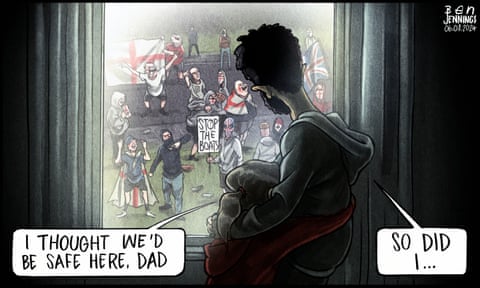

 Acceptable response to the Southport slaughter: Teddy bears, unicorn balloons and pink posturing (images from


