
Featured Articles

Andrei Lyubegin, Russian Nationalist and Right-Wing Reformer

Andrei Lyubegin—“Nationalism 2.0” Activist and Right-Wing Reformer

Andrei Lyubegin is an alumnus of the famous Russian right-wing journal Sputnik and Pogrom and then the lesser known and shorter-lived “Vendee” project. Sputnik and Pogrom was the largest right-wing publication of its kind in Russia and was quite a phenomenon at its time. Vendee was something more akin to the “Neo-Reaction” blogs in the English-speaking blogosphere. Andrei was the head organizer of the largest club of “intellectual nationalists” in St. Petersburg and has made it his personal project to understand and chronicle the history of the post-Soviet nationalist movement in Russia. He runs the “Baza” channel on VK and cooperates with other nationalists online. Full disclosure, I know Andrei quite well and run a podcast with him where we interview other right-wingers and talk about the news of the day, in Russian. Andrei is a somewhat controversial figure in the nationalist scene, mostly because of his frequent criticisms of the leadership. Whether or not Andrei was correct in his views or not, the simple fact is that he has outlived (literally in some cases) most of the people who disagreed with him and is one of the few people who has been left standing in this field from the old days at this point. So, by my reckoning, he must be doing something right and that makes him worth listening to.

Alright Andrei, you know the drill at this point. Who are you and how did you become the nationalist that you are today? 

Right, well, I come from a small town in Russia—Rybinsk. There are several factories there, the typical commieblocks and a nice center from Imperial times and so on. As for how I got here, I like to say that Russian nationalism is all about climbing a ladder of shit, if you will. I started with a group of something akin to skinheads in my little town. I didn’t join them, no. I got my start by critiquing them and pointing out what they were doing wrong. I always knew that there were problems with the right-wing movement in Russia. The kids I grew up with were simple factory boys that quickly got in trouble with the FSB because of their right-wing radicalism. My best friend was beaten by agents, interrogated and incarcerated for being too vocal in his views. My other friend decided to seize the means of production one day, pulled out his revolver and tried to seize the factory that he was an employee at. He was a big fan of The Turner Diaries. In fact, we all were. American right-wing literature was quite popular in Russia among the youth of the 90s and 00s. Needless to say, my friend’s rebellion came to an end quickly. He served his time and then he joined the airborne troops, just like the other friend did, actually. They’re both serving in Ukraine now.

Point being, I didn’t like what we were doing. I figured that we were living on borrowed time and that sooner or later, the FSB would get around to arresting us if we carried on in this way. At about this time, I finished my education, moved to St. Petersburg and the famous journal Sputnik and Pogrom was established, of which I was a big fan. But, even then, I critiqued their work at first. Still, credit where credit is due, they brought new ideas to the right-wing. Instead of sitting around and pining for the long-awaited RaHoWa and planning an armed revolution, we suddenly got exposed to “Intellectual Nationalism” which Russia sorely lacked. We even heard of Kevin MacDonald’s Culture of Critique series of books at around this time. We organized lectures on his work at our club.

A different kind of person was attracted to this sort of nationalism. People who were interested in their national culture, people who took an interest in their national history and so on—basically people who were more intelligent suddenly appeared on the scene. Even after the closure of the magazine, the effect that the magazine had on right-wing strategy and ideas cannot be denied. I was an early organizer of what can be called Nationalism 2.0 or “Intellectual Nationalism.” We had clubs that met to hear lectures and so on. This was all during the time of the Russian Spring of 2014 which saw the return of Crimea and an upsurge in patriotic feeling in the country. Our Petrograd Book Club (for fans of Intellectual Nationalism) became the largest nationalist organization of its kind in Russia. At the time, there were people from the National Democrat movement (liberals) and from the Rodina party (socialist-nationalists) all rubbing shoulders with us. This situation struck me as strange, but I will have more to say on this later.

At some point, Egor “Pogrom” Prosvirnin, the founder of the magazine and the biggest name in Russian Nationalism at the time, decided to hire me to rework the format of the club and make it into an active organization involved in political activism. We got together, declared ourselves the leaders of the so-called intellectual nationalist movement and started making headway. The magazine brought new people into the movement and our club organized the people who wanted to get more involved. Our first order of business was to open clubs all over the country and we eventually ended up opening 40 successfully.

Unfortunately, we had to spend a lot of time flushing out provocateurs and self-serving saboteurs. For example, we had a group of people from Ivanov that declared themselves a part of our network. As it turned out, these were actually local Rodina party officials who wanted to cash in our popularity. Rodina, you have to understand, was on its way out. It was a dying organization trying to stay relevant. Furthermore, in Russia, the people don’t trust the political parties because they consider them corrupt—and rightly so. And so, it was important to us that we stay clear of that association.

Anyway, the Russian Spring turned out to be a false thaw. The enthusiasm waned, and Egor Pogrom, who had ridden the wave of patriotic interest, began lashing out at his own dwindling base of supporters. Egor’s site was then banned by the Roskomnadzor and he refused to fight the ban, even though it was possible to get around it. The articles deteriorated in quality and his drug problems only exacerbated the problem. In the end, Egor ended up killing himself by imbibing drugs and jumping off his balcony in the center of Moscow. But I saw the writing on the wall before that.

The problem that quickly became apparent to me with our movement was that we had these so-called “nationalists” among us who weren’t even conservatives. They were oppositionists, first and foremost. And there was this attitude promoted by the leadership that we ought to be willing to rub shoulders with anyone that was against the government. Discontent continued to grow in the movement because one group of people, especially around Egor himself, was pro-drugs, anti-Orthodox, pro-Feminism, pro-punk rock, etc. Eventually the movement split because it had too many people in it that had absolutely nothing to do with one another. Furthermore, it was clear that we, the nationalists, were being used by other groups who showed up with money, media connections, and friends in the West.

Speaking of the West, you guys were gaining momentum right around the same time as the Alt-Right in America, right?

Yes and the American Alt-Right had a huge effect on us in Russia. Of course, the Alt-Right ended up being a laughingstock and, if anything, the lesson that we got from the Alt-Right was basically to avoid being like the Alt-Right. Still, there were many talented people who were inspired by what the Alt-Right managed to do right. Their enthusiasm, their memes and their way of forcing their way into the public spotlight inspired us. In many ways, we are still using the aesthetics of the Alt-Right in Russia today. The old aesthetic was entirely different—it was basically red flags with hammers and sickles or swastikas. Or the Imperial flag of Russia—the yellow, black and white one. Activism was largely confined to street marches like the infamous “Russian March.” The influence of the Alt-Right cannot be overstated in this sense. We suddenly started using slick designs, vaporware, green frogs and a different rhetoric. We began copying the model of internet activism instead of running people into police batons and spending the night in jail cells. Just like in the West, this new format was appealing to the youth. I count three main influencers who pushed for this new approach—myself, Kirill Nesterov, and Anatoly Karlin (to some extent).

Do we really want to go into detail about these eccentric e-personalities? 

I think it’s worth bringing them up because they were part of a larger problem on the right.

For example, Nesterov got big making videos popularizing Alt-Right ideas in Russia, which got millions of views. Unfortunately, he developed a drug problem because of his association with Egor Pogrom, who was his supplier. He had a public mental breakdown, denounced Russia and all Russians and left the country. He’s in Cyprus last I heard and publicly supports Ukraine on the internet now. Karlin also did drugs with Pogrom (common knowledge in the movement), called Russians “sub-humans” on his Twitter for not masking up during the Corona hoax and seems to have dropped out as well. The point here I’m making is simple: drugs and right-wing politics do not mix. The conservative faction of the movement understood this. You need “conservative nationalism,” not just “oppositionist nationalism,” to avoid these tragedies that are a byproduct of pursuing a Libertine lifestyle. This is why we are still around and they are not. The largest problem that we faced in the nationalist movement in Russia was the problem of old associations with oppositionists. There were always people within the movement that had absolutely nothing to do with the ideas of conservatism or nationalism, but who were only interested in using us as a battering ram against the government.

I noticed this as well and have frequently critiqued Nationalists for allying with Liberals in the FSU as well. 

Yes. Take, for example, Constantin Krylov, who everyone and their mother in the Russian right-wing knows about.
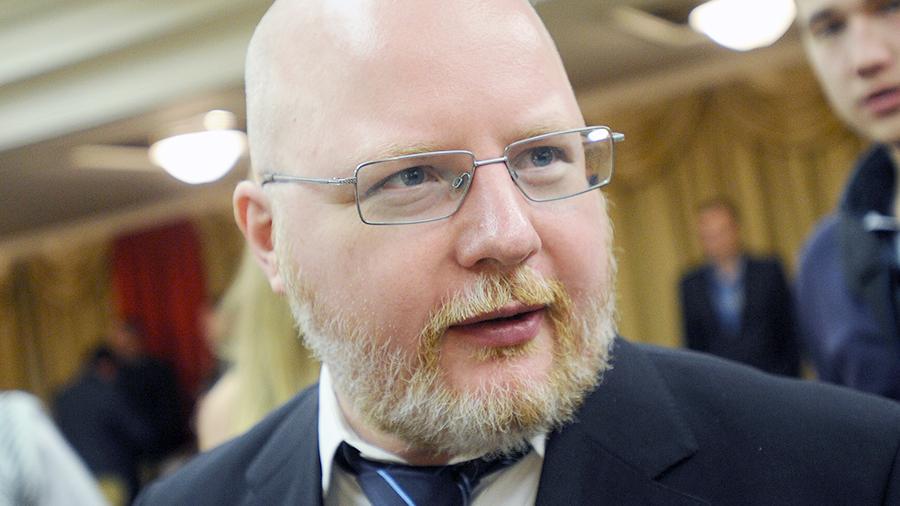
He was a large proponent of this alliance with the Liberal opposition and did more than anyone to normalize the idea and bring it about. And now a few words about Krylov: he was a Zoroastrian, a drug user, a constant criticizer of Russian culture and a man who always dreamed of running away to live in Italy. This man was considered a nationalist. Do you see the problem with this?

How could someone like this be considered a Russian nationalist by any sane person? In America, despite all the problems that the right has there, there is at least some common understanding of what a nationalist ought to be. 

Yes, although you certainly have your strange idiosyncrasies in America as well, as you well know. Such as support for large corporations or Zionism.

But let me provide you with another example—Egor Kholmogorov.
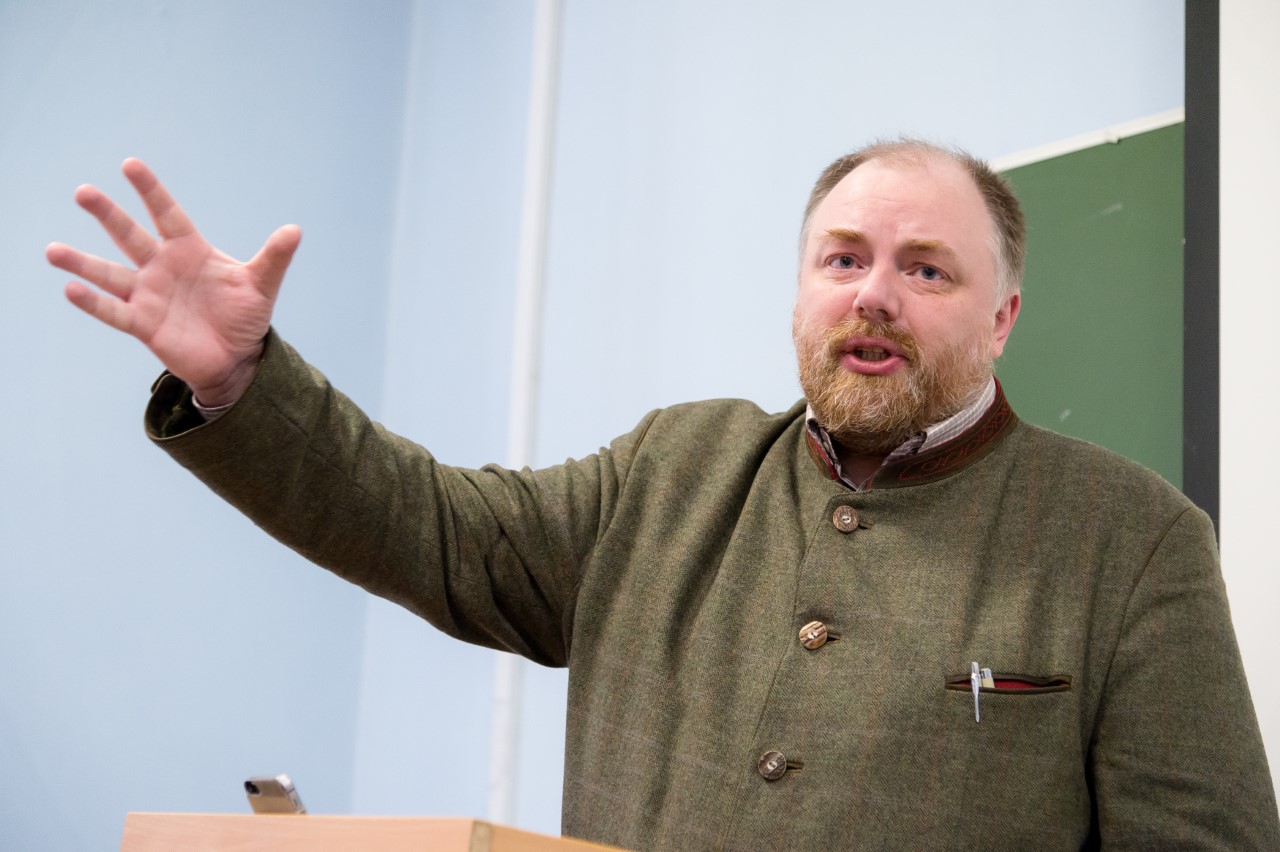
He is on RT now and friends with Margarita Simonyan, despite critiquing her liberalism for years.

The running joke about this man is that even his readers do not read what he writes. This is because he has a style of writing wherein one can’t figure out what he is saying. He appears to be saying everything and anything. From what we can understand of what he says though, he doesn’t actually believe in ethnic Russian nationalism. His is an ideological sort of nationalism. That means that if one follows the right ideology, the right set of ideas—his of course—then one can be counted as Russian. The problem is that no one can understand exactly what his ideology is. Furthermore, he has openly stated that he would be in favor of importing Ethiopians into Russia because they are Orthodox and because they have the so-called “Russian soul.”

What’s worse, he actually seems to believe this and isn’t saying it to avoid getting into trouble or to advance his career. These people have no place in nationalism, but, in Russia, there is no quality control at all.

This is a common theme at this point—lack of internal policing on the right and some sort of ideological schizophrenia, no?

Yes! And while we’re on the topic we really should spare a few words about Mikhail Svetov. He was the leader of the Libertarians of Russia—an opposition group that held street protests in Moscow and St. Petersburg.

In Russia, we can’t help but notice that Libertarians seem to have a hard time understanding the concept of age-of-consent laws. Svetov, for example, was quite open about his gore-and-torture fetish and his preference for pre-pubescent girls on his infamous blog. He was eventually arrested, released and then fled the country. His movement, which tried so hard to take over the Russian nationalist scene, crumbled soon after as the rest of his people also got in trouble with the law—most for their similar Libertine proclivities. These people were all comrades, members of the Russian nationalist movement at some point. No quality control. No common platform.

But I think I’ve made my point.

Instead of focusing on the negative, what about something positive that you or the movement has achieved. Is there anything that you’re proud of?

Well, the survivors of the Sputnik and Pogrom shipwreck got together and formed the Vendee magazine. For the first time, we began to delve into the ideas that actual Russian nationalists in the past had written about. If, before, we were simply copying the West, we suddenly started discovering our own intellectual tradition. We continued to publish nationalist ideas, but the thing that I am most proud of are the alumni of the magazine that went on to do their own successful projects after Vendee closed down as well. They went on to start their own groups and projects on Telegram and [social networking site] VK. Our movement decentralized and new people joined of their own accord and then started working on their own projects on their own.

This is where you come into the story, Rolo.

You joined our podcast, “Russians Forward,” and then we transitioned to “Culture of Discussion.” We were pioneers in the podcast format in the Russian right-wing. There were no podcasts or even interest in podcasts before this. In America, everyone has a podcast from what I can tell. But, this new format is still in its nascent stages in Russia.

Our group started appropriating the idea of “cancel culture” and putting it to good use online. We harassed many personalities and companies for promoting homosexuality or making anti-Russian statements and exerted pressure on them through the use of internet mob tactics. This method is now being used by larger, mainstream conservatives in Russia now. I consider us pioneers in this field. We had to fight against literally everyone to prove that this method was both necessary and effective. Just like in America, our right-wingers were largely toothless and obsessed with playing by the rules, even though our opponents didn’t. Now, they all act like it was the most obvious thing in the world. I am proud of the effect that we had working with our small internet guerrilla outfit. For the first time in living memory, the Russian right is on the offensive against the Liberals. We are cancelling them, they are not canceling us.

Things have changed quite a bit in Russia haven’t they?

The entire political landscape in Russia has changed in recent months.

Everything has shifted to the right, and what was once considered fringe and extreme is now mainstream. The aforementioned Egor Kholmogorov, who once wanted to import Ethiopians, now talks about the Russian ethnos, something that he used to deny even existed a few months ago. Alexander Dugin, who is famous in the West for being a Russian nationalist, also used to refuse to acknowledge the biological reality of race. Now though, he claims that the Russian ethnos is even more important than the Russian government or any nation-state structure—that the Russian people exist as a distinct entity and that their interests have to trump all others!

From the side of the government, the word ‘Russian’ has been recently added to the constitution. The constitutional court declared that the Russian people are the “state-forming” ethnos of Russia. That is, Russia has other ethnicities sure, but that the Russians created Russia. This was done before the special operation, mind you. Then, the infamous 282 hate speech law was drastically softened years ago and no one except Islamic terrorists gets in trouble over it. Judging by everything that the government is doing, we are seeing a serious turn to the right. The government is also leaning heavily into Orthodoxy. Funny enough, Liberals used to accuse the Orthodox of being Russia’s Taliban. Nowadays, I think they may be more right than wrong—and that’s a good thing!

Readovka, the patriotic media site, believes that the government will no longer be able to ignore or repress nationalists going forward. This is just speculation at this point, but it makes sense to me when the situation is taken into context. Readovka has some alumni journalists from Sputnik and Pogrom and Vendee working for it, by the way. They get millions of views.

But the main problem, despite all our recent efforts to rectify this, is that we do not have a true nationalist school of thought yet in Russia. The Poles, the Germans, and many other nations do have this intellectual tradition, even if they do not use it. We need to work out our own model of nationalism using our own historical context, our internal and external situation, and so on. Our people do what they can, but we need an anti-university (antiversitet) that does the work of explaining our ideas and building a working model. The closest we have is the work of Alexander Dugin, but this is simply not enough. We need an internal and external program. We need to explain our ideas. We need to stop borrowing our thinking from the West and trying to graft it onto our own society. Because we were repressed for so many years, we have a problem with culture and content-production. But I think this will change soon.

Right-wing culture is on the upswing.

Is the Covid Program an Attack on Whites and on Western Culture?

“The more corrupt the state, the more numerous the laws.” Tacitus

Some assertions you may disagree with, and I’m obviously asking a somewhat dramatized question. But my central argument is that, whatever you may think of the Covid program, it appears to affect the White race especially, and especially those in the United States and Western Europe.

Why is that?

Because the West has the highest density of institutions, and the most ubiquitous and organized rule of law, and those institutions through which we all live and act, are the means of enforcing the Covid medical program: either you comply or you don’t shop, travel, go to school, keep your job, attend college, get admitted to a hospital, receive a transplant, operate a small business (the vast majority of Americans are employed by them), or attend even a fine arts industry convention. The Covid program flows in a top-down institutional manner, from institution to institution, as each in turn follows the other by an assumption of authority and law (One major university medical expert has privately reiterated that in his experience, higher education merely follows whatever the CDC tells them to do, and that they can, they believe, thereby blame the CDC if anything goes wrong, irrespective of whether their own university bio-health programs can cause harm. That works by following CDC policies to the full.  Under this procedure, should anything bad actually occur, the school would point to the CDC and say that it was “just following orders.” and “did everything that it could.”  The fact that the university policies are unscientific or irrational or even harmful is irrelevant in this scenario”).

The professions are also especially hard hit: airline pilots have been unusually vocal about how vaccines compromise their ability to pass a flight physical, and thousands are retiring in protest, while the vaccinated and unvaccinated are being pitted against each other by their compliant corporate leadership (and the current Biden administration is pursuing an explicit racial program to make airline cockpits more “reflective of diverse cultures.”  The New York Times recently ran a prominent article titled “The End of the All-Male, All-White Cockpit.”).

Most of the Black, Latino, Middle Eastern and many other non-White groups, by contrast, live in typically far less developed countries, or in more isolated regions with far fewer, in some cases with no, effective institutional corralling and control, or they form a less institutionally concentrated mass than Whites, and they are often “at large” outside many institutional interactions.  Moreover, our entire southern border is wide open to non-White races who provide no medical documents (or any documents whatsoever) and are not subject to Covid enforcement.  It is middle-class America that is most affected by their daily interaction with, and dependence on, institutions, creating an endless testing, vaccination and “booster” regime. Whites also have higher, more concentrated levels of medical insurance coverage as a group, that allows the Covid syndicate of pharmaceutical companies and hospitals to charge enormous premiums that contribute to their current financial windfall: White middle-class wealth is subsidizing the Covid vaccine program, and is effectively a tax and wealth transfer (“As of 2019, nonelderly AIAN [American Indian  and Alaskan Native], Hispanic, NHOPI [Native Hawaiian and Other Pacific Islanders], and Black people remained more likely to lack health insurance than their White counterparts”). Another study asserts that “The combined effect of income and race on insurance coverage was devastating as low-income minorities with bad health had 68% less odds of being insured than high-income Whites with good health.”

Our colleges and universities also contain the single largest institutional concentration of White young adults (a separate issue from the total mix of races in college) than in any other single kind of institution, and these institutions of higher education rigorously enforce Covid “biosecurity” compliance, including testing, tracing, tracking and reporting.  Illegal immigrants by contrast, roam the country at large, and their numbers multiply by the thousands, every day.  We have an emerging two-tier society formed by a biopolitical program, combined with a toppling of Western institutions—including law and order—in a radical open-society fantasy.

The Covid pandemic bio-security construct appears to function primarily as an attack not just on individuals through coerced vaccination and other rules, but an attack directly targeted at White, Western culture that is especially known for, and is especially a threat to, the current radical governing group: freedom of association, the Catholic church, schooling, and family itself if it resists the replacement of parental authority and dominion by the State.

This attack also is naturally coordinated with capitalism (of the middle class, not Wall Street per se), which is largely institutionally based (including new invasive banking rules).  By contrast, nearly all illegals and many other non-White labor groups work on a cash, non-banking basis.  Nobel economist and legal historian Oliver E. Williamson’s classic book, The Economic Institutions of Capitalism, reinforces the Western dependency on the strength and integrity of its institutions: and no group has arguably perfected institutional penetration and corruption more than those who affiliate first with Israel or with Zionism. It is through institutions that Whites are pitted against other races, and even against themselves.  It is through the law that races are divided—and conquered politically.

But I would like to advance one other provocation: that a deep culture of revenge is inherent to Jewish hostility to Whites, and to White culture. The Holocaust Industry thrives largely through its ability to broadcast blame, culpability and reparations.  The Covid program could be seen as a form of both revenge, through a psychological reversal and compensation of victim and victimizer from World War II—that is, as a modern symbol of the “Auschwitz” memetic, with a reversal of Jew and German (popular movie culture is full of Jewish revenge fantasy where violence “is the best revenge”), combined with a specifically engineered effective bio-fascism.

Paul Lagarde on Jews and Indo-Europeans, Part 3: Jews and Politics

Go to Part 1
Go to Part 2

There remains one point to be discussed: the participation of the Jews in politics. From the start one should suppose that the members of a nation that lives in the midst of enthusiastic followers of the nationalist principle would have enough sense of honor to raise demands, even for their nationality itself, that Jewry will work for the founding of a state located in Palestine. However, from an ethical point of view, the Jew thinks as little as the parasite that battens on a foreign body ubi bene, ibi patria.[1] One should further think that a nation foregoing a political life for almost two thousand years would decide to remain far from politics that is unaccustomed to them; a Jew who politicizes today, however, offers the spectacle of an eighty-year-old man who, because he once as a boy—and no longer—rode with a sword and went skating, embarks on a sabre duel, romps on a stallion before his beloved, and does a big act on hoar frost. One should, thirdly, suppose that all nations that have behind them an uninterrupted political work of centuries, even if often not enjoyable, would find it especially stupid to allow themselves to be advised on the political work now at hand by those who cannot have, and do not have, insight into politics, who, faced with the tasks of German political life, stand with the ingenuousness of a jackdaw that flies away from a copy of Iphigenia or Antigone lying tattered in a garden or over a score of Grell’s[2] Mass for sixteen voices. But matters have developed differently than they should have according to propriety and reasonableness. The long-dammed stream of Jewish skill pours out like the well-known Wilhelmshöher waterfall; after a long pause, Israel gives birth to politicians, people like Johann Jacoby,[3] Lasker, Ludwig Loewe,[4] Singer, Sabor. “Small Germany” is the battle-cry; they thus appear on the scene with the betrayal of Greater Germany. The Jews of Austria must indeed first be able to eat up Austria in peace before they go on to the harder task of digesting the “new Reich.” Almost all of them appear with [promises of] utopias, the loudest of them with principles which, when one has tried to implement, must give up after a short time, and the most Jewish of them with “No, No, No” against everything that is, even if not the best, still necessary at the moment. And since a Jew “will not prostitute himself before potentates,” Iohann Jacobi says to the King of Prussia who finally plucks up courage against the dirt of the revolution acted out by the Jews, in his house, the great words: “that is the misfortune of kings, that they do not wish to hear the truth,” and Mr. Singer remains seated when the German Reichstag rises in honour of Field Marshal Moltke.[5] If a Pincus Hersch, convicted on account of a serious procuration, should at one time direct an appeal for clemency to the German Kaiser, he will sign “with friendly greetings, Pincus Hersch,” for “wagging his tail” is not his style and he—who is a Republican—tolerates the Kaiser of Germany only according to I Samuel 8.[6]

Why does the German Philistine let himself be led by the Jews by the nose? Because he is a Philistine.

Jacob Grimm once wrote to his brother Wilhelm that, after his brother, nobody stood closer to his heart than Savigny[7] and Clemens Brentano.[8] This Clemens Brentano is too good to be reproached for the ale-bench; I must nevertheless cite an essay of Brentano’s against the danger of seeing him too drawn into the mire. In the fifth volume of his collected works is printed Brentano’s “jocular essay on the Philistines in and according to history,” which once appeared in Berlin by itself, but became known to me only very recently, even though I have always loved Clemens. Brentano recognises the Jews and the Philistines as the two heads of the old serpent set one against the other; he would agree with me if I said briefly that the Jews and the Philistines (which latter are now called Liberals) have in common that they deny history, that they think that something can be good and lasting that does not appear as the continuation of an already existent good or as the combating of a bad that has already been combated. The strife of the world does not start from today, because God is eternal and his enemy, the Devil, is older than the world of humans.

Moritz Lazarus and Levin Goldschmidt[9] had a sense of the situation when they warned the Jews before the last Reichstag elections to leave the progressive party if they wished to be tolerated in Germany. They acted as Jews when they presented to the Reich Chancellor, no matter in what way, the prospect of the votes of Jewry if he would forbid anti-Semitism:  something would be gained thereby. They did not perceive that the Jews would have to stop being Jews if they—who, in Brentano’s words (1887), wish to make a business of the manna fallen to them from heaven three thousand years ago—wished to recognise for once that one can appease the hunger of 1887 only with the corn grown shortly before 1887. They did not perceive that, in England and Germany, a considerable number of commoners were accepted into the aristocracy but that this aristocracy of recent date could stop being parvenus only because they found an old aristocracy of ancient custom and emulated them, and that, analogously, every member of a foreign nation can become a German but on condition that he acknowledge Germany and indeed acknowledge it as something much higher than one’s own nationality that has to be given up, but that he cannot, and will not, become a German if he prides himself on the uniqueness of his own nationality, if he wishes to become or be a German and, as an entrance courtesy, he undertakes to make the Germans like himself and to master them.[10] Those two have not perceived that every government of Europe that is not anti-Semitic—in my sense—conducts a betrayal of the people whom they serve. They are as little aware that they imagine that there are among us respectable men who are not anti-Semites—in the good sense; I know born Jews who suffer badly under the anti-Semitism of the masses and themselves practise my anti-Semitism as necessary.

And as proof that Jews as Jews never have an understanding of real life when it is not represented through exchange, interest coupons and Deutschmarks, Lazarus and Goldschmidt are ostracized by Jewry. “May he not be remembered any more”[11]—that is how it goes in the old excommunication formula of the synagogue against Lazarus. Lazarus was one of the idols of his people, though an idol the reverence for whom I never understood; now he has fallen and his place is vacant. Perhaps Mr. Abraham Berliner[12] notes (14,15) now that I was not so far removed from the right path when I considered a refutation of Mr. Graetz signed “M.L.” as being written by Moritz Lazarus;  I knew the man well enough to know that the essay “To the German Jews”[13] bothered him a long time.

I have for years been convinced that Jewry nested in the Christian-Germanic-Roman cultural world is, as a result of the above-mentioned characteristics, the cancer of our entire life. Our economy cannot thrive on account of them, our nationality withers, the truth is withheld from us by them, the Church is hostile to them and makes them contemptible instead of helping them to a new life.

Friendship is possible with every individual Jew, but only on condition that he cease to be a Jew. Jewry as such must disappear. And the individual Jews will be glad to experience by themselves what Ludwig Steub,[14] certainly a man of insight and intelligence, wrote to Mr. Isidore Singer in Vienna, thus to a Jew:

There are no more persecutions as soon as there are no more Jews. That is why I greet with joy all measures that can make them disappear, as for example the freedom to marry. I do not believe that tasks are still placed for the Jews that cannot also be solved by Christians and to that extent I see no great loss if they disappear from the screen. They will obtain peace only when they are no longer there.

I have often enough acknowledged that we Europeans, Christians are not what we should be when there are still Jews among us; I have therefore thrown a good part of the blame for the deep decadence of our life on our shoulders. But where there is heaped up such a mass of putrefaction as in the Israel of Europe one achieves one’s goal only through an inner physic after one has removed the collected pus through a surgical procedure. I have therefore taken from the Jews that for whose sake they are Jews and through which they rule, money, thrown out the financial monopoly, and explained it in my Deutsche Schriften 496–498. That I am thereby in the right is shown to me by the rage of Mr. Abraham Berliner (26):

The speech about the methods of taking away wealth and income from the Jews truly deserved to be rewarded with the diploma of a gang of burglars from the remotest recess of Corsica.

Here Mr. Abraham Berliner is apparently not anxious in the choice of his expressions. He clearly does not fear “crossing the boundaries of the penal code” in this sentence. Perhaps he was interested to find out from the front page of the Vossische Zeitung of 25 February 1887 that in the Kreuzzeitung, in the “national” programme of the Conservative Party a high stock-exchange turnover tax, or a “nationalization of the Reich bank” appears. We do not fly, we go step by step.

Europe suffers under a debt burden of 96,000 million Deutschmarks;[15] those men who stand at the top of European affairs do not have enough insight and will to understand that the shedding of these 96 billion is the very first condition for the prosperity of Europe. Much less do these men understand that through these debts of ours the Jews become important.[16] Roughly calculated, through the manipulations made with these debt securities, every year 960 million marks go into the pockets of the Jewry working in financial trade. So that the ten percent—not paid in Germany, far exceeding that in most other countries of Europe—may not be lacking, I do not calculate the debts of the municipalities, from which Israel likewise has its profits, but remark that the supplies for the army in many states lie regularly in the hands of the Semites and I let you consider what is earned from these supplies.

I present here the last statistical notice known to me on the number of Jews. Of the six million, three hundred thousand Jews that there are overall, there live

In Europe 5,400,000
In Asia 300,000
In Africa 350,000
In America 250,000
In Russia 2,552,000
In Poland 768,000
In Austria-Hungary 1,644,000
In Galicia 688,000
In Germany 562,000
In Romania 263,000
In Turkey 105,000
In the Netherlands 82,000
In France 63,000
In Italy 40,000

Whereby one may note that the homeland of the people, Palestine, hosts 25,000 Jews, Prussia has 366,543 of them, and especially Berlin 64,355.

When one divides the number of inhabitants of Europe by five and a half million—the number of Jews of Europe—one will discover what percentage of the population of Europe the Jews constitute. When one then considers that 960 million in expenses that the Jewry of Europe draw from us, one will understand why in 1881 I wrote the sentence:

The Jews remain Jews not only because of our fault but also because of our debts.

It is extremely advantageous to be a Jew. Many Liberals who, in the interest of humanity and justice, speak on behalf of the Jews, and now we, know that the Jews are not sparing with tips—the form of the tip is of no importance—they have funds for this and what they invest in such tips—recommendations, testimonials, contributions, positions on the boards of directors—is advertising capital. But what sort of statesmen, what sort of princes are they who do not put an end to this corruption! Are they really not aware of it?

And the Jews will finally thank us themselves. We shall take from them that which maintains them as Jews: as they will no longer possess money, they will become free of the Old Adam and be forced to become what we are already, Germans.

And now, in conclusion, another observation.

I have for many years been the proponent of the view that the present German Reich and Austria-Hungary should be joined in an indissoluble manner. I have always thought of Central Europe as divided into two but united; numerous students and friends know that I became reserved about a public confession of this view only after the inordinate incapacity of the Austrian statesmen was exposed fully at the Frankfurt Diet of Princes[17] and did not obtain a correction from the Habsburg-Lothringen dynasty.

That the German Reich is not viable is now clear to all: it collapses on account of its position between enemies and unreliable friends, on account of the necessity conditioned by this position of being constantly armed to the teeth, and on account of the financial distress forced by this necessity to live in an armed peace.

That Austria is not viable the representative Knotz said in the Austrian House of Representatives on 5 May 1887. As far as I know regarding the mood of the German Austrians, they all think like Knotz. The Irishman Tahaffey=Taafe[18] has lost all ground among his people: the civil war in Austria—my discussion published almost twelve years ago, in September 1875, can be read in the Complete Edition of my Deutsche Schriften, 134, 135—the civil war stands so clearly recognisable before the gates that indeed the newspaper apparently supported by Count Taafe’s government in which Mr. Güdemann,[19] non sine diis animosus,[20] was able to write the essay printed above on pages 264–268[21]; he had to call his burlesque remarks on Knotz “little dignified,” but the other newspapers (one may read the evening Vossische Zeitung of 7 May 1887) recognised the remarks of the representative for Teschen as essentially justified. The Germans of Austria are the cultural fertilizer—this expression was introduced into the world by me around thirty years ago—with which Czechs, Magyars and other ethnic communities are rendered receptive to the rule of Jewry; our brothers in Austria do not have a right to be Germans any longer, in spite of the declarations made by Kaiser Franz Josef at the Frankfurt Diet of Princes.[22] And Austria is bankrupt.

Everywhere where there is financial distress, especially where there is financial distress as a result of disorganized political conditions, the Jew flourishes on the ruins of nations. For, one may lie about peace or about war, the Jew profits; if Pinkus operates when conditions are bad, Pinkus’s brother Schmul operates when they are good; when there is war, Pinkus and Schmul together undertake the supplies; when thereafter there is peace, they undertake the financing of the necessary loans; the family wins in all cases. Only those served by the family lose.

Financial distress prevails in Germany as in Austria, and indeed as a result of the separation of these two Reichs. From this it follows that the Jews wish to maintain the division of these two Reichs. From this it follows that every patriot of Germany and Austria must wish to remove the division of the Reichs and, for the sake of the unification of the Reichs, the Jews—about individual Jews we can speak.

But the Jews know about more than the financial side of the matter; they know also that every German is not an enemy of individual Jews but an enemy of Israel as Israel. The stronger German life becomes the more certainly Israel will disappear. That is why Israel prevents the rise of a Central European Union. For, in this union there would be no masters but the owners of the land, the Germans. Let Israel exist as an independent nation and establish an independent state; Germany and Austria will live with this nation and state in peaceful concord, and members of this Israelite state will be treated by us as benevolently and politely as the members of any other state will be—as foreigners. That Israel wishes to rule among us, that it allows itself to be praised by Geiger, and Graetz and comrades as the bearers of a cultural mission, since it, in truth, does nothing but exploit Europe financially and praises the grinning grimace of our culture as an ancient family possession of Israel—that we Germans precisely refuse before the other nations because we are younger and more unprotected than the other nations and therefore more sensitive to attacks and diseases.


[1] “The fatherland is where life is good”—a saying that may date back to Marcus Pacuvius, a second-century B.C. Roman poet quoted by Cicero.

[2] Eduard Grell (1800–1886) was a German composer noted for his sacred choral compositions.

[3] Johann Jacoby (1805–1877) was a German Jewish doctor who became a Liberal politician who fought for the emancipation of the Jews.

[4] Ludwig Loewe (1837–1886) was a German Jewish industrialist and member of the Reichstag whose socialist friends included Ferdinand Lassalle and Walther Rathenau.

[5] Helmut von Moltke (1800–1891) was a Prussian Field Marshal who commanded Prussian troops during the Austro-Prussian War and the Franco-Prussian War and was famed for his skills in military organization and strategy.

[6] This refers to section of the first book of Samuel that begins the account of Samuel’s establishment of a monarchy among the Israelites through his appointment of Saul as king.

[7] Friedrich Carl von Savigny (1779–1961) was a famous German jurist.

[8] Clemens Brentano (1778–1842) was a German Romantic poet and Catholic who wrote several essays on Christian subjects.

[9] Levin Goldschmidt (1829–1897) was a German Jewish jurist, academic and member of the Reichstag.

[10] Lagarde: Cf. something on Heinrich Heine, one of the most repulsive subjects that have ever been printed on earth—H. Hüffer in J. Rodenberg’s Deutsche Rundschau, 1878—and something which G. V. Albert has discussed in 1886 in the—at the moment, to me, substandard—Revue des deux mondes and which Mr. Graetz has acknowledged as correct—and in a commendatory way—in his monthly journal of 1886, 188, 189.

[11] This is also the opening line of a poem by Heine, “Nicht gedacht soll seiner werden”

[12] Abraham Berliner (1833–1915) was a German Jewish theologian and historian. He also published a pamphlet against Paul de Lagarde, Paul de Lagarde, nach seiner Natur gezeichnet (1887).

[13] Moritz Lazarus, An die deutschen Juden, 1887.

[14] Ludwig Steub (1812–1888) was a German jurist and writer.

[15] Vossische Zeitung (10 March, 1887).

[16] Paul de Lagarde, Deutsche Schriften, Complete Edition, 413.

[17] The Frankfurt Diet of Princes took place in August 1863 to discuss reforms of the princely Deutscher Bund that lasted from 1815 to 1866. The Deutscher Bund was an association of 39 predominantly German-speaking sovereign states in Central Europe.

[18] Eduard, Graf von Taafe (1833–1895) was an Irish Austrian statesman who served as minister-president of Cisleithania in the Austro-Hungarian Empire.

[19] Moritz (Moshe) Güdemann (1835–1918) was an Austrian Jewish historian and Chief Rabbi of Vienna.

[20] The line from Horace’s ode “Descende caelo” is “non sine diis animosus infans” (“a spirited child not without the help of the gods”).

[21] The pages referred to in Mittheilungen, II, reproduce an article entitled “Der ‘deutsche Nationalheilige’ Paul de Lagarde” by Güdemann published in the Viennese Freie Presse, 42 (February 12, 1887).

[22] de Lagarde, Deutsche Schriften, 507.

Paul de Lagarde on Jews and Indo-Europeans, Part 2: Internationalism, Stock Exchanges, and the Media

Go to Part 1

That which speaks against the Jews, apart from the atavism and racial arrogance that by themselves force one to an unqualified rejection of the Jews, is first of all their internationalism. It is not true that the German, French, English, Russian Jews feel that they are members of the country in which they live; wherever possible they appear on the scene as sons of the Jewish nation and thereby they are the enemies of every European nation. Their declamations that things are different is believed by nobody. They stand on the same platform as the Jesuits and the Social Democrats: they are without a fatherland.

The second thing that speaks against them is their desire to bring in fellow racial comrades wherever possible. Wherever a Jew has set foot there are, in a short time, twenty Jews, and where there are twenty they rule, because members of cultured nations disdain the means used shamelessly by the Jews to acquire influence and because they are too considerate to express themselves freely and do not have the courage to act.

What thirdly turns the entire world against them is their usury, the term usury taken in the wider sense. I shall let men speak for me to whom nobody will deny the faculty of judgement, first Napoleon and then an advisor to a Prussian ministry. I became acquainted with Napoleon’s speeches and decrees only very recently but found to my great joy, however, that the man, who was truly perceptive, already in 1806 thought in the same way that any respectable German without exception thinks in 1887, in a radically anti-Semitic manner, in the sense of a double-sided humanity. I wish to help my countrymen through the printing of the speeches and decrees of Napoleon to help them to find the courage to say what they think and to translate it into deeds:

Meeting (of the Council of State) of 30 April 1806.[1]

Legislation is a shield that the government should carry everywhere where the public welfare is attacked. The French government cannot regard with indifference that a nation vilified, degraded, capable of every baseness, possess exclusively the two beautiful administrative departments of ancient Alsace; the Jews must be considered as a nation and not as a sect. It is a nation within the nation; I would like to remove from them, at least for a specific time, the right to take mortgages, for it is too humiliating for the French nation to find itself at the mercy of the vilest nation. Entire villages have been expropriated by the Jews; they have replaced feudalism; they are veritable flocks of crows. We saw them at the battles of Ulm[2] rushing from Strasboug to buy from the marauders what they had pillaged.

One should prevent, by legal means, the arbitrariness which one will find oneself obliged to employ with regard to the Jews; they would risk being massacred one day by the Christians of Alsace, as they have so often been, and almost always by their own fault.

The Jews are not in the same category as the Protestants and the Catholics. They should be judged according to political rights and not civil rights because they are not citizens.

It would be dangerous to let the keys of France—Strasbourg and Alsace—to fall into the hands of a population of spies who are not attached at all to the country. In the past, Jews could not even stay overnight in Strasbourg; it will perhaps be appropriate to decree today that there will not be more than fifty thousand Jews in the upper and lower Rhine; an excess of this number would spread at will into the rest of France.

One could also forbid them commerce based on what they have corrupted of it through usury and cancel their past transactions as tarnished by fraud.

The Christians of Alsace and the prefect of Strasbourg have brought to me many complaints against the Jews during my travel to this land.

Meeting of 7 May 1806

It has been proposed to me that the migrant Jews who do not merit the title of French citizens be expelled and the tribunals be invited to use their discretionary power against usury; but these means would be insufficient. The Jewish nation, since Moses, has been constituted in a usurious and oppressive way; it is not the same with the Christians: usurers are the exception among them and have a bad reputation. It is thus not with metaphysical laws that one will regenerate the Jews; here we need simple laws, laws of exception; one can propose nothing worse to me than to drive out a great number of individuals who are men like others; legislation can become tyrannical through metaphysics as through arbitrariness. Judges do not have discretionary power at all; they are physical machines by means of which the laws are implemented just as the hours are marked by the needles of a watch: driving out the Jews would be a weakness, correcting them would be a strength. One should prohibit commerce to Jews because they abuse it, just as one prohibits his profession to a goldsmith when he makes false gold. Metaphysics has misled the writer of the report to the point of preferring a violent measure of deportation to a more efficacious and gentle remedy. This law needs to be matured; one should assemble the general estates of the Jews, that is, summon fifty or sixty of them to Paris; I wish to have a general synagogue of Jews in Paris on 15 June.[3] I am far from wanting to do anything against my glory and that could be disapproved of by posterity—as they represent me as wanting to do in the report. My entire council gathered together cannot make me adopt a thing that would have this character; but I do not want the welfare of the provinces to be sacrificed to a principle of metaphysics and egoism. I state again that people do not complain of the Protestants or the Catholics the way they do of the Jews; it is that the evil that the Jews commit comes not from individuals but from the constitution of these people themselves; they are caterpillars, locusts that ravage France.

On 30 May 1806 appeared the famous decree through which Napoleon I summoned an assembly of individuals professing the Jewish religion and inhabiting the French territory to Paris; I extract the following from the official Bulletin des lois de l’empire franςais, 4,4 (1806), No.1631:

Based on the account that has been delivered to us that in many northern departments of our empire certain Jews, exercising no other profession but that of usury, have by the accumulation of the most immoderate interests thrown many farmers of these lands into a state of great distress,

We have thought that we should come to the aid of those of our subjects that an unjust cupidity has apparently reduced to these vexing extremities;

These circumstances have made us at the same time learn how urgent it was to reanimate, among those who profess the Jewish religion in the lands subject to our allegiance, the sentiments of civil morality which unfortunately have been weakened among too large a number among them by the state of subjection in which they have languished for long, a state that is certainly not our intention either to maintain or renew;

For the accomplishment of this design we have resolved to unite in an assembly the leaders of the Jews and to have our intentions communicated to them by commissioners who we will nominate to this end and will obtain, at the same time, their vows regarding the means that they estimate the most expedient to encourage among their brothers the exercise of the arts and of useful professions in order to replace by an honest industriousness the shameful resources to which many of them have delivered themselves from father to son for several centuries;

For these reasons,

In connection with the chief justice of the Ministry of Justice and our Minister of the Interior, Our Council of State included

We have decreed and decree the following:

First article:  There is a stay of a year, counting from the date of the present decree, of all executions of judgements or contracts other than through simple protective action against the non-trading farmers of the departments of the Sarre, the Roer, Mont-Tonnerre, the Upper and Lower Rhine, of Rhin-et-Moselle, of the Moselle and the Vosges, when the debts against the farmers have been agreed upon by them in favor of the Jews.

One will find it understandable that this precise knowledge of their character excited the Jews. I point to unimpeachable evidence—of the geographer Karl Ritter—Bericht über die Aufnahme, welche Napoleon als Messias in Frankfurt am Main fand.[4] These Jews did not prostitute themselves before a “foreign potentate” since the Grand Duchy of Frankfurt under a Freiherr von Dalberg belonged at that time to the Rheinbund;[5] they immediately resorted even at that time to [HEBREW TERM], the presumption characteristic of their race—expressed so repugnantly in Heine and the press Jews of our age.

I cannot have the report cited in full which the Senior Privy Councillor Thiel made on “Usury in the provinces” of Prussia in the Farmers’ Club in Berlin on 1 March 1887; the material at the basis of the report will appear in an official publication; for the time being it is sufficient to point to the Vossische Zeitung of 3 March 1887; I deliberately cite a democratic newspaper that is friendly to the Jews. According to Thiel, in Alsace and Lorraine, about whose Jews Napoleon complained already so bitterly, it had become worse than it had been in the previous centuries. I have heard hair-raising things a long time ago—from a very insightful and benevolent party, a very highly-positioned man who was unreservedly candid with me—about the usurious Jews of the two provinces. For the conditions in the administrative district of Cassel it is significant that, in the first electoral district of Hesse, the long-serving Conservative representative was recently ousted by a newcomer who was able to gain the sympathies of the country people through fanatic anti-Semitism. It is a matter, besides, not only of money and credit usury but also of cattle usury, real estate usury, commodities usury. In the Bitburg district there are 91 professional cattle-lenders who have sold 1000 units of cattle to small folk. In Kreisbach district there are 700 loaned cows; the yearly turnover in the cattle loan business amounts to 105,000 Marks, the profit of the lender 35,000 Marks, thus around 34 percent, often 100 percent. The practitioners of usury are everywhere the same; the Senior Privy Councillor describes them, though actually every worldly-wise man knows about them. You may investigate or observe how many percent of these usurers are Jews! Where, in many places, I myself have been asked for help I have constantly found Israelites in my quest: once, at my request, a rich Jew, the father of one of my students, helped me kindly against the Jews.

It would take a heart of the hardness of crocodile skin not to feel compassion for the poor Germans sucked dry and—what is the same thing—not to hate the Jews, not to hate and despise those who—out of humanity!—make a case for these Jews or who are too cowardly to squash this usurious vermin. One does not negotiate with trichinae and bacilli, trichina and bacilli are also not educated, they are destroyed as quickly and fundamentally as possible.

In the summer of 1853, Prince Adam Czartoryski[6] came with his family to London. He was spied on by a Russian Jew whom I helped to expose. Since this Jew is still alive, and is a man of the upper class, I wish to remind him that he lived at that time in Jermyn Street (I think no. 23), that he was introduced by Baron Berg to the Alfred Club, that he had, at a matinée ball of an aristocratic house that he had sneaked into uninvited, insulted Prince Félix Salm-Salm,[7] and that he had disappeared as a result of a conversation that a woman of the English aristocracy conducted with the Russian envoy Baron Brunnow, at a party of the Marchioness of Breadalbane. Since 1853 I have never heard of a spy of the poisonous political sort who was not a Jew; today, when I write this, I am informed from a German capital of two new examples of this vermin.

How the Jews stand in relation to the press I do not need to tell anybody. The whole world knows that the majority of the reviewers of the political press of Europe, like the majority of the impresarios, are Jews. That these Jews do not express and disseminate the views of the peoples of Europe but those of the Jews is doubtless. Their success has become so great that they have been able to praise to the heavens a long series of Jewish and half-Jewish scholars, writers, musicians, actors, politicians but that they have also silenced or thrown dirt upon everything that did not bear la tarla giudiaca [the Jewish woodworm], that through them even the worldview of the educated people of Europe has been transformed from a European and Christian to an Asiatic and heathen one; for, ever since the Old Testament gave way to the New Testament and the Christian Church arose, the Jews are, in spite of the papier-maché monotheism, heathens.

In closest relation to the press stands the stock-exchange. To substantiate this, I refer to two articles of the Vossische Zeitung.

The above-mentioned newspaper wrote on the evening of 27 January 1887 from Paris:

It is an old trick of thieves to shout out the alarm-signal, “Fire!,” in a crowded theatre hall or church in order, in the midst of the frightful confusion that unfailingly ensues, to rake in a rich harvest of wallets and items of jewellery. That in the process dozens, sometimes even hundreds of men, are crushed, trampled upon, killed or made cripples for life is a matter of indifference to the criminals. The chief thing is that they can steal. Now then; it seems that there are nefarious stock-exchange speculators somewhere in the world who imitate this time-tested trick of rogues. At a moment when Europe is already nervous they suddenly shout out the signal “Fire!”; a wild panic seizes all stock-exchanges, the prices tumble like towers in an earthquake, families are thrown to the ground within an hour, assets disappear, bankers shoot a bullet in their head, an entire continent suffers an earthquake from which it cannot recover in weeks and which exercises its after-effects for a long time on the working life of nation; the rascals however who have wrought this calamity rake in millions that a timely discharge of all possible securities has yielded to them and are ready at the next suitable opportunity to repeat the scoundrel’s trick with greater force.

There is no other explanation for the crazy anxiety that gripped all European stock-exchanges yesterday but most of all the local ones. The notorious message of the London Daily News identified the relations between Germany and France as extremely menacing, declared that an imminent outbreak of war was most likely and concluded with the following words: “The first action will apparently come from the German side which will, in a short while, demand explanations from France about the recent troop movements at the German border.” There can be no doubt that this message came from stock-exchange circles and had the sole purpose of conjuring up a stock-exchange panic.

The same newspaper then declared solemnly, in the morning of 2 February 1887, that the belief that the member of the English parliament, Labouchère, had caused the message regarding an imminent war between Germany and France to appear in the Daily News for the sake of a dishonest stock-exchange speculation was erroneous. And, on 15 February 1887, the Vossische Zeitung returns to a similar story with the statements:

The well-known war-like article of the Post against Boulanger[8] supposedly owes its origin to a stock-exchange fiddling and yielded six million for its initiator.

The Deutsche Adelsblatt is supposed to have made this discovery and publicises it in the following manner:

Not only in England and France but also in Germany there are heinous stock-exchange speculators and we are assured by the best sources that the last article on ‘War in sight’ of a local newspaper was initiated and inspired not, as one would like people to believe, by the government or by diplomatic circles but by a local banking house which, one may remark by the way, is supposed to have earned six million thereby. It is the peculiar relationships, both of the intellectual initiators and of the abused—as we wish to assume without further ado—newspaper, that place on all who are named therein the inescapable obligation to delve into the causal connections ruthlessly and to draw the guilty to justice in the sharpest manner.’

In this context we may mention that the Kreuzzeitung explains that it was in no way edified by this, that the ‘stock-exchange rats’ made as if to move to the Conservative party.  It threatens: ‘We will be able to get them off our back once again after 21 February. Court Chaplain Stöcker[9] has stated that on the 11th of this month in the most definite manner and we agree with him.”

In well-informed circles—that is clear from these articles that have not been troubled by any complaints from those affected and are therefore not to be attacked—one considers it possible that in the Daily News and in the Berliner Post, thus not in the gutter press, articles of the character described in the Vossische Zeitung can be slipped in. One who knows the history of the last Berlin Reichstag elections will find the thought process of the Vossische Zeitung in its article from 15 February fully clear: the article names the person without mentioning any name.[10]

I cannot believe that any respectable German can be interested in this way of gaining money and creating values. Only, I must conclude from the writing of the Privy King’s Counsel, Mr. Goldschmidt, full professor of mercantile law at Berlin University, thus certainly an expert, that stock-exchange businesses are conducted on a wide scope in Germany. I thought I knew that already a quarter of a century earlier; now I demonstrate the rightness of this fact with a quote from that Mr. Goldschmidt’s article on the “Reichstag elections,” 56:

All classes whose members wish to become rich without work take part, as is well-known, in the stock-exchange game, as in the at least as dangerous and corrupting house speculations and the like.

Through Bethel Henry Strousberg[11] the ‘speculations’ acknowledged by a professor of mercantile law have come into the highest circles of German society, and through a great host of other Jews—whose strenuously distributed offers, even to railway conductors, are known from hearsay by the whole world—have come among the so-called small folk. When Eduard Lasker, now buried among the pious in the synagogue in Weißensee, poured out a Niagara of outrage in the Prussian state parliament against the initiators, people thought at first that his fury was genuine; it soon emerged that his investigation stopped short of his friends, that the entire melodrama was only the legally authorized form of assassination of political opponents; but the fact that Germans placed in the highest positions in society speculate is also admitted by Lasker, indeed proven. I know a small city in which the Gründerzeit[12] cost the inhabitants around four and a half million Marks and scattered the percentages of this organised robbery to the Jews advising and helping in the enterprises and speculations, who alone gained in the economy, both in the formation and in the dissolution of businesses.

If the reader should not be satisfied with the Privy King’s Counsel Goldschmidt as a witness, I direct him to O.M.—everybody knows who O.M. once was in the National Zeitung—who is heard speaking in the weekly Im neuen Reich, 1876, 2,401–413. A highly positioned official (such is the one who speaks) cannot express himself more roughly than in the sentences written—judging from the style—in wild indignation:

This was precisely one of the most hateful and repulsive aspects of the recent German swindle era that the divide that separates honest folk from commercial criminality was blurred through a thousand golden bridges of profitable stock-exchange manoeuvres. … All shame disappeared; neither rank nor position nor good reputation, deterred one from dancing around the stock-exchange lists arm in arm with the riff-raff of fund speculators, stock-exchange jobbers, con-men.

The stock-exchange is also a curse for nations because it makes it possible for those working in it to gain wealth of previously unimaginable extent that is completely detached from any duty to serve any others than the one who owns it. A manorial lord requires, the greater his property is, the more men to work it; the financier can satisfy himself with heaping interest upon interest without having to give the least to anybody other than his broker. Even when he feasts and squanders he does not give. But he forces a number of men to the foolish desire, and the even more foolish attempt, to imitate the stock-exchange people in gluttony and pretensions, without a stock-exchange, from the yield of a small amount of money or from a salary: in the hearts of the unemployed, who are not yet taken to good colonies in well-arranged trains, such stock-exchange wealth awakens the desire, already often expressed, to kill the Jews. Woe to a nation in which such thoughts occur. We officials have in a way unthinkably high salaries; the stock-exchange causes that, as a consequence of the development of wealth made possible by the speculations of this temple of Baal, even a minister or a commanding general is no longer equal to the demands of society with that which the state provides him. It is, in my eyes, equally shameful—as apparently happened in Berlin 25 years ago—to give a servant maid little pay and declare then that, after 9 p.m., one should make no more demands on her, as to say to a scholar, if he cannot manage with his salary, that he should marry a rich Jewess or speculate in the stock-exchange. Do not act as if it were not so: this is not the place to be abashed.

The world owes the cloaca of stock-exchange speculation and of stock-exchange influence to the Jews.

Go to Part 3.


[1] Lagarde: Pelet de la Lozère, Opinions de Napoléon (Didot, 1883), 213–217.

[2] The Battle of Ulm took place in 1805 between the armies of France and Austria. Napoleon succeeded in forcing the latter’s surrender.

[3] The Grand Sanhedrin of Jewish notables convened by Napoleon I took place in Paris between February and April 1807.

[4] Lagarde: “Report on the Reception that Napoleon Found in Frankfurt am Main as a Messiah,” in G. Kramer, Carl Ritter, ein Lebensbild, I (1870), 107; Janssen, Zeit- und Lebensbilder, 20–24. Somewhat later the Jews in Poland “of average salary” served their Messiah as “providers or informers”; Guizot, Revue des deux mondes, 70 (1867).

[5] The Rhenische Bundesstaaten was formed by Napoleon in 1806 as a confederation of protectorate German states that simultaneously left the Holy Roman Empire. It was disbanded in 1813 after the defeat of Napoleon in the Battle of Leipzig.

[6] Prince Adam Czartoryski (1770–1861) was a Polish nobleman who served as foreign minister to Tsar Alexander I when Poland was partitioned by Russia, Prussia and Austria.

[7] Prince Félix Salm-Salm (1828–1870) was a Prussian military officer who served in several armies including the Prussian, Austrian, the Union army in America, and the army of Maximilian I in Mexico.

[8] Georges Boulanger (1837–1891) was a French general whose staunch nationalism helped to foster anti-German sentiment (“revanchism”) in France after the latter’s defeat in the Franco-Prussian War of 1870–1871.

[9] Adolf Stoecker (1835–1909) was the court chaplain to Kaiser Wilhelm I and a leading anti-Semitic agitator of his day. He founded the Christlich-soziale Partei in 1878 to counter the growing influence of the Marxist Sozialdemokratische Partei Deutschlands (SPD) and participated in the international anti-Semitic congress in Dresden in 1882.

[10] LaGarde: That the Post can be mentioned in this connection is so much more regrettable as this newspaper occasionally also issues very important exposés. In it there appeared, on 8 April 1875, the famous article “Is War in Sight?” that one can read in the book of Mr. L. Hahn, Fürst Bismarck, 2, 774–776. In the Post there appeared also, on 10 September 1886 (No.247), the article signed by a retired Prussian officer and doctor of philosophy from Sofia:

Everybody familiar with the local conditions knew that the present Russian military attaché of the consulate general whom Court Chaplain Koch mentioned in his well-known “Dispatch from Lemberg” was the organiser of the conspiracy; I could have conveyed this to the Post even in my first letter to the Post. But since this attaché is an active Russian officer, I did not do this for obvious reasons and mentioned rather the Bulgarian-born lieutenant colonel Kesiakoff discharged from the Imperial Russian military service who in person publicly led the instigation of the masses after the departure of the legitimate prince.

[11] Bethel Henry Strousberg (1823–1884) was a German Jewish industrialist who, already early in his career, embezzled clients’ funds while working as an agent for some societies in Germany. He was convicted and imprisoned for this crime but was later involved again in dubious manipulations of stocks during his career as a major railway entrepreneur in Germany.

[12] Literally, the Period of the Founders, i.e., the period in the last quarter of the nineteenth century during which many new industries were founded in Germany.

Paul de Lagarde on Jews and Indo-Europeans, Part 1 of 3: German Opposition to Judaism and Its Relation to Christianity

Paul de Lagarde on Jews and Indo-Europeans; [extract from Ch. 13: “Juden und Indogermanen” (“Jews and Indo-Europeans”) of Mittheilungen (Cummunications), II (1887).]

Translated by Alexander Jacob

Paul de Lagarde (1827–1891) was a distinguished Orientalist and Biblical scholar who was appointed Professor of Oriental Languages at the University of Göttingen in 1869. He was a prolific author, and many of his books remain in print. Lagarde (who was born Paul Bötticher but adopted Lagarde from his great-aunt’s surname) also contributed to the development of the ideology of the Conservative Party of Prussia, especially in the essays collected in his Deutsche Schriften (1878).[1] As a theologian, he was in favour of a return to an original Christianity that predated the established Church, whether Roman Catholic or Protestant, and he encouraged the development of a new religion that would be fully nationalist in form and feeling. His anti-Semitism, displayed in many of his essays, was based on the fact that the Jews always constituted a nation within a nation and one that was deleterious to the host nation. The arguments he presents in this last section of Chapter 13 of his 1887 work, Mittheilungen II, are consequently pivoted on the primary mistake of Jewish emancipation and on the rapid social depredations that Jewry was enabled to undertake as a result of this unfortunate event.

*   *   *

I find that the term ‘anti-Semitism’ requires explanation.

Europe suffers from some peoples who belong to an earlier human epoch and remain from the latter, incapable of development as nations—the gypsies, the Basques, the Irish, the Jews.

Of these, the gypsies can remain outside consideration. They are acknowledged to be a burden on Europe but a burden that can be borne.

The Basques make life difficult for the Spanish: for the Carlists[2] would be impossible if they did not repeatedly find in the Basques the point from which they could plunge the Iberian Peninsula into a civil war.

What the Irish are for Great Britain and—through their influence on the politics of Great Britain incapacitated by them—directly for all of Europe is known to everybody.

That the Jews groan under the hatred, the contempt, the aversion of the people of Europe is a fact so obvious that the Jews themselves will not deny it quite easily; that, however, the people of Europe have more than sufficient reason for those feelings follows naturally from the fact admitted by the Jews.

I speak here of the Basques, the Irish, the Jews as nations, for individual Basques, Irishmen and Jews have at all times been accepted in their midst happily and cordially by the Europeans.

These four nations raise the claim to live in the Europe of the nineteenth century under conditions which this Europe is not in a position to grant. They wish to be foreigners and citizens at the same time, nourish views of long-lost centuries and nevertheless be allowed the full possession of all the rights of modern men.

As a consequence, they are not only foreign to us but also abhorrent. They act on us like antipathetic guests with whom one cannot come to any understanding because one wishes always that they would go away.

We Germans know that we are of Indo-Germanic, Aryan origin. But we do not feel as Indo-Germans or Aryans but as Germans separate from the Romans and Slavs—who likewise belong to the Indo-Germanic family—and separate from even the non-German Teutons.

If we all together, with the exception of the strictly progressive people, reject the Jews not as Jews but as Semites or, in rarer cases, as Phoenicians, there is in this expression at the same time the reason why we do it: the instinct of the people has, without knowing what is happening to it, stamped the term, and the view underlying the term is therefore also right: it has emerged from the psyche of the nation. I recall an expression of similar import: ‘reptile’.[3] We are anti-Semites because Jewry living among us in the nineteenth century and in Germany represent views, customs, and claims that date back to the times after the division of the races close to the time of the Flood and, because they do, seem as strange to us as flint knives and nephrite arrowheads. We are anti-Semites, not anti-Jewish, because in the middle of a Christian world the Jews are Asiatic heathens. Circumcision and the dietary laws of the Jews are atavisms. The monotheism of the Jews stands on the same level as the report of a petty officer commanded to the commissariat who announces the existence of only one copy of any object: one God, two tables, three fathers, four mothers, and the 2307 Passover foods to be found in nature. The belief in the chosenness or, as it is now called, the “world-historical mission” of Israel then crowns the absurdity: a people who through the centuries have not produced anything for history—name one if it really does exist—are able to shout in the face of the Indo-Germans—who have indeed developed everything on which we live—that they are the favourite people of God.

Thousands of Israelites were accepted into the German nation—I limit my observation to it—before 1830, have amalgamated into it and the descendants of those who were first converted have already no inkling any more that they originate from Israelites. This amalgamation, however, proceeded so felicitously only because the people accepting made no bones about the fact that they were the ones giving, the ones drawing others up. Even the Jews leaving the old racial community without clear knowledge knew fully, at that time, that they were improved by the conversion, that they had escaped a fully unsustainable condition, a “heathen religion,” as Goethe had told them in Wilhelm Meisters Wanderjahren 2,1, that they had been permitted into a nation that could not be mentioned in the same breath as the Jewish nation, one of the earliest in history, that they were able to become men first through the conversion to us. We Germans were, and are, obliged to give individual Jews our best; but it is a betrayal of our best, it is a gross ignorance of our property and our life, if we call this Asiatic famed for intellectual gifts that are not existent equal to ours. We enjoy now the fruits of the tree planted by our liberal and humane grandfathers and fathers. The first condition of achieving peace with the Jews, of benefiting the Jews as well as ourselves, is that of returning—even after the unfortunately declared emancipation—to the standpoint of the time before the emancipation. The Jews will become Germans only if they always hear from us that they are not yet that, and that they, as Jews, present to us nothing but a burden that is for us odious and useless for history by continuing to carry that upon which we squander strength that can be better employed.

But, after the emancipation, the Jews are rather worse than what they were before. We told them that they are equal to us, had the same rights as us: in thanks the Jews tell us that they are better than us and we have to learn from them.

Anyone who matters knows that the modern education of Germany, insofar as there is one, is based on the Germanic character of the people, of which also their monarchical sensibility is a part, next, on the Church, and third on the effect of the spirit of the Greeks. Anybody who matters knows that we Germans are a historic people.

Since they were emancipated, the Jews have done more than just begin to deny all of that, to speak to us about their Asiatic rubbish as our salvation; they are also so insolent as to expect a rejection of our history. In political life they always stand on the side of the progressives standing in the way of all progress who demand that we build a house without foundation, who call it freedom not to become free and tolerance to act like apes.

Mr. Kaufmann explains on p. 45: “I shall not be silent for the sake of Zion.” He speaks in the manner of Deutero-Isaiah 62.1.7,[4] That had been done before him already by K. Lippe, M.D., and Mr. Lippe appears as a protector of our sacred sites, of our immortal ancestral heritage, of the humane law-giving of Zion and the pure civilisation of Jerusalem.

What do Zion and Jerusalem have to do with the fellow countrymen of Siegfried and Hermann? Mr. Delitzsch,[5] as a Protestant and Jew, Mr. Kaufmann and Mr. Lippe, as Jews, are not at all in a position to understand what the circumstance means that Luther has changed—and how!—the ancient Church forms of the names of the Old Testament in his contrary wisdom. HEBREW and HEBREW= Zion and Jerusalem are suitable only for the Jews, and for the Jews as Jews; the Church became acquainted with, and named, those places not through the Jews but through the mediation of the Greek-speaking synagogue and with the sense that these Hellenistic synagogues imparted to the place names translated into Greek; the Church then further placed its interpretation in the tradition dating therefrom, and that is why the Church speaks of Zion and Jerusalem and considers the people speaking of Zion and Jerusalem as ἐθvιxoí [ethnikoi], as heathens. The Church sings the best Psalms, those expressing most fully the regular religious service of the ancient synagogue, the cantica graduum (119–133=120–134),[6] according to the synagogue, but it sings these in its own sense. Zion and Jerusalem are, for Germans who have not sunk into Liberalism and Protestantism, nothing at all, for the Jews as important as the Forum in Rome for the Italians, the Kaaba for the Mohammedans. But even the German born after the heartless and mindless Reformation, still full of the ancient faith, sighs

Jerusalem, thou lofty city,
God will that I were there.

And the theologian who has studied his subject knows very well how he has to deal with the passages in the Letters to the Hebrews, which my readers may wish to consult 12,22,13,14. Zion (rather, Çiyyón), Jerusalem, Ezekiel=Kaskel=Yeḥezqeél, Yirmeyohu or the Jeremiah of Ewald[7] and his five-penny pupils are, for sensitive men all over Europe, not at all existent. One who praises them to us—quickly over the border with them! Our “Lord” arose from the Adonai of the ancient synagogue read as Yahweh; the new synagogue, which has become Jewry, that is, ἔθνος [ethnos], understands neither Adonai nor Yahweh; it must throw aside the significance of these names—which became apparent first to me—for Yahweh and Adonai lead to the Lord of the Church, whom the Protestants do not recognise and the Jews ridicule and malign.

Related to the explanations of Mr. Kaufmann and Mr. Lippe is the answer that Goethe gave in Wilhelm Meister’s Wanderjahre 3, 11:

We tolerate no Jew among us; for, how can we grant him a share in the highest culture, whose origin and convention he denies?

Here nobody objects that Goethe was in his old age a man of a past age who had become childish—one hears now many things. I cite from the Vossische Zeitung, certainly a paper that is not suspicious, from 19 April 1884, the approval of the “golden sentence that should be pondered on” that Alfred Christian Kalischer, a baptised Jew, ventured in a volume on Spinoza published by Franz von Holtzendorff:

It cannot be in the long run acceptable to want to constantly sustain a nationality at the cost of the eternal eradication of that spirit of this nationality that all epochs of creative cultured peoples praise and respect as their most excellent divine spirit.

Much is to be objected to in Kalischer’s sentence: One must acknowledge that the merely reactionary aspect of Jewry, these cinders of an age that has long been burnt out, is judged by him clearly enough.

The view expressed here would long ago have been the universal one if Protestantism had not stood in its way, itself a cinder like Judaism. Mr. Moritz Lazarus[8] has, in his writings to the German Jews, 10,11, cited the statement of a man of “famed Christian piety,” the Privy Church Counsellor, Franz Delitzsch:

On the part of the Christians there enters into the anti-Semitic movement an un-Christian racial hatred that cries out to the heavens and, since the roots of Christianity are the same as those of the Old Testament religion, represents the disgusting conduct of a bird that dirties its own nest

Mr. Delitzsch would perhaps have come out better from this affair since he himself is of Jewish origin, thus an interested party. If that which is propounded in the sentence just quoted, which is ill-considered beyond pardon, should be taken as Protestant theology this theology no longer deserves to be considered as a subdivision of Christian theology.[9]

The Church does not recognise any Judaism and any Christianity but the Old Testament and the New Testament: the form of the latter is the Church. The Church teaches that Christ was conceived by the Holy Spirit, born of the Virgin Mary, and rejects through these formulae every connection of the head of the Church, and therewith of the Church, with Judaism. The Church calls Jesus the Christ, that is, it sees in him the fulfiller not of the old expectations of Judaism but of the old promises of God. The Church calls Jesus Christ the Lord, that is, it finds in him the Yahweh of the Old Testament, not the one belonging to the Semites or one of their race, but to the theologians of Israel, the ones who called forth the promises of God into being. It is not true that the Jews living today adhere to the “religion” of the Old Testament, for one who speaks of the Old Testament recognises therewith a New Testament. It is not true that the canon of the synagogue has been the central point of the life of any Jew after Christ for, although it modelled its expressions after this canon, the synagogue further matured through the Mishna and the Gemara to the Neoplatonism and Aristotelianism of the Middle Ages transmitted by the Arabs to the Jews and, thereafter, through the Deism of the English to Mendelssohn,[10] Geiger,[11] Holdheim,[12] Graetz,[13] Lazarus, Lasker,[14] Sonnemann,[15] Sabor[16] and Singer.[17] In the course of this development, whose direction will not be unclear to anybody, the race remained identical, only the clothes with which the race covered—and covers—its shameful nakedness have changed. But the fourth Gospel [according to John], the most anti-Jewish book of the New Testament, maintains in 1:13 against the Jews that the children of God are not produced by the blood (of Jewish patriarchs) and not out of the flesh and the will of man but by God; this Gospel  recognises, in 4:22,23, that salvation derives from the Jews but it sets the genuine worship of God in spirit and truth in opposition to the Jewish worship; this Gospel announces straightforwardly, in 3:5, that one who is not born from above cannot see the kingdom of God; it therefore denies that which the Bible-believing Royal Saxon Privy Church Counsellor teaches, that a Christian dirties his own nest when he sets forth against the unashamed claims of a nation that once, through its prophets and pious men, stood closer to the Church than the other heathens, through their sibyls and prophets, from which however the light and warmth has disappeared because they were foolish enough to consider the revealed and gifted wealth as the fruit of their own natural development.

Go to Part 2.


[1] For my translation of part of this work, see Alexander Jacob, Europa: German Conservative Foreign Policy 1870–1940 (University Press of America, 2002).

[2] Carlism is a legitimist movement that began in Spain around 1830 and sought to establish the dynasty of Don Carlos (1788–1855) on the Spanish throne. It lasted until the Spanish Civil War, when the Carlists allied with General Franco. The movement found regular support in the Basque territories and among the Basque nationalists.

[3] Lagarde: See my Deutsche Schriften, in Vollständige Werke (Complete Works), 448ff.

[4] “For Zion’s sake will I not hold my peace, and for Jerusalem’s sake I will not rest, until the righteousness thereof go forth as brightness, and the salvation thereof as a lamp that burneth.”

[5] Franz Delitzsch (1813–1890) was a Protestant Hebraist who was assumed by many to be of Jewish descent. He attacked both the anti-Semitic movement in Germany and the attacks on Christianity in the Jewish press.

[6] Bartolomeo Botta’s edition of Psalms, the Cantica graduum was published in Milan in 1563.

[7] Heinrich Ewald (1803–1875) was a German orientalist and Protestant theologian.

[8] Moritz Lazarus (1824–1923) was a German-Jewish philosopher who established “Völkerpsychologie” (national psychology) as a branch of philosophical studies.

[9] LaGarde: Cf. the Complete Edition of my [Lagarde’s]  Deutsche Schriften, 292, 293.

[10] Moses Mendelssohn (1729–1786) was a philosopher and theologian of the “Haskalah” or Jewish Enlightenment.

[11] Lazarus Geiger (1829–1870) was a philologist and philosopher.

[12] Samuel Holdheim (1806–1860) was a rabbi and a leader of early Reform Judaism.

[13] Heinrich Graetz (1817–1891) was a Jewish historian and apologist who wrote a 11-volume Geschichte der Juden (History of the Jews) (1853–1875).

[14] Eduard Lasker (1829–1884) was a Liberal politician.

[15] Leopold Sonnemann (1831–1909) was editor of the Frankfurter Zeitung and a founding member of the Liberal “Deutsche Volkspartei.”

[16] Adolf Sabor (1841–1907) was a Social Democratic member of the Reichstag.

[17] Paul Singer (1844–1911) was a founding member of the Sozialdemokratische Partei Deutschlands (SPD).

Canada Outlaws “Condoning, Denying or Downplaying” the Holocaust Mythos: Jewish Political Theology Enshrined in the Criminal Code

According to the OED, a “mythos” is a “traditional or recurrent narrative theme or pattern; a standard plot in literature.”  For many, the Holocaust Mythos conjures up the hope of universal redemption from the absolute evils of racism, anti-Semitism, and militant White nationalism.  Arising out of the allegedly planned extermination of the Jewish people by “Nazi” Germany and its collaborators, the story has acquired canonical status in officially-constructed “memory cultures” throughout the West.  In Canada, where the politically correct Trudeau regime clearly craves recognition as a humanitarian superpower, the government has followed in the footsteps of Germany and several other European states by enshrining the official narrative in the Criminal Code, s. 319.  Henceforth

(2.1) Everyone who, by communicating statements, other than in private conversation, wilfully promotes antisemitism by condoning, denying or downplaying the Holocaust

  • (a) is guilty of an indictable offence and liable to imprisonment for a term not exceeding two years; or
  • (b) is guilty of an offence punishable on summary conviction.

Even before the criminal law was amended to outlaw the “[w]ilful promotion of antisemitism,” schools, universities, churches, and the media in Canada routinely stigmatize anyone who publicly dares to doubt the truth of the Holocaust Mythos.  The Canadian parliament, therefore, meekly echoed Jewish historian Alon Confino who describes the Holocaust as “a foundational event that tests the limits of our humanity.”  Another Jewish historian, Matthew Feldman, acknowledges that the received interpretation of “the Holocaust” as “history’s greatest crime” emanates a quintessentially religious aura.  No Member of Parliament wanted to be seen “profaning” the memory of Jewish victims of “the supreme example of human inhumanity” by voting against the proposed amendments.  For its part, the Trudeau government can be confident that enforcement of its postmodern anti-blasphemy law will not be impeded by the much-hyped Charter of Rights and Freedoms.  For a long-time Charter sceptic such as myself, this is no surprise.

After the massive violations of a host of fundamental rights and civil liberties supposedly “guaranteed” by the Charter during the recent Covid pandemic, suppression of presumptive rights to form and publicly express controversial opinions on the history of the Third Reich is about par for the course.  Is it merely coincidence that this restriction of free speech reflects the power and serves the interests of one particular, highly-visible, economically well-endowed, socially privileged, and politically powerful ethnic group?  Curiously enough, at least one prominent Jewish spokesman fears that to make “condoning, denying, or downplaying the Holocaust” a criminal offence will not be good for the Jews.  Nevertheless, Carolyn Yeager, an American blogger of German ancestry, has documented the widespread support for such legislation within the organized Jewish community in Canada.

When it was announced, the text of the Trudeau regime’s proposed amendment to the Criminal Code was buried in Annex 3 of the federal budget papers presented to Parliament in the spring of 2022.  By the end of June, the government’s amendments had sailed through Parliament as part of a long and complex budget bill, receiving royal assent without debate on their merits (much to the relief of MPs, one suspects).  The current legislation adopts the definition of the Holocaust originally proposed in a private member’s bill blatantly mirrored by the government measure; namely:

Holocaust means the planned and deliberate state-sponsored persecution and annihilation of European Jewry by the Nazis and their collaborators from 1933 to 1945

As it happens, such a definition has been repeatedly “denied” or “downplayed” by the so-called “functionalist” school of mainstream historians who portray the Holocaust as an evolving reaction by bureaucrats, military personnel, and collaborators to events during the war years rather than the product of an “intentional,” “planned” or “deliberate” scheme directed from the top down.  It remains to be seen whether s. 319(3)(1)(c) will provide an adequate defence for someone publicly promoting a “functionalist” interpretation of the Holocaust.  According to this provision, no-one shall be convicted if “the statements were relevant to any subject of public interest, the discussion of which was for the public benefit, and if on reasonable grounds they believed them to be true.”  This defence does not, of course, prevent prosecutions in which the process is itself intended to serve as the punishment.  Outside the respectable realm of decorous academic debate, however, renegade “revisionists” risk the full measure of legal retribution.

Why, then, is the foundational event of Christianity, the paschal mythos surrounding the death and resurrection of Jesus Christ, less deserving of protected legal status than an officially prescribed, crypto-theocratic single-sentence story arising out of the Second World War?  Is it merely coincidental that the Holocaust Mythos features a narrative arc remarkably similar to the Easter story?  Although set in the twentieth-century, the Shoah is a story of undeserved Jewish suffering in the “death camps” of Eastern Europe followed by their triumphant, ethno-religious resurrection in the promised land of Israel.

In Canada from now on, anyone publicly “condoning,” “denying,” or even “downplaying” the Jewish Holocaust narrative faces the threat of two years imprisonment.  This repressive measure was announced shortly after Christian pastors were charged merely for holding Easter Sunday church services in contravention of public health orders during the contrived Covid “emergency.”  When contrasted with the obsequious reverence accorded to contemporary Jewish sensibilities, such blatant disrespect for age-old Christian rituals represents a remarkable challenge to the political theology of every Anglo-Protestant church.

Are the truth claims of the official Holocaust Mythos any more or less contestable than the biblical and ecclesiastical narratives concerning the historical Jesus?  One often hears the claim that “the Holocaust” is the best documented “event” in human history.  But when, where, and by whom have the relevant and reliable documents been subjected to free, fair, and public forensic cross-examination and opened to continuing debate between all interested parties?

How did we reach the present sorry state of affairs? The answer to that question requires a fundamental critique of contemporary Anglo-Protestant political theology and, in particular, that of the Anglican church.  After all, given a literal definition of “political” as meaning “affairs of state,” any aspect of the theology professed by the Church of England is political in the sense that it is an established, state church.  True, in the first half of the twentieth century, the Anglican churches in the old White dominions were not state churches, but their overwhelmingly Anglo-Saxon membership by and large trusted their governments and, following their lead, accepted the declarations of war against Germany in 1914 and 1939 without significant demur.

Moreover, in Great Britain, the bishops of the Church of England were members of the House of Lords.  De facto, the government of the day decided who were to be identified as enemies of the British people and punished as such.  Assigning guilt for the state of war between Germany and the British Empire was a matter of state policy.  In both the Versailles treaty (aka, the Diktat) imposed on Germany in 1919 and the Nuremburg trials following Germany’s defeat in WWII, the imperial and dominion governments upheld the charge that Germany alone was guilty of waging a war of aggression.

But political theology denotes more than the everyday activities of an established church complying with state policies.  According to the German jurist Carl Schmitt, politics, in the deepest sense, has to do with the existential distinction between friend and enemy.  Because the Church was not an autonomous ecclesiastical polity of, by, and for the English people, friends and enemies of the British state were, ipso facto, friends or enemies of the Church.

Unfortunately, neither the WASP laity nor the ecclesiastical leadership of the Church of England, either “at home” or in the dominions, have done much to defend and preserve the ethno-religious dimensions of Anglican identity.  This stands in stark contrast to the well-known ethnocentrism of the Jewish people.  By enshrining the Holocaust Mythos in the Criminal Code, the Canadian government has embraced a quintessentially Jewish political theology.

Dirk Moses, the Frank Porter Graham Distinguished Professor of Global Human Rights History at the University of North Carolina-Chapel Hill, in his well-received book on The Problems of Genocide, identifies the narrative structure of the Holocaust Mythos as “the archetypical genocide” in international law. He observes that both law and popular culture present “the image of the largely agentless and innocent—that is unpolitical—Jewish victim [as] the ‘ideal’ or ‘exemplary’ victim.” Orthodox Jews typically “emphasize…the traditional religiosity of Jewish victims” and “[t]his theological interpretation has permeated general commemoration, which thereby constitutes a political theology.”  The officially-prescribed, global “memory culture” adopts that particularistic political theology whenever it associates Jews with “the archetypical and universal form of victimhood”.

There is no denying the particularistic, ethno-religious significance of the Holocaust Mythos.  This was evident, for example, when a cross-party trio of Jewish MPs rose in the House of Commons to offer their fulsome support during the second-reading of Tory M.P. Kevin Waugh’s now redundant private member’s bill to criminalize “Holocaust denial” in Canada.  The Trudeau regime, of course, has a broader agenda, aiming to burnish its self-proclaimed credentials as the first post-national state.  The government, therefore, will probably “deny” or “downplay” the ethno-religious favouritism inherent in its decision to sanctify Jewish political theology by force of law.

Whatever the consequences of that decision in Canada however, Anglo-Protestants throughout the Anglosphere now have a rare opportunity to consider how their ethno-religious interests might be adversely affected by the criminalization of public dissent from the officially-prescribed Holocaust narrative.  We should pray that the opportunity to reflect upon who “we” are, where “we” came from, and perhaps even where “we” are going will not be missed.  Sadly, however, Anglo-Protestants, especially Anglicans, have embraced a liberal humanitarianism that now makes it all but impossible to distinguish between “us” and “them.”

Racial Narratology in Law and Policy

CALLED THE MOST CITED LEGAL SCHOLAR OF ALL TIME, former federal appellate judge Richard A. Posner calls himself a “pragmatist” in the dimensions of legal interpretation and in the judgment of many contentious social issues, including forms of personal identity and race.

His bona fides are impressive, and the references made by other judges, scholars and writers to his many judicial opinions, books, law review articles and legal journal essays, do indeed verify his ranking in citations.

The concept of pragmatism, or more specifically, American pragmatism, which is generally identified by early twentieth-century thinkers including William James, John Dewey, and Charles Sanders Peirce, goes by many variations, but perhaps most simply it is a school of philosophy that seeks to direct its attention to facts (often inconvenient), and to the consideration of effects stemming from policy and politics; that is, on the reasonably probable impact of decisions on groups, institutions and even larger society. These effects can be unintended, which in more abstract versions of philosophical inquiry, are frequently overlooked.  In academia especially, the use of “narrative” or story-telling (which can also go by the term of rhetoric, or the use of language in order to persuade, often regardless of factual inconsistency), has replaced investigation and solid social science methods of research, verification, and testing of hypotheses.

Mr. Posner is generally known among his former law school colleagues at the University of Chicago, as an iconoclast; as even a critical troublemaker in his willingness to call out bias and illogical positions taken by numerous legal scholars.  This bias and emotionalism can become especially pitched when the topic turns to personal identity; but more, when it can be formulated as a more generalized phenomenon.  One subject that lends itself especially well to such rhetorical manipulation is race.

In one of Posner’s books is an assemblage of several of his essays, titled Overcoming Law (where by “overcoming” he generally refers to those aspects of our Western legal system that rest on false assumptions, weak factual awareness, denial of facts, or even the logic of the law as an independent or “autonomous” construction). Posner asserts that law should be “more empirical and less conceptual” and that “the judicial game” should be “a little closer to the science game.”

This is good advice in my view, and he unpacks several examples of law school peer literature that exhibit difficulties in clear thinking, and are cases of non-pragmatic arguments that are advanced by feeling, emotional hyperbole, exaggerated claims, and perhaps especially, a hostility to criticism.  But more than mere hostility, many of his law school colleagues who write on political issues are almost hysterical (in a clinical sense) and even violent in how they will attack their ideological opponents (or their imaginary enemies).

This problem may be most pronounced in theories of race, both in the way race “hustlers” or race promoters see themselves as victims, and in how they describe their asserted tormentors and adversaries as “colonizers,” or even “terrorists.”  It is a dangerous practice that survives—despite its basis in hate speech—through the ideological accommodation of modern law school culture.

Posner does a good job of putting his finger on the excesses of many law professors who have taken up a cause of extremism or vengeance for perceived historical wrongs.  He cites their “loose grip on facts” and their consistent failure to see (or even consider) how their speech and policies can have many unintended consequences in creating the very racial division they putatively seek to cure.

But Posner has a major blind spot of his own: he finds racial and other forms of modern identitarian causes to be largely misguided (while defending otherwise the liberty to be free of formal prejudice), and while he will describe critical race theories, for example, to be distorted in the ways they seek to carve out their own special forms of suffering and justifications for compensation. However, he sees no such distortions to American society by the entrenched interests that have codified the concept of “anti-Semitism.”

What Posner calls “empathetic jurisprudence” is further classified as “narratology” and imaginative literary writing, drawing into the discussion Aristotle’s distinction between history and literature (or fact-seeking versus storytelling). All of this Posner filters through his pragmatic preferences for rational thought, while nevertheless drawing a hard line around anyone who would dare criticize the holocaust narrative (not merely so-called holocaust denial but the stable mass media version of its features).  He even praises Canada’s punitive criminal law on “holocaust denial.”  This law assumes that “denial” or even questioning official narratives creates harm, and that this harm incurs a social cost that requires government intervention.

This kind of special-interest blindness, even by a scholar who prides himself on rational empiricism, and practical or “pragmatic” criticism of such protected special categories, is likely not surprising to most readers here.  But the particular implication I would like to raise is that in the context of today’s increasing hysteria, violence and “re-education” initiatives organized around classes on White racism, the law itself is moving in a steady manner toward criminalization of the White race itself—and, ipso facto, in its supposed historical culpability of Whites, especially toward two particular racial or ethnic categories: Blacks and Jews.

In the former, Posner asks if Blacks can ever locate and accept a group identity that is not affiliated or linked to Black slavery.  But he fails to interrogate what may be an even more dangerous and entrenched narrative that continues to destabilize American society through its highly organized political interests: Can modern Jews locate and accept an identity that is not linked to the Holocaust?

Posner ends one of his essays with a seeming fair-minded consideration: “If Whites must acquire a stereoscopic biracial perspective in order to cope effectively with our society’s racial problems, blacks must too.”  This may indeed signify a path toward a more enlightened perspective on American racial division (a “tit for tat” or good for the goose and gander simplification of course), but what he leaves out is that his personal identity is anchored in modern Zionism and is therefore excepted from any such consideration.  But worse, the anti-Semitic construct continues to be growing more legs and arms in how it is defined, protected as a program (a profitable one), and as codified in international criminal law. The current “disinformation” agenda of the political Left lends itself to the interests enmeshed with the official narrative on anti-Semitism, and it achieves its success not by pragmatic refutation or rational dialogue, but, like Black racial extremism, through an organized effort to diminish White status (and White demographic representation), and to simply erase its culture and history. The parallels to Bolshevik hostility and violence toward White Russians are telling; e.g., writer Douglas A. Smith characterizes the White Russians as “former people.”  This is precisely the political nature of a growing Black racial extremism that is combined with a highly organized Jewish institutional agenda that together seek a partnership in a systematic program (pogrom?) to make the American White race not only diminished but effectively extinguished culturally, economically, and electorally.  This may ultimately fail, but not without a pragmatic preemptive response by Whites. As John Stuart Mill advised in Considerations on Representative Government, change is accomplished by the activation of the twin pillars of a functional democracy: political participation and competence.

V.S. Solovyev is a graduate of the University of Chicago


