Featured Articles

Frederick the Great’s Jewish Policy: Between Containment and Profit, Part 3
Go to Part 1.
Go to Part 2.

The Political Testament of 1752 and the Jews: “The Most Dangerous of Sects”

Frederick the Great’s two political testaments are significant documents—systematic presentations of political doctrine, which rulers of Brandenburg-Prussia had composed since the days of the Great Elector (apparently inspired by Richelieu). These expound not only many of Frederick’s general doctrines but also contain his longest and most explicit comments on Jews and justifications concerning his Jewish policy. These are therefore essential documents for understanding the monarch’s thinking.

In the Political Testament of 1752, the Jews are presented essentially as an economic problem. Their numbers in Prussia had increased substantially following Frederick’s conquest of Silesia in the 1740s, which had also lengthened the country’s border with Poland, where Jews had an important economic role. Under the heading, “On Rules for Commerce and Manufactures,” Frederick writes on the need for industrial policy, local manufacturing, and tariffs. In this context, he says of the Jews:

One must watch over the Jews and prevent them from getting involved in wholesale trade, prevent their numbers from increasing, and, at fraud they do, deprive them of the right of residence, for nothing is more contrary to the merchants’ commerce than the illegal trade done by the Jews.[1]

Frederick, a deist, was essentially contemptuous of all traditional religious stories and organizations. Under the heading “On Ecclesiastics and Religions,” he advocates religious tolerance rather than fanaticism, ensuring civil peace and prosperity for “Catholics, Lutherans, Reformists, Jews, and many other Christian sects.”[2]

All that having been said, Frederick notes that the Jews are nonetheless “the most dangerous of sects” due to their economic practices:

The Jews are the most dangerous of sects, because they harm Christian trade and are useless to the State. We need this nation for some trade with Poland, but one must prevent their numbers from increasing and fix them, not at a certain number of families, but a certain number of heads, and restrict their commerce and prevent them from wholesaling, so that they only be retailers.[3]

Frederick therefore opposed Jews not on religious grounds but because he thought them prone to fraud, detrimental to other businesses, and useless to the State, except in enabling trade with underdeveloped Poland. Frederick argues for Jewish policy to be motivated strictly on utilitarian economic grounds rather than on religious or racial ones: practical measures included both economic policy (keeping Jews out of wholesaling), and a voluntarist population policy aimed at limiting Jewish numbers (headcount not family count), but also including the forcible deportation of those found guilty of fraud.

The Political Testament of 1768 and the Jews: Against Usury and Fraud

Frederick’s Political Testament of 1768 still predates the first partition of Poland, during which the Jewish population of Prussia would grow with the annexations of Polish territory. Nonetheless, this Testament too dedicates significant attention to the Jews, essentially presented as an economic problem. Jews are denounced again, this time not only for fraud but also usury. Hence, under the heading “On the Bank,” dealing with lending, Frederick praises “the Lombards established in the big towns, who lend money for manufacturing and other works at low interest, to prevent the Jews from crushing the peoples through usury.”[4]

Under the heading “Views for the Future,” Frederick expounds on the need to develop the country, its agriculture, cities, and industry. Again, Frederick notes the Jews’ usefulness for trade with Poland, but otherwise finds them harmful:

We have too many Jews in the cities. We need some on the border with Poland, because in that country there are only Hebrew merchants. If a city is not close to Poland, the Jews become harmful by their usury, by the contraband among them, and by the fraud undertaken to the detriment of the Christian bourgeois and merchants. I have not persecuted the people of this sect; but I believe it is prudent to ensure that their numbers do not increase too much.[5]

Frederick mentions the Jews a final time under the heading “On the General Police,” charged with enforcing order, safety, and good manners. He writes that the police must, among other duties, ensure that “the Jews do not crudely conduct their usury.”[6]

Frederick’s basic attitude on Jews had thus not fundamentally changed between 1752 and 1768. Claiming to not be motivated by religious prejudice, purely economic and political reason, he denounced their “crushing the peoples through usury” and their “thousand scams [friponneries] which turn to the detriment of the Christian burghers and merchants.”[7] They were again only useful in Poland and their numbers ought to be carefully limited.

Conclusion: The Contradictions of Frederick the Great’s Jewish Policy

Frederick the Great’s attitudes and policies towards the Jews were free from religious or racial prejudice, animated by the Enlightenment’s spirit of toleration for religious minorities. In other words, because of Enlightenment values, he was naturally inclined in a theoretical, a priori sort of way to view Judaism as deserving tolerance, just like other religious sects. However, in practical terms, he realized the harm that Jewish business practices caused to the non-Jewish population whose interests, after all, were his main concern. And he inherited a contradictory set of policies from his predecessors which aimed at simultaneously limiting the Jewish population and the economic problems associated with it, while economically profiting from that population’s licit or illicit activities. Frederick’s own experience in government and warfare led him to essentially maintain, rationalize, and further develop these policies.

Frederick himself had a liberal reputation as an “enlightened despot.” The French philosopher Jean le Rond d’Alembert wrote him:

[The Austrian emperor] is apparently granting the Jews freedom of conscience and the status of citizens, which his ancestors the august emperors would have regarded as the greatest crime. It is you, Sire, whom humanity and philosophy must thank for all which the other sovereigns are doing and will do to favor tolerance and suppress superstition; because it is [Your Majesty] who gave them the first great example.[8]

In fact, Frederick’s policies were quite restrictive on the whole, but this statement is symptomatic of the secularizing Enlightenment’s move away from religiously-defined citizenship and toward the gradual recognition of Jews as individual citizens, free of any group loyalty or ethnic bias.

In fact, assimilation and shedding of group identities and ties did not occur at any level of the Jewish community, including the movement of Reform Judaism, and it was never intended by any significant segment of the Jewish community. Jews had warmly greeted the Enlightenment and “emancipation” but refused to accept the Enlightenment’s premise that group ties would be rejected in favor of a thoroughgoing individualism. As Israeli historian Jacob Katz noted,

The predicament of emancipated Jewry, and ultimately the cause of its tragic end, was rooted not in one or another ideology but in the fact that Jewish Emancipation had been tacitly tied to an illusory expectation—the disappearance of the Jewish community of its own volition. When this failed to happen, and the Jews, despite Emancipation and acculturation, continued to be conspicuously evident, a certain uneasiness, not to say a sense of outright scandal, was experienced by Gentiles. . . . If gaining civil rights meant an enormous improvement in Jewish prospects, at the same time it carried with it a precariously ill-defined status which was bound to elicit antagonism from the Gentile world.[9] (Katz 1983, 43)

Jewish writers on this period have rightly emphasized the self-contradictory and even self-defeating quality of Frederick’s policy of accepting Jews for economic reasons but seeking otherwise to limit their numbers and influence. As the number of wealthy Jews gradually rose, these steadily increased pressure on the government to eliminate checks against them, a self-reinforcing pattern common in Western history. The Jewish Encyclopedia writes:

During Frederick’s entire reign the Prussian Jews continually protested against harsh edicts, but without much success. In 1763, however, succession to the rights of the Schutzjuden was extended to second sons on condition that these take up manufacturing. For this privilege the Jews had to pay 70,000 thalers. For further privileges the Jews had to purchase a definite number of pieces of porcelain from the royal porcelain manufactory.[10]

The Jewish Virtual Library confirms this trend, also reinforced by the large Jewish population Prussia acquired by conquering parts of Poland:

In Berlin, Breslau, and Koenigsberg the upper strata of the Jews, who were rich and influential, took the first steps toward assimilation, acquiring the General-Privilegium, which granted them the rights of Christian merchants (such as freedom of movement and settlement). Through the First Partition of Poland (1772) Prussia’s Jewish population had almost doubled, and Frederick feared above all an influx of Jews from the newly annexed province of West Prussia.[11]

It is no wonder that Frederick’s policy proved unsustainable and was gradually dismantled by his successors. The Jewish Virtual Library notes: “Frederick’s nephew, Frederick William II (1786–97), inaugurated a period of liberalization and reform in Prussia. As crown prince, he had borrowed large sums from Berlin’s Jewish financiers.”[12] The vicious circle of Jewish emancipation, Jewish economic, political, and cultural empowerment, and anti-Semitism would of course culminate in the apocalyptic conflict between Jews and Germans in the first half of the twentieth century.


[1] Gustav Berthold Volz (ed.), Die Politischen Testamente Friedrich’s des Grossen (Berlin: Von Reimar Hobbing, 1920): http://www.archive.org/stream/diepolitischente00freduoft/diepolitischente00freduoft_djvu.txt

[2]Ibid. Frederick added, in a manner typical for Enlightenment politicians, that while he was contemptuous of religions one ought to be respectful in public:

It is indifferent in politics whether the sovereign has a religion or not. All religions, when examined, are based on some fabulous and more-or-less absurd System. It is impossible for a man of good sense to enter into these matters and not witness Terror; but these prejudices, these errors, this wonder are made for men, and one must know how to respect the public to not scandalize them in their religious practice, whatever their religion be.

[3]Ibid.

[4]Ibid.

[5]Ibid.

[6]Ibid.

[7]Ibid.

[8]Frederick, Œuvres, 25/214.

[9] Jacob Katz, “Misreadings of anti-Semitism,” Commentary 76, no. 1 (1983):39–44, 43.

[10]“Frederick II,” JE: http://www.jewishencyclopedia.com/articles/6334-frederick-ii

[11]“Prussia,” JVL: https://www.jewishvirtuallibrary.org/prussia-virtual-jewish-history-tour

[12]Ibid.
Frederick the Great’s Jewish Policy: Between Containment and Profit, Part 2

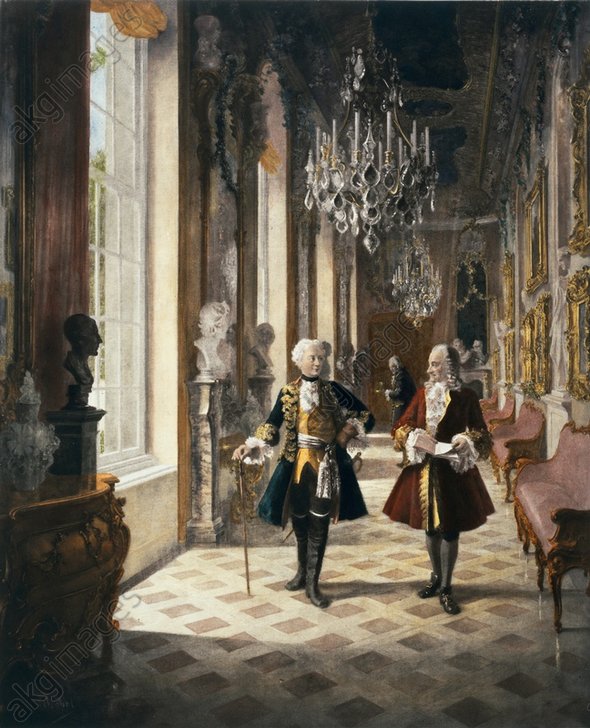
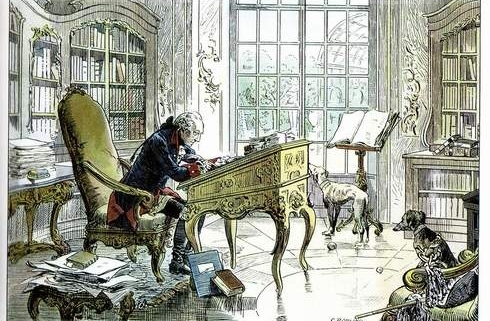
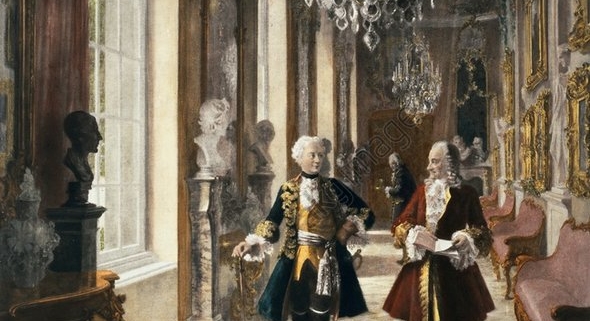
Voltaire at the court of Frederick the Great.

Go to Part 1.

Frederick, Voltaire, and the Jews

Frederick the Great and the famous French philosopher Voltaire had one of the most celebrated relationships between prince and intellectual of the Enlightenment. Indeed, on this rests some of Frederick’s claims to being an “enlightened despot.” Voltaire himself was a vociferous critic of both the Jewish religion and Jews as a people. He wrote in his Philosophical Dictionary: “It is with regret that I speak about the Jews: this nation is, in many respects, the most detestable which has sullied the earth.” Voltaire’s letters to Frederick have numerous critical comments on Jews. For instance, reacting to Catherine II of Russia’s sending a Jew to Egypt to investigate the situation in the country, he said: “The Jews have always loved Egypt, whatever their impertinent story [Exodus] says.”[1] Voltaire appears to have been much more emphatically anti-Semitic than Frederick.

Frederick and Voltaire fell out for various reasons, one of the most important being displeasure over crooked financial dealings between Voltaire and a Jew, Abraham Hirschel. According to Voltaire’s biographer Wayne Andrews:

On November 23, 1750, [Voltaire] called upon Abraham Hirschel, a Jew known for his talent in making money in forbidden transactions, and requested him to buy up for his account in Dresden a certain amount of Saxon bonds. These were then selling at thirty-five per cent below par, but according to a Prussian-Saxon treaty, could be redeemed at par by Prussians. This was such an easy invitation to attack the Saxon treasury that Frederick, on the eighth of May 1748 agreed that the bonds could no longer be imported. Despite this, Voltaire went ahead. Offering a bill of exchange on Paris for forty-thousand francs and a draft on a Berlin Jew for four thousand shillings, he made Hirschel his agent. As agent, Hirschel turned over certain diamonds as security. But then Voltaire saw fit to cancel the bill of exchange that Hirschel cashed, and a nasty quarrel followed with Hirschel demanding the return of his diamonds. Voltaire lost his temper, snatched a ring off Hirschel’s finger, and the affair had to be settled in court. [. . .]

Frederick was not pleased, and the dignity with which he behaved on this occasion was, for once, kingly. He would not allow Voltaire in his presence until the case was settled. He knew that Voltaire was lying when he claimed he had sent Hirschel to Dresden to buy furs and diamonds and was irritated by his language.[2]

Frederick laconically described the affair: “[concerning] Voltaire’s trial with the Jew: it’s a matter of a scoundrel who tried to hoodwink a crook.”[3] This scandal concerning a Jewish financial speculator and a greedy Frenchman contributed to the brevity of Voltaire’s stay in Berlin. Read more

Frederick the Great’s Jewish Policy: Between Containment and Profit, Part 1

Frederick the Great’s Jewish Policy: Between Containment and Profit

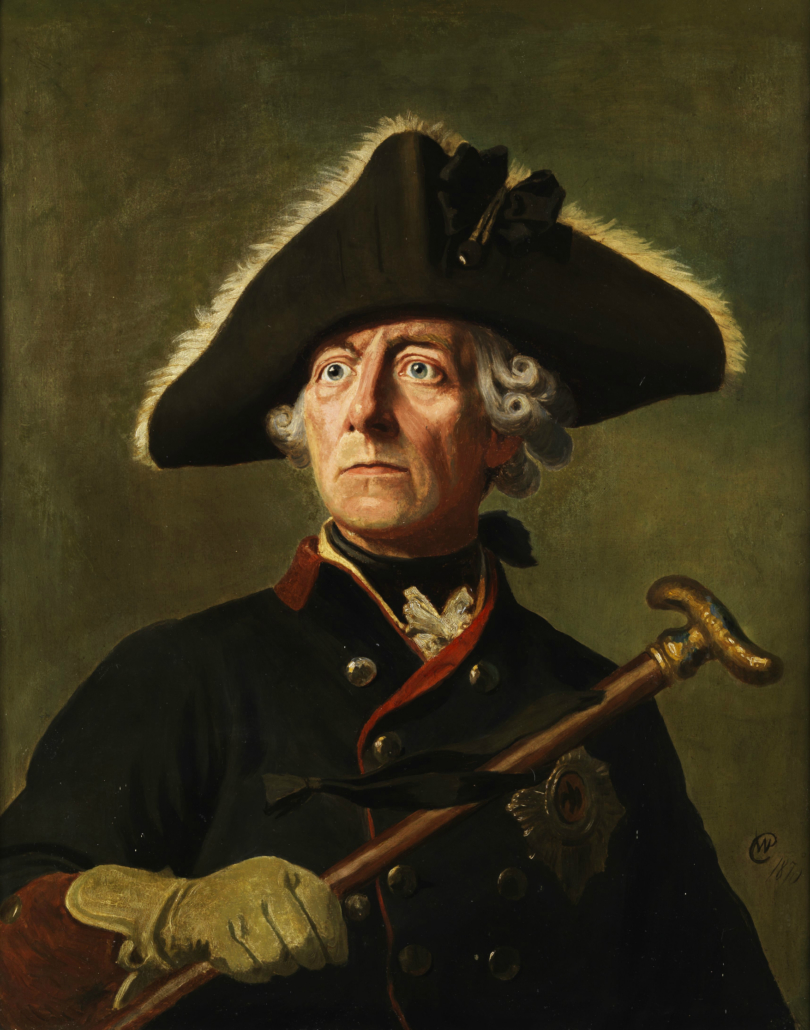
Frederick II of Prussia, known as “the Great,” is one of the celebrated figures in Western history. On the one hand, he was an accomplished statesman and military leader, who through skill and dogged determination in wars with far larger states, doubling the size of his vulnerable and relatively poor north-German realm, turning Prussia into one of Europe’s great powers. But Frederick was also an almost unique example in history of a statesman who was also a genuine intellectual, the paradigmatic “enlightened despot,” who undertook reasonable reforms and could converse with the great minds of his day.

Frederick’s political works are a classic statement of autocratic good government.[1] Certainly, while the republican tradition is in a sense characteristically and almost uniquely Western, we should not forget that for most our history we have been governed by monarchs. Roman emperors and medieval and early-modern kings certainly presided over as many our great achievements as did the Hellenic city-states or the modern republics.

In this article, I would like to detail a little-known aspect of Frederick the Great’s government: Jewish policy. Frederick had inherited somewhat contradictory policies from his forefathers: on the one hand preventing the growth of the Jewish population (notably by limiting the right of residence), for Jews were considered to be involved in illicit trade and would drive Christians out of business, and on the other hand exploiting Jewish business acumen, whether by taxing them, getting loans from them, or using their skills for complex, and sometimes dubious, monetary transactions.

Frederick’s attitude towards this inheritance is of interest because, as monarch of the Enlightenment, he held no religiously-motivated hostility towards the Jews, nor was he affected by the anti-Semitic racial theories which would become popular in the nineteenth century. Instead, the Prussian king’s policies were determined by his classical education, which informed his outlook in general, political pragmatism, and his actual personal experience with Jews.

Frederick essentially upheld his predecessors’ approach, justifying hard-headed population policies limiting Jewish growth by the need to protect the economic balance, mores, and well-being of Prussia as a whole. In this, Frederick’s approach appears reminiscent of the muscular communitarian population policies of Plato and Aristotle, two philosophers whom he had carefully studied. As we shall see, while Frederick maintained and reinforced the policies of his predecessors, he was not able to overcome their contradictory character, paving the way for their dismantlement under his successors. Read more

Man, Beast and Enlightenment: The Special Place of Humans in Nature

It is said that Pythagoras could recognize, by means of certain signs, when the soul of a friend had been reincarnated in an animal. Belief in the transmigration of souls was common in antiquity; even Plato toyed with the notion in the myth of Er. But the Pythagoreans used it to support vegetarianism and even an early form of animal liberation. Here’s a cautionary tale from a likeminded contemporary. A farmer’s son dies and is reincarnated as an animal. The farmer chooses this animal for a sacrifice. The killing makes the farmer a filicide even as he desecrates his offering and angers the gods. Then, in the Greek way, the farmer burns the fat and organs and he and his remaining family eat the meat. Now they are all cannibals. So put down that hamburger, you never know who might be in there.

What interests me about this argument is how it is framed. Ancient philosophers took for granted that men are superior to animals. The discovery that the animal was a friend or relative makes it an exception to that general rule. But the exception comes at the cost of incoherence. It isn’t clear what it means to say that the dead friend and the living animal are the same person, since they share no memories, dispositions or abilities. That’s why it’s so easy to generate absurd counterexamples. If the farmer’s son dies before I repay him the $10 I borrowed, do I owe $10 to the animal? I am persuaded, contra Pythagoras, that a person is his mind (sometimes called his soul) and his body, so if both are different, replaced with those of an animal, there is nothing of the person left over.

If ancient animal liberationists tried to lift a few animals up to the level of human beings, nowadays animal liberationists press for the full admittance of animals to the moral community. The reason for this change in tactics is that between the ancient and the modern world falls the long shadow of the period that named itself “the Enlightenment.” The Enlightenment’s understanding of community is still with us today: a community is a group of equals. A nation-state made up of citizens is such a community of equals, for nobody is more of a citizen than anybody else. Enlightenment ethics mirror Enlightenment politics. The moral community is like a nation state, with each member possessing moral citizenship. What makes one a moral citizen? The Enlightenment and its heirs supplied many answers, from the experience of pleasure and pain (Bentham, Mill) to being an end in oneself (Kant) to having rights (Paine) to having ‘dignity’ (I am sorry to say that the Church is to blame for this last one). That there really is a slippery slope that leads from Enlightenment ethics to animal liberation was never clearer than when Thomas Paine wrote his Rights of Man. The book was followed almost immediately by Mary Wollstonecraft’s Vindication of the Rights of Woman, and then by the anonymous Vindication of the Rights of Brutes. Although the last was satire, all three made the same point: if rights alone make you a ‘citizen’ of the moral community, then we can’t exclude anyone, including animals.

One of the crucial differences between conservatives and reactionaries is that conservatives embrace the Enlightenment picture of the moral and political community of equals. That’s why conservatives invariably lose arguments to animal liberationists. To win, conservatives would need to find a way to exclude animals from moral citizenship. They can only do this if they find a morally significant criterion which makes all humans moral citizens but which not even a single animal possesses. Animal liberationists only need one counterexample to blow the whole thing up.

Every five years or so, some conservative will charge into the argument about the place of animals, confidently waving a new or rediscovered criterion of the moral uniqueness of human beings, and then the game of finding a counterexample begins. Aristotle said that men have reason and animals don’t. Could the criterion be reason? But lots of research shows that some animal species have quite sophisticated reasoning ability. For example, New  Caledonia  crows  are  able  to  develop  a  causal rule that enables them to solve novel problems and learn from watching other birds use tools (here, p. 45).

Read more

American Free Press Interviews Glen Allen On His Lawsuit Against the SPLC

This interview first appeared in American Free Press, April 14,2019.

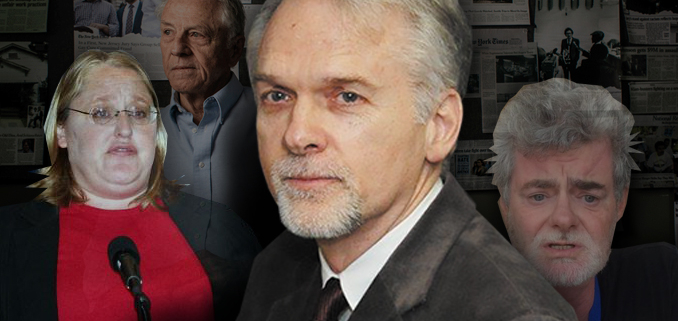
Glen K. Allen, an attorney in Baltimore, Maryland, is the plaintiff in a lawsuit he filed in December 2018 in federal court in Maryland against Heidi Beirich, Mark Potok, and the Southern Poverty Law Center (SPLC). Recently, Allen sat down with AFP to talk about his case as well as free speech in the current political environment in the United States.

* * * * *

AFP: Mr. Allen, could you give us a summary of your lawsuit?

Allen: Sure. In August 2016, Heidi Beirich and the SPLC improperly orchestrated my termination as an attorney for the City of Baltimore, where I was doing competent and ethical work.

The SPLC, in its remarkable arrogance, not only does not deny it did this but has boasted about it on one of its so-called “hate maps,” together, of course, with the most unflattering photo of me it could find. I have brought suit in federal court alleging three federal and six state law claims.

My claims are based on the SPLC’s actions against me but also on its conduct over decades that I contend is inconsistent with its status as a law firm and a purported 501(c)(3) nonprofit dedicated to an educational mission. So, in essence, I’m seeking to redress the harms done to me but also to vindicate basic principles of free expression and the rule of law.

AFP: You mentioned free expression. Did you have an interest in that subject prior to this case?

Allen: Yes, for half a century I have seen our American traditions of free expression and free assembly as unique and fragile and have advocated constant vigilance to preserve them. I have tried to do my part to protect them. Read more

Hyper-Whites with Hyper-Privilege: Jews Are Losing their Status as Persecuted Victims

Jonathan Portes is a Jewish economist and a big fan of mass immigration. In collaboration with the Jewish immigration minister Barbara Roche, he was central to New Labour’s successful conspiracy to open Britain’s borders to Eastern Europe and the Third World. The conspiracy was very bad for Labour’s traditional supporters in the White working-class, but very good for the rich Jewish businessmen who funded Tony Blair and dictated New Labour’s policies.

Inflammatory nonsense

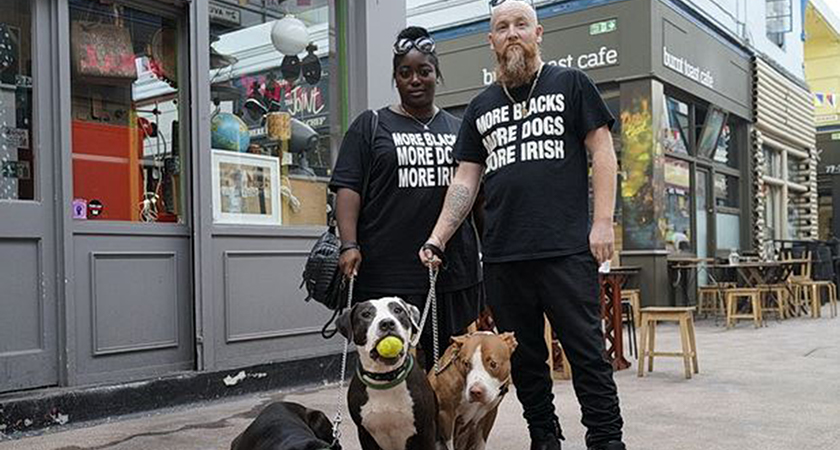
But while Portes (pronounced “Port-iz”) believes in open borders, he also believes in closed mouths. In other words, he’s a big fan of censorship and doesn’t like Whites discussing racial differences and the effects of mass immigration. When the conservative philosopher Roger Scruton was sacked from a government committee for alleged anti-Semitism, Islamophobia and racism, Portes welcomed his departure and condemned him for peddling “inflammatory nonsense,” “tabloid-level ignorance and straightforward falsity.” He then went on to peddle some inflammatory nonsense of his own when he praised the heavily Jewish “Race Relations Act of 1968,” claiming that the Act “outlawed direct discrimination in housing or employment, as exemplified by signs saying ‘No blacks, no dogs, no Irish’.”

“More Blacks, More Dogs, More Irish”: SJWs exploit an urban myth

That’s how hate-filled the White English were in the 1950s and ’60s, you see: when they were offering houses or rooms for rent, they put up signs saying “No blacks, no dogs, no Irish.” Thousands of signs up and down the land. Well, hundreds, anyway. Well, they were a common sight. So common, in fact, that there’s no solid proof that they ever existed. The Irish Studies Centre (ISC) at London Metropolitan University (LMU) has a single photograph of “somewhat uncertain” “provenance” donated in the 1980s. And when the academic Steve Bruce was researching the topic in the 1990s, he “tried without success to find one and had to fake one for a book cover.” Writing in 2015, Bruce issued a “plea to Guardian readers. If ‘No Irish’ signs were as common as is asserted, there should be plenty of them remaining in private collections, local archives and the like. … Can we please see some?” No, we can’t. Instead, we need to have faith. Dr Tony Murray, Director of the ISC at LMU, says that: “Ample evidence exists in numerous oral history interviews with both Caribbean and Irish migrants that such signs existed well into the 60s.” Read more

Jews and the Left by Philip Mendes: Review, Part 3

Go to Part 1.

Go to Part 2.

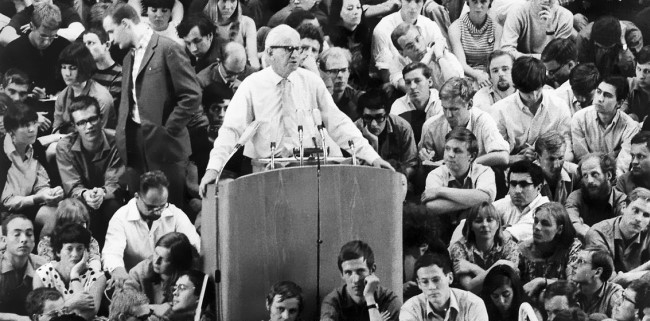
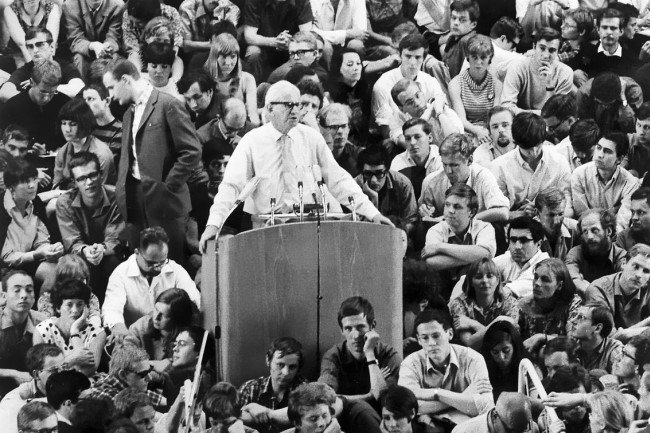
Herbert Marcuse addressing American students in 1968

Jewish involvement in the New Left

In Jews and the Left, Mendes recounts the disproportionate Jewish involvement in the New Left—a political movement that began in the early 1960s when students travelled to the southern states to support the emerging “civil rights” movement. In the mid-1960s, the movement switched to northern campuses to advocate student rights, free speech and opposition to the Vietnam War. This was the time when the ideas of Frankfurt School intellectuals like Erich Fromm and Herbert Marcuse began to displace orthodox Marxism in leftist movements throughout the West. Mendes notes that:

Jews contributed significantly to the theoretical underpinning of the New Left. From 30 to 50 per cent of the founders and editorial boards of such New Left journals as Studies on the Left, New University Thought, and Root and Branch (later Ramparts) were of Jewish origin. Radical academic bodies and think tanks such as the Caucus for a New Politics, the Union of Radical Political Economists and the Institute for Policy Studies were overwhelmingly Jewish. A number of the key intellectual gurus of the New Left such as Paul Goodman, Noam Chomsky, Howard Zinn, and Herbert Marcuse were also Jewish.[i]

The Jews who flooded the ranks of the New Left in the early-to-mid 1960s “appear to have been largely assimilated third-generation Jews from Old Left backgrounds [i.e., “red diaper babies”], although some had participated in Labor Zionist Groups.” Studies of American Jewish New Left activists reveal many had grown up in highly politicized left-wing family environments. Jews made up around two-thirds of the White Freedom Riders who went south in 1961, and about one-third to one-half of committed New Left activists in the USA, including key leaders such as Abbie Hoffmann and Jerry Rubin. In 1964 they represented from one-half to two-thirds of the volunteers who flooded Mississippi to help register black voters. At Berkeley in 1964, around one-third of the leaders of the Free Speech Movement (FSM) demonstrators were Jewish, as were over half of the movement’s steering committee, including Bettina Aptheker, Suzanne Goldberg, Steve Weisman, and Jack Weinberg who coined the famous phrase “You can’t trust anyone over thirty.[ii] Moreover:

In 1965 at the University of Chicago, 45 per cent of the protestors against the university’s collaboration with the Selective Service System were Jews. At Columbia University in 1968 one-third of the protestors were of Jewish origin, and three of the four student demonstrators killed at Kent State in 1970 were Jewish. Jews comprised a large proportion of the leaders and activists within Students for a Democratic Society (SDS). Some of the key leaders included the founder Al Haber, Todd Gitlin and Mark Rudd. Approximately 30 to 50 per cent of the SDS membership in the early–mid 1960s were Jewish.[iii] At one point in the late 1960s, SDS presidents on the campuses of Columbia University, University of California at Berkeley, University of Wisconsin (Madison), North Western University, and Michigan University were all Jews. Jewish participation in SDS was particularly high at Pennsylvania University and the State University of New York. There was also a number of Jews in the violent Weathermen group.[iv]

Read more