Review of Nothing Sacred: The Truth about Judaism
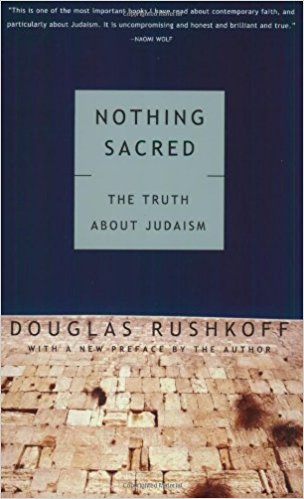
 I had known about Douglas Rushkoff’s treatment of Judaism; Nothing Sacred: The Truth about Judaism, for some time and had always meant to read and review it.[i] A video of Rushkoff discussing his take on Judaism surfaced online discussing the infamous ‘Barbara Spectre moment’ — that is a political gaffe from the tribe’s mouth. We can say these “Spectre moments” are when a Jewish activist candidly discusses Jewish cultural activism on non-Jews and their nations. Here’s Rushkoff’s Barbara Spectre Moment:
The thing that makes Judaism dangerous to everybody, to every race, to every nation, to every idea, is that we smash things that aren’t true, we don’t believe in the boundaries of nation-state, we don’t believe in the ideas of these individual gods that protect individual groups of people; these are all artificial constructions and Judaism really teaches us how to see that.
In a sense our detractors have us right, in that we are a corrosive force, we’re breaking down the false gods of all nations and all people because they’re not real and that’s very upsetting to people.”
The central reason Jews like Rushkoff and Barbara Spectre allow themselves to speak candidly about Jewish social engineering is because they believe that by manipulating predominantly non-Jewish societies they are doing the world a service — they are in fact doing God’s work. By undermining their host nations so as to bring about conditions of disunity, Jews like Rushkoff and Spectre believe that in performing this role of “a corrosive force” “breaking down the false gods of all nations and all people,” they are performing a mitzvah as part of their god-ordained task of tikkun olam. A mitzvah is translated as a ‘commandment’ but more commonly means a good deed done from religious duty. Rushkoff describes tikkun olam as “a poetic way of expressing the responsibility Jews have to ‘heal the earth.’[ii] In my two part essay on integration, “Manspreading for Lebestrum,” I discuss the HBO series Show me a Hero, based on a book by Jewish New York Times writer Lisa Belkin about the integration struggle in Yonkers between the NAACP and their Jewish lawyers versus the ethnic Whites of Yonkers. Again we discern the same underlying self-justification:
Belkin seeks to frame the issue of integration in terms of a progressive Jewish solution to the Jewish problem, while fully retaining her Jewishness. When asked about the overtly Jewish role in integration, Belkin neither denies nor downplays the Jewish role. Instead she invokes the Jewish religious principle of Tiklun Olam, a Hebrew phrase meaning ‘repairing the world.’ Tiklun Olam, was described by Rabbi Samson Raphael Hirsch in terms of a Kehilla (community) of Jews in galut (diaspora) successfully influencing their non-Jewish neighbors.”[iii]

 In January, I wrote about E. Michael Jones and his book on usury, Barren Metal (