Huddersfield Horrorshow: Another Non-White Rape-Gang in Brave New Britain
Like Friedrich Nietzsche, George Orwell is often and unfairly thought to have no sense of humour. But there’s a lot of humour amid the horror of Nineteen Eighty-Four (1949). Take the scene in which a group of workers at the Ministry of Truth conduct a “Two Minutes Hate” against thought-crime and then worship Big Brother with “a deep, slow, rhythmical chant of ‘B-B!… B-B!’ — over and over again, very slowly, with a long pause between the first ‘B’ and the second.”
The Ministry of Mendacity
Does the juxtaposition of “B-B” with “Ministry of Truth” remind you of anything? It should, because Orwell was satirizing the B.B.C., where he worked on propaganda for part of the Second World War. In Orwell’s novel, the Ministry of Truth was dedicated to lying and to the suppression of inconvenient reality. That’s why it was full of memory holes, “large oblong slits protected by wire grating” that “existed in thousands or tens of thousands throughout the building, not only in every room but at short intervals in every corridor.” Memory holes exist to destroy memory, not preserve it, as the novel’s hero, Winston Smith, sees in a torture-chamber at the Ministry of Love. His torturer O’Brien shows him a photograph proving the evil and corruption of the governing ideology:
“It exists!” he cried.
“No,” said O’Brien.
He stepped across the room. There was a memory hole in the opposite wall. O’Brien lifted the grating. Unseen, the frail slip of paper was whirling away on the current of warm air; it was vanishing in a flash of flame. O’Brien turned away from the wall.
“Ashes,” he said. “Not even identifiable ashes. Dust. It does not exist. It never existed.”
“But it did exist! It does exist! It exists in memory. I remember it. You remember it.”
“I do not remember it,” said O’Brien. (Op. cit., Part 3, ch. 2)
That’s how the BBC really behaves in the twenty-first century. When reporting restrictions were lifted at the end of Britain’s latest vibrant rape-gang trial, the BBC held the story up briefly before the eyes of the British public, just as O’Brien held a truthful photograph up before the eyes of Winston Smith. Then the BBC imitated O’Brien and dropped the story down the memory hole: in a day, it had vanished from news-bulletins. As far as the BBC is now concerned: “It does not exist. It never existed.”
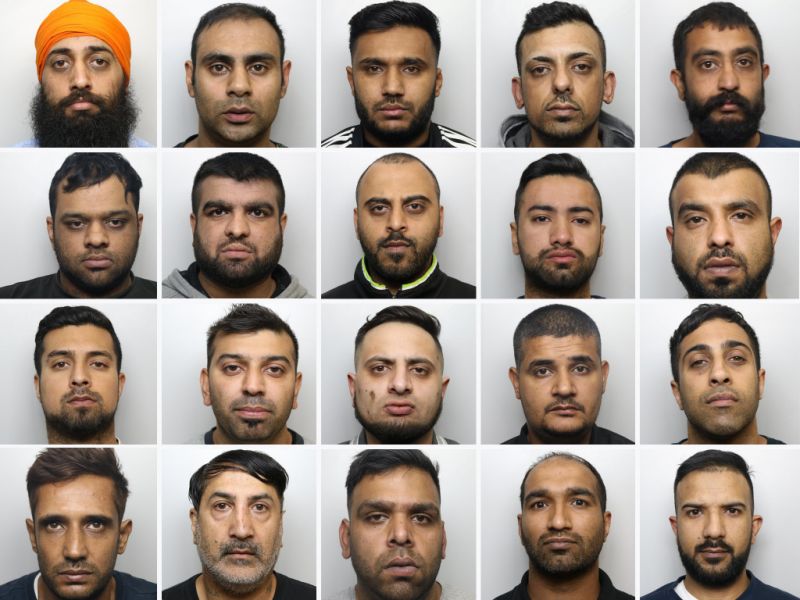
A few of the vibrant rapists behind the Huddersfield Horrorshow