Featured Articles

Bitter Harvest: A Brilliant Film on the Ukrainian Holodomor

“This particular film was extremely important to me, and it felt almost like a mission. I wanted to bring knowledge about the famine genocide, the Holodomor, to the Western world, and that’s why I did it.”
        Ian Ihnatowycz, Bitter Harvest Producer
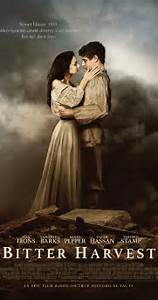
Bitter Harvest (2017) is a film inspired by the love and rediscovery of the writer Richard Bachynsky Hoover’s ethnic heritage. On a trip to the homeland of his Slavic ancestors he began to ruminate on how to capture the story of the Holodomor on film. With small acting parts in a variety of television series Bachynsky Hoover was learning the ropes of the film and entertainment industry. He went again to Kiev, investigating his family history. It was 2004 and the Orange Revolution was in full swing — he saw firsthand a Ukraine in the midst of upheaval. He learned that Western audiences had never seen the Holodomor dramatized on film — a dramatically different situation compared to that other genocide that has become a touchstone of Western Civilization and both a sword and a shield for Jewish and Israeli interests through endless promotion in the media.  In 2008 he would return with a script, seeking financing for an English language period piece set during the Holodomor. He met with officials from the Ukrainian Government as well as various oligarchs. All of them turned him down. It was not until 2011 that the dream to make his movie finally caught a glimmer of hope when fellow Ukrainian Canadian investor Ian Ihnatowycz committed $21 million to the film.

British actors Max Irons and Samantha Barks star as Yuri and Natalka, two childhood sweethearts from the same village. They marry young and soon their lives are thrown into the whirlwind of revolution and resistance that comes with annexation of the Ukraine by the Soviet Union and eventual famine by way of grain confiscation. Barry Pepper and Terence Stamp are crucial to the supporting cast as Yuri’s family. Pepper sports the classic Cossack khokol (also called oseledets in the Ukraine) haircut — a long lock of hair on the top or front of an otherwise completely shaven head. Tamer Hassan, an English actor of Turkish Cypriot descent, takes the role of the real life villain Sergei, a Soviet officer who enforced Stalin’s will with relentless brutality. Hassan is the only non-White cast member, and may in fact be the only non-White member of the film crew. With the exception of a few stunts the entirety of the film was shot in Ukraine with Ukrainian extras and crew — some of whom took part in the Euromaidan protests during their off hours while shooting from late 2013 to early 2014. In several interviews and promotional appearances for the film much of the cast — but most significantly Max Irons — expressed a slight sense of shame over their prior ignorance of the Holodomor and the need to raise awareness of this historical tragedy. Read more

Lessons from Trump’s Condolence Call: It’s All About Race Now

The acrimony surrounding Trump’s call to the Black widow of soldier Sgt. La David T. Johnson killed in Niger demonstrates many truisms about race relations in a society dedicated to multiculturalism and leftist identity politics.  Trump, along with regular Americans, would be well advised to take note.

I’ll take it for granted that readers will share my assumption that Trump did not call the widow Myeshia Johnson in order to somehow provoke her.  What he didn’t realize is just how easily such unintended provocations may occur in multicultural contexts, in particular when the White-Black dynamic is at play.

President Trump was quoted in the press, as reported by (Black activist) Rep. Frederica Wilson who was listening in on the call, as telling the widow heartlessly, “You know, he must’ve known what he signed up for.”  This has been taken out of context as to be a kind of taunt to the widow rather than simply reflecting on the natural role of a soldier.  Left out was the second clause of the sentence: “but it still hurts”

What can we learn from this whole affair? Read more

Harvey Weinstein: Revenge and Domination as Jewish Motives

Edmund Connelly’s article on Harvey Weinstein and the shiksa phenomenon discusses revenge as a motive. From this perspective, what Jews like Weinstein are doing is the result of hatred toward the goyim because of their perceptions of the long history of anti-Semitism. Of course much of this narrative is false and exaggerated, but the point is that this “lachrymose” version of Jewish history is entirely mainstream among Jews and a cornerstone of Jewish education and Jewish self-conception.

Revenge is important — even critical — in understanding the main currents of Jewish behavior. However, several of the passages from Portnoy‘s Complaint seem to be much more about dominance and sexual competition than revenge. This suggests that another way to look at shiksa lust is from the perspective of evolutionary psychology which suggests that a central motive is domination over the women of the outgroup. In the competition for dominance among males, females are the ultimate prize. Recall that a constant theme of human history is that women are the spoils of war. Conquering males seize the women of their defeated foes — the Mongol harems throughout Asia come to mind, as well as the behavior of our Indo-European forebears. Read more

Harvey Weinstein: On Jews and the Shiksa

Harvey Weinstein with Hollywood prostitutes

Let me cut right to the chase: The title for this essay should really be “The Specifically Jewy Perviness of Harvey Weinstein,” which, as luck would have it, is in fact the title of a short entry by Jewish writer Max Oppenheimer in the very Jewish magazine Tablet. This Jewish writer opines that “Harvey, sadly, is a deeply Jewish kind of pervert.”

Okay, I’m good with that. It fits the facts.

What is this “perversion”?  Well, Herr Oppenheimer kindly explains how it is common for Jewish men to lust after women with a “non-Jewish origin,” or, to be more specific, White non-Jewish women. As Oppenheimer writes about the targets of Weinstein’s lust, “It goes without saying that nearly every one of these women — Rose McGowan, Ambra Batillana, Laura Madden, Ashley Judd, etc. — was a Gentile, all the better to feed Weinstein’s revenge-tinged fantasy . . .”

Now what’s all this talk about revenge?  And what does that have to do with non-Jewish women? To unpack all of this, I’m going to have to go back in literary history to a Jewish American writer few of my readers under age forty (or fifty?) will even know: Philip Roth.

Needless to say, Oppenheimer knows this history, which is why he employs the following subtitle to his piece:  “The disgraced film producer is a character straight out of Philip Roth, playing out his revenge fantasies on the Goyim.” Before visiting what Roth has written, however, I must offer a brief description of the word “shiksa” and its manifestation in American film. Read more

Academic Censorship and Self–Censorship: Once upon a Time in the Land of the Free 

This is a short address given at the dinner, sponsored by the Propertarian Institute in NY, on September 26, after the earlier round table held at the New York University.

Allow me to say a few words about the media witch-hunt targeting now non-conformist intellectuals, including some of our friends here. Firstly, however, let me extend my greetings on behalf of our small party, the American Freedom Party, our Chairman Mr. William Johnson, and our colleagues who also helped organizing our round table.

Let me illustrate this new media witch-hunt in the West by drawing parallels with the former communist East. One of the big advantages of living in communism was the ability of its citizens to grasp quickly the main notion of the political: who is the foe and who is the friend. Even a simple citizen in the Soviet Union, or in the ex-communist Eastern Europe, knew very well that communism was a fraud. The official communist narrative about the upcoming paradise on earth sounded so surreal that it could not be taken seriously by anybody, including communist party bosses. By contrast, in the modern liberal West, and particularly in the US, the ruling class, but also a large number of citizens and academics, do believe in the same crypto-communist message, albeit wrapped up in different words and decorated with a different insignia. The imagery of the former muscled proletarian in Eastern Europe, carrying the hammer and the sickle, has been now replaced by a starving African or a Middle Eastern refugee and for good measure by a tolerance preaching homosexual, designed to induce lachrymose and self-denying feelings among their guilt-ridden White hosts. The repression of non-conformists and dissidents in the West is far more insidious than the repression in the former communist East. It is more subtle, less violent and its jargon, diffused in the mainstream media, academia and among politicians, is less polemical. Moreover, it doesn’t leave martyr’s blood behind — for the time being at least.

It is fundamentally wrong to study communism as an ideology only. Communism is first and foremost an anthropology which is nearest and dearest to the masses regardless of is dreadful consequences. Communism represents the true state of nature, ideal for mass multiracial and stateless societies of people with mediocre intelligence facing diminishing materiel resources and vanishing opportunities. The question arises: Why did then Communism fall part in the late 80s in Eastern Europe? Communism fell apart in the East because its much vaunted goals had already been better implemented in the West:  the welfare state, steady economic growth, and ethnic and racial quota system, known in the USA as “affirmative action.” All those big buzzwords, now legally taken for granted by many US citizens, were tested unsuccessfully in the ex-communist East. Also shut-up and criminalizing words like “Nazi,” “Fascist,” “ racist,” “anti- Semite,” which are now very popular in the American mainstream media and colleges, especially when smearing political opponents, were thrown around in the communist East on a daily basis against any potential trouble maker or a dissident.

It is wrong, however, to assume that citizens in former communist Eastern Europe were all starving for Western freedom, all of being ready to overthrow the communist system. Only a few did. It is also wrong to think that anticommunist dissidents were respected species enjoying mass popular support. They were shunned like a plague even by their family members. We can observe the same type of ostracism and self-censorship  among prominent White academics in the USA, not just on the official state level, but also within their own family and  at their work place.

Although being a frugal and violent system communism in Eastern Europe did offer citizens psychological security and economic predictability which citizen in the USA could have only dreamed about. What most citizens in the communist system craved for were mostly Western commodities and Western standard of living. Those individuals who were a threat to the fake and fragile consensus between the communist rulers and the communized ruled were generally despised and demonized as terrorists.

Where do we go from here? Our future actions will depend on a specific local circumstance. By now, however, we have at least the privilege of being able to decipher our main enemy. It is useless and counterproductive to point fingers at them and call their names. Instead, one must raise a very simple question in order to elicit a very simple answer. Who are the people who benefit most from the overuse of criminalizing words “racists,” “white supremacists” and “anti-Semites”? It is not difficult to make them out.  We know them well. Thanks for your attention.

Homage To The Post-First World: My Wanderings in Europe, Part 2

Budapest — Pest side, Hungary

I was walking with the nice Bulgarian girl I had met the day before.

We stepped over puddles and little rivers of piss. You try not to, but you can’t help but notice that the Pest side of the city smells like a giant urinal after 6 pm.  And it was gypsy Christmas the day before. Hungarians tossed all their unwanted junk into the streets and hordes of gypsies rummaged through the scrap, claiming what they wanted. Some of the gypsy men had bats to guard their junk. I learned that Gypsy law states that anything on the street automatically belongs to them, and they enforce that law.

All the junk still hadn’t been cleared yet, although we try not to pay attention to it and we laugh it off as best we can. We have already gotten used to the beggars and bums nestled in the doorways, under the scaffolding and on the corners of the streets. We block them out of our vision as well.

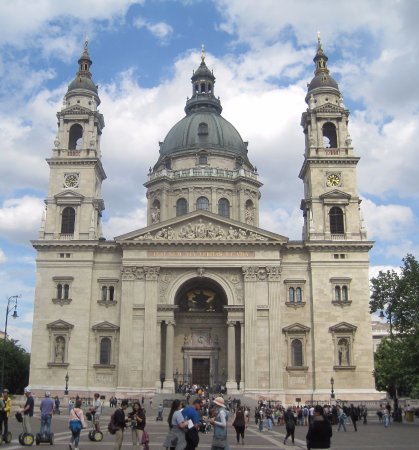
And then we reach the square in front of the famous Saint Stephen’s cathedral. There is a wine degustation going on that night, and there was one pretty much every night that week. It is picturesque and romantic.

Christmas lights suspended above, benches with White, soft and jolly Europeans in the middle.

Read more

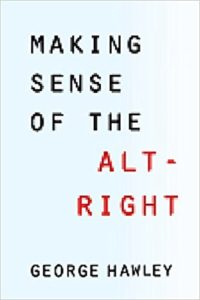
He Doth Opine: A Review of Making Sense of The Alt-Right by George Hawley

Making Sense of The Alt-Right
George Hawley
New York: Columbia University Press, 2017, 218 pp.

With any book, it helps to take into account who wrote it and who published it.   George Hawley is an assistant professor of political science at the University of Alabama.   Assistant professor is the lowest professor rank.   Hawley’s a young faculty member, in his early thirties by the looks of his picture with his young child on his website — just starting his academic career, or so he hopes. Assistant professor is probationary status.  At the end of six years typically, you are checked out by senior faculty and administrators and if you pass muster, you get promoted to associate professor and granted permanent status, or tenure, at the university.  If you don’t get tenured, it’s the help wanted ads over breakfast, so the stakes are extremely high for young Hawley.  (With tenure, there’s just one more promotion, and it can be anytime, or never, to full professor.)   A must for getting tenure is a good publication record — publish or perish is real — which means Hawley had to give the editors at Columbia University Press what they wanted or he was dead in the water.

All to say, don’t expect an assistant professor to take intellectual or professional risks—such as running up against the PC doctrine of today’s universities and academic presses; or to go much, if at all, beyond the boundaries of his (or, of course, her) academic discipline, political science in this case — integrating, say, history, philosophy, psychology, and/or literature into his considerations; or to produce mature scholarship so early in his career.  Do expect diligence, however—nobody works harder than an assistant professor.

In sum, I got what I expected from this book.  That means a 4, perhaps 5, on a 10 scale—not bad, but it could have been a lot better.   That acknowledged, this book was worth my time—in fact, I read it in a single setting.  Professor Hawley thinks clearly enough (for this stage of his working life), he writes reasonably well, and he obviously devoted much time and effort to this project.  I profited from his descriptions of what’s going on with the internet (the Alt-Right, he reports, is largely an internet phenomenon, much of it anonymous), about which I am clueless.   I also found helpful the distinction he draws between the Alt-Right and the “Alt-Lite.” Alt-Lites he mentions include Milo Yiannopoulos, Mike Cernovich, Joseph Paul Watson, and the only two women in the book, Ann Coulter and Laura Southern.    No Alt-Right women, such as Lana Lokteff of Red Ice Radio, in this presentation.   The quotes in the book from Hawley’s interviews, including those with Richard Spencer,  were very good, though you couldn’t prove it by me that he took in and worked with what these people actually said. Read more