Featured Articles

US Media, Churchill, and the end of free Britain: Churchill set a bad example

Last Friday, August 8, two prominent US Media outlets coincidently carried articles vividly demonstrating the sorry state of the United Kingdom and of the country’s historiography.

The Neocon-controlled Wall Street Journal wheeled out prominent British historian Andrew Roberts to launch Why the Far Right Hates Churchill.

From its position high up the Right food chain, ZeroHedge posted Why Britain Arrests 30 People Every Day For Speech by Taylor Durden.

The WSJ piece, unusually, was posted outside the Paper’s paywall. The Drudge Report, now of course a news aggregator for Establishment Democrats, linked to the essay for an unusually long time. This was a smear which important elements wished to propagate.

The WSJ/Andrews essay is simply an attempt to utilize the widely-revered Churchill legend to shut down consideration of the wisdom of British WWII policy, and by extension the foreign policy of today. Andrews says

“Today’s revisionists project their views about Iraq, Afghanistan and now Iran backward through history and denounce the leading global interventionists of yesteryear.”

The reciprocal of this is equally true.

Andrews intones:

Churchill …stands watching over a world order that is now challenged by, among other things, a populist far right whose influence is spreading dangerously.

His position seems to be that the catastrophic and ongoing damage done to the UK by WWII (which he never mentions) is of no consequence compared to the achievement of destroying the Third Reich.

An American NeoConservative could understandably take this view. But Roberts is an Englishman still living there.

The ZeroHedge piece is an annotated reprint complete (with video) of an essay of the same title at Modernity News. It is a current account of the astonishing eradication of free speech underway in Britain, for centuries renowned for not repressing opinion.

Apart from supplying the startling ‘Arrests 30 people everyday’ headline the interviewee, founder of the UK’s Free Speech Union Lord Young of Acton

…warns of broader threats to free expression…including a quarter-million non-crime hate incidents recorded…often for online posts challenging government narratives on immigration

In the opening minutes of the video, Young directly says he expects further tightening and from 8:00 explains how free speech protections in the legislation have been circumvented.

The sick truth is that Britain’s “Conservative” Party is equally responsible for this murderous attack on British historic rights. I discussed this in UK: Totalitarian Night Descending. Social liberals have been in control of the Tories for over two generations.

In his 1995 book Alien Nation Peter Brimelow wrote

There is a sense in which current immigration policy is Adolf Hitler’s posthumous revenge on America. The U.S. political elite emerged from the war passionately concerned to cleanse itself from all taints of racism or xenophobia. Eventually, it enacted the epochal Immigration of 1965

This also applies to the UK – Tony Blair actually confirmed this in his 2010 autobiography. And of course it applies to matters of Race generally. WWII poisoned public discourse, as Diana West has persuasively argued.

But it was not necessary to wait so long to realize that WWII was an unparalleled catastrophe for Britain. The Americans plundered all her huge foreign assets and drove her deeply into debt. (Unlike the aid to the USSR, Lend-Lease to Britain was not a gift.) The Soviet Union had seized half of Europe and very likely would have taken the rest had it not been for the Atomic bomb. That was just an unproven dream when the key war decisions were made in 1939–40. To control the always treasonous impulses of the Left, Churchill during the war handed control of domestic policy to the Labour Party. Fortified by this, Labour held power from 1945–51.

As a result, Britain was forced into a socialist straight jacket which crippled the economy until the Thatcher years in the 1980s. And of course, Labour eagerly set about destroying the British Empire.

I do not blame Churchill for the British decision to go to war in 1939. He was not in Government, and although he was a major leader of anti-German opinion, it was clearly the consensus of British elite opinion that Hitler had become an insufferable nuisance.

But I do hold him responsible for the decision to fight on after the Fall of France in 1940.

By this time the British had fought literally scores of wars, by no means all of them victorious. They were experts at shutting wars down. When Churchill engineered the decision to fight on (and subsequently ignored all peace feelers) he was defying a central characteristic of British statecraft.

I have discussed this situation at length in Why Did Churchill Have Britain Fight On After Summer 1940? It’s Bad News. Not only was this action contradictory to British traditions, but it is anomalous set against his own record of longsighted sagacity both before and after WWII. (His Iron Curtain Speech of March 5, 1946, was disavowed by the Truman Administration; He tried hard in 1954 to get his “Conservative” Cabinet to curtail colored immigration into Britain.)

Clearly Churchill enjoyed leading the Country in war. But the frightful experience of the early ‘40s should have satiated anyone let alone a Statesman thinking about the future.

I am afraid the answer is that apparently first discovered by the ultra-taboo historian David Irving. (On David Irving as an Historian, I commend Ron Unz’ definitive exculpation: The Pyrrhic Attack on David Irving). The fact is that from March 1938 Churchill was completely dependent financially on one Sir Henry Strakosch. Having bailed him out from the consequences of the American stock market collapse of 1937-8 with a vague but substantial soft loan arrangement, Strakosch made another smaller payment in June 1940, after Churchill had become Prime Minister on May 10.

In his extraordinary 2015 book No More Champagne: Churchill and His Money which draws on Churchill’s actual financial records, author David Lough drily comments of the 1940 transaction:

The amount reached Churchill’s account on 21 June. Thus fortified, he paid a clutch of overdue bills from shirt-makers, watch repairers and wine merchants before he turned his attention back to the war.

Both payments rescued Churchill from insolvency. A Bankrupt cannot be a Member of the UK Parliament.

Who was Sir Henry Strakosch? He was a Jew, born in the Austrian-Hungarian Empire, who migrated to England in 1891 and thence to South Africa. There he made a fortune promoting gold mines. He became a British citizen in 1907 and was knighted in 1921. He spent the interwar years in London, interesting himself discreetly in public affairs.

Henry Strakosch - Alchetron, The Free Social Encyclopedia

From the early 1930s he was supplying Churchill with information on the German military buildup, about which he was presciently concerned.

The plain and ugly fact is that when in summer 1940 Churchill was facing the most momentous decision in modern British history, an anti-Hitler partisan had him by the financial throat.

Since David Irving discovered this story, most biographers of Churchill have simply briefly mentioned the 1938 transaction without analysis or comment.

But Andrew Roberts in his 1,152 page 2018 book Churchill: Walking with Destiny handled this awkward matter differently. He made no mention of Strakosch at all, except for one from October 1943, This however is extremely significant.

Roberts quotes from the diary of Churchill’s long time private secretary saying Churchill was exuberant the day after Sir Henry died, telling her the Strakosch Will expunged the Churchill debt and additionally left him a similar sum.

This means that more than 4 years into the war, Churchill had still been apprehensive about the hold Strakosch had on him.

On reflection, it is quite appropriate that the Wall Street Journal should mobilize the Churchill name to delude the peasantry.

After all, it is clear to those who pay attention that the US foreign and immigration policies of recent decades which the WSJ has supported have also been maintained by (much more massive) bribery.

From Patrick Cleburne’s Substack: US Media, Churchill, and the end of free Britain. Posted with permission.

Manufactured Martyrs: A Survey of Self-Slain Blacks and Anti-White Subversion in Scotland

Sanguis martyrum semen ecclesiae — “the blood of martyrs is the seed of the church.”[1] It’s an ancient Christian principle embodying some potent psychological and cratological truths. Those who suffer and die for an ideology thereby inspire and invigorate their fellow believers. By honoring and celebrating the martyrs, the believers indirectly honor and celebrate themselves. They increase their own solidarity against a shared enemy, strengthen their own courage and will-to-power, assure themselves of the rightness and righteousness of their cause.

Bashed bacteria bounce back

In short, ideologies that embrace martyrdom are harnessing the power of antifragility. This is a phenomenon identified and named by the Lebanese-Christian statistician Nassim Taleb. When an ideology or entity is antifragile, it benefits from being attacked and from experiencing adversity. Fragile things break under pressure; antifragile things get stronger. You can see antifragility in action everywhere from Christianity to botany to microbiology. When pagans persecuted Christians, they got more Christians. When gardeners dig up Japanese knotweed, they get more Japanese knotweed. When doctors attack bacteria with antibiotics, they get superbugs. The details differ, but the principle is the same: “Attack us and we get stronger.” That’s why Christianity and other religions have martyr-cults: they’re harnessing the power of antifragility. Indeed, martyrdom is so potent as an institutional fertilizer that a sub-principle applies: if martyrs don’t exist, it’s necessary to invent them (the same applies to hate-hoaxes).

Two thuggish Black criminals, two manufactured martyrs: George Floyd and Sheku Bayoh
You can see martyrs being manufactured in that perversion of Christianity known as leftism. In America, leftists made martyrs of Trayvon Martin and Michael Brown, two thuggish Black criminals who self-slew by behaving badly. But those martyr-cults were only moderately successful, so leftists kept trying. They hit the big time with the martyr-cult of George Floyd, another thuggish Black criminal who self-slew by behaving badly. The martyr Floyd was the institutional fertilizer for Black Lives Matter (BLM), which oversaw riots and destruction not just in America but around the world. It’s interesting and instructive to compare the leftist martyr George Floyd with the Christian martyr St Stephen. Indeed, St Stephen was the protomartyr of the Faith, the first of his holy kind and the model for all who followed him.

Loving and loathing

In both cults there is an in-group and an out-group, the righteous Godly group that supplied the martyr and the unrighteous, un-Godly group that killed him. In Floyd’s case the righteous in-group was Blacks and the wicked out-group was Whites. In Stephen’s case the righteous in-group was Christians and the wicked out-group was Jews. But Stephen died forgiving his killers, praying for his enemies. As the New Testament puts it: “he kneeled down, and cried with a loud voice, Lord, lay not this sin to their charge. And when he had said this, he fell asleep” (Acts 7:60). In Christianity, martyrdom is meant to inspire love; in leftism, martyrdom is meant to inspire loathing. The martyr-cult of George Floyd was also a murder-cult directed at Whites. And a looting-cult, an arson-cult directed at White property. In Christianity, martyrs inspire righteousness; in leftism, martyrs inspire riots.[2]

And in one sense the martyr-cult of George Floyd is wholly unnatural. In another, it’s as natural as the birds and the bees. Why should a majority-White society create and host a martyr-cult that elevates the Black minority and excoriates the White majority? A martyr-cult that insists on the saintliness of Blacks and the wickedness of Whites? Well, I think it’s an example of the parasitic subversion often seen in nature. Smaller and weaker parasites can manipulate their hosts into behavior that harms the host and benefits the parasite. With birds, you’ve got cuckoos. With bumblebees you’ve got cuckoo bumblebees, which behave in a similar way. With rats, you’ve Toxoplasma gondii, a microscopic and mindless organism that subverts the brain of its highly intelligent mammalian host. Healthy rats flee cats, as you would expect. Rats infected with toxoplasma are attracted to cats, who are the next stage in the life-cycle of toxoplasma. The infected rats aren’t paradoxically suicidal; they’re parasitically subverted. And I think there are clear parallels with the self-destructive behavior of White societies that elevate non-White minorities and excoriate the White majority.

Based on a giant lie

I further think that Jews, those aces of antifragility,[3] have played a necessary (but not sufficient) role in this parasitic subversion of White societies. As Kevin MacDonald has documented, the National Association for the Advancement of Colored People (NAACP) in America was run and funded not by Blacks, but by Jews. In the UK, the anti-racist Runnymede Trust was founded by two Jewish lawyers, Anthony Lester and Jim Rose, to attack Whites and promote mass immigration from the Third World. Lester himself hailed the inspiration of “the ‘Long Hot Summer’ of civil rights action in the American South” during the 1960s. In other words, parasitic subversion in America inspired parasitic subversion in Britain. That pattern has continued. Some of the riots inspired by the martyr George Floyd took place in Britain, which already had its own well-established martyr-cult celebrating a saintly Black who died at the hands of evil Whites.

For once the martyred Black wasn’t a criminal and hadn’t brought about his own death by his own bad behavior. No, Stephen Lawrence was a genuinely innocent victim of genuinely criminal Whites—so, like St. Stephen, he was an ideal martyr. But Lawrence might easily have survived his chance encounter with those Whites and was always at much greater risk of murder by his fellow Blacks. And guess what? A Jewish “anti-racist” called Dr Richard Stone was instrumental in creating and sustaining the martyr-cult of Stephen Lawrence. As with George Floyd, the cult is based on a giant lie: that violent, hate-filled Whites are an omnipresent threat to the lives and well-being of gentle, enriching non-Whites. In fact, far more Whites are killed in far worse ways by non-Whites in the ethnically enriched West. But there is no martyr-cult for the White couple Channon Christian and Christopher Newsom, horrifically raped, tortured and murdered by Blacks in America. And no martyr-cult for the White schoolgirl Mary-Ann Leneghan, horrifically raped, tortured and murdered by Blacks in England.

Another thuggish Black criminal

There is also no martyr-cult for the White schoolboy Kriss Donald, horrifically tortured and murdered by Pakistanis in Scotland. But leftists in Scotland have striven mightily to create a martyr-cult for a dead Black. And this Black followed the typical pattern of leftist ethno-martyrs: he brought about his own death by bad behavior and stupid decisions. The truth is apparent even in the article about him at highly leftist Wikipedia:

On the morning of 3 May 2015, [Sheku] Bayoh visited a friend’s house to watch TV. His friends noticed he was acting out of character after he took a cocktail of drugs including MDMA and Flakka. He left their property and went home. After he returned home, a fight broke out between Bayoh and his friend, Zahid Saeed. Zahid fled and Bayoh then took a large kitchen knife and left his house. Concerned neighbours called emergency services to report a man with a knife acting erratically, chasing cars and trying to get into cars. Police were dispatched. After six Police Scotland constables arrived at the scene, Bayoh refused to listen to instructions and began to walk away ignoring police commands. He then turned on PC Nicole Short, chasing her, punching her to the back of the head as she ran away, knocking her to the ground, where he thereafter stamped and kicked at her torso while she lay unconscious in the middle of Hayfield Road. Officers rugby-tackled Bayoh after he failed to respond to baton strikes during his attack on PC Short. Bayoh continued to fight and resist arrest and a short time later lost consciousness. Officers immediately commenced CPR and requested an ambulance. He was pronounced dead in hospital. A post-mortem report revealed injuries to Bayoh’s head and face, burst blood eye vessels (consistent with positional asphyxiation), bruising across his body, a fractured rib, and the presence of the street drugs MDMA and Flakka. His cause of death was recorded as “sudden death in a man intoxicated … [drugs] whilst under restraint”. (“Death of Sheku Bayoh,” Wikipedia)

Like George Floyd, Sheku Bayoh took drugs, committed crime, and was accidentally killed by police. And as with George Floyd, the left reacted to Bayoh’s death not by urging Blacks to behave better but by maligning the police for failing to preserve a Black criminal from the consequences of his own bad behavior. The result of such leftist agitation is that police become reluctant to confront Black criminality and Blacks are emboldened to commit more and worse crime, including especially against other Blacks. In other words, more Blacks die because leftists posture about their concern for keeping Blacks alive.

Leftists have performed the same malignant trick with other non-White groups. In the Scottish city of Glasgow, for example, the leftist police refused to take tough action against Pakistani criminals, who were therefore emboldened to commit more and worse crime. This culminated in one of the worst murders ever committed on British soil: the kidnapping, stabbing and incineration of the fifteen-year-old White schoolboy Kriss Donald by a sadistic Pakistani gang. But despite the direct culpability of the police in that murder, there has never been a public inquiry into their conduct. After all, such an inquiry would undermine rather than promote what really matters: the power and prestige of anti-White leftism.

No guesses needed

In short, leftists did not demand or conduct a public inquiry when the police were plainly to blame for the death of the innocent White schoolboy Kriss Donald. So what did leftists do when the police were not at all to blame for the death of the thuggish Black adult Sheku Bayoh? You won’t need any guesses. As that Wikipedia article goes on to state, a “public inquiry” into the self-inflicted death of Sheku Bayoh was announced in November 2019 by the anti-White politician Humza Yousaf. More than five years later, the inquiry is still running. But Wikipedia does not reveal the eyewatering cost to White taxpayers in Scotland: “The inquiry has so far cost £24.8m, with an additional £24.3m spent by Police Scotland, including £17.3m of legal costs.”

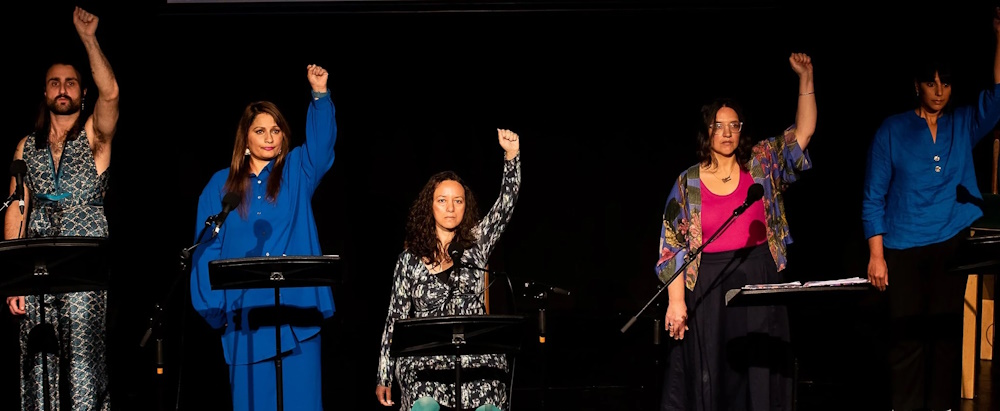
Hannah Lavery (second right) “Disrupting the Narrative” with other anti-White activists, including the “award-winning and critically acclaimed” non-binary and neuro-diverse Niall Moorjani in a dress (image from Lavery’s website)

Yes, Scottish lawyers are doing very well out of the leftist martyr-cult of Sheku Bayoh. So are Bayoh’s family, who have received undisclosed sums of compensation from Scottish police with the help of the anti-White Pakistani lawyer Aamer Anwar. Also doing very well out of the martyr-cult is the anti-White Black “poet, playwright and performer” Hannah Lavery, who wrote and directed a Lament for Sheku Bayoh in 2019. Just as the Black martyr Bayoh follows a typical pattern of bad behavior and self-inflicted death, so the Black poet Lavery follows a typical pattern of bad verse and self-serving activism. In other words, she’s a poetaster, which is the useful Latin term for “bad poet.” Lavery’s fellow Black Jackie Kay is also a poetaster and, just as Kay was made National Makar (Poet Laureate) for Scotland in 2016, so Lavery was made Makar for the Scottish capital Edinburgh in 2022. Here is some of

Lavery’s poetastry, as included in Best Scottish Poems 2021:

I was invited here
I am sure I was
to read my poetry
That’s what the email said.

I’ve been writing a lot about trees
Oh! there is this nest I found in a hedge
blue wee eggs. A Starling — was it?

Aye, well. I was invited
that’s what it said.

Tonight, for all you lovely folk
I am unpacking my poetry suitcase — ta da!
The travelling poetry salesman. That’ll be me
Roll up, Roll up, going, going, going…

And they say after, they say, I love
how you spoke about found nests
as a metaphor for immigration
truth is I’ve always been here

I was just writing about this wood
at the back of my house
about a nest I found.

How at night, I duck the bats
as if they might fly into my hair
even though I know, I duck.

Even though I know
they know this place
just as well as they know
I know this place. Still, I duck. (“Flying Bats”)

Like so much modern poetry, it’s simply banal prose chopped into short lines for delivery in a special “poetry” voice. And like so many modern poets, Lavery has made her name not through talent but through her identity. She’s Black and female — bow before her greatness, ye wicked wee whites! Her art and activism never tire of emphasizing those twin poles of her identity. Indeed, her art and activism aren’t simply self-serving: they’re self-worshipping. Her Lament for Sheku Bayoh is intended to celebrate Blacks like herself and malign Whites unlike herself. The play was first “commissioned by the Royal Lyceum Theatre” of Edinburgh. But has any Scottish theater ever commissioned a Lament for Kriss Donald? Or any English theater a Lament for Mary-Ann Leneghan? Or any American theater a Lament for Channon Christian and Christopher Newsom?

“Wicked Whites, Saintly Blacks”

Of course not: leftists regard Whites sadistically killed by non-Whites as fit only for oblivion, not for endless publicity. But leftists have reacted very differently to Hannah Lavery’s play about the self-inflicted death of Sheku Bayoh. The play has been extravagantly praised in the Guardian, which hailed it as “impassioned, poetic and alive with political import” and as “a stark critique of Scotland’s self-image.” The Scotsman went even further, describing the lachrymose Lament as “a beautiful and shattering ritual of rage and mourning that — in the year of George Floyd and Black Lives Matter — is both painfully familiar, and new in its insistence that here too, in bonnie Scotland, black people sometimes cannot breathe, purely because of the colour of their skin.”

Got that? The simple message of Lament for Sheku Bayoh is that Whites are wicked, Blacks are saintly.

Hannah Lavery was back with that simple message in 2025, celebrating Blacks like herself and maligning Whites unlike herself in the Guardian. As you read her words, note not only her self-righteousness and blaming of Whites for all non-White failure, but also the relish with which she pours opprobrium on Scottish heroes and demands the dismantling of Scottish history:

As a young woman growing up in Edinburgh, I was taught this was a city built on the genius of the Scottish Enlightenment. That story was sunk deep into our bones and passed between us as our treasured inheritance. It formed our sense of ourselves and our belief in Scotland’s good and worthy contribution to the world.

We walked past statues of David Hume and Adam Smith. We celebrated their intellect and claimed it as our own. Statues to those men were erected. Yet no one spoke of what lay beneath that brilliance — of whose labour built their wealth, whose bodies were stolen, dispossessed and abused as a consequence of their “thinking”. Edinburgh was framed not as a city of complicity but of genius. That silence shaped us.

Now, the University of Edinburgh’s review of its legacies of enslavement and colonialism joins a wider reckoning that has been building across Scotland. It confronts the stories we were told — that we continue to tell. That we love to tell.

Scotland has long positioned itself as a nation on the margins of empire. We speak of being oppressed, victimised — or as a benign participant in the British imperial project. But many of us, through our family histories, have always known that’s not the whole truth. It’s a lie of omission. One that has excluded us, exiled us from a national story in which we also have histories to contribute, and in which we have a claim.

Edinburgh University’s recent inquiry into its history is sobering. It focuses on the institution’s financial gains from plantation slavery, its intellectual support of racial pseudoscience and its memorialisation of colonial figures. It names how Enlightenment thinking in Scotland justified racial hierarchies. These aren’t revelations for many Black and Brown Scots, or for those involved with Scotland’s anti-racism movements — they’re confirmations of truths long lived and denied.

And still, we are met with denial, minimisation and the defensive recoil of a nation uncomfortable with the truth of itself. There’s a reflex to preserve pride at all costs within our society — even when the cost is exclusion and erasure of fellow Scots; of their histories and their story of Scotland. […] Race is a social construct. But we must now confront the fact that it was constructed, in part, here, by so-called “great men” — our great men — whose legacy continues to shape our country and institutions. And their legacy still causes us harm.

This harm is not abstract. In 2024 alone, Police Scotland recorded 4,794 hate crimes under the new Hate Crime and Public Order (Scotland) Act. Black and minority ethnic people are 60% more likely to live in the most deprived parts of Scotland than their white counterparts. Black and minority ethnic workers have poorer outcomes than white workers when applying for jobs in our public sector organisations.

These are reverberations of a legacy born in Enlightenment philosophies that theorised racial hierarchies — ideas presented as science, later used to justify enslavement and colonialism. These narratives of white supremacy negatively affect us all, and they continue to endanger and blight the lives of Black and Brown people.

What happens next must therefore go beyond apology and symbolism. It must be structural, sustained and fiercely imaginative. Education is key. Not just to correct the record, but to transform how we imagine and create a better nation. Within our schools, reform is under way — initiatives such as Education Scotland’s Building Racial Literacy programme and collectives such as The Anti-Racist Educator provide vital resources and training. Such efforts must be scaled, funded and politically backed if they’re to meaningfully reshape how we understand ourselves, how we embed anti-racism within our institutions and how we teach Scotland’s history.

Edinburgh council’s Slavery and Colonialism Legacy Review, endorsed by councillors in 2022, included a public apology and the creation of an implementation group, chaired by Irene Mosota, to guide reparative action. This included initiatives such as the Disrupting the Narrative project, which has formed the main body of my work as Edinburgh makar (the city’s poet laureate). The meetings of the Scottish BPOC [Black and People of Colour] Writers Network’s writers group at the University of Edinburgh, and the important work of mentorship and support from We Are Here Scotland are also living examples of this reparative work. This work is not symbolic — it is foundational. It allow us to rebuild from the margins, and write ourselves back into the story of Scotland, and into the story we tell. […] History is not settled. Our story is not finished. We are capable of confronting ourselves honestly and critically. We can take pride in our history of social justice movements — but this pride must also own and acknowledge the truth of what and who built this nation. That means interrogating our past and the reasons for our collective amnesia. It means listening to voices long silenced. The time has come, Scotland. The time has finally come. (“This is the week Scotland was forced to confront its role in slavery, and say: ‘Yes, that was us’,” The Guardian, 2nd August 2025)

Hannah Lavery is obviously full of resentment and envy at what Scottish Whites have achieved (notice Lavery capitalizes Black and Brown, but not white, as in “white supremacism”). And she is obviously lying when she writes that “We are capable of confronting ourselves honestly and critically.” Just as obviously, she relishes the prospect of leading a neo-Maoist “Cultural Revolution” in Scotland, of tearing down the wicked White past and creating a glorious non-White future. I’m sure that non-Whites like her, Humza Yousaf and Aamer Anwar would be delighted to exercise arbitrary, unaccountable power in the way Mao and his followers did. It’s easy to picture Lavery and Co overseeing show-trials of Whites, imprisoning and exiling Whites whilst exalting and honoring themselves and their own kind. Okay, I don’t think those resentment-filled non-Whites will ever get the power to enact such persecution, but be in no doubt: all of their activism is directed towards achieving it.

Paragons of pathology

Fortunately enough, although Hannah Lavery likes to think of herself as “fiercely imaginative,” she is in fact farcically incoherent. In that article, she constantly talks about “we” and “us” and “our,” asserting that non-Whites like herself are fully and authentically Scottish. But she’s speaking with a forked tongue, because she’s denying that “Black and Brown Scots” have any share in the negative aspects of Scottish history and culture. The villainy of Scotland is reserved strictly for Whites, the virtue strictly for non-Whites. Indeed, her vision is of  an old White Scotland stained and soiled by “so-called ‘great men’” like David Hume and Adam Smith. That wicked White Scotland can be redeemed only by virtuous, visionary non-Whites like herself, who will “embed anti-racism within our institutions.”

And extract money and prestige from “our institutions,” of course. But when she says “our,” she really means “your” — the institutions were created by Whites and are still funded by White taxpayers. Scotland has indeed been a land of genius, making a vastly disproportionate contribution to the science, engineering, art, literature and philosophy of the West. But all of that genius has been White, from David Hume to Robert Louis Stevenson, from James Watt to Thomas Telford. Non-Whites like Hannah Lavery and Sheku Bayoh neither belong in Scotland nor contribute anything but harm and subversion there. Bayoh is routinely described by leftists as a “gas engineer,” as though Scotland were deprived of a highly skilled technician by the malign forces of White racism and White police brutality. In fact, he was only a trainee, and his drug-abuse and violence strongly suggest that he wasn’t going to become a paragon of the profession. Blacks are rarely paragons of any profession. But they and other non-Whites are often paragons of pathological behavior.

New poet and true poet: the Black Zimbabwean Tawona Sitholè and the White Scot Rabbie Burns
And if they’re not committing gross violence against people or property, then they’re committing gross violence against poetry. Take Hannah Lavery’s fellow “Black poet” Tawona Ganyamtopè Sitholè, a Zimbabwean male who is comfortably “embedded” at the University of Glasgow as a “Lecturer in Creative Practice Education within the UNESCO Chair in Refugee Integration through Education, Languages and the Arts.” If you thought that Hannah Lavery’s poem was bad, well, you ain’t seen nothing yet. Here is one of Tawona Sitholè’s poems, formatted exactly as I found it on the internet:

seeds of antiracist education (by tawona ganyamtopè sitholè)
vakuru vakati chinokanganwa idemo
asi muti wakatemwa haukanganwi
the proverb is a reflection that
what forgets is the axe
but the tree that was cut does not forget
the mouth of this river is dreaming of words
in dreamtime but in the meantime
it is not going swimmingly
bursting on the inside but on the outside
all we get to see is the brave face
so to ask where is the safe space
brave enough for difficult conversations
safe enough for nuanced observations
elsewhere it is just life
“racism isn’t a problem in Scotland”
“oh God she’s talking about racism again”
at the same time
“no matter how much i’m perceived to be loud
my voice is still not heard”
“I feel like I cannot bring my whole self
just parts that are acceptable”
and in the meantime
instead of raising instead erasing
the young talking of problem behaviour
unfair burden placed on people of colour
racial trauma leading to mental unwellness
in all this embarrassing richness
we cannot afford to ignore race
to ignore race is to ignore ourselves
we cannot afford to neglect healing
to neglect healing is to neglect learning
fundo cunoastere seekna al táleem ionnsaich
so much ground covered
so much left uncovered
in the spirit of this dear rugged land

That is the kind of poetry celebrated in modern leftist Scotland. It has no beauty or grace, no style or sweetness. It’s ugly, uncouth and anti-White. That’s why it presently succeeds, of course. But that’s also why it is destined to die and be forgotten, unlike the true poetry created by a true Scot. He’s a White man called Rabbie Burns and his centuries-old verse offers the cure for modern Scotland’s anti-White sickness:

“SCOTS WHA HAE”

ROBERT BRUCE’S ADDRESS TO HIS ARMY, BEFORE THE BATTLE OF BANNOCKBURN

Scots, wha hae wi’ Wallace bled,
Scots, wham Bruce has aften led,
Welcome to your gory bed,
Or to victorie.
Now’s the day, and now’s the hour;
See the front o’ battle lour!
See approach proud Edward’s power—
Chains and slaverie!
Wha will be a traitor knave?
Wha can fill a coward’s grave?
Wha sae base as be a slave?
Let him turn and flee!
Wha for Scotland’s King and law
Freedom’s sword will strongly draw,
Freeman stand, or freeman fa’?
Let him follow me!
By oppression’s woes and pains!
By your sons in servile chains!
We will drain our dearest veins,
But they shall be free!
Lay the proud usurpers low!
Tyrants fall in every foe!
Liberty’s in every blow!
Let us do or die!


[1] The principle was originally formulated by the Christian theologian Tertullian (c.155-c.220 AD) as sanguis martyrum semen Christianorum or “the blood of martyrs is the seed of Christians.”

[2] It’s also instructive to compare Christian martyrs, who die forgiving their enemies, with Muslim martyrs, who die slaying their enemies. See, for example, my article “Martyr with a Machine-Gun,” which discusses how a vicious political assassin called Mumtaz Qadri became an honored martyr in Pakistan.

[3] For examples of how Jews are antifragile, see the way some Jews have explicitly stated that antisemitism benefits Jews. And the way Jews often commit hate-hoaxes, manufacturing antisemitism when demand outstrips supply.

Bootstraps or Bailouts? The Hidden Truth of Israel’s Military Power

depositphotos 84024600 l

As America continues pouring billions into Israeli defense, the uncomfortable truth is that Israel’s security and strategic position have always depended on outside assistance—contrary to popular conservative claims.

Conservative pundits like Ben Shapiro repeatedly boast about Israel’s alleged independence in the face of external foes, arguing that “Israel has bootstrapped its way into military dominance despite all of the internal obstacles” it has faced. However, this claim contradicts the extensive evidence of American and Western support the Jewish state has received since 1948.

From the crucial Soviet arms supplies in 1948 to the unprecedented $38 billion U.S. military aid package of 2016, Israel’s history reveals a persistent dependence on outside aid, belying its image of independence. Israel’s very survival during its founding depended critically on external military support, primarily from an unexpected source: the Soviet Union.

The Soviet Union initially backed Israel in 1948 by facilitating arms deals between its satellite state Czechoslovakia and Israel. These arms transfers proved decisive in the War of Independence. As David Ben-Gurion later acknowledged, “They saved the country, I have no doubt of that… The Czech arms deal was the greatest help, it saved us and without it I very much doubt if we could have survived the first month.”

Perhaps most remarkably, Israel’s early survival also depended on support from Jewish-American organized crime networks. Meyer Lansky, more notoriously known as “the Mob’s Accountant,” donated a million dollars to the Zionist cause in 1948, a contribution that proved crucial during Israel’s War of Independence. Lansky, an Ashkenazi Jew born in present-day Belarus, immigrated to Manhattan in 1911. He later used his extensive criminal network to aid the Jewish state, obstructing arms shipments to Arab countries and assisting Jewish settlers.

Lansky’s operations extended beyond just financial donations. He controlled major U.S. ports through his connections with the Italian Mafia and the International Longshoremen’s Association, enabling him to manipulate cargo shipments. Workers and customs officials who feared Lansky’s reputation helped ensure key weapons shipments reached Israel safely while Arab-bound arms mysteriously “fell” from cranes into harbors or were “mistakenly loaded” onto ships sailing to remote destinations, according to a report by JFeed.

In a similar vein, Jewish mobster Bugsy Siegel organized secret meetings in Los Angeles with Jewish businessmen and other members of the criminal underworld to raise donations for weapons smuggling. According to reports, Siegel donated tens of thousands of dollars toward the Israeli independence movement through meetings held with Zionist diplomat Reuven Dafni. Siegel viewed the Zionist struggle as a chance to achieve something of lasting consequence that would endure beyond his lifetime. At a fundraising meeting, he declared, “When Israel is established, I want to know that I had a part in it.”

The Jewish Agency ran a secret arms-purchasing operation from the Hotel Fourteen in New York, where Jewish gangsters from Brooklyn offered their services. According to electronics engineer Dan Fliderblum, who witnessed these meetings, “The mobsters offered to help in any way they could. One of them said, ‘If you want anyone killed, just draw up a list and we’ll take care of it.’”

Beyond the shadows of Brooklyn backrooms, Israel soon secured a lifeline through official state agreements that dwarfed underworld contributions. The 1952 Luxembourg Agreement provided Israel with another source of critical funding during its infancy as a state. In this instance, West Germany agreed to pay Israel $714 million (3 billion marks) over fourteen years for Holocaust reparations. These payments made up 87.5% of Israeli state revenue in 1956 and were instrumental in building Israel’s infrastructure.

In contrast to later massive aid packages, U.S. economic assistance during Israel’s early years was relatively modest. President Harry Truman laid the foundation for U.S.-Israel relations by approving a $135 million Export-Import Bank loan in 1948 for immigrant absorption. Between 1949 and 1973, the United States provided Israel with an average of about $122 million annually, totaling $3.1 billion.

The Six-Day War in 1967 fundamentally altered the trajectory of U.S. foreign aid to Israel. France’s post-conflict arms embargo left Israel scrambling for reliable suppliers, creating an opening for Washington to cement itself as the country’s principal military patron. As a direct result, U.S. military aid skyrocketed from $7 million in 1967 to $25 million in 1968—a staggering 450% increase.

This upward trend in military support set the stage for the next major inflection point. The 1973 Yom Kippur War triggered the largest American airlift in history. Operation Nickel Grass delivered 22,325 tons of military supplies to Israel between October 14 and November 14, 1973. Congress subsequently passed $2.2 billion in emergency aid, increasing military assistance by 800%. This emergency response during the Yom Kippur War established the precedent for massive U.S. injections of military aid whenever Israel faced military challenges that purportedly posed a threat to its national security.

The 1978 Camp David Accords would subsequently establish a new aid paradigm. The United States agreed to funnel $1.3 billion annually to Egypt as part of the peace treaty with Israel. This economic aid transfer effectively purchased Egyptian acquiescence while simultaneously neutralizing Egypt’s military threat to Israel and preserving Israel’s position as the main beneficiary of American aid in the region.

In the decades following Camp David, successive agreements and policy shifts steadily expanded the scale and scope of U.S. assistance to Israel, culminating in a series of long-term commitments that dwarfed earlier aid packages. The landmark 2016 Memorandum of Understanding established the largest military aid package in U.S. history: $38 billion over ten years (2019-2028). This includes $33 billion in foreign military financing and an unprecedented $5 billion commitment for missile defense.

These vast funding commitments have translated directly into advanced weapons acquisitions, enabling Israel to maintain a “qualitative military edge” over its regional rivals. Israel has received thirty-nine of its ordered fifty F-35I “Adir” aircraft as of 2024, with an additional twenty-five advanced stealth fighter jets ordered for $3 billion in June 2024. In 2018, Israel became the first country to use F-35s in combat operations. Additionally, the United States has provided over $1.7 billion for Iron Dome development since 2011, with an additional $1 billion approved in September 2021.

Since the October 7, 2023 attacks, U.S. military aid to Israel has soared to unprecedented heights. By September 2024, Washington had already delivered $17.9 billion in security assistance. The following month, the Joe Biden administration approved an enormous $20 billion arms sale that included F-15 fighter jets and advanced missile systems. The surge continued into President Donald Trump’s second term, with his administration authorizing an additional $3 billion emergency arms package in March 2025.

The United States is still Israel’s leading provider of military assistance, but European states have supplied significant amounts of weaponry as well. Between 2018 and 2022, European Union member states sold arms worth €1.76 billion to Israel. Germany emerged as the largest European supplier, providing 30% of Israel’s weapons between 2019-2023.

The current Trump administration has approved close to $12 billion in military sales to Israel in its first one hundred days. Secretary of State Marco Rubio fast-tracked $4 billion in military aid using emergency powers in March 2025. From 1948 to 2025, the United States has provided Israel with over $300 billion in aid, reflecting decades of sustained support.

This enormous and ongoing flow of financial, military, and economic assistance underscores a simple reality: without U.S. foreign aid, Israel’s ability to maintain its security, economic stability, and regional position would be severely compromised. In practical terms, the nation’s survival and strategic strength remain deeply tied to continued American support.

Those who insist that Israel is fully capable of thriving without American assistance will be confronted with an unwelcome reality. Decades of overwhelming U.S. aid have underpinned Israel’s security, technological edge, and economic resilience. To suggest otherwise ignores the depth of this dependency and vastly overestimates Israel’s ability to maintain its strategic posture independent of Washington.

For those who champion a restrained or non-interventionist U.S. foreign policy, this reality carries a clear implication: Israel represents not merely a fiscal burden but a strategic commitment whose ongoing subsidization no longer aligns with broader American interests. If geopolitical stability and the long-term health of U.S. national security truly matter, it is time to recognize that continued American aid to Israel must ultimately be ended.

Reposted from Libertarian Institute, with permission.

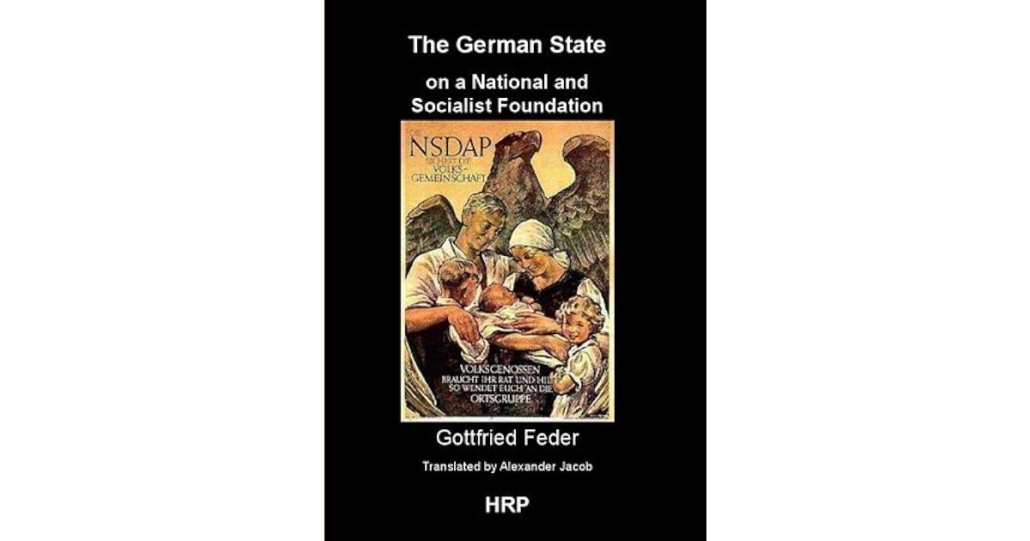
Gottfried Feder on a German state built on national and socialist foundations[1]

The German State on a National and Socialist Foundation


Gottfried Feder was  born in 1883 in Würzburg and studied engineering at the Technical Universities in Munich, Berlin and Zurich. After the completion of his studies, he set up a construction company in 1908 under the aegis of Ackermann and Co. and undertook several projects in Bulgaria. From 1917 onwards he taught himself economics and political economy, and in late 1918, not long after the proclamation of the Weimar Republic by Philipp Scheidemann in November of that year, Feder wrote a manifesto on usury[2] and sent it to the Kurt Eisner government, though he obtained no response. The Treaty of Versailles signed in June 1919 which determined Germany as solely responsible for the war and liable to reparations caused Feder to fear that Germany was now firmly in the hands of the international financiers. In September of that year, Feder established a militant league (Kampfbund) with a program of ending interest slavery and nationalising the state bank. His anti-capitalism was bound also to racialism insofar as the international financiers were considered to be mostly Jews.

Feder’s nationalist efforts drew him into a close alliance with the anti-Communist activist Anton Drexler (1884-1942) and Dietrich Eckart (1868-1923), the editor of the anti-Semitic journal Auf gut deutsch and later, of the National Socialist organ, Völkischer Beobachter. The three together formed, in January 1919, the Deutsche Arbeiter Partei (DAP).[3] Adolf Hitler joined the DAP in late September 1919 and soon emerged as the leader of the party, which he renamed the Nationalsozialistische Deutsche Arbeiterpartei (NSDAP). Hitler had, even before his joining the party, attended Feder’s lectures on economic subjects and wrote later in his Mein Kampf (1925/6):

For the first time in my life I heard a discussion which dealt with the principles of stock-exchange capital and capital which was used for loan activities. …The absolute separation of stock-exchange capital from the economic life of the nation would make it possible to oppose the process of internationalization in German business without at the same time attacking capital as such, for to do this would jeopardize the foundations of our national independence. I clearly saw what was developing in Germany and I realized then that the stiffest fight we would have to wage would not be against the enemy nations but against international capital.[4]

In the Foreword to the original 1923 edition of Feder’s work, Der deutsche Staat, Hitler wrote that in this work the National Socialist movement had indeed acquired its “catechism”.

In 1920, Hitler, along with Feder and Drexler, composed the ’25-point Programme’ of the NSDAP. This programme rejected the Treaty of Versailles and called for a reunification of German peoples along with an exclusion of aliens, especially Jews, from national life. In February 1920, Hitler held a rally in which he presented the programme to the German people. Later, in 1927, Feder published a comprehensive version of the programme entitled Das Programm der NSDAP and seine weltanschaulichen Grundlagen.[5] In 1923, Feder offered a further elaboration of his national economic views in the present work, Der deutsche Staat auf nationaler und sozialer Grundlage, which was re-issued in 1932 in the “Nationalsozialistische Bibliothek” series[6]

Feder took part in Hitler’s failed Beer Hall Putsch against the Bavarian government in 1923 but was only fined 50 marks for unlawful assumption of authority since he had acted, for a day, as the new “finance minister”. In 1924, he was elected a representative to the parliament. In parliament, he demanded the confiscation of Jewish property and the freezing of interest-rates. which were key elements of the anti-capitalist programme of the party. In 1926 Hitler entrusted Feder with the editorial direction of a series of books on National Socialist ideology under the title “Nationalsozialistische Bibliothek” (National Socialist Library). In 1931, Feder was appointed chairman of the economic council of the NSDAP. But gradually, under pressure from big industrialists like Gustav Krupp, Fritz Thyssen and Emil Kirdorf, Hitler decided to distance himself from Feder’s socialist ideas.[7] With Hitler’s strategic alliance with big industrialists and capital, even foreign capital, for his intended war on Bolshevism, Feder lost most of his influence on the party, since foreign banks especially would not have supported Feder’s plans for a nationalised interest-free banking system. The loss of interest in Feder’s economic policies among the party members is evidenced in Hans Reupke’s book Der Nationalsozialismus und die Wirtschaft (!931), where the author stated that it was no longer necessary to deal with the “breaking of interest slavery” in “the extreme form in which it first emerged”.[8]

Thus, when Hitler assumed power in 1933, Feder was not named Economics Minister but rather only State Secretary in the Economics Ministry. However, in 1933 Feder published a collection of his essays entitled Kampf gegen die Hochfinanz as well as a book on the Jews called Die Juden. In 1934, the influential banker Hjalmar Schact was made Economics Minister since his contacts with the big industrialists made him more useful to Hitler in his rearmament aims than Feder with his stark anti-capitalist doctrines. Feder’s subordination to Hjalmar Schacht was indeed a concrete sign of his fall from grace.  After the Knight of the Long Knives in 1934, when left-wing nationalists like Gregor Strasser were assassinated, Feder withdrew from the government. In 1936, he was given a new job as professor at the Technical University in Berlin which he maintained until his death in 1941.

*   *   *

Feder’s Deutsche Staat is indeed one of the most important treatises on National Socialist economics.[9] However, it has a precedent in the Austro-Hungarian Bohemian German, Rudolf Jung’s work, Der Nationale Sozialismus (1919). Rudolf Jung (1882-1945) was a civil engineer from Jihlava (in the current Czech Republic and former Austro-Hungarian Empire) who joined the Bohemian Deutsche Arbeiter Partei (DAP) in 1909. The DAP was founded in 1903 in Aussig (now Ústí nad Labem in the Czech Republic) by Germans threatened by the increasing Jewish and Czech influence in the empire. It was renamed Deutsche Nationalsozialistische Arbeiter Partei (DNSAP) in 1918. Jung’s work Der Nationale Sozialismus: seine Grundlagen, sein Werdegang und seine Ziele (1919) was intended as a German nationalist answer to Marx’s Das Kapital.[10] The work is divided into two parts, the first dealing with ‘The Foundations of National Socialism’ and the second with ‘The Development and Goals of National Socialism’. Jung’s nationalism focusses on social and economic questions and, exactly like Feder, Jung stresses the difference between income derived from real work and that arising from interest.[11] His strong socialist and anti-Jewish viewpoint is  evident throughout this work: 

All non-socialist parties are based in the main on “individualism”, i.e. the demand for the greatest possible freedom and lack of constraint of the individual. Economically it is expressed in Manchester liberalism and, further, in Mammonism. The ruthless ruler who is tormented by no pang of conscience is the goal, the weaker man falls thereby under the wheels. Now, since the Jew is the most ruthless, he can fare best thereby. Thus all non-socialist anti-Jewish orientations unwillingly support the rise of Jewry to world-rulership.[12]

Further, democracy itself is the vehicle of Jewish international capitalism:

If we were to sum up, we might say that the entire international democracy whose alleged ideals the major press and parties represent and on whose flag they swear, is nothing but the political crystallisation of the Jewish spirit and, in the final analysis, serves no other goal but the establishment of the world-rule of Jewry.[13]

Another writer who contributed to the exact identification of the Jewish constitution of international high finance was Heinrich Pudor (1865-1943), who also wrote under the pseudonym Heinrich Scham (the German translation of the Latin “pudor”). Pudor was a vegetarian and naturist who, from 1912, published several anti-Semitic pamphlets and books including an extensive series on the international connections between the various Jewish high financiers.[14] Feder refers sympathetically to Pudor in the present work. However, Pudor’s magazine Swastika was banned in 1933 by the National Socialists for its criticisms of the National Socialist leadership and the regime’s surprising toleration of Jews. Further, five issues of the series on Jewish high finance were banned including no.13, Neues über Br. Roosevelt und seine jüdischen und Kommunistischen Verbindungen (News about Brother Roosevelt and His Communist Connections) and no. 49, Judendãmmerung. “Juden unerwünscht” Keine jüdischen Rechtsanwälte mehr. Ende der Judenfinanz in Deutschland ((Judendãmmerung. “Jews Unwanted.” No more Jewish lawyers. End of Jewish finance in Germany). The pamphlets were banned on account of what a state official, Raymund Schmidt, described as Pudor’s “no longer opportune polemical methods” which were indeed exploited by the English for the purpose of counter-propaganda.[15]

*   *   *

Feder’s treatise on national economy, like Rudolf Jung’s, is remarkable for its strong moral foundation and its formulation of National Socialism as a movement for social justice as well as for national regeneration. Unlike capitalism with its “soul-destroying materialistic spirit of egoism and avarice with all its concomitant corrupting manifestations in all fields of our public, economic and cultural life” (p.31)[16] and unlike Marxism, which insists that everything should belong to the One, which might be either the State or Mammon controlling it, National Socialism wishes to revert to the mediaeval and Prussian dictum of “suum cuique”, ‘to each his own’, whereby each person will earn as much as he deserves according to his performance of work, with the fullest possible responsibility, as a duty. Economically, this moral doctrine is translated into the doctrine of serving “the public interest” before self-interest. Not profitability but fulfilment of demand is the National Socialistic basis of the economy.

Unlike Marxism, National Socialism will not prohibit private property but respect it as the privilege of the creative and productive Aryan man. On the other hand, the mobile Jewish mind has no deep connection with the land but rather exploits the production and property of the natives financially through all sorts of legal claims, bonds and mortgages, whereby “property” is turned into a profitable “possession” (p.14). In order to counter these avaricious strategies of the Jews, the National Socialist state will enforce limitations on the right to property, personal or commercial, so that in all cases the welfare of the whole, the nation, rather than of individuals will be first served. In Feder’s discussion of the party’s programme in Part II, we note that, since the social policy is “the welfare of the whole”, the financial policy of the National Socialist state is accordingly directed against those financial powers who tend to develop “a state within the state” (p.29). As he puts it:

In the last and deepest analysis, it is a matter of the battle of two worldviews that are expressed through two fundamentally different intellectual structures — the productive and creative spirit and the mobile avaricious spirit. The creative spirit rooted in the soil and yet again overcoming the world in metaphysical experience finds its principal representatives in Aryan man — the avaricious, rootless commercial and materialistic spirit directed purely to the this-worldly finds its principal representative in the Jew (p. 31).

The strength of Germany before the war was due to its unity under Bismarck and its efficient industrial sector. This advantage was undermined by the dependence of the economy on the credit system of the banks and “the inventors and bearers of the modern credit system” are the Jews (p. 36). The mediaeval system of credit was based on the belief (“credo”) of the creditor that his money could be used to greater economic advantage by the debtor whereby the debtor, if successful in his enterprise, may return a share of his profits in gratitude to the creditor. Standardised interest, on the other hand, was forbidden by the Church as usury (p. 45). Feder advocates a return to the conception of money as a token of “performed work” or of a product so that money cannot, independently of any work, be hoarded for the purpose of being lent out later at interest.

Feder further points out that it is the stock-market that lies at the basis of the alienation of capital from work:

Anonymisation — the depersonalisation of our economy through the stock-marketable form of the public limited company — has to a certain degree separated capital from work, the shareholder knows in the rarest instances something of his factory, he has only the one-sided interest in the profitability of his money when he has invested it in the form of shares (p.36)

Apart from the indifference of the shareholder to the quality of the goods produced by the company in which he invests, the market in general has diverted production from its legitimate task of fulfilling real needs to that of stirring up — through the Jewish market-crier’s technique of advertising — artificial needs among the public that will bring in greater profits. This fundamental transformation of national economics has been supported in academic circles by Jewish scholars who restrict their economic analyses to descriptions of the current economic system rather than investigating its social and political legitimacy. This sort of intellectual subversion is further continued by the Jewish intelligentsia in the fields of art, entertainment and the press.

The major source of the current distress of Germany is indeed the interest owed to large loan capital. The burden of interest has indebted entire nations to international high finance and forced them to become interest-collectors for the latter which they do by taxing the working people ever harder. Feder calls this false economic process an “international fraud” (p. 53). The power of international finance has however grown so great that it was able to encircle Germany as soon as it perceived that its currency was rising in strength and independence. Once they succeeded in militarily defeating Germany, the international financial powers then enforced further enormous debt burdens on it through the Treaty of Versailles. Feder therefore proposes the cancellation of the payment of the interest on these debts to the Allies (p. 97). Indeed, the remedy to the interest burdens of all nations to international finance is the legal abolition of interest (p. 94). And this is simultaneously the solution to the Jewish question itself:

The solution of the interest problem is the solution of the Jewish question. The solution of the interest problem in the sense of our explanations is the breaking of the Jewish world-rule, because it smashes the power of world Jewry — its financial power.

The fullest representation of the socio-economic interests of a nation should be the state, and its industries should be models of efficiency and commercial success. One example of such an industry in Germany is indeed the transport industry and especially the German railways. Unlike Bolshevism, which seeks to control all production, the National Socialist state will, through the establishment of storage and distribution cooperatives under state supervision (p. 917), remove only the avaricious interference of private commerce between production and consumption. As the means of exchange necessary for the exchange of goods, money will be under the control of the state through a nationalised state bank.

Instead of borrowing money from private banks, the state should, in the case of all large public works projects, finance the latter though the issuance of interest-free notes of its own. The Reichsbank’s sovereignty of issuing notes must be regained through nationalisation (p. 72). Freed of interest-burdens to banks, the state will ultimately be able to operate in a mostly tax-free manner (Ch. 22, ‘The state without taxes’). Taxes will be restricted to the coverage of non-productive tasks such as the administration of justice, the police system, medical and educational systems, if the commercial enterprises of the state such as the railways, post and telegraph, mining and forestry do not present surpluses wherewith to pay for these tasks (p. 92). International transactions should be conducted through a clearing system rather like that of the international postal union “without the international finance benefiting two or three times in all these simple mercantile operations and becoming big and fat at the cost of the productive nations” (p. 77).

But the state must be powerful if it is to effect any reforms. Unfortunately, the Weimar Republic has abjectly accepted the monstrous burden of guilt after the war with the result that “the members of the Chosen People can, on these reparations, forever lead a glamorous work-free life in all the countries of the world at the cost of German work.” (p. 19). The crisis faced by Germany after the war was facilitated by parliamentarianism and Mammonism. The “great democratic lie of the capacity of the people for self-government” is to be combated along with the real capitalistic rulers of democracies. Marxism likewise is a sham socialist system that employs the dissatisfaction of those exploited by Mammonism for the benefit of the “handlers for international capital” in order to “divert from themselves the hatred of the exploited” (p. 25).

The majority of the principal Marxists as well as Mammonists are Jews, and so “The Jewish question is becoming a world-question on whose solution the welfare and woe of the nations will be dependent” (p. 26). The solution of this question cannot be through violence since “indeed one cannot kill the plague bacillus individually, one can only eradicate it by cutting off its life necessities from it” (p. 26). A suggestion of what might be done to reduce their ill-earned gains is contained in point 17 of the party’s programme which envisages

creation of legal possibilities of confiscating if necessary land that was acquired in an illegal way or not administered according to the viewpoint of the welfare of the people. This is directed thus mainly against the Jewish land speculation companies. (p. 47)

Further, removal of Jews from all public positions will cause no difficulty to the nation since “the real vitally important productive activity in industry and agriculture, in the professions and administration, is almost entirely free of Jews” (p. 38). Concomitant with the removal of Jews from the “national body” is the enforcement of new citizenship laws whereby the citizenship rights will be “acquired” by the citizens and not merely granted to them. Thus only those who pledge themselves to the German community and culture and do not continue an adherence to another nation can obtain these rights (p. 39).

The National Socialist state will be a strong state that includes all the German tribes, and its power will be concentrated in a strong leader, or autocrat, who embodies “the highest responsibility” (p. 22)[17] since the German people have traditionally wanted a strong leader, and monarchs are not always to be relied upon. The leader of the National Socialist state, on the other hand, is not envisaged as a permanent ruler but one chosen only for the re-establishment of order and the prosperity of a debilitated nation. After he has accomplished his goals, he may step aside to let other rulers take his place under the constitution. Indeed, the National Socialist state may be characterised as a constitutional autocracy (p. 31). The constitutional aspect of the state will be used especially to ensure an effective labour law and social insurance (p. 23). Obviously, in a German national state, no members of foreign races can assume the leadership of state affairs (p. 22).

Feder is aware of the adverse reaction of the international financiers to such autarkic measures, but he believes that a transformation of interest-bearing bonds into interest-free bank assets or postal cheque accounts (p. 96) whereby foreign creditors can be paid will avert the wrath of the latter. He also suggests that boycotts can be overcome through transactions with neutral countries. As for military action, he believes that it is not likely to be pursued by the foreign creditor nations since

if the German people saw the French or Jewish tax collector sitting in every tax- and pension office, and if the best cows were taken from the stalls of the farmers by these foreign oppressors — then the anger and indignation would perhaps become soon so strong that one night would sweep the foreign spectre away with a bloody broom and free Germany. (p. 97)

*   *   *

We see that, in spite of the lucidity of his economic doctrines, Feder rather underestimated the unforgiving nature of the Mammon that he was striving against. In keeping with Feder’s doctrines, the Nationalist Socialist state officially cancelled the war debt to the Allied nations and sought, from 1933 on, to combat the cumulative deflation by the creation of money and work.[18] Work was created by increasing public works activity, such as notably the building of superhighways, and other construction and agricultural projects. These projects were financed, as Feder had recommended, by the issuance of government bills.[19] The production of armaments especially was spurred by the use of the so-called ‘Mefo’ bills — named after Schacht’s Metallurgische Forschungsgesellschaft (Mefo), which served as a government holding company.[20] These bills were used by government contractors for payment of their needs and were valid as a form of currency. As Overy notes, as a result of these economic strategies, “the banks increasingly became mere intermediaries, holding government stock and helping in the job of keeping bills circulating in the way that the government wanted.”[21] Tax levels were simultaneously reduced for farmers, small businesses and heavy industry through the “remission of taxes already paid”.[22] However, Hitler was also dependent in his ambitious rearmament plans on foreign finance, which certainly would not have accepted Feder’s insistence on an abolition of interest.[23]

The National Socialist economy was an increasingly state-controlled one that sought to avoid inflation by controlling prices and wages and foreign trade. Autarkic restrictions on imports were offset by bilateral barter agreements. Whether the war that began two years after the 1937 edition of Feder’s work was, as Feder’s view of the role of international finance in the first World War would suggest, another effort to punish Germany’s financial independence under National Socialism or whether it was indeed secretly willed by the international financiers for their own geopolitical ends, the increasing losses suffered by Germany in the course of it certainly provoked Hitler into attempting to “sweep the foreign spectre away with a bloody broom”, as Feder had predicted.

But neither Feder nor Hitler may have foreseen the severity of the revenge — more cruel since more lasting than that after the First World War — that the international Jewish interests would take on Germany after its defeat in 1945. While Feder hoped that other nations of the world will also eventually follow the German example and  “mankind, freed of the Jewish oppression, will experience an age of unprecedented prosperity — and, above all, Germany — the heart of the world”, the opposite of that indeed has occurred, since most of Europe has been turned into “a slave, fellaheen, bondman and servant of the all-Jewish world-power” (p. 35). And the heart of Germany itself, drained by a tyrannical psychological control of its population, has virtually stopped beating.


[1] This article is taken from the Preface to my edition of Gottfried Feder, The German State on a National and Socialist Foundation, Sanctuary Press, 2019.

[2] Manifest zur Brechung des Zinsknechtschaft des Geldes, Diessen vor München: Joseph C. Huber, 1919; cf. The Manifesto for the Breaking of the Financial Slavery to Interest, tr. Alexander Jacob, History Review Press, 2012; Sanctuary Press, 2019.

[3] Another major early member was Karl Harrer (1890-1926), who joined the party in March of 1919. Harrer, like Drexler, was a member of the occultist Thule society in Munich, which was an off-shoot of the Germanen Order founded in 1912 by Theodor Fritsch. Eckart too was influenced by the doctrines of the Thule society.

[4] Adolf Hitler, Mein Kampf, tr. James Murphy, London: Hurst and Blackett, 1939, pp.168,171.

[5] This work was translated by E.T.S. Dugdale as The Programme of the NSDAP and its general conceptions, Munich, 1932.

[6] I have for my translation used the 1932 edition, vol.35 of the “Nationalsozialistische Bibliothek” series.

[7] For the part played by big industries in Hitler’s rise to power see G. Hallgarten, “Adolf Hitler and German heavy industry 1931-1933”, Journal of Economic History, 12 (1952).

[8] H. Reupke, Der Nationalsozialismus und die Wirtschaft, Berlin, 1931, pp.29ff.

[9] The closest to National Socialist economics is the Social Credit movement founded in Britain by C.H. Douglas (1879-1952), whose work Economic Democracy was published in 1920 (see F. Hutchison and B. Burkitt, The Political Economy of Social Credit and Guild Socialism, London: Routledge, 1997). Douglas influenced Oswald Mosley’s British Union of Fascists in the thirties (see Kerry Bolton, “Breaking the bondage of interest, part 2”, Counter-Currents, August 11, 2011, http://www.counter-currents.com/2011/08/breaking-the-bondage-of-interesta-right-answer-to-usury-part-2/

[10] It was on his suggestion that Hitler changed the name of the German branch of the DAP in 1920 to Nationalsozialistische Deutsche Arbeiterpartei (NSDAP).

[11] Feder’s manifesto on interest-slavery was interestingly published in the same year as Jung’s work on National Socialism.

[12] Rudolf Jung, Der Nationale Sozialismus, Munich, 1922, p.187f.

[13] Ibid., 53f.

[14] The pamphlets that he self-published (in Leipzig) in this series, “Die internationalen verwandtschaftlichen Beziehungen der jüdischen Hochfinanz” (The international kindred relationships of Jewish high finance’), between 1933 and 1940 present short historical accounts of the different branches of Jewry in various countries of Europe as well as in America. For instance, the first pamphlet is on Das Haus Rothschild, numbers two to four on Ginsberg und Günsberg und Asher Ginzberg, five to eight on Jakob Schiff und die Warburgs und das New Yorker Bankhaus Kuhn, Loeb & Co., nine to ten on Amsterdamer und Oppenheimer Juden, eleven on Französische Finanzjuden, twelve on Tschechoslowakische Finanzjuden, fourteen on Rumänische Finanzjuden, fifteen on Lessing und Moses Mendelssohn und das Bankhaus Mendelssohn & Co., seventeen on Polnische Finanzjuden, eighteen on Schwedische Finanzjuden, nineteen on Holländische und belgische Finanzjuden, twenty on Frankfurter Finanzjuden und die I.G. Farben, twenty-one to twenty-three on Englische Finanzjuden, thirty-four to thirty-eight and forty-three to forty-four on Tshechische Finanzjuden and thirty-nine to forty-two on Ungarische Finanzjuden. In addition, he published, in Halle, a similar work on Amerikanische Finanzjuden (1936).

[15] “nicht mehr zeitgemäßen Kampfmethoden, die sogar von den Engländern in jüngster Zeit zum Zwecke der Gegenpropaganda ausgeschlachtet wurden” (see Gerd Simon, “Chronologie, Pudor, Heinrich“, http://homepages.uni-tuebingen.de/gerd.simon/ChrPudor.pdf, p.19f.)

[16] All page-references are to my edition.

[17] The “Führer principle” was championed also by Rudolf Jung in his Nationale Sozialismus, p.177f.

[18] See G. Senft, “Anti-Kapitalismus von Rechts? – Eine Abrechnung mit Gottfried Feders ‘Brechung der Zinsknechtschaft’”, Zeitschrift für Sozialökonomie, 106 (1995), pp.18-32.

[19] According to Henry Liu: “through an independent monetary policy of sovereign credit and a full-employment public-works program, the Third Reich was able to turn a bankrupt Germany, stripped of overseas colonies it could exploit, into the strongest economy in Europe within four years, even before armament spending began” (Henry C.K. Liu, “Nazism and the German economic miracle,” Asia Times Online, 24 May 2005, http://www.atimes.com/atimes/Global_Economy/GE24Dj01.html).

[20] Hitler’s eagerness to rearm Germany is not surprising in the light of the eastern expansionist and anti-Bolshevist foreign political aims outlined by him already in Mein Kampf, Vol.II, Ch.14.

[21] R.J. Overy, The Nazi Economic Recovery 1932-1938, Cambridge: Cambridge University Press, 1996, p.43.

[22] Ibid., p.38.

[23]See the web-log by “Scanners”, “Gottfried Feder und das zinslose Geld”, http://www.utopia.de/blog/umweltpolitik/gottfried-feder-und-das-zinslose.The western financial powers may have partly supported Hitler’s effort to check the westward spread of Bolshevism. For American involvement in National Socialist finance, for example, see Anthony C. Sutton, Wall Street and the rise of Hitler, Sudbury: Bloomfield Books, 1976.

Tsar Wars

The on-again off-again meeting between Donald Trump and Vladimir Putin is set to take place in Alaska this Friday. This formerly Russian possession is a most symbolic setting if indeed territorial exchanges are to be discussed. The form guide, however, suggests that it will be mostly a publicity stunt — a summit of mutually unrealistic expectations, as impossible to make real progress as it would be to make roasted ice cubes. The Russians are now beginning to capitalize strongly on their frontline momentum, and they still regard the conflict as something existential to their security and sovereignty. On the other hand, Trump salvaging something from project Ukraine seems to be an existential matter for his imperial ego.

What a difference a few months makes; Trump’s pendulous politicking has gone from ending the war in 24 hours to saber-rattling various sanctions and nuclear submarines through a battery of deadlines. Analysts are still at a loss to explain Trump’s change of heart and his decision to add Biden’s War to his own portfolio — the only official statement coming in June when Melania was watching a news report of some apartment blocks getting hit in Kiev. It’s deja vu for people who recall the first Trump term, where it was Ivanka’s tears for Syria that forced Trump to reverse course on that as well.

The MAGA faithful are decidedly livid at what is yet another betrayal of the America First credo. The base has long known of Trump’s weakness for Israel, but Ukraine is a bridge too far and a clear broken promise along with the Epstein List release. Steve Bannon, Tucker Carlson, Thomas Massie, Matt Gaetz and the rest of what could be called paleo-MAGA are right to assume that the neocons have won again, while even Marjorie Taylor Greene is questioning her place in the party. Perhaps Bannon and friends need to work on their golf game more, because it is currently warmonger Lindsey Graham who has regular access to probing the president over 18 holes.

Another issue that’s proved a deal-breaker for America Firsters is the freedom to protest Israel, which Trump first infringed through the universities and is now threatening to withhold natural disaster relief to any states or cities that boycott Israeli companies—what is fundamentally a First Amendment right. If there is a single moral to the story of AIPAC’s influence, it is that Jewish and Israeli lobbies are unnatural disasters on American civil liberty.

Not since William Buckley’s infamous neocon circumcision has a de-facto W.A.S.P. aligned so strongly with Israeli interests and against public opinion. Trump seemed genuinely taken aback that so much of his base now identifies as suffering Israel-fatigue — but if you want blind loyalty, get a guide dog. The only other head of state whose manic chauvinism for the Jewish state is comparable to Trump’s is that of eccentric Argentine Javier Milei, a man who takes the Wailing Wall name a little too literally, while also claiming to be the reincarnation of a gladiator from ancient Rome.

The cult of personality is not something to be ignored in times when the political process itself is part of the bread and circuses. Indeed, mavericks and outsiders would likely have never come to power without it, while the flipside usually means the people must bear a leader of tempestuous rule, self-admiration and overconfidence. Benito Mussolini famously wanted to straighten the Leaning Tower of Pisa — Trump wants to put the cane sugar back into Coke, but to each his own. There are a number of figures from antiquity who could be seen as historical analogues to President Trump, but the likeness is probably most congruent with Emperor Commodus. This was a man born in the purple yet obsessed with his public image and popularity among the plebeians, resorting to such ploys as artificially lowering the price of grain and performing as a gladiator in the Colosseum, slaying countless exotic beasts and crippled opponents.

It wasn’t so long ago that Trump’s supporters were merchandising the God Emperor meme online in his honor. But with Lyndsey Graham as the new First Buddy in this annus horribilis, MAGA looks to be dying — quite literally with the passing of mascot Hulk Hogan — and if Trump doesn’t reverse his heel turn soon, he can call The Undertaker for the midterms because the base has had enough. Once bitten, twice shy as Trump’s Republican predecessor used to try to say. It’s slowly dawning on people that what one Mayorkas can do in damage will outweigh what several Trumps can attempt to ameliorate, meanwhile Trump is choosing to relitigate the Russia hoax conspiracy (well past the statute of limitations). All the America First movement wanted was a genuine non-interventionist and immigration patriot, but after two fresh starts in office, Trump is yet to cross that Rubicon — rather it’s looking like he has once again just conned the rubes.

One group that hasn’t fallen for Trump’s bluff and bluster includes the leaders of India, Brazil and China, who stood firm in the face of tariff threats. Putin’s Russia was the mastermind behind the BRICS alliance and continues to be its galvanizing force. Should we have expected any less from the home of Tetris?

The current situation on the frontlines is likewise comfortably in Russia’s favor, as panic and desperation set in for the NATO powers. Last week, ZeroHedge reported that the Zelensky regime will now allow men and women over the age of 60 to enlist, adding to the forced mobilizations of young men, disabled men and even people with Down syndrome. At a time when the regime is short on supplies, manpower and even funds to pay active duty soldiers, the only thing growing is the Ukraine crazy train. In a move reminiscent of the ninth-century trial of Pope Formosus, a Ukrainian court has decided to indict Russian nationalist Vladimir Zhirinovsky for supporting the breakaway regions of Donetsk and Lugansk, in spite of the man being dead for three years. Ukraine “cannot be counted among civilized countries,” opined Hungarian foreign minister Peter Szijjarto.

Russia, by contrast, presents a picture of confidence in light of its heavily sanctioned economy spurring domestic innovation and resolve. Russia is going to win the war, and the people know it. Putin’s approval now stands at 86%, which is just shy of his peak 88% rating from the year 2000. Russians are a pragmatic and results-oriented people, so it’s probably not of too much concern that a number of corrupt officials and incompetent generals fell from high places — it evidently led to rapid reform within the military and to battlefield success. A popular Russian anekdot on Putin’s ruthless efficiency that one is likely to hear from haters and supporters alike is as follows: Stalin appears to Putin in a dream and tells him, “I have two bits of advice for you: kill off all your opponents and paint the Kremlin blue.” When Putin asks, “Why blue?” Stalin responds: “I knew you wouldn’t object to the first instruction.”

Even abroad, Putin maintains his popular appeal, especially in the Global South where his unapologetic masculinity, traditional values and opposition to Western hegemony is admired. Whether he is a dictator by democratic consent or not is ultimately a matter for the Russian people, but various gripes about his alleged tsarist ambitions are something that can be dismissed by merely looking at who cast such aspersions. It is invariably the neoliberals and neocons, the biggest imperialists of them all, with might is right as their doctrine and a unipolar world as their vision. Trump’s tariff policies have already taken executive privilege to an unprecedented level, and the neocons would have no issue if such executive overreach was channeled into their bellicose global leadership agenda.

Possible sabotage of the peace talks in Alaska is a concern of several pundits who note the mismatched momentum of the two sides coming in. Analyst Brian Berletic considers the summit an unfathomable risk for the Russians to be taking given the recent sneak attack assassinations that the Americans carried out under the pretense of negotiations with Iran. However, there is another possibility that involves Putin sending a body double to Anchorage. Folks may recall the 2018 Singapore Summit in which a doppelganger stood in for Kim Jong-Un. Nobody even remembers why tensions with North Korea were at breaking point, but they soon subsided and Trump happily bagged the good publicity. It’s highly unlikely that Trump has any qualms about partaking in such charades for the cameras. His own political theatre seems to operate on a weekly cycle, as if naturally in sync with TV scheduling. As Jeffrey Sachs likes to say, “Russia plays chess, China plays go and the United States plays poker.” Trump is the epitome of this syllogism, while his counterparts focus on the long game.

Other pundits are similarly making mention of the mismatch in negotiation prowess — the Russians have Lavrov, Ushakov and Ryabkov, while the Americans have former property developer Steve Witkoff  (who has already undermined negotiations by supposedly misinterpreting a translator’s message). What use are envoys of Russian-Jewish ancestry if they haven’t preserved at least a smattering of the mother-tongue? Not since Education Secretary Linda McMahon referred to A.I. as “A1” has the Trump administration been this embarrassed by a miscommunication, although it can’t be easy when you work for a man who oscillates between hyperbole, superlatives and sarcasm.

Those who have dealt with Trump in a professional capacity often attribute his erratic decision making as a negotiation tactic, akin to good cop-bad cop. The less charitable view is that Trump’s train of thought resembles a Mobius strip, where the mere passage of time returns him to the same initial position but now having the opposite view. It’s generally agreed that the Americans hold practically no cards as far as Ukraine is concerned, but there are other things on the table. The optimist’s view is that, at the very least, the summit in Alaska will work toward a new treaty on nuclear arms, and that the US and Russia will cooperate in the Arctic. The pessimistic outlook is that Project Ukraine drags on for much longer, and that Trump tries to ban Russia from the 2028 Ozempic Games in Los Angeles.

It’s worth remembering that Putin has war hawks in his orbit as well who are now especially excited by the sight of wounded prey and wanting the quarry whole — rare earth minerals and all. In this context it may actually be Trump and Putin, the wasp and cagey bee, who are the cooler heads that prevail. The spy agencies and military-industrial complex will remain the chief obstacles to this process. My own prediction is that a partial ceasefire will be agreed and some constructive dialogue is reached before a second round of talks take place in St. Petersburg, Russia. Perhaps even firebrand Dmitry Medvedev will make an appearance and trade shot glasses with DUI-hire Pete Kegsbreath on the undercard. For now the war still has life left in it, indeed Trump needs more time to build one of his hotels on the Gaza Riviera and offer Zelensky residency. His philistine ways should have seen him expelled there long ago.

The English Are Sick of Being Polite. They Are Making Clear Who’s One of Them

There is a fascinating new debate taking place in England over what it means to be English. Until post-War non-White immigration, this didn’t even need to be discussed. To be English was to descend from the Anglo-Saxons – Angle-land – who settled in what is now England after the collapse of the Roman Empire. Some pub bores would insist that there is a degree to which, in the west of the country, the Anglo-Saxons interbred with rather than simply replaced the Celts, meaning that those in the west were a Saxon-Celtic cline. This is true, but they are still descended from the Saxons and this is so even if there was an incursion of Normans, Vikings and Danes. As Frank Salter has shown in On Genetic Interests, the native English make up a distinct genetic cluster, two random English people are more genetically similar to each other than an Englishman and Frenchmen. On average, two random English people are twelfth cousins and they all descend from King Edward I, due to the way in which those of high status used to have higher completed fertility.

Multiculturalism has forced people, out of politeness and out of a desire for equality, to attempt to overturn this; to completely redefine what it means to be English. Such that Black and brown people can be included, and such that any sense of English identity and attachment to the pre-Multiculturalism past can be obliterated, opinion-formers have attempted to redefine Englishness. This process may have started as far back as the 1980s. There was a political advertisement by the Conservative Party in which was a Black man. Beneath him was the slogan: “Labour Say He’s Black. Tories Say He’s British.” Except most of them didn’t: “British” meant you were English, Scottish, Welsh or Irish. Therefore, very few people thought he was British, let alone English. In the 1980s, Black football players would be regularly booed and subject to monkey noises at matches.

The new definition of English, or British, is simply that you are born in the country. The ludicrousness and tendentiousness of such a definition is brought into stark relief if we ask, “If a White person was born in Bengal, does that make him Bengali?” As the Prime Minister and military leader the Duke of Wellington, whose Englishness was questioned because he had been born in Ireland, put it: “Being born in a stable does not make one a horse.” But this was something that, until relatively recently, prominent people simply didn’t say.

We English all knew that Englishness was a matter of blood; we were an extended genetic family based around shared ancestors. But, being English, we tried to be polite and to not publically talk about such things. However, as I have pointed out in my book Woke Eugenics: How Social Justice is a Mask for Social Darwinism, the Woke appear to be accelerationists. They have manifested because, with the collapse of harsh Darwinian conditions since the Industrial Revolution, there has been a huge build-up in mutation. Prior to that. we were selecting for mental health, physical health and group-orientation to better win the battle of group-selection (conservatism). But now there has meant a build-up of mentally unstable, left-wing, selfish people who virtue-signal to the point of anti-natalism: feel bad for being White, feel bad for being human, abort your offspring, do not have children, White people are evil. . . . This eventually creates a situation where the only survivors are the genetically conservative and it creates a conservative backlash before it’s too late.

These mutants have now taken over the culture and have become so tyrannical that conservatives have found themselves utterly excluded and having the feeling of being “in the world but not of the world” that fundamentalists have. Conservatives have been forced to find each other and they strongly bond with each other over shared adversity. In other words, Wokeness has created polarisation and once you are in the “conservative” camp, and understand that people will back you up, you dare to state your genuine opinions and you also conservatism-signal, such that the long-buried are reawakened. Further, Wokeness is, a sense, the new Church: it is, effectively, inviting young people to rebel against it. Conservatism is, ironically, now edgy, rebellious and cool, at least for a portion of young people. Remember the 1990s cartoon Daria? If she’d been born in the year 2000, I’m fairly sure she’d be “trad” and her sister would be Woke. And naturally, the English were pushed even further when, in 2022, they found themselves with an Indian Prime Minister and, in fact, all senior government positions occupied by non-British people. The English are also constantly being pushed further by unrestrained non-White immigration and the attendant crime, including the rapes of little girls. Serious politicians are, therefore, discussing remigration.

Sensing the way the wind was blowing, in February 2025, the right-wing Conservative former Home Secretary Suella Braverman, who was born in the UK but whose family are from Goa, declared that though she was British she was not English, as this was clearly an ethnicity, like being Bengali. In a Woke context, only a brown person could dare to say this, and, in so doing, she was likely trying to make herself likeable to the increasingly angry English population. The comedian Nick Dixon joked on Twitter, in response: “I’ve always liked Suella Braveman and I will be sad when she is deported.”

In August 2025, a journalist called Robert Tombs wrote in the Daily Telegraph that Englishness didn’t really exist and, if it did, it was a culture that could be learnt. Naturally, this was met with derision. Did he think that cultures fell out of the sky like thunderbolts and randomly hit groups of people? Of course, there is a genetic component to Englishness. The previous month, at a public debate entitled “How to Save England,” Tombs had made the same assertion. It was met with gasps of disbelief from the (young) audience, with people insisting that Englishness was a matter of ancestry. Tombs, it should be said, is part-French, so not fully English.

For many years there has been a debate among feminists over what it means to be a woman. The typical Cluster B Personality Disorder, virtue-signalling “activists” have screamed as loud as they can that “Transwomen are real women.” This is important, because to say otherwise might hurt the feelings of victim-signalling men who are sexually aroused by the idea of themselves as a woman. Other women would regard it as “mean,” and women, being highly socially anxious, must seem “kind” in front of other women; in front of people whose friendship system is based around finding alloparents for their hypothetical children.

So-called “TERFs” (Trans-Exclusionary Radical Feminists) insist that sex is biological; you cannot change sex and, in that sex is a matter of your chromosomes, they are obviously correct. Tranwomen are simply deluded men who are trying to make us take part in their delusion.

The same debate has now arrived in the world of Englishness. Some people seem to believe that you can be trans-racial or trans-ethnic. This is palpably absurd. What we mean by “English,” as English people, is a person who is a member of our genetic family; a person who shares our ancestors, the founding ancestors who occupied our piece of land for a very long time. And it is Woke tyranny that has forced the English to be so impolite as to say this. We are fed up of being polite. A growing body of us are FERNs (Foreign Exclusionary Radical Nationalists) and, like ferns, we know our roots, deep in the primordial forest.

The STEMACI Theory of National Power

There are numerous factors that can go into what makes empires rise or fall or nations grow or decline in power, wealth, and influence vis-a-vis other nations, and it is not my goal here to discuss all of them; rather, what I hope to do is focus on just two of the biggest and most important ones — ones that dwarf virtually all of the others, those being the quality of a nation or empire’s human capital and its cultural institutions, which together largely determine to what extent that human capital can live up to its full potential. As my STEMACI (STEM [science, technology, engineering, and math] and cultural institutions) theory of national power shows, these two elements largely determine national or imperial power. Not that such power is everything—this theory in no way argues that it is—but since here on earth, power is ultimately what determines whether or not a country will survive and in what form, it’s hardly something even we, who care about the long-term preservation of our people, can neglect.

In the history of empires, the rise of the British Empire provides the best illustration of the power of high-quality human capital (for which STEM-level IQ scores serve as something of a proxy). That a tiny Island nation could bring such a large percentage of the world’s landmass under its rule is remarkable: most empires throughout history (the Persian, the Khazar, the Aztec, etc.) never managed to place under their rule an amount of land that was so much greater than that controlled naturally by those who served as the empire’s ethnic core. But technology is a force multiplier, and the British, who were the first nation on earth to industrialize, had enough of a technological advantage to multiply their power far beyond what any empire had before. Just a few of the major battles between Brits and non-White natives attest to this:

Battle of Kambula: Part of the 1879 Anglo-Zulu War, the battle marked the end for determined military resistance to British rule—hardly surprising, given how badly the Zulus were defeated: despite having an absolutely massive army of around 20,000 warriors (compared to 2,086 for the British), they not only lost but sustained casualties of anywhere from over 700 to 2,000 killed, while their White enemies only lost 29 (and only 54 were wounded).

Battle of Assaye: Fought in 1803 during the Second Anglo-Maratha War in India, it witnessed the badly outnumbered army of the East Indian Company (which had both British and Indian soldiers) under the command of the Duke of Wellington (yeah, the guy who defeated Napoleon at Waterloo) overcome the massive army of the Maratha Confederacy: despite the latter having over 10,000 European-trained Indian infantry, plus 10-20,000 irregular infantry, plus 30-40,000 irregular cavalry, compared to a total force of 9,500 for the Brits and their Indian allies. The Maratha Confederacy suffered 6,000 casualties while its enemies incurred only 428 dead, 1,138 wounded, and 18 MIA.

Battle of Abu Klea: Immortalized in Rudyard Kipling’s poem “Fuzzy-Wuzzy” which depicts a British common soldier’s admiration for the suicidal bravery of the attacking Mahdists (those supporting the self-proclaimed Mahdi—an end-times figure who, according to Islamic eschatology, will appear and rid the world of evil before Jesus makes his return). During this 1885 battle in Sudan the Mahdists briefly managed to break the square formation of some British infantry before being defeated; despite their bravery (or foolhardiness) and their outnumbering the British 3,000 (14,000 if you count the total that could have engaged the Brits) to 1,400, they ended with 1,100 killed and an unknown number wounded vs the British suffering only 76 killed and 82 wounded.

And to be clear, I am not saying here that technological supremacy was the only thing making the British soldier (and Western man in general) victorious on the battlefield. There is also courage, stamina, individual intelligence, and discipline, which Western soldiers in general and (at least at that time) British ones in particular possessed in relative abundance; contrast them with the 20th-century revolutionary Ernesto “Che” Guevara’s observation about the state of so many African soldiers (he had traveled to the Congo to try to jump-start a communist revolution there, but gave up in disgust for obvious reasons after less than a year[i]):

[C]amp life for the men meant carrying out no military operations or even undergoing training, confident in the enemy army’s inactivity and relying on the peasants for supplies. The peasants had to bring them food and were frequently humiliated and mistreated. The fundamental character of the People’s Liberation Army was that it was a parasitic army that did not work, did not train, did not fight, and demanded provisions and labor from the local population, sometimes with extreme brutality. The peasants were at the mercy of groups who came on leave from the camps to demand extra food, and who repeatedly consumed their poultry and little luxury food items they kept in reserve.[ii]

However, it is unlikely that the British alone should have risen to the imperial heights that they did relative to both non-Whites and their fellow Europeans without the technological advantages they enjoyed in time and in degree relative to them, as can be seen from the very non-lopsided casualty figures in European vs European wars, such as the Second Boer War in which the British, despite utilizing hundreds of thousands of troops, suffered about 99,000 casualties compared to about 51,000 for the Boers; in fact the only reason the British were able to defeat the indomitable Boers was that British economic and technological superiority combined with huge numbers of non-British auxiliary troops that their empire provided to gradually wear them down. That that same empire would later have to call on America’s help to overcome the might of highly industrialized Germany in both World Wars is only further proof of that truth.

And the reverse, though less obviously, is equally true, as the genetic history of the Roman Empire shows; as Edward Dutton, Emil Kirkegaard, and Davide Piffer reveal in their analysis of the genetics of skeletons from the Roman heartland in Italy through the various periods:

We analysed 127 Ancient Roman genomes with a view to understanding the possible reasons for the fall of the Roman Empire. Taking the polygenic score for educational attainment . . . as a proxy for intelligence, we find that intelligence increased from the Neolithic Era . . . to the Iron Age . . ., declines after the Republic Period and during the Imperial Period . . . and increases in Late Antiquity . . . and is approximately at the same level today. . . . We show that this is congruent with a cyclical model of civilization based around intelligence, with the documented history of Rome, and also with patterns of immigration into Rome.[iii]

In other words, the average IQ of the general population increased from the earlier ages up to the time of the Iron Age and the Republic, then decreased during the imperial period, before recovering in later ages following the Western Roman Empire’s fall.

Furthermore, historical documents (many of them cited by the authors) basically convey the same message, albeit more indirectly. From Ovid’s comment on rich young men not fathering children, to Caesar Augustus’s attempt to tax the childless among the upper classes to compel them to have more children (which didn’t work, as large numbers simply paid the tax), there is ample evidence that during the imperial period the smartest Romans were having fewer children relative to their less cognitively gifted brethren (to say nothing of the non-Romans coming to the Roman heartland as slaves or workers) and that this decline in all likelihood contributed to the destruction of the empire renowned in the ancient world for its siegecraft, civil engineering feats (aqueducts, roads and the like), and other signs of mastery of high (for the time) technology.

As two of the godfathers of intelligence research Richard Lynn and Tatu Vanhanen show in IQ and the Wealth of Nations, there is a strong correlation between a nation’s average IQ and its wealth per capita. As they write in Chapter 4, Section 3. Intelligence and Per Capita Income across Nations:

From these studies showing that intelligence is positively and causally related to earnings among individuals, it can be predicted that this association should also be present across nations. The earnings of nations are generally expressed as per capita income. The results of studies confirming that national IQs are positively related to per capita income are summarized in Table 4.3.[iv]

George Mason University professor Garett Jones is not brave or foolhardy enough to openly endorse the race realism of a Lynn or Vanhanen—though he never denies that heredity plays a part in determining a person’s IQ. Jones gives far more weight to environmental factors than most Dissident Right types ever would (though this hardly matters, given that he’s measuring the effects of national IQ levels, not the ultimate causes of those levels), but he comes to basically the same conclusion in his book Hive Mind: How Your Nation’s IQ Matters So Much More Than Your Own, in which he shows that while for individuals an increase of 1 IQ point would lead to on average about 1% higher wages, for nations an increase of 1 point in average IQs leads to a 6% increase in GDP.

What are the implications of this for the US? Well, let’s consider a hypothetical situation. The average IQ of America is currently 98,[v] and its demographic makeup is, according to the United States Census Bureau’s 2022 estimate, 59.3% non-Hispanic White,[vi] and its GDP in 2022 was $25.74 trillion.[vii] Yes, I know the numbers can be pretty skewed for political purposes, but that doesn’t affect my example.

How much higher would that number be (remember, the proportion holds even if that nominal GDP figure is not the true amount) if the US were as White as it was at the height of its wealth and power, say the eve of World War II? Well, let’s find out!

Going by the numbers from 1940, the country was 89.8% White—which we’ll round up to 90% for our example. What U.S. states are about that White still? Well, let’s go with the current ten Whitest states:[viii]

Maine: 93.0%
Vermont: 93.8%
West Virginia: 92.8
New Hampshire: 92.6%
Idaho: 92.6%
Wyoming: 92.3%
Utah: 90%
Iowa: 89.8%
Montana: 88.7%
Nebraska: 87.5%

We see that their percentages average 91%, or very near what the entire US was in the early ‘40s. Now let’s average their IQ levels: when we get the average of all of them:[ix]

Maine: 103.4
Vermont: 103.8
West Virginia: 98.7
New Hampshire: 104.2
Idaho: 101.4
Wyoming: 102.4
Utah: 101.1
Iowa: 103.2
Montana: 103.4
Nebraska: 102.3

It comes to 102.39, which we’ll use as our estimation of what the nation’s average IQ would be if it were that White. The difference—4.39 (102.39 minus 98)—shows how much higher our GDP would be, were we still as White as we had been in those prewar days.

So, since it’s about a 6% increase per IQ-point increase, and since GDP is nominally currently (that is, in the first quarter of 2025) $29.98 trillion:

At 99 points, it would be: (.06 x $29.98 trillion) + $29.98 trillion = $31.78 trillion.
At 100 points, it would be: (.06 x $31.78 trillion) + $31.78 trillion = $33.69 trillion.
At 101 points, it would be: (.06 x $33.69 trillion) + $33.69 trillion = $35.71 trillion.
At 102 points, it would be: (.06 x $35.71 trillion) + 35.71 trillion = $37.85 trillion.

Taking our 37.85 trillion figure as our new GDP, let’s see what avenues would open up for the US were its demography to improve to that level, driving its economy to follow suit; that is, what intelligent uses the US regime could put that money to? I say could, as there’s no guarantee that the average intelligence of the US ruling class will improve, though it might, given that smarter people are less likely to be fooled by fantasy promises than dumb ones.

Let’s start by talking about the national debt. Currently, it stands at about 36 trillion, or 121% of GDP.[x] Were the economy to become as productive as a 102-IQ population would allow, that figure (assuming for the sake of argument it didn’t increase in the interim) would shrink to being only about 95% of GDP. Beyond that, interest on the debt would become far easier to service: last year the US spent $881 billion on interest payments alone, equivalent to about 2.9% of GDP; had US GDP been at our 102 IQ figure, that payment would have constituted 2.3% (still not good at all, but less horrific). Moreover, in 2024 the federal government’s tax-revenue-to-spending stood at $4.92 trillion vs $6.75 trillion (and thus a deficit of $1.83 trillion): in other words, that year it was able to collect 16.4% of GDP in tax revenue; and thus if GDP then had been at our calculated levels, revenue collection of 16.4% would have brought in $6.21 trillion and the deficit would have been only $54 billion (again, not good, but far, far less horrific than $1.83 trillion).

And before going on, let me make one thing very clear: I am in no way whatsoever defending the current level and specifics of the feds’ spending; it is beyond wasteful, being outright counterproductive, given that most of it comes from smart productive Whites (the genetic seed corn) of a strong economy, while an inordinate amount goes to a relatively small numbers of dumb Whites (White trash, if you will) and a large number of feral Blacks. As with the Roman Empire discussed earlier, which toward the end had a welfare state almost as bad as our own, we are destroying ourselves by paying the dumbest (and in the case of Blacks, the most violent as well) to breed, which further hurts the birthrates of the intelligent via the higher taxes needed to pay for the welfare state. That said, I am merely trying to demonstrate the economic power of eugenic policies in terms that even a brain-dead bureaucrat can understand.

And, of course, that power is not economic only, since such intellectually driven economic power is the key to long-run military power—whether that power be used for purely defensive purposes or for (as is our case) imperial purposes is another matter altogether. But it’s indisputable that all peoples, being fallible, evil-prone mortals, have the temptation toward avarice and empire, and thus it is critical that all those who wish to remain free be at least able to fight a great war, if only to defend themselves. This is doubly true for nations without large amounts of natural resources such as Japan, whose GDP figures are predominantly the result of advanced production techniques: the more you siphon off from your normal production into military tech, the less you have for other purposes, as the huge shortages of consumer goods in the U.S. during World War II vividly illustrate.

Speaking of World War II, let’s give an empirical illustration of the formula behind how it can be the case that average IQ/STEM numbers = economic power = military power at work. Consider that from 1941 through 1945 (inclusive), the US spent through the Lend-Lease Act of 1941 a total of $11.3 billion,[xi] or 1.19%[xii] of GDP total for those years, on creating the vast war machine that saved the Soviet Union, as Stalin, Nikita Khrushchev and Soviet Marshal Georgy Zhukov admitted; “[Stalin] stated bluntly that if the United States had not helped us, we would not have won the war.”[xiii] Zhukov stated that “the Americans sent us material without which we could not have formed our reserves or continued the war.”[xiv] As the Louis Simpson poem about America’s industrial war-might put it, “For every shell Krupp fired/General Motors sent back four”)[xv] Regarding the defeat pf Germany, I should mention the great sorrow of those who know the true history of World War II and how Germany’s defeat led to our present evils.

Now we take our estimate of how much higher the current US’s nominal GDP would be if the entire nation were White and use that difference in inverted fashion. (again, I’m well aware these numbers can be manipulated). That is, use the percentage difference to estimate how much lower total US GDP would have been for 1941 to 1945 (inclusive), the years during which the US gave the Soviet Union $11.3 billion under the Lend-Lease Act, had the country then been 59.3% White as it is today with an average IQ of 98 (see note 5, above), we can estimate that GDP then would have been only $168.67 billion[xvi] rather than $190.16 billion (average of 1941/129.3; 1942/166; 1943/203.1; 1944/224.4; 1945/228).[xvii]

Assuming the percentage which the US spent to prop up Russia’s war machine was the maximum it could afford to (1.19% of GDP), its new Lend-Lease figure would be only $10.03 billion (1.19% of 843.34 billion) rather than the actual $11.3 billion (1.19% of 950.8 billion); or 91% of the actual $11.3 billion sent. What kind of changes would that make? Well, let’s look at what that original figure bought; in the course of the war, the US sent to Russia under Lend-Lease:

As the U.S. Embassy and Consulates in Russia puts it on its website:[xviii]

Even before the United States entered World War II in December 1941, America sent arms and equipment to the Soviet Union to help it defeat the Nazi invasion. Totaling $11.3 billion, or $180 billion in today’s currency, the Lend-Lease Act of the United States supplied needed goods to the Soviet Union from 1941 to 1945 in support of what Stalin described to Roosevelt as the “enormous and difficult fight against the common enemy — bloodthirsty Hitlerism.”

400,000 jeeps & trucks
14,000 airplanes
8,000 tractors
13,000 tanks
1.5 million blankets
15 million pairs of army boots
107,000 tons of cotton
2.7 million tons of petrol products
4.5 million tons of food

Had its people been that much less White and its economy that much weaker, those figures would have been 70% of the actual number sent (for the sake of argument, we’re assuming that the proportion of each type of war hardware would be bought):

280,000 jeeps & trucks
9,800 airplanes
5,600 tractors
9,100 tanks
1,050,000 blankets
10,500,000 pairs of army boots
74,900 tons of cotton
1,890,000 tons of petrol products
3,150,000 tons of food

How would that have affected the outcome of the war? Well, let’s take a look at one of the pivotal battles, the Battle of Kursk, which along with the more famous Battle of Stalingrad was one of the most pivotal in the entire war. (I chose to use the former rather than the latter for my example since at the time of Stalingrad the full flow of US Lend-Lease money and equipment had yet to take effect; by the time of the Battle of Kursk it had.) During that titanic battle, which lasted a full month, two weeks, and four days and was the largest and deadliest in human history, both sides threw everything they had into the fight, making use of record numbers of men and weapons of all kinds:[xix]

Germany:

2,928 tanks
7,417 artillery pieces
1,800 aircraft

USSR:
5,000 tanks
31,000 artillery pieces
3,500 aircraft

Had Lend-Lease been from a less-White America and Britain (the only nations lending the USSR large amounts of war equipment), those numbers would have been 30% less; that is, if the US and Britain had had the capacity to produce, and thus to lend—though diminished by the amounts calculated above—they would have been able to send in the course of the war only 6,720 artillery, 8,103 tanks, and 13,127 airplanes: according to official Soviet historians (whose figures seem to largely line up with US numbers). On its own the USSR produced during the course of the war “489,900 artillery pieces, 102,500 tanks and self-propelled guns, and 136,800 aircraft”[xx] while receiving from the US and Great Britain “9,600 guns, 11,576 tanks and self-propelled guns, and 18,753 aircraft”[xxi]; and thus if the US/British proportion of the total were only 70% percent of what was in reality sent, their absolute totals of internally produced weapons plus Allies-supplied ones would have been 496,620 artillery guns, 110,603 tanks and self-propelled guns, and 149,927 airplanes or 99.4%, 97%, 96.3%, respectively, of what was actually sent.

If we assume a proportionate reduction of such equipment at Kursk, the new German/Soviet figures would be:

Germany:
2,928 tanks
7,417 artillery pieces
1,800 aircraft

USSR:
4,850 tanks
30,814 artillery pieces
3,370 aircraft

Would that change have been enough to affect the battle’s outcome? Most likely not, given that the Soviets had such an overwhelming numerical advantage that the reduction barely brought the two sides into an equality of force. But what if Russia itself had been that much less White and that much more filled with low-IQ non-Whites, such as from, say, Chechnya? For although the USSR as a whole had large amounts of non-White peoples, the Russian heartland where the engineers designed and the factories churned out supplies for the war was overwhelmingly White. Just assuming for the sake of argument that the USSR had the same reduction in its White population and economic power that we’ve calculated with regard to the WWII-era US (that is, a 30% reduction in war output). Would that have affected the outcome of Kursk? Well, let’s figure it out.

Let’s assume both the US/Britain and the USSR suffer the same White/production loss, bringing the absolute totals of their war implements to: 349,650 artillery (342,930 in house + 6,720 from US/Brits), 79,853 tanks and self-propelled guns (71,750 in house + 8,103 from US/Brits), and 108,887 airplanes (95,760 in house + 13,127 from US/Brits)—or 70% of the original figures in all cases. This would mean that the new proportionate numbers for Kursk would be:

Germany:
928 tanks
7,417 artillery pieces
1,800 aircraft

USSR:
3,500 tanks
21,700 artillery pieces
2,450 aircraft

As you can see, although the USSR still has a numerical advantage, it’s no longer particularly huge. In fact, given the relative casualty rates in the most important German/Soviet battles of the war, for example, at Kursk, according to Sky HISTORY:

Although specific numbers are still debated amongst historians, it’s estimated the Battle of Kursk caused around 800,000 Soviet casualties and 200,000 German casualties.[xxii]

And Stalingrad, of which Encyclopedia Brittanica writes:

The Soviets recovered 250,000 German and Romanian corpses in and around Stalingrad, and total Axis casualties (Germans, Romanians, Italians, and Hungarians) are believed to have been more than 800,000 dead, wounded, missing, or captured. Of the 91,000 men who surrendered, only some 5,000–6,000 ever returned to their homelands (the last of them a full decade after the end of the war in 1945); the rest died in Soviet prison and labour camps. On the Soviet side, official Russian military historians estimate that there were 1,100,000 Red Army dead, wounded, missing, or captured in the campaign to defend the city. An estimated 40,000 civilians died as well.[xxiii]

Thus, in all likelihood the Germans would have won both the Battle of Kursk and the war itself, at least on the Eastern Front, which in turn would have allowed them command of the resources and territory that might have made possible, if not likely, their ability to continue the war until war-weariness would have induced the Allies to offer them a non-Carthaginian peace. Extremely ironically, this might have prevented the US and Europe from become as non-White (and their regimes as anti-White) as they are today: if Germany had de facto won, the history books would not be filled with tales of inhuman Nazis killing lamb-like Jews via roller coasters of death and other implausible Rube Goldbergish methods; in fact, had all that blood and treasure not been spent in vain (on nothing more than a negotiated peace), US citizens might have turned inward, subjecting their lying leaders to extreme scrutiny and thus been able to see just how little the World War II propaganda differed from the lies peddled to get them into World War I. A hypothetical reality in which Germany fought the Allies to a standstill would likely also have witnessed Jewish propaganda being intellectually shredded and Jewish control being upended. In that way, a German victory might have spared the collective West the pains that it has suffered since. Such is the power of economic might and such is the power of the demographic as well as cultural (but that’s a story for our next essay)—reality that underlies it. For that matter, Western victory in a future (defensive, hopefully) war that it might find itself in depends heavily on those same factors.

And for those of you who might be inclined to argue that the nature of war has changed since then, that nuclear weapons and the emphasis on smarter, deadlier weapons over number of weapons—quality over quantity, as it were—make my example nonrepresentative, let me point out something: war and its evolution is always and everywhere essentially the same, best described as a kind of lion vs unicorn series of alternations between the triumph of quality and the triumph of quantity. While an advanced weapons technology might give a nation a decisive advantage for a time, the ability of other nations to partially catch up or steal that technology means that the tech-creator nation will maintain its advantage only if it can either move on to an even newer and better technology (the quality solution) or use superior economic power to produce the same tech in numbers its rivals could not match (the quantity solution). Beyond that though, even weak and outdated subsonic missiles can overcome the most advanced missile defense systems in the world if you throw enough of them at the enemy to simply overwhelm those systems: quantity has a quality of its own, as Stalin pointed out. In either case, high-quality human capital in large numbers is the sine qua non to maintain that edge.

Hence, the greater their production ability, the smaller the amount of their economy a nation would have to subtract from their export industries and/or their own consumption while maintaining the same amount of military power. Thus, it can be said that the higher the average IQ of the nation (and, hence, the more STEM types per capita it has), the more powerful a military it can maintain without straining its economy and impoverishing its citizenry—other things being equal, of course, which brings us to the second part of our STEMACI theory: the CI (cultural institutions) component, which will be the topic of the next and final essay in this series.


[i]Newsweek Staff. “How Che Saw Kabila.” Newsweek, Newsweek, 13 Mar. 2010, www.newsweek.com/how-che-saw-kabila-171416.

[ii]Guevara, Ernesto Che. Congo Diary: Episodes of the Revolutionary War in the Congo, files.catbox.moe/mxxpki.pdf. Accessed 24 Jan. 2025.

[iii]Dutton, Edward, et al. The Rise and Fall of Roman Polygenic Scores, Open Psych, 23 July 2023, openpsych.net/files/papers/Piffer_2023a.pdf.

[iv] Lynn, Richard, and Tatu Vanhanan. IQ and the Wealth of Nations, Jan. 2002, www.researchgate.net/publication/289962908_IQ_and_the_Wealth_of_Nations, p. 75.

[v] “Average IQ by State 2023.” Data Pandas, www.datapandas.org/ranking/average-iq-by-state. Accessed 24 Jan. 2025.

[vi] “Whitest States: White Only Percentage 2023.” Data Pandas, www.datapandas.org/ranking/Whitest-states. Accessed 24 Jan. 2025.

[vii] O’Neill, Aaron. “United States GDP and Real GDP 1929-2022.” Statista, 4 July 2024,

[viii] “Whitest States: White Only Percentage 2023.” Data Pandas, www.datapandas.org/ranking/Whitest-states. Accessed 24 Jan. 2025.

[ix] “Average IQ by State 2023.” Data Pandas, www.datapandas.org/ranking/average-iq-by-state. Accessed 24 Jan. 2025.

[x] U.S. Office of Management and Budget and Federal Reserve Bank of St. Louis, Federal Debt: Total Public Debt as Percent of Gross Domestic Product [GFDEGDQ188S], retrieved from FRED, Federal Reserve Bank of St. Louis; https://fred.stlouisfed.org/series/GFDEGDQ188S, July 9, 2025

[xi] U.S. Mission Italy. “America Sent Gear to the USSR to Help Win World War II.” U. S. Embassy and Consulates in Italy, 2 May 2023, it.usembassy.gov/america-sent-gear-to-the-ussr-to-help-win-world-war-ii/#:~:text=From%201941%20through%201945%2C%20the,and%20services%20to%20the%20Soviets.

[xii] GDP historic figures (in billions): 1941/$129.3; 1942/$166; 1943/$203.1; 1944/$224.4; 1945/$228 = $950.8 from: O’Neill, Aaron. “United States GDP and Real GDP 1929-2022.” Statista, 4 July 2024, www.statista.com/statistics/1031678/gdp-and-real-gdp-united-states-1930-2019/.

[xiii] U.S. Mission Italy. “America Sent Gear to the USSR to Help Win World War II.” U. S. Embassy and Consulates in Italy, 2 May 2023, it.usembassy.gov/america-sent-gear-to-the-ussr-to-help-win-world-war-ii/#:~:text=From%201941%20through%201945%2C%20the,and%20services%20to%20the%20Soviets.

[xiv] Coalson, Robert. “‘We Would Have Lost’: Did U.S. Lend-Lease Aid Tip the Balance in Soviet Fight against Nazi Germany?” RadioFreeEurope/RadioLiberty, RFE/RL, 7 May 2020, www.rferl.org/a/did-us-lend-lease-aid-tip-the-balance-in-soviet-fight-against-nazi-germany/30599486.html.

[xv] Lofgren, Mike. “Why Can’t America Build Enough Weapons?” Washington Monthly, 24 June 2024, washingtonmonthly.com/2024/06/23/why-cant-america-build-enough-weapons/.

[xvi] Starting with the 1940s IQ of 102.3 via extrapolation above and 1941-45 inclusive average GDP of $190.16 billion, drop the $190.16 billion figure by 6%, for each 1 IQ point change down to an IQ figure of 98.39 which is close to the 2023 average US IQ figure of 98 (see note 5, above): IQ 102.39/GDP $190.16, IQ 101.39/GDP $178.75, IQ 100.39/GDP $168.02, IQ 99.39/GDP $157.94, IQ 98.39/GDP $148.46, using compounding as per personal correspondence with Dr. Garett Jones, then calculate average GDP of $168.67 billion.

[xvii] O’Neill, Aaron. “United States GDP and Real GDP 1929-2022.” Statista, 24 July 2024, www.statista.com/statistics/1031678/gdp-and-real-gdp-united-states-1930-2019/.

[xviii] US Embassy and Consulates in Russia. “World War II Allies: U.S. Lend-Lease to the Soviet Union, 1941-1945.” US Embassy and Consulates in Russia, 10 May 2020, ru.usembassy.gov/world-war-ii-allies-u-s-lend-lease-to-the-soviet-union-1941-1945/.

[xix] Beyer, Greg. “Battle of Kursk: The Largest Tank Battle in History.” The Collector, 31 Jan. 2024, www.thecollector.com/battle-of-kursk/.

[xx] Samsonov, A. M., et al. “History of the USSR in Three Parts. Part III: From the Beginning of the Great Patriotic War to the Present Day.” Translated by Maximilian Schlossberg, Internet Archive, 14 Dec. 2020, archive.org/details/historyussrthreeparts3/page/1/mode/2up?q=102%2C500, p. 65.

[xxi] Samsonov, A. M., et al. “History of the USSR in Three Parts. Part III: From the Beginning of the Great Patriotic War to the Present Day.” Translated by Maximilian Schlossberg, Internet Archive, 14 Dec. 2020, archive.org/details/historyussrthreeparts3/page/1/mode/2up?q=102%2C500, p. 65.

[xxii] “The Battle of Kursk: The Largest Tank Battle in History.” Sky HISTORY TV Channel, www.history.co.uk/article/the-battle-of-kursk-the-largest-tank-battle-in-history. Accessed 4 Aug. 2025.

[xxiii] “Battle of Stalingrad.” Encyclopædia Britannica, Encyclopædia Britannica, inc., 31 July 2025, www.britannica.com/event/Battle-of-Stalingrad.*