
Featured Articles

Review of Paul Gottfried’s “Leo Strauss and the Conservative Movement in America,” Part 2

Part 1.

2. The “Lockean Founding” of the United States

Gottfried is apparently attracted to the anti-rationalist Burkean tradition of conservatism, which in effect claims that history is smarter than reason, therefore, we should take our guidance from historically evolved institutions and conventions rather than rational constructs. This form of conservatism is, of course, dismissed by the Straussians as “historicism.” Gottfried counters that the Straussians

seek to ignore . . . the ethnic and cultural preconditions for the creation of political orders. Straussians focus on those who invent regimes because they wish to present the construction of government as an open-ended, rationalist process. All children of the Enlightenment, once properly instructed, should be able to carry out this constructivist task, given enough support from the American government or American military. (pp. 3–4)

In the American context, historicist conservatism stresses the Anglo-Protestant identity of American culture and institutions. This leads to skepticism about the ability of American institutions to assimilate immigrants from around the globe and the possibility of exporting American institutions to the rest of the world.

Moreover, a historicist Anglo-Protestant American conservatism, no matter how “Judaizing” its fixation on the Old Testament, would still regard Jews as outsiders. Thus Straussians, like other Jewish intellectual movements, have promoted an abstract, “propositional” conception of American identity. Of course, Gottfried himself is a Jew, but perhaps he has the intellectual integrity to base his philosophy on his arguments rather than his ethnic interests

(Catholic Straussians are equally hostile to an Anglo-Protestant conception of America, but while Jewish Straussians have changed American politics to suit their interests, Catholic Straussians have gotten nothing for their services but an opportunity to vent spleen against modernity.) Read more

Review of Paul Gottfried’s “Leo Strauss and the Conservative Movement in America,” Part 1

Paul Edward Gottfried
Leo Strauss and the Conservative Movement in America: A Critical Appraisal
New York: Cambridge University Press, 2012

Paul Gottfried’s admirable book on Leo Strauss is an unusual and welcome critique from the Right.

Leo Strauss (1899–1973) was a German-born Jewish political theorist who moved to the United States in 1937. Strauss taught at the New School for Social Research in New York City before moving to the University of Chicago, where he was Robert Maynard Hutchins Distinguished Service Professor until his retirement in 1969. In the familiar pattern of Jewish intellectual movements as diverse of Psychoanalysis, Marxism, and Objectivism, Strauss was a charismatic teacher who founded a cultish school of thought, the Straussians, which continues to this day to spread his ideas and influence throughout academia, think tanks, the media, and the government.

The Straussians have not, however, gone unopposed. There are three basic kinds of critiques: (1) critiques from the Left, which range from paranoid, middlebrow, journalistic smears from such writers as Alan Wolfe, Nicholas Xenos, and John P. McCormick, to more scholarly critiques by such writers as Shadia Drury and Anne Norton, (2) scholarly critiques of the Straussian method and Straussian interpretations from philosophers and intellectual historians such as Hans-Georg Gadamer and Quentin Skinner, and (3) scholarly critiques from the Right.

As Gottfried points out, the Straussians tend only to engage their critics on the Left. This makes sense, since their Leftist critics raise the cultural visibility of the Straussian school. The critics are also easily defeated, which raises Straussian credibility as well. Like all debates within the parameters of Jewish hegemony, the partisans in the Strauss wars share a whole raft of assumptions which are never called into question. Thus these controversies look somewhat farcical and managed to those who reject liberalism and Jewish hegemony root and branch. Read more

Conversion to White Advocacy: The Social Nexus

Greg Johnson asked me to comment on my conversion to my present political views in his essay on William James’s ideas on religious conversion “The Psychology of Conversion” (December 17, 2013).  I agree with the general point that people who convert have already come to accept a new set of ideas, so that conversion for me was a matter of re-prioritizing beliefs already there. As an evolutionary biologist by training, I was open to the idea that the human mind was shaped by natural selection. I could see that in many ways, particularly in the area of sex differences. But when scientists like J. Philippe Rushton came out with data on race differences in IQ, I saw this work as subject to the same standards of scientific scholarship as any other.

I had long been aware that the opponents of sociobiology were often the same people who made hysterical, blatantly political pronouncements on race differences, and from my days as a graduate student, I was aware that the most prominent among them were Jews in elite academic positions—most notably, Stephen Jay Gould and Richard Lewontin. Much of this then became the focus of Chapter 2 of The Culture of Critique, which may be seen as a sort of intellectual, footnoted version of what started out as a gut level reaction to my surroundings and readings as a graduate student in the 1970s.

And at an even more basic level, an appreciation of the process of evolution makes one aware that the name of the game is competition between different gene pools—a basic idea underlying my writing on Judaism from an evolutionary perspective. Again, the same people who were trashing sociobiology and the science of race differences were creating an evolutionary biology of humans in which fitness (what Frank Salter labels “ethnic genetic interests”), particularly relative fitness between groups, didn’t matter at all. Quite frankly, I became very concerned about the future of the people from my gene pool—would we prosper in the future, or even survive at all. Going the way of the dinosaurs is more than an expression. Where are the Samaritans now? The decline of Whites and their culture is happening with breathtaking speed. As humans, we can decide not to play the evolutionary game. But if you don’t play, you lose. Animals instinctively play the game—they are engineered to do nothing else. But at this point and given the importance of culture for humans (the culture of White pathology), White people have to decide that the game is worth playing and that it is morally acceptable to play. Read more

Moshe Is Monitoring You: Duplicity, Double-Think and the Jewish Dream of a Communist Europe

Denis “The Slug” MacShane had a bad 2013. This veteran campaigner against anti-Semitism, a former Minister for Europe and policy advisor to Labour Friends of Israel, was charged with fraud in July and jailed shortly before Christmas (see here). But he must have been celebrating in March. Why? Because, like the journalist Nick Cohen and the lawyer Anthony Julius, he’s a staunch defender of free speech. In March, a university tribunal struck a strong blow for this vital freedom:

Lessons should be learned from this sorry saga. We greatly regret that the case was ever brought. At heart, it represents an impermissible attempt to achieve a political end by litigious means. It would be very unfortunate if an exercise of this sort were ever repeated … We are also troubled by the implications of the claim. Underlying it we sense a worrying disregard for pluralism, tolerance and freedom of expression. (See here)

Cohen, Julius and MacShane must have celebrated this ruling long into the night. When Cohen published a book defending free speech in 2012, Julius and MacShane wrote extravagantly positive reviews. Julius said the book deserved to stand beside “Milton’s Areopagitica and Mill’s On Liberty” (see here); MacShane saluted Cohen as heir to Voltaire and other “giants of the 18th century” (see here). That’s why they must have been so pleased by the university ruling in March. But what was the case about? Here are the details:

Denis MacShane, Friend of Free Speech

Denis MacShane, Friend of Free Speech

A Jewish academic who claimed the University and College Union’s policy on Palestine constituted harassment has been rebuked by an employment tribunal for misusing the legal process. Ronnie Fraser, a further education lecturer and founding director of Academic Friends of Israel, argued that the UCU [University and College Union] was institutionally anti-Semitic owing to motions passed in favour of a boycott of Israel.

Despite enlisting the services of Anthony Julius, best known as Diana, Princess of Wales’ divorce lawyer and a partner at Mishcon de Reya, all of his 10 claims of harassment have been “dismissed in their totality”. During the 20-day hearing in December, Mr Fraser called several witnesses to give evidence, including Howard Jacobson, the Booker Prize winning novelist, John Mann MP, the former MP Denis MacShane and numerous leading Jewish academics. …

The action is branded by tribunal panel members as “an impermissible attempt to achieve a political end by litigious means” and a case which showed a “worrying disregard for pluralism, tolerance and freedom of expression”. Scorn is also invoked for Mr Julius’s decision to pursue certain points, with complaints variously dismissed as “palpably groundless”, “obviously hopeless” and “devoid of any merit”. (Tribunal slams academic for bringing anti-Semitism case, Times Higher Education Supplement, 27th March 2013) Read more

Making “America as user-friendly to Jews as possible.” The Anti-Defamation League and the Indoctrination of our Youth.

I’ve recently been occupying my spare time with careful study of the ADL’s “Anti-Bias Lesson Plans and Resources for K-12 Educators.” On the ADL’s website, it is said that these lesson plans, which target children in grades three through twelve, have been designed to help “educators” “integrate multicultural, anti-bias, and social justice themes into their curricula.”

In reality, it doesn’t take long for the informed individual reading through these lesson plans to conclude that they are little more than crude tools designed to strip White children of any sense of identity, rendering them little more than androgynous automatons — pliant prototypes of the ‘tolerant age,’ utterly devoid of race and gender.

There is a range of delicious fare on offer for those teachers with an appetite for ensuring that little boys and girls understand the concept of “gender stereotyping,” and who believe that little Mikey should be actively encouraged to play with dolls and a stroller since, as one ADL anti-bias handbook puts it, “there really is no such thing as a girl’s toy or a boy’s toy.”

More interesting still are the numerous lesson plans on offer which claim to “address anti-Semitism,” bearing tag-lines boldly proclaiming that these educational gems will challenge anti-Semitism by “debunking the myths and responding with facts.”

It is to an example from the latter set of these lessons plans that I wish to devote some attention in the following article. In studying these plans, we may well come to learn something — though that “something” will be considerably different from that envisaged by our erstwhile tutors. Read more

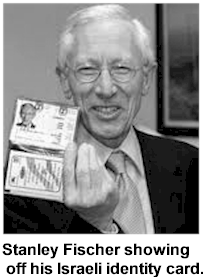
Stanley Fischer: A Dual U.S./Israeli Citizen and Pro-Israel Activist as Vice-Chair of the Fed

fische1Grant Smith, writing at Antiwar.com provides an enlightening account of the nomination of Stanley Fischer as Vice-Chair of the Federal Reserve (“AIPAC’s Fed Candidate Stanley Fischer on a Warpath against Iran: Dual-citizen nominee’s lifetime benefit to Israel comes at a heavy cost to America“). When I first read that Fischer was a possibility, my only thought was something like “Can’t we find anyone who’s not Jewish to fill a post like that?” After all, the Chair of Federal Reserve has been Jewish since 1987, Janet Yellen, the present vice-chair, will likely be the next chair, and Yellen’s predecessor was Donald L. Kohn.

And one would think that appointing an Israeli citizen —and a high-level one at that (former head of the Israeli Central Bank and likely on a first-name basis with everyone who matters in Israel) — would raise all kinds of red flags about old-fashioned issues like dual loyalty.

But there is much more to the story. Fischer, it turns out, will be AIPAC”s man at the Fed.  Smith notes that

as Bank of Israel governor, Stanley Fischer played a central role in coordinating the implementation of AIPAC-generated sanctions against Iran—ostensibly over its nuclear program.  Stuart Levey, the head of the U.S. Treasury Department’s division for “Terrorism and Financial Intelligence,” an office created after heavy AIPAC lobbying, met often with Fischer in Israel alongside the Prime Minister, Foreign Minister and chiefs of both the Mossad and Shin Bet to explore how to “supplement” UN sanctions and end-run Russian and Chinese opposition.[v]  The Levey-Fischer strategy was “to work outside the context of the Security Council to engage the private sector and let it know about the risks of doing business with Tehran” particularly against European banks that had only partially drawn back their business dealings with Iran.  In 2010, Israel dispatched Fischer to meet with Chinese and Russian “counterparts” in order to financially isolate Iran.[vi]

Smith’s phrase “ostensibly over its nuclear program” is beautifully suggestive. The fact is that Israel has many reasons to want a destructive war with Iran besides the putative nuclear weapons program—its support of Hezbollah, its alliance with Syria, its hostility toward Israel, and simply the fact that it is an energy-rich, technologically sophisticated neighbor with a population of around 75 million and regional ambitions. Israel would love to crush a rising rival power in the region before it becomes too difficult. Read more

Freedom of Association and the Right of Exclusion: The Rights Before All Others, Part 3

Part 1
Part 2

The Legal Landscape

American law deals frequently and expansively with the topic of race[1]. The Constitution itself has three amendments that implicate race.  The 13th Amendment outlaws slavery, though it does not explicitly mention race.  The 14th Amendment requires governments to give citizens the “equal protection of the laws.”  It also does not mention race, but it plainly forbids many imagined government treatments of race — say, a state law prohibiting Asians from owning property or setting different punishments for different races for the same criminal act.  The 15th Amendment forbids both federal and state (and by extension, local) governments from prohibiting anyone from voting for racial reasons (“race, color, or previous condition of servitude”).  The Voting Rights Act, absurdly applied though it is, is a good example of racial legislation based on the 15th Amendment.

Brown v. Board[2], because public school segregation was at issue, is a good example of a case decided under the 14th Amendment.  The “separate but equal” defense, it should be noted, was perfectly Constitutional, but the true inequality between Blacks and Whites was exposed:  an all-Black school, by virtue of lower Black IQ and behavioral differences, was bound to be a shabbier environment, and it was imagined that the by the alchemy of shoulder-rubbing with White students, Blacks would by osmosis become smart, well-behaved little versions of Whites.

The 14th Amendment, however, has a “state action” requirement:  the racial discrimination must be accomplished by the government for it to be illegal.  In the Supreme Court case of Shelley v. Kraemer[3], the court managed to wrangle in the “state action” requirement by declaring that two private parties, battling over a racially exclusive covenant in the sale of a home, had created state action by merely seeking enforcement of that right in a state court.  A decision like this shows the depths to which courts will sink to defeat a White right of association. Read more


