
Featured Articles

Desdemona’s “Just Understanding” of Othello’s Virtue
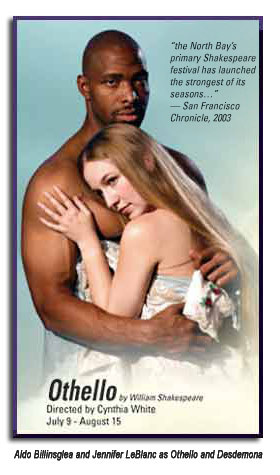
Othello_MSC2004Editor’s note: A theme of TOO is that the entire culture of the West has been corrupted. This includes essentially all the arts and academic fields in the social sciences and humanities. It is therefore not surprising that Shakespeare criticism has been influenced by the reigning culture of the academic left. This essay is an abbreviated version of the second chapter of George F. Held’s ebook, Othello’s Disenchanted Eye, available at Lulu. Held shows that Othello, a play about an interracial marriage, has been seen through the eyes of current racial sensibilities.

I have stated elsewhere[1] that Othello is an “ethically lucid play.” I stand by that statement, but will now provide evidence which will to some extent undermine it. The play, though generally lucid, is not simple, and has been subject to gross misinterpretation. In his introduction to the play Frank Kermode writes:

His marriage to Desdemona, founded upon her just understanding of his virtue, is a triumph over appearances; it is grounded in reality and independent of such accidents as color or the easy lusts of the flesh; it is more like the love of Adam and Eve before than after the Fall. The archaic grandeur of Othello’s diction (as in the long speeches to the Senate in I.iii) and the extreme innocence of Desdemona (as the courtly Cassio expresses it in II.i) are ways of emphasizing these simple themes; one may see them ideally reflected in the music which Verdi wrote for Otello’s heroic entry, and the soaring purity of his Desdemona. . . .

There is room for another and more worldly view of the honesty of Desdemona’s proceedings; Iago and Brabantio express it. Her penetrating to the truth of Othello under an appearance conventionally thought repulsive can seem less a result of her purity of response than of some pagan witchcraft of his. It is precisely because such a union must appear to the disenchanted worldly eye perverse or absurd that Iago can destroy it. He represents a sort of metropolitan knowingness, a pride in being without illusion and a power to impose upon others an illusory valuation of himself. He converts to his own uses all the praise of honesty which properly belongs to Othello and Desdemona.[2]

Kermode sees the play in terms of a dichotomy involving two opposing groups: the first group consists of Othello and Desdemona, the second of Iago, Brabantio, and all those disenchanted with Othello’s and Desdemona’s union. The views of the members of each group[3] are similar to each other but differ substantially from those of the members of the other group. Specifically, the members of the first group adopt an unworldly, just, accurate view of race, color, Othello’s “virtue,” and “the honesty of Desdemona’s proceedings,” whereas the members of the second group adopt an unjust and inaccurate “worldly view” of all these same things. The views of the members of the first group are the result of their desire and ability to see reality as it is and to look beyond mere appearances; the views of the members of the second group are the result of convention and prejudice.[4] I will show that this analysis is not merely oversimple but entirely bogus and is itself a product of modern politically correct prejudice. Read more
Ulrichsberg: A Memorial Place or a Road Sign to New Catastrophes?

ulrichsberg


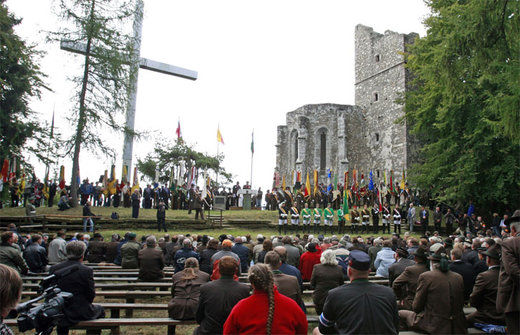
What follows is my translation into English of my featured speech, delivered in the German language on September 15, 2013, at Ulrichsberg, a village near the town of Klagenfurt, Carinthia, Austria, during the annual Memorial Day for the victims of communism and the victims of the Allied persecution in the aftermath of WWII.  The event was organized by the Austrian veterans’ organization Ulrichsberggemeinschaft. (Carinthia  was the last line of the  Axis defense by mid-1945,  before the surrender to British troops and mass deportation of civilians and soldiers to the Soviet Union and Yugoslavia. The famous term, the “Iron Curtain” became then the hall mark of Carinthia).

Approximately 300–400 hundred people, mostly elderly, attended this open air event, mostly post-WWII German expellees from Eastern Europe, dozens of former Waffen SS and Wehrmacht veterans, including the descendants of other European Waffen SS units and other foreign auxiliary Axis troops from France, Italy, Hungary, Byelorussia, Croatia, Romania, Flanders, Wallonia, and Alsace. There were also a dozen representatives from Great Britain, Australia and the USA. The Ulrichsberg memorial day has a strictly commemorative purpose; any unconstitutional insignia any glorification of Nazism or Fascism is considered a serious breach of law and severely punished under the Austrian legislation. The annual event is partly sponsored by the local government of Carinthia.  In 2000, the featured speaker at the Ulrichsberg event was the late leader of the Austria’s FPÖ, Jörg Haider. Read more

Paul Gottfried and Claes Ryn on Leo Strauss

The academic life is probably like many careers in that ultimately you have to find an audience. Professors spend months or years on a major project, then try to get it published in the best possible venue. Then they hope for positive reviews and, ultimately, acclaim and influence. I suspect that if one did a study based on exit interviews of academics as they retired from the profession, not a few of them would express the feeling that the game was somehow stacked against them—that their work did not get the attention it deserved, that it should have been discussed in all the elite intellectual venues—the New York Times Book Review, the New York Review of Books, and ultimately, perhaps, become assigned reading in college courses everywhere. They should have been somebody.

Lots of academics probably feel this way, but no one has so explicitly expressed it quite like Paul Gottfried has. In his recent VDARE.com piece, “Claes Ryn, Allan Bloom, Leo Strauss, and Me,” Gottfried is clearly frustrated. He managed to get his book, Leo Strauss and the Conservative Movement in America, published by an elite academic publisher, Cambridge University Press—no mean feat. But intellectual fame and fortune haven’t happened, and Gottfried is not pleased:

I shall lay my cards on the table. I am outraged at how the usual suspects kept my book from being discussed. Despite my well-known views on certain delicate subjects, I tried to produce a fair study of a difficult topic and bent backward in showing sympathy for the movement’s founder and at least some of his disciples. The successful attempt to white out my work has annoyed me no end.

In order to explain this lack of attention, Gottfried refers to Claes Ryn’s  “Allan Bloom and Straussian Alienation“:

The arguments marshaled by [Claes] Ryn indicate, as does my book, why Straussians reign in the NYT’s Sunday Book Review Section as well as in Conservatism, Inc. Although Ryn does not make this last point explicitly, perhaps for fear of reprisal, a fuller explanation is at least implicit in what he does tell us. His comments may also explain why my book, initially marketed by Cambridge with high hopes and considerable promo, received absolutely no attention in the national Main Stream Media.

For fear of the Straussians.

So how have the Straussians been able to dominate all the high ground of American culture? And in particular, how they have managed to completely co-opt what passes for conservatism? These questions are not really answered by either Gottfried and Ryn, but there are hints. Both emphasize that Straussian ideology has functioned to pave the way for a new elite with no ethnic or cultural ties to the old elite by conceptualizing America as a proposition nation without specific ethnic or religious roots. Given the very large role of Jewish intellectuals among the new elite, the motivation is obvious: If one doesn’t share the ethnic, religious, and historical roots of a society but wants to be accepted as the new intellectual elite, then define the society as having no ethnic, religious, or historical roots. Ryn notes that

the desire to have America be something different from its historical past and to make it perhaps also more palatable to an aspiring new elite is probably most evident and explicit in Bloom’s fellow Straussian Harry Jaffa. Jaffa has made a career of asserting that America must not, repeat, not, be understood as owing anything of importance to an old historical heritage. It must be seen as born out of a radical break with the past and as based on abstract principles of an essentially Lockean cast—Lockeanism understood concomitantly as a departure from earlier thought.

The subterfuge of the Straussians was to attempt to locate this proposition culture in the deep wellsprings of Western culture in order to make it more palatable to conservatives, a position that required them to completely disregard normal standards of scholarship. Thus Plato is presented as an ardent democrat. Ryn:

Allan Bloom contends that Plato, whose iconic status and authority he would like to invoke on behalf of his own beliefs, is markedly different from how a long tradition of classicist scholarship has understood him. Contrary to all appearances, Plato is not scornful of democracy and democratic man. He is a democrat in disguise.

Indeed, in the hands of the Straussians, all of Western philosophy comes down to alienation from society and from tradition—an odd proposal to say the least, and here Ryn also mentions the Frankfurt School as completely on board with the Straussians. The tension arises from the fact that rejection of society and tradition are usually considered to be of the left. As Ryn notes,  “in their disparagement of tradition [they] resemble the open, unqualified left.” In place of tradition and ethnic or cultural particularity, these philosophers opt for universalist abstractions in which the White race or Christianity are excluded as significant categories. Read more

O Lobby Israelense e a comunidade judaica organizada querem mudança de regime na Síria

Tradução e i
O presidente Obama agora está dizendo que sua administração decidiu atacar a Síria mas vai buscar a aprovação do Congresso para fazê-lo. Isto cria uma situação realmente interessante se o Congresso não concordar, como parece bem possível.
A ideia de Obama ordenar um ato de guerra contra a Síria sem apoio internacional significativo e sem um mandado do Congresso sempre foi uma coisa espantosa. Eis aqui nosso presidente de extrema-esquerda advogando mais outra guerra no Oriente Médio depois de se opor à guerra no Iraque quando era senador. O mesmo presidente que tem uma relação gélida com Benjamin Netanyahu e repetidas vezes ficou aquém das exigências do lobby israelense.

NKVD: Excerpt from Sergei Semanov, The Russian Club

Editor’s note: The horrific events of the first decades of the Soviet Union are an object lesson in the likely consequences of an ethnic majority being ruled by ethnic outsiders, especially ethnic outsiders with historical grudges. As discussed repeatedly on TOO, the West is entering a very dangerous period because its elites have shown repeatedly that they are hostile to its traditional people and culture and that a major aspect of the strategy of these elites is to import millions of ethnic outsiders, lessening the power of European-derived majorities, encouraging non-assimilation, and thus setting the stage for a very grim future for the traditional peoples of the West.

Nationalities of NKVD Purge Officials Identified

By Sergei Semanov

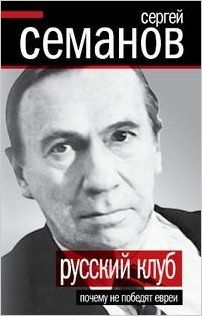
Translated and edited by Dan Michaels from Sergei Semanov, The Russian Club: Why the Jews Will Not Win. Algoritm Publisher, Moscow, 2012, pp. 169-179.

Following is the official list of the most notorious NKVD officials operating during the Stalinist purges (1934-1938) under Yagoda and Yezhov. By the time Beria took charge of the NKVD in 1940 hardly a single individual from the original list remained alive. On Stalin’s order, most of the purgers were – in time – themselves purged, thereby leaving no witnesses to incriminate the top political leaders.

In November 1935 NKVD agents were assigned military ranks, like those in the Red Army. Yagoda, the head of the NKVD, was the only official to receive the highest SS (State Security) rank of marshal-general, the others received “general” ranks, i.e., SS Commissar of the 1st, 2nd, or 3rd ranks. The following individuals initiated and conducted the Great Purge from 1936 to 1938, but by 1941 only two of the original purgers still remained alive and Stalin was at liberty to replace the NKVD leadership with Beria’s Georgian mafia. Read more

Sergei Semanov and the “Russianists”

semanovRecently deceased Sergei Semanov (1934–2011), Russian writer and editor, was at times in his life a Stalinist, a critic of the post-Stalinist Soviet governments, an historian, and a public political commentator closely associated with the nationalist Russian political parties and the Russian Club, all of which peaked in popularity in the late 1960s under General Secretary Leonid Brezhnev. The Russian people generally approved of Brezhnev’s 18-year rule (1964–1982). Although known derisively in the West as a period of stagnation, it gave the people time finally to take stock of Russia’s postwar position in the world and plan for a future such as circumstances would permit.

However, even these early subdued expressions of the Russian people’s desire to influence the governance of their country ended abruptly when newly appointed Secretary General Yuri Andropov, an enemy of the nationalists whom he called “Russianists,” had Semanov arrested, interrogated in Lefortovo prison, removed from all his editorial and writing positions, and threatened with expulsion from the Party for the crime of propagating dangerous, possibly treasonous nationalist ideas.

Following the deaths of Stalin and Beria and the gradual disappearance of the military heroes of the Great Patriotic War, the USSR was obliged to choose new leaders to manage the affairs of the Russian State in the nuclear age. Unfortunately, because of the enormity of the wartime destruction and the dearth of energetic youthful Party leaders possessing even a fraction of the stature and authority of Stalin, the Soviet Union found itself lacking strong leadership. Although many native Russian intellectuals personally despised Communism, they nonetheless continued to support it as State doctrine for fear that many of the peripheral countries taken over hundreds of years by the Imperial Russian Empire would break away from Moscow if the combined centripetal forces of Moscow, the Party, and State security were not kept strongly in evidence. This façade of the all-powerful USSR was retained as a protective shield even though Russia was bereft of strong leadership, an effective economy, a reliable agricultural base, and a unified nation.

The enigmatic subtitle of Semanov’s posthumous The Russian Club: Why the Jews Will Not Win refers to a clandestine society of Russian intellectuals – members of the so-called Russian Club.[1] Semanov was one of the Club’s founding officers who met weekly from the 1960s to the early 1980s to discuss the existing state of native Russian cultural and political affairs, often critical of the official Marxist government positions. So influential had the Russian Club become by 1981 that it can take some credit for the collapse of Communism. Read more

The United States of Syria: Domestic Lessons in a Distant War

Description and Prediction. It’s a richly vibrant police-state. It’s ruled by a paranoid, self-pitying minority. The minority is trying to crush a rebellion by the dispossessed majority. That is a description of Syria. It’s also a prediction for the United States, the United Kingdom, France and other Western nations. The mainstream media are talking a lot about Syria nowadays. But one thing you won’t hear from the mainstream is this: the civil war in Syria demolishes the Three Great Lies on which the modern West is founded.
Lie #1: Diversity Is Our Strength. Syria is a very diverse country, full of different ethnic and religious groups who have a long history of conflict and mutual hatred. That’s why it has to be a police-state: only harsh repression keeps the different groups from each other’s throats. At present, Bashar al-Assad is fighting to maintain his tyranny. His enemies are fighting to replace it with their own tyranny. And some would be happy to keep the pot boiling:

“Our ‘best-case scenario’ is that they continue to busy themselves fighting each other and don’t turn their attention to us,” an Israeli intelligence officer told BuzzFeed’s Sheera Frenkel. “Better the devil we know than the devils we can only imagine if Syria falls into chaos and the extremists from across the Arab world gain a foothold there,” the officer said. (The Horrifying Secret Of Syria Policy, Buzzfeed, 9th September, 2013)

Lie #2: Minorities Are Saintly Victims. Liberal organizations like Amnesty International have been protesting for decades against the repression and torture used by the Syrian dictators Hafiz al-Assad and his son Bashar. But they don’t mention that the repression and torture are natural consequences of minority control. Since the 1960s, Syria has been ruled by members of a small and impoverished Shiah sect called the Alawi, who have a long history of persecution by the Sunni majority. When they came to power, the Alawi did not forgive, forget and govern for the benefit of everyone. Instead, they took the opportunity to enrich themselves and to persecute in their turn. The cycle of repression and resentment has inevitably ended in civil war. And if the rebels win, the prospect is for expulsion and genocide:  “Christians to Beirut, Alawites to the grave.Read more



