Traduction en français à partir de la version en anglais de Michael Colhaze.
Note de la rédaction: Cet article de Freeman montre qu’en dépit de la présence des nationalistes de Svoboda au nouveau gouvernement ukrainien, son président Arseniy Yatsenyuk (qui compte trois grand-parents ethniquement juifs) est fermement lié aux néoconservateurs, aux intérêts économiques occidentaux, et à des personnalités éminentes elles-mêmes liées au mouvement d’hostilité envers la Russie.
Depuis le 27 février 2014, Arseniy Yatseniouk est le “premier ministre” du régime illégal actuellement en place en Ukraine. Comme nous l’a appris la conversation téléphonique interceptée entre Nuland et Pyatt, Yatseniouk est le candidat préféré de Victoria “Fuck the UE” Nuland, ce qui explique pourquoi le Département d’État des États-Unis l’a propulsé à la tête du putsch.
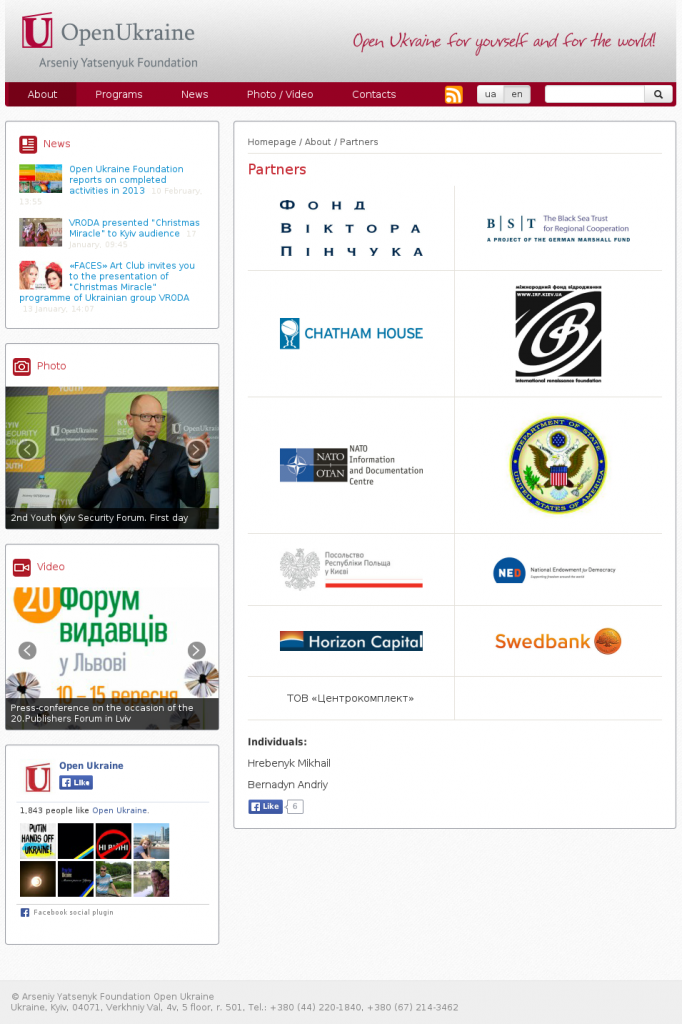
Saviez-vous que M. Yatseniouk avait une organisation nommée l’ “Open Ukraine Foundation” [Fondation pour une Ukraine Ouverte] ? Si vous le saviez, vous allez être surpris d’apprendre que toute trace de cette fondation vient d’être éradiquée d’Internet. Le site de la Fondation Arseniy Yatseniouk (openukraine.org) et sa page Facebook (https://www.facebook.com/pages/Open-Ukraine-Foundation) ont carrément disparu. L’entrée Wikipedia existe toujours, mais les liens ne mènent nulle part.
Comme tout le monde le sait, Internet n’oublie rien, et il reste possible d’examiner une capture d’écran du site. Et qu’y voyons-nous ? La liste des partenaires de la fondation. Son examen révèle à l’observateur ébahi un beau regroupement des suspects habituels. Suspects qui, nous le soupçonnons fortement, expliquent pourquoi la fondation est maintenant défunte, et ses traces oblitérées.
Un extrait de la liste des partenaires :
– Black Sea Trust for Regional Cooperation (A Project of the German Marshall Fund)
– Chatham House
– NATO Information and Documentation Centre
– State Department of the United States of America
– NED National Endowment for Democracy
– Horizon Capital
– Swedbank
Avec de tels partenaires, et vu le scénario actuel, il n’est pas étonnant que la page ait été supprimée. Car on voit parfaitement qui se tient derrière M. Arseniy Yatseniouk, et derrière le coup d’État.
Commençons par le German Marshall Fund, dont le Président est Guido Goldman. Son père, Nahum Goldman, fut co-fondateur du Congrès Juif Mondial, président de l’Agence Juive, et président de l’Organisation sioniste mondiale. Guido a étudié à Harvard, et l’un de ses professeurs était l’ancien conseiller présidentiel à la sécurité Zbigniew Brzezinski. C’est Henry Kissinger qui plus tard a supervisé la thèse de doctorat de Guido. Les contributions financières au German Marshall Fund ont été approuvées par l’ancien ministre allemand des Finances Alex Möller. Ce dernier, à l’occasion du 25e anniversaire du Plan Marshall, a attribué au German Marshall Fund une dotation de 150 millions de marks sur 15 ans, sous prétexte de promouvoir les relations entre l’Europe et les États-Unis.
Rien que cela est très révélateur, car on trouve ici les noms de quelques-uns des plus virulents contempteurs de la Russie.
Mais penchons-nous sur Chatham House. Cette Fondation, créée en 1920, connue jusqu’en 2004 sous le nom de l’Institut royal des affaires internationales, est un groupe de réflexion britannique basé à Londres. C’est une institution privée de renommée mondiale, dont les membres discutent des questions actuelles et des évènements politiques au niveau international à travers des programmes d’études, des groupes de travail, des tables rondes, des conférences et des séminaires. Les recommandations et avis d’experts qui y sont élaborés sont disséminés à travers le monde par ses membres internationaux. Certains projets clés sont financés et parrainés par la Fondation Rockefeller, la Fondation Bill & Melinda Gates, la Fondation Konrad Adenauer, ou par l’OTAN ou l’Union Européenne. En plus des sociétés membres, qui comprennent 75 grandes sociétés, des banques d’investissement, des entreprises du secteur énergétique, ainsi que 263 autres sociétés, Chatham House compte actuellement parmi ses membres 2770 personnes influentes originaires de 75 pays, qui travaillent toutes dans les affaires, la diplomatie, la science, la politique et les médias. Parmi les sponsors de Chatham House se trouve la Reine Elizabeth II.
Cela ferait presque penser à une blague absurde, si ce n’était aussi extraordinaire. Car maintenant, nous voyons clairement pourquoi il s’est produit un bouleversement en Ukraine: ce sont les suprêmes gros-bonnets de la soi-disant élite mondiale qui l’ont voulu.
Les dirigeants de l’OTAN voulaient intégrer l’Ukraine à leur club de guerre, afin que les missiles puissent être déployés encore plus près de la Russie. En 2008 le secrétaire général de l’OTAN Jaap de Hoop Scheffer, avait rendu visite à Arseniy Yatseniouk et à sa Fondation.
Le Département d’État des États-Unis a grandement aidé au putsch, comme déjà mentionné en ce qui concerne Victoria Nuland et son désormais célèbre juron. En distribuant des moyens financiers massifs, le Département d’État a décidé quels hommes de paille pouvaient ou non rejoindre le régime. Si bien que ce balourd de Vitali Klitschko a été sélectionné à la courte paille, comme le voulait l’abominable Nuland.
La NED ou National Endowment for Democracy est une fondation américaine dont l’objectif déclaré est de promouvoir la démocratie dans le monde entier. Il s’agit d’un [groupe paraventdes néoconservateurs] fondé en 1983 par le Congrès américain, et qui reçoit son financement annuel du budget fédéral des USA. Ainsi l’argent directement pompé sur le contribuable américain est détourné pour servir au changement illégal de régime en Ukraine et dans de nombreux autres pays.
Cette toile de fond est très révélatrice. Lorsque des fonds spéculatifs [Hedge Funds] et des banques comme Horizon Capital et Swedbank se trouvent affiliés à la fondation de Yatseniouk, il est clair qu’on a affaire à des vautours qui attendent de pouvoir piller l’Ukraine.
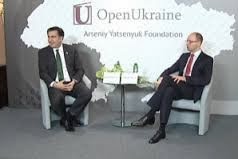
L’un des bons amis d’Arseniy Yatseniouk et de sa Fondation est Mikheil Saakashvili, l’homme de paille mis en place par Washington [voir ici et ici] , et autorisé à jouer au Président de la Georgie de 2004 à 2013. Les dernières nouvelles concernant sa personne semblent prouver que c’est aussi un meurtrier. Selon le journal georgien Asawal – Dasawali, il a été impliqué dans la mort de l’ancien Premier ministre georgien Zourab Jvania. D’après ce journal, qui cite une source proche de l’enquête, le Bureau du Procureur de Tbilissi a découvert la preuve de la complicité directe de Saakachvili, avec un enregistrement secret où l’on entend la voix audible de Saakachvili ordonner: “Enlevez le cadavre et faites comme convenu”.
Oui, ce distingué “partenaire” était bien un habituel invité d’honneur de feu l’Open Ukraine Foundation, d’Arseniy Yatseniouk. Ce qui est inhabituel, c’est que même dans le cache de Google, on ne trouve plus rien à ce sujet.
Nous comprenons maintenant pourquoi Arseniy Yatseniouk a été installé à la tête du “gouvernement” ukrainien par Merkel et Cie, l’Union Européenne, l’OTAN et Washington. Il est simplement le nouvel homme de paille qui sert à avancer leurs intérêts en Ukraine, et certainement pas les intérêts du peuple ukrainien.
Texte d’origine posté samedi 8 mars 2014 par Freeman, éditeur du blog Rien que du Bruit et de la Fumée