Featured Articles

Our Weapon: The Truth

Some of our people seem to regard honesty as an impediment. More than that, they think it is clever, having ascertained the crooked practices of some of our racial adversaries, to do as they do. This is a wrong attitude.

The tactics that have been used by our enemies will not always work for us. This is, in the first place, because what our enemies have been doing is not what we are trying to do. Tactics that will work for corrupting and weakening a people are often not applicable for the opposite purpose.  In the second place, we and our supporters are not like our enemies. We are a different kind of people with a different character. While Jews and Blacks and other non-White groups will put group-solidarity ahead of truth, the best of our people will only support a spokesman if he tells the truth. Finally, we can only have a significant impact with our small voice if what we say carries weight. We have to cultivate credibility; otherwise there will be no reason to trust what we say over and against the all-pervasive propaganda of the anti-White mass-media.

Counter-Propaganda

There are two different phases of the truth that we have to tell. The most fundamental truth for us will consist in debunking the system’s propaganda, to the extent that we can do this convincingly based on credible sources. Read more


Kevin Costner’s Mr. Brooks: Smart, White and a Serial Killer

In the 2007 psychological thriller Mr. Brooks, Kevin Costner stars as the eponymous Mr. Brooks, a wealthy and accomplished White American male. The film begins with him receiving an award for Portland, Oregon, Man of the Year, whereupon he thanks his faithful and attractive blonde wife. Mr. Brooks looks good in his tuxedo and exudes an enviable air of restrained confidence, quiet reason, and generous compassion. He’s a  Christian, an American man in the prime of life, a role model for those with traditional American values.

He is also an inveterate serial killer. Read more

Enslaving White Women: The Phenomenon of the Alien ‘Loverboy’ in Holland

One of the darkest chapters of multiculturalism in Holland is the enslavement of White women by immigrant men, mainly Muslims (see also “Pakistani family networks prey on White girls in the UK“). The current antiracist discourse makes White parents and their daughters blind to the dangers of foreign men. Since the 1990s the luring of Dutch women into prostitution by young foreign males has been documented and is worthwhile for a wider audience than the Dutch-speaking countries.

Immigration, women and group behavior

In the prevailing Islamic culture among the majority of Dutch immigrants (Turks, Moroccans), a woman should be a virgin until marriage and it is customary to marry with the consent of the parents and within the same ethnic group. Islamic immigrants have a very high rate of marriage within the same ethnic group despite the fact that the third generation has grown up in Holland. In 2001 between 90% (Turks) and 95% (Moroccans) marry within the own ethnic group. In 2007 (gelijke herkomst = common descent) and 2010 (allochtoon = foreign) the figures are not much different. When we look at those figures it should also be taken into account that word ‘autochthonous’ only says something about crib and not about creed.  Read more

Altruism’s Bloody Roots: Cultural and Genetic Selection for Altruism in Humans

Altruism and the question of group selection continue to generate heated debate among biologists. Because there are so many misunderstandings of these issues, it’s worthwhile discussing how they relate to my writing on group evolutionary strategies. A recent paper, by Sam Bowles, “Altruism’s Bloody Roots“, argues that group selection could have evolved among humans as a result of between-group competition. Bowle’s paper is based on data showing high rates of violence and genetic variation in Stone Age groups. A computer simulation showed that selfless groups eventually predominated over groups composed of selfish individuals. (Another recent paper, co-authored by E. O. Wilson, rejects the now traditional idea that kin selection is the root of eusociality—social forms in which animals like bees and humans have division of labor and altruism [see here]. This is compatible with Bowles’ results, but goes quite a bit further in its rejection of kin selection and is not necessary for the following discussion.)

Bowles’ model is explicitly compatible with cultural group selection. The theory of group competition presented in the first chapter of A People That Shall Dwell Alone: Judaism as a Group Evolutionary Strategy is phrased in terms of cultural group selection. That is, the theory does not depend on genetic tendencies toward altruism, but rather on the ability of humans to monitor and punish free-riders and defectors. This is not merely theoretical. For example, traditional Jewish groups had strong internal controls that enforced group-oriented economic behavior (e.g., not competing with monopolies controlled by other Jews; Ch. 6 of PTSDA) and punished “informers”—the practice of Mesirah which  prohibited informing on other Jews to the non-Jewish authorities. Mesirah continues to operate in the contemporary world, particularly among Orthodox and Haredi groups—a recurrent theme on TOO. Read more

It’s the Demographics, Stupid!

Michael Moran, Expert

The paranoid worldview holds that secretive global elites who know the score are plotting world domination at their shady little international conferences. Personally, I believe this is only partially true. There’s definitely a cabal of global elites and they’re definitely plotting world domination, but I’m not convinced they know the score. I suspect they not only write the clueless drivel shoveled out by the New York Times and Wall Street Journal editorial pages–they believe it, too!

Michael Moran, a leading luminary in the internationalist Council of Foreign Relations, fancies himself to be an “analyst of international affairs”. His most recent analysis is It’s the Politics, Stupid! The basic thesis is that America’s biggest problem isn’t its economic crisis but rather its political crisis.

Much has been made of the depth of the economic crisis facing the United States, and it should not be underestimated. But only about 30 percent of the trouble facing the U.S. today is economic — the U.S. economy, compared with all the other developed economies, is in the best structural and demographic shape to weather this storm and ultimately regain its health. But a cancer does exist: The real problem America faces is political, and once again today, it is on stark display.

What happened today? The “super-committee” delegated by Congress to resolve the latest budget impasse admitted failure. Nobody doubts that the American political scene is becoming increasingly polarized, paralyzed, and radicalized. For this priest from the Church of the Status Quo, supporting radical political change is heretical. For Mr. Moran, what the world needs is more “moderates”, this seemingly interminable problem of America declining and failing on every front could be solved if we only had more “respectable” people lining up to vote. Read more

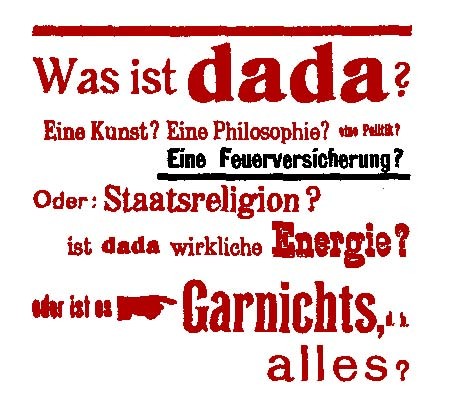
Tristan Tzara and the Jewish roots of Dada, Part 4

The destructive legacy of Dada

Dada’s destructive intellectual and cultural influence has proved to be seminal and long-lasting in at least three ways. First, as Dempsey points out, Dada’s notion that “The presentation of art as idea, its assertion that art could be made from anything and its questioning of societal and artistic mores, irrevocably changed the course of art.”[i] As Dickerman notes, looking at the output of Dada from its various centers of production emphasizes the degree to which it coheres

around a set of strategies — abstraction, collage, montage, the readymade, the incorporation of chance and forms of automatization — so foundational for the rest of the century that today we have to struggle to recognize their historical novelty. [Together these media] signal an assertive debunking of the ideas of technical skill, virtuoso technique, and the expression of individual subjectivity. … Dada’s cohesion around these procedures points to one of its primary revolutions — the reconceptualization of artistic practice as a form of tactics.”[ii] [These tactics consisting variously of] intervention into governability, that is, subversions of cultural forms of social authority — breaking down language, working against various modern economies, willfully transgressing boundaries, mixing idioms, celebrating the grotesque body as that which resists discipline and control.[iii]

Dada’s iconoclastic force had enormous influence on later twentieth century Conceptual art. Godfrey notes that “Dada can be seen as the first wave of Conceptual art” which exercised an enormous influence on subsequent art movements. [iv] In the late 1950s and 1960s, in opposition to the then dominant Abstract Expressionism and Post-Painterly Abstraction, Robert Rauschenberg and Jasper Johns resurrected the Dadaist tradition, describing the works they produced as “Neo-Dada” — a movement that, together with the “pre-emptive kitsch” of Pop Art, effectively relaunched the Conceptual art of the original Dadaists, and which has plagued Western art ever since. Read more

Tristan Tzara and the Jewish Roots of Dada, Part 3

Dada in New York

According to Marcel Duchamp’s own account, in late 1916 or early 1917 he and Francis Picabia received a book sent by an unknown author, one Tristan Tzara. The book was called The First Adventure of Mr. Antipyrine and had just been published in Zurich. In this work Tzara declared Dada to be “irrevocably opposed to all accepted ideas promoted by the ‘zoo’ of art and literature, whose hallowed walls of tradition he wanted to adorn with multicolored shit.”[i] Duchamp later said: “We were intrigued but I didn’t know who Dada was, or even that the word existed.”[ii] Tzara’s scatological message was the catalyst for the establishment of the antipatriotic and anti-rationalist Dada message in New York, and it may well have informed Duchamp’s decision to submit his infamous Fountain to the Society of Independent Artists in New York.

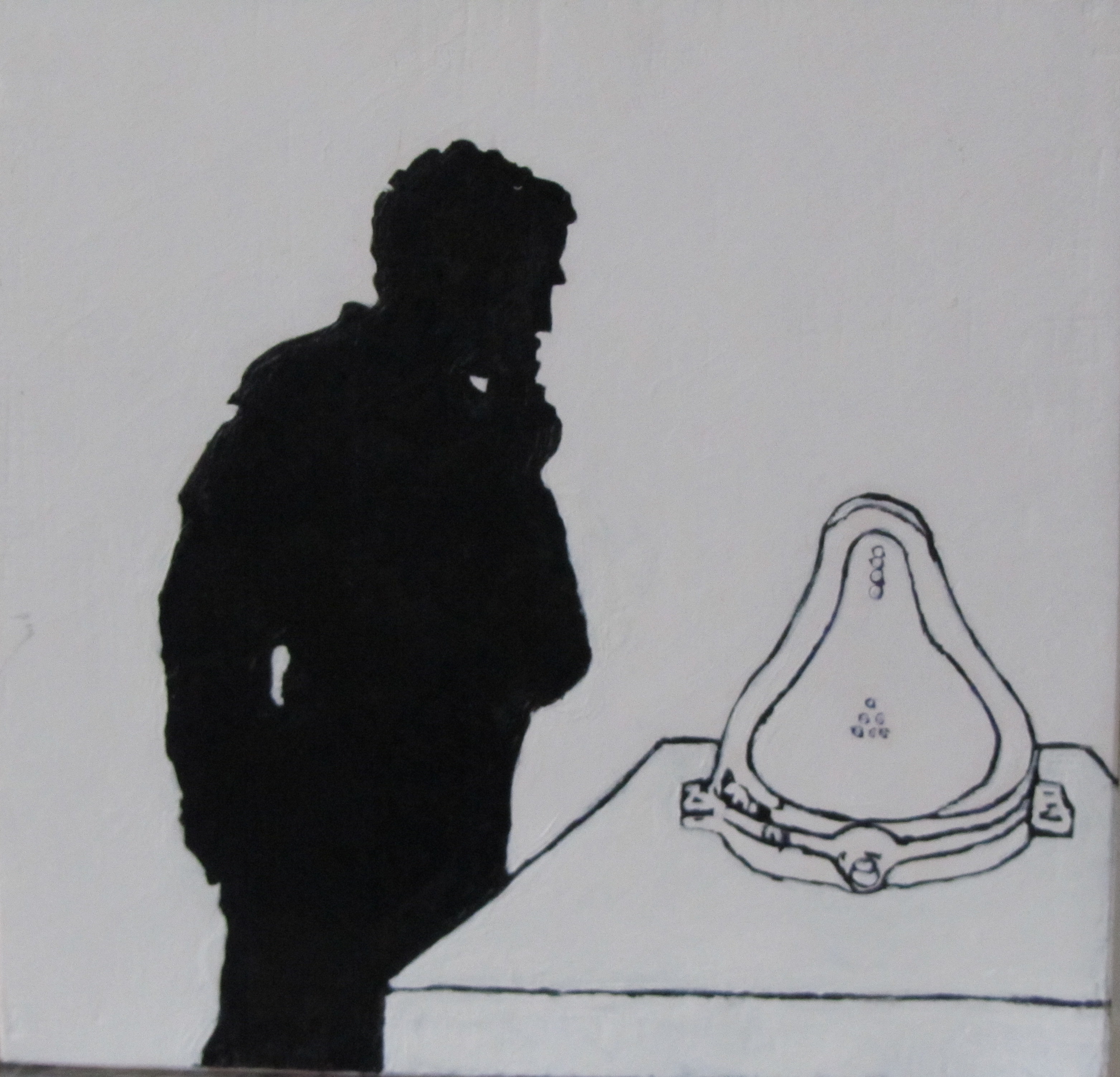
In February 1917 Duchamp famously sent the Independent an upside-down urinal entitled Fountain, signing it R. Mutt (famously photographed by Alfred Stieglitz). By doing so Duchamp directed attention away from the work of art as a material object, and instead presented it as something which was an idea. In doing so he shifted the emphasis from making to thinking.

Duchamp later did the same with a bottle rack and other items. Through subversive gestures like these he parodied the Futurist machine aesthetic by exhibiting untreated objets trouvés or readymade objects. To his great surprise these became accepted by the mainstream art world. Read more