Featured Articles

Why Did Churchill Have Britain Fight On After Summer 1940? It’s Bad News.

C’est magnifique, mais ce n’est pas la guerre. (It is magnificent, but it is not war)
     French General Pierre Bosquet, observing the charge of the Light Brigade, Crimean War October 28, 1854.

In the high summer of 1940, the politicians who comprised the British Government faced a terrible and momentous problem.

So, on a personal level, did the new British Prime Minister from May 10th, Winston Churchill. More on this later.

At the time, the British Empire is often said to have ruled a quarter of the land surface of the world and upon which the sun never set. It had an appropriate navy. The white Dominions of Canada, Australia, New Zealand and South Africa were expected to follow Britain’s lead, and indeed did.

It was a world power.

To everyone’s astonishment, the outbreak of war with Germany in September 1939 had not deadlocked in the static trench warfare of the Western Front in World War I (1914–1918).

Instead, the Germans, starting in April 1940, conquered Norway and Denmark, and then went on to conquer the Netherlands, Belgium and France. Most of the British Army was extricated from France via Dunkirk, but without much heavy equipment.

This admittedly was a stunning emotional blow to Britain’s elite, quite a few of whom (unlike their American counterparts) had fought on the Western Front in World War I and where many of whom had lost relatives.

Britain by the middle of the twentieth Century had had tremendous experience in fighting wars, in an astonishing number of countries (Wikipedia reckons 171). Quite a few of these had been unsuccessful. sometimes humiliatingly so — most notably of course the American War of Independence.

War, to the British, was a business. They were not Crusades. Sometimes you won, sometimes you lost. Then you moved on.

What was so different about 1940?

Operation Sea Lion (the German sea crossing to England) was of course in planning. But it was pro forma. It is clear from the literature that the German Navy — the Kriegsmarine — always said it could not protect cross channel transports from devastating attacks from the then enormous Royal Navy. The Luftwaffe was also not optimistic.

This must also have been the assessment of the British military (never, as far as I know, ever disclosed).

Paradoxically, Britain was probably in a less dangerous position in 1940 than during the several years in the early nineteenth century during which Napoleon controlled the Continent and threatened invasion .

The internal combustion engine had allowed air raids on England, distressing — but with no possibility of being decisive. However it also eliminated the ghastly chance that unfavorable winds would prevent the Royal Navy attacking vulnerable invading vessels. Wind had been a critical element of risk in previous crises. The two most significant successful invasions — William the Conqueror’s in 1066 and William III’s in 1688 — had been able to avoid defending warships because of the chance of wind.

What the British Government had to consider in 1940 was: Why fight on?

Britain had always been against an excessively powerful Continental entity. But this had now happened.

Britain had also in recent centuries become extremely concerned to protect its extensive overseas assets — the British Empire. France had usually been the threat to this — and so, around the turn of the twentieth century, had been Imperial Germany.

But Hitler’s Germany was not a threat. Archival evidence proves that Hitler was absolutely opposed to destroying the British Empire which he saw as a congenial component of an ideal world order. Instead, he was completely focused on the geopolitical threat from the Soviet Russia. This was known at the time.

The geopolitical threat from the Soviet Union was also — or should have been — as great a concern to the British. They had actually borne the brunt of Soviet subversion efforts in their Empire during the interwar years. National Socialism had little intrinsic appeal to the British people, oblivious as they were to the threats and problems which engendered it. But this was far from true with Communism and Socialism. Varieties of these had struck deep roots in British society. The scandalous post-war espionage revelations of the ‘Cambridge Five’ were probably just a hint of the reality.

In August 1940, Britain simply had no path to military victory. During World War I there was always the hope that the next offensive would break through (which indeed did happen in late 1918). France was never knocked out of the war. Fighting on in World War I may not have been sensible, but it was not irrational.

In 1940 this hope was gone. The idea that Britain by itself had any chance of subduing Germany in a continental land war was clearly ridiculous.

There was the alternative of seducing other countries into the war, as with America in 1917.

Experience had proved this was a highly unattractive option. America had brought much strength but little wisdom into World War I, insisting on imposing an unstable redrawing of the European map and creating dangerous problems. Furthermore she had proved a merciless and irresponsible creditor for much of the next two decades.

The fact was that the American elite was endemically Anglophobic and anti-imperialist. They were jealous of the British Empire. Confusingly this was disguised somewhat by often very pleasant interpersonal relationships. And this was before one considered the increasing influence of the tedious Irish and the newly arrived Russian Jews.

On the other hand, the Soviet Union was a flat-out proven danger. Beyond their incessant promotion of their antithetical and blood-soaked doctrines between the wars, the Russians under Stalin’s highly enterprising leadership had made war certain in 1939. By concluding the Ribbentrop Molotov Pact on August 23, 1939, they freed Hitler’s hand in Western Europe. They went on to bolster Germany by supplying large new quantities of raw materials. Even worse, the Soviet seizure of the Baltic States, a large slice of Poland, part of Romania, and a (dearly-bought) fragment of Finland removed all doubt that the USSR was additionally an aggressive predatory power in the old style.

Putting Britain at the mercy of these dangerous parties was not obviously more attractive than coming to an agreement with Germany.

However, before Winston Churchill who became Prime Minister on May 10, 1940, could think about this problem, he had a more pressing crisis to weather.

He was about to become insolvent, which would have forced his retirement from Parliament.

Churchill’s return to office in September 1939 had destabilized his always precarious finances. He could no longer hope to complete various lucrative writing deals on which he had counted. Income taxes, interest on bank loans and many personal debts were falling due at the month end. He did not have the cash to pay them.

As recounted in the extraordinary 2015 book “No More Champagne: Churchill and His Money” by David Lough, Churchill was rescued by a GBP 5,000 check from Sir Henry Strakosch, arranged by Churchill’s ‘fixer’ Brendan Bracken. At the time Bracken was co-owner with Strakosch of the famous magazine “The Economist”. (Derived from Lough’s figures, this would be about GBP 347,000 or some $410,000 today).

Lough drily comments

The amount reached Churchill’s account on 21 June. Thus fortified, he paid a clutch of overdue bills from shirt-makers, watch repairers and wine merchants before he turned his attention back to the war.[i][1]

This was not the first time nor the most desperate crisis from which Sir Henry Strakosch had rescued Churchill. In March of 1938 a collapse in the American stock market, in which he habitually speculated aggressively, brought Churchill margin calls he could not meet. He faced bankruptcy, which as noted above would have forced him out of Parliament. Both his London and Kent homes were briefly put up for sale.

But Brendan Bracken approached Sir Henry Strakosch, who paid the broker off for GBP18,000 (about GBP1.518 million or $1.765 million today). Strakosch entered into a curious and apparently unwritten agreement with Churchill for Strakosch to hold and manage the portfolio for at least 3 years, with Churchill paying GBP 800 a year in interest. There seems to have been no explicit arrangement about repayment.[2]

This rescue enabled Churchill to continue leading the anti-German faction in Parliament and the country.

So who was this Sir Henry Strakosch, whose generosity quite likely altered the course of British and World history?

Henry Strakosch, according to Wikipedia (at present), was born in “Hohenau, Austria” on May 9, 1871. Actually, Hohenau is in Germany. His parents were Jewish, a fact that Wikipedia sometimes stipulates but at this writing is repressing. (David Irving, who appears to be the first historian to realize the significance of Strakosch, thought he was born in Moravia.[3] This is now the southeastern part of the Czech Republic. If so, he was born a subject of the Hapsburg Austrian-Hungarian Empire).

Strakosch was clearly part of the highly sophisticated and cultured German-Jewish community the American manifestation of which was memorialized by Stephen Birmingham in his book “Our Crowd”.

At an early age, the decision seems to have been made to migrate Strakosch into the Anglosphere. Wikipedia says he completed his education in England and was working in the London financial district by 1891 at the age of 20. By 1895 he was employed by an entity called the Anglo-Austrian Bank of South Africa.

This involved Strakosch in the extraordinary South African gold mining boom, which had started in about a decade earlier.

To a remarkable degree, this phenomenal cornucopia of wealth was facilitated by stock market activities. To an equally remarkable degree, these quickly became dominated by emigre German Jews.

Individual mines were incubated by investment firms which became known as ‘Mining Finance Houses’. When operational, mines were introduced to the stock market with the remit to exhaust the property and maximize dividends. The whole process, unlike the otherwise analogous Silicon Valley phenomenon, was driven by dividends, frequently of enormous size.

This meant that the ‘Randlords’ were not just rich on paper. They rapidly started swimming in cash.

Strakosch became involved in the Mining Finance House of A Goerz & Co, which was renamed Union Corporation in 1918. He was Chairman from 1924 to his death in 1943. He became a British citizen in 1907 and was knighted in 1921.

In the interwar years, which he spent primarily in London, Strakosch displayed strong interest in public affairs and in political influence. Writing on the Gold Standard in the early 1920s, he became heavily involved in the affairs of India (then of course the Crown Jewel of the British Empire) from the mid ‘20s. From 1929 to 1943 he was Chairman of The Economist magazine and, as mentioned, a part owner.

At some point in the mid 30’s Strakosch began supplying Churchill with data purporting to evidence the size of the German military buildup. Where Strakosch obtained this material from is not clear. As noted, he himself had been absent from Germany all his adult life. Lough suggests his knowledge of South African trade with Germany in strategic metals may have been involved, but South Africa’s activity in these areas only really became substantial after World War II.[4]

Most likely Strakosch was the conduit for intelligence collected by anti-Nazis in Germany, very probably many themselves Jewish.

Whether this information was accurate or alarmist is also a cloudy question. In 1934–5 Churchill utilized very high claims about the rate of German aircraft production to participate in a Kennedy Missile Gap-like scare. This destroyed the political career of the Air Minister, his second cousin, the 7th Marquess of Londonderry. While British Intelligence had (probably justified) confidence in its own lower assessments, Londonderry’s ability to use espionage sources in his own defense was obviously limited.

This was the pattern of the latter 30s. Heavily armed with information from a wide range of sources, by no means all Jewish, Churchill continued as undisputed leader of the anti-German element in British public opinion. In this he was helped of course by the craven and irresponsible pacifistic line of the moderate British Left, exemplified by the Labour party.

Generally, Churchill biographers have treated this situation of financial dependence with great circumspection and conspicuous lack of interest.

In Churchill: The End of Glory  John Charmley, the harshest of Churchill’s biographers on the appropriateness of the Strakosch arrangement, displays most penetration:

So was Churchill “hired help” for a Jewish lobby, which, regarding Jewish interests as superior to those of the British Empire, was determined to embroil that Empire in a war on their behalf?[5]

Excusing himself from answering this question on the grounds that it is too dangerous, Charmley then sidesteps the issue by arguing that an anti-German stance was congruent with Churchill’s world view. It was lucrative for him to do what he wanted to do.

Recently this question of Churchill’s financial dependence on Jewish money came into the limelight by being mentioned in the Tucker Carlson/Darryl Cooper interview discussed here in The Free Press Versus Darryl Cooper for deviating from the WWII narrative by Horus Nov 13, 2024 and at greater length by Ron Unz.

Cooper actually endorsed Charmley’s assessment that Churchill’s hostility to Germany was sincere and not just a mercenary decision. Nevertheless, the Political Police were outraged, Court Historian and all-round Big Foot Niall Ferguson was ordered into action.

Fergusson’s petulant tantrum “History and Anti-History (The Free Press, or WWSG, September 5, 2024) reveals a very deficient character. He makes a fool of himself. I think he may have been drinking while writing. But the essay does indicate something very significant about the Churchill/Strakosch discussion.

Ferguson’s caption: According to Cooper, the “official story” about the rise of Hitler is as follows. Once upon a time, Germany was a “sophisticated, cultural superpower.” But then, after the First World War and the Weimar Republic “they all turned into demons for a few years, and now they’re fine again.” But that’s not what really happened.

Ferguson sneers that Cooper reads.

David Irving, whose remaining reputation as an historian was destroyed in 2000 when he was exposed as Holocaust denier in a libel case that he himself brought against Deborah Lipstadt …

and

Ah yes, of course. Churchill, the puppet of the financiers. Now why does that seem familiar? Well, because it was one of the leitmotifs of Joseph Goebbels’s wartime propaganda.

Not an argument, of course. And having lived through the Biden years, we are now well aware what politically motivated lawfare looks like.

On David Irving as an Historian, I commend Ron Unz’ definitive exculpation: The Pyrrhic Attack on David Irving

But the suspicion arises that Fergusson has to smear his way out of the Churchill financial issue because he has no other defense.

“Certainly it is more than possible that Ferguson has never heard of or read David Lough’s definitive discussion of Churchill’s finances No More Champagne. After all, Lough is not an ordained Academic! He did win an open history scholarship to Oxford where he achieved a first class degree, but then degraded to a lowly City of London career in squalid finance.”

But the facts of the Churchill/Strakosch relationship have been known for decades. For instance, William Manchester’s The Last Lion, volume 2, which lays out the matter clearly[6] (but with no analysis) was published in 1988.

Throughout his political life, Churchill seems to have been a surfer in search of the Perfect Wave. He was elected to Parliament in 1901 as a Conservative during a surge of patriotism as the Boer (South African) War 1899–1902, in which he had become a celebrity, was successfully concluding. In 1904, sensing massive socialistic reform was in vogue, he crossed the floor and joined the Liberals. He appears to have been an enthusiast for war in 1914. When the Liberals imploded after World War I, he managed to rejoin the Conservatives. In the 1930s he experimented with resisting the decision of the British Establishment to withdraw from ruling India and then with dissuading Edward VIII from abdicating. Finally, with characteristic opportunism, he fixed on leading the anti-German lobby.

In my view, the process by which Britain found itself in the terrible crisis of Summer 1940 is best discussed in Patrick Buchanan’s great book Churchill, Hitler and the Unnecessary War

All of this is beside the point. The question is: why did Churchill push Britain to fight on in 1940?

The consequences were totally disastrous. The Americans ruthlessly plundered the British Empire. At the 1943 Tehran Conference Roosevelt privately invited Stalin to take over and Sovietize India — with American help! [7] Britain was quickly forced to abandon plans to make the British Empire an economic bloc (“Imperial Preference”). It was rapidly stripped of its enormous financial overseas assets, many acquired at fire sale prices by Americans . Henry Morgenthau and Harry Dexter White (both Jewish and the latter also a Soviet Asset) also engineered the Allies into adopting the Morgenthau Plan which proposed to deindustrialize and agrarianize Germany, rendering it unable to feed its people. (Churchill, to his credit, reflexively denounced the plan as “Unnatural, unchristian and unnecessary” — but he was quickly bullied into going along).[8] This stiffened German resistance in the West, conveniently for Stalin, but in any case, it would have been a catastrophe for the European economy.

Worse, the Soviet Union was able to tyrannize Eastern Europe for half a century, causing huge suffering and inflicting much anxiety and massive expense on the West.

Too easily it can be forgotten that without nuclear weapons there is every reason to expect that the USSR would at some point have started another conventional ground war. With its enormous forces, it would very likely have conquered the rest of the Continent. Britain’s leaders in 1940 could have had no inkling such a Guardian Angel stood in the future.

Another highly predictable consequence was that the social stresses and resentments of war precipitated the election of the socialist Labour Government in 1945. Labour’s price for participating in the wartime Coalition Government had already been the imposition of many of its policy nostrums in domestic affairs. By the time the 1945–51 Labour Government ended, Britain was tightly bound in a socialistic straight jacket which crippled the economy until Mrs. Thatcher’s Administration in the 1980s.

Labour of course was only too happy to start the collapse of the British Empire with the blood-stained scuttle out of India in 1947.

All these deplorable events flowed from the decision, made in August 1940 and maintained thereafter, not to settle with Hitler.

The simple fact is that Sir Henry Strakosch had Churchill by his financial throat. Had he wished, he could probably have ruined Churchill financially and certainly have shattered his public reputation. This was not simply a matter of being a hired hand: Churchill could not easily have resigned.

That Churchill was uneasy about this relationship emerges from two events.

Not normally notably quick to pay off debts, he did repay the GBP 5,000 June 1940 Strakosch loan in the first half of 1941, as steeply rising enthusiasm for his literary properties improved his liquidity.[9] This despite it seemingly not having had any particular due date. Probably he felt it just looked too bad.

Even more dramatic is the situation revealed by the only Strakosch reference in Andrew Robert’s widely praised 1,152-page 2018 biography Churchill Walking with Destiny.

On 30 October 1943, Churchill was bequeathed GBP 20,000 … on the death of his friend the South African miner and financier Sir Henry Strakosch. The next day Marion Holmes’ diary records that Churchill was understandably ‘in high spirits. He began, but did not finish, the jingle “There was a young lady of Crewe.’ [10]

In addition, Strakosch forgave the GBP 18,000 amount of the 1938 loan.

Strakosch had died that day, so Churchill must have known of the will’s provisions in advance.

At first glance, Robert’s treatment of the Strakosch/Churchill relationship (providing no context) appears professionally negligent. And it certainly is timid. But to those who know, what Roberts did is to unpin and roll in a grenade.

What we are invited to contemplate is that the leader of the British Empire, almost two-thirds through the world war, was so riven with anxiety about what his creditor might do that he exploded with emotion when the Damoclean sword was removed.

(GBP 20,000 is about GBP 1.143 million or $1.486 million today. So the total gift from Strakosch was worth some $2.8 million. Puny by the standards of what, say, the Biden family appears to have raked in, but financial assets had gone through a 14-year deflation, not a 40-year inflation.)

David Irving, in his masterly second volume on Churchill Triumph in Adversity  discloses that two other cabinet ministers (whom he does not name) had received loans from Strakosch. This he discovered by reading the Strakosch Will, which expunged them.[11]

The depressing thing about this sorry story is that Churchill, of all men, had the wide knowledge, erudition and vision that would have enabled him to exert what might be called statesmanship. Relapsing into emotional war hysteria was for lesser beings.

This stands out in stark relief in his magisterial and colossal biography of his great ancestor John Churchill, first Duke of Marlborough: Marlborough: His Life and Times

(In my view this book is the most valuable component of his legacy to his country.)

In this study, Churchill astutely analyzes the shifting motives of the numerous participants in the War of the Spanish Succession (1701–13) which was in effect a World War in the West. It is a triumph of perceptiveness and judgment.

Even more impressive is his treatment of the squalid end of this war. In 1710 the leaders of the Tory party in Britain, who gained the ear of Queen Anne, evicted Marlborough’s political allies in London, and exploited national war-weariness and jealousy of Marlborough to force through a peace with France.

This abandoned the glittering prospect visible earlier in 1710, when, in large part due to Marlborough’s military and political genius, it seemed likely that the war would produce a smashing victory for Great Britain and her Allies. There was a real chance that France’s preeminent position in Europe could permanently undermined. Instead Britain spent the next 150 years struggling to block French ambitions.

Churchill might have been expected to have joined the many subsequent historians in denouncing the unwisdom and turpitude of this action, particularly since it was so damaging to his beloved ancestor.

Instead he accurately notes that the War Party in Britain had succumbed to mission creep. The unexpected death of the Austrian Emperor in April 1711 meant that his brother and heir, the Allies’ candidate for King of Spain, would if victorious rule a European Colossus not much preferable to the possible combination of France and Spain which had triggered the conflict. He also gives due weight to the war-weariness in Britain, which had largely financed the conflict.

In his own career, Churchill several times displayed remarkable far-sightedness. In 1919, he tried hard to persuade the Cabinet to intervene effectively in the Russian Revolution on the side of the White Russians. His coalition colleagues, led by the Liberal Prime Minister Lloyd George did not take the Communist threat seriously enough. Probably reflexive anti-Czarism and Leftist romanticism was at work, besides war weariness, ignorance and timidity.

Obviously if the White Russians could have been sustained, the next seventy years would have been much pleasanter. Ironically Lloyd George fell in 1922 because of his aggressive anti-Turkish stance in defense of Greece in the Chanak crisis. Risking war over the fate of bits of the Greek and Turkish coastline while rejecting the possibility of stopping Communism in Russia is curious.

Churchill displayed similar vision over India. By the 1930s the British political establishment had tacitly decided to yield India to local nationalist forces. The Imperial British-Indian relationship was very subtle and complex, as Churchill, who had spent years there, well knew. So was India itself. Whether skillful management of the different forces at play could have sustained British influence there, as it had for the previous centuries, is a deeply unfashionable subject. But Churchill was unquestionably right to see that the quick termination of British rule would be the death blow to the British Empire, both in a material sense and morally. That is why the post-war Labour Government was so eager to do it.

Another example is seen in Churchill’s famous article ZIONISM versus BOLSHEVISM. A STRUGGLE FOR THE SOUL OF THE JEWISH PEOPLE. This was first published, strangely, in London’s Illustrated Sunday Herald on February 8, 1920.

Notoriously in this essay Churchill stipulated a fact which increasingly became unmentionable in the following decades:

There is no need to exaggerate the part played in the creation of Bolshevism and in the actual bringing about of the Russian Revolution by … Jews. It is certainly a very great one; it probably outweighs all others. With the notable exception of Lenin, the majority of the leading figures are Jews. … In the Soviet institutions the predominance of Jews is even more astonishing. And the prominent, if not indeed the principal, part in the system of terrorism applied by the Extraordinary Commissions for Combating Counter-Revolution has been taken by Jews, and in some notable cases by Jewesses.

Most Churchill enthusiasts hurry past this essay with averted eyes and tight lips. This causes them to miss the astounding prescience he displayed.

In the article Churchill suggested that Zionism could become the antidote to Communism in the Jewish community, greatly to the benefit of everyone else.

Zionism has already become … a powerful competing influence in Bolshevik circles with the international communistic system. Nothing could be more significant than the fury with which Trotsky has attacked the Zionists. … The cruel penetration of his mind leaves him in no doubt that his schemes … are directly thwarted and hindered by this new ideal, which directs the energies and the hopes of Jews in every land towards a simpler, a truer, and a far more attainable goal.

… [i]n building up with the utmost possible rapidity a Jewish national centre in Palestine … a task is presented on which many blessings rest.

The younger generation knows and dislikes the neoConservatives as the enforcers of the invidious “Invade The World, Invite The World” doctrine, seducing America into questionable wars and hindering the reversal of the nation-destroying 1965 Immigration Act.

But, especially now we see how difficult stopping these mistakes is. It has to be recognized that the energetic anti-Communism the neoconservatives adopted in the ‘70s and ‘80s was crucial. Without their forcefulness, the Reagan Administration might well have been unable to overcome the GOP establishment’s détente fixation and to overthrow the pro-Communism of the Democratic Party Left which had produced the Viet Nam disaster.

Of course, the NeoCons did this for Israel. But Churchill was right to see that in some circumstances Zionism could produce a general benefit.

More recently it has become apparent that Churchill’s vision, if acted upon, could have saved not only the British Empire but Britain itself.

Colored immigration into Britain started as a trickle in the late 1940s. By 1954 according to Andrew Roberts, non-Whites were only 0.16% of England’s population. But Churchill was alarmed.

Roberts reports:

‘Problems will arise if many coloured people settle here’ Churchill told the Cabinet on 3 February 1954. ‘Are we to saddle ourselves with colour problems in the United Kingdom? They are attracted by the Welfare State. Public opinion in the United Kingdom won’t tolerate once it gets beyond certain limits’ …

On the issue of West Indian immigration, on another occasion he told the Cabinet that a good slogan was ‘Keep England white’ “[12]

Unsurprisingly, since the British Conservative Party was firmly under the control, then as now, of social liberals, Churchill found no supporting interest. His colleagues were no doubt already under the influence of “Hitler’s revenge” and unwilling to consider political matters from a racial perspective. And doubtless they were complacent that any difficulties would be endured by the lower classes and not their own families.

But of course, Churchill was right. Britain has faced huge costs arising from excessive colored immigration, financially and in terms of criminality.

And even more horrifying, Britain’s political elite has moved to repress the nation’s response that Churchill predicted by abrogating the country’s ancient right to freedom of speech. The current Labour Government’s punishment of the protests following the Southport murders has proved that a police state machinery has quietly been established as onerous, if not (yet) as bloody as that of Nazi Germany or the USSR. Such punishment certainly severely limits public discussion of immigration.

This is almost precisely the reverse of what the British thought they were fighting for in World War II.

So how did it come about that this sophisticated analyst of world affairs, who, for better or worse, had striven all his career for the advantage not only of Britain but also the British Empire, should suddenly lose his will and acquiesce in steering the country into such a shattering disaster?

Could it be that at the end of his career the aging actor put aside his concerns for his nation and countrymen to grasp this one great role? Notwithstanding reservations he might have felt about the style of the production and character of its backers?

This was what his victim Lord Londonderry thought. In 1947 he wrote

[W]e need never have had this war with its ghastly results as the price for Winston gaining an everlasting historical name as a war-leader.[13]

The more one reads of the actions of rulers, particularly in war, the more one sees that rank ego on their part does indeed play a distressingly large role.

Sadly, I think this is too charitable an interpretation for Churchill. In the summer of 1940 he was only 65. He went on to display powerful mental acuity and energy for well over another decade, running and energizing the British war machine with great competence including an exhausting travel itinerary far exceeding that of Roosevelt and Stalin. (He was also involved in regular combat with enemies on the floor of the House of Commons, a harsh test that American leaders are spared. A President Biden or Wilson situation of hidden decrepitude cannot survive in the British Parliamentary system.)

Once it became clear in the latter part of 1940 that Germany was not going to attempt an invasion, interesting possibilities for Britain arose. A settlement with Germany could have meant that he Italian threat in North Africa would have died on the vine. It would certainly not have prevented Hitler’s attack on Russia, which, to use Churchill’s phrase above, would have been “… a task…on which many blessings rest.”

If, as is not unlikely, a German-Soviet War would have still have caused dubious elements in America to provoke war with Japan to help the USSR, Britain would have been is a much stronger position to defend her interests. And having Britain as a non-belligerent might have prevented Hitler making his supreme blunder of gratuitously declaring war on the U.S. after Pearl Harbor.

Indeed had the pro-war faction in America managed to make war with Germany a possibility, Britain might even have had the pleasant experience of having the U.S. as a supplicant!

The concept that Churchill in 1940 or for years thereafter was merely an exhausted Thespian, grasping gratefully at a glorious role albeit in an uncongenial production is destroyed by considering the circumstances of his great Iron Curtain speech in Fulton, Missouri on March 5 1946:

From Stettin in the Baltic to Trieste in the Adriatic an iron curtain has descended across the Continent. Behind that line lie all the capitals of the ancient states of Central and Eastern Europe. Warsaw, Berlin, Prague, Vienna, Budapest, Belgrade, Bucharest and Sofia, all these famous cities and the populations around them lie in what I must call the Soviet sphere, and all are subject in one form or another, not only to Soviet influence but to a very high and, in some cases, increasing measure of control from Moscow …

I do not believe that Soviet Russia desires war. What they desire is the fruits of war and the indefinite expansion of their power and doctrines.

From what I have seen of our Russian friends and Allies during the war, I am convinced that there is nothing they admire so much as strength, and there is nothing for which they have less respect than for weakness, especially military weakness.

This was delivered only 10 months after the German surrender. The full extent of the brutal and sinister character of the Soviet tyranny in Eastern Europe was not yet widely known or indeed implemented. Czechoslovakia was not taken over fully until February 1948, and as Anne Applebaum documents in Iron Curtain: The Crushing of Eastern Europe, imposing full totalitarianism took quite some years. George Kennan’s verbose (8,000 word) “Long Telegram’, credited with alerting the US Foreign Policy Establishment to Soviet expansionism had only been sent 13 days earlier, on February 22, 1946, and so cannot have been fully digested. A public version was only published in the Foreign Affairs magazine’s July 1947 issue.

Cold War legend holds that the Fulton speech catalyzed US opinion to immediately accept the responsibility for leading the West against Soviet ambitions for the next 45 years. In reality, it was highly controversial, and the Truman Administration, which seems to have encouraged Churchill, promptly distanced itself.

A considerable element of the US elite was actually actively pro-Communist. Knowledge of the full extent of this requires the completion of the suspended Venona Project decoding. But the continued influence of this faction even under Truman was demonstrated by the rapid abandonment of the Chinese Nationalists to the Chinese Communists after World War II.[14]

Beyond that, large swathes of the Americans were still under the influence of the pro-Soviet and dishonest media coverage of the war years — and even more were war weary. They had not yet realized that, unlike the countries the Allies had liberated in the west, eastern European nations were not going to be allowed to reclaim their independence and govern themselves. And all too many of them put a childish faith in the potency of the new United Nations.

Churchill knowingly accepted the price of stimulating Anglophobia and accusations of war mongering. The fury of his opponents is well documented in Fraser J Harbutt’s The Iron Curtain: Churchill, America, and the Origins of the Cold War, Chapter 7

Churchill did not have to do this. He too had been the beneficiary of American media lionization and he could have basked in ample adulation indefinitely.

Instead a strongly held opinion led him to plunge into the maelstrom of controversy to achieve a crucial national objective: rallying the US to protect the West from the Soviets. Not the action of an exhausted and selfish politician.

Churchill, as noted above, was extremely well-read in the history of seventeenth- and eighteenth-century European diplomacy, packed as it is with betrayals and startling reversals of alliances. And he had the stomach for this cold-blooded process. Sean McMeekin reveals that right after VE day (May 8th, 1945) he ordered his Chiefs of Staff to plan an attack on the Soviet Union to improve the deal given to Poland. His appalled Generals named it “Operational Unthinkable” (freedom of speech still then existed in the UK). Whatever the merits of this idea, it demonstrates that Churchill still possessed the reptilian emotions of a real statesman.[15]

So what happened in the high summer of 1940? (Churchill’s behavior in the run up to war in 1939 is a different issue: probably he shared the common view that the war would deadlock as in 1914 and so might not be existential).

Why did Churchill refuse to face facts, and not navigate his country away from the waterfall? Surely with his charisma and perhaps after a suitable period for the Dunkirk evacuation and the Battle of Britain to have been formulated into soothing national legends, something could have been done?

There is no evidence he even tried — rather the reverse.

Clearly, Churchill’s behavior in 1940–41 was wooden and anomalous. Some unusual, powerful, and exogenous force appears to have been acting upon him.

It was. And of course the financial and hence political chokehold Sir Henry Strakosch had achieved was only the visible demonstration.

Throwing British war policy into reverse would have provoked lethal fury on the Left and in the Jewish community. John Charmley’s cautiously floated trial balloon cited above deserves repeating:

So was Churchill “hired help” for a Jewish lobby, which, regarding Jewish interests as superior to those of the British Empire, was determined to embroil that Empire in a war on their behalf?

This was a factor of which Churchill, as demonstrated by his 1920 article, was acutely aware.

In my view, Churchill’s long-standing hostility to Germany, very normal in his generation (b. 1874) which grew up alarmed by Germany’s industrial surge and the histrionics of Kaiser Wilhelm, may partially exonerate his actions in the run up to 1939.

But not after the events of early summer 1940, which created a profoundly different situation.

On the morning of May 25, 1940, the commander of the British Expeditionary Force in France, Viscount Gort, woke up and abruptly reversed his orders of the night before. Rather than moving south with the French Army, the British were to move north to Dunkirk and try to evacuate. This saved them from being captured when the French surrendered.

Abandoning his French allies on the battlefield must have been emotionally and morally devastating for Gort, a straightforward man who had served alongside the French on the Western Front throughout World War I (in which he won the Victoria Cross).

Considering this action after the War, Field Marshall Viscount Montgomery, who had a low opinion of Gort professionally and who was generally uncharitable, wrote:

For this I give him full marks, and I hope history will do the same. He saved the men of the BEF…when all said and done, it must never be forgotten that in the supreme crisis of his military life, in May 1940, he acted with courage and decision – doing the right thing for Britain.

If he had failed at that moment, disaster might well have overtaken British arms.

He did not fail.[16]

Sadly for Britain, Winston Churchill did fail.

Patrick Cleburne wrote for many years for VDARE.com.


Bibliography

No More Champagne: Churchill and His Money David Lough

Churchill’s War  David irving

Churchill: The End of Glory  John Charmley

The Last Lion William Manchester

Stalin’s War A New History of World War II Sean McMeekin

The Iron Curtain: Churchill, America, and the Origins of the Cold War Fraser J Harbutt

Churchill: Walking with Destiny Andrew Roberts

Making Friends with Hitler Ian Kershaw

Monty: The Making of a General Nigel Hamilton

References

[1] David Lough, No More Champagne, 288-9.

[2] Ibid., 263-4.

[3] David Irving, Churchill’s War, vol 1, 104.

[4] No More Champagne, 235.

[5] John Charmley, Churchill: The End of Glory, 336-7..

[6] William Manchester, The Last Lion, vol 2, 302-3.

[7] Sean McMeekin, Stalin’s War, 497.

[8] Fraser J Harbutt, The Iron Curtain: Churchill, America, and the Origins of the Cold War, 72.

[9] No More Champagne, 294.

[10] Andrew Roberts, Churchill: Walking with Destiny, 122.

[11] David Irvine, Churchill’s War, vol. II Triumph in Adversity, 145 footnote

[12] Roberts, Churchill: Walking with Destiny, 943-4.

[13] Ian Kershaw, Making Friends with Hitler, 334.

[14] Sean McMeekin, Stalin’s War,  Epilogue.

[15] Ibid., 655.

[16] Nigel Hamilton, Monty The Making of a General, 377.

What is the Psychology of the Murderess?

There has been yet another devastating school shooting in America; this time at the Abundant Life Christian School in Madison, Wisconsin. They seem to occur with such numbing regularity that in 2018 South Park captured the response with cutting accuracy in the episode “Dead Kids.” Shootings keep taking place at South Park Elementary, nobody cares any more, and when one mother does, it is assumed she has Pre-Menstrual Tension. However, there is a key difference when it comes to the Madison shooting, in which three people, including the shooter, were killed. The perpetrator was a natal female: 15 year-old Natalie “Samantha” Rupnow.

School shooters are overwhelmingly male, as are murderers and suicides. In the US, according to Bureau of Justice, the male-female murderer rate is 9:1, the suicide rate is 3:1 and the mass murderer rate is 20:1. For a female to behave like this is astonishingly unlikely. This begs a crucial question: What makes a murderess? How is a female murderer psychologically different from a male murderer, in particular when it involves killing in an extremely violent fashion?

According to the available research, such as the review “Risk of Homicide and Major Mental Disorders,” male murderers tend to have Psychopathic Personality Disorder. This is characterised, among other traits, by lack of empathy, a Narcissistic sense of entitlement and grandeur, and a high level of aggressiveness and impulsivity. Such killers will feel an overwhelmingly sense of rage against a society or an individual, which they believe has been impertinent enough to fail to recognize their importance. These feelings overwhelm them to such an extent — the negative feelings will be so potent — that they will kill. Further, their self-importance will be such that they’d rather kill themselves than allow others to have power of them. These traits will stay in populations because when they come together with other traits — such as optimal intelligence, social skill or even with forms of depression — they can result in extremely high social status; demonstrated by Felix Post in his British Journal of Psychiatry study “Creativity and Psychopathology.” David Buss explains in The Evolution of Desire that females are evolved to find status highly sexually attractive. This is because if a male has the genes which permit him to survive and flourish then so will the offspring and, also, because such men will have resources which they can invest in the mother and child, aiding survival.

The murderess is psychologically very different, as noted in the Walden University PhD thesis “Examining Psychosocial Characteristics of Female Serial Murderers.” They display evidence of Borderline Personality Disorder, its close relative Post-Traumatic Stress, and what is known as Munchausen Syndrome by Proxy. Fascinatingly, Natalie Rupnow appears to make sense, in terms of these conditions, to an extraordinary degree.

As I have explained in my book Woke Eugenics, Borderline Personality Disorder (BPD) is characterised by highly unstable and extreme moods, poor emotional regulation, a fundamental fear of abandonment and of being alone, pronounced feelings of shame, intense and unstable relationships (including sexual risk-taking, perhaps due to a feeling that “love” may not come again) and unstable goals and even sense of identity, due to being plagued by intense negative feelings (such as shame, anxiety, self-loathing and self-doubt), and a weak sense of self. They may swing from overtly loving to psychopathic; from grandiose to victim; from histrionic to schizoid and avoidant.

In that sufferers from BPD cannot regulate their emotions, they cannot regulate their self-esteem; so they may swing between grandiose Narcissism (believing one is perfect, superior and being entitled) and self-loathing in an attempt to suppress their fears and feelings of abject worthlessness. For the same reason, their identity and goals can radically change in accordance with these swings in self-esteem and in mood.

Due to their fear of abandonment, such people will tend to idealise those with whom they have relationships. This is a way of suppressing their anxiety about potential problems in the relationship that may cause it to end. It evidences their relatively immature way of seeing the world and their desire for someone to fill the void of emptiness and meaninglessness which they often feel. In other words, they cannot cope with their extreme negative feelings, so they create a fantasy world which produces positive feelings; this perfect person being their rescuer. However, due to their instability, they can easily de-idealise them, regard them as evil and in consequence become psychopathic and degenerate into paranoid psychosis, similar to paranoid schizophrenia, in which everyone wants to destroy you. Hence, paranoid schizophrenia crosses over with BPD.

In females in particular, BPD correlates with autism (poor social skills, anxiety, imbibing too much information, a need for order), possibly because autistics are more likely to be abused. BPD symptoms also manifest as a result of Post-Traumatic Stress and though BPD is about 50% genetic, the key environmental component appears to be abuse: an unstable childhood in which parents are unpredictable, love is capricious, and the world is impossibly frightening.

Now, in her manifesto, War Against Humanity, what do we discover about Rupnow? She describes her parents as “scum” who “didn’t love her” and made her feel she was the “wrong child.” They have both been divorced multiple times, something which implies high psychopathic traits and high levels of mental instability, both of which cross-over with BPD and both of which have a significant genetic component. They are also substance abusers, further implying anti-social traits. In other words, they have created precisely the kind of unstable childhood which would cause BPD.

Her manifesto also reveals evidence of autistic traits, most obviously that she is obsessed with school serial killers, has researched everything about them, has concluded that they are morally good, and identifies with them, even noting that her birthday is the same as the date of one of their killing sprees. Those with BPD are plagued by self-doubt due to a world where they haven’t found the stability to see who they are in relation to others. They search for a sense of identity and then create a very pronounced (though unstable) one when they seem to find it. This is what Rupnow has done.

There is also a degree to which she sees herself as a victim; a component of “Vulnerable Narcissism,” in which you are the world’s most misunderstood victim but you are brilliant and you look for a man upon whom you can be a parasite. Munchausen Syndrome relates to this: you pretend to be ill so that others will look after you and give you attention. Munchausen Syndrome by Proxy involves projecting the “illness” onto your child; something which also provides you with care and attention. Female murderers can kill via this motivation, persuading themselves that it’s morally good that the person must die. Rupnow argues, in essence, most people are vermin so it is “better for evolution” that she kill some of them.

Rupnow, then, clearly conforms to the available studies on female murderers. We should be no more shocked that Rupnow has committed murder than we should be that there has been yet another school shooting in the US. The question now is: How can we identify females like this and keep them away from society? One marker is that 80% of females with BPD have self-harmed, and will have scars from cutting or burning accordingly.

The Reason for the Season: Following the Followers But Failing the Faith

Secretary to an anti-Pope. I’m not among the very few people on earth who can claim to be one. But I am among the few who can claim to have corresponded with one. It was by email around the turn of the century, after I came across the website for a tiny schismatic Catholic sect in Montana. As I’ve said before at the Occidental Observer, I’m fascinated by islands, both real ones and metaphorical ones. An anti-Pope, or rival to the generally accepted Pope, is like an island of self-assertion in a sea of hostility, ridicule and indifference.

Core to Christianity

The anti-Pope for the sect in question was Lucian Pulvermacher (1918–2009), who was elected as Pope Pius XIII by the True Catholic Church in 1998. I can’t remember the name of his secretary, but I can remember that I was impressed by that secretary. He genuinely seemed to possess something that is supposedly central to Christianity but seems rarely practised by Christians. What is it? Humility. Christ urged it on His followers, but my experience is that they often turn a deaf ear to that and much else urged upon them by their Lord. The anti-Pope’s humble secretary gave me a good example of Christians ignoring Christ when he told me that he used to get mocking emails from staff at the Vatican. They found him and his master supremely ridiculous. After all, they were working for a continent-spanning colossus at Rome, where all roads lead, and he was working for a tiny schismatic sect in Kalispell, Mt. And yet he had the spirit of the Christ-child and they didn’t.

The Virgin of the Lilies (1899) by William-Adolphe Bouguereau (image from Wikipedia)

The Christ-child is, of course, the reason for the season of Christmas. He was born of a virgin after a miraculous conception by the Holy Ghost. According to true Christians, that is, but I’m not one of them. Like Hell, the Resurrection and Transubstantiation, the Virgin Birth of Christ is one of the scandals that prevent me from becoming a Christian. Skandalon, σκάνδαλον, is a New Testament word and literally means “stumbling-block.” I stumble and fall when I try to believe that Christ was born of a virgin and rose from the dead. And yet I once believed in something far more supernaturally extravagant than those two doctrines in Christianity. That is, I once believed in the Psychic Unity of Mankind, namely, that all races, from Swedes to Somalis, from Tibetans to Tongans, have the same fundamental psychology and cognitive potential. According to leftists, it’s nurture, not nature, that explains why, for centuries, tiny numbers of Jews have effortlessly outperformed vast numbers of Blacks in cognitively demanding fields like science, mathematics and chess.

A risible superstition

The same leftists will usually reject the Virgin Birth of Christ with scorn. And yet accepting the Virgin Birth of Christ demands belief only in the miraculous conception of a single child in Palestine two thousand years ago. Accepting the Psychic Unity of Mankind demands belief in the miraculous conception of billions of children for thousands of years in places as wildly different in climate and geography as the icy, oxygen-starved plateau of Tibet and the sea-clasped, sun-kissed island of Tonga. In other words, those who believe that all races are cognitively equal must believe that the human brain was miraculously exempt from the evolutionary forces that have shaped all other aspects of human physiology, from skin-color to blood-chemistry to lung-function to bone-structure.

The brain isn’t exempt from evolution, of course, and the Psychic Unity of Mankind is a risible superstition. But my brain was once one of the millions that housed that risible superstition, while rejecting the Virgin Birth of Christ and being thoroughly hostile to Christianity. Fortunately, my brain was also capable in time of recognizing the contradictions and absurdities of leftism. And of becoming much less hostile to true Christianity. I sometimes feel as though my small feet are treading in the giant prints of C.S. Lewis, who wrote this in his spiritual autobiography Surprised by Joy (1955):

Then I read Chesterton’s Everlasting Man and for the first time saw the whole Christian outline of history set out in a form that seemed to me to make sense. Somehow I contrived not to be too badly shaken. You will remember that I already thought Chesterton the most sensible man alive “apart from his Christianity”. Now, I veritably believe, I thought — I didn’t of course say; words would have revealed the nonsense — that Christianity itself was very sensible “apart from its Christianity”. (Surprised by Joy, chapter XIV)

I feel about Lewis what Lewis felt about Chesterton: that he is a very wise and insightful writer “apart from his Christianity.” But what if his wisdom and insight had brought him to Christianity and been nourished and strengthened by his Christianity? I ask the same question about the more forbidding figure of Hilaire Belloc (1870–1953), the great Catholic writer who published these powerful words in 1938:

[T]here is (as the greatest of the ancient Greeks discovered) a certain indissoluble Trinity of Truth, Beauty and Goodness. You cannot deny or attack one of these three without at the same time denying or attacking both the others. Therefore with the advance of this new and terrible enemy against the Faith and all that civilization which the Faith produces, there is coming not only a contempt for beauty but a hatred of it; and immediately upon the heels of this there appears a contempt and hatred for virtue. (The Great Heresies, chapter 6, “The Modern Phase”)

Belloc was right. Christianity in the true sense welcomes, nurtures and creates Truth, Beauty and Goodness. Leftism — and Christianity when corrupted by leftism — hates all of those things. Among the beauties nurtured by Christianity is the poetry of John Betjeman (1906–84). He didn’t create anything to rival the music of Bach or the architecture of the Gothic masters, but he did — and does — move the heart with verses like these:

And is it true? And is it true,
This most tremendous tale of all,
Seen in a stained-glass window’s hue,
A Baby in an ox’s stall?
The Maker of the stars and sea
Become a Child on earth for me?
And is it true? For if it is,
No loving fingers tying strings
Around those tissued fripperies,
The sweet and silly Christmas things,
Bath salts and inexpensive scent
And hideous tie so kindly meant,
No love that in a family dwells,
No carolling in frosty air,
Nor all the steeple-shaking bells
Can with this single Truth compare —
That God was man in Palestine
And lives today in Bread and Wine. (“Christmas,” 1954)

Betjeman believed but had doubts. I have doubts and can’t believe. The doctrines are too much for me. I can’t believe in the Virgin Birth and I can’t believe that the flesh and blood of Christ are literally, but undetectably, the bread and wine taken by Christians at Eucharist. But again I can see that the Christian belief in transubstantiation is much less irrational and superstitious than the leftist belief in transgenderism. Christians believe that Christ becomes bread and wine because God so wills it. Leftists believe that men become women because the men in question so will it. The men might have beards and balls and ten-inch todgers, but they’re fully female all the same. Only heretical haters deny this great and glorious truth.

“A slender elf-woman”

Okay, leftists don’t call the deniers “heretics” or “witches” or “blasphemers.” But it’s clear that religious psychology is at work in leftism, which is an ugly parody of Christianity rather as transgenderism is an ugly parody of transubstantiation. Tolkien put it like this: “The Shadow … can only mock, it cannot make: not real new things of its own.” Tolkien is another great Christian writer whom I revere but can’t follow into Christianity. The Virgin Mary appears in Tolkien’s masterpiece, The Lord of the Rings (1954–5), but under another name: Galadriel. She’s the awe-inspiring Elven lady who nevertheless has the humility to resist the golden temptation of supreme power:

She lifted up her hand and from the ring that she wore there issued a great light that illuminated her alone and left all else dark. She stood before Frodo seeming now tall beyond measurement, and beautiful beyond enduring, terrible and worshipful. Then she let her hand fall, and the light faded, and suddenly she laughed again, and lo! she was shrunken: a slender elf-woman, clad in simple white, whose gentle voice was soft and sad.

“I pass the test,” she said. “I will diminish, and go into the West and remain Galadriel.” (The Fellowship of the Ring, 1954, Book II, chapter 7)

That is Tolkien’s portrayal of the Virgin Mary, who bore God but did not aspire to godhead herself. The Star of Bethlehem appears in Lord of the Rings too. I think so anyway. I think it’s the hope-lifter and heart-raiser seen by the humble hobbit Sam from the ash-choked death-land of the Dark Lord Sauron:

Far above the Ephel Dúath in the West the night-sky was still dim and pale. There, peeping among the cloud-wrack above a dark tor high up in the mountains, Sam saw a white star twinkle for a while. The beauty of it smote his heart, as he looked up out of the forsaken land, and hope returned to him. For like a shaft, clear and cold, the thought pierced him that in the end the Shadow was only a small and passing thing: there was light and high beauty for ever beyond its reach. (The Return of the King, 1955, Book VI, chapter 3)

But where is the Christ-child in Tolkien’s masterpiece? Nowhere and everywhere, I would say. Tolkien could not have created the Truth, Beauty and Goodness of his trilogy without believing in the Christ-child and the Virgin Birth. But beliefs can do good, can inspire great art and literature, without being true. And I think one thing is more certain about Christianity than the Virgin Birth or the Resurrection. In its highest, best, and most inspiring forms, Christianity is a White religion, indissolubly bound to the pale-skinned folk of Europe and her diaspora. Whites created Christianity and Christianity created Whites by influencing their evolution. Belloc put it like this, perhaps with deeper meaning than he intended: “Europe is the Faith and the Faith is Europe.” That’s why the enemies of Whites, like Jews and leftists, are also the enemies of Christ. And why there’s a war on Christmas. In this war, we should side with Belloc, Tolkien, Lewis and Betjeman. And they all followed the Christ-child, Maker of the stars and sea.

True Christianity is beautifully White: Madonna of the Magnificat (c. 1483) by Sandro Botticelli (image from Wikipedia)

Review of Critical Daze: The No College Club – Book 2

You can preorder Spencer J. Quinn’s Critical Daze here.

Spencer J. Quinn
Critical Daze: The No College Club – Book 2
San Francisco: Counter-Currents 2024

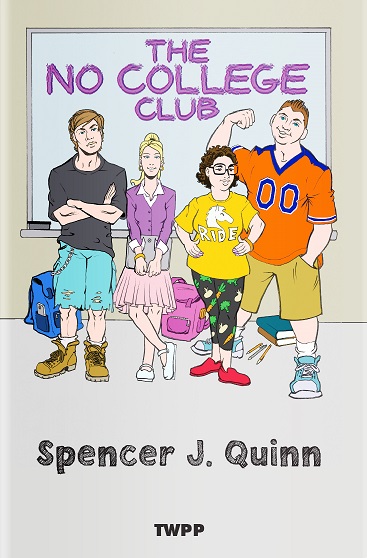
Critical Daze follows on Spencer J. Quinn’s No College Clubreviewed at TOO by F. Roger Devlin. As Devlin notes, there is probably no area in greater need of pro-White messaging than fiction aimed at young adults (aged 12–18). And, although it is aimed at this age group, I found it to be a riveting page-turner in which I became immersed in the characters both good and bad. Throughout I was curious how it would all play out, and was quite satisfied by the ending.

There are three main characters—pictured above on the cover, two of whom are transformed in the story. At the outset, the protagonist Will is a tall, decidedly overweight 18-year-old high school student with the nickname Willrus (Will + walrus). He is something of a social reject, into comic books and video games, and he is an unmotivated, undistinguished student.

Will’s best friend is JD, described as unusually short in stature and with the ambition of becoming a videographer. Like Will, JD is a social reject but he is more aware of the changes wrought in recent decades as a result of reading Will’s father’s collection of comic books of the 1980s, peopled with square-jawed White males and pretty White women—quite a descent from contemporary examples promoting racial diversity, homosexuality, and leftist political messaging.

Will joins the Critical Theory Club because, as happens so often to teenagers, he has a romantic interest in one of its members, his “tall, smart, and pretty” classmate Connie who presents herself as half-Indian (feather variety). The Critical Theory Club naturally focuses on the leftist anti-White mantras that Will had long been inundated with from television, movies, comic books, and the internet—to the point that he was rather bored with hearing them again. But Will had no reason to question them. After all, these mantras have become part of the furniture of American life. Revealingly, Connie becomes an enthusiastically applauded star at the meeting simply because of her claim that she is a person of color.

The speaker for the meeting is one Nadine Alterman, a self-described
“white person” studying for a Ph.D. in Critical Studies at the nearby state university. She tells the assembled (mostly female, virtually all White) students that White supremacy and racism are everywhere and that the “colorblindness” so loved by conservatives is nothing more than a “subterfuge” and a subtle form of racism.

Later at a meeting in her office with Will, she rejects the objectivity of academic tests because she claims that such tests “dehumanize people of color” by not taking into account the racist environment Blacks must live in—a ridiculous (but depressingly common) argument to say the least. And when Will innocently asks why Asians do so well, Alterman rejects his “Enlightenment rationalism,” apparently because it makes people prone to making what she regards as evil inferences. Enlightenment rationalism, after all, “is steeped in a European tradition that historically has been violent to people of color and produces a race-based hierarchy of knowledge.”

As Will continues to ask difficult questions, the meeting ends with a thinly veiled threat: stop asking such questions or your life will be ruined, just like the No College Club that is being “sued out of existence”—the first mention of the club that will figure prominently in the second half of the book. It’s no surprise that she is horrified that some very bad people have the temerity to believe that it’s possible to be racist against Whites! Will leaves the meeting quite confused and wondering how she could talk to him like that since she was “white—like him.”

Alterman is of course a common Jewish name, although the J-word never appears in the book and Alterman claims to be “white”. But in any case, it’s not surprising that an important element of the plot is that much later, in a conversation with Connie, she lets out that she hates Christians and White people, and in the conference with Will she refers to the Tulsa race riot as a “pogrom,” a common term for the anti-Jewish riots in nineteenth-century Eastern Europe.

Another hint that Jewishness is a major—if submerged—theme is that of the eight judges for the critical theory scholarship essay competition (which Connie enters), two are Black, one is named Johnston and presumably White, and, besides Alterman, the other four are named Cohen, Silver, Rothstein, and Cantor respectively. (All of the judges except one of the two Black judges are female). Much later in the book, having been enlightened about the fraud of critical theory and its basis in promoting power over Whites, Will asks himself how so many “white” people can subject themselves to what amounts to hatred against Whites. He never figures this little puzzle out.

I suspect that Quinn is raising the Jewish issue subtly in case some readers already have their J-dar activated but without needlessly putting off those (perhaps readers with a strong Christian background) who would be repelled by the very thought that Jews, the eternal victims, could possibly have such hateful thoughts.

Chapter 3 introduces Andrew, Will’s father who is hyper-politically correct and has an “awkward” relationship with his son. He gushes about a Chinese student of his wife and he worries that Will is racist because he had overheard JD commenting that, unlike the 1980s, in today’s comics “every other hero is black. And if he’s an old hero, they replace him with a black.” And he remains aggressively anti-White even after he is fired from his librarian job because an “overweight,” “dreadlocked,” “heavily perfumed” Black woman complained that he didn’t promote her, even though she was clearly unqualified.

So JD seems a bit skeptical of the political correctness around him, and he is quite perceptive about people’s character. He sees Connie as a “faker,” a manipulator and a leech—with an alcohol problem to boot. JD sees Connie as trying to get Will to do most of the work for their joint critical theory scholarship essay project.

Try to imagine that a person who identifies as a person of color is not a perfect person in a novel directed toward young people. Impossible! But I guess it requires suspension of disbelief.

Nevertheless, Will remains attracted to Connie and willing to cooperate on the project despite the fact that Connie already has a boyfriend and shows little sign of reciprocating in the romance department—apart from some flirting when she wants to get Will to do what she wants. Will is a super nice guy and therefore a bit gullible and open to being exploited. One can easily imagine that a low-status person like Will would be easily manipulated by an attractive high-status girl who gives off even a hint of sexual interest.

Will’s mother, Melissa, seems less naturally inclined to be politically correct but goes along with it, even displaying platitudes like “Hate has no home here” in her living room. Her main motive seems to be fear of the consequences if one gets out of line on race. She is quite aware that truth is irrelevant when it comes to accusations of political incorrectness, telling Will to watch what he says “because it doesn’t matter if you are innocent”—while looking to make sure no neighbors are watching. For Melissa, the informal mechanisms of thought control are quite enough to keep her in line.

You can buy Spencer J. Quinn’s young adult novel The No College Club here.

It’s the same with JD’s mom. It’s all about fear. JD: “My mom is a public school teacher, Will. She’d lose her career and her pension if she were caught being racist. She is terrified of black people.”

The turning point of the story is when JD and Will visit JD’s uncle Gus, a 90-year-old retired college professor who is quite versed in the origins of critical theory in the 1950s. On their journey it’s apparent that Will is having doubts about critical theory from his own reading as well as JD’s cogent criticisms. For example, he notes that critical theory is massively funded while pro-White organizations like the No College Club are getting sued out of existence and prevented from getting donations via credit cards. Not exactly “white privilege.”

So they were not blank slates when they encountered Uncle Gus, but the visit turns out to be a crossing of the Rubicon for their racial thinking. Gus’s analysis is spot on—not surprising since he has publications like Wilmot Robertson’s The Dispossessed Majority and Instauration in his collection. (Perhaps Will eventually will come to understand the significance of the Jewish names among the critical theory judges when he absorbs Robertson’s work.)

Uncle Gus states baldly that critical theory is a “cult” that actually comes down to “tribalism,” and he notes that they are “clannish”—another not-so-subtle hint that we are dealing fundamentally with a Jewish movement. It’s a tribalism dedicated to destroying whatever is blocking their total power, whether it’s over kings, tsars, or nations—a tribalism that abandoned the Marxist vision of a proletarian revolution because the working class was not acting according to theory because it didn’t rise up against the capitalist class (and many of them even voted for Hitler). This tribal cult, sounding very much like the Frankfurt School, therefore switched strategies and began blaming everything on White people. They attempted to control how people think by “pathologizing everything that was natural and healthy”—”everything that made Western culture great”). The White working class was now part of the problem because they were far too dedicated to religion, patriotism, and healthy family life.

This tribe is impervious to criticism. It “forgets when they do evil things that kill millions.” But if there’s a backlash, “ya never hear the end of it.” Critical theory was never an attempt to find the truth. It’s all about the tribe’s self-interest, controlling how people think, and obtaining total power. And now that they have power—now that they have become a hugely influential component of Western elites because of their position in the media, academic, and political arenas—they silence all criticism. In fact, they ruined Uncle Gus who lost his professorship because he opposed the “anti-white-ism” of this very powerful group. So believable.

But back to Will. As has happened to so many of us, after being aware of the history and the lies behind his oppressive, politically correct environment, Will starts losing friends and becomes even more of a social outcast. It starts with trusting, gullible Will naively telling Connie that critical theory is really all about power, resulting in an argument overheard by many of his schoolmates, including Connie’s screams that Will is a “racist” and a “Nazi.”

After this outburst, his only friend—the only fellow student who would talk to him or return his texts—was JD, and they continued to discuss Uncle Gus’s treasure trove, including JD informing a skeptical Will about the biological reality of IQ and how biological differences between the races result in the obvious racial differences in academic performance on display in their high school. Here Quinn does a masterful job of providing a research-based introduction to the IQ issue comprehensible to young readers unfamiliar with the issue.

Then come the presentations for the critical theory contest. Quite surprisingly, Connie begs Will to give the presentation despite their previous argument about critical theory—a development that only makes sense because Connie got embarrassingly drunk at a party with heavily tattooed, nose-ringed college students. Because she would be in no shape to give the presentation, the ever-manipulative Connie gets Will to give the presentation by flirting with him. So, despite JD’s warnings, Will, the ever-gullible nice guy, agrees to read Connie’s contest entry to the assembled leftists, including the “diverse” group of judges who decided that Connie is a winner of the contest even before the presentations.

But then, perhaps because she is still a bit drunk, Connie claims that she hates critical theory and that her mainly plagiarized, cliché-ridden essay only won because “they just want some pretty Indian girl to be the face of the future.”

In other words, she is gaming the system even at the tender age of a high school student. This is a girl that could definitely go places! And the Nadine Altermans of the world are more than willing to make that happen. After all, Alterman later proclaims that critical race theory is the only thing standing between America and Nazism: “We can’t let our youth be radicalized into fascism. This what happened in Nazi Germany and we can’t let it happen here. Critical race theory is the key pedagogical bulwark against the repeat of history. We must never forget that.”

Will, perhaps thinking that it would be okay with Connie to say what he really thinks given that her expressed attitudes are in sync with his, discards her vapid essay and lets it rip, stating, among other truths, that “what they really want it to destroy the identity and culture of the white majority.” Exactly.

Needless to say, the result of his temerity is a complete blow up at the competition and, soon thereafter, banishment from his home and disavowals from Connie. And of course there was a media firestorm, including another hint of Jewish angst on TV: “‘This young man is no better than Hitler youth!’ warned an incensed woman with a thick New York accent. … ‘He violates all the tenets of the Civil Rights Movement and what it means to be an American.’”

This claim about what it means to be an American is another favorite move by Jewish activists, framing what they don’t like in terms of violating deeply held ideals that appeal to wide swaths of the population. As holocaust activist Deborah Lipstadt said recently in “explaining” anti-Semitism: “Jews become stand-ins for “anti-democracy, anti-capitalism, [and] anti-Western values,” values the great majority of Westerners endorse. To criticize Jewish power is to put oneself outside the moral universe accepted — whether because of fear, ambition, or lack of information — by the great majority of Westerners.

I see it a bit differently. As always, conflicts of interest are at the root of serious outbreaks of anti-Semitism, but Jewish activists frame their interests as a moral crusade in an effort to persuade the gullible and uninformed — and to provide talking points for the ambitious and a sense of moral superiority to be fearful. Here the conflict is between the legitimate interests of the White majority as exemplified by the No College Club and perceived Jewish interests in lessening the power of the White majority—indeed, as Will phrased it, “to destroy the identity and culture of the white majority.”.

At this point we are about halfway through the book. Since the No College Club figures prominently in the title, it’s not surprising that it is a central theme in the second half of the book. I will say only that the ending is quite is satisfying.

Finally, one more theme should be explored. Throughout the book, women are portrayed as generally more accepting of critical theory. Women are the great majority of the Critical Theory Club and of those in the media going off on Will after he got real about race in a very public forum. The portrayal of Will’s mother Melissa gets at the greater fear that women in general have over being ostracized and subjected to social opprobrium. Not all women in the book are like this—there are several heroic women in the No College Club.

But the general portrayal of women is quite accurate. Women in general are higher on the personality system underlying fear and they tend to be more conformist partly as a result. Being high on fear leads to conformity because in the contemporary West there is much to fear if one fails to conform to the attitudes of the mainstream moral community—loss of job, loss of friends and family, and general ostracism. It’s much safer to remain within the confines of the moral community.

As emphasized throughout my Individualism and the Western Liberal Tradition, moral communities are the social glue of Western societies whereas kinship relationships are the social glue of the other culture areas of the world. Moral communities based on a reputation as capable, honest, trustworthy, and fair are a fundamental aspect of Western individualism and have been a big reason for the historical trajectory that led to Western dominance of the planet—a dominant position that may well end as the European peoples who created it are energetically replaced by people who hate them as the result of the activism of the clannish, tribal people referred to here. In the environments that Western peoples evolved in, major departures from the moral strictures of the community would result in ostracism. Whereas in the contemporary West, people like Will can survive such ostracism by finding a new niche of like-minded friends, in prehistoric Europe ostracism would have certainly resulted in death.

So in conclusion, a major plus is that the reader instinctively feels sorry for the White people victimized by the current regime or cowering in fear of what will happen to them if they get out of line. Empathy for the pantheon of the supposed victims of White racism is constantly preached from all the moral high ground in the West—the media, academia, K-12 educators, politicians, and religious authorities. Indeed, it is virtually mandated, as for example, in requirements that prospective faculty at many universities must write statements not only on their support for diversity, equity and inclusion, but also on what they have personally done to advance these goals. Only activists need apply.

But presenting sympathetic characters who suffer greatly from the regime of political correctness and anti-White hate is nonexistent in the mainstream culture of the West. I even felt sorry for Will’s father because his life is being destroyed because he did the right thing in not promoting an incompetent Black woman while still saluting the flag of political correctness and coming down hard on Will for crimethink.

This is a book that should have wide appeal well beyond its target audience of young adults. Even at well over 200 pages, it’s a quick, entertaining read because you want to find out what happens to the characters, so even people who are entirely on board with the ideas of the dissident right will enjoy it. And it’s a book that could quite possibly red pill many White people, especially if they haven’t thought deeply about the issues raised or if they have not personally been subjected to an environment of fear for expressing forbidden thoughts. People who are aware of the reality of the very sad state of affairs depicted in the book should think of people who would benefit from getting it as a Christmas present.

Jews and the The First New Deal, 1933-1934, Part 1

During the occasional tumult that accompanied adjustment to a new order beginning with Franklin Roosevelt’s election in 1933, not a few opponents of his administration over the following years charged that his New Deal recovery program of the 1930s was a “Jew Deal” (or the related charge that it was a way for Jews to force communism on America).[1] This three-part series will address the accuracy of this charge by looking at the activities of Jews vis-à-vis the New Deal.

The New Deal, FDR’s somewhat revolutionary, somewhat reformist program to pull America out of the Great Depression and institute progressive change, dealt with a vast firmament of issues that affected the nation and brought changes to the state and its relationship to American society. It is much too complex a phenomenon to discuss in its entirety or to examine any part of it in great detail, so I have chosen some major features and programs from it to the exclusion of more minor ones, a strategy that makes no great sacrifices. I will not discuss Jewish involvement in affairs outside of the New Deal, most notably non-monetary international issues including World War II, Hitler’s Germany, or the Holocaust.

I will also limit myself to the New Deal through 1936, here organized into two periods, what scholars identify as the First and Second New Deals. The First New Deal covers 1933–1934 and the Second New Deal covers the period between 1935–1936.[2] After 1936, the New Deal underwent an eclipse as Roosevelt passed fewer bills against powerful business headwinds that began in late 1935 after a legislative flurry that summer. In 1937, Roosevelt experienced a political setback with his failed “court-packing plan” and later that year a major recession hit the country, while conservative opponents of the New Deal won the midterms of 1938.[3] Following 1938, the administration’s attention was rapidly moving to Europe. Therefore, the most significant period for the New Deal was overwhelmingly in Roosevelt’s first term.

In part one, I will talk briefly about Franklin D. Roosevelt and his relationship to the Jews, the Democratic Party, and the 1932 election, along with a look at two First New Deal agencies, with some accompanying sideline discussions including the nature of managerial and corporate changes. It will take an extended look at Jerome Frank, Bernard Baruch, and Gerard Swope. Part two will examine the relationship between Jews, banking and money during the New Deal with an extended look at Henry Morgenthau Jr. (with some info on others as well, including Jimmy Warburg, Louis Brandeis and Felix Frankfurter). Part three will look at the Second New Deal period (1935–36) including agencies and programs, a profile of the Jews who entered public service (with a focus on lawyers), the question of socialism and labor, more information on Brandeis and Frankfurter, and conclusions regarding the reputed “Jew Deal.”

THE MANAGERIAL SYSTEM AND THE DEMOCRATIC PARTY BY 1932

Roosevelt’s triumph in 1932 saw the Democratic left come to power with the full force of its epoch-creating liberal managerial ideas — central planning, the public good over private interest (and the blurring of these distinctions), forms of collectivism over individualism, the rights of labor, from an “age of production … to an age of redistribution,”[4] etc. In meeting the exigencies of the Great Depression, in the view of many conservatives, the left dealt brusquely with the once revered monuments of the country enshrined in the Constitution,[5] such as the American mythos of laissez-faire and small government, the sanctity of private property rights and the natural rights of man.[6]

This new great river flowed from many tributaries and White male gentiles were overwhelmingly the font for these intellectual currents. For instance, there had been anticipatory ideas about the expansion of governmental administration in the nineteenth-century progressive political theories of the administrative pioneers Woodrow Wilson and Frank Goodnow.[7] The progressive intellectuals John Dewey, Charles Beard and Thorstein Veblen sought reconstructive change through their contributions to the new schools within psychology, history, and economics, and had called for new institutional arrangements in the construction of a democratic order.[8] They would count as their disciples many future New Dealers, like Frances Perkins and Rexford Tugwell. The progressive and sociological jurisprudence of men like Oliver Wendell Holmes, Jr., Louis Brandeis, and Roscoe Pound would become important for the New Deal and the liberal democratic state with their pronouncements that the study and adjudication of the law ought to incorporate social and pragmatic considerations that could be used to elevate the societal good.[9]

There had been a precedent before FDR’s state expansion that served as a forerunner to New Deal innovations. Upon entering World War I in 1917, President Wilson’s administration oversaw the greatest effort at state-run collectivism the nation had ever witnessed, involving the creation of numerous emergency government agencies.[10] As Sam Francis says about this, “The increase in the size of the state consisted not only in larger budgets and more personnel but also in the proliferation of its functions in regulating the economy, supervising and engineering social institutions, and preparing for and conducting the total mobilization of natural, human, social, economic, psychological, and technological resources for mass warfare [i.e., World War I, briefly discussed below],” although the wartime agencies were rolled back after the emergency was over. “These new functions were highly technical in nature and required the application of the physical and social sciences, the techniques of administration, and the skills of mass communication to the goal of what McNeill has called ‘human engineering’,” that this was first pioneered beginning in the late nineteenth century across the West.[11]

The wartime measures under Wilson and the New Deal under Roosevelt meant that this private-public fusion of the economy and state took place under the stewardship of the Democratic Party. For generations, the party had had almost as many partisan perspectives as national regions eager to move it in one direction or another during its bid to become nationally competitive again since the end of the Jacksonian era. By 1932, what Joseph Huthmacher called the “urban industrial Newer American” population (i.e., urban immigrants), was the “backbone of the New Deal voting coalition.”[12] Once elected in 1932 with a mandate to end the Depression, FDR had the responsibility of confecting a workable amalgamation of ideas for the New Deal’s agenda during the managerial state’s birth. To rule over a heterogenous democracy required being less dogmatic and more practical. Accordingly, Roosevelt himself has been characterized by scholars across his career as either having no real ideological commitments and as being a “pragmatic opportunist.”[13]

During the 1932 presidential campaign, he wafted from one end of the Democratic political spectrum to another. He both endorsed the need for administrative planning in one speech and in another pleased the conservative Democrats with calls for balanced budgets. Overall, Paul Moreno says that FDR “followed Wilson in conducting an ambivalent, often apparently conservative campaign to win the nomination and election, and then becoming more thoroughly progressive to win re-election.”[14] That spectrum was no less important during the days of the new administration. Conservatives with “Bourbon” democratic leanings, trust-busting and inflationist agrarian radicals, urban Jeffersonian opponents of the behemoth Gilded Age industrial corporations, and Hamiltonian large government progressive planners all jostled for Roosevelt’s attention.

Schlesinger uses three categories for the Party by 1932. The conservative Democrats, believers in laissez-faire economics, sound money (i.e., the gold standard), low-tariffs, a balanced budget, and states’ rights, were represented by figures like Al Smith and Maryland governor Albert Ritchie, and in FDR’s presidential administration by budget director Lewis Douglas and southern congressman Cordell Hull. The legacy of the older progressive tradition, having its roots in the agrarian “Populist” movement (associated with William Jennings Bryan) had divided into a western and southern camp of populists (e.g., Robert La Follette, Huey Long) and an eastern-intellectual camp (Louis Brandeis). Finally, the newer progressivism of the left Democrat administrative government planners — the authors of the administrative state — was a recruited Columbia University professoriate that represented the core of the first “Brain Trust” of Raymond Moley, Rexford Tugwell, and Adolf Berle, who, “accepting the drive of modern technology toward [corporate] bigness, [sought] to reorganize the chaotic business order into a system of national integration”; that is, unlike many of the older progressives who wanted to apply anti-trust laws to restore a nineteenth-century economic order, they accepted the inevitability of large corporate business entities but looked for balance through an expanded centralized regulatory state.[15]

This pluralism would be tested under the constraint of shifting circumstance and expediency. For Roosevelt, the more leftist experiments were in keeping with his progressive record as governor (1929–1932), when he advocated planning schemes including recommending moving populations out of the city into the countryside to correct imbalances.[16] FDR had been a Democratic Party booster during the Republican business decade of the 1920s; he had often been vocal about his convictions that his party was the party of progress.[17] As president during the Great Depression, he sanctioned many new functions of government.

This Brain Trust circle would change over the years. The Columbia circle of Tugwell-Berle-Moley, originally recommended by Jewish advisor Sam Rosenman, another Brain Truster who first proposed assembling a group of academic advisors,[18] did not remain a team after the election.  Economist Raymond Moley would still be an insider. He moved to the State Department,[19] as would fellow economist Rexford Tugwell, who was sent to the Department of Agriculture to help oversee the planning schemes in the Agricultural Adjustment Administration where he would attempt to boost farm prices. Harvard Law School professor Felix Frankfurter was influential from the opening of the administration and would exert influence from behind the scenes using his protégés, a similar strategy to that of Bernard Baruch as we’ll see.[20]

Frankfurter had been important since FDR’s inauguration, acting as a “one-man recruiting agency,” both recommending personnel when asked by New Deal leaders and recommending them on his own initiative, thus exerting his influence towards building the modern state.[21] In the middle of 1935, Frankfurter was at the White House more than at any other time and became part of FDR’s inner circle, despite having a teaching career. During this period, the press claimed Frankfurter was the principal advisor, pushing out Moley.[22] Over the years, Frankfurter and Brandeis also “stood out among [FDR’s] closest advisors on governmental policies.”[23]

In FDR and the Jews Breitman and Lichtman note that Roosevelt, first as governor and later as president, chose his advisers and staff according to “experience, brains, and liberal values.”[24] Roosevelt’s most “trusted advisor among the professional politicians” had been the lawyer and politician Edward J. Flynn.[25] Others include Louis Howe, Roosevelt’s long-time political operative who laid the groundwork for his election and without whom, “FDR might have faded from history at the age of 30.”[26] Another, James Farley, was commonly referred to as a political kingmaker, as he was responsible for Roosevelt’s rise to the presidency. The previously-mentioned aide Sam Rosenman was “the major figure in the executive chamber” in Albany when Roosevelt was New York governor;[27] he worked for Roosevelt’s presidential campaign of 1932 and would be a close adviser of FDR for the rest of his life.[28] Rosenman was responsible for using the phrase “New Deal” for a 1932 Roosevelt speech. The phrase was borrowed from the progressive, technocratic authoritarian writer Stuart Chase in an article for the New Republic.[29] Like others profiled here, Rosenman was a strongly identified Jew: “By the mid-1930s, Rosenman had emerged as a leading spokesman for the New York Jewish community.”[30] 

FUNDING FOR FDR’S 1932 PRESIDENTIAL CAMPAIGN

The Democrats were assigned to oblivion after the collapse of progressivism and the left in 1919, leading to the Republican business-oriented rule of the 1920s.[31] After the 1928 presidential election that put Republican Herbert Hoover in office, the Democratic Party’s woes were complicated by the financial position of the National Committee, and two men, DNC chairman John Raskob (a Catholic like Al Smith who backed Smith in his loss to Hoover in the 1928 presidential election) and Bernard Baruch were benefactor millionaires who were determined to keep the party afloat despite its string of presidential losses since 1920. However, in doing so, they expected influence in the party. However, Schlesinger notes that Raskob, who was past head of Du Pont, found politics “difficult and unattractive” but that Baruch was “infinitely more skilled in political operations.”

In March 1931, Schlesinger lists three men as having donated the largest amount to Roosevelt’s presidential campaign, including Henry Morgenthau Sr. whose famous son would become the United States Secretary of the Treasury during most of the FDR administration.[32] Morgenthau, Jr.  would play a lead role in financing the New Deal. Herbert Lehman, who was a major Jewish Democrat in New York State and who was Roosevelt’s lieutenant governor and would follow Roosevelt as governor, instituting a “little New Deal” there, donated a smaller amount.[33]

During the campaign in the election year of 1932, Schlesinger also identifies numerous gentiles giving to Roosevelt’s campaign, including Raskob, industrialist William Hartman Woodin, newspaper publisher William Randolph Hearst, investor Joseph Kennedy, and Boston politician James Michael Curley, yet Bernard Baruch stood out as the largest donor.[34] In his decision to support Roosevelt for president, Baruch was influenced by Morgenthau Sr., who told Baruch in 1932 “That’s my candidate!”[35] During the nominating convention Al Smith refused to relinquish his votes to Roosevelt, deliberately stonewalling a unanimous nomination, which was ended only with the personal intervention of three Jews who pressured him over lunch: (the ubiquitous) Baruch, Herbert Bayard Swope, and Felix Frankfurter.”[36]

Breitman and Lichtman note that “Although Republicans collected a larger share of business dollars during FDR’s presidential campaigns, Jewish businessmen primarily supported Democrats,”[37] and that “shortly after his nomination, FDR selected Henry Morgenthau Sr. as vice chairman of his Executive Finance Committee. Six other New York Jews also served on the committee: Bernard Baruch, Herbert Bayard Swope, Jesse I. Straus, Sidney Weinberg, Walter Weinstein, and Laurence A. Steinhardt.”[38] Their job was to raise over a million dollars at a time when a million dollars was worth about 23 million in 2024 dollars.[39] When we talk about the National Recovery Administration (NRA), we’ll encounter Herbert Bayard Swope’s brother Gerard Swope, whose planning scheme had the backing of a critical portion of Wall St. interests to help FDR’s win the presidential election.[40]

Furthermore, Sidney Weinberg, who was a partner at Goldman Sachs, raised more money for Roosevelt’s 1932 campaign than anyone else on the Democratic National Campaign Finance Committee. From Wikipedia: “Since many on Wall Street had opposed Roosevelt in the 1932 presidential election, Weinberg stood out as a prime candidate for the new president’s liaison to Wall Street. Indeed, in 1933, Roosevelt assigned Weinberg the task of organizing a group of corporate executives — called the Business Advisory and Planning Council — to serve as a bridge between the government and the private sector during the economic upheaval of the New Deal. Weinberg handpicked executives with whom he wanted to develop business relationships, and deliberately invited no other investment bankers to join the Council, putting himself in the perfect position to network. Roosevelt admired Weinberg’s work greatly, nicknaming him “The Politician” and offering him numerous federal appointments, all of which Weinberg refused.”[41] 

ROOSEVELT AND THE JEWS

Roosevelt won by a landslide in 1932 carrying almost every state, beginning the New Deal Coalition where Jews played an important role.[42] The Jews certainly felt victorious from the Roosevelt triumph if historian Arthur Hertzberg’s statement that “the Jews loved Franklin Delano Roosevelt with singular and unparalleled passion” is an indication.[43] Roosevelt received 70 to 80% of the Jewish vote in 1932,[44] a figure that would grow to 90% in the 1936 election.[45]  Dinnerstein notes that many Jews were motivated to vote for Roosevelt because of similarities between Judaism and the values and aims of the New Deal, including the intellectuality of its policies along with the desire to help the marginal, and that Jewish upbringing prepared them for these roles.[46] “Jewish values.”

Roosevelt had more Jews around him than any previous president[47], which was consistent with his appointments as governor.[48] Dinnerstein mentions that “Roosevelt worked comfortably with Jews.”[49] Around 15% of his appointments were Jews, who “held middle-level positions in the economic agencies and departments of government.”[50] A source from 1942 wrote that, although “the number of Jews in [the entire] government didn’t exceed their percentage in the population [4 percent], “it is also my observation that men who are Jews occupy very influential positions.”[51] Hertzberg’s opinion is that Roosevelt was not influenced by Jews any more than anyone else. Roosevelt was known for being extremely guarded about what he was thinking underneath an oftentimes agreeable exterior,[52] and that he played advisors off against each other.[53] Many Jews, nonetheless, believed that Roosevelt had a “special love” for them — their protector and “benevolent king”[54] in a world in which Hitler had just come to power, and where Roosevelt was the only world leader who wasn’t hostile to Jewish interests[55] — a role Roosevelt loved to play.[56] He had been the first major presidential candidate in American history to condemn anti-Jewish attitudes.[57] This was indeed a breakthrough for the Jews, as a 1938 poll taken showed a substantial number of Americans felt Hitler’s anti-Semitism was the Jews’ fault. American Jewish leaders even believed it a possibility that given a choice between European Jews and Nazism, the American public might not choose the Jews.[58]

Roosevelt of course came from American royalty, a class that generally not only paid attention to breeding and caste but was one which existed in the heyday of racial thinking.[59] Roosevelt himself claimed his “membership in the ‘Aryan races’,”[60] and during a 1912 speech in Troy, New York, he claimed that civilized progress and the struggle for freedom was associated with them.[61] So, what was the source of this apparent “special love” for Jews? Roosevelt’s father James had had business dealings with Jews. Breitman and Lichtman report that he “counseled his son about the immorality of anti-Semitism and his contempt for it.” His mother Sara, despite having an “acute sense of class,” made friends with Jews and contributed to Jewish causes.[62] As a result, his father, like his son, maintained amicable business relationships with Jews during his adult life.[63]

Baltzell is important in providing the concept of the “affirming aristocrat,” an establishment figure who rejected the exclusive class caste system they were born into in favor of supporting the integration of minorities into society and into the elite.[64] With his election, Franklin Roosevelt was the man who led Jews, both the Jews who originated in Germany and the descendants of the Eastern European Jews, into the functional elite. Also, the Roosevelts, a Dutch colonial “Knickerbocker” family from New York, eschewed the Upper Ten Society in their rejection of “ostentation and frivolity.”[65] It’s then no wonder Roosevelt was called a “traitor to his class.”[66]

It’s worth noting the role of Caesarism within the managerial state, with the political Caesar who, according to Max Weber, “often grows out of democracy.” Such a leader bases “his power on his personal competence and charismatic appeal, uses the mass population to undermine the institutions, traditions, and power of an existing elite, and elevates a section of his mass following to the position of a new elite.[67] To this, we can add the following by Kevin MacDonald, that Jewish “elites are unlikely to identify with the interests of the society as a whole, and they are relatively eager to agree on arrangements that are personally beneficial, even if they negatively impact other groups of the society.”[68] Thus, it’s worth exploring to what extent Roosevelt played a key role in bringing about a miracle for the Jews in America by exploiting a civilizational crisis, defying his genteel bourgeois roots, and gaining votes from and rewarding this “elevated section”.

While the German Jews had been here since the mid-nineteenth century, the immigrants from Eastern Europe had mainly come during the post-1880 immigration flood. They were encouraged to immigrate to meet the needs of rapid industrialization by the nouveau riche captains of postbellum industry, but this immediately led to exclusionary behavior that began in the 1880s — which was manifested in the appearance of the patrician summer resorts, country clubs (the first in Brookline, MA in 1882), and the sudden preoccupation with one’s roots, in such organizations as the Sons of the Revolution, founded in 1883.[69] After this, the newcomers from Eastern Europe would be battling the patricians to make room in the establishment, and in a stunning reversal of fortune, by the end of the 1960s, those old-line patricians would be made déclassé. This transition would take place less than a century after the post-1880 immigration wave.


[1] Brad Snyder, Democratic Justice: Felix Frankfurter, the Supreme Court, and the Making of the Liberal Establishment (W.W. Norton and Company, 2022), 237. Arthur M. Schlesinger, Jr., The Politics of Upheaval (Boston Houghton Mifflin Company Boston, 1960), 27. Leonard Dinnerstein, “Jews and the New Deal,” American Jewish History 72, no. 4 (June, 1983): 461, https://www.jstor.org/stable/23882507. Myron Scholnick, The New Deal and Anti-Semitism in America (Garland Publishing, 1990), 62;73.

[2] “New Deal,” Wikipedia, last modified October 25, 2024, accessed October 27, 2024, https://en.wikipedia.org/wiki/New_Deal#Summary_of_First_and_Second_New_Deal_programs.

[3] William Dudley, The Great Depression, Opposing Viewpoints (Greenhaven Press, 1994), 205. See also, “Recession of 1937-1938,” Wikipedia, last modified June 6, 2024, accessed October 27, 2024, https://en.wikipedia.org/wiki/Recession_of_1937-1938.

[4] Paul D. Moreno, The American State from the Civil War to the New Deal (Cambridge University Press, 2013), 225.

[5] E. Digby Baltzell, The Protestant Establishment: Aristocracy and Caste in America (Random House, 1964), 165.

[6] Ronald J. Pestritto, American Transformed (Encounter Books, 2021), 71. See also William Leuchtenburg quote in Sam Francis, Leviathan & Its Enemies (Washington Summit Publishers, 2016), 222.

[7] Pestritto, 200-219.

[8] Baltzell, 162. See also Arthur M. Schlesinger Jr., The Crisis of the Old Order (Houghton Mifflin Company Boston, 1957), chapter 17.

[9] Stephen M. Feldman, American Legal Thought from Premodernism to Postmodernism (Oxford University Press, 2000), 108-109. See also Moreno, 54-58.

[10] Hugh Rockoff, “U.S. Economy in World War I,” Economic History Association, accessed October 27, 2024, https://eh.net/encyclopedia/u-s-economy-in-world-war-i/. See section titled ‘The Government’s Role in Mobilization’.

[11] Francis, 44.

[12] J. Joseph Huthmacher, “Senator Robert F. Wagner and the Rise of Urban Liberalism,” American Jewish Historical Quarterly 58, no. 3 (March, 1969): 343. https://www.jstor.org/stable/23876008.

[13] Moreno says this works because progressive liberalism is based on pragmatism anyhow (i.e., based on rational, scientific decision-making and is supposedly or ideally post-ideological). In Moreno, 220. Baltzell says that the ideas of John Dewey, who “socialized William James’s [Pragmatist] ideas,” were perfect for the “experimental, rather than dogmatic, political reformers who filtered into the Democratic Party under the leadership of Woodrow Wilson and Franklin Roosevelt.” In Baltzell, 167.
This pragmatic approach was found within individual departments. Agricultural expert M.L. Wilson insisted in 1932 that a variety of approaches be included in the Ag. Bill (and not just his own domestic allotment program) and that the secretary should decide on an ad hoc basis which to use. The resulting bill (Ezekiel, Wallace, Lee, and Frank) was probably the most inventive bill in U.S. history. In Arthur M. Schlesinger Jr., The Coming of the New Deal (Boston Houghton Mifflin Company Boston, 1959), 38-39.

[14] Moreno, 220.

[15] Schlesinger, TCOTND, 18-20 and TCOTOO, 416-20. For general info on the planners’ philosophy, see TCOTOO, 190-198. Moley, Tugwell, and Berle were gentiles. Berle was a Bostonian former student of Frankfurter who had supported Brandeis against the Brahmin establishment in 1916. In Arthur Hertzberg, The Jews in America: four centuries of an uneasy encounter: a history (Simon and Schuster, 1989), 221.

[16] Moreno, 222.

[17] Schlesinger, TCOTOO, 103.

[18] Ibid., 398-399.

[19] Ibid., 473.

[20] Ibid., 451-452.

[21] Snyder, 224. See also Leonard Dinnerstein, Antisemitism in America (Oxford University Press, 1994), 108.

[22] Snyder, 251-252.

[23] Dinnerstein, 108.

[24] Richard Breitman and Allan Lichtman, FDR and the Jews (Harvard University Press, 2013), 34.

[25] Schlesinger, 278.

[26] Breitman and Lichtman, 13.

[27] Dinnerstein, J&TND, 471. Dinnerstein in his article also mentions that, among his advisors, Rosenman was the closest to Roosevelt over the longest period. Dinnerstein, 470-1.

[28] Breitman and Lichtman, 32.

[29] Schlesinger, TCOTOO, 403. Chase was influenced by anti-capitalist economist Thorstein Veblen, and The New Republic was started in 1914 by Herbert Croly, Walter Weyl (Jewish), and Walter Lippmann (Jewish).

[30] “Samuel Rosenman,” Wikipedia, last modified October 17, 2024, accessed October 27, 2024, https://en.wikipedia.org/wiki/Samuel_Rosenman.

[31] Schlesinger, 43-45.

[32] Ibid., 280.

[33] Ibid., 273-274. The “little New Deal” is mentioned in Daniel Ernst, Tocqueville’s Nightmare (Oxford University Press, 2014), 80.

[34] Schlesinger, 421.

[35] Ibid., 288.

[36] Leonard Baker, Brandeis and Frankfurter (Harper & Row, 1984), 277.

[37] Jews had supported Hoover as well, with Sutton listing Jews as contributing more than half the funds to the RNC among contributors giving more than $25,000 in 1928, including the Guggenheims, Eugene Meyer, Otto Kahn, and Mortimer Schiff. In Sutton, 315. Jews had contributed heavily to many prior campaigns, including Wilson in 1912: “Cooper remarks that his “big contributors” included the likes of “Henry Morgenthau, Jacob Schiff, and Samuel Untermyer, as well as a newcomer to their ranks, Bernard Baruch.” In Thomas Dalton, “The Jewish Hand in the World Wars, Part 1,” CODOH, July, 2013, https://codoh.com/library/document/the-jewish-hand-in-the-world-wars-part-1/.

[38] Breitman and Lichtman, 39.

[39] “Seven Jews on Finance Committee of Democrats,” Jewish Daily Bulletin, September 18, 1932, 2, http://pdfs.jta.org/1932/1932-09-18_2357.pdf. Also, “A political ally of New York Governor Franklin D. Roosevelt, in March 1931, Jesse Straus funded a poll of the delegates to the 1928 Democratic Convention to assess Roosevelt’s chances in the race for the 1932 Democratic presidential nomination.” In “Jessie I. Strauss,” Wikipedia, last modified October 24, 2024, accessed October 27, 2024, https://en.wikipedia.org/wiki/Jesse_I._Straus.

[40] The election claim is according to scholar Anthony Sutton.

[41] “Sidney Weinberg,” Wikipedia, last modified August 26, 2024, accessed October 27, 2024, https://en.wikipedia.org/wiki/Sidney_Weinberg.

[42] “New Deal Coalition,” Wikipedia, last modified October 25, 2024, last modified, accessed October 27, 2024, https://en.wikipedia.org/wiki/New_Deal_coalition.

[43] Hertzberg, 282.

[44] Breitman and Lichtman, 43.

[45] Hertzberg, 285. Many of the socialist readers of the Communist Morgen Freiheit gave Roosevelt their vote over Earl Browder.

[46] Dinnerstein article, 462-463.

[47] Hertzberg, 282.

[48] Breitman and Lichtman, 65.

[49] Dinnerstein, 108.

[50] Breitman and Lichtman, 65.

[51] W.M. Kiplinger, “The Facts about Jews in Washington,” Reader’s Digest, September 1942, 2.

[52] Breitman and Lichtman, 9.

[53] Hertzberg, 282.

[54] Ibid., 284.

[55] Dinnerstein, 104.

[56] Hertzberg, 286.

[57] Breitman and Lichtman, 42.

[58] Hertzberg, 289.

[59] Kevin B. MacDonald, “Eric Kaufmann’s The Rise and Fall of Anglo-America,” The Occidental Quarterly 15, no. 4 (Winter 2015—2016): 22, http://www.kevinmacdonald.net/Kaufmann-final.pdf.

[60] Breitman and Lichtman, 8.

[61] Ibid., 13.

[62] Ibid., 8. In the same section Breitman and Lichtman also say that FDR’s parents inculcated compassion for the less fortunate. In Ibid., 9. Also, sociologist E. Digby Baltzell notes that class can trump ethno-religious identity. In Baltzell, 63. At least this can be said about White Europeans.

[63] Breitman and Lichtman, 8-9.

[64] Baltzell, 28. For speculation on Roosevelt’s reputed Jewish ancestry: Thomas Dalton, “The Jewish Hand in the World Wars, Part 2,” July 1, 2013, https://codoh.com/library/document/the-jewish-hand-in-the-world-wars-part-2/en/.

[65] Michael McGerr, A Fierce Discontent: The Rise and Fall of the Progressive Movement in America, 1870-1920 (Oxford University Press, 2005), 36.

[66] Consider the book title of: H.W. Brands, Traitor to His Class: The Privileged Life and Radical Presidency of Franklin Delano Roosevelt (Knopf Doubleday, 2008), https://books.google.com/books?id=bmKMa_y3hh0C.

[67] Francis, 55. Francis also says that managerial elements encourage the extension of the franchise to groups that the bourgeois elite cannot discipline. In Ibid., 56.

[68] Kevin B. MacDonald, A People That Shall Dwell Alone (Writer’s Club Press, 2002), 173. This statement is made within the context of a discussion about the relationship between the Jews and gentile elites.

[69] Baltzell, 113. See also Howard Sachar, A History of the Jews in the Modern World (Vintage Books, 2006), 384-385, and Dinnerstein, 41.

The Woke Right

A new metaphor is stalking the internet. It is promoted by the writer James Lindsay and by Konstantin Kissin of the popular anti-Woke podcast “Triggernometry.” It is called the “Woke Right.”

By implication, those who are to the right of these people – those who are intellectually consistent and are consequently prepared to explore such issues as the ethnic and genetic foundations of culture, genetic racial differences in key psychological traits, dysgenics, and other crucial issues that attempt to understand the causes of our current situation – are the “Woke Right.” If you go beyond merely stating that Wokeness is bad for civilization and you attempt to examine how a civilization is maintained (because this might offend current mores, and your sources of income, slightly too much) then you are “like the Woke, but right wing.”

There’s a very clear sign that a person is losing an intellectual battle: the fallacies of “appeal to insult,” appeal ad hominem and “connotation fallacy.”

If you cannot successfully logically argue with the less intelligent or more emotional, you may yet win them to your cause by emotively insulting your opponents or attempting to connect them to something viscerally wicked. If you – the one subject to this tactic – point this out, your opponent may accuse you being “hyper-sensitive” or “pearl clutching,” but this is just further appeal to insult and further emotional manipulation. They are employing these methods to manipulate the feelings of others and, hopefully, to shut you down, because you fear being ostracised.

Why are they so emotional? Very possibly because they are experiencing “cognitive dissonance.” The “Woke Right” confronts them with the fact that they are mere “Bravery Signallers.” They present themselves as fearless fighters, against Woke ideology, for the truth . . . but they’ll only take this battle so far, because they also desire a certain degree of comfort and respectability. Thus certain areas of discourse – those that the Woke Right explore – are forbidden. The Woke Right, therefore, confronts them with their own intellectual cowardice: a highly emotional reaction is the result.

Konstantin Kissin deploys not only the term “Woke Right” for these people but also, just as emotively, the “Barbarian Right,” though, more sensibly, also the “Dissident Right.” In effect, his argument is that “Woke Right” is an appropriate term because there are a number of superficial points which the “Woke” and the “Dissident Right” share. These are, he avers, as follows:

(1) Thinking the West is bad and siding with its enemies; by implication Russia.

(2) Playing identity politics on the basis that their group is oppressed by a secret invisible force controlled by another group/groups; by implication the Jews.

(3) Having an obsession with group-based victimhood and grievance; in other words two-tier policing and other examples of discrimination in favour of minorities.

(4) Seeking to revise and pervert history to fit its ideological narrative. I assume this is a reference to Holocaust Revisionism.

(5) Reacting to disagreement with name-calling, ostracism and bullying.

(6) “Creating a culture of fear among more centre-leaning people on their side to prevent criticism (you should see how many people message me privately to say they agree about the Woke Right but don’t want to say anything).”

Kissin is correct that, very broadly, there are some superficial points of commonality between the Woke and the Dissident Right. For example, as I have discussed in my book Woke Eugenics: How Social Justice is a Mask for Social Darwinism, being Alt Right is associated with psychopathy whereas being Woke is predicted by Narcissism and Machiavellianism. These three personality disorders have much in common – they intercorrelate at about 0.5 – so we can conceive of the “Dark Triad.” Most of Kissin’s criticisms of the Woke Right – name-calling, intimidation and so on – reflect the behaviour of people like this; not of those who are simply “red pilled” on assorted important social and scientific issues.

Overall, these people – the “red-pilled” – are completely different from the Woke. They are high in mental and physical health, low in mutational load, high in pro-social traits and strongly desirous to have children and to pass on their genes. They are, in evolutionary terms, adaptive, where the Woke are the opposite. We have, then, a completely hollow metaphor at a crucial level; like comparing a hover-fly to a wasp.

Indeed, as a metaphor, it quickly falls apart on many other levels as well. Firstly, Kissin seems to characterise here the absolute extreme of the Dissident Right; the kind of people who, whenever I publish anything on any subject, respond, “Why don’t you name the Jew, Ed?! Why don’t you name the Jew?!” Clearly, this is a straw man argument; a completely unfair characterisation of those whom he opposes.

Secondly, the Dissident Right think the West is bad because it is dysgenic, maladaptive and decadent. The Woke think it is bad because it isn’t dysgenic, maladaptive and decadent enough. They have in common the fact that are both critiquing the kind of traditional liberal conservatism for which Kissin stands, but their critique is completely different. You might as well argue that Kissin is “Woke” because, like the Woke, he criticises the Dissident Right.

Thirdly, the grievance of the Dissident Right is adaptive in an evolutionary sense; it is looking out for the interests of their group. The grievance of the Woke is maladaptive; it is looking out for the interests of other groups, though it is adaptive in the selfish, individualistic sense that so-doing is a way of virtue signalling your way to power.

James Lindsay has effectively argued that “Woke Right” is a synonym for Fascist, which makes even less sense than Kissin’s idea. As I noted in Woke Eugenics, the left are concerned with the moral foundations of harm avoidance and equality whereas the extreme right are highly group-oriented: concerned with obedience to authority, traditional sanctity and in-group loyalty. They are fundamentally different.

Also, “Fascist” tends to have a fairly clear meaning, beyond being a political insult. In his essay “On Defining the ‘Fascist Minimum,’” political scientist Roger Eatwell maintains that Fascism is “‘an ideology that strives to forge social rebirth based on a holistic‐national radical Third Way, though in practice fascism has tended to stress style, especially action and the charismatic leader, more than detailed programme, and to engage in a Manichaean demonization of its enemies.” Is this what all those to the right of Lindsay are doing? Clearly it is not.

People like Lindsay have eked out a specific niche as the edgy critics of Wokeness; but not so edgy that they are ostracised from many of the good things in life. Those who are prepared to go beyond bravery-signalling and to seriously logically critique current taboos, taking their analysis to its logical conclusion, threaten those in this semi-comfortable niche and confront them with what they are. This explains their attempt to shut them down with the very emotional and very unpersuasive metaphor of “Woke Right.”

Who is behind the successful jihadist attack in Syria?

Ahmad Al Khaled sends this information about himself:

I’m a freelance journalist mainly focused on the Middle-East and North Africa. I’ve been covering various conflicts in the region and notable political events  for the past 7 years.

I’ve had my articles published by leading regional and global media (Youm7, Jerusalem Post, Times of Israel, Ahval, etc.). Here are examples of my previous work:

https://www.jpost.com/
https://www.jpost.com/opinion/
https://globalsecurityreview.

After a four-year freeze in the conflict established as a result of negotiations between Turkey and Russia, the situation in Syria has changed dramatically. Within ten days of a rapid offensive, the fighters of the Hayat Tahrir al-Sham group established control over most of the country, forcing the government troops to retreat.

On the morning of December 8, armed opposition forces led by the HTS captured the capital of Damascus, thereby formalizing the fall of the Assad clan, which had been ruling Syria for more than 50 years. According to the latest information, former President Bashar Assad left the country and requested asylum in Russia.

The day before three guarantor countries — Turkey, Iran, and Russia — met in Qatar’s capital of Doha and stressed the need for political dialogue between the parties of the conflict to peacefully transfer power in the country and prevent bloodshed. In turn, the HTS command guaranteed the security of state institutions, diplomatic missions, and military facilities, including Assad’s allies — Russia and Iran.

Currently, due to the rapid changes taking place in Syria, it is difficult to predict how the situation in the Arab country will develop. However, the factors and circumstances that ensured jihadists’ success on the battlefield and their quick rise to power can already be studied in detail.

The new tactics of using small mobile groups on light automotive equipment, the use of reconnaissance unmanned aerial vehicles and strike first-per-view drones, as well as the timing suggest that the HTS could not organize an operation of such range alone. In this case, the question arises: who helped the HTS or at least played into its hands?

The role of Turkey

Answering this question, it is fair to say that Damascus and its allies, Russia and Iran, have closely watched the threats posed by the HTS. For the past three months, local media have been full of circulating reports of an impending attack by militants.

After establishing the ‘Idlib de-escalation zone’ as part of an agreement between Russia and Turkey in 2020, the HTS was able to get the most out of the calm at the front. This faction, formerly known as Jabhat al-Nusra, was previously part of Syria’s al-Qaeda terrorist organization but then distanced from it and emerged as one of the dominant forces in the northwest of Syria.

Since the observation points of the Turkish Armed Forces were deployed along the front line, they served as a kind of shield, behind which the HTS was able to hide and calmly build up forces without fear of a possible attack from Damascus and its foreign backers. Therefore, it is safe to say that Ankara’s diplomatic and military patronage directly contributed to the strengthening of the HTS stance, not to mention economic assistance and the supply of electricity and fuel to Idlib through Turkish umbrella companies.

Taking advantage of the fragmentation of other opposition groups, the HTS, led by its leader Abu Muhammad Al-Julani, managed to consolidate power in the rebellious province of Idlib. It completely captured the economic sector and has been ruling the so-called last bastion of the Syrian opposition through the puppet Syria Salvation government. Militarily, the HTS has also greatly strengthened, uniting under its banners many independent groups and foreign fighters from among Caucasians, Turks, and Uyghurs.

All these factors allowed the HTS to accumulate a sufficient margin of safety to make constant raids against government forces and even claim to expand the zone of influence in northern Syria. At the same time, its status as an independent group also provided it with additional opportunities, without limiting freedom of action to agreements with third countries.

Thus, Ankara de facto helped to nurture the HTS military machine, but de jure can avoid responsibility for its actions, as the HTS does not obey it entirely like the Turkish-affiliated Syrian National Army.

The role of Ukraine

It is not an exaggeration that any HTS activity was constantly the focus of attention of the main actors in Syria, especially Russia. Recently, Moscow has repeatedly stated that there is close cooperation between the HTS and its geopolitical adversary — Ukraine.

The Turkish newspaper Aydynlyk reported that Ukrainian instructors were training Syrian militants in the production and use of FPV drones to strike at military facilities of the Russian Armed Forces in Syria. It also said that in exchange for drones, Kyiv asked the HTS to allow its foreign militants, mainly immigrants from Caucasian and Central Asian countries, to reach Ukraine and fight against Russia.

Ukrainian media have also repeatedly published videos in which Syrian rebels in cooperation with Ukrainian intelligence hit Russian targets in Syria with strike drones. In one of these videos, the opposition fighters struck the facilities of the Russian Armed Forces at the Quwayres air base, east of Aleppo.

Notably, until the last HTS offensive, Ukrainian officials preferred to ignore the media claims about cooperation with Syrian rebels. However, after the capture of Aleppo, Kyiv finally made a sincere confession and said that the “Khymyk” group of Ukraine’s Main Directorate of Intelligence was preparing the HTS militants to use attack drones against Russia.

The role of the US

But if cooperation with the Ukrainian special services can explain the increased combat capabilities of the HTS in terms of the use of unmanned technologies, then the start time of the jihadists’ offensive indicates possible coordination with the United States. While the US has officially denied any involvement in current developments in Syria, there is direct and indirect evidence that suggests otherwise.

Firstly, the launch of the HTS offensive on Aleppo suspiciously coincided with the entry into force of the US-initiated peace treaty between Israel and Lebanese Hezbollah on November 27. Therefore, it is not unreasonable to assume that the Syrian opposition waited for Israel to defeat Hezbollah to begin a campaign against the regime forces without fear that Lebanese fighters would come to help Assad.

Thus, it is clear that the United States played a major role in weakening Assad’s allies, which directly led to the HTS decision to attack.

Secondly, it should be noted that although the United States recognized the HTS as a terrorist organization, it did not interfere in any way with its trade ties with Turkey, also contributing to the economic strengthening of the HTS. This approach to the terrorist organization was in stark contrast to Washington’s unprecedented sanctions pressure on Damascus.

In addition, the United States and its allies in the International Coalition maintained close ties with the HTS. In particular, they exchange information in order to launch air strikes against field commanders of some independent armed groups active in Idlib province. Syrian opposition fighters on social networks repeatedly accused the HTS of providing the United States with accurate data on the whereabouts of the fighters hiding in the rebel-held areas. According to them, the US UAVs hit them almost immediately after meetings with the leaders of the HTS.

In addition, the United States and the EU over the past years have unofficially worked to “whitewash” the reputation of HTS to exclude it from the list of terrorist organizations. To present him as a leader of moderate opposition, several American publications conducted interviews with Abu Muhammad Al-Julani, in which the jihadist leader appeared in a business suit, and also abandoned his characteristic fanatical slogans in favor of more secular and pragmatic rhetoric. During the last offensive, Al-Julani also made some demonstrative statements in which he warned his fighters against illegal actions against civilians and their property, and also called for respect for the cultural diversity of Aleppo”.

Given the covert interaction between the United States and the Al-Julani group, there is reason to believe that after the end of hostilities in Lebanon, the Biden administration could initiate another escalation in Syria, using the HTS militants as a proxy. Thus, the White House probably planned to weaken the position of its geopolitical rivals, Russia and Iran, before the imminent transfer of power to the newly elected president Donald Trump. Judging by his pre-election statements, the latter would hardly agree to such an adventure and would prefer to deal with domestic problems, rather than create the next hotbed of tension in the world or a particular region.

But Joe Biden’s foreign policy staff, finalizing the last two months of his term, could decide differently, especially when all the necessary conditions were ripe for the Syrian militants to attack. Russia withdrew the main troops from Syria and is fully focused on the war with Ukraine; another main ally of Damascus — Tehran is weakened as a result of constant attacks by Israel and threw its main forces to support affiliated formations in Palestine and Lebanon; and Hezbollah, which also played an important role in establishing the former status-quo in Syria, suffered significant losses during the IDF operations and can no longer help the Assad government.

Given the acute contradictions between the two political camps that emerged during the last elections in the US, it is not difficult to assume that the Democrats wanted to make it as difficult as possible for Trump upon entering office. They sought to shackle opportunities to later accuse him of failing to fulfill the promises he gave to American voters. Therefore, the new round of escalation in Syria can be seen as a desperate attempt by the current US administration to influence Trump’s future policies, to force him to wallow in endless conflicts and rivalries with other countries instead of solving more important problems related to domestic policy.

The large-scale HTS offensive has already dealt a heavy blow to civilians throughout Syria, significantly exacerbating the migration crisis and increasing the suffering of ordinary Syrians from renewed clashes and shelling. At the same time, regardless of the further development of events in the Arab country, the United States, as the main international actor, has done nothing to prevent the strengthening of the HTS. Moreover, Washington purposefully encouraged the HTS to use it as a counterweight to Damascus and its rivals in the region — Russia and Iran. And while the winners in this geopolitical game are unclear, the loser is already obvious: this is the Syrian people, who once again became a “bargaining chip” and are paying with blood for other states’ ambitions.