“Normal People”: British White Nationalists in Recent Academic Studies
“People are really rather afraid that this country might be swamped by people of a different culture. The British character has done so much for democracy, for law, and done so much throughout the world that if there is any fear that it might be swamped, then people are going to be rather hostile to those coming in.”
Margaret Thatcher, February 1978.
An acquaintance recently forwarded me an interesting news item from England. It would appear that the background of one Duncan Weldon, the new economics correspondent for the BBC’s flagship current affairs show Newsnight, has been sending shivers down the spine of those who stalk the halls of power. Weldon’s unforgivable error seems to be that he “flirted” with the “far Right” in his college days, and participated in a leafleting campaign in 2000 organized by the British National Party (BNP), Britain’s largest movement that explicitly advocates for the interests of the White majority.
Weldon, to my eyes at least, appears to be a political opportunist. He describes his brief “flirtation” with the BNP as “misguided” and points out that he went on to carve out a career for himself as a dedicated Leftist, attacking conservative policies with all the fabled zeal of the convert. While some have pointed out that Weldon might be unsuitable for the position because of his current role at the Trades Union Congress as well as a marked lack of journalistic experience, the heaviest criticism has been laced with insinuations that links to White Nationalism, and in particular to the BNP, render Weldon permanently unsuitable for any position of public prominence. An article at Breitbart.com accuses “the former fascist,” of having a “flirtation with the works of Oswald Mosley” because Weldon once blogged that he read Robert Skidelsky’s biography of the war-time leader of the British Union of Fascists. (It would appear that the author of that particular piece needs reminding that reading a biography of someone is not the same thing as reading their works and that reading the works of someone is not the same as endorsing them. Else, God forbid, I would be accused of endorsing the ethnocentric ravings of Anthony Julius.)
The heaviest condemnation has come from the Conservative party politician, Andrew Bridgen, who has said: “Given the revelations about his secret BNP past, it is clear Mr Weldon is unsuitable for a position in our national broadcaster.”
Those wishing to ensure that a wolf does not penetrate the fold need not be so alarmist. It is likely that Weldon never held a single conviction during his dabble with White Nationalism, and it should put more than a few minds at rest that Weldon has the approval of the Newsnight editor Ian Katz, a South African Jew, as well as that of the BBC Creative Director, Alan Yentob, a British Jew.
Needless to say, the Beeb is in no danger of any enthusiasm for the interests of the indigenous population of the UK. The “Guardian trained” Katz has previously been the subject of criticism for being an unabashed and relentless promoter of “diversity.” The ire-provoking incident in question was Katz’s choice of two women, one Black and one Sri Lankan, to discuss what one Daily Mail columnist described as a “report about (White, male) American scientists who’ve detected the origins of the universe.”
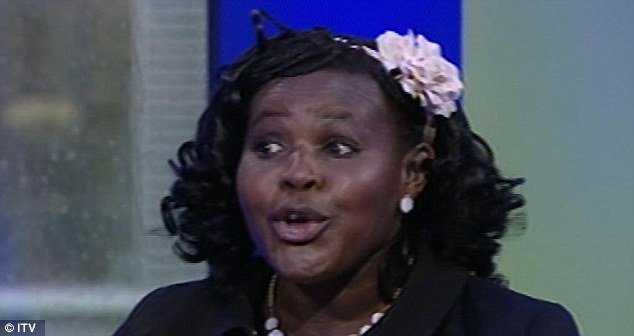
Sky at Night presenter Maggie Aderin-Pocock discusses the origins of the universe as revealed by White males on Newsnight.
A former deputy-editor of the Guardian, Katz was once a graduate trainee at the Sunday Correspondent along with fellow Jewish journalist Jonathan Freedland. Freedland is also keen on diversity. Responding to the 2011 British census, Freedland pointed out that “the country is now less white and less Christian. In 2001, white people accounted for 91% of the total population. In the latest census, that figure is down five points to 86%.” Freedland reported gleefully that “White Britons have become a minority in London, accounting for only 45% of the city’s population,” and ended with the astonishing remark that “the main story is surely that this country has undergone a radical transformation in this last decade and the ones before — and it has done so with relative peace and relative calm. No one will hand out any gold medals for that, but it’s a kind of triumph all the same.” A triumph for whom, Mr. Freedland?