Western Culture

The High-Mindedness of the British: New Zealand and the United States

Fairness and Freedom: A History of Two Open Societies, New Zealand and the United States.
David Hackett Fischer
New York: Oxford University Press, xxv + 629 pages.

I have to start off by saying that David Hackett Fischer’s Albion’s Seed: Four British Folkways in America has shaped the way I see American history and much else. He provides a compelling account of how the four main British-derived groups (Puritans, distressed Cavaliers, Quakers, and Scots-Irish borderers) differed and their struggle for dominance in America. To me as an evolutionist, a big part of the attraction is that Fischer roots these cultural differences in the distant past—in English pre-history. Thus the tendencies of the two main groups, Puritans based in East Anglia and the Cavaliers in Southeast England, go back to the murky period of English pre-history. These types (Puritans relatively egalitarian, Cavaliers elitist and hierarchical) indicate very strong cultural differences and thus likely to be influenced by ethnic-genetic differences.

Fairness and Freedom continues his comparative approach, this time comparing two different British-derived societies, New Zealand and the United States. The basic thesis is that New Zealand political culture is much more infused with “an abiding concern for fairness” (p. 14), while the U.S. is more focused on an ideology of individual freedom.

Interestingly, until the mid-20th century and then doubtless because of Western influence, there are no words for fairness in languages apart from English, Danish, Norwegian, and Frisian. Moreover, the words for fair and fairness have no Greek or Latin roots, but are nevertheless traceable to an Indo-European origin where they appear only in the above group of Northern European languages (and notably excluding German). The original Indo-European word meant “to be content,” later giving rise to the Gothic fagrs, meaning pleasing to behold and often connoting blond hair and fair complexion. It eventually came to mean something that could be agreed on by most parties—e.g., a fair price. Read more

The Future of the European Peoples, Part 2

The following is part 2 of the translation of my speech delivered in the German language ( Die Zukunft der Völker Europa) at the NPD Summer Academy in Saarbrucken, Germany (August 23-26, 2012).  The meeting and the lectures were also attended by several representatives of the Front National from the nearby Alsace, France. The original speech in the German language can be downloaded here. 

*                       *                       *

A Forthcoming War in Europe

A likely war in Europe is not going to have clear cut demarcation lines between “good White Europeans” vs. “evil dark-colored non-Europeans,” as many nationalists in Europe and the USA often anticipate. The pending war will demonstrate nasty features of combined class struggles, racial struggles and messy interethnic struggles within, between and amidst Europeans themselves. And yet, the aforementioned distorted and politically biased historical narratives must not be an excuse for Europe’s age-old small time nationalisms. Petty nationalism, whether of the German, Croatian, American, English, or French extraction, has inflicted immense damage to all European peoples. Only in retrospect can wee see the disastrous legacy of the nation-state which has bequeathed upon us, in the span of the last two hundred years, murderous religious wars, ongoing territorial disputes, and false historical memories. Last, but not least, we must all raise an embarrassing question: What does it mean today to exclaim “I am proud of being a German, a Fleming, a French, or an American,” considering that more than 10 percent of Germany’s citizens, 15 percent of  France’s  citizens and 30 percent of the U.S. population are of non-European descent? Read more

The Future of the European peoples (Part 1)

The following is a translation of my speech delivered in the German language ( Die Zukunft der Völker Europa) at the NPD Summer Academy in Saarbrucken, Germany (August 2326, 2012).  The meeting and the lectures were also attended by several representatives of the Front National from the nearby Alsace, France. My original speech in the German language can be downloaded here

*           *           *

First off, thanks to the NPD for the invitation. I would also like to extend my greetings from my colleagues from our American Third Position Party. The ethnic and demographic situation in Europe today looks completely different from 40 years ago. Therefore, it is appropriate to reevaluate differently terms such as ‘nation’, ‘state’ and ‘national consciousness’.  My main thesis is that the future of the European peoples, or rather their chances of survival, lie in the rejection of petty nationalism, in the rejection of all forms of interethnic resentments, as well as in the revival of the idea of the Reich.

I must point out that some unpredictable historical deviations occurred during the period of the last decade of the previous century. In the early nineties of the last century communism collapsed in Eastern Europe because its ideas had already been better put into practice in the West — albeit under a different name. Many paleo-communist ideas, such as egalitarianism, the intellectual Gleichschaltung, as well as the belief in permanent economic progress in a putative multicultural system — all those ideas the early Bolsheviks and latter-day Marxist intellectuals had dreamed about — were better realized in the capitalist West. For that reason alone, it was to be expected that former Marxist intellectuals and politicians in Germany or the EU could easily convert to liberalism and the ideology of the free market. Read more

Research on Pornography and the Sexualization of Culture

Lasha Darkmoon’s current TOO article provides case studies illustrating the sexual deviance of some of the main promoters of pornography. The question here is whether the availability of pornography is bad for Whites or, indeed, for any group.

Historically, explicit sexuality was a taboo in all Western societies. Growing up Catholic in the 1950s, one was aware that sexually explicit material was far underground and that it was eminently disreputable. Implicitly and perhaps explicitly in some circles, pornography was seen as incompatible with the social utility of creating social supports for marriage based on love and affection between partners; marriage thus conceived encourages fertility and provides an ideal environment for children.

Implicitly at least, there was a recognition that sex is a strong biological urge, an attitude that no evolutionary psychologist would question. The basic findings of research on pornography fit well with the evolutionary theory of sex: males are naturally more attracted to pornography than females because males benefit from relatively indiscriminate mating, multiple mates, and depersonalized and even coercive sexual encounters.

Females, on the other hand, are expected to place a greater value on relationships of intimacy and love as signals of male investment in them and their children. Females generally suffer huge costs from indiscriminate mating and from sexual coercion (no paternal investment; bad genes). Because of the demands of pregnancy and lactation, they do not benefit from multiple mates with the result that polyandry is vanishingly rare in human societies. Read more

Snow White and the Huntsman

Snow White and the Huntsman
Directed by Rupert Sanders
Produced by Sam Mercer, Palak Patel, Joe Roth
Screenplay by Evan Daugherty

I realize that if a studio is going to spend $170 million on a movie, they are going to do their best to appeal to a wide audience. Movies with mass appeal necessarily have emotional hooks that draw the audience in. In Snow White, there are two such hooks. Read more

The Southern Point: Rhetorically Speaking

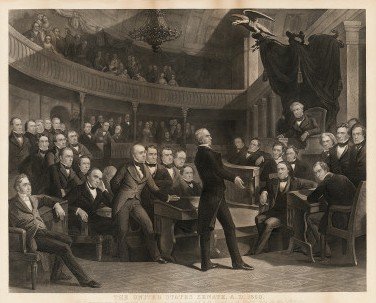
The U.S. Senate Chamber, 1850 – Robert Whitechurch

A world is supported by four things…the learning
of the wise, the justice of the great, the prayers of
the righteous and the valor of the brave. But all of
these are as nothing…without a ruler who knows the
art of ruling. Make that the science of your tradition!

                                      -Frank Herbert, Dune

The Old South was far ahead of the New World Order.  What it lacked in technological development, it made up for in a concrete understanding of human nature that was grounded in reality. That reality was firmly rooted in two principles based upon experiential observation: the existence of ineradicable distinctions between different races and the danger of concentrating power in one unitary source that could arbitrarily determine the outcome of local domestic issues from afar. Indeed it may be stated unequivocally, that American civilization cannot truly go forward at all if its interpretation of human relationships and psychology deniesthese two points. It is for this reason that the philosophic fountainhead of resistance to the New World Order in the United States must inevitably begin with an endorsement of Southern rhetoric.

The term “rhetoric” has come to mean one of two things in contemporary culture: artificial speech or dishonest propaganda. This is a sorry state of affairs. It represents, in part, the overwhelming distortion that a purely nominal and positivistic machine age has introduced into human discourse.  The ancients had a much more elevated conception of the term, viewing it as a necessary analogue to the process of dialectic. Rhetoric was the high art of persuasion and the power of a particular style. Elsewhere I have addressed the polarization between the scientific and poetic modes of discourse and the need for redressing a balance between the two. The original ideal concept of rhetoric represents another evolutionary component of the poetic mode, a category that I previously dubbed the Bardic Dynamic. Read more

Review of Thomas Martin’s “The Victory of Humanism”

The Victory of Humanism: The Psychology of Humanist Art, Modernism, and “Race”
Thomas Martin
Palm Coast, FL: Backintyme, 2011; 177 pages

There can be little doubt that in historical perspective, perhaps the most important upheaval in Western culture has been the decline of aristocratic culture. This is apparent, for example, in two recent books that have influenced my thinking, Ricardo Duchesne’s The Uniqueness of Western Civilization and Andrew Fraser’s The WASP Question (my review will appear in the first issue (June) of Radix, a new magazine edited by Alex Kurtagic and Richard Spencer). For Duchesne, aristocratic individualism is the key to understanding the uniqueness and creativity of the West. Fraser laments the decline of Indo-European aristocratic culture, beginning with the Puritan revolution of the 17th century and carried to its logical conclusion in America with the defeat of the South in the Civil War.

Thomas Martin’s The Victory of Humanism focuses on the decline of aristocratic culture in Western art. Following the “perfection of antiquity,” the breakthrough occurred in the Renaissance with the work of Leonardo Da Vinci, Raphael, and Michalangelo.

A critical observation by Vasari is that those artists achieved perfection by only portraying the beautiful. They did this by using the most beautiful examples of the human body or nature. In this way, they achieved the idealization or perfection of both body and nature.  In fact, Vasari goes so far as to say that Michelangelo was so wedded to the idea of perfection that he had a policy of never doing a portrait of a living person.This would have been descending away form the ideal in the “mind of God” or the human mind, and losing himself in the particular of the empirical.

Martin correctly points out that this sense of ideal human form is an innate part of human psychology. Evolutionary psychologists have shown that the faces that humans find attractive are generalized. That is, faces that are produced by averaging dozens of real photos are judged attractive. Martin expands on this by suggesting that “there is a certain nobility in the generalized face, which helps create the sense that it is ideal. Seeing the face that is in the mind takes the viewer above or out of this world and into the mind, the most powerful and noble part of our bodies.” Read more