
The Amnesty/ Immigration Surge And Senator Schumer’s War Against “White Anglo-Saxons”
This article is also posted at VDARE.
Senator Chuck Schumer, one of the notorious Eight Banditos, gave a revealing speech to the Center for American Progress about the Tea Party the other day. Conservatism Inc. types like Bill O’Reillycriticized Schumer’s remarkably blatant call for the IRS to be used against the Tea Party. But more important was Schumer’s equally blatant acknowledgement of the ethnic agenda behind post-1965 immigration policy—and behind the implacable drive for some form of Amnesty/ Immigration Surge, which the House GOP Leadership appears to endorse this week.
Basically, according to Schumer, Tea Partiers are afraid of change. He drew an analogy with the Temperance Movement of the 1920s as a reaction to the changes wrought by the last 1880–1924 immigration Great Wave:
This reaction against social and cultural changes isn’t new to us. Edward Shils, a professor from the University of Chicago, wrote about the Temperance Movement identifying that it was about much more than abolishing liquor. In the 1880s the U.S. was a rural country and people were on farms and small towns living a clean, God-fearing life. By 1920, America had been urbanized and diversified because of manufacturing, immigration, and so many other forces.
And the cities were a totally different way of life with slums, bars and dance clubs, emerging suburbs and country clubs. Prohibition was not simply about abolishing alcohol; it was an attempt by rural Americans to pull their country back to a Jeffersonian agricultural ideal that was being rapidly replaced by a new cultural and economic order.
Today, we see the Tea Party doing much of the same thing. Tea Party adherents see an America that’s not reflective of themselves, and the America they have known, and they just don’t like it. [Emphases added throughout].
The reference to Edward Shils is revealing: Shils, a member of the New York Intellectuals—a Jewish intellectual movement reviewed in Chapter 6 of my book The Culture of Critique—was a leading theorist of the idea that attempts by majorities to resist the increase in the power and influence of other groups are contrary to the democratic process. A defining feature of the New York Intellectuals was their hostile reinterpretation of Populism, the anti-elite insurrectionary movement of the 1890s. Read more

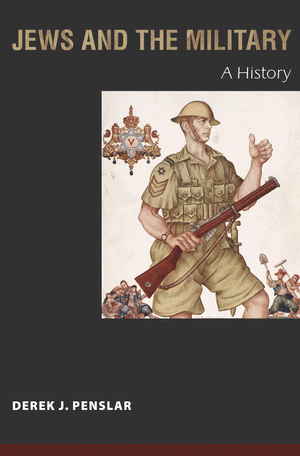 The subject of Jewish attitudes to military service, particularly in the diaspora, has been a key interest of mine for some time. Since ancient times, military service has been regarded as the touchstone of true citizenship and patriotism and, to me at least, it seemed the perfect backdrop against which Jewish identity and its hierarchy of loyalties might be seen more clearly. Though never given truly comprehensive scholarly attention, there are countless brief references to Jewish attitudes and actions in taking up arms in works ranging from flagrant Jewish apologetic, to the productions of the racialist right. Most of these references pertain to accusations that Jews historically have shirked military service and often resorted to the most elaborate, and often ridiculous, methods in order to avoid doing “their share” in the defence of the nation-state.



