Featured Articles

Foreword to The Way Life Should Be, by John Q. Publius

The Way Life Should Be? The Globalists’ Demographic War on America, with Maine as a Microcosm 
John Q. Publius
Ostara Publications, 2020; $16.95

The power of the pro-immigration lobby is well known and often written about. The vast majority of this writing is concerns events at the center of American political culture, at the federal level. There is good reason for this. Most immigration policy is produced at the federal level, and states such as Arizona and California that have attempted to enact legislation limiting immigration in one way or another have been slapped down by the judicial system.

In general, the pro-immigration forces have gotten their way. The main players are well known: the ethnic lobbies seeking more of their people as immigrants, leftist activist organizations seeking to alter the demographic and political balance of the U.S., together with big business interests intent on importing cheap labor.

The uniqueness of John Q. Publius’s The Way Life Should Be? is that it delves into how the pro-immigration forces have penetrated down to the state and local level. It focuses on what may seem like an unlikely target—the state of Maine which, as of this writing, remains around 95 percent White. It is also the most rural state east of the Mississippi, with a population of around 1.4 million.

But Maine is nevertheless the target of an extensive network of NGOs and various other religious and secular groups masquerading as charities that have focused their efforts on importing as many Third World peoples into the United States as possible. In this effort the NGOs are joined by business, political, academic, and media elites. Maine is thus a microcosm of what is happening in the rest of the country. The only group left out in all this are white middle-and working-class Americans who bear the burden of this onslaught in terms of increased taxes and a deteriorated social fabric.

Before embarking on all the detailed workings of these interlocking interest groups and their effect on immigration, Publius provides an excellent overview in the Introduction. It is an unequaled portrait of the big picture of how the neoliberal establishment has operated since the 1970s. The main trends are clear: the transformation of the economy from a focus on manufacturing to finance, outsourcing of jobs to foreign countries, free trade, the decimation of labor unions, importing a new underclass from the Third World, and a decline in an ideology of economic or political nationalism. This has had the effect of enriching those at the top of the economic pyramid—Wall Street and those who own or manage multinational corporations able to take advantage of these trends. But it has devasted the working class: Wages have stagnated beginning in the 1970s.

These changes have especially impacted the white working class. Not only have their wages stagnated, but they have less political power because of the decline of unions that had been a central constituency of the Democratic Party. The Democratic Party had been the party of the white working class but in the decades since the 1965 immigration law it became the party of diversity as intellectuals increasingly adopted the now-dominant “diversity is our greatest strength” stance that was clearly not in the interests of the white working class. Whereas unions had staunchly opposed immigration because of its effects on jobs and wages, the Democrats welcomed immigration as the future of the party—as indeed it is given that non-whites vote overwhelmingly Democrat. Without political representation at the national level, the white working class drifted to the Republican Party—the party that often gave lip service to immigration restriction but in fact welcomed immigration because it was the party of big business and cheap labor. The political genius of Donald Trump was that he tapped into the political frustration of the white working class by adopting a populist, anti-immigration rhetoric that went beyond the moribund class basis of American politics by appealing to an implicit sense of whiteness and the interests of the working class in repatriating manufacturing and lowering immigration. The Republican Party would be refashioned to be the party of white Americans, and the white working class became the largest constituency of the GOP. Of course, Trump’s actions since becoming president have not lived up to his pre-election rhetoric—due at least partly to being stymied by investigations, threats of impeachment, a unified and extremely hostile Democratic Party, and some Republicans who are not on board with his policy proposals.

A focus of my work, particularly my book, The Culture of Critique, is the rise of a new Jewish-dominated elite in America after a huge increase in the Jewish population resulting from immigration beginning in the late nineteenth century and continuing until immigration restriction was enacted in the 1920s. The Jewish rise to power and influence was gradual but even in 1911 Jewish activism was responsible for abrogating the U.S.-Russia trade agreement despite opposition from President Taft. By the 1920s Jews had developed important strongholds in the media (Hollywood, The New York Times, CBS, NBC) and in academia (particularly in departments of anthropology because of the influence of Franz Boas). Jewish influence increased markedly after World War II and anti-Semitism, which had been quite widespread in prior decades, declined dramatically.

However, the 1960s was a watershed decade that saw the eclipse of the previously dominant White Anglo-Saxon Protestant elite with its power emanating from Ivy League universities and dominating business and professional societies. As Eric Kaufmann noted,

By the 1960s, as if by magic, the centuries-old machinery of WASP America began to stall like the spacecraft of Martian invaders in the contemporary hit film, War of the Worlds. In 1960, the first non-Protestant president was elected. In 1965, the national origins quota regime for immigration was replaced by a “color-blind” system. Meanwhile, Anglo-Protestants faded from the class photos of the economic, political, and cultural elite—their numbers declining rapidly, year upon year, in the universities, boardrooms, cabinets, courts, and legislatures. At the mass level, the cords holding Anglo-Protestant Americans together began to unwind as secular associations and mainline churches lost millions of members while the first truly national, non-WASP cultural icons appeared.[1]

As Kaufmann notes, a key piece of legislation during the 1960s was the immigration law of 1965 that ended the national origins bias of U.S. immigration law that had favored northwest Europe. In retrospect this law should be seen as a sort of coming out party for the new Jewish elite. Culture of Critique documents the role of Jewish activism in bringing about this sea change in American immigration policy. While the law did not immediately alter the demographic balance of the country, it did open the door, and in the ensuing decades activists, and, in particular, Jewish organizations, continued to press for greater numbers, with the result that the white population has declined from around 90 percent in the 1950s to less than 65 percent today. These non-White immigrants and their children vote overwhelmingly for the Democratic Party which has championed immigration in recent years to the point that there is a very real possibility of one-party rule by a decidedly left-wing party. Democrat presidential candidates called for an end to border enforcement, abolishing the Immigration and Customs enforcement, and making all immigrants—legal or illegal—eligible for medical care, voting rights, and driver’s licenses. Any calls to limit immigration are greeted with cries of “racism,” and attributions of Nazism are common. Publius documents the continuing Jewish influence on immigration policy throughout, the interlocking network of NGOs, activists, media owners and producers, and wealthy donors.

With all that as background, Publius details the incredibly elaborate and incredibly well-funded pro-immigration infrastructure in the present. Immigration advocacy organizations are funded by a class of wealthy capitalists. For example,

Pueblo Sin Fronteras is just one of a huge number of NGOs that are part of the vast refugee resettlement network. This network has virtually unlimited resources and is backed by some of the world’s wealthiest individuals, not to mention multi-national corporations, banks, private equity firms, and national governments. Their synergy has produced the terrible globalist monstrosity known as “neo-liberalism” confronting us today.

He then describes how Pueblo Sin Fronteras is connected to a whole host of other non-profits and to donors like George Soros. And of course, Soros supports a wide range of leftist activist organizations and politicians. The districts of politicians who are not completely on board with the immigration agenda are pinpointed for refugee resettlement. These are overwhelmingly white districts. The point is to destroy white enclaves and the high-trust societies that developed in traditional America.

Publius does an excellent job describing the costs of this onslaught. Crime: Somalis “are almost solely responsible—along with the Congolese—for all of the crime in the city” of Portland. There are also huge costs for welfare benefits and public housing, which push up property taxes. Public housing is stretched to the point that there is an increase in homelessness for native Mainers, “yet the political class has prioritized the comfort of these migrants who have the backing of the entire globalist establishment.” Most remain unemployed or in low-wage, part-time unskilled labor.  Academic achievement is predictably poor. Thus Maine is importing an underclass, but it’s an underclass that will reliably vote for liberal politicians and provide cheap labor for Maine’s businesses. All of this is justified by corrupt politicians bought and paid for by powerful economic and diversity-related interests who intone about Maine’s “values”—the moral imperative that justifies this assault on the traditional population of Maine. Needless to say, these same processes are at work throughout the rest of the U.S.

The Way Life Should Be provides a highly detailed picture of what is going on in Maine. It’s really a reference source for those wishing to understand the interlocking, lavishly funded infrastructure that is destroying America. It’s conclusion is exactly right:

The many service providers and NGOs described in this book are absolutely essential to the vast matrix of “philanthropic capitalism,” and it should be abundantly clear by now that all of these organizations from the “charitable” to the state- and corporate-sponsored are inter-connected and their machinery is geared toward first splintering and then eradicating the native populations of the Western world, indeed all unique races, ethnicities, and cultures under the heel of the neo-liberal oligarchy. Understanding these mechanisms is absolutely essential in counter-acting the Establishment’s destructive agenda.


[1] Eric Kaufmann, The Rise and Fall of Anglo-America (Cambridge: Harvard University Press, 2005), 2–3.

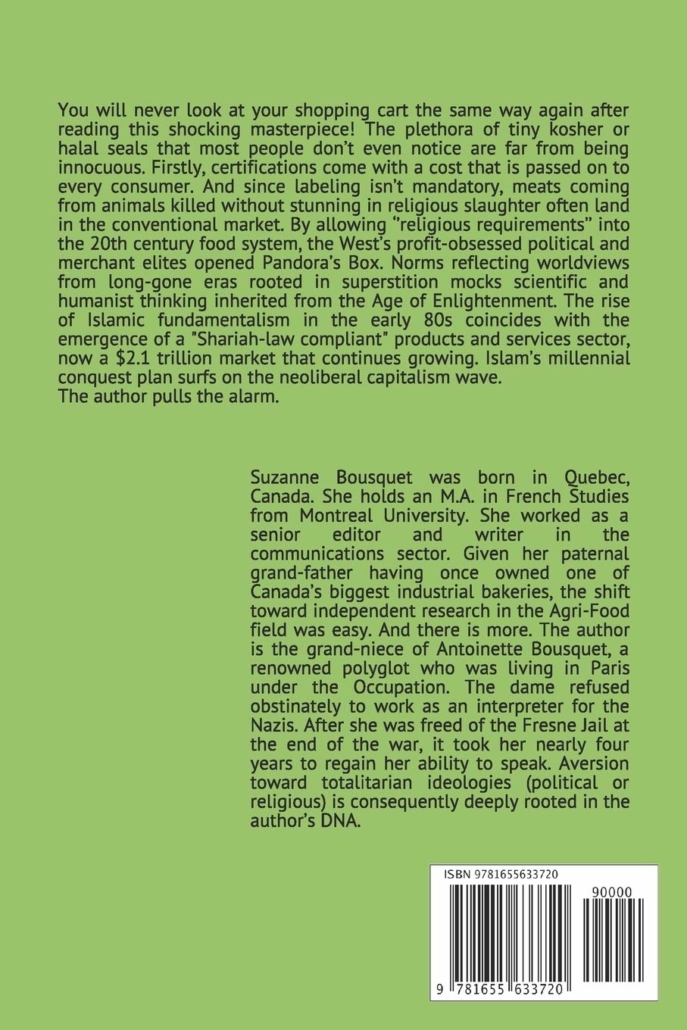
Review: From Kosher to Halal


From Kosher to Halal: When Greed, Politics, and the Sneaky Destruction of Western Civilization Intertwine
Suzanne Bousquet
Translated from French by David Smith, 2020.

Four years ago, I was asked by a Jew on social media why I thought myself an expert on the Jewish people. The question was obviously intended as the prelude to an argument or abuse, and I’d gotten used to such approaches. “I don’t think any such thing,” I replied. “There are large swathes of information about Jews, their religion and history, that I’m not even remotely interested in. The Talmud, for example, would bore me to read in full. But I do consider myself to possess some expertise on the subject of anti-Semitism. I’m interested in Jews only insofar as they affect, and have affected, Europeans. You can start with the cumulative bibliography of my essays, spanning hundreds of texts, if you wish to argue otherwise.” My Jewish correspondent had no reply to this, and I never heard from him again.

The Jewish Question is, of course, vast in terms of its historical and geographical spread, and my claims of expertise were somewhat tongue-in-cheek. Yes, I’ve read a great deal of the historical literature. I’ve even spent 12,000 words in reviewing much of the best of it, and I’ve written over 200 essays of original material on aspects of the subject. But there are always areas in which it is best to defer to others. I was reminded of this when reading Suzanne Bousquet’s recently-published From Kosher to Halal which, more than any other book I’ve read in recent years, confirmed for me just how much I don’t know about the Jewish Question. Much of my pre-existing opinion on kosher slaughter had been informed by the 1920s pamphlet “The Legalised Cruelty of Schechita” by the eccentric British veterinarian, and avowed Fascist, Arnold Spencer Leese. But this pamphlet, although retaining remarkable relevance, is now a century old, and has nothing to say about the modern mass-certification industry. Bousquet’s extremely well-researched, well-written, and tightly argued book brings an entirely different, and infinitely more professional, level of detail and context to this quite convoluted subject, and she connects dots I barely knew existed. In the following review I want to offer a summary of what I now regard as an essential text in the study of Jewish influence on Western modernity.

Bousquet’s From Kosher to Halal is a fascinating combination of religious study, history, and contemporary political commentary. In the words of the Quebec-born author,

This book seeks to fill a remarkable gap, viz., the absence from any Canadian publisher’s catalogue of any rigorous explanation of the business of kosher and halal certification from an outsiders’s point of view. This absence can be explained in several ways, including a certain sensitivity about dealing with a subject whose mere mention causes controversy — as if there were domains that must remain taboo from the mere fact of their religious connotations.

Bousquet is the granddaughter of the former owner of one of Canada’s largest industrial bakeries, and, in From Kosher to Halal, she combines some inherited instincts from the Agri-Food industry with editorial and communications experience gained in her professional life. Bousquet’s concern is primarily that, although we live in an age of “enlightened consumerism,” kosher and halal certification is shrouded in almost complete secrecy and is declared off-limits politically.  The author comments that although

there are discreet kosher logos on nearly 80% of products at the grocery, and subtle pressures are increasingly felt by producers to acquire halal certification as well, these two labels are not publicized: they remain a mystery for many people. And meat from animals slaughtered in kosher or halal fashion are still not subject to systematic, strict identification and labelling even now.

The agencies which sell religious certification services, and the companies which profit from products labelled kosher or halal, have never been subject to an objective or critical scholarly examination of their practices. We soon learn just how necessary such an examination is. Bousquet argues that these agencies push companies to adopt high certification costs that are then passed on to the consumer, a kind of “kosher tax,” with the acquired funds funnelled into the Jewish and Muslim communities. Bousquet proposes to analyze the practices of the agencies, and follow the money trail, “modestly putting down a first milestone toward a better understanding of a reality unknown to the public.”

The book’s first chapter “From Kashrut to Kosher Industry,” begins with an historical overview of the development of kashrut, the set of dietary laws dealing with the foods that Jews are permitted to eat and how those foods must be prepared according to Jewish law. Bousquet points out that dietary laws were a means by which Jews could accentuate ethnic particularism, arguing that “the ‘chosen people’ distinguish themselves in particular by the way they eat.” Bousquet demonstrates a comprehensive reading of Jewish religious texts in this area, including the Mishnah, and is very clear in their implications:

Rabbi David Bar-Hayim of the Merkaz HaRav Yeshiva confirms in a study that Judaism establishes a distinction between individuals based on religion. Meat designated “kosher,” and by extension the absolute obligation that the slaughter be carried out only by a believing Jew, comes from a conception which figures in the Hebrew Law (the halakha), whereby non-Jews (goyim) are considered animals. The terrestrial soul of non-Jews has the same type of anima as that of impure animals (such as pigs or apes): the goyim are creatures judged very inferior, and this is why meat from an animal slaughtered by them cannot be kosher.

The text then moves to an analysis of the essential rules of kashrut before providing a very interesting, and for me entirely novel, account of the origins of kosher certification in North America. Kosher certification is, we learn, an invention of early twentieth-century New York, having no real precedent in history. The practice, revealed here as little more than an elaborate scam, was created in 1919 by a New York Jew named Joseph Jacobs. Jacobs had been a school teacher in the Bronx until a failed attempt to obtain a promotion resulted in a move to the advertising industry. Taking up a position at the Yiddish-language Daily Forward (Forverts), Jacobs “got the idea of offering his services to facilitate the sale of certain products to the Yiddish-speaking community of New York, at that time 1.5 million strong and unable to understand English.” In 1919, Jacobs founded the Joseph Jacobs Advertising Agency, Inc., which still exists. In the early days of the company, kosher certification was more or less limited to kosher marketing — convincing Yiddish-speaking Jews that foods they thought were prohibited were in fact permitted under kashrut. Bousquet uses the example of coffee:

To illustrate how Jacobs worked, let us take the example of coffee. At the time, religious Jews considered this vegetable matter, a bean, and thus not kosher for Passover. Jewish grocers classed coffee with hamets (forbidden for Passover) under the erroneous belief that coffee beans were kitniyot, when they are in fact the seeds of a fruit — and not beans. So Jacobs launched a publicity campaign to explain that coffee beans are not leguminous vegetables but fruits, and consequently kosher. He found a cooperative Rabbi to confirm his point of view and published announcements in the Yiddish papers. This is how Maxwell House became kosher: without inspection or blessing.

Jacobs soon merged this kind of kosher marketing campaign with a more formal style of kosher certification rooted in Jewish communal meat regulation. This latter context is explored in detail by Bousquet, who reveals the entire subject to be rooted in Jewish gangsterism, violence, and attempted murder. The violence had its origins in the desire of the rabbis to boost their income by overseeing shechita, or kosher slaughter. Rabbis would form small kosher certification boards and, if a town or city had two or more rabbis, violent rivalry would break out between factions as each sought a monopoly on shechita funds. As part of this rivalry, each faction would place its own brand on kosher products (e.g. “U” for Union of Orthodox Jewish Congregations), and encourage the boycott of products marked with a rival brand.

Joseph Jacobs saw an opportunity to bring this branding into play in his own marketing efforts, and convinced an increasing number of non-Jewish businesses to mark their products with “K” for kosher and, later, any one of the expansive range of other logos or initials that represented the various kosher certification factions. Competition between Jews persisted to some extent but, since the target was now the more lucrative outgroup market, the violence eased. Maxwell House (1923) and Coca-Cola (1937) were among the first mass market products to obtain kosher certification, but the pace didn’t really begin to pick up until the 1960s, alongside Jewish advertising campaigns that marketed kosher hot dogs and rye to non-Jews as “healthier, superior foods.” [Bousquet skewers this later in the book.] Despite the relatively minuscule numbers of observant Jewish consumers, over the next six decades the kosher certification industry has expanded in the West to cover everything from toilet paper, household soap and diapers, to pet food and suppositories. In America, up to 50% of grocery products are now kosher certified, for an estimated annual sales of 500 billion dollars.

When you want your ferret to have a better diet than the goyim

At this point, Bousquet’s book really comes into its own. The most contentious aspect of kosher certification, aside from methods of slaughter, is the question of cost. What expenses are incurred by certification, and what impact do they have on retail prices? Here Bousquet employs detective work and penetrating logic. The author notes the mafia-like silence on this issue, pointing to a “sort of omertà regarding how much money certifiers earn from their activities, going as far as denying all profitability.” The Center for Israel and Jewish Affairs, for example, decries “mistaken beliefs” that kosher certification is a for-profit industry, arguing that costs merely cover inspection and that certification only profits the companies certified. Other interested parties have argued that “the additional costs assumed by consumers are quite minimal,” and that “rabbis make no profit from certification.” Bousquet, by contrast, points to a number of studies, including a 2011 PhD thesis, demonstrating that kosher certification brings in enough profits to be dispersed not only within certification bodies, but also Jewish schools, cultural institutions, and other Jewish communal organizations. In short, it’s quite easy to deduce that kosher certification is not only highly profitable, but that it involves a significant transfer of wealth from the general population to the Jewish population.

Bousquet describes in detail this “lucrative racket,” which involves the mass certification even of products already regarded as intrinsically kosher (e.g. virgin olive oil, frozen blueberries, coffee, detergent, dishwashing soap, toilet paper, salt, and pepper). In Bousquet’s native Canada, the kosher-certified market has expanded 64% since 2003. We learn that the situation reached such ridiculous proportions in Canada that Paul Lungen, an investigative journalist with Canadian Jewish News, conducted an eight-month investigation into kosher certification practices at the Kashrut Council of Canada (COR) that exposed numerous irregularities and abuses. These included arbitrary pricing and false declarations of what is and isn’t kosher. It was also revealed that COR reported annual revenues of over $5 million, but, despite being a registered charity, dispensed only $2,500 to charitable causes. One vegetable oil company reported that it had to cancel its kosher certification after learning that COR would charge $45,000 just to have a rabbi, possessing no meaningful qualifications in food production, attend an annual inspection of their manufacturing processes. For his efforts in reporting these facts, Lungen was quickly denounced by his co-ethnics for committing the sin of chillul HaShem, which translates as “profanation of the name of God” but actually means that a Jew has informed non-Jews of Jewish misdeeds. In other words, Lungen was declared a race traitor.


The scam runs deep, and often has links to Jewish influence in government. At least one Canadian kosher certification business, the Canadian Kosher Food Safety Initiative (CKFSI), was started thanks to a $763,650 funding grant from government minister Christian Paradis, the latter having a history of bribery allegations. The government has also permitted rabbis from organizations like CKFSI to profit from conducting general health inspections at food production sites, despite their overwhelming lack of professional or educational qualifications in the area. This has prompted economist David MacDonald from the Canadian Centre for Policy Alternatives to declare: “It is not the responsibility of a religious organization to determine the safety of the food you eat. … We cannot have the same level of confidence. … We will have less well-trained, less experience personnel.” Because Jews are combining their dubious “health inspections” with expensive kosher certification, production costs are expected to increase 5-7%, with the additional costs then passed on to consumers.

At less than 1% of the population in Canada and the United States, with similar representation throughout the West, it’s clear that Jews aren’t assuming the costs of the vast kosher certification enterprise, which takes up 60% to 80% of the grocery trade and has “kosherized” entire production chains. Jewish apologists for the kosher certification industry have claimed that non-Jews have come to the conclusion that kosher foods are of superior quality and that kosher means “good food” to many consumers. They argue that kosher certification is sought after by the general consumer, and that the various kosher logos are therefore an attractive attribute for any product. Bousquet points out that such claims stand in sharp contrast to university studies that have found these kosher labels “pass almost unnoticed by the general population,” many of whom have absolutely no idea what the logos actually mean.

To those that do know what the labels mean, and object to the wholesale kosherization of the food industry, Jews have a blunt response. Bousquet has a very interesting section on how Jews, especially the ADL, have used accusations of anti-Semitism to silence criticism of kosher certification and prevent meaningful investigation of its practices. In 1991, the ADL effectively created a template response to accusations of a “kosher tax” that has been used by almost every kosher certification body since. The hallmarks of this template response are:

  • Declare the idea of a “kosher tax” to be a “hoax” concocted by “right wing extremists.”
  • Assert that any insinuation that rabbis are enriched by kosher certification is a “conspiracy theory” dependent on “stereotypes about Jews.”
  • Deny that only a small segment of the general population desires such markings.
  • Repeatedly mention that the idea of a kosher tax has been promoted by “various Ku Klux Klan groups” thus making anyone uneasy to share these ideas.

Bousquet does an excellent job of interrogating the ADL’s claim that kosher certification costs are “so negligible in practical terms as to be virtually non-existent.” In response, Bousquet asks, if they are so low, why no business has ever revealed the exact figures, and why the Jewish communities which demand certification can’t pay the costs themselves. Also, asks Bousquet, if this is such a low-revenue industry, why are there 273 kosher certification agencies in the United States all competing fiercely for a slice of what is alleged to be a very meagre pie? The author then points out that COR’s revenues for 2013 were $5.4 million, with nine of its employees earning salaries of between $80,000 and $119,000, with one making between $120,000 and $159,000. All from a “virtually non-existent” income!

Despite its factual bankruptcy, the ADL template is used with alarming regularity. When Louise Mailloux, a philosophy professor and candidate for the Parti Québécois, spoke of a “religious tax” during an April 2014 electoral campaign, the Quebec branch of the Center for Israel and Jewish Affairs issued a statement accusing Mailloux of echoing “a conspiracy theory created and spread by the Ku Klux Klan” and insisting that there is no real cost behind certification and that companies get certified in order to “open up a new market segment and boost sales.” When Pierre Lacerte, a journalist, attempted to defend Mailloux and add detail to her claims, a Rabbi Zvi Hershcovich issued a statement accusing both of “bringing up a myth created by Ku Klux Klan and neo-Nazi groups. … The cost of certification is minimal. … Acquiring kosher certification is a wise business decision.” All of which goes to show that while Jews are not a creative people, what they lack in originality they make up for in sheer repetition. As such, their outcries are not so much dramatic, as possessing the ominous monotony of the drone of an approaching swarm of hornets. Undeterred by the obvious weakness of a lie, they’ll beat you with it a thousand times rather than open up the books.

Bousquet is undeterred by the swarm, and swats back at it very effectively. She follows the money relentlessly, and finds many examples of major companies and organizations (and even one rabbi) who are willing to go on record as confirming that kosher certification is expensive and that the costs are passed on to the consumer. When Jewish pressure was brought to bear on the Girl Guides to make their cookies kosher, Girl Guide Cookies replied publicly: “Although the ingredients are kosher; Dare equipment is not. The kosher certification is very expensive, over and above the annual cost required to maintain it. We are refraining from certifying these produces because the costs greatly outweigh the benefits. We are sorry, but making these cookies kosher is not a good business decision.” Didn’t these Girl Guide bigots, with their prejudiced cookies, realize they were making the same claims as the Ku Klux Klan? Apparently not. Later, however, after “lots of perseverance,” Jewish lobbying was able to achieve the desired result. How many observant Jewish consumers of Girl Guide Cookies are out there? It doesn’t matter. What matters is the Girl Guides aren’t like the Ku Klux Klan, and you can now be sure you’re eating a superior, and more expensive, food.

The book’s treatment of halal is no less fascinating and infuriating. Although there is a richness of detail, the main theme that emerges here is that Muslims have essentially followed the Jewish template, inventing a certification system that funnels money into their community while spreading their unchecked influence in the food production system. In the words of Hajj Habib Ghanim, President of the USA Halal Chamber of Commerce:

The introduction of halal certification to the United States owes much to the kosher certifiers who conducted similar, well-established activity and know the industry. We have learned from them. … We are learning from our Jewish cousins who have been operating for years. We are learning, and we have a great deal of support from them.

Much of this mutual support is rooted in the shared desire to continue ritual slaughter in Western lands where the mistreatment of animals is illegal. Bousquet’s chapter on ritual slaughter is exceptional, with an excellent section titled “From Multiculturalism to Legal Pluralism,” in which she argues that the “pernicious cultural relativism of multicultural policies has allowed religious fundamentalists quietly to impose legal pluralism.” Thus the laws for producing kosher and halal meat obey Hebrew and Islamic law and not the law of the nation. Bousquet explores these grim methods of slaughter and succinctly dismantles apologetics in their favor. Most concerning to the author is the fact that a lot of kosher and halal meat finds its way to the mass market, where it is not labeled as such. For example, Jews might ritually slaughter 100 cattle, but perhaps only 10 will pass inspection as kosher after the slaughter. This is because a rabbi conducts an examination of the major internal organs after the killing of the animal, and even a slight blemish on a lung is sufficient for the meat to be declared unclean and fit to be consumed only by goyim. It is then placed back onto a conveyor belt, butchered, packaged, and sold to an unsuspecting housewife entirely unaware that this evening’s steaks were earlier essentially tortured alive, eviscerated, mulled over, and rejected by an Ashkenazi fanatic.

The complicity of the major meat processors is revealed by Bousquet as owing much to the desire to build a thriving meat export business supplying the Middle East and North Africa, while filtering undesired meat to Western consumers without even a hint of the way in which the animal was killed. The author’s detailed and lengthy analysis in this area, too sizeable to be given adequate treatment in this review, represents a damning indictment of modern monopoly capitalism and its willing participation in Western cultural decline, a participation motivated by greed and underscored with a cold indifference to the great mass of consumers. Indeed, in an age where we are fed the lie that the consumer is king, Suzanne Bousquet’s exploration of kosher and halal certification reveals we are more like the topic’s unfortunate cattle, being mass farmed and abused for the benefit of others.

Suzanne Bousquet is to be congratulated for this brave, original, and detailed study of a subject I was quite unfamiliar with. I have no hesitation in recommending it to others with an interest in Jewish influence, the kosher and halal industries, or the interplay between multiculturalism and globalist capital. This is precisely the kind of investigative and damning literature we need, and it’s a very worthy addition to my library. If there’s a Jew out there busily preparing to ask the author just why exactly she thinks herself an expert in this area — I can assure you, she is.

Noam Chomsky’s “Requiem for the American Dream”: Jewish Activism by Omission

I discussed this video with Frodi Midjord on the Scandza Forum.

Noam Chomsky is, as this documentary notes, “widely regarded as the most influential intellectual of his time.” Given that Chomsky is on the left, it might seem that he has little to offer. But in many respects, his comments here reinforce many of the ideas linked to the populist right, although, as with the influence of the (never mentioned) Israel Lobby, he also has an very large blind spot when it comes to Jewish power. Chomsky, born in 1928, was already a superstar linguistics professor at MIT by the 1960s when he became a fixture among New Left activist intellectuals, joining such figures as Paul Goodman, Herbert Marcuse, and Howard Zinn. The documentary is really a history of America beginning in the 1950s seen through the eyes of a New Left intellectual.

Unlike the continued vilification of the 1950s that streams out of Hollywood, Chomsky labels the decade a relatively egalitarian “golden age,” noting that the relative wealth of the bottom 20% increased about as much as the top 20%, labor unions were strong, working class people could afford a home and a car, and taxes  (including taxes on capital gains and dividends) were relatively high on the wealthy. Nowadays we are told only about Jim Crow practices that still occurred  in the South in the 1950s, but Chomsky notes that Blacks were able to get good jobs working in automobile factories, etc.

All that changed, beginning with what Chomsky calls the “significant democratization” of the 1960s—the Civil Rights movement, feminism, and environmentalism. In my writing, both in The Culture of Critique and Individualism and the Western Liberal Tradition, I regard the 1960s as a watershed, transformative decade, marking the rise of a new Jewish-dominated left-of-center elite based on power in media and the academic world. Chomsky does not agree, claiming that beginning in the 1970s there was a reaction against the 1960s that culminated in the relative dispossession of the working class. This is true as far as it goes, but it fails to come to note the rise of Jewish power in finance and business also occurred during this period.

In arguing for his position, Chomsky emphasizes that the 1970s marked the beginning of the rise of the financialization of the economy. Whereas in the 1950s manufacturing was 28% of the economy and finance 11%, the balance had reversed by 2010. Chomsky notes that companies like General Electric realized they could make more money with sophisticated financial maneuvering than by manufacturing. Complex financial instruments were invented and financial regulations that had been in place since the 1930s to prevent economic crashes were removed. And it was the beginning of outsourcing manufacturing to foreign countries with cheap labor and the consequent decline of labor unions and the economic and political power of the White working class. And when the complex financial instruments blew up (as happened in 2008 with collateralized debt obligations [the result of bundling good and bad (including “liar loans’) loans into one financial product]), the government bailed out “too big to fail” Wall Street but not individual homeowners.

As Chomsky notes, the result of these developments was rising economic inequality—the rise of the super-rich top 0.1 percent to unrivaled political power. Chomsky notes that the super-rich much prefer oligarchy to democracy and indeed the data support him. they are able to control the political process via donations to political candidates and control of media messages. Jews are recognized as the “financial engine of the left,” as Norman Podhoretz phrased it, and contribute around 75% of the funds for Democrats and probably at least 50% for Republicans (Sheldon’ Adelson’s generosity toward Trump. (A prominent example is Sheldon Adelson whose support of Trump [north of $200 million] is predicated on a pro-Israel foreign policy; in general the Republican Jewish Coalition favors a pro-Israel foreign policy and moving the party to the left on social issues like immigration and gender).

Illustrating the importance of media control, Chomsky notes that Obama’s presidential campaign received an award for the most effective public relations media campaign and he decries the Supreme Court’s decision in the Citizens United case which framed financial donations to political campaigns by corporations and labor unions as free speech, in effect further opening the gates for the wealthy to control the political system. He then notes this is quite unlike media corporations like CBS which are “supposed to be a public service.”

This of course, is absurd, implying that CBS (and by implication other mainstream media corporations) has no political biases and acts as a public service. CBS is part of ViacomCBS, whose major owners are the Sumner Redstone and his family, who are Jewish and whose values are typical of the liberal-left attitudes of the mainstream Jewish community (here, p. xlvi–lvi).

Chomsky clearly has a distaste for oligarchy but he fails to mention the very large body of writing by Jews opposed to populism—a major theme of The Culture of Critique, especially Chapter 5. As noted there, citing Paul Gottfried (After Liberalism) and Christopher Lasch (The True and Only Heaven):

In the post–World War II era The Authoritarian Personality became an ideological weapon against historical American populist movements, especially McCarthyism (Gottfried 1998; Lasch 1991, 455ff). “[T]he people as a whole had little understanding of liberal democracy and . . . important questions of public policy would be decided by educated elites, not submitted to popular vote” (Lasch 1991, 455).

In his 1963 book The Tolerant Populists,  Walter Nugent, was

explicit in finding that Jewish identification was an important ingredient in the [anti-populist] analysis, attributing the negative view of American populism held by some American Jewish historians (Richard Hofstadter, Daniel Bell, and Seymour Martin Lipset) to the fact that “they were one generation removed from the Eastern European shtetl [small Jewish town], where insurgent gentile peasants meant pogrom.” 

Indeed, another example comes from Chomsky which occurred well before the rise of Jews to cultural dominance. Walter Lippmann, also Jewish, is quoted as writing in 1925 “The public must be put in its place.” Throughout European history down to the Soviet Union and post-World War II communist societies in Eastern Europe, Jews have always made alliances with ruling elites, often alien ruling elites and often in opposition to other sectors of the population.

Chomsky’s blinders on the media and populism are part of a larger pattern. Chomsky sees post-1960s America as a backlash against the 1960s but in fact the post-1960s America described by Chomsky is the result of the same forces that produced the 1960s counter-cultural revolution: the rise of Jewish power discussed in The Culture of Critique. Chomsky fails to mention that Wall Street and corporate America are decidedly on the left when it comes to the social issues that came to prominence in the 1960s: civil rights (now morphed into racial identity politics for all non-Whites), feminism (now morphed into gender identity politics), and the environment (now dominated by “climate change”). Leftist attitudes on these issues pervade elite media, the academic world, and corporate America.

And he fails to mention that Wall Street is well known to be a center of Jewish power. In his 1999 book, The Fatal Embrace: Jews and the State Benjamin Ginsberg claimed that Jews comprised 50% of Wall Street executives. It’s doubtless at least that high now, and that number doesn’t really get at the extent of Jewish control of key Wall Street players like Goldman Sachs.

Kevin Phillips provides some detail on Chomsky’s economic history of America since the 1980s:

My summation is that American financial capitalism, at a pivotal period in the nation’s history, cavalierly ventured a multiple gamble: first, financializing a hitherto more diversified U.S. economy; second, using massive quantities of debt and leverage to do so; third, following up a stock market bubble with an even larger housing and mortgage credit bubble; fourth, roughly quadrupling U.S. credit-market debt between 1987 and 2007, a scale of excess that historically unwinds; and fifth, consummating these events with a mixed fireworks of dishonesty, incompetence and quantitative negligence.

The Occidental Observer has posted 44 articles on the topic of Jews in the Economy/Finance. (This link goes to the most recent of these articles, Edmund Connelly’s “Jews and Vulture Capitalism: A Reprise.” If you scroll to the bottom of the page there are links to the other articles in this topic—an awkward system; will fix.) Connelly has contributed several other articles on these topics, including “The Culture of Deceit” illustrating the legitimacy of financial fraud within the mainstream Jewish community and several articles on how the Jewish role in financial manipulation has been airbrushed by Hollywood. Also included in this collection are are several articles by Andrew Joyce (“Vulture Capitalism Is Jewish Capitalism,” Paul Singer and the Universality of Anti-Semitism,” and “Jews and Moneylending: A Contemporary Case File), and by me (“Does Jewish Financial Misbehavior Have Anything To Do with Being Jewish?” and “Now Comes the Anger.”

Finally, another enormous blindspot is Chomsky’s never mentioning immigration at all, despite its tranformative effects on America. Chomsky dutifully mentions the role of outsourcing jobs in compromising the interests of the working class but never mentions that immigration is a major part of the reason for wage stagnation since 1970 as well as forcing working-class Whites to move out of formerly White areas in areas like Southern California which have been inundated by immigration. Chomsky champions a class-based politics, but the Democratic Party, formerly the bastion of labor unions, has become the party of diversity, embodying all the themes of the 1960s counter-cultural revolution and ignoring the interests of their White working-class constituents, with the result that the White working class was the largest group supporting Donald Trump with his populist rhetoric during the 2016 election. Because of importing of millions of non-Whites, the class-based politics of the 1950s has been destroyed in favor of a coalition of non-Whites and upper-middle-class White liberals (Individualism and the Western Liberal Tradition, Chapter 8).

Another blind spot is free speech. Free speech was a rallying cry for the Old Left in the 1950s and for the New Left in the 1960s, at a time when the anti-communist movement was able to force professors to sign loyalty oaths. The original 1960s protest movement at the University of California was called the Berkeley Free Speech movement. Even during the 1950s, Jews were deeply involved in creating a culture of the left that was mainly concerned to protect communist professors and other leftist dissidents, such as Hollywood screen writers, targeted by McCarthyism. Inherit the Wind (by Jerome Lawrence Schwartz and Robert Edwin Lee) was written to oppose McCarthyism. Another famous example of anti-McCarthyism from the 1950s is Arthur Miller’s The Crucible which implicitly condemned the  House Un-American Activities  Committee by comparing it to the Salem witch trials. Although quite powerful, the culture of the left was not yet the dominant elite that it has become since the 1960s.

Chomsky thinks that free speech is still championed by the left, but he is sorely mistaken. The rise of the new elite has coincided with the power of organizations that support leftist attitudes on free speech—organizations like the now discredited Southern Poverty Law  Center and the ADL that  specialize in getting people fired for  thought crimes and care nothing  for  free speech. Mainstream conservatives are  prevented from speaking at universities or greeted with riots and protests. There is clearly an  ethnic aspect to this transformation,  with Jewish organizations acting as leading proponents of “hate speech” legislation throughout the West. While there are endless tears (see here and here, pp. 39–40) for Hollywood screenwriters blacklisted during the anti-communist fervor of the 1950s and since promoted to cultural sainthood, don’t  expect our new elite to condemn witch hunts like the ones that have targeted right-wing dissidents, many of whom have been fired from their jobs and ostracized from their families and friends. And don’t expect a hit Broadway play based on an allegory in which the ADL or the SPLC are condemned for their persecution of race realists and White advocates.

Since Chomsky, the renowned professor of linguistics, is an intelligent person, it’s hard to believe that he is not aware of all this. Of course, self-deception is always a possibility.

The Gates Millepus: A Thousand Tentacles of Money Entwine the Nation

Learning how Bill Gates and a bunch of patent attorneys and mad scientists through the Institute for Disease Modeling (Mongering) are advising Oregon’s Governor Kate Brown in her continuing lockdown apocalypse on the economy and people of the state, I wondered what other states were receiving similar advice from IDM.

I sent IDM an email inquiry and received this reply: “Washington, NYC, White House Council of Economic Advisors, 3-4 other states.”

Washington State

It should be expected that Washington State would be a recipient of IDM’s philanthropy, since its offices are located in Bellvue WA. Just as in Oregon, IDM provided a study paper to Washington’s Governor on April 10 titled “Physical distancing is working and still needed to prevent COVID-19 resurgence in King, Snohomish, and Pierce counties.” with an addendum of April 16. Authors Niket Thakkar, Roy Burstein, Daniel Klein, Jen Schripsema, and Mike Famulare are all with IDM.

The Authors

See the previous essay “Oregon Governor Advised by Bill Gates and Patent Lawyers“ for Klein’s links to Gates.

Niket Thakkar seems only to have indirect ties to Gates. Aside from receiving a PhD from University of Washington, which gets huge grants from Gates, he also won a National Science Foundation Graduate Research Fellowship. It was over ten years ago that Gates partnered with NSF in a joint $48 million grant, but it funded a five year competitive awards program for technologies to improve ag production in developng countries.

Roy Burstein is another U of WA PhD graduate, who worked previously at the Institute for Health Metrics and Evaluation, a disease modeling firm similar to IDM which received a gargantuan grant from Gates in 2017, as will be explained below. Prior to working at IDM, Burstein conducted “primary data collection… for the Global Burden of Disease (GBD) project.” “GBD work was initiated at the World Health Organization.” to which we know Gates is now the largest donor in the world. “With funding from the Bill & Melinda Gates Foundation, IHME began to serve as the coordinating center for the international network of GBD contributors to produce comprehensive GBD updates. … GBD estimates have been produced to provide policymakers, donors, and other decision-makers with the most timely and useful picture of population health.” It is certainly useful to Gates and the medical industry in selling vaccines and other med tech world-wide.

Jen Schripsema is a Senior Technical Writer and “has written and edited content for Windows Embedded.” Here’s an author who formerly worked with Microsoft, like the top founders and advisors at Intellectual Ventures.

Mike Famulare is still another PhD grad from U of WA. He works in the Global Polio Eradication Initiative for IDM. It was noted in the previous essay that GPEI received huge funding from Gates’s Foundation and other organizations Gates funds. Not to single out Famulare, but do he and his colleagues ever factor in polio vaccine-caused damage and death to their models, or for all vaccines, or iatrogenic effects generally? Because Gates’s polio vaccine program paralyzed almost half a million children in India alone, and is Spreading polio, not eliminating it.

Washington Precariousness Must Endure

What implications does the IDM study have for the state of Washington? First of all, just as in Oregon, IDM affirms that the “social distancing measures are working: Our collective efforts to limit physical interaction across society have stabilized the rate of spread of COVID-19, but the situation remains precarious with the effective reproductive number near and possibly varying above and below one.” The recommendations for Washington are not surprisingly exactly the same as Oregon: “Continued adherence to physical distancing policies remains necessary to further reduce transmission; otherwise, rebound transmission is likely to occur.” IDM provides similar graphs showing alarming spikes and upward swooping curves in their projection models to incite the appropriate fear that justifies their recommendations.

As in Oregon, Washington’s Governor Jay Inslee is buying it. He even denounced the gathering of protestors in the state Capital recently.The lockdown apocalypse will continue in Washington as in Oregon, to the devastation of both economies and peoples. But the IDM will not be tracking and graphing the increasing numbers of bankrupt small businesses, laid off employees, desperately impoverished people, increasing mental health epidemics, drug abuse, suicides, domestic violence, cancelled medical treatments and fear and despair. They are not in the model.

I lost the tangled trail of IDM and did not examine all fifty states for its influence. IDM stopped responding to my emails with this reply from COVID@idmod: “We are an independently supported institute, and neither solicit nor accept contracts or other outside financial support. We freely share our analyses to those partners that we solely determine we can assist.” We know where you get your money, and thanks for the free help.

New York City & IHME

I could not discover that New York City Mayor De Blasio or NYC Health Department are using IDM data and recommendations. No problem, Gates has this covered. The other disease modeling (mongering) center he funds is on the job. The Institute for Health Metrics and Evaluations (see below) is certainly being used by NYC Mayor De Blasio and the Health Department to decide when and how to let the city breathe again. Market Watch’s City Watch article lays it all out, and as you can imagine, IHME has the exact same requreiments based on the exact same fears for NYC as the IDM. Like IDM, Gates’s IHME also advises other states with its benevolent philanthropy, and even the Federal Government, as we will see. June at the earliest is IHME’s best case scenario to start loosening NYC’s lockdown apocalypse, though that should be long enough to destroy the targeted number of businesses and lives. Longer would be better. I mean worse.

National  & IHME

Director of the White House Council of Economic Advisors (CEA) Larry Kudlow (J) said on CNBC (1:00) that “The data itself… and all of the health guidelines and the roadmaps for Governors and Mayors are based on the data.” Who is supplying this data? IDM told me it’s them, but I find no evidence. I do see that IHME advised the CEA on its:

Dynamic Ventilator Reserve to ensure that patients everywhere can continue accessing ventilators. The Dynamic Ventilator Reserve will deploy ventilators from areas throughout the country with ample excess supply to places that may need a bigger buffer to avoid local shortages.

The Great Ventilator Swap

State Governors and the White House are virtue signaling to show that “We’re all in this together” by shhippng ventilators around the states and beyond. California assessed it might be short of ventilator supply early on, and requested more. When 170 arrived from the National Ventilator Stockpile sent by President Trump, CA Governor Gavin Newsome claimed some were broken, and had to be repaired. In Illinois, Governor Pritzker (J) claimed he was “competing” with other states, the Federal government and other countries to purchase expensive ventilators. In New York State, Governor Cuomo also complained that competition is driving up ventilator prices, since “all 50 states, plus the federal government, are trying to acquire ventilators.” The President quickly responded to Pritzker and sent 300 ventilators to Illinois, but has been dismissive of Cuomo and New York, refusing ventilators. That’s when Oregon and Washington came to the rescue of New York, since mean old Trump would not. Oregon Governor Kate Brown sent ventilators to New York, and Washtington Governor Inslee returned over 400 ventilators to the National Stockpile so they could go to New York. California, perhaps having repaired some of the broken ones, returned some to the National Stockpile to help New York. California’s ventilators in the National Stockpile were sent to Nevada, Maryland, Delaware, the District of Columbia, the Northern Mariana Islands and Guam.  Colorado ordered 500 ventilators, but they were seized by FEMA instead. Trump, artist of the deal, negotiated with FEMA and eked out 100 to Colorado.  Cuomo had to finally admit New York had thousands of unused ventilators in storage. Governor Cuomo went on to send ventilators to Michigan and Maryland. Outcry arose when President Trump suggested sending ventilators to Europe. He’d already sent ventilaltors to China, with minimal outcry. Turns out Chinese businessmen sent ventilators to New York.

This I call the Great Ventilator Swap, and it has one big problem: ventilators are not needed for the main symptom of concern, oxygen deprivation. The symptom is essential hypoxia, insufficient oxygen exchange, for which supplemental oxygen supply is needed—not ventilators. In fact ventilators, which are used to assist lung function—not a symptom in these cases—are associated with lung damage and even death. Most patients placed on ventilators die. Senator Jensen from Minnesota who is also an MD has said that hospitals get compensation three times higher from Medicare when they use ventilators, from around $13,000 per COVID-19 patient intake, to over $39,000 when they are put on ventilators.

But never let a good fake crisis fail to sell a good fake cure.This is all a sales opportunity of course. “Companies that include Medtronic, Drager and Philips currently make ventilators, as do overseas competitors including in China, while efforts like the venture between General Motors and Ventec Life Systems are working to produce more ventilators to fill the need. A new startup called BreathDirect has designed a new slimmed-down ventilator.” Gates has given grants to Medtronics and Phillips in the past, and through his investment in Berkshire Hathaway holding company (see below) has investments in Phillips and GM.

Institute for Health Metrics and Evaluations

Gates has the national level advisory position covered as well. The models that predict medical system overload which the US government’s Presidential Coronavirus Task Force is using come from the Institute for Health Metrics and Evaluation, based at the University of Washington. IHME is proud to state: “You may have heard during a recent White House press briefing about ‘the Chris Murray Model,’ a new COVID-19 forecasting model created by Dr. Christopher Murray and researchers in Washington state that predicts the state-by-state impact of the coronavirus pandemic on health systems in the United States. That model is our model.” And a dire model it is, showing alarming spikes in the near future for hospitalizations, need for ventilators, and deaths, overwhelming state capacities to meet (potentially) exploding needs. Proud of its mention in the national spotlight, IHME says: “Dr. Deborah Birx, the White House Coronavirus Response Coordinator, was referring to the Institute for Health Metrics and Evaluation’s model when she spoke with ‘Meet The Press‘ host Chuck Todd in a March 29, 2020, conversation about steps the US government is taking to support COVID-19 ‘hot spots’ across the country.”

As you might guess for almost any such research center predicting disease disasters, especially in the Pacific Northwest, it will be produced by Gates’ minions. I’ll let the Director of IHME and now national celebrity Christopher Murray express it. It comes in the very first sentence of his Director’s Statement: “The announcement of the 10-year, $279-million investment in IHME by the Bill & Melinda Gates Foundation this year (2017)  provides a moment in time to reflect and to look ahead.” Yes, let’s take a moment to reflect on how much $279 million of Gates money can influence national policy and promote false panic about overwhelmed hospitals.

Looking under the History tab, we find the IHME launched in 2007. Who funded the start up? “The Institute for Health Metrics and Evaluation (IHME) launches with the goal of providing an impartial, evidence-based picture of global health trends to inform the work of policymakers, researchers, and funders. Main supporters are the Bill & Melinda Gates Foundation and the state of Washington.” No further mention is made of Gates in the timeline until “October 2016: The University of Washington’s Population Health Initiative receives a $210 million gift from the Bill & Melinda Gates Foundation to fund construction of a new building to house several UW units working in population health, including IHME.” Just a few months later we see the $279 million to fund the Institute’s work for the next decade, including the advice they are distributing today directly to the President’s Coronavirus Response Task Force on this devastating disease scare.

Of note among the distinguished Founding Board Members of IHME, we find the current Director of the World Health Organization, Tedros Adhanom Ghebreyesus, Minister of Health, Ethiopia (2005–2012). Like China, Ethiopia is a Communist country, and Tedros was a high-ranking member of that country’s Politboro totalitarian dictatorship. Prior to his Ministerial position he was a member of a group US intelligence identified as terrorists, and oversaw slaughters and attempted genocide of tribal rivals. As Health Minister Tedros was known to have suppressed knowledge of cholera outbreaks, endangering lives. Bill Gates was instrumental in installing Tedros as WHO Director.

He… developed a close relation with the Bill and Melinda Gates Foundation. As (Ethiopian) health minister, Tedros would also chair the Global Fund to Fight AIDS, Tuberculosis and Malaria that was co-founded by the Gates Foundation. …Today the largest donors to the WHO are the Gates Foundation and its associated GAVI Alliance for vaccination. With backers like Gates… it was no surprise that Tedros went on, after a stint as Ethiopian Foreign Minister, to win the post of WHO Director-General.

The President of the US has suspended donations while conducting an investigation into Tedros and WHO, making Gates now the top donor. Gates objected, disease-mongering as usual.

Other powerful people among the Founders of IHME are Gro Harlem Brundtland, former Prime Minister of Norway; Lincoln C. Chen, President, China Medical Board, USA; Harvey Fineberg, President, Institute of Medicine, USA; Julio Frenk, Board chair, Dean, Harvard School of Public Health; and Jane Halton, Secretary, Australian Department of Finance, among others.

Gates is a huge donor to the Harvard School of Public Health, making multiple whopping multi-million dollar grants in 2019 alone. Fineberg was Dean of the School for thirteen years, and Gates’s grants go back to 2010. Fineberg, like so much of this medical network, is focused on “medical technology, evaluation of vaccines, and dissemination of medical innovations”. Gates has also made grants to the Institute of Medicine in the past, where Fineberg is now President.

Another prior Dean of Harvard School of Public Health and founder of IHME is Julio Frenk (J). Among many positions and accolades, including at “World Health Organization as executive director in charge of Evidence and Information for Policy” and Minister of Health of Mexico, “He also served as a senior fellow in the global health program of the Bill & Melinda Gates Foundation…”

IHME co-founder Jane Halton was the Secretary of the Australian Department of Finance and formerly its Secretary of Health. “Ms. Halton is the Chair of the Board of CEPI…” This stands for the Coalition for Epidemic Preparedness Innovations, to which Gates gave an enormous grant of $100 million in 2017.  CEPI is all about vaccines and nothing else. It’s main slogan is “New Vaccines For A Safer World”. You can bet Gates is deeply involved. Under Investors and Partners, we read “CEPI was founded in Davos by the governments of Norway and India, the Bill & Melinda Gates Foundation, the Wellcome Trust, and the World Economic Forum.” “CEPI has secured financial investment from the Governments of Australia, Belgium, Canada, Denmark, Ethiopia, Finland, Germany, Japan, the Netherlands, Norway, the UK and Switzerland, as well as the Bill & Melinda Gates Foundation…” Distinguished company.

The last co-founder of IHME we will look at is David Roux. He is the chairman of Jackson Laboratory, to which Gates gave over $3.5 million in 2011, to understand the impacts of pneumonia vaccines in Africa and SE Asia. And what were these impacts? I could not find results for the original study, but other studies show the devastation pneumonia conjugate vaccines (PCV) cause to child and adult health. A top researcher at pharmaceutical giant Genentech and chancellor of the University of San Francisco gave the keynote speech at a Jackson Laboratory Discovery Day event, then went on to become the CEO of the Bill & Melinda Gates Foundation in 2014.

Other States?

Having established the powerful influence of IDM and IHME, both Gates-funded institutes providing ‘assistance’ to state Governors and the Federal Government in prolonging the lockdown apocalypse, I chose some sample states partly randomly, partly based on rumors, to see if any of Gates’s thousand tentacles were entwined.

Ohio

Ohio State University is providing the data and recommendations upon which Ohio’s Governor Mike DeWine is continuing the lethal lockdowns. It uses different graphics to frighten the public than IDM uses in Oregon and Washington, but the effect is the same: alarmism at spiking infection rates if social distancing measures are relaxed.

The Director of the Bill & Melinda Gates foundation gave the Commencement Address at Ohio State in 2018. Also,

The Ohio Global One Health Initiative team met with the Bill & Melinda Gates Foundation core team members[who) …expressed great interest to work with the Global One Health Initiative to establish an integrated system to support interventions and also assist in the alignment of programs with the Ethiopian government’s priorities and building capacity for development.

The Gates Foundation urged Ohio State to become more involved in Ethiopia:

As the Ohio State Global One Health Initiative East Africa Regional Office takes its roots in Addis Ababa, Ethiopia, the Foundation team highly commended that Ohio State will need to play a convening role in bringing together stakeholders of the One Health Initiative in the region to create more collaborative engagement, use effective and efficient mechanisms and bring about sustainable outcomes at the grass root level.

We have already seen Gates’s mentorship of Communist tyrant Tedros in Ethopia and rise to WHO Director. It looks like the Gates Foundation Millepus (thousand-armed octopus) tentacles of money have also deeply entangled Ethiopia with Ohio State—the same institution that is advising the Governor.

North Carolina

North Carolina is also a suspect for Gates money and influence. Governor Roy Cooper uses the exact same language as other Governors we have examined, in his ‘Path Forward‘ statement.

“We want to get back to work while at the same time preventing a spike that will overwhelm our hospitals with COVID-19 cases.” Expert modeling has shown it would be dangerous to lift the restrictions all at once because it would increase the chances that hospitals become overwhelmed and unable to care for severely ill patients. Cooper emphasized that changes in restrictions must protect public health, especially those who are most vulnerable to severe illness.

Cooper uses very similar language when describing what’s needed to restore life and sanity: “In order to ease restrictions, the state needs to make more progress in three areas: testing, tracing and trends.”

The following statement from Cooper has startling similarity to a now notorious statement Gates himself recently made: “This virus is going to be with us until there is a vaccine, which may be a year or more away. … That means that as we ease restrictions, we are going to enter a new normal.” Compare to Gates: “To the world at large, normalcy only returns when we’ve largely vaccinated [Gates snickers] the entire global population [!].”  Gates gave an eighteen-month timeline.

Where does Cooper’s “expert modeling” come from? The North Carolina Department of Health and Human Services (NCDHHS)  is working with: “The models, constructed by experts from University of North Carolina at Chapel Hill, Duke University, RTI International, and others..”

UNC

The UNC Gillings School of Global Public Health received over $1 million from the Gates Foundation from 2015–2018. Margaret Bentley PhD works there, and is also Associate Director of the Institute of Global Health and Infectious Diseases, and Fellow at the Carolina Population Center. Dr. Bentley “is Principal Investigator of a Bill and Melinda Gates Foundation grant for analyses of nutrition data from the Breastfeeding, Antiretroviral and Nutrition (BAN) study.” The Carolina Population Center received a grant from the Gates Foundation in 2017 of $4 million, to study “contraceptive method choice for youth aged 15–24” in “10 countries in sub-Saharan Africa and South Asia.” This is a favorite stomping ground for Gates, and contraception and population control is a fundamentalist pursuit of his. Bentley’s colleague at IGHID Jeff Stringer “holds active grants from… Bill and Melinda Gates Foundation…”

Duke

The Gates Foundation gave well over $12 million to Duke University just last year alone. This money went to a few endeavors, including vaccine development and studying the funding mechanisms for clinical trials of new medical products—for-profit ventures. Duke is conducting a special research project during this crisis, the COVID-19 Pandemic Response Network, looking to enroll 200,000 participants. If you “would like to track your symptoms twice a day for four weeks” you can sign up here. This must be the collaboration Governor Cooper references, “to assess changes in COVID-19 prevalence.” The parent organization sponsoring the study is National Institute of Health, to which Gates donated over $30 million last year alone.

RTI

RTI International presumably stands for Research Triangle Institute, since it is located in Research Triangle Park, North Carolina. The Gates Foundation grant tracker returns no hits, but searching on the RTI website shows the first eight hits are media reports or brochures directly referencing the funding of the Gates Foundation to RTI (though none more recent than 2016). Next are ‘experts’ who either work on projects funded by the Gates Foundation, or were former employees of Gates. From there, the relevance of the search terms falls off.

RTI describes itself as “an independent, nonprofit research institute dedicated to improving the human condition. Our vision is to address the world’s most critical problems with science-based solutions in pursuit of a better future. .” It’s funding sources are not readily found, but its revenue was approaching $1 Billion in 2018. RTI does have two for-profit business operations, including RTI Health Solutions, which offers many services assessing data for pharmaceutical and health companies, including vaccines.

RTI’s scope of operations is vast, and like Gates its tentacles encompass health, energy, education, agriculture, social justice and more. I could not review all of the website’s many sub-pages, but sampling under Emerging Issues, I was curious to see what RTI is doing with Drone Research and Application. “We have worked with law enforcement and other first responder agencies to use drones in crime scene investigation, crowd control, intelligence collection…” Remember, RTI is “seeking ways to use (drones)…that improve the human condition”—and spot violators of social distancing?

Of course RTI is fully engaged in COVID-19 research, and like IDM and IHME is also in the computer modeling game. It worked with the North Carolina Department of Public Health as well as the CDC to develop a model for identifying and tracking health care workers that will now be adapted to track everyone for COVID-19. It uses “geospacially explicit… information about patient movement.” As part of its modeling possibilities, RTI was opportunistic in monitoring people’s Twitter activity to track their locations and movements in and out of Wuhan China, and “reviewed the (sample) group’s activities on Twitter for a 30-day period.” RTI will no doubt do more of this social media spying to ID and track us as the epidemic goes on. RTI is studying “the use of wearable sensors for… public health interventions.” and leads a project for DARPA to use wearable mobile sensors to “detect respiratory pandemics”. Our future lockdowns are assured.

Of special note, leading the RTI modeling team is Sarah Rhea. Among her many accomplishments in her career, “Before joining RTI, Dr. Rhea was an Epidemic Intelligence Service (EIS) Officer…” EIS has come to attention recently in the reporting of a long-time analyst of phony disease scares, who calls EIS agents “virus hunters”. They identify viruses as the cause of disease clusters and health issues, no matter what other environmental factors are contributing. Covering up the damage done to popluations by corporations and governments is one specialty of US intelligence agencies, and EIS specializes in naming boogey-viruses. I’m sure Sarah Rhea was a good agent.

An entire book devoted to the virus pretext scam, Virus Mania, How the Medical Industry Continually Invents Epidemics, Making Billion Dollar Profits at Our Expense, still available on Amazon for now, is gaining renewed interest. Dr. Kaufman presents a succinct explanation of the viral fraud, and the new-old theory that viruses are in fact exosomes.

The Gates Millepus

Following the Gates Foundation’s grant and funding paths is like tracking the arms of a spastic octopus. But this is a Millepus, because in the last two years the Foundation has made over 2000  different grants to a huge range of organizations and businesses, in a vast scope of areas, from education to global development to of course vaccine and other medical tech, to universities, local food banks, the World Health Organization… This is just for 2020 and 2019, and we are not even a third of the way through 2020. Just scanning through this year so far, I see grants anywhere from $5000 to $22 Million ( the largest I saw, to WHO). Median amount seems to be around $500,000, though this is a wild guess. The information is too voluminous to crunch. Perhaps one of Gates’s AI programs could accomplish it.

These totals are for grants only, and “do not include direct charitable contracts or Program Related Investments.” This last is a link, but “this site can’t be reached.” Oh well, I am already overwhelmed with the information. How much all these grants total per year must be staggering, perhaps in the  billions, Last year, 1918 different grants were issued.

Of note, Warren Buffet is a Trustee and pledged over $30 billion to the Foundation in 2006, in the form of stock from Buffet’s Berkshire Hathaway. This giant holding company has among its Operating Subsidaries energy companies, pipelines, military defense contractors, insurance companies, media outlets, clothing manufacturers, diamonds and more. When we look at Buffet’s Notable Minority Holdings we see the pharmaceutical companies including Johnson & Johnson, big banks including Goldman Sachs (how much is that helping life in the developing world?), oil companies, more media, Master Card and Visa, Coca-Cola (another blessing for the Third World), and much more. But Buffet and Gates are devoting their huge wealth to helping the poor and sick of our suffering world. The contrast between their for-profit companies ostensibly inflicting harm on the world’s poor and sick, and their philanthropies trying to save them is either schizophrenia or an interactive plan for world power and control. I expect it’s the latter.

The World’s Most Evil Philanthropist?

Should anyone still be wondering if Bill Gates is a genuine philanthropist trying to help the poor sick children of the world, much investigation into the associations between pedophile blackmailer agent Jeffrey Epstein and Bill Gates emerged during that too-soon-forgotten atrocity scandal.

But just days ago, astounding new knowledge came from a three-hour interview investigator Whitney Webb had with long-time Epstein sex-trafficking victim Maria Farmer.

Epstein made most of his money from his business ties to three men: Leslie Wexner, Donald Trump, and Bill Gates. … In 2001, Epstein had made a ton of money with Bill Gates. And she [Maria Farmer, Epstein victim] said she was around Epstein and Ghislaine (Maxwell) from 1995 to 1996—and she said that she heard them talking about Bill Gates like they knew him really well. And there was definitely a relationship there.Whitney Webb, TLAV (16:50)

Even much fake stream media was examining the connections at the time the scandal broke, though most posing it as a question, casting doubts, wondering at the implications. Whitney Webb at Mint Press News at the time, gives a good summary:

Epstein’s most notable “business links” in 2001 contradicts Bill Gates’ recent assertions that he never had any business relationship with Epstein and did not meet with him until 2013. Notably, Gates’ former chief scientific adviser was recently named as an alternate executor for Epstein’s will and Gates appears on the flight logs of Epstein’s now-infamous private plane.

We must face it. Bill Gates had close connections with Jeffrey Epstein going back to the mid-90s, but lied about them. Lying is the least of Gates’s evil. Even any association at all with Epstein after the world knew of his underage solicitation and certainly worse in 2007  is enough to bring serious denunciation on Gates, and bring all of his profiteering disastrous “philanthropy” to a rattling halt.

But Gates is spending billions to help the poor and sick children of the world. He’s a sincere philanthropist changing the world for the better with a genuinely giving and caring heart. Follow one tentacle of the Gates Millepus back to its source and there we find at least a god-complex of stupendous ego, and at most a demonic agenda of world population control, dysgenics, and totalitarian technocratic tyranny. We’ve only considered a few of the tentacles here. Many more exist to be explored. They all meet at the center, which is the man, the god, the demon, Bill Gates.

Humanity has its own historic course. People and nature have lived in a profound dance of destiny through the eons long before any of this big money, big tech, big ego of Gates. The mere thought—much less public statement—of trying to inject anything into the entire population of the world, for any reason or no reason, or else it must be confined in an ever-shrinking prison of house arrest, is a hubris perhaps no demagogue God-Emperor ever conceived. None ever had the means to make it remotely come true.

Bill Gates cannot seriously believe he has this means today. It is upon us, We the People, to evoke the spirit of freedom  in humankind to show him he’s dead wrong.

Schopenhauer and Judeo-Christian Life-Denial, Part 2

Go to Part 1.

Sexual Abstinence as Jewish Ethnic Strategy

Among many other things, Schopenhauer was fascinated by human sexuality, which for him assumed deep metaphysical importance. The human essence, the will-to-live, finds “as its kernel and greatest concentration, the act of generation”—which is to say, sexual reproduction. Here is the beginning of everything, not only of biology but of the whole great charade that is human existence. With a biting sense of humor, he explains it this way:

Seriously speaking, this is due to the fact that sexual desire, especially when, through fixation on a definite woman, it is concentrated to amorous infatuation, is the quintessence of the whole fraud of this noble world; for it promises so unspeakably, infinitely, and excessively much, and then performs so contemptibly little.[1]

Appropriately, then, sexual desire is the prime urging that must be suppressed by any real ascetic. Hence, by rights, we should find this admonition in the New Testament; and in fact, we do. Schopenhauer examines this matter in his exceptionally important Chapter 48 of Volume Two of World as Will and Representation:

The ascetic tendency is certainly unmistakable in genuine and original Christianity… We find, as its principal teaching, the recommendation of genuine and pure celibacy (that first and most important step in the denial of the will-to-live) already expressed in the New Testament.[2]

And he means, not only for single men and women, but for the married as well. Schopenhauer’s astonishing claim, that he proceeds to adduce from primary evidence, is that good Christians should not have sex—ever. He then dedicates the next several pages to building his case for this “perpetual chastity,” which includes these lines from an 1832 book by the Catholic author Friedrich Carove:

By virtue of the Church view…perpetual chastity is called a divine, heavenly, angelic virtue. … [Quoting a Catholic periodical,] “In Catholicism, the observance of a perpetual chastity, for God’s sake, appears in itself as the highest merit of man.” … To both [Paul and the author of Hebrews], virginity was perfection, marriage only a makeshift for the weaker. … The self should turn away and refrain from everything that contributes only to its pleasure. … We agree with Abbe Zaccaria, who asserts that celibacy … is derived above all from the teaching of Christ and of the Apostle Paul.[3]

At this point we want to exclaim: Can this be true? Could original Christianity actually expect its followers to adhere to “perpetual chastity,” even when married? And what would prompt such a call?

Evidence for this claim must ultimately come from our primary source, the New Testament. We further know that the earliest NT writings are the letters of Paul, which predate the four Gospels by two or three decades, at least. Let’s briefly look at the evidence, both that which Schopenhauer offers and that which we may supplement on our own.

Schopenhauer cites two passages from Paul. The first and earliest is 1 Thessalonians (4:3), an oddly cryptic passage. Paul says, “For it is the will of God, for your sanctification, that you abstain from porneias.” I cite here the Greek original—but what is porneias? Among the 70-odd English translations we find a range of terms, such as “immorality” (RSV), “sexual immorality” (NKJV), and “fornication” (KJV), all of which suggest illegitimate sex, perhaps unmarried sex, perhaps adultery. But we also find broader terms, like “all sexual vice” (AMPC), “sexual sins” (ERV), “sexual defilement” (TPT), and even “unchastity” (RSV). Paul goes on to say that “each one of you knows how to take a wife in holiness and honor, not in the passion of lust like a heathen.” Can he be suggesting that men take wives as “partners in Christ” all while abstaining from the sexual lust of heathens?

The second passage is a lengthy portion from 1 Corinthians 7. Again, it is oddly conflicted. At the start of the chapter, Paul says, bluntly, “It is good for a man not to have sexual relations with a woman” (7:1, ESV). But owing to “the temptation to immorality”—presumably meaning sexual intercourse—a man may take a wife. Affirming his own unmarried status, Paul then says “I wish that all were as I myself am. … To the unmarried and the widows, I say that it is well for them to remain single as I do” (7:7-8). “But if they cannot exercise self-control”—that is, if they are weak—“they should marry.” Later in the chapter, Paul returns to the subject: “Are you free from a wife? Do not seek marriage” (7:27). Two lines later he warns, “those who marry will have worldly troubles [!], and I would spare you that.” Paul goes on to state that married people are worried about worldly matters and about pleasing each other, which distracts them from their “undivided devotion to the Lord.” A married man may do well, says Paul, “but he who refrains from marriage will do better” (7:38). These are striking words from our “Apostle.” It seems clear—Paul will accept you if you marry, but he would much prefer that you did not.

There are other Pauline passages that Schopenhauer might have cited. For example, Colossians 3:5: “Put to death, therefore, whatever belongs to your earthly nature: sexual immorality, impurity, lust, evil desires and greed, which is idolatry” (NIV). Or Galatians 5:16-19: “Do not gratify the desires of the flesh. For the desires of the flesh are against the Spirit… The acts of the flesh are obvious: sexual immorality, impurity and debauchery.” Or 1 Corinthians 6:18: “Flee from sexual immorality. All other sins a person commits are outside the body, but whoever sins sexually, sins against their own body.” Or Romans 13:14: “Rather, clothe yourselves with the Lord Jesus Christ, and do not think about how to gratify the desires of the flesh.” We might also include the pseudepigraphic Ephesians 5:3: “But among you there must not be even a hint of sexual immorality, or of any kind of impurity, or of greed, because these are improper for God’s holy people.” This is prudish Puritanism in the extreme. Paul, indeed, seems to strongly prefer that his fellow Christians have no sexual relations at all.

There are other related suggestions in the Gospels. Schopenhauer refers to Matthew 19:10, where the disciples offer to Jesus the idea that “perhaps it is better not to marry.” Jesus gives a typically cryptic reply, suggesting that chastity may be best:

Not everyone can accept this word, but only those to whom it has been given. For there are eunuchs who were born that way, and there are eunuchs who have been made eunuchs by others—and there are those who choose to live like eunuchs for the sake of the kingdom of heaven. The one who can accept this should accept it.

The apparent suggestion here is that we all should ‘be like a eunuch,’ and not have sex. In Luke 20:34 Jesus addresses the future resurrection of married people: “The people of this age marry and are given in marriage. But those who are considered worthy of taking part in the age to come, and in the resurrection from the dead, will neither marry nor be given in marriage.” Indeed, the unmarried are “equal to angels and are sons of God.” It’s clear who the preferred people are.

Outside the Gospels and the Pauline Epistles, we have 1 John 2:15: “Do not love the world or the things in the world. … For all that is in the world, the lust of the flesh and the lust of the eyes, is not of the Father but is of the world.” Or we could cite 1 Peter 2:11: “Beloved, I urge you as aliens and exiles to abstain from the desires of the flesh that wage war against the soul” (NSRV). And in the late-written Revelations, we read that the Lamb of God will return to Earth only with those “who have not defiled themselves with women, for they are chaste” (14:4).

What is one to conclude? It seems that Schopenhauer is right—that perpetual chastity is the prescribed course of action for all good Christians.

But why? Why would Paul, for example, encourage his would-be followers to abstain from sex? Obviously he did not get this suggestion from “Jesus” or from God; it was clearly his own doing. Obviously he did not get it from the Old Testament, with its many calls to “be fruitful and multiply.”[4] The idea itself of a celibate religious group was not unknown to him, as it was characteristic of a number of esoteric cults and secretive groups over the centuries. But Paul wasn’t aiming at some clandestine cult; he wanted a mass movement. He must have known that it was poor organizational strategy to ask people to commit to chastity. Clearly, he had some compelling reason for introducing this component into his new religion.

Schopenhauer had no real knowledge of evolution, having been born a few decades too early, and so it is understandable that he had no idea of group evolutionary strategy. If he had, he might have discerned something in Paul’s motive—an overriding concern for the welfare of his fellow Jews. As an elite Pharisee Jew, Paul (born Saul) clearly resented the incursion of the Roman Empire into Palestine in the decades prior to his birth. He also surely shared the long-standing Jewish antipathy for his neighboring Gentile masses—Arabs, Greeks, and Egyptians.[5] Seeing the futility of violent resistance to Rome, Paul was surely searching for nonviolent, indirect, psychological or moral means of undermining the enemy. Then he hit upon a plan: Why not play up the alleged divinity of a recently-crucified Jewish rabbi, Jesus of Nazareth, turning him into the savior of all humanity? This way, all of Paul’s exhortations—in his self-assigned role as “Apostle to the Gentiles”—could be turned into an anti-Gentile morality and placed into the mouth of God himself. “It’s not my idea,” implies Paul; “God wants you to be chaste—forever.”

But is “perpetual chastity” anti-Gentile? Yes—if, by proscribing future children, it erodes Gentile families. This, in fact, is the only practical consequence: fewer Gentile children. Seen this way, as a Jewish ethnic evolutionary strategy, Paul found a way to inhibit the growth of the non-Jewish population. If there is any historical basis to the concept of “White genocide,” this is it.

And it wasn’t only Paul. Above I gave two chastity quotations from the Gospels of Matthew and Luke. Those same two books also contain, unsurprisingly, a number of explicitly anti-family passages. In Matthew 10:21, Jesus says, “Brother will betray brother to death, and a father his child; children will rebel against their parents and have them put to death.” At Matthew 19:29, Jesus proclaims, “And everyone who has left houses or brothers or sisters or father or mother or wife or children or fields for my sake will receive a hundred times as much, and will inherit eternal life.” In the Gospel of Luke (12:52) we read, “From now on, there will be five in one family divided against each other, three against two and two against three.” And later (14:26) we find that Jesus says, “If anyone comes to me and does not hate father and mother, wife and children, brothers and sisters—yes, even their own life—such a person cannot be my disciple.” What is this but a family-destroying message, an admonition to tear apart familial ties, all while staying chaste, simply for the sake of “Jesus”? The Jewish Gospel writers seem to have clearly endorsed Paul’s anti-Gentile strategy.

In the end, of course, this anti-family stance had to be abandoned, as Schopenhauer makes clear. Beginning with Clement of Alexandria, circa 200 AD—especially in book 3 of his Stromata—Gentile Christian Fathers rejected the anti-marriage, anti-family, and anti-child stance of the early Jewish Christians. Clement rails against earlier Church Fathers like Marcion and Tatian, who held to the literal, anti-natalist reading: “they teach that one should not enter into matrimony and beget children, should not bring further unhappy beings into the world, and produce fresh fodder for death.”[6] Writing two centuries later, Augustine too recognized this dilemma in the early Christian Fathers: “They reject marriage and put it on a level with fornication and other vices.” By way of modest defense, and with perhaps a touch of irony, he adds that, with mass abstention, “the kingdom of God would be realized far more quickly, since the end of the world would be hastened.”[7]

Still, it was clear that mass perpetual chastity was not a practical way to build a worldwide religion, and in the end it had to be abandoned or “reinterpreted” by Catholics and Protestants alike. They had to adopt the Jewish optimism, the pánta kalá lían, and surrender the central aspect of Christian asceticism, its perpetual chastity. But in doing so, they drained away the key elements of their own religion. As Schopenhauer says, summing up the situation, “From all this, it seems to me that Catholicism is a disgracefully abused, and Protestantism a degenerate, Christianity.”[8]

On the Jews

Where, then, does all this leave us? For Schopenhauer, Christianity had an original and profound core in its inherently life-denying outlook, something which was consistent with his own philosophical stance. But it got subverted and contaminated with the detestable Jewish optimism, and thus lost to history. For all his skepticism, Schopenhauer seems to believe that an historical (but non-miraculous) Jesus really existed, and that Paul was an honest interpreter of his message. In retrospect, this seems utterly naïve. Far more likely is that Paul and the Jewish Gospel writers were master deceivers—“artful liars,” as Hitler might have put it[9]—who were only interested in Jewish power and Jewish well-being, and who thus instituted an effective Jewish group-strategy to confuse and weaken the Gentile masses. And in the end, and even though some aspects had to be jettisoned, it worked. Rome collapsed and Christianity went global. Given that we have some 2 billion Christians on Earth today, the implications are enormous.

Schopenhauer’s many reflections on religion, and his negative assessment of Judaism in particular, furthermore allowed him the opportunity to offer a number of critical comments on Jews generally. Even in his early writing, in volume one of World as Will and Representation, he offered harsh commentary. In a passage on the development of the arts, he briefly addresses “the history of a small, isolated, capricious, hierarchical (i.e. ruled by false notions), obscure people, like the Jews, despised by the great contemporary nations of the East and of the West.”[10] “It is to be regarded generally as a great misfortune,” he adds, “that the people whose former culture was to serve mainly as the basis of our own were not, say, the Indians or the Greeks, or even the Romans, but just these Jews.”

For the next three decades, he said little about them. But he returned to the topic, in a very pointed manner, in Parerga and Paralipomena. Volume 1 begins with a sketch of the history of idealism and the limitations of that metaphysical view. The classic idealists are closely allied with Judeo-Christian theology, and thus “are all marred by that Jewish theism which is impervious to any investigation, dead to all research, and thus actually appears as a fixed idea.”[11] But the subsequent essay, on the history of philosophy, brings the occasion for an extended digression on the subject:

The real religion of the Jews, as presented and taught in Genesis and all the historical books up to the end of Chronicles, is the crudest of all religions because it is the only one that has absolutely no doctrine of immortality, not even a trace thereof. … The contempt in which the Jews were always held by contemporary peoples may have been due in great measure to the poor character of their religion. … Now this wretched religion of the Jews does not [offer any conception of an afterlife], in fact it does not even attempt it. It is, therefore, the crudest and poorest of all religions and consists merely in an absurd and revolting theism. … While all other religions endeavor to explain to the people by symbols and parables the metaphysical significance of life, the religion of the Jews is entirely immanent, and furnishes nothing but a mere war-cry in the struggle with other nations.[12]

Here we see real insight: Judaism is not a religion at all, but rather a war-manual in the competition with other peoples. It serves to sustain and promote the Jewish race in their material well-being, nothing more.

Volume 2 elaborates on these ideas, especially in the chapter titled “On Religion,” which brings this observation:

Also we should not forget God’s chosen people who, after they had stolen, by Jehovah’s express command, the gold and silver vessels lent to them by their old and trusty friends in Egypt, now made their murderous and predatory attack on the ‘Promised Land,’ with the murderer Moses at their head, in order to tear away from the rightful owners, by the same Jehovah’s express and constantly repeated command, showing no mercy, and ruthlessly murdering and exterminating all the inhabitants, even the women and children.[13]

A footnote to the above passage adds this widely-cited remark:

Tacitus and Justinus have handed down to us the historical basis of the Exodus. … We see from the two Roman authors how much the Jews were at all times and by all nations loathed and despised. This may be partly due to the fact that they were the only people on earth who did not credit man with any existence beyond this life and were, therefore, regarded as beasts. … Scum of humanity—but great master of lies [grosse Meister im Lügen].[14]

The ultimate tragedy, for Schopenhauer, is that the pathetic Judeo-Christian culture dominated the history of Europe, rather than the nobler Greco-Roman: “The religion of the Greeks and Romans, those world-powers, has perished. The religion of the contemptible little Jewish race [verachteten Judenvölkchens], on the other hand, has been preserved…”[15]

But, as noted, the Hebrew tribe is not simply defined by a religion; “it is an extremely superficial and false view to regard the Jews merely as a religious sect. … On the contrary, ‘Jewish Nation’ is the correct expression.”[16] Like Johann Fichte and Johann Herder, Schopenhauer was also concerned about the political consequences of integrating and granting rights to, this Jewish Nation. The Jews were a “gens extorris” (refugee race), eternally uprooted, always searching for but never finding a homeland:

Till then, it lives parasitically on other nations and their soil; but yet it is inspired with the liveliest patriotism for its own nation. This is seen in the very firm way in which Jews stick together…and no community on earth sticks so firmly together as does this. It follows that it is absurd to want to concede to them a share in the government or administration of any country.[17]

Schopenhauer was more moderate than Fichte; banishment was not necessary. He was willing to grant them limited rights, provided they took no role in government. “Justice demands that they should enjoy with others equal civil rights; but to concede to them a share in the running of the State is absurd. They are and remain a foreign oriental race.”[18] The race could be tolerated, but the corrupt ideology had to go: “We may therefore hope that one day even Europe will be purified of all Jewish mythology.”[19]

Finally, Schopenhauer found much use in an intriguing little phrase, foetor Judaicus—the “Jewish stench.” For him, the stench represents not so much a literal smell but rather an intellectual odor of stale Jewish thought, arising primarily from the Old Testament. Oddly enough, he applies it most often in his critique of Jewish approaches to animal rights.[20] In the Parerga he criticizes Spinoza (and his view of animals) as a man who speaks “just as a Jew knows how to do, so that we others, who are accustomed to purer and worthier doctrines, are here overcome by the foetor Judaicus.”[21] Of the Genesis account that God created animals for man’s use, Schopenhauer exclaims, “Such stories have on me the same effect as do Jew’s pitch and foetor Judaicus![22] Somewhat later he refers to “Europe, the continent that is so permeated with the foetor Judaicus.[23] And on the same subject: “It is obviously high time that in Europe, Jewish views on nature were brought to an end. … A man must be bereft of all his senses or completely chloroformed by the foetor Judaicus not to see [this].”[24]

Members of the alt-right, no longer “chloroformed by the foetor Judaicus” nor deceived by the “great master of lies,” can see the evident truth in such statements—statements that were years ahead of their time, and written in a period when a great thinker could still speak the truth. Sadly, and thanks to Jewish domination of our society, we can no longer openly say such things without harsh recriminations. True free speech no longer exists. Hence we are locked into a long struggle with the Jewish race, simply to achieve basic freedoms of speech and expression, and to live our lives out from under the dominance of the Jewish hand.

Perhaps this is our lot in life—and indeed, the lot of all people everywhere. This calls to mind a well-known quotation from Schopenhauer, which I cite here in context:

History shows us the life of nations and can find nothing to relate except wars and insurrections; the years of peace appear here and there only as short pauses, as intervals between the acts. And in the same way, the life of the individual is a perpetual struggle, not merely metaphorically with want or boredom, but actually with others. Everywhere he finds an opponent, lives in constant conflict, and dies weapon in hand.[25]

Less known is that the concluding thought appears earlier in the book, in different form, and is attributed to Voltaire. The words are apt:

In this world where “the dice are loaded,” we need a temper of iron, armor against fate, and weapons against mankind. For the whole of life is a struggle, every step contested, and Voltaire rightly says, on ne réussit dans ce monde qu’à la pointe de l’épée, et on meurt les armes à la main (“In this world, we succeed only at the point of the sword, and we die with weapons in hand.”)[26]

In such a world, says Schopenhauer, our motto should be (quoting Virgil): tu ne cede malis, sed contra audentior ito (“Do not give way to evil, but face it more boldly”—Aeneid 6.95). The situation demands courage and resolve; “we should not think of nervousness or hesitation, but only of resistance.” We must harden ourselves, and stiffen our resolve; he cites Horace: Si fractus illabatur orbis, Impavidum ferient ruinae (“Even if the world collapses over a man, the ruins still leave him undismayed”—Odes III, 3.7). The future is there for those who are willing to face the battle head-on: Quocirca vivite fortes, Fortiaque adversis opponite pectora rebus (“Therefore he lives bravely and presents a bold front to the blows of fate”—Satires II, 2.135). As they say, timeless wisdom is eternally valuable.

But perhaps we leave the last word to Schopenhauer himself. His pessimistic realism held true to the end. In volume two of the Parerga, he sums up all the strivings of our lives:

A happy life is impossible; the best that man can attain is a heroic life, such as is lived by one who struggles against overwhelming odds in some way and in some affair that will benefit the whole of mankind, and who, in the end, triumphs—although he obtains a poor reward, or none at all.[27]

The message is clear: Have low expectations of life; as a rule, things will not go as we wish. Any victories will be rare, hard-fought, fleeting, and unacknowledged. Life is perpetual struggle; therefore, never give up. Above all, strive to be heroic.

Words to ponder, for all those who would fight for justice in this unjust world.

Thomas Dalton, PhD, has authored or edited several books, including a new translation series of Mein Kampf, and the book Debating the Holocaust (4th ed, 2020). For all his works, see his personal website www.thomasdaltonphd.com


[1] P&P, vol. 2, p. 316.

[2] WWR, vol. 2, p. 616.

[3] WWR, vol. 2, p. 619-620.

[4] Genesis 1:28, 9:1, 9:7, 17:20, 28:3, 35:11; Exodus 1:7; Leviticus 26:9; Jeremiah 23:3.

[5] Jewish misanthropy is notorious and well-documented. It dates back at least to Hecateus of Abdera, circa 300 BC, who observed that “Moses introduced a way of life [for the Jews] which was to a certain extent misanthropic and hostile to foreigners.” Apollonius Molon, circa 75 BC, “reviled the Jews as atheists and misanthropes.” In 50 BC, Diodorus Siculus remarked that “the nation of Jews had made their hatred of mankind into a tradition.” The list of such commentaries is extensive; for details, see my work Eternal Strangers (Castle Hill, 2020).

[6] Cited by Schopenhauer in WWR, vol. 2, p. 622 note.

[7] Cited in WWR, vol. 2, p. 618 note.

[8] WWR, vol. 2, p. 626.

[9] In Mein Kampf, vol. 1, section 2.25, he expresses his amazement at the Jews’ “art of lying” (Kunst der Lüge). And later in chapter 10 (section 10.4), he employs the explicit phrase “artful liars” (Lügenkünstler). See my new translation (Clemens & Blair, 2017).

[10] WWR, vol. 1, p. 232.

[11] P&P, vol. 1, p. 15.

[12] P&P, vol. 1, p. 125-126.

[13] P&P, vol. 2, p. 357.

[14] Payne mistranslates this sentence, interpreting the final phrase as “past master at telling lies.”

[15] P&P, vol. 2, p. 393.

[16] P&P, vol. 2, p. 263.

[17] P&P, vol. 2, p. 262.

[18] P&P, vol. 2, p. 264.

[19] P&P, vol. 2, p. 226.

[20] Schopenhauer was a passionate advocate for animal welfare, far ahead of his time on that count. He was the first major philosopher to incorporate them into his ethical schema.

[21] P&P, vol. 1, p. 73.

[22] P&P, vol. 2, p. 370. “Jew’s pitch” is a naturally-occurring bituminous asphalt, found in ancient times around the Dead Sea and other parts of Judea.

[23] P&P, vol. 2, p. 372.

[24] P&P, vol. 2, p. 375.

[25] P&P, vol. 2, p. 292.

[26] P&P, vol. 1, p. 475. Original source for Voltaire is Les pensées et maximes (1821).

[27] P&P, vol. 2, p. 322.

Schopenhauer and Judeo-Christian Life-Denial, Part 1

Vitam impendere vero (“Dedicate one’s life to truth.”)
—Juvenal, Satire IV, 91[1]

Every movement needs its icons, the alt-right no less than any other social-political ideology. Any icon—a term deriving from the Greek eikôn, meaning a likeness or image—serves to embody key elements or aspects of a particular outlook, or to encapsulate certain key values. Within Christianity, the image of a crucified Jesus serves this purpose, as does an empty cross, which signifies his alleged resurrection. Within the alt-right, we have our own secular heroes, often drawn from among the great philosophers and intellectual figures of Western history, among whom I would include Socrates, Plato, and Aristotle; French thinkers like Rousseau, Diderot, and Voltaire; and leading German intellectuals like Kant, Goethe, and Nietzsche. All have contributed seminal and indispensable ideas to the Western project.

But special standing is reserved for Arthur Schopenhauer (1788–1860), a man of exceptional insight and courage. At once a brilliant metaphysician and a visionary social critic, Schopenhauer combined both aspects of his persona in his two main works, The World as Will and Representation (1818)[2] and Parerga and Paralipomena (1851)[3]. It is worthwhile examining his views on life and death, Christianity, and the Jews. There are valuable lessons here for us all.

Metaphysics of the Will

Let’s start with the big metaphysical picture. In its broad outline, Schopenhauer’s worldview consists of a universe of struggle, strife, and conflict—of tension and opposition which is only ever temporarily relieved, except to resume once more later on, in new and more potent forms. We see this clearly, he said, in the human realm, in the guise of war, oppression, and criminality. We see it in the mundane struggles of daily life, for money, friends, influence, power. We see it in countless minor actions and decisions that we all make, every day, aiming at something new, something better, something more. Every human action, even the most trivial, is a manifestation of a want, a desire, an urging, a striving—in short, of the will. As such, all social conflict reduces, ultimately, to a battle of wills.

But this situation is not limited to humans. We see a comparable picture in the animal kingdom, in the struggle for existence, for mates, for food, and for survival. We see it in plants, in their battle for sunlight and water, and for nutrients in the soil. And we see it even in inanimate nature, via such forces as gravitation, magnetism, and electrostatics. All the world, said Schopenhauer, is comprised, in its essence, of struggle, strife, frustration, and opposition; all the world is a manifestation of the will. The metaphysics here are fascinating and strikingly original, but I won’t elaborate for now. Here, we are most concerned with the social realm and the far-reaching implications of seeing “the world as will.”

For we humans, as mentioned, our daily life is a constant expression of our will. We want: want food, want drink, want material goods, want sex, want prestige, want power. Different people express their wills differently, but the essential nature of all people is the same: a constant striving or desiring for something. This has two important consequences. First, since we all are constantly striving—often for the same limited things—we are thereby engaged in an endless competition with others. As in any competition, there are (a few) winners and (many) losers. The losers become frustrated, disappointed, depressed, perhaps angry, perhaps aggressive. They either vow to try harder next time, or they give up altogether. Even the winners—and we all do win, from time to time—are not really satisfied. After a short-lived sense of relief or satisfaction, we immediately settle into a new sense of desiring and wanting. The sweetness of victory is fleeting. Soon we are either fending off jealous rivals, or we are constructing new, higher desires that we hope to fulfill. At best, we are simply bored.

Hence the second consequence: the basic reality of human life is a condition of unsatisfied want, endless craving, relentless competition, and unfulfilled desire—in other words, of suffering. Our lot in life is a constant striving for things that we can never really possess, least of all ‘happiness,’ and therefore the tangible reality of life is pain, suffering, and want. ‘Happiness’ or ‘satisfaction’ are merely temporary releases from such pain; therefore, happiness and pleasure are negative in their nature, and pain and suffering are the positive realities of the world.

Thus we arrive at Schopenhauer’s infamous pessimism. Life is a task, a chore, indeed, a punishment. We are all condemned to lives of greater or lesser suffering, sometimes physical, sometimes psychological, sometimes intense, sometimes mild—but ever-present and always looming greater in the future. The end of this life of suffering comes only with the ‘great suffering’ of physical death, which we all dread, and which therefore weighs upon our heads as yet more suffering. It would have been better, he concludes, if we had never been born.

What to do? Such a depressing picture almost inclines one to suicide. And yet Schopenhauer masterfully turns the picture around for us, finding a way through the morass of existence. First, he says, we are strangely fortunate that the world is as it is. Were it otherwise—if we somehow attained fulfillment and satisfaction on a regular basis, life would become truly pointless. We would either be driven insane by boredom, or would create artificial conflicts and struggles, wars and mass atrocities, simply to have a reason for being. Failing these, we might simply end our own lives—ironic, that the suicidal person is the one who has all his desires satisfied, not the one, like us, condemned to a life of struggle and pain. Suffering, said Schopenhauer, was like the ballast of a ship; it keeps us on the straight-and-narrow, keeps us focused, and drives us forward. Paradoxically, we ought to be grateful for our condition; if nothing else, it leads us to the ultimate metaphysical truths about the world.

Be that as it may, we still need to live our lives, preferably with a minimum of suffering. Hence we are faced with a profound dilemma: Life is desire, and desire leads to the very suffering that we seek to avoid. On the one hand, then, we ought logically to minimize or reduce (“deny”) our desires. But this is tantamount to denying life. This may be a theoretical possibility for a saint or a god, but it is an unworkable plan for the real world. At its worst, a ‘life of life-denial’ is an incoherent and self-annihilating concept, one appropriate only for a pathological individual.[4]

Therefore, to live, we must accept the struggle and pain of life, keep our expectations low, press ahead, and hope for the best. This is the only practical conclusion. Yes, we ought to minimize our desires where possible: avoid a fixation on money, material things, status—all those things that Jews, for example, obsess about, and thus foist upon the public mind as the ultimate goals in life. We should not be too concerned about a nebulous and facile goal like ‘happiness,’ which in any case is virtually impossible in a world of perpetual strife. We ought not expect that things will necessarily turn out well, and therefore not be disappointed when they don’t. Life goes on, the struggle goes on—such it is.

It’s a striking moral picture that Schopenhauer paints for us, one that is hard to refute. I think we all can relate to such thinking in our everyday experience. Much of this rings true, and yet we rarely follow the logic out to the full implications.

If it all sounds vaguely Buddhist, that’s because it is. One of Schopenhauer’s great surprises, and greatest satisfactions, was his discovery of Buddhist philosophy in the 1830s, well after he had written volume one of his monumental work, World as Will and Representation. There are many obvious affinities, and Schopenhauer viewed himself as independently coming to the same eternal truths as the Buddha but from an entirely different route, and with a much firmer philosophical foundation. Their prescriptions were essentially the same: end suffering via an elimination of desire and attachment, which is the source of that suffering.[5] But Buddhism was entangled in a mythological schema involving samsara or a cycle of endless reincarnation and rebirth, and of nirvana, conceived as an end to that cycle. Schopenhauer had no patience for such mythology but he respected the metaphysical insight, and placed it, in his mind, on a superior rational footing.

‘One True Christian’

But it wasn’t only Buddhism that Schopenhauer found affinity with; it was also there, to a surprising degree, in Christianity. In fact, his alignment with ‘original’ or ‘true’ Christianity was so strong that Schopenhauer considered himself the ‘one true Christian,’ and the only such person in all of modern history: “my teaching could be called Christian philosophy proper, paradoxical as this may seem to those who do not go to the root of the matter, but stick merely to the surface.”[6] This astonishing conclusion demands some examination.

Consider, he says, the basic creation myths of the major religions. In Hinduism, the god Brahma is said to have created the world “through a kind of original sin”[7]—a mistake or error, one in which Brahma himself must atone for. (Schopenhauer adds with emphasis: “This is quite a good idea!”) Buddhism, for its part, sees the world as coming into being “in consequence of an inexplicable disturbance in the crystal clearness of the blessed…state of Nirvana.” (“An excellent idea!”) The ancient Greeks saw the formation of the cosmos as an act of “unfathomable necessity,” that which simply had to be. This too was reasonable. All such views saw the act of cosmic creation as a negation, as a failing—an error, a mistake, or an unfortunate necessity.

But the Judaic view was altogether different. There, the Jewish god Jehovah creates this world “of misery and woe,” stands back on the seventh day, and declares it “all good”—what is this? Utter nonsense, declares Schopenhauer, and in fact “something intolerable.” Recall the key passage from Genesis 1:31: “And God saw everything that he had made, and behold, it was very good.” Schopenhauer repeatedly mocks this idea, drawing from and paraphrasing the Greek Septuagint version by use of the phrase πάντα καλὰ λίαν (pánta kalá lían),[8] “all was very good.” This was pure nonsense, utterly disproven by common sense, philosophical insight, and even a modicum of a realist view of the world. Indeed, says Schopenhauer elsewhere, the world could hardly be any worse than it is.[9] To proclaim the opposite is sheer stupidity.

As a putative religion, however, Judaism is even worse. There is a god in it, of course, but this deity is merely a brutal enforcer of the Law. He praises and cajoles his “chosen” and smites their enemies, nothing more. In this metaphysical system there is no immortal soul, no real afterlife, no heaven, no hell; all such things are utterly lacking in the Old Testament. Schopenhauer concludes,

And so in this respect, we see the religion of the Jews occupy the lowest place among the dogmas of the civilized world, which is wholly in keeping with the fact that it is also the only religion that has absolutely no doctrine of immortality, nor has it even any trace thereof.[10]

Not that Schopenhauer endorsed the concept of an immortal soul; far from it. But he realized that any honest religion must include some such doctrine. Judaism, as we will see, evidently served a different purpose.

Nor did he accept anything like a moral, omnipotent, all-good god. “Such a view…is too flagrantly contradicted by the misery and wretchedness that fill the world, on the one hand, and by the obvious imperfection and even burlesque distortion of the most ‘perfect’ phenomenon…of man.” The evil inherent in worldly existence, and the many failings of humanity, decisively disprove the existence of any such god. In fact, the great suffering of the world is proof of the opposite, namely, that it came into being in “sin,” as the other religions have it. There remains a trace of this original sin, of course, in the Bible, in the myth of the Fall, of Adam and Eve—which stands as the only philosophically valid insight in Judaism: “it is only the story of the Fall of Man that reconciles me to the Old Testament. In fact, in my eyes, it is the only metaphysical truth that appears in the book.”

Schopenhauer next turns to a central issue: the view of earthly life in the various religions. For emphasis, he contrasts the ancient Greek view with that of Christianity. Consider first the distinction between Greek and Christian views of death, as seen in images engraved on ancient sarcophagi. For the Greeks, the dead man’s life is depicted in happy, optimistic terms: his birth, family, marriage, occupation, and so on. It is, says Schopenhauer, an essentially positive, life-affirming outlook; life is good, life is to be lived to its fullest, and people can indeed attain happiness. Then look at the Christian coffin: draped in black, and topped by the cross, the symbol of ultimate suffering and death. This, he said, is an essentially life-denying outlook. But it is fitting: for the Christian, this temporal life of sin and suffering is superseded by eternal life in heaven. What is life for a Christian, after all, but a test, a burden, indeed, a “cross to bear”?

From the perspective of a modern-day secular philosopher, one looks at this distinction and says: “Of course, the Greeks were right; you have one life, it can be good, so live it to the fullest. Those foolish Christians, with their mindless belief in an afterlife, disavow the value of earthly existence. They are always looking ahead, to heaven, never to the here and now.” But Schopenhauer again turns the tables on us:

Between the spirit of Graeco-Roman paganism and that of Christianity is the proper contrast of the affirmation and denial of the will-to-live, according to which, in the last resort, Christianity is fundamentally right.[11]

(I note here parenthetically that he frequently clarified his concept of the will as, more specifically, the will-to-live [der Wille zum Leben].) Christianity is “right” in the sense that the world is suffering, it is ‘sin’—not for Christian reasons, of course, but because that is the nature of a world of pure willing. Even more, the Christian ‘solution’ is nearly the same as Schopenhauer’s: deny the will, be life-denying. Will is will-to-live, and thus to deny the will is to deny life. Deny your material desires, deny bodily pleasures. Become an ascetic. “Take up your cross and follow me.”[12] This is the path of redemption.

Hence Schopenhauer sees his philosophical worldview as aligned with the Christian New Testament and its ‘pessimism’ about the world, whereas other philosophers are inherently more consistent with the ‘optimistic’ view of Judaism and the Old Testament:

My ethics is related to all the ethical systems of European philosophy as the New Testament to the Old, according to the ecclesiastical conception of this relation. Thus the Old Testament puts man under the authority of the Law [of Moses] which, however, does not lead to salvation. The New Testament, on the other hand, declares the Law to be inadequate, in fact repudiates it. On the contrary, it preaches the kingdom of grace which is attained by faith, love of one’s neighbor, and complete denial of oneself; this is the path to salvation from evil and the world. For in spite of all protestant-rationalistic distortions and misrepresentations, the ascetic spirit is assuredly and quite properly the soul of the New Testament. But this is just the denial of the will-to-live…

He then places his own outlook in historical context:

Now all the philosophical systems of ethics prior to mine have kept to the spirit of the Old Testament, with their absolute moral law and all their moral commandments and prohibitions, to which the commanding Jehovah is secretly added in thought. … My ethics, on the other hand, … frankly and sincerely admits the abominable nature of the world, and points to the denial of the will as the path to redemption therefrom. It is, accordingly, actually in the spirit of the New Testament, whereas all the others are in that of the Old, and thus theoretically amount to mere Judaism (plain despotic theism). In this sense, my teaching could be called Christian philosophy proper, paradoxical as this may seem to those who do not go to the root of the matter, but stick merely to the surface.[13]

Thus he arrives back at the quotation I cited above. Judaism, with its pánta kalá lían, an all-good God, and a promise of material prosperity, is a pathetic form of optimism, utterly at odds with the real world. (Of course, for the Jews themselves over the past century at least, and excepting a few years during World War II, the world has been exceptionally good; it’s good to be king. I will return to this shortly.) Christianity, with its sufferings of the world, its sin and misery and death, and its “you will be hated by all,”[14] is realistic pessimism—albeit, as with Schopenhauer, with an escape route, namely, denial of the will and the consequent asceticism. The analogy is imperfect but sufficient to allow for an instructive comparison. It permitted Schopenhauer to draw out some fascinating implications but it also blinded him to a likely deeper truth about Christianity.

Go to Part 2.


[1] Opening quotation in Schopenhauer’s Parerga and Paralipomena (Oxford: Oxford University Press, 1851/1974; E. F. J. Payne, trans.). Original from Juvenal, circa 110 AD.

[2] World as Will and Representation (New York: Dover, 1969; E. F. J. Payne, trans.) The German title is also rendered in English as The World as Will and Idea, owing to the ambiguity of the word Vorstellung.

[3] A ‘parergon’ is a supplement or addition, and a ‘paralipomenon’ is something omitted or overlooked. Hence this book comprises a number of essays and aphorisms on a variety of topics that are supplemental to Schopenhauer’s main work. As an aside, I note that some of Schopenhauer’s other “books,” such as Essays and Aphorisms and On the Suffering of the World, are just extracts from Parerga and Paralipomena.

[4] Nietzsche recognized and acknowledged this very point: “For an ascetic, life is a self-contradiction. … [For such a man,] life somehow turns against itself, denies itself” (Genealogy of Morals III, sec. 11). And again: “Morality, as it has so far been understood—as it has in the end been formulated once more by Schopenhauer, as ‘negation of the will to live’—is the very instinct of decadence, which makes an imperative of itself. It says: ‘Perish!’” (Twilight of the Idols V, sec. 5).

[5] Putting an end to personal desires and attachment to material things was in fact the third of the Buddha’s “four noble truths”.

[6] Parerga and Paralipomena (hereafter, P&P), vol. 2, p. 315.

[7] P&P, vol. 2, p. 300.

[8] The full phrase in Genesis is: kaí eíden o theós tá pánta ósa epoíisen kaí idoú kalá lían kaí egéneto espéra kaí egéneto proí iméra ékti.

[9] “Now this world is arranged as it had to be, if it were to be capable of continuing with great difficulty to exist; if it were a little worse, it would no longer be capable of continuing to exist. Consequently, since a worse world could not continue to exist, it is absolutely impossible; and so this world itself is the worst of all possible worlds. … Consequently, the world is as bad as it can possibly be, if it is to exist at all.” (WWR, vol. 2, pp. 583-584).

[10] P&P, vol. 2, p. 301.

[11] P&P, vol. 2, p. 314.

[12] Mark 8:34; Matthew 16:24.

[13] P&P, vol. 2, p. 314.

[14] Matthew 10:22, Luke 6:22, John 15:19.

Coronavirus and the Crisis of Neoliberalism

Introduction:

Many of the world’s contemporary ills are a direct result of the philosophies, actions and policies of the mainstream establishment, its elites, and their bizarre ideology-cum-religion of liberalism, more recently dubbed “neoliberalism” in its most extreme incarnation. Figuratively speaking, it’s more than fair to posit that the dangerously interconnected and interdependent neoliberalized world is like a giant network server, ever perilously teetering on the verge of a cataclysmic failure. When writing of the excesses of the liberal system, and most notably the dangerous interconnectivity of the globalized world Guillaume Faye acutely summarizes our current predicament when he writes:

A series of ‘dramatic lines’ are approaching one another and converging like a river’s tributaries with perfect accord (between 2010 and 2020) towards a breaking point and a descent into chaos (Faye 2012, 12)

Continuing Faye then offers a glimmer of hope when he writes:

From this chaos — which will be extremely painful on the global scale — can emerge the new order of the post-catastrophe era and therefore a new civilization born in pain (Faye 2012, 12)

The accelerationists among our ranks will chortle that collapse is a good thing. They believe that civilizational collapse will pave the way for a “new world order,” images of valiant last stands reminiscent of those envisioned by William Luther Pierce’s The Turner Diaries or James Mason’s Siege first and foremost in their minds. While the more grounded elements of our movement—those interested in gradual, and realistic metapolitical, and eventual political change—tend to take another view. Realistically speaking, collapse would be a nightmare, wrought with unimaginable suffering and death. Moreover, presumably many of the victims would be our fellow Whites. Political disintegration is a recurring theme throughout world history, and as the study of history has taught, its seldom a pleasant phenomenon.

Bringing matters to a head, and intensifying the instability of the Western world, is the Chinese coronavirus. In true Huxleyan dystopian fashion, with each passing day the fate of the liberalized world rests atop “a pale tenuous membrane,” veering ever closer towards systemic planetary collapse. I cannot help but liken the current crisis to a near-death experience and like any near-death experience, I am cautiously optimistic that some good may arise from our collective veering so close to the proverbial edge. More precisely, I’m hoping that all the fear, misery and uncertainty engendered by the Wuhan pestilence elicits a bona fide existential crisis in whatever’s left of the dwindling soul of the European variant of homo economicus. Let’s hope that with what is tantamount to a national quarantine here in America and most of Europe, that the racially unenlightened kindred among us begin to contemplate just how we got here. The current litany of crises afflicting the West appeared long before the emergence of the Chinese coronavirus, but the virus has managed to bring many of the systems weaknesses to the world’s attention.

War is peace / freedom is slavery / ignorance is strength

In The Collapse of Complex Societies, Joseph A. Tainter argues that societies become unsustainable when the their problem-solving structures diminish (Tainter 1988). Liberalism as a way of life, has precipitated a number of calamities, on a global scale, many of which remain unresolved, and in fact, are growing to monstrous proportions, immigration chief among them.

Related to the above, the true severity underpinning the coronavirus crisis is a direct result of the extreme uncertainty as to how or when it will end. This uncertainty in turn endows the virus with a potency much more immediately felt than, say, mass immigration or overpopulation, both of which take years for their effects to be realized by the mainstream. Generally speaking, risk can be quantified, in fact, there’s a whole science of risk quantification present within the field of project management devoted solely to the evaluation of risk. Uncertainty, however, isn’t quantifiable, and by its nature is completely unpredictable, and it is this unpredictability which imbues the Chinese virus with so much psychological stress. From this the question arises, how will European man, and ultimately European civilization react to the uncertainty of the Chinese scourge? Will this crisis be the springboard which propels European man towards real ontological, and by extension, civilizational transformation? Or will the retracting empire of European civilization drift closer to the precipice of total racial annihilation? Only time will tell what the future will bring, but some optimism is warranted.

Regardless of outcome, it’s obvious to even the dimmest among us that tangible civilizational change is necessary, at least if the European race is to persevere beyond the twenty-first century. At present, the Chinese scourge is doing a fantastic job of illuminating the real contagion infecting the atrophied West, that of neoliberalism. From atop their echo chambers, a number of mainstream pundits have parroted the statement that the Chinese virus is a global problem. The Chinese virus is a global issue, but presumably much to their chagrin, it is a problem directly caused by neoliberal ideology, and more specifically by its intrinsic preference for and reliance upon globalism. It is the global reach and totalitarian nature of liberalism that has endowed its ideology with such pernicious virulence. It’s probably more than safe to say that if the West wasn’t enthralled by the deranged ideology that is liberalism, that there would be no coronavirus ravaging our homelands and endangering the lives of our folk.

Liberalism isn’t a precise ideology, unlike nationalism which is based on a simple, and fundamental truth, like the love for one’s nation, or an all-encompassing, consensual worldview, like National Socialism. Neoliberalism, unlike its more tolerant ancestor, is more akin to a Rabelaisian salmagundi of rigidly intolerant dogmas and precepts, which are slowly assuming all the accoutrements of a secularized mystery religion. For all practical purposes, liberalism is a loose-knit, ideology-cum-religion, premised upon an axiomatic dogma dedicated to fulfilling individual human wants and desires. Liberalism seeks to satiate these wants and desires, the so-called “happiness” of those under its sway, via the specious “freedoms” diffused by the market-economy.

Like all things en-vogue in contemporary in the West, there is a degree of utopian millenarianism present within neoliberal thought, which promises salvation from the cruel sufferings of this world via its fetish for free-market economics. Like all successful swindles, the unconscious pull of neoliberal thought comes from its ability to present and manipulate half-truths. The long and varied successes of the European race are derived from both the individualism and the competitive nature of our civilization, and it is this truth which neoliberalism insidiously exploits. To the neoliberal order, competition is the defining characteristic of human relations. However, competition is framed not as the conquest, or attainment of individual glory or achievement, but primarily as an economic process, of buying and selling, and thus of a hypertrophied free-market. Liberalism has apotheosized the free-market system by portraying it as the most effective, the most rational, and the most natural of social institutions, capable of producing the most “happiness,” and by extension arousing the most “freedoms” for the greatest number of people. These statements aren’t meant to say that free-market capitalism isn’t a profoundly powerful economic system, but rather to illustrate the point that as a concept, it is just a system of production, distribution, and consumption of goods and services, and not the totality of a civilization. As Alain de Benoist has correctly pointed out over the years, a society is not a market, and this notion has been twisted by liberalism for decades.

Adding to and intensifying the already perplexing liberal ideological milieu is the establishment’s confusion over the very real differences that exist between a capitalist system and a free-market system. A capitalist system focuses on the creation of wealth and the ownership of capital. In the traditional capitalist system of America, the economy was an industrially oriented economy, as opposed to the so-called “knowledge-economy” of present times in which growth is seen as dependent on the quantity, quality, and accessibility of the information available, rather than the means of production. The industrial orientation of the American economy ensured that economic growth occurred largely in the sectors of farming, mining, construction and manufacturing. Moreover, it was during the industrial period of American economic history, and by extension European economic history, that the middle-class was ascendant, and the private ownership of capital (i.e., small businesses) was disbursed among a much larger percentage of the population.

The liberalization of trade, and the expansion of globalism as an ideology rather than just as a byproduct of technological advancement, acted to deindustrialize large swathes of America, resulting in the mass economic dislocation of workers, specifically within import-competing economic sectors. The decades long process of the deindustrialization of America resulted in an economic restructuring of the economy, which precipitated a shift of the locus of American economic output from the generative (e.g., manufacturing) to the parasitic (e.g., financialization). The resulting postindustrial, “knowledge-based” economies of both contemporary America and the West, are focused on the services, finance, and technology, and as such are parasitic in nature, focusing on the exchange of wealth, rather than its creation. Obviously, creation does occur in the knowledge economy—say, for example, a new technology, but the actual production of the new technology will likely end up going to low-wage countries. This outsourcing of manufacturing has resulted in what one might term the intangibleization of the economies of the West, which has in turn led to stagnant wages for the working class and increasing economic inequality. This ongoing economic process has transformed Western civilization, with the its ancestral European peoples being gradually turned into a postmodern servile class dominated by a globalist elite that recognizes no borders. To wit, the current incarnation of the parasitic, free-market economy is a system most vehemently embraced by a Judaized “Western” elite, who profit off of the labor of others, and who have little in common with the new servile class that they now lord over.

The Eschewal of Inequality and the Perversion of the Natural Order:

Central to the noxious confusion of liberalism is its denunciation of inequality. European civilizational agency—the capacity to act in accordance with one’s own will rather than being a victim of some immutable external force or circumstance—is one of the hallmarks of Western civilization. However, the liberal conceptualization of “agency” ignores the fact that there are differences between individuals in the capacity for agency. These differences reliably produce different economic outcomes, and liberalism, despite decades of trying one panacea after another, has been unable to eradicate these differences at the group level: Blacks, e.g., are still underperforming academically as a group despite decades of interventions aimed at “closing the gap.”

From Jean Bodin to John Stuart Mills to Friedrich Hayek and beyond, classical liberal thought posits that freedom stems from the impartiality of economic markets and its role as the great equalizer, which in turn allows people to reach their maximum potential. In an attempt to reconcile the reality of inequality with their ideology, liberal elites have taken to a program of elevating those individuals, and groups, whole racial groups in fact, whose outcomes don’t coalesce with the egalitarian, and thus utopian aspirations of liberal ideology. In terms of general intelligence (the g factor) for example, numerous studies have shown that Sub-Saharan Blacks on average score a whole standard deviation (or more) below that of Whites. IQ is correlated highly to measures of academic achievement, and better academic achievement, more often than not, results in better life outcomes, in terms of social status. Objectively speaking, the higher an individual’s (or groups) status, the more socially valuable they are. This is an empirical fact, which is rooted primarily in genetics and phenotypic expression, and thus a facet of the inequality of the natural world. Liberalism has elevated hordes of the worthless in a confusing attempt to artificially improve their social status, despite their actual lack of tangible societal value. The relatively new concept of “human rights” is a product of this delusional logic.

To the typical liberal, the Black-White IQ gap is a matter of material inequality, an economic problem, and thus completely unrelated to genes or biology. Charles Murray summed up not only the differences in racial intelligence, but also the futility of the utopian neoliberal project perfectly when he wrote: There is this notion that if traits are genetically determined, that’s bad, and if traits are environmentally determined, that’s good, because we can do something about them if they are environmental. And if there is one lesson that we have learned from the last 70 years of social policy, it is that changing environments in ways that produce measurable results is really, really hard and we actually don’t know how to do it, no matter how much money we spend (Harris 2017). Thus, the neoliberal perspective is immanently flawed as it conceptualizes reality in a way which posits that all negative outcomes are a result of material or economic inequality—which is routinely glossed as the result of White racism—and not an issue of ability or capacity, and by extension a facet of objective reality. Liberalism as the reigning ideology has blurred the lines between the real and unreal, between subjectivism and objectivism. Our current age is characterized by a radical subjectivism, where any notion of absolute, objective truth has been deliberately disregarded and replaced by a facetious tapestry of plural “my truths.”

As the oft-used adage goes, the definition of insanity is doing the same thing over and over again but expecting different results. It is the philosophical inadequacy of liberalism that reduces all things to the level of material and underlies the multitudes of fallacies present within the many “truths” which make up its pseudo-ideology. As Martin Heidegger posited throughout the entirety of his works, the factual world is perfectly real; it is the human, and by extension, the hyper-liberal propensity to base reality on “projection” (ideal) rather than on “facticity,” (fact) which corrupts the liberal mind and wreaks havoc upon the world.

It is neoliberalism’s adherence to the alleged agency of man, achieved solely by possessing economic and thus political rights, which limits its ability to successfully cope with actual real-world issues. Bridging the gaps in wealth and achievement and abolishing inequality is always just another trillion dollars away. Or it is just a matter of refining our laws to enforce equal outcomes between groups in areas such as income and academic achievement.

And because purely economic adjustments have proved ineffective, political solutions must be found. Policies like quota systems must be enacted and if they are threatened by public opinion—as they most assuredly are— liberalism necessarily morphs into a totalitarian ideology. Bertrand de Jouvenel described the liberal paradox as the cause of what he called “totalitarian democracy.” In the totalitarian democracies of the West, individual decision making, and the explicit “democratic” political processes, maintain the guise of political representation, while in reality decision making is a process done largely by groups of unelected donors—the oligarchs—and their politician minions who really run the system. This is a system which seeks only to maintain and enrich itself. And because its fundamental ideology conflicts with the realities of human nature, such as race differences in IQ, it must necessarily seek total hegemony because that is the only way it can attempt to exempt itself from the realities of nature. It must crush all dissent. Religion, the nation-state, and the family, are all obstacles to the smooth operating of the economy and are ground to dust beneath the machine of market economy. Race is useful only as a means of subverting the traditional power of White majorities, so that only the traditional White majorities are prohibited to have a racial identity or pursue racial interests.

Freedom as an ideal is so ambiguous in orientation that as an abstract notion it can be manipulated to represent anything. It is the economic determinism intrinsic to liberalism which endows it with the myopia of its reductionist tendencies and which, by extension, degrades all things which are real, true and beautiful. In The Society of the Spectacle, Guy Debord asserts that just as industrial capitalism moved the focus of existence from being to having, post-industrial culture has moved that focus from having to appearing (Debord 1995). Postmodern neoliberalism isn’t about reality, it’s about the maintaining of appearances to perpetuate the farce of reality—lies, injustice and ugliness masquerading as truth, justice and beauty.

In the degeneration that is the liberal age, presentism is the rule of the day. The generally low-IQ, high-time preference “men without chests” of the postmodern world sacrifice all future gains, whether they be economic, political, racial or otherwise, in favor of high-risk, and often fleeting, short-term gains. As GOP Senator Ron Johnson recently phrased it, we have to reopen portions of the American economy post-haste because “death is an unavoidable part of life.” This train of thought is exemplary of the philosophical weaknesses of liberalism, particularly as it relates to its overreliance on presentism. The behavior of individuals currently living will generally have long-term consequences that affect the well-being of those who will come to live in the future. In this age of dissolution, many people pay lip service to future generations, but act as if it’s not necessary to treat the interests of future generations as equivalent to those of their own. Again, this lack of future-mindedness, and overall lack of care for others beyond oneself, specifically for one’s racial kin, is baked into the giant shit cake which is the liberal establishment.

Conclusion:

The money-grubbing elites of the West have willfully, and quite deliberately forgotten that the purpose of the economy is to serve a people, and not vice-versa. It is this inversion, Nietzschean in its transvaluation of reality, that has led to the series of crises and conflicts destabilizing the West. However, in America, and throughout Europe, people of European descent are gradually awakening to the hostility of these elites. Each new crisis spurred by neoliberalism both edges our people one step closer to the proverbial edge and potentially one step closer to civilizational transformation. In fact, over the past several weeks many legacy media outlets have been publishing stories about the need to suppress the natural, “nationalistic instinct” which has arisen in response to the China plague. Like the farce of multiculturalism, the pervasiveness and popularity of this “nationalistic instinct” is rendered self-evident by the obvious fact that the talking heads in the media are actively working to suppress it. If the works of George Orwell have taught us anything, the more preposterous an untruth, the more vigorously it must be defended.

In times of turmoil like these, it’s important to remember that the disease of liberalism, and those who perpetuate it, are the true enemy of all European people. If America and the West weren’t dominated by the perversion that is money-power, then the coronavirus wouldn’t have happened. If the hostile elites hadn’t sold out the American people and gleefully deindustrialized America, then the coronavirus wouldn’t have happened. If we weren’t dominated by a ruthless and rootless, predominantly Semitic, transnational elite whose only interest is the “almighty dollar,” then the coronavirus wouldn’t have happened. If the borders of America were closed and if immigration was biased toward Europeans, as it was before 1965, then the coronavirus wouldn’t have happened. If we lived in a racially homogenous nation-state, populated by people of European descent, then the coronavirus wouldn’t have happened. In other words, if neoliberalism wasn’t the rule of the day, then the coronavirus wouldn’t have happened. Regardless of what emerges from these times of trouble, let’s hope that the loss of life isn’t great, and that the Wuhan scourge is one more nail in the coffin which is the absurdity of postmodern neoliberalism.


Debord, Guy. 1995. The Society of the Spectacle. Cambridge: Zone Books.

Faye, Guillaume. 2012. Convergence of Catastrophes. Budapest: Arktos Media Ltd.

Harris, Sam. 2017. Forbidden Knowledge – A Conversation with Charles Murray. https://samharris.org/podcasts/forbidden-knowledge/.

Tainter, Joseph A. 1988. The Collapse of Complex Societies. Cambridge: Cambridge University Press.