Featured Articles

“Racism is a Crime, Not an Opinion”: Jewish Goyophobia and the War on White


It would sound better in Russian or Chinese: Le racisme n’est pas une opinion, le racisme est un délit – “Racism is not an opinion, racism is a crime.” It doesn’t sound good in French, language of liberty and the Enlightenment. But I’d guess those words come from an outsider who is both Francophone and Francophobe, hating the native White French and eager to destroy their country, culture and lives.

Contre le Racisme et l’Antisémitisme

There are many Francophobes in France and the most successful are Jews, as Guillaume Durocher has described for the Occidental Observer in articles like “Jewish Influence and Ethnic Networking in France.” Just as in Britain, America, Australia and Sweden, Jewish groups like SOS Racisme and LICRA (Ligue Internationale Contre le Racisme et l’Antisémitisme) have worked tirelessly to close debate, criminalize resistance and punish dissidents. Here’s that line again: Le racisme n’est pas une opinion, le racisme est un délit — “Racism is not an opinion, racism is a crime.” It sounds very Jewish to me, not just for its implicit aggression, but also for its dishonesty. What it really means is this: Le racisme est un délit par la pensée — “Racism is a thought-crime.”

But that would be too blunt, too clearly a statement of totalitarian mindset and liberticidal intent. So the mindset and intent were expressed indirectly instead, with a pretence of respect for freedom of speech. They don’t want to crush opinions, you see, they want to crush crimes. And other crimes automatically suggest themselves: “Sexism is not an opinion, homophobia and Islamophobia are not opinions — they’re all crimes.” The left pretend that we could create paradise if we could just stamp out hate and stop nasty people thinking nasty things. In fact, the left don’t want paradise: they want power. The torturer and ideologue O’Brien put it like this in Orwell’s Nineteen Eighty-Four (1949): “It is intolerable to us that an erroneous thought should exist anywhere in the world, however secret and powerless it may be.”

Ideology trumps reality

But the left define “error” by reference to ideology, not by reference to reality. That’s as true for real leftists in 2018 as it is for the fictional O’Brien in Nineteen Eighty-Four. Take the question of biological differences between human beings. There is more and more scientific evidence that different human populations followed different evolutionary paths in different environments, whether it was the warmth and humidity of fertile Africa or the cold and thin air of infertile Tibet. And some of us have interbred with other human species: the Neanderthals and Denisovans in Europe and Asia, unnamed archaic species in Africa. In short, reality says that race exists and influences every aspect of psychology, culture and achievement. But cultural Marxism denies this reality. It blames all bad outcomes for non-White groups on White racism, which is an eldritch, unspeakably wicked force occupying the same ideological niche as witchcraft once did. The hostile elite have even created martyr-cults to insist, incessantly and incontrovertibly, that vice and virtue are evenly divided between Whites and non-Whites.

Whites have all the vice and non-Whites all the virtue. What could be fairer than that? In Britain, the chief martyr-cult worships the Black teenager Stephen Lawrence, who was killed by White racists in London. In America, the chief martyr-cult worships the Black teenager Emmett Till, who was killed by White racists in Mississippi. In both countries, far more Whites are murdered by Blacks than vice versa. Worse still, Black-on-White murders can involve prolonged sadism and sexual violence: the White American couple Channon Christian and Christopher Newsom were raped, tortured and murdered by Blacks; the White English schoolgirl Mary-Ann Leneghan was raped, tortured and murdered by Blacks. These horrible crimes are unknown to the vast majority of Whites in America and Britain. The martyr-cults of Emmett Till and Stephen Lawrence are designed to reverse the truth about inter-racial violence, not to reveal it. But the American cult is bigger and more influential and its martyrology is regularly aired in the British media. Read more
The Jewish War on White Australia: Colin Tatz and the Genocide Charge—PART FOUR

Go to Part 1.
Go to Part 2.
Go to Part 3.

The “Stolen Generations”

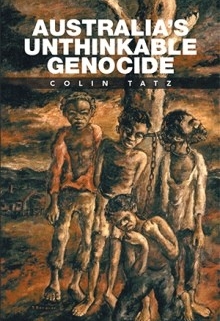
Colin Tatz has made the “Stolen Generations” the lynchpin of the “genocide” charge he levels against White Australia. The myth of the “Stolen Generations” was born in 1981 with the publication of a short pamphlet by a postgraduate history student, Peter Read, who argued that part-Aboriginal children were systematically removed to separate them from the rest of their race, claiming that “welfare officers, removing children solely because they were Aboriginal, intended and arranged that they should lose their Aboriginality, and that they should never return home.” He based this controversial thesis on interviews with Aborigines about their experiences with the welfare system, and his research into the New South Wales official records, from which he asserted that 5,625, or up to one in six Aboriginal children had been taken in New South Wales with the intent of permanent removal from their culture between 1883 and 1969.

Read, who wrote his pamphlet “at white heat in a single day,” initially wanted to call it “The Lost Generations” but his wife thought this too bland and suggested the more polemical “Stolen Generations.” Following its enthusiastic reception on the radical Left, Read, who later became Professor of History at the University of Sydney, hardened his thesis to claim Australian authorities sought not just to end Aboriginal culture, but to physically eliminate Aborigines altogether: “Their extinction, it seemed, would not occur naturally after all, but would have to be arranged.” In later writings, he drew an explicit analogy between the “Stolen Generations” and “the Holocaust.”[1]

Read’s thesis was the default assumption for the polemical Bringing Them Home report of 1997, the result of an inquiry by the Human Rights and Equal Opportunity Commission, which claimed that, in various parts of the country, up to one in five Aboriginal children were forcibly removed from their families during the sixty years prioe to 1970. This report relied on the anonymous and unverified testimony of people claiming to have been affected by removals. Echoing the later pamphlet by Read, a finding of genocide was presented: the removals were intended to “absorb,” “merge” and “assimilate” the children, “so that Aborigines as a distinct group would disappear.” It urged the federal government to apologize and offer compensation to the alleged victims and their families.

Read more

The Jewish War on White Australia: Colin Tatz and the Genocide Charge—PART THREE

Professor Colin Tatz

Go to Part 1.

Go to Part 2.

Critiquing Australia

From his arrival in Australia in 1961, Colin Tatz quickly identified those aspects of Australian society to his extreme distaste—what he describes as the “warts, some of which I have watched grow into malignant lumps.”[1] Foremost among these, he claims, was the gap in social indicators between White Australians and the Aborigines. Australia’s indigenous population has always had the worst health, and the lowest educational, occupational, economic, and social status of any identifiable section of the Australian population. The annual report on progress in the Australian government’s strategy of “Closing the Gap” between indigenous and non-indigenous Australians has been called an “annual statement of failure, a catalogue of defeat.”

In 2015–16, $33.4 billion of Australian taxpayers’ money was spent on Aboriginal programs: $44,886 for every Aborigine in the nation. More than a thousand government initiatives seek to ameliorate the myriad manifestations of Aboriginal social and economic dysfunction. In many communities there is one service for every five residents. Wilcannia, in New South Wales, for example, had 102 funded services in 2012 for an indigenous population of 474. Despite this, Aboriginal people continue to trail other Australians in virtually all metrics including life expectancy, child mortality, health, education and employment. As journalist Grace Collier noted: “The problems are shocking but seem intractable—we feel horrified and helpless; we don’t know how to assist. Worse, no matter how much money we give, it is never enough. Thirty-three billion dollars a year goes off into the ether, never to be seen again, and nothing seems to ever improve.”

Despite the burgeoning funding of proliferating Aboriginal programs, the Aboriginal leader and activist June Oscar had the nerve to excoriate successive governments for “abandoning” their commitment to tackling Aboriginal disadvantage, and for failing to execute and adequately fund Closing the Gap. Rather than responsibility for the lack of any improvement residing with Aboriginal people themselves, Oscar maintained that failure of achieve the Closing the Gap targets measured nothing but “the collective failure of Australian governments to work together and stay the course.” Read more

The Jewish War on White Australia: Colin Tatz and the Genocide Charge—PART TWO

Professor Colin Tatz

Go to Part 1

Colin Tatz is a stereotypical Jewish intellectual activist whose mindset is characterized by an intense ethnocentrism and an equally intense hostility to the traditional people and culture of the West. He reflexively subjects White people and Western societies to radical critique while exempting Jews from any equivalent evaluation. Identifying with, and taking great pride in the Jewish penchant for critiquing Western societies, Tatz claims that “Whatever else, I am a ‘product’ of Lasswell, of Cecil Roth and his notion that Jews (or some Jews) are the eternal protest-ants, of the doctrine of the Jewish Sages about tikkun olam. It is a synonym for social action, a conscious manipulating of skills to be proactive rather than reflective or contemplative.”[1]

Cecil Roth, a Jewish historian, had argued “Jewish intellectualism” was primarily about “protesting at the insufficiency of the status quo.” Tatz agrees, and points to “a Jewish existential value which asserts that history has taught us that whatever is, no matter what it is, it is not good enough—hence the moral dictate of tikkun olam, that one is compelled to try to repair a flawed world.”[2] Of course, for “fiercely argumentative” Jews like Tatz, a “flawed world” is any world where Jewish interests are not forever prioritized. Tatz claims that “My activism is motivated by both personal and societal alienation,” and the “inner dynamic of my life, the foremost factor, is my version and interpretation of my Jewishness.” He notes that a “related if not conjoined propulsion” is “a lifelong devotion to matters of race and racism.”[3]

Tatz makes no pretense of Jewishness being anything but an essentially biological phenomenon. Despite being an avowed atheist he remains a proud Jew, declaring his “unshakeable admiration, even a veneration for what I call Jewishness,” observing how “I remain within even while lacking faith, ritual, observance or any sense of Covenant.”[4] For Tatz, Jews comprise an easily identifiable ethnic type characterized by “body mannerisms, the shrugs, distains, the ever-present deprecatory and interrogative tenses of body and voice.”[5]

Tatz is a descendent of the Litvaks, the Jews from Lithuania who, prior to their recent mass exodus from post-Apartheid South Africa to countries like Britain and Australia, made up ninety per cent of that country’s 120,000 Jews. According to Tatz, Lithuanian Jews were “economically forlorn and politically intimidated” and left Lithuania in “hordes” in the late nineteenth and early twentieth centuries, the majority landing in England, the United States and South Africa. He notes that “In South Africa I learned to live in a Lithuanian communitas, a transposed shtetl world of like-minded, like-speaking, like-behaving people. It was a society in transition from Tsarist oppression to a semi-welcomed ethnic minority moving into modernity.”[6] The hyper-ethnocentric mentality of South Africa’s Lithuanian Jews was encapsulated in “daily pontification about the Jewish-goyishe divide” and his grandfather’s refrain that “The worst of ours are better than the best of theirs.”[7]

During World War II the South African government officially supported the Allies, with Prime Minister Jan Smuts appointed to Britain’s war cabinet. Despite this, most Afrikaners backed the Germans, and Tatz claims his childhood in South Africa in the 1940s was dominated by awareness of “a raging world war, civil strife between the pro- and anti-war forces, between English- and Afrikaans-speakers for political power, violent anti-Semitism in a country rife with fascist movements, the seeming calamity for Jews when the Nationalist Party came to power in the late 1940s, the fear of rising racial tensions of the 1940s, 1950s and beyond.”[8] Tatz claims to still be haunted by “domains that are oppressively black and cruelly white; and me, not quite a crowd—Jewish, alienated, migratory, and deeply troubled by food.” Read more

The Jewish War on White Australia: Colin Tatz and the Genocide Charge — PART ONE of FOUR

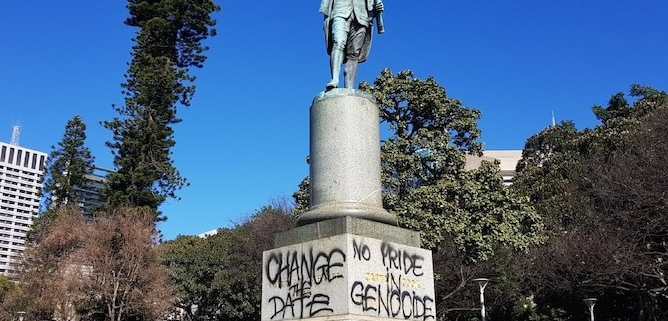
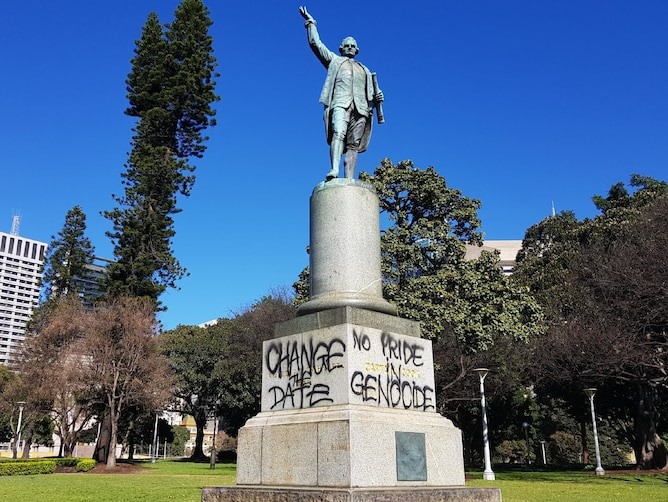
Captain James Cook statue, with graffiti

January 26 is Australia Day, a national public holiday marking the date the first permanent British settlers (mostly convicts) arrived in Sydney in 1788. These thousand or so souls — transported to the other side of the world and told to fend for themselves — laid the foundations for one of the most successful nations in history. Traditionally a day to celebrate this remarkable achievement, Australia Day has, in recent years, been attacked by leftwing activists who, emboldened by the escalating anti-White rhetoric of the intellectual establishment, have rebranded it “Invasion Day.” Every year sees shrill demands for Australia Day to be moved to another date, recast as a day of mourning, or abolished altogether. Despite the growing agitation against Australia Day, two-thirds of Australians favor retaining the date as a national public holiday.

Speaking to an “Invasion Day” protest rally in Melbourne this year, Aboriginal activist Tarneen Onus-Williams, screamed: “Fuck Australia,” expressing her hope “it burns to the ground.” A statement produced by her organization, the so-called Warriors of the Aboriginal Resistance (WAR), drew freely on the Cultural Marxist lexicon, insisting they “would not rest until this entire rotten settler colony called Australia, illegally and violently imposed on stolen Aboriginal land at the expense of the blood of countless thousands, burns to the fucking ground, until every corrupt and illegal institution of white supremacist, patriarchal, capitalist settler colonial power forced upon us is no more… Fuck your flag, your anthem and your precious national day. … Abolish Australia, not just Australia Day.” Aboriginal activist Tony Birch insisted Australia “does not deserve a national celebration in any capacity,” while Onus-Williams later claimed “people who celebrate Australia Day are celebrating the genocide of Aboriginal people, waving Australian flags in our faces. It’s disgusting.” Aboriginal activist Dan Sultan likewise maintained that Australia Day marks the “day that started the ongoing genocide of our people.” A local councilor for the city of Moreland (in Melbourne) claimed that commemorating Australia Day is “like celebrating the Nazi Holocaust.” Read more

Rape and Murder in the Heartland

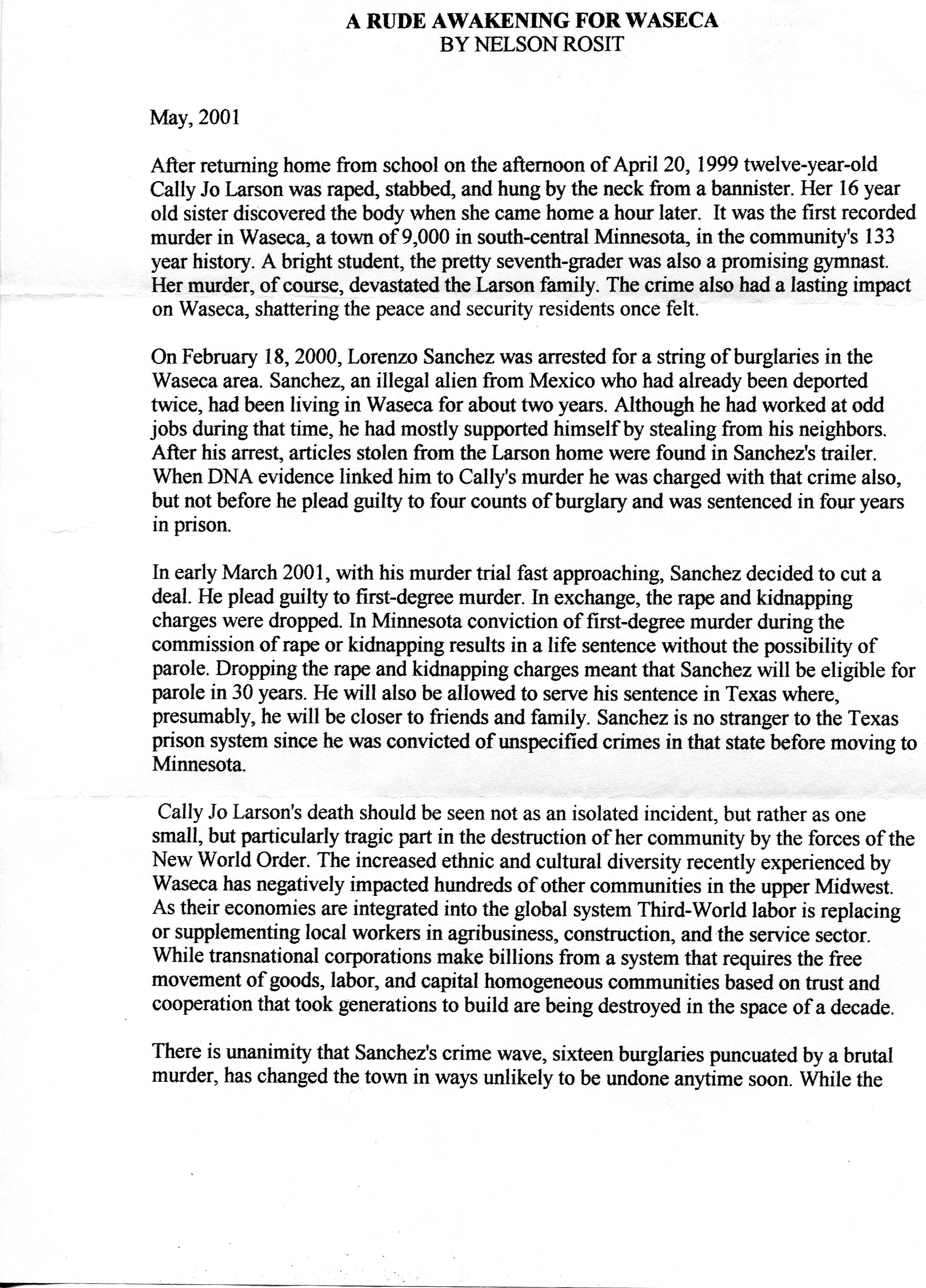
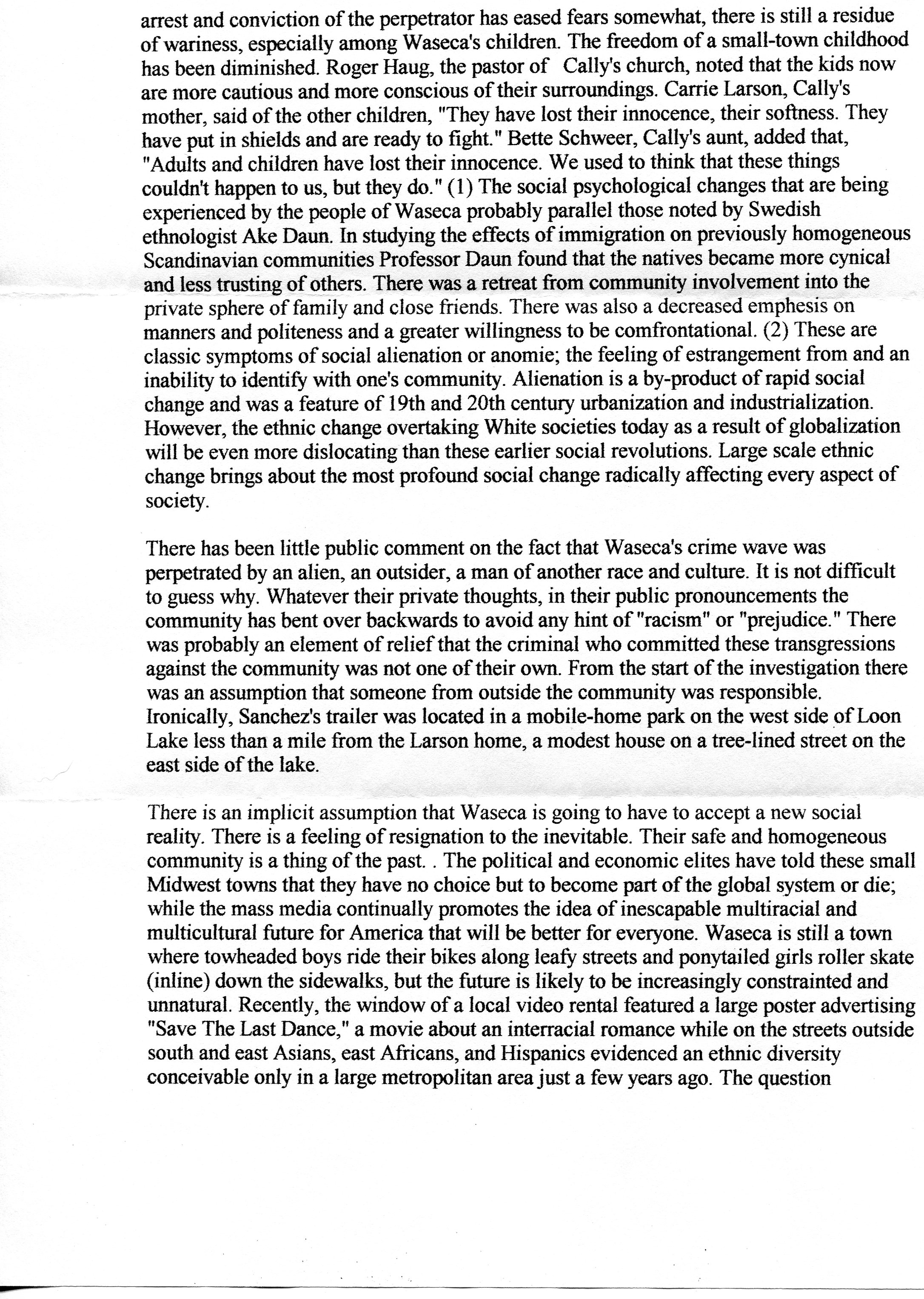
Editor’s note: This is a scanned version of a very prescient article written in 2001 by Nelson Rosit about the 1999 murder of Cally Jo Larson, a case that is sadly similar to the recent case of Mollie Tibbetts. Obvoiusly, this has been going on for a long time. As Rosit notes, anticipating the findings of sociologist Robert Putnam (2007), the result is less trust and less involvement with the community. He also lays the blame ultimately on your hostile elites: “The political and economic elites have told these small Midwestern towns that they have no choice but to become part of the global system or die; while the mass media continually promotes the idea of an inescapable multiracial, multicultural future for America that will be better for everyone.” As now, the citizens of Waseca did not mention race or immigration status in their comments. But because Donald Trump is president and because race has come to dominate all our discussions, it has been raised in the case of Mollie Tibbetts, with inevitable backlash from the mainstream media (and Tibbetts’s family). I suppose that’s progress, but obviously we still have a long way to go before Americans can rightly be outraged by events like the rapes and murders of Cally Jo and Mollie. And do what needs to be done.


Poison for the Goyim: More Hysteria and Hyperbole about Labour Anti-Semitism

Jeremy Corbyn has a beard. So has Jonathan Sacks. But this shared philopogony hasn’t brought the two men closer together. Sacks is the former Chief Rabbi of Britain and, to be fair, I think we would be better off if more Jews were like him. He doesn’t seem to hate Whites and the Christian religion in the way so many of his co-ethnics do.

Battle of the Beards

But that doesn’t mean Sacks is a reasonable or objective man where his own race is concerned. He can be ethnocentric and apply double standards with the best of them, as he’s just proved by his comments on his fellow beardie:

Jeremy Corbyn is “an anti-Semite” who has “given support to racists, terrorists and dealers of hate”, the former chief rabbi Jonathan Sacks has said. In an exclusive interview with the New Statesman, the peer described Corbyn’s recently reported 2013 remarks on “Zionists” as “the most offensive statement made by a senior British politician since Enoch Powell’s 1968 ‘Rivers of Blood’ speech”.

Sacks, who was chief rabbi from 1991 until 2013, added: “It was divisive, hateful and like Powell’s speech it undermines the existence of an entire group of British citizens by depicting them as essentially alien.”

At a speech made at the Palestinian Return Centre in London in 2013, Corbyn said of a group of British “Zionists”: “They clearly have two problems. One is they don’t want to study history and, secondly, having lived in this country for a very long time, probably all their lives, they don’t understand English irony either.” (Corbyn’s “Zionist” remarks were “most offensive” since Enoch Powell, says ex-chief rabbi, The New Statesman, 28th August 2018)

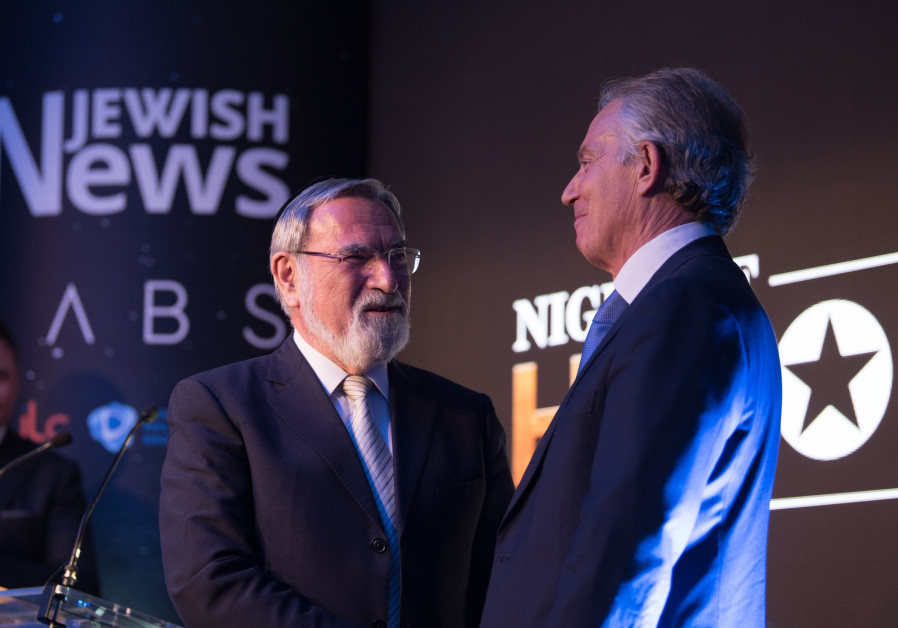
Jonathan Sacks is given an award by the war-criminal Tony Blair

Enoch Powell predicted that mass immigration would lead to race war. Jeremy Corbyn said that some Zionists don’t get “English irony.” Whether or not you agree with Powell, is it reasonable to compare the words of the two men? Are they “hateful” and “divisive” in a similar way? I’d say no, they’re obviously not, and the vast majority of British Whites probably agree with me.

Sacks doesn’t agree with me, and he has the Community with him, according to the Jewish Chronicle: “Reform Rabbi Jonathan Romain of Maidenhead Synagogue said that, while the Enoch Powell analogy may have shocked people, ‘it accurately reflected what most British Jews feel.’” Read more