Featured Articles

Censoring Liberty

There is a Canadian woman being held in a German jail without any recourse to friends or family or even legal representation. She is presently charged with no crime but was arrested for a video that questioned the “Holocaust” and is therefore that most evil of criminals, a “holocaust denier.” Most Americans would view her situation as a version of Orwell’s 1984 and believe it fictional. It isn’t. Today, in many Western nations, not only can an individual be imprisoned for being an “anti-Semite,” but that person’s lawyer can be arrested and imprisoned for providing a proper defense against that charge to his client!

Even worse, this attack on human liberty lacks limits. Exactly what is “anti-Semitism” and, in the same vein, what is “racism”—and is either a matter of criminality? After all, both of these concepts are political constructs, the latter emanating from communist Leon Trotsky, one of the first to use the word. Now, most people know the definition of “bigotry.” A bigot hates people for something over which they have no control whether it is it race or nationality or any other part of the human condition. On the other hand, matters of choice—such as religion—with their inevitable results are different as these can motivate people to do things that are in fact deserving of condemnation. Yet even the actual bigot does not break the law unless he commits a crime motivated by his bigotry!

Today the terms ‘anti-Semite’ and ‘racist’ are based not only on people’s reactions to matters of nationality and race, but on beliefs and behaviors found in and committed by the groups involved. In other words, if today I point out that communism has mainly Jewish origins and that the present-day left is financed and led by a great many persons of that religious and cultural persuasion, I am immediately judged to be an anti-Semite. It doesn’t matter if what I say is true, it only matters that I am pointing out a reality that certain groups do not want publicly voiced. If I question any Jewish historical construct, again I am an anti-Semite even if I can prove my claim with facts. And the same can be said of unpopular comments about Blacks! No matter how factual the comments, their utterance is simply not countenanced. Thus, bigotry is no longer a matter of mindless hate directed at particular groups, but any negative response, however valid, to the actions of those same groups.

Yet this understanding is not maintained throughout the culture. For instance, any intolerance directed at Whites and especially White males, as well as traditional Christians is perfectly acceptable though it contradicts the claim that mindless hate and intolerance are never acceptable. So we not only have a very broad definition of anti-Semitism and racism, but that definition is subject to a complete reversal contingent upon the target group. Thus, it is considered “Islamophobic” to criticize Muslims for raping and killing their fellow Muslims and infidels alike, but it is politically correct to persecute a Christian baker or florist for refusing to participate in a homosexual celebration because it is contrary to his or her religious beliefs. Yet, if it is wrong to even hold Jews or Blacks responsible for any truly objectionable behavior, why is it legally and morally permissible to persecute Whites and Christians for beliefs and behavior that is neither illegal nor immoral! Catholic Brett Kavanaugh is crucified for unproved sexual allegations while Bill Clinton is acknowledged to have raped and abused many women but gets a pass.

A somnambulant public needs to understand that the terms ‘anti-Semitism’ and ‘racism’ are not legitimate. In many cases, such terms may not represent mindless bigotry (which though morally reprehensible is not legally actionable). Rather, they criminalize a rational response to the actions of certain groups and thus violate our God-given right to think and act. As long as these spurious “crimes” are used to shut down debate and opposition to acts of the State, we are essentially in chains.
Germany Rises as ‘Eurostan’ Looms Closer

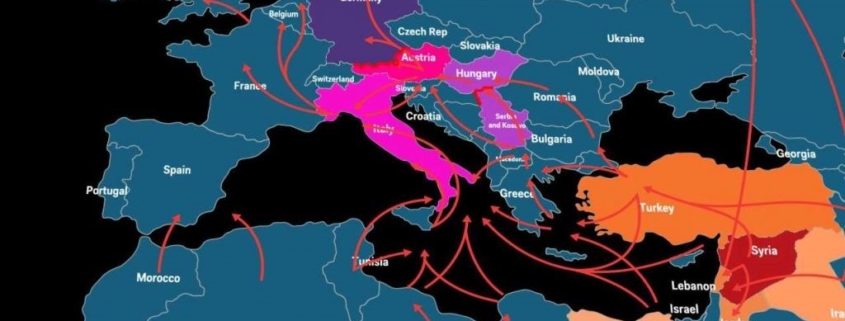
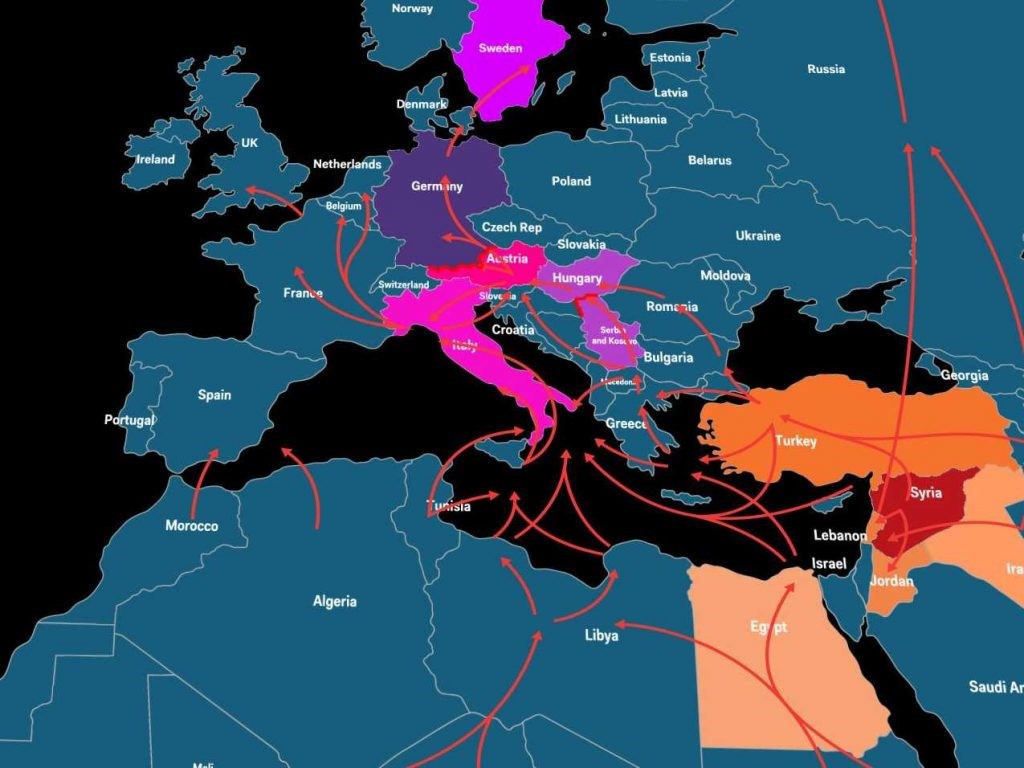
The new ‘Eurostan’ in the making: Countries impacted by the migrant crisis

The writing is on the wall. The old Germany of our Christian ancestors is in the process of being destroyed. And after Germany, Europe is the target.

The EU, as we all know who have eyes to see, has now become the United States of Europe in all but name — an undemocratic and despotic confederation of states without borders whose primary aim appears to be White Genocide — the slow and systematic destruction of the white indigenous people of Europe by means of uncontrolled mass immigration and mongrelisation.

German Chancellor Angela Merkel has been the main force behind the ongoing destruction of the Europe of our ancestors, the Europe of traditional values firmly rooted in its Christian ethos.

Under Angela Merkel’s auspices, Germany has heard its death knell. It has seen its great cities with their shimmering Gothic spires, and its peaceful towns and villages nestling in the green countryside, invaded by well over a million uninvited guests from lawless lands who have turned their nation into a multicultural zoo. German women are being raped and sexually assaulted literally every day of the year by migrants. And still Frau Merkel sits there smiling complacently amid the ruins of her country, making no attempt to turn back the tides of mounting terror. Read more

“Modify the standards of the in-group”: On Jews and Mass Communications — Part Two of Two

Go to Part 1.


“Millions of leaflets, pamphlets, cartoons, comic books, articles
and more recently radio and movie scripts — have been produced and disseminated in the propaganda war.”  Samuel H. Flowerman, Mass Propaganda in the War Against Bigotry, 1947.[1]

The Protocols of Samuel H. Flowerman

Samuel H. Flowerman, as Research Director at the American Jewish Committee, as colleague of the Institute for Social Research, and as a kind of hub for the expansive Jewish clique of mass communications scholars, was at the center of the drive to put Jewish “opinion research” initiatives into practical action. The clearest articulation of what this practical action would look like was articulated in his 1947 essay, “Mass Propaganda in the War Against Bigotry.” Flowerman’s foremost concern was that, although millions of dollars were being spent by organisations like the American Jewish Committee and the Anti-Defamation League on propaganda, propaganda may not by itself be sufficient for the mass transformation of values in the host population — in particular, for the weakening of its ethnocentrism.

Flowerman begins by explaining the format and extent of existing efforts: “Millions of leaflets, pamphlets, cartoons, comic books, articles — and more recently radio and movie scripts — have been produced and disseminated in the propaganda war (429).” Flowerman’s use of the language of warfare is of course interesting in itself and will be discussed further below. For now, we should focus on what Flowerman lists as the five aims of the “propaganda war”:

1. “The restructuring of the attitudes of prejudiced individuals, or at least their neutralization.”
2. “The restructuring of group values toward intolerance.”
3. “The reinforcement of attitudes of those already committed to a democratic ideology perhaps by creating an illusion of universality or victory.”
4. “The continued neutralisation of those whose attitudes are yet unstructured and who are deemed “safer” if they remain immune to symbols of bias.”
5. “Off-setting the counter-symbols of intolerance.” (429)

Flowerman concedes that the level of work and control required to achieve these aims would be extensive, and that the project was highly ambitious, seeking nothing less than “successful mass persuasion in the field of intergroup relations (429).” But he is equally clear in the conditions required for such success. Read more

The Zeroth Commandment: Thou Shalt Not Recognize Patterns

What is the point of a nervous system? Well, you could call it a mechanism for recognizing patterns and responding to them. Sensory information enters a nervous system, is processed, and generates a response. A blind nematode wriggling in the slime at the bottom of a lake has a nervous system and can recognize patterns. So has and can a kestrel hovering at 60 feet and scanning the ground with ultra-violet vision. Or a bat flitting through the night sky, shrieking at the top of its voice, and listening for faint ultrasonic echoes.

Undisputed champion

Bats and kestrels operate at a much higher level than nematodes in more senses than one. But the undisputed champion of pattern recognition on Planet Earth is the species known as Homo sapiens. For example, you are performing an astonishingly subtle and sophisticated form of pattern recognition at this very moment. In other words, you’re reading. If language was the most important evolutionary advance in the history of life, then writing was the invention that supercharged language. Millennia later, printing was the invention that supercharged writing. Modern science could never have developed without the printed word.

But the printed word contributed to science both directly and indirectly. It allowed scientific ideas and data to circulate ever faster and ever more widely. But it also, and inadvertently, expanded the scientific armoury. Short-sightedness is unknown among hunter-gatherers but very common in literate societies. That’s why glasses were invented. Books begat glasses and glasses begat two very important scientific tools: the telescope and the microscope. These were ways for scientists to extend and refine their senses, allowing them to — guess what? — recognize more patterns. The history of science has involved human beings inventing ever-more powerful ways of recognizing and analysing ever-more subtle patterns. When the English genius Isaac Newton (1642–1726) improved the reflecting telescope and experimented with a prism, he was taking the first step towards radio astronomy. When the Dutch biologist Antonie van Leeuwenhoek (1632–1723) looked at stagnant water with his early microscopes, he was taking the first step towards cytology and DNA analysis.

Stephen Jay Gould: Masquerading as a Scientist

The same under the skull

The biologist Stephen Jay Gould (1941–2002) was Jewish, not English or Dutch. He wasn’t a genius either, but he was part of a truly extraordinary scientific development — something that Newton and van Leeuwenhoek could never have imagined possible. Those two goyim wanted to advance science by refining human senses and allowing us to recognize yet more patterns. Gould and his Jewish confrères, in complete contrast, wanted science to reject sense-data and restrict its understanding of the world. They added a new commandment to the Mosaic Decalogue. It’s the Zeroth Commandment, supreme over all the rest (see Steve Sailer’s “Zeroth Amendment”), and it states: “Thou Shalt Not Recognize Patterns.” However, the Zeroth Commandment doesn’t forbid the recognition of all patterns, just those that constitute “Hate-Think.” For example, the Zeroth Commandment says that biologists must not recognize the very obvious patterns of racial and sexual difference. Swedes and Somalis, Magyars and Māoris, Tibetans and Tongans — they might look and act very different, but they’re all the same under the skull. To suggest otherwise is evil, disgusting and racist. In short, it’s hate-think and it breaks the Zeroth Commandment. Read more

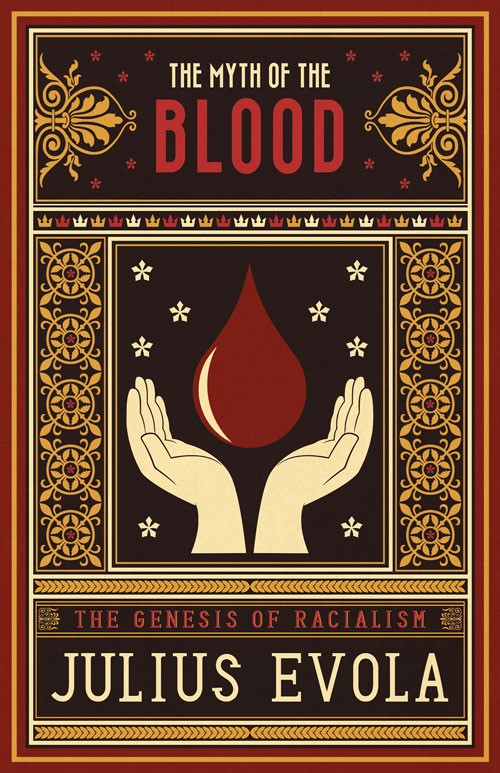
Review: Julius Evola’s “The Myth of the Blood: The Genesis of Racialism”

The Myth of the Blood: The Genesis of Racialism
Julius Evola
Arktos, 2018.

My history with Julius Evola is proof that first impressions aren’t everything. I was in my mid 20s before I picked up my first volume by the Italian philosopher – a nicely presented hardback edition of Revolt Against the Modern World. I’d considered ordering it after a number of recommendations from friends and associates, and was finally pushed to the purchase after viewing a typically excellent 2010 speech/lecture on Evola (titled “The World’s Most Right Wing Thinker”) by Jonathan Bowden. Whether it was the sheer hype that I’d been exposed to, my resultant exaggerated expectations, or simply the content of the text itself, in the end I was disappointed with the book. It hadn’t helped that, other than forays into the work of Nietzsche and Heidegger, I possessed a marked inclination toward the Anglo-American or analytic philosophical tradition. As I result, I developed a kind of prejudice against Continental philosophy (and Continental philosophers) as being typified by pretentious posturing, convoluted or repetitive arguments, and (among the later set) more than a whiff of Marxism. Ideologically speaking, Evola was, of course, light years from the likes of quack contemporaries like Jean-Paul Sartre. I could tell, as I made my way through Revolt, that, in between quasi-mystical musings, Evola had some extremely important thoughts to offer. In fact, it was a source of great frustration that, despite apparently having these valuable things to say, they were unnecessarily and unfortunately lost in the convoluted style and structure of the text. Somewhat ‘burned’ by the experience, I avoided Evola for a number of years — a move I now regret.

In the interval between my reading of Revolt and my later rediscovery of Evola, the Italian’s perceived importance in mainstream academia began to grow, aided by increased translation and reception of his work. The most significant two works of recent years are  probably Francesco Germinario’s Razza del Sangue, razza dello Spirito: Julius Evola, lantisemitismo e il nazionalsocialismo (1930–43) (Bollati Borlinghieri, 2001), and Paul Furlong’s Social and Political Thought of Julius Evola (Routledge, 2013), in which the author posits Evola as a major anti-Enlightenment thinker and, in the words of another scholar, “convincingly disposes of the claim made by [leftist and “antifascist” academic] Roger Griffin, and assumed by many others, that Evola is merely a philosopher of fascism, suggesting instead that he should be understood ‘within the context of European conservative thought since 1789’.”[1] Read more

Riga, Latvia

The nationalist ethnostate, in all of its glory! Seriously, no brown people here. Not even of the tourist variety.

Gloomy though. And the people don’t really help the atmosphere. They’re quite… prickly. Even the ones who are paid to smile while they bring you your food and drink. They don’t seem to keen on being hospitable either. In fact, the whole city seems to seethe at you, as if you’re a foreign bacteria and the white cells are after you. 

Just like most of Northern Europe, really. Especially the Baltic Biosphere, where I spend most of my time. 

So I tell Sven after a day wandering around, “see, this is what I’m talking about. We need something more. This place is like a pretty open-air museum. It feels dead. It’s all fake. Like the graveyard of a nation.” 

I’m paraphrasing Dostoevsky here, who said as much about Western Europe when he traveled through there. If I come off as dour and depressed, I have nothing on Dostoevsky and his letters. And that was more than a century ago. Hell, if you ask me, Dostoevsky was a drama queen who had it good. 

  • “More, as in, like a religion?”

“Exactly, the Cult of the Living City!” I enthuse. 

Read more

What is “Nazism”?

For an intelligent and well-educated man, Barack Obama says some incredibly stupid things.  Speaking to a college campus on September 7, on the topic of the many failings of the Trump presidency, and in particular his response to the alt-right, white nationalist Charlottesville rally in 2017, Obama denounced Trump for not clearly and unconditionally denouncing the marchers.  The participants, who represented a range of views and political opinions, were uniformly condemned by the mass media as “Nazis.”  At the time, Trump said there were “good people” among the marchers.  Obama disagrees; he said, “We’re sure as heck supposed to stand up clearly and unequivocally to Nazi sympathizers.  How hard can that be?  Saying that Nazis are bad?”[1]

Now, it’s unclear if Obama is ignorant, brainwashed, bribed, or coerced into saying such simple-minded and facile things.  The degree of distortion, deception, and propaganda in this short statement is quite amazing—and likely deliberate.  It’s worth taking a moment to dissect this situation, and draw some plausible conclusions.

First, it’s not evident that there was much ‘Nazism’ in Charlottesville at all.  A few Nazi flags were to be seen, and a few random swastikas (from unknown perpetrators possibly engaged in a false flag operation) but they were vastly outnumbered by American flags, Confederate flags, and a range of alt-right and nationalist symbolism.  I don’t recall seeing any stiff-arm salutes, pro-Hitler chants, or anything of the sort.  And yet Obama and the media—left and right—love to call the marchers ‘Nazis’ or ‘neo-Nazis,’ as if this were some magic incantation with the power to ward off evil.  Calling someone a Nazi is evidently an effective all-purpose slur intended to stifle discussion and demonize one’s target.  And in our present politically-correct, media-dominated world, it works—at least, on the unthinking masses.

But any thoughtful person understands that there is much more going on here.  Any thinking person would ask at least two questions:  1) What exactly is a ‘Nazi’? and 2) Why are they ‘bad’?  Let’s start with these elementary issues, because even here there is much to be revealed.

Most people, I hope, know that ‘Nazi’ is a slang shorthand for the National Socialists of Hitler’s Germany (Nationalsozialisten in German, hence the ‘z’).  It was coined by his opponents, along the lines of an earlier term, ‘Sozi,’ that was applied to the Social Democrats (Sozialdemokraten).  Hitler himself apparently never used the term ‘Nazi,’ and others, such as Goebbels, did so only rarely.  They preferred the full German word, or would use the acronym NSDAP (for Nationalsozialistiche Deutsche Arbeiterpartei, or National Socialist German Workers’ Party).

But beyond this simple terminology, we have the striking fact that no one today—virtually no one—knows what a ‘Nazi’ is.  Are they Jew-haters?  No, that’s an anti-Semite.  A Hitler-lover?  Perhaps, but that’s not a definition, and certainly not a requirement.  A violent right-winger?  Hardly.  A racist?  More likely a ‘racialist,’ but again, that’s no definition.  Read more