Featured Articles

Sartre’s Anti-Semite and Jew: A Critique [Part Three]
“Sartre’s analysis is mere gossip parading as well-reasoned, irrefutable phenomenological argument.”
Pierre Birnbaum, 1999.

Sartre on ‘the anti-Semite’

As noted previously, the ambivalent response to Sartre’s thoughts on ‘the Jew’ is in stark contrast to the much-more positively received section of the text dealing with ‘the anti-Semite.’ Indeed, Michael Walzer states that this portrait of the anti-Semite is “rightly taken to be the strongest part of the book.”[1] Jack Kugelmass has described it as a “key text for Jewish cultural studies.”[2] Herbert Spiegelberg, meanwhile, argues that Sartre’s interpretation of the anti-Semite is “persuasive and brilliant.”[3] Such appraisals, it will be demonstrated, can be based only on the value of Sartre’s conclusions as an ideological weapon: that the anti-Semite is a highly pathological individual, and that Jews and their behavior have absolutely no bearing on the opinions of Jews formed in the minds of the surrounding population. This conclusion is nowhere summarized more succinctly than in Sartre’s formulation: “Far from experience producing his idea of the Jew, it was the latter which explained his experience. If the Jew did not exist the anti-Semite would invent him.”[4] It is argued here that Sartre’s dubious critique of ‘the anti-Semite’ has enjoyed significant praise solely because the author provided Jews with the strength of his own personal reputation as a public intellectual, as well as a relatively novel and valuable theory of anti-Semitism which denied it any social or political legitimacy and heavily stigmatized individuals associated with it. It is further argued that, in terms of methodology and historical awareness, Sartre’s ‘portrait of the anti-Semite’ is perhaps the weakest and most ignorant text ever produced on the subject of anti-Semitism.

Sartre’s anti-Semite is an overwhelmingly negative presence in society, and the philosopher’s interpretation of anti-Semitism is overwhelmingly beneficial to the reputation of Jews. Sartre argues that it is wrong to examine external causes when attempting to understand why host populations develop antagonistic attitudes to Jews. He writes that anti-Semitism cannot be explained as “an impersonal phenomenon which can be expressed by figures and averages, one which is conditioned by economic, historical, and political constants.”[5] He adds that it is merely the idea of the Jew that causes anti-Semitism and that history can tell us nothing about the phenomenon: “No external factor  can induce anti-Semitism in the anti-Semite.”[6] Joseph Sungolowsky summarizes it thus: “Sartre contends that anti-Semitism is a self-sufficient psychological process taking the form of a passion that is not motivated by any external cause, but rather the idea that has been formed of the Jew.”[7] Read more
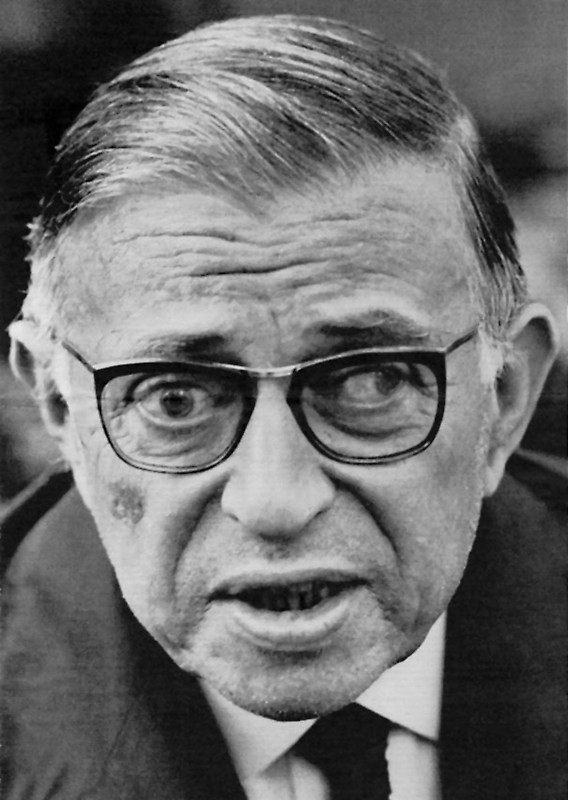
Sartre’s Anti-Semite and Jew: A Critique [Part Two]

“Sartre almost always swallowed huge quantities of amphetamines when writing non-fiction.”
    John Gerassi, 1989.[1]

Sartre on ‘the Jew’

Sartre’s Anti-Semite and Jew is divided into four sections, concerned as it is with four actors, or character profiles: the anti-Semite, the democrat, the inauthentic Jew, and the authentic Jew. Existing criticism of the book has almost exclusively concerned Sartre’s treatment of Jews (in Sartre’s jargon, both ‘inauthentic’ and ‘authentic’), while the most highly praised aspect of the book has been his incredibly negative characterization of the anti-Semite. Since Sartre’s comments on ‘the democrat’ are generally regarded as the most meagre and the least consequential, this critique is concerned only with Sartre’s comments on both the Jew and the anti-Semite. We will start with a summary of problems in his theory of Jewishness.

Other than swallowing huge amounts speed, a habit that would ultimately lead to several debilitating strokes, Sartre conducted no preparations before writing Anti-Semite and Jew, telling Benny Levy in 1980: “I wrote without documentation, without reading one book about Jews.”[2] Sartre also failed to conduct any research into the history of anti-Semitism, or to read widely the arguments put forth by anti-Semites. He would later state that his opinions on anti-Semitism had been shaped for the most part by his reaction to reading a handful of contemporary French anti-Semitic pamphlets.[3] It is notable that while Sartre’s lack of research on the history and nature of anti-Semitism hasn’t prevented his commentary on anti-Semitism being portrayed as a “a classic,” his lack of research on Jews and their history has been pointed out as highly problematic. Indeed, from the moment of its publication Jews have been torn between a desire to adopt Sartre’s ‘weapon’ against the anti-Semite, and their unease at Sartre’s treatment of their own sense of identity.

Jewish criticisms of Sartre have for the most part revolved around his Marxist/existentialist interpretation of Jewish identity, and to a large extent these criticism are valid. It was argued in the first section of this essay that Sartre was beholden to an image of Jews and Jewishness as useful allies in his subconscious quest for social and cultural revenge. For Sartre this would necessarily involve denying Jews and their history any specificity which may exclude him. Predictably then, he advanced a theory that ‘the Jew’ was not a member of a rigid ethnic group defined by blood, history, and culture, but was instead a mere abstract compilation of Jewish ‘traits’ — the Jew as ‘intellectual,’ ‘urban,’ ‘social critic,’ ‘marginal,’ and ‘disruptive’—traits which he would himself come to embody, so one might label his book an exercise in narcissism. In his haste to portray Jews as a picture of innocence in relation to the origins of anti-Semitism, Sartre essentially suggested that the Jews themselves didn’t even exist, or if they did, it was in a largely ‘inauthentic’ form. In Anti-Semite and Jew Sartre writes that Jews are neither a national or religious community, but merely “an abstract historical community.”[4] Jews are not united with each other, or made Jews, by their history or religion, but “because they have in common the situation of a Jew, that is, they live in a community which takes them for Jews.”[5] Jews are thus, like Sartre himself, ‘created’ from exclusion and marginalization. Read more

Sartre’s “Anti-Semite and Jew”: A Critique [Part One]


“That book is a declaration of war against anti-Semites, nothing more.”
 Jean-Paul Sartre, 1980.

A little over a decade ago I decided to research the Jewish Question in earnest. The precise chain of events leading to this decision was complex, but the main engine driving it was sheer intellectual curiosity. Here was a subject at once profound and deeply entwined with European history, and yet also obscure and apparently also half-sunk in a quagmire of shame. As a young developing scholar in the Arts, I felt the Jewish clash with Europeans had it all — economic aspects, religious factors, the opinions of philosophical giants, the dictates of kings and the risings of peasants. Here was history in raw, perpetually political form. As a result, I found myself haunting college and public libraries, slowly absorbing the topic’s mainstream texts, along with the not so mainstream, until one day I came across a small, unassuming volume just barely visible between two much larger books.

The name of the author brought about a spark of recognition, but it was the title that made me reach for it. There was something about Anti-Semite and Jew (1946) that suggested a personal approach to the subject that I felt had been hitherto lacking in the works I’d consulted. I took Sartre’s slim monograph to a nearby table where I devoted an afternoon to some but not all of its contents. I couldn’t finish it. Materially sparse and logically recondite, the book disappointed all initial hopes. I returned it to the shelves, and for the next ten years never felt the need to consult Sartre’s contribution to the discussion of anti-Semitism.

Until now. Prompted by a public radio discussion on Sartre (mainly focussing on his childhood and private life), around three months ago I decided to return to the Frenchman’s ideas on anti-Semitism — not because of any value inherent in the ideas themselves, but because of what a thorough critical treatment of them might tell us about Sartre and about philo-Semitic apologetics in general. During that time, I examined the text in full, making notes as I progressed. These notes eventually formed the following essay, which is, as far as I am aware, the first time that an ‘anti-Semite’ has replied to Sartre’s work.

The Significance of Anti-Semite and Jew

Jean-Paul Sartre (1905–1980) was a French philosopher, writer, political activist, and literary critic. In 1964, Sartre was awarded the Nobel Prize for his literary work but refused it on the grounds it was a cultural symbol with which he did not wish to be associated. He is perhaps best known as one of the key figures in the philosophy of existentialism, an area of philosophy which contends that Man is a self-creating being who is not initially endowed with a character and goals but must choose them by acts of pure decision — existential ‘leaps.’ Sartre was born into a bourgeois Parisian family of comfortable means but would go on to be generally regarded as one of the most important Marxist philosophers of the 20th century. His father died when he was 15 months old, something which I believe profoundly affected the philosopher, consciously or not, throughout his life.

Sartre may be usefully characterized as someone in several respects at war with his roots, a fact demonstrated in stories (almost certainly apocryphal) from his autobiography and related to friends. Among them, for example, is an account of Sartre throwing his family tree into a waste basket.[1] Much of his future intellectual work could be seen as a rebellion against his own deeply bourgeois roots and perhaps even a form of self-loathing or an attempt to escape the Self. Never growing more than five feet tall, and painfully aware from a young age of his physical unattractiveness, Sartre invested a great deal of time on philosophical speculations on ugliness. Importantly, he viewed his ugliness as a form of social marginalization. It is particularly interesting that in these discussions he linked ugliness to other forms of perceived social marginalization, and even more interesting that he sometimes used the formulation “Aryan/Jew, handsome/ugly.”[2] Read more

Operation Excalibur: Back to Church, Bucko! Part 2

For the word of God is living and powerful, and sharper than any two-edged sword, piercing even to the division of soul and spirit, and of joints and marrow, and is a discerner of the thoughts and intents of the heart. (Hebrews 4:12)

Go to Part One

Toward an Alt Right Biblical Theology

As teen-agers many secular humanists on the Alt Right probably rejected one or other of the millenarian visions of Christian theology (pre-, post- or amillennialist) available to the average suburban church-goer.  For these folks, the Bible situates us within as-yet-unfinished story.  We are awaiting the end times; we just cannot agree on when or how the Day of the Lord will come.  But what if there is another, better way of reading the grand narrative set out in the Bible?  Perhaps God knows how to tell a story.  Perhaps the biblical narrative is set in historical time with a beginning, a middle, and an end that has already come and gone.

On that assumption, it seems to me that there is a good fit between the embryonic cosmology of the Alt Right and the eschatological views of a dissident school of predominantly white Anglo-Protestants known as “preterists” (from Latin, praeter or “past”).  The covenantal eschatology (from the Greek eschaton, or “end times”) espoused by preterists holds that biblical prophecies promising that the Lord would come again in judgement (the Parousia) were fulfilled with the destruction of the Temple in AD 70.  On a preterist reading of Scripture, the Day of the Lord occurred in real historical time.  The forty-year interval between the Passion of Christ and the Parousia marks the Exodus of the righteous remnant from Old Covenant Israel.  In that period, the apostles preached the gospel to the ends of the earth, thereby fulfilling the Great Commission (Matthew 28:18-20).

In the Last Days of the Old Covenant age, the New Jerusalem came down to earth, forever supplanting the Temple made with hands.  A new heaven and new earth took its place.  Within a reborn cosmic temple, the saints of Old Covenant Israel as well as those who had “fallen asleep” in Christ in the first century were resurrected from the dead.  No, the physical bodies of Abraham and the prophets did not rise magically from the grave.  Rather, the long-promised, long-awaited spiritual communion of the Old Testament saints with the Body of Christ (now incarnate in the early Church) was consummated.  The providential telos, the divine point and purpose of Old Covenant Israel had been fulfilled.  What relevance, then, has preterist eschatology to the desperate need in our time for an Anglo-Protestant political theology? Read more

Operation Excalibur: Back to Church, Bucko! Part 1

Then, He said to them, “But now…he who has no sword, let him sell his garment and buy one.” (Luke 22:36)

“Talk is for lovers.  I need a sword to be king!” Excalibur Opening Scene (Battle of the Knights) 1981

Setting the Scene

Images of Excalibur, King Arthur’s legendary sword, typically mirror the mythic iconography of the Christian Cross.  Note the cosmic aura surrounding the gleaming hilt of the sword in the stone on the cover of my book, Dissident Dispatches.  Its mysterious magnetism beckons the man of destiny.  Only a true hero, uniquely possessed of the strength to pull the fearsome blade from the rock of ages, will be endowed with the sacred majesty of kingship.  Excalibur was a fearsome weapon, striking down the king’s enemies in a spiritual struggle between good and evil.  Of course, as a figment of literary imagination, Excalibur is more useful as an instrument of psychological or cultural rather than physical warfare. Accordingly, like any other popular meme, it can be deployed in cyberspace by any number of combatants, for fun or in deadly earnest.

On the Alt Right, the most famous, politically effective meme has been the seemingly innocuous cartoon image of Pepe the Frog.  Amidst the tumult and confusion of the Trump campaign, Pepe helped the Alt Right movement sort out amused friends from outraged enemies. The sorting process was a two-way street, however.  As part of the wider push by corporate and political wire-pullers to de-platform the Alt Right, the powerful Jewish activist organization, the Anti-Defamation League conducted a concerted, well-funded campaign of its own to brand Pepe memes as anti-Semitic and racist “hate speech”.  The goal was to outlaw reproduction of the Pepe meme by Alt Right publishers, broadcasters, and bloggers.  The tool chosen to achieve that outcome was copyright law.  Simply for featuring Bishop Pepe on the cover of a book, Arktos Media, already well-known as a dissident right publisher, found itself the target of legal action organized by the ADL.

The response was both unexpected and disproportionate.  Bishop Pepe triggered determined, well-resourced, and crafty enemies.  The frog cartoon cover art was quickly leveraged into a credible threat to the survival of Arktos Media.  In its campaign against Alt Right Pepe , the ADL had enlisted Matt Furie, a cartoonist who had drawn a primitive Pepe in a comic book, more than ten years ago.  In the meantime, thousands of green frog images had appeared on the internet and IRL during the meme wars of 2015–2016.  The ADL supported Furie in his claim to copyright ownership and hence all profits derived from the commercial use of Pepe the Frog memes.  A major corporate law firm was engaged (putatively pro bono publico) to enforce Furie’s putative proprietary interest in Pepe against all the world.  In practice, only parties associated in some way with the Alt Right or the Trump campaign received notices to cease and desist their use of Pepe memes and to hand over to Matt Furie any profits they may have earned therefrom.  In their letter to Arktos, Furie’s lawyers threatened substantial legal and commercial penalties should the publisher not capitulate to this demand.  Read more

Cognitive Biases, Polarization, Social Media and White Identity

Robert Wright’s review of Steven Pinker’s Enlightenment Now got me thinking about how politics is increasingly polarized—a good thing certainly, but Wright adds some interesting wrinkles. A few preliminaries:  Ricardo Duchesne has already said all the necessary things about Pinker’s hostility to identity politics—and White identity politics in particular as somehow irrational (thus ignoring entirely Frank Salter’s work on ethnic genetic interests). The basic situation is that Whites are uniquely prone to individualism. The Enlightenment that Pinker is so enthusiastic about is a direct result of Western individualism and hasn’t taken root in other cultures. The problem is that if you invite millions of other peoples and other religions into the West, identity politics are inevitable. Wright notes “the obvious downside of tribal antagonism—the way it leads nations to go to war or dissolve in civil strife, the way it fosters conflict along ethnic or religious lines.”  And the deeper problem is that there is every reason to suppose that individualism has been shaped by the unique evolutionary history of the West (the roots of Western individualism go back to prehistory, as among the Indo-Europeans), and that other peoples (certainly including Jews) will continue to practice identity politics for the foreseeable future.

The result is the classic group selection dilemma: inviting non-individualists into individualist societies means inviting people who will depart from the basic individualist assumptions of the society—the fundamental critique of Judaism made by Enlightenment intellectuals: As Count Clermont-Tonnere expressed it in addressing the French National Assembly in 1789, “The Jews should be denied everything as a nation, but granted everything as individuals… . The existence of a nation within a nation is unacceptable to our country.” From the standpoint of group selection theory, non-individualists in an individualist society are cheaters. So the problem confronting individualists in such a society is that if you don’t become part of an identity group, you will lose the competition—well-organized, intelligent groups always outcompete individualists. A basic theme of my book Separation and Its Discontents is that the most intense historical examples of anti-Semitism have arisen as a reaction to competition and group conflict with Jews. Eventually, even individualists assume a group identity. The Jewish solution (not all Jews, but that’s where the power has been at least since the 1940s) has been to encourage the migration of other identity groups to the West and to pathologize any hint of White identity politics while continuing to exist as a vibrant and influential entity with group interests within Western societies. I rather doubt this scenario will end well.

Pinker, who has assumed the Stephen Jay Gould Chair for Politically Correct Popularization of Evolutionary Biology/Psychology at Harvard, is one of those faux evolutionists who is on board with the research until it has anything to do with the evolution of group differences (except for Jewish IQ). Prof. Duchesne also emphasizes Pinker’s hostility to populism, which places Pinker in a long Jewish intellectual tradition going back to the 1930s and seen most strikingly among the New York Intellectuals (see also Chaps. 5 & 6 of CofC). Since objectivity and emotional involvement are key to this essay, I can’t help quoting  Peter Novick  from his book on objectivity among historians. Novick is quite explicit in finding that Jewish identification is important, attributing the negative view of American populism held by some American Jewish historians (Richard Hofstadter, Daniel Bell, and Seymour Martin Lipset) to the fact that “they were one generation removed from the Eastern European shtetl [small Jewish town], where insurgent gentile peasants meant pogrom.”  This is a great example of how identity and emotions springing from that identity can and do influence academic research. One wonder to what extent Pinker’s Jewish identity is linked to his horror of populism among White people and White identitarianism in general. Read more

Semites, Self-Pity, Aggressiveness, and Censorship, Part 2: Freedom of Meech

Pug’s paw: Mark Meechan’s hate-crime

Go to Part 1.

New Labour served Jewish interests in another very important way. Jews do not like free discussion of Jewish behaviour, racial differences and the consequences of Third-World immigration. New Labour obligingly strengthened Britain’s already harsh laws against “hate speech.” The taboo on discussing Jewish behaviour is apparent even in those who criticize New Labour’s laws. We can see this in the reaction to the conviction of a White man called Mark Meechan. In March 2018, he was “found guilty of breaching Section 127 of the 2003 U.K. Communications Act, which prohibits ‘grossly offensive, indecent, obscene, or menacing’ electronic communications.”

How did Meechan fall foul of this New Labour law? He posted a YouTube video of his girlfriend’s pug “perform[ing] a Nazi salute when he said ‘Sieg Heil’ or ‘gas the Jews’.” This was, according to the judge, “grossly offensive” and a clear breach of the 2003 Communications Act. Prominent British comedians like Ricky Gervais and the repulsive David Baddiel (who is Jewish) have criticized the conviction and defended Meechan’s right to free speech. They say that a highly subjective test like “offensiveness” is completely wrong for comedy, which should have the freedom to break taboos and question everything. I agree with them and with the other British liberals who are saying the same thing. But I note that all of these liberals are silent on some highly relevant aspects of the case. For example, they don’t say that it was effectively a blasphemy conviction under Britain’s new state religions of Holocaustianity and minority worship. Read more