Sartre’s Anti-Semite and Jew: A Critique [Part Two]
“Sartre almost always swallowed huge quantities of amphetamines when writing non-fiction.”
John Gerassi, 1989.[1]
Sartre on ‘the Jew’
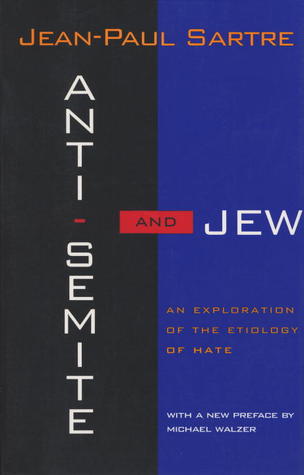
Sartre’s Anti-Semite and Jew is divided into four sections, concerned as it is with four actors, or character profiles: the anti-Semite, the democrat, the inauthentic Jew, and the authentic Jew. Existing criticism of the book has almost exclusively concerned Sartre’s treatment of Jews (in Sartre’s jargon, both ‘inauthentic’ and ‘authentic’), while the most highly praised aspect of the book has been his incredibly negative characterization of the anti-Semite. Since Sartre’s comments on ‘the democrat’ are generally regarded as the most meagre and the least consequential, this critique is concerned only with Sartre’s comments on both the Jew and the anti-Semite. We will start with a summary of problems in his theory of Jewishness.
Other than swallowing huge amounts speed, a habit that would ultimately lead to several debilitating strokes, Sartre conducted no preparations before writing Anti-Semite and Jew, telling Benny Levy in 1980: “I wrote without documentation, without reading one book about Jews.”[2] Sartre also failed to conduct any research into the history of anti-Semitism, or to read widely the arguments put forth by anti-Semites. He would later state that his opinions on anti-Semitism had been shaped for the most part by his reaction to reading a handful of contemporary French anti-Semitic pamphlets.[3] It is notable that while Sartre’s lack of research on the history and nature of anti-Semitism hasn’t prevented his commentary on anti-Semitism being portrayed as a “a classic,” his lack of research on Jews and their history has been pointed out as highly problematic. Indeed, from the moment of its publication Jews have been torn between a desire to adopt Sartre’s ‘weapon’ against the anti-Semite, and their unease at Sartre’s treatment of their own sense of identity.
Jewish criticisms of Sartre have for the most part revolved around his Marxist/existentialist interpretation of Jewish identity, and to a large extent these criticism are valid. It was argued in the first section of this essay that Sartre was beholden to an image of Jews and Jewishness as useful allies in his subconscious quest for social and cultural revenge. For Sartre this would necessarily involve denying Jews and their history any specificity which may exclude him. Predictably then, he advanced a theory that ‘the Jew’ was not a member of a rigid ethnic group defined by blood, history, and culture, but was instead a mere abstract compilation of Jewish ‘traits’ — the Jew as ‘intellectual,’ ‘urban,’ ‘social critic,’ ‘marginal,’ and ‘disruptive’—traits which he would himself come to embody, so one might label his book an exercise in narcissism. In his haste to portray Jews as a picture of innocence in relation to the origins of anti-Semitism, Sartre essentially suggested that the Jews themselves didn’t even exist, or if they did, it was in a largely ‘inauthentic’ form. In Anti-Semite and Jew Sartre writes that Jews are neither a national or religious community, but merely “an abstract historical community.”[4] Jews are not united with each other, or made Jews, by their history or religion, but “because they have in common the situation of a Jew, that is, they live in a community which takes them for Jews.”[5] Jews are thus, like Sartre himself, ‘created’ from exclusion and marginalization. Read more