The Face of Revolution: Reflections on Red Rosa
The Polish-Jewish revolutionary Rosa Luxemburg (1871–1919) was that rare thing: a sympathetic Marxist. Unlike Lenin, Stalin, Trotsky and the feuding revolutionaries of our own day, she doesn’t seem to have fuelled her politics mainly on power-lust, egomania and hatred. She opposed Bolshevik tyranny and defended free speech with the classic line Freiheit ist immer Freiheit der Andersdenkenden — “Freedom is always the freedom of those who think differently.” She loved nature, wanted the call of the “large blue titmouse” carved on her gravestone, and even had a soft spot for wasps.
“Written on her face…”
Would she have remained sympathetic if she’d come to power in the working-class revolution she tried to foment in Germany after World War I? We’ll never know, because she was murdered in 1919 by right-wing Freikorps troops in Berlin. One thing seems certain, however. If Marxists had come to power in Germany, they would have created tyranny à la Lenin, not Freiheit à la Luxemburg. That’s what happened in Hungary at the same time during the disastrous but thankfully brief “communist republic” ruled by the Jewish Marxist Béla Kun (i.e., Cohen). Unlike Kun, Luxemburg never got to power and her martyr’s death has ensured her a special place in Marxist hagiology. You could call her the Bonnie Prince Charlie of progressive politics, but with an important caveat: she wasn’t bonny.
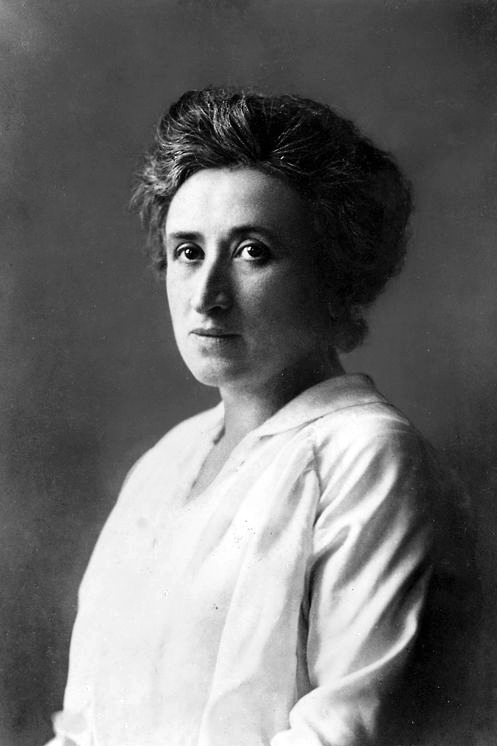
The face of revolution: Rosa Luxemburg
Instead, she had decidedly Jewish features. You can see them on almost every page of Kate Evans’ Red Rosa: A Graphic Biography of Rosa Luxemburg (Verso, 2015). Evans doesn’t merely embrace Luxemburg’s Jewishness: you could say she insists on it. She quotes from a letter of Luxemburg’s: “I have no special place in my heart for the ghetto. I feel at home wherever there are clouds and birds and human tears.” (15) To illustrate these sentiments, Evans portrays Luxemburg in profile gazing at a swallow through the window of a synagogue. The text below continues: “Rosa’s lack of religious faith cannot buy her freedom. Her cultural identity is written on the features of her face. She will always be seen as a Jew.”