Featured Articles

The Alt Right and the Jews

Certainly the most basic issue of the Alt Right is that it is entirely legitimate for Whites to identify as Whites and to pursue their interests as Whites, such as resisting attempts to make White Americans a minority.

Ethnic and racial identities are common among all other groups, and, despite constant propaganda emanating from centers of media and academic power, Whites should be no exception. Voluntarily ceding political and cultural power is the ultimate foolishness, particularly in an atmosphere of non-White grievance and the hostility towards Whites, their history and their culture, that is so apparent today.

Another important issue is to accept that there are genetic influences on race differences in intelligence and impulse control. When these are kept out of the discussion and only environmental influences are allowed, it’s inevitable that Whites will be unfairly blamed for the failure of Blacks, Latinos, and similar groups.

However, another issue that is central to the world view of many on the Alt Right (but by no means unanimous) is the issue of Jewish power and influence. Ultimately, this stems from an understanding of the role of Jews in White dispossession, both historically and in the contemporary West. Accounting for around 2% of the U.S. population, Jews have never had much power as a result of sheer numbers. What counts is Jewish power in the media, in the academic world, and in government. Read more

The Duke Campaign, Mike Pence, and the “Stoning of the Devil”

duke1It is customary during the annual Hajj pilgrimage that Muslim devouts throw pebbles at three walls (formerly pillars), called jamarāt, in the city of Mina just east of Mecca. One of a series of ritual acts that must be performed in the Hajj, it is a symbolic re-enactment of Abraham’s hajj, where he stoned three pillars representing the temptation to disobey God and preserve Ishmael. The ceremony is commonly known as “the stoning of the Devil,” and may be regarded as a practice designed to reinforce socio-religious conformity and obedience.

I’ve been reminded of this practice by the constant re-appearance in our own society of a primitive, ritualistic “stoning of the Devil” — the now mandatory condemnation of David Duke by aspiring politicians on the Right. A society, of course, reveals much about itself by its choice of devils. In this case, the “devil” is not necessarily the person of David Duke, but rather his career, and the struggle for White interests, heritage, and ultimately survival that this career has entailed. In terms of our visible political landscape, Duke has come to represent the personification of the “folk devil” of White identity.

Those on the edges of “acceptable” political discourse must be seen to “stone” this folk devil, and dissent is tantamount to complicity. Indeed, the further to the Right that the candidate may appear, the more essential it is deemed by the shapers of political culture that the candidate should prove his mainstream credentials by refuting, condemning, and distancing themselves from the non-conforming “Other.” Read more

Woody Allen’s Café Society

cafe_society

“I have never been so upset by a poll in my life. Only 22% of Americans now believe “the movie and television industries are pretty much run by Jews,” down from nearly 50% in 1964. The Anti-Defamation League, which released the poll results last month, sees in these numbers a victory against stereotyping. Actually, it just shows how dumb America has gotten. Jews totally run Hollywood.” [i] — Joel Stein

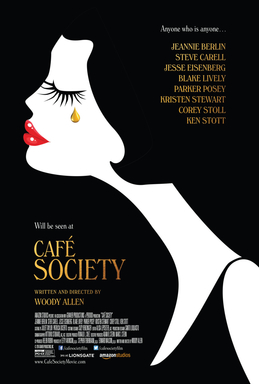
Woody Allen’s crepuscular film Café Society (2016) is as boring as it is instrumentally instructive as a testament to Jewish cosmopolitanism, domination and reshaping of American values and culture. Set in the 1930s the film centers on Bobby Dorfman (Jesse Eisenberg), the youngest son of a New York Jewish family, who leaves his father’s jewelry business for Hollywood. If Fellini used Mastroianni, as an idealized surrogate-self, Eisenberg is used rather as Allen’s mirror image, neurotic, shlumpy, physically weak, lascivious, overtly sentimental but quick-witted, clever with high verbal acuity – a certain Jewish je ne sais quoi.

Jesse Eisenbert, Kristen Stewart, and Woody Allen in Cafe Society

Jesse Eisenberg, Kristen Stewart, and Woody Allen, on the set of Café Society

The conflation of Dorfman and Allen is made even more obvious with Allen’s voiceover narration throughout. The Dorfman family trio functions as a trio of Jewish stereotypes, his elder brother a gangster, his sister married to a Marxist intellectual, and both he and his uncle settled in the entertainment industry. Radical intellectualism and entertainment are a microcosm of the Jewish cultural enterprise, and the explicitly crude expression of usurious tendencies in the gangster are a stand-in for a still-common Jewish phenomenon of exploitative business practices (see Andrew Joyce’s “Jews and Money Lending: A Contemporary Case File”).  Each of these enterprises supports and affirms the other.

Continuing with the Jewish stereotypes, Allen intersperses scenes with Jews who fleetingly pass off stock tips, whispering in an ear at a party – implicitly showcasing ethnic networking. Read more

Jews Versus the Alt Right: Lessons from History

Belloc

“The anti-Semitic movement is essentially a reaction against the abnormal growth in Jewish power, and the new strength of anti-Semitism is largely due to the Jews themselves.” Hillaire Belloc, The Jews (1922)

Just over a week ago, Hillary Clinton gave a speech attacking Donald Trump’s alleged associations with the Alt Right. In that boring and over-wrought piece of public speaking, Angela Merkel’s rival as the matriarch of mendacity described the Alt Right as a barely coherent whirlwind of “race-baiting,” “anti-woman,” “anti-Muslim,” and “anti-immigrant ideas.”

Predictably, it was revealed shortly after the speech that parts of it had been cribbed directly from an April propaganda piece by the Southern Poverty Law Center. Originating with an organization that makes a living by peddling horror stories, fantasies, and libels, it was no surprise that the speech relayed exaggerated and contradictory messages about this “emerging racist ideology.” According to Clinton, the Alt Right is “loose” but also “organized.” Its membership is “mostly online,” but also on our streets in droves in the form of a “rising tide of hardline, right-wing nationalism around the world.”

So far, so banal. However, by mentioning Trump’s alleged Twitter usage of “an anti-Semitic image — a Star of David imposed over a sea of dollar bills,” along with “anti-Semitic slurs and death threats coming from his supporters,” Clinton clumsily broke what seems to have been a long-standing convention that kept Jews and anti-Semitism off discussion tables at the highest level. After decades on the wings, political anti-Semitism had made it to the main stage. Read more

Keeping It Feel: How Liberals Wage War on Reality

donald-trump-nigel-farage

Roger Cohen is one of many Jews supplying guidance to the goyim at the New York Times. He was dripping with contempt after Nigel Farage supported Donald Trump at a rally in Missouri earlier this year. And understandably so. Like Trump, the former UKIP leader is infamous for his vile public statements. For example, he said something “outrageous,” “disgraceful” and “completely unacceptable” in the run-up to the Brexit vote. He was following up his despicable behaviour in January 2015, when he said something “irresponsible,” “sickening” and “utterly wrong.”

So what did he say? Did he suggest the Queen be put to work as a shoe-shine girl on Oxford Street? Did he demand a revival of the worship of Moloch, with live child-sacrifice broadcast twice daily from Westminster Abbey?

The First Law of Western Politics

No, it was far worse than that. Farage spoke the truth about a minority. In doing so, he broke the First Law of Western Politics: “Minorities are always in the right, the majority always in the wrong.” While campaigning for Brexit, Farage said that staying in the European Union increased the chance of women in Britain experiencing sex attacks like those in Cologne at the New Year. In January 2015, he said that the Charlie Hebdo massacre proved there was a Muslim “fifth column living within [Europe], holding our passports, who hate us.” Read more

From a Chat to Metapolitics: A Journey in Thought, Part Two

Part 1

It seems to me that a cultural message of the following sort (the reader is invited to read it over and improve on it) needs to be communicated to white people, particularly the young:

You are white and that matters incredibly. You can be very, very proud of who you are. You owe it to yourself to learn about the best your race has thought and achieved over the span of its history so that you will know why.  Being a white person carries with it responsibilities: You need to develop your mind and body and character and personal effectiveness so that you can live honorably and decently and productively as a white man or woman by the highest standards of your race.  And you should feel an obligation to protect and enhance the places your forebears left to your care, and to look out for the wellbeing of your racial kinsmen.

The question, of course, is how to impart this message (or one that’s better).  The first thing that comes to mind is to do what the Cultural Marxists and their liberal allies have done so effectively in recent decades through the schools and the mass media, except do it in reverse:  that is, instead of tearing down whites and their ways and their heritage, build them up.

The problem with that approach, however, is that anybody disposed to go in that direction would not have ready access to the schools and to the mainstream media.  Entities that train and license teachers and the schools that hire them have zero tolerance for white consciousness and commitment, and white activists don’t control movie studios, television networks, newspapers, and record labels.  Also, going public with anything favorable about white people is dangerous: it’s a way to get smeared, harassed, snubbed, and marginalized, and to lose your job or not get the one you applied for, as well as to get rejected in school applications.  The evidence demonstrates that those who have advocated for whites under their own names—no exceptions I can think of—have paid heavy dues for it. Read more

From a Chat to Metapolitics: A Journey in Thought, Part One

In mid-August of 2016, I was included in a group of five people sitting around a table chatting at the University of Vermont, which is in the city of Burlington, Vermont’s largest, 42,000 people.  Four of us were a current or retired faculty member at the university and the other was a new dean who had arrived in town from California a few weeks earlier.  Basically the occasion was to meet and welcome the newcomer; he was center stage.  No big agenda, professional small talk over coffee.

During the conversation, the new arrival—I’ll call him Bill—commented that he was indeed happy to come to Vermont, great state, but that he realized it takes a generation to be accepted by Vermonters as one of them, as a real Vermonter.  I remembered being told that same thing soon after I came to Vermont from Minnesota over forty years ago to take up my duties as a tenure track assistant professor at the university.  The assumption behind this piece of conventional wisdom is that Vermonters have a strong and positive sense of who they are as a unique people and feel connected and committed to one another and to this place and to their way of life, and that it takes a good measure of socialization and accommodation for an outsider to become one of them.

“I’m not sure what you said is true, Bill, or true now anyway,” I offered.   “I mean, Bernie Sanders came here from New York City back when I did and he’s a senator.  And Howard Dean, another presidential candidate from this state, in 2004, came here from Massachusetts, I think it was, and he got to be governor.   I felt checked out and kept at a distance by Vermonters when I first got here, but I don’t think this sort of thing goes on much now, if it goes on at all.”  Read more