Featured Articles

Norway vs. Sweden on immigration: The importance of becoming part of the mainstream

In his article on the Africanization of France, Guillaume Durocher notes that

no doubt North American White Nationalists can be critical of the FN’s [National Front’s] positioning [i.e., their  public stance that they are unconcerned whether the ethnic French become a minority in France]. I would note however that, as of today, this position is necessary for the FN to be a media-acceptable and potentially electable political party (in contrast for example with the British National Party, which nonetheless does important counter-cultural and metapolitical work). If Marine Le Pen becomes President of the Republic, as a recent poll suggests she could if she faces François Hollande in the second round in 2017, then no doubt freedom of speech on this topic would be much greater in France. For example, already Prime Minister Viktor Orbán in Hungary has been able to argue with other European leaders that “[t]he goal is to cease immigration whatsoever” and that “the ethnic basis of the Nation-State” should not be broken.

Another case where moderating the message can result in important influence on issues such as immigration policy is illustrated in the contrast between Norway and Sweden, as discussed in a New York Times article by Hugh Eakin (“Scandinavians Split over Syrian Influx“).

AFTER eight years of center-right rule, the narrow victory of the left-leaning Social Democratic Party in Sweden’s national elections last Sunday marked a broad shift in the country’s politics. But the new coalition government the party hopes to form is unlikely to reconsider one of the country’s most challenging policies: its response to a war being fought some 2,000 miles away. The country has taken an open-door approach to people fleeing the conflict in Syria, which is bringing more Syrians to Sweden than to any other European country.

Never mind that Sweden has double-digit youth unemployment. That there have been riots in immigrant neighborhoods in Stockholm. That there is a severe housing shortage for new arrivals. Or that the Swedish Migration Board, which handles asylum seekers, needs a drastic budget increase — almost $7 billion — to cover soaring costs over the next few years.

And never mind that the far-right, anti-immigrant Sweden Democrats won 13 percent of the vote in Sunday’s election, their best showing ever. They more than doubled their seats in Parliament — from 20 to 49 — and are now the third-biggest party in the country.

“We are the moral guardians of the world,” Magnus Ranstorp, a specialist in counterterrorism at the Swedish National Defense College, told me a few days before the election, referring to Swedes. “We haven’t fought a war in 200 years. We are righteous. But sometimes the righteousness doesn’t meet reality.”
Read more

The Africanization of France: Medical data suggests one-third French births are non-White

Si0yyX2

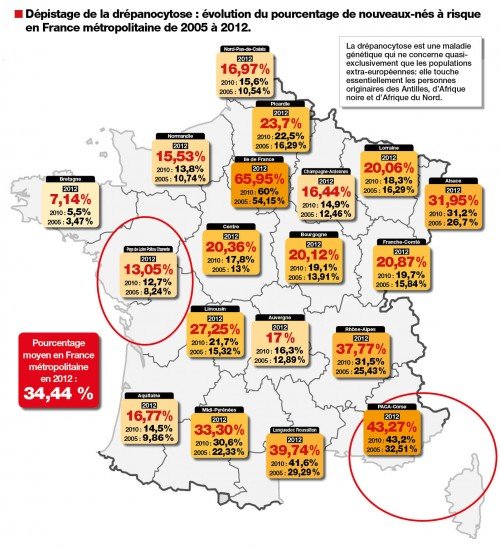
Map of percentage of newborns screened for sickle-cell disease, overwhelmingly of Arab, Black, Turkish and Indian descent. In 2006 these made up 27% of newborns, rising to 34.44% in 2012.


I take bold claims from alternative media with a grain of salt. So when the popular French racialist blog Fdesouche (short for “ethnic French”) claimed that around 34.44% of newborns in France in 2012 were non-White, I did not think much of it, supposing this figure was much too high to be realistic. 

I decided to reconsider however when I came across a shockingly bad article in Le Monde supposingly “debunking” Fdesouche’s claim under the patronizing title “Sickle-cell anemia, the genetic disease which is exciting the far-right.” The “rebuttal” is a long collection of sophistic arguments and non-sequiturs*, none of which address Fdesouche’s data purporting to show that demographic change and de-Europeanization in France are rapidly occurring on a massive scale, what the French call le Grand Remplacement or “the Great Displacement.” 

Admittedly, it is very hard to get a handle on the rate of demographic change in France given the lack of official ethnic statistics (I have attempted to provide some sense of the ethnic situation in France with statistics on first- and second-generation immigrantswe know that while ethnic Europeans rapidly converge economically/educationally to the French average, Blacks and Maghrebis do not, and that first-generation North Africans have a relatively high birth rate). We know that Pew forecasts that the United States will have a non-White majority by the 2040s and an Oxford professor has estimated that native Britons will become a minority in their own country by the 2060s. Very obviously France, with a comparable immigration history since World War II, could be on a similar timeline.  Read more

Reflections on Hilaire Belloc’s “The Jews” (1922) [Part Three of Three]

Part 1
Part 2

As Belloc moves into the second half of his book, I personally feel that the work becomes weaker. His characteristic style remains powerful, but it is in the second half of the book that Belloc’s attempt to come across as balanced goes too far. The sixth chapter examines “The Causes of Friction upon Our Side.” Here Belloc neglects to concede that the great mass of Europeans has never urged the Jews to settle among them, that they have never held them captive, and certainly never sought out conflict with them. As Martin Luther once so insightfully pointed out:

Now behold what a nice, thick, fat lie it is when they complain about being captives among us. … [W]e do not know to this day which Devil brought them into our country. We did not fetch them from Jerusalem! On top of that, no-one is holding them now. Land and highways are open to them; they may move to their country whenever they wish to do so.

This is a fundamental issue in the history of Jewish-European relations that Belloc fails to recognize. Purposeful or not, the presence of a powerful but separate foreign, political entity exerting influence to its own ends in the elite strata of a given society amounts to one thing and one thing only: colonialism. In such a scenario, one would be hard-pressed to find fault with the colonized. Jews have remained in European society out of choice and with purpose and goals; not out of captivity. There are no passive partners. We are not locked into a fateful and unceasing struggle with all exits blocked. But instead Belloc strains to keep a balance which loses touch with the reality of the situation. He argues that “it is certain that we play a part ourselves in this quarrel between us and the Jews (124).” While certain actions on our part may escalate tensions, I would argue you that no fully accurate assessment of the situation can be made without having as a foundation an acknowledgement of the scenario I have just outlined. Read more

Reflections on Hilaire Belloc’s “The Jews” (1922) [Part Two of Three]

Part 1.

After discussing denial among non-Jews on the issue of the “Jewish problem,” Belloc moves in the third chapter to his thoughts on how that problem had manifested in his lifetime. He describes Jewry as a “political organism” which, like any independent organism, seeks after its own interests. The author writes (44):

It is objected of the Jew in finance, in industry, in commerce — where he is ubiquitous and powerful out of all proportion to his numbers — that he seeks, and has already reached, dominion. It is objected that he acts everywhere against the interests of his hosts; that these are being interfered with, guided, run against their will; that a power is present which acts either with indifference to what we love or in active opposition to what we love. Notably it is said to be indifferent to, or in active opposition against our national feelings, our religious traditions, and the general cultural and morals of Christendom which we have inherited and desire to preserve: that power is Israel.

Although these objections had, for the most part, merely simmered under the surface of Western liberal convention, Belloc argues that the Bolshevik revolution shocked Europeans. The leading role of Jews in the Russian catastrophe “struck both at the benevolent who would near no harm of the Jews, and those who had hitherto shielded or obeyed them as identified only with the interest of large Capital (45).” Although liberal convention on the Jews officially held the field, the Bolshevik menace “compelled attention. Bolshevism stated the Jewish problem with a violence and an insistence such that it could no longer be denied either by the blindest fanatic or the most resolute liar (46).” Read more

Reflections on Hilaire Belloc’s “The Jews” (1922) [Part One of Three]

Belloc

Of all the fallacies that one confronts when engaging with the theme of relations between Jews and Europeans, one of the most easily disproven is the idea that antagonism towards Jews is constantly changing. In the ‘mainstream’ reading of the history of European-Jewish interactions, the friction that exists between Jews and other elements of the society is argued to be linked solely to a Christianity-induced communal psychosis on the part of Europeans. This psychosis is said to undergo almost ceaseless metamorphoses.

The idea is so deep-rooted among organized Jewry that, even today, we are forced to listen to endless bleating about the emergence of a “new anti-Semitism”? This redundant cry resounds almost weekly even though, to the informed observer, it is clear that there isn’t, and has never been, any real change in the essence of the friction between Jews and Europeans. The ‘Jewish Problem,’ if one wishes to employ that archaic terminology, is seemingly as timeless and unchanging as the Jews themselves.

In my examination of Robert Wistrich’s Antisemitism: The Longest Hatred, I pointed to that author’s typically contorted argument that a “virus” existed in Europe,  in which “pagan, pre-Christian anti-Semitism grafted on to the stem of medieval Christian stereotypes of the Jew which then passed over into the post-Christian rationalist anti-Judaism of the eighteenth and nineteenth centuries.” Needless to say Wistrich’s phantasm, and similar poorly-fabricated ‘theories,’ are prejudiced at a very early stage by the employment of that fundamentally meaningless term: ‘anti-Semitism.’ By its very nature the term places the Jew or the ‘Semitism’ immediately in the passive position, thereby avoiding confrontation with the true essence of the problem — that there is a mutual friction between two essentially different entities, with divergent group interests and goals. Read more

Identity and Difference, Part 2: Identity

Part 1, Difference

Identity

The question of identity (national, cultural, etc.) also plays a central role in the debate about immigration. To begin, two observations must be made. The first is that there is much talk of the identity of the host population, but, in general, there is much less talk of the identity of the immigrants themselves, who nevertheless seem, by far, the most threatened by the fact of immigration itself. Indeed, the immigrants, insofar as they are the minority, directly suffer the pressure of the modes of behavior of the majority. Pulled to disappearance or, inversely, exacerbated in a provocative way, their identity only survives, frequently, in a negative (or reactive) manner by the hostility of the host environment, by capitalist over-exploitation exerted on certain workers uprooted from their natural structures of defense and protection.

The second observation is the following: It is striking to see how, in certain ways, the problem of identity is situated exclusively in relation with immigration. The immigrants would be the principal “threat,” if not the only one, that weighs on French identity. But that is tantamount to overlooking the numerous factors that in the whole world, both in the countries with a strong foreign labor as in those without it, are inducing a rapid disintegration of collective identities: the primacy of consumption, the Westernization of customs, the media homogenization, the generalization of the axiomatic of self-interest, etc.

With such a perception of things, it is too easy to fall into the temptation of scapegoating. But, certainly, it is not the fault of the immigrants that the French are apparently no longer capable of producing a way of life that is their own nor to offer to the world the spectacle of an original form of thought and of being. And nor is it the fault of the immigrants that the social bond is broken wherever liberal individualism is extended, that the dictatorship of the private has extinguished the public spaces that could constitute the crucible in which to renew an active citizenry, nor that individuals, submerged in the ideology of merchandise, turn away more and more from their own nature. It is not the fault of the immigrants that the French form a people increasingly less, that the nation has become a phantasm, that the economy has been globalized nor that individuals renounce being actors of their own existence to accept that there are others who decide in their place from norms and values that they no longer contribute to forming. It is not the immigrants, finally, who colonize the collective imagination and impose on the radio and on the television sounds, images, concerns, and models “which come from outside.” If there is “globalism,” we say too with clarity that, until proven otherwise, where it comes from is the other side of the Atlantic, and not the other side of the Mediterranean. And let us add that the small Arab shopkeeper contributes more to maintain, in a convivial way, the French identity than the Americanomorphic park of attractions or the “shopping center” of a very French capital. Read more

Identity and Difference, Part 1: Difference

Alain_de_Benoist

Alain de Benoist

Translated from the Spanish by Lucian Tudor 

* This was translated into English from the Spanish version titled “Identidad y Diferencia,” published in the digital journal Elementos: Revista de Metapolítica para una Civilización Europea, No. 47 (May 2013): 3-10. The Spanish text was the translation and combination of the original French articles titled “Le droit à la différence” and “Qu’est-ce que l’identité? Réflexions sur un concept-clef,” published in Eléments, No. 77 (April 1993): 24-25 & 44-47. The translator wishes to thank Daniel Macek for reviewing the translation and Alain de Benoist for approving of the translation.

Difference

The debate about immigration has raised in a sharp manner the questions of the right to difference, the future of the mode of community life, of the diversity of human cultures and of social and political pluralism. Questions of such importance cannot be treated with brief slogans or prefabricated responses. “Let us, therefore, oppose exclusion and integration,” writes Alain Touraine. “The first is as absurd as it is scandalous, but the second has taken two forms that need to be distinguished and between them there must be searched for, at least, a complementarity. Speaking of integration only to tell the new arrivals that they have to take their position in society as such and what it was before their arrival, that is much closer to exclusion than of a true integration.”[1]

The communitarian tendency began to affirm itself in the early eighties, in liaison with certainly confusing ideological propositions about the notion of “multicultural society.” Later it seemed to be remitted due to critiques directed against it on behalf of liberal individualism and “republican” universalism: the relative abandonment of the theme of difference, considered as “dangerous,” the denunciation of communities, invariably presented as “ghettos” or “prisons,” the over-valuation of individual problems to the detriment of the groups, the return of a form of purely egalitarian anti-racism, etc. The logic of capitalism, which, to extend itself, needs to make organic social structures and traditional mentalities disappear, has also had weight in that sense. The leader of immigrant minorities, Harlem Désir, sometimes accused of having inclined towards “differentialism,”[2] has been able to boast of having “promoted the sharing of common values and not the identitarian tribalism, the republican integration around universal principles and not the construction of community lobbies.”[3] Read more