Featured Articles

Ukrainian identity and the coming Khokholodomor

An English couple, an American couple and a Ukrainian couple were dining in a high-end restaurant. The Englishman asks his wife: “Could you pass me the honey, honey?” A little later, the American asks his wife: “Could you pass me the sugar, sugar?” Upon seeing this, the Ukrainian says to his wife: “Pass me the bacon, you pig.”

The above joke is recited by the Ukrainians themselves, in jestful awareness of east-meets-west stereotypes. This essay is a short and unauthorized biography of the modern Ukrainian people, their mentality and some of their divergent traits. As such, it should be a corroborating conclusion to my earlier pieces on the history and ethnomorphosis of the early Slavs to Kievan-Rus and the Ukrainian state. As is often said in the East: Доверяй, но проверяй [Trust, but verify].

This contemporary foray into Ukrainian identity begins in the place that I think will provide readers with a relatable context — the Ukrainian diaspora in the United States. This population has contributed to America’s intellectual and social elite in quite remarkable proportions. Roughly 1.4 million Americans have Ukrainian ancestry compared with 2.5 million of Russian ancestry, though you wouldn’t know it from their respective share of eminent individuals. Perhaps the best explanation for this is that the Stalinist purges, forced collectivization and NKVD terror disproportionately befell Ukrainians post-World War II, rendering these surviving emigres the residue of a significant fitness filter.

Two prominent American Jewish intellectuals have Ukrainian roots — Noam Chomsky is fairly well known in this regard but the posthumously influential Milton Friedman is less so (on account of his Ashkenazi surname). Chomsky’s tempered analysis of the Ukraine war now sees even him branded a Putin Apologist. Chomsky was a college freshman during World War II, born before Martin Luther King Jr., but is still around to provide his awful recommendations of Yugoslav socialism and covid-19 police-statism.

The Biden administration had a tryzub of Jewish-Ukrainian appointees to prominent cabinet positions — Antony Blinken, Merrick Garland and Janet Yellen — though on the Hill there’s no shortage of those who might require yellow-and-blue-badging. Senator minority leader Chuck Schumer’s ancestors hailed from Western Ukraine while fellow anti-Trump Democrats Alexander and Eugene Vindman were born in Soviet Ukraine. The late Ruth Bader Ginsburg’s Jewish-Ukrainian roots managed to counterbalance Elena Kagan’s Russian-Jewish roots on the Supreme Court, whereas, contrary to popular belief, the war-hawk and vulture Victoria Nuland has no ties to Ukraine.

Pop culture and the arts are where the Ukrainian diaspora has reached prodigious levels of overrepresentation. A number of comedians who got their start in the Borscht belt of Jewish resorts in upstate New York ended up becoming Hollywood royalty like Mel Brooks, Jerry Lewis, Sid Caesar and Don Rickles. Jewish-Ukrainian-Americans also led the more conventional path to the silver screen, from method-acting pioneer Lee Strasberg to the classically trained Walter Matthau. It’s a tradition that never really ceased, considering the industry’s modern heavyweights like William Shatner, Dustin Hoffman, Adam Sandler, Steven Seagal, Peggy Segal, David Duchovny, Mila Kunis, Liev Schreiber and Seth Rogan. The somewhat camouflaged origins of director Steven Spielberg lie not in his namesake town in Austria, but in Western Ukraine. Even among Jews, the Ukrainians are overrepresented.

Among entertainers of varying levels of Ukrainian-Jewish admixture one finds Bob Dylan, David Copperfield, Alex Trebek, Barbara Streisand, Sylvester Stallone, John Stewart, Michael Bolton, Bruno Mars, Chris Jericho and Winona Ryder. Famous voice-actor from the Simpsons, Hank Azaria, is perhaps worth mentioning on account of being Sephardic Jewish while possessing a surname that signifies Khazarian-Jewish roots.

Andy Warhol, considered the most important American artist of the twentieth century on account of his revolutionary obscenity and pop art industrialization, belonged to the obscure minority group called Rusyns or Ruthenians whose language and culture are not recognized by Ukraine as separate. Michael Smerconish also descends from this semi-ethnicity, as did the paleoconservative virtuoso Joseph Sobran. Since the abode of the Rusyn highlanders left them straddled at the confluence of several Carpathian states, they are in a way the borderland of the borderland, and, frankly speaking, seem to have elevated levels of borderline personality disorder.

In the course of researching the general character of career engagements and civil entanglements of the Ukrainian diaspora, one facet that becomes almost immediately salient is the profusion of eccentricity, weirdness and even antisocial disposition. Libertarian and former candidate for president Gary Johnson (maternally Ukrainian) is on the milder side of this spectrum, while at the extreme end one finds the late Anton LaVey, who founded the Church of Satan in spite of having Jewish Ukrainian roots (Levey).

Some neural divergence may be an asset for artistic pursuits; alas for the Ukrainians it seems to bleed lymphatically into their craft and in their casting appointments. Author Chuck Palahniuk, famous for Fight Club, is a homosexual like Warhol who went on to publish highly questionable adult material under the pretense of being avant-garde.

In addition to Shatner, the cast of Star Trek included Leonard Nimoy as the iconically strange and detached Spock. Both of his parents came from Western Ukraine. Actor Marty Feldman was providentially cast as Igor in Young Frankenstein on account of his famously misaligned eyes, and only by chance did his Jewish-Ukrainian heritage match the character’s. Mary Shelly never included such a character in the original story. However later adaptations were inspired by the notoriety of Soviet scientific experimentation. The irony of such an operating theatre in current times is that Switzerland is where the living go to die and Ukraine is the failed experiment. As it happens, the man most responsible for the death of the Soviet Union, Mikhail Gorbachov, was originally from Ukraine and his surname means hunch-backed.

My own experience in dealing with Ukrainians and Russians is that tempers can be fickle, and there is a general elevation in cynicism and irritability. Relations can be warm and breezy until such a time that contact is suddenly severed, not because you have wronged them but because of a difference of opinion, at which point they no longer wish to breathe the same air as you.

In anticipation that such anecdotal observations might produce a strong allergenic reaction among the gallery of commentators, I checked what little empirical research is available. A 2007 study published in the Journal of Cross-Cultural Psychology included Ukraine among 56 countries surveyed for the Big Five Personality Traits. Scores were abnormal for three of the five. They were very low on Openness, with only Japan and Hong Kong lower. They were among the most introverted in Europe (France and Belgium scored lower but this was likely a language issue). Most tellingly, they ranked dead last on Agreeableness.

Suspecting more closeted divergences than data were readily available for, I then happened upon some interesting anecdotal evidence from historical accounts of masochism in the Slavic lands. The Russian Primary Chronicle, penned in Kiev in the 12th century, relates a much older account of the Apostle Andrew’s visitation to the Novgorod Slavs:

I noticed their wooden bathhouses. They warm them to extreme heat, then undress, and after anointing themselves with an acid liquid, they take young branches and lash their bodies. They actually lash themselves so violently that they barely escape alive. Then they drench themselves with cold water, and thus are revived. They think nothing of doing this every day, and though tormented by none, they actually inflict such voluntary torture upon themselves. — Russian Primary Chronicle

It may not be such a coincidence that the term masochism actually derives from the name of a half-Ukrainian half-Austrian writer: Leopold von Sacher-Masoch. Born in Lemberg [Lviv] in 1836, Sacher-Masoch was somewhat traumatized as a child, having witnessed police brutality and interrogation at the station his father was chief of. The Ukrainian mammy who raised him also had a profound influence. Though he moved to Austria as a teenager, his political works made it clear that he hated both the German language and German society, preferring the French language and the quaint Galician homeland that he was nostalgic for. His fictional works, inspired from his private life, revealed that he enjoyed humiliation and intense physical pain administered by his mistress. For these reasons psychiatrist Richard von Krafft-Ebing coined the term masochist, to Sacher-Masoch’s vocal opposition, but possibly also his secret indulgence.

Notwithstanding the heightened artistic and creativity apparent in Ukrainian cognition, natives excel in the rational and computational fields. According to IQ data, Ukraine ranks near the lower end of Europe (90), more than six points below Russia, however these figures may require adjustment. The country is an IT powerhouse—ranking highly in coding competitions, hosting R&D centers of tech giants, and developing startups like GitLab, Grammarly and cryptocurrency services.

Over the last ten chess Olympiads, Ukraine has outperformed Russia, a long-time superpower in the sport. One of the veterans of the game is Vasyl Ivanchuk, a top player for decades and fan favorite on account of his authentic aloofness. In a recent event he burst into tears after a tough loss. The second strangest character on tour is fellow Ukrainian Anton Korobov, whose unique look and unfiltered way of communicating charms fans.

After Ukrainians and Russians, one can scarcely find people as direct in their apprehensions and laconic in their exchanges. This has its benefits and drawbacks, but in times of war gets to be harrowing. A year into the conflict and with large numbers of casualties mounting, prime-time Russian propagandist Vladimir Solovyov told viewers “life is highly overrated” anyway. More recently, a commander was filmed giving new soldiers a motivational speech in which he told them they were “all going to die” but that “flowers would be brought to all of their headstones for centuries.”

Ukrainian culture is considerably less Spartan, albeit in some ways more mafia-like, considering the recruitment of soldiers-by-abduction drive, the death (liquidation?) of writer Gonzalo Lira, seen as pro-Russian, and the extensive weaponry racketeering. Moreover, Ukraine has embarked on the kind of nationalist extremism and ethnic chauvinism that Russia could never afford to do given its plethora of minorities and semi-autonomous regions. I recall seeing this intolerance indoctrinated into children even on the national stage. Around 2012, a now deleted clip from Ukraine’s Got Talent showed six-year-old Diana Kozakevich reciting poetry and speaking on the need to linguistically de-Russify certain segments of the population. There can be little doubt as to which side disrupted the country’s homeostasis with a foolhardy attempt at cultural hegemony.

In addition to a certain cultural immodesty, one of the divergent traits of the Eastern Slavs appears to be a reduced ability at coping with excess and addiction, related to low-trust behaviors like kleptomania and megalomania. Reading Dostoevsky’s Brothers Karamazov, I was surprised just how much of the story reverberated around vice. It does, however, provide a backdrop to the grotesque materialism of some modern Russians and Ukrainians—the women often being worse—be it in London, Tel Aviv or Dubai. President Putin hasn’t exactly helped in this regard, saying in 2017 that “our [Russian prostitutes] are undoubtedly the best in the world.”

One need only look at the sight of the Russian president, solo at an immensely long table, to know that this is a man addicted to power. The Zelenskys, by contrast, have a coffee-table significantly more cluttered, but whatever the vice there is as always an ironic analogue from the pages of history. The man whose name both presidents carry, Volodymyr the Great, was one of the most vice-filled men of all time. The German chronicler Thietmar of Merseburg appointed him the Latin epithet “fornicator immensis” prior his miraculous conversion to Christianity and subsequent canonization:

He had three hundred concubines at Vyshgorod, three hundred at Belgorod, and two hundred at Berestovo. He was insatiable in vice. He even seduced married women and violated young girls, for he was a libertine like Solomon. —Russian Primary Chronicle

“It’s good to be the king,” as Mel Brooks famously said. Centuries later Christian mystic Rasputin found another way to live the lifestyle and follow in the footsteps of Saint Volodymyr, barefooted as was his style. Older and more conservative Russians no doubt look to the church-going Putin as a force for traditional mores and necessary authoritarian rule, protecting them from their own ancestral weaknesses, be they from pagan times or the recent communist-atheist epoch.

Ukrainians who moved to Russia decades ago complain of not being able to recognize their home country anymore, such has the profusion of American values altered the behavior and attitudes of the people. Therefore the ongoing conflict is understood as a culture war in addition to a geopolitical one. Among some of the harbingers is the influx of diversity and mixed marriages. One of the first Afro-Ukrainian marriages was personally blessed by then president of Ukraine Viktor Yushchenko, although the couple separated after their first child. The country’s current top female athlete, Elina Svitolina, is wedded to Caribbean-French tennis player Gaël Monfils.

Though most wouldn’t know it, American celebrity Kendra Wilkinson is half-Ukrainian—not that it had anything to do with being pimped by the polite society of Hugh Hefner’s Playboy brand. There is little doubt as to why she was heavily promoted with her own cable TV spin-off after her engagement to NFL star Hank Baskett. In her youth, Wilkinson wanted to be a marine biologist, but instead ended up a self-pitying “mud shark” as the racialists would say—an epithet that has completely changed meaning since Frank Zappa’s 1971 song of the same name.

The argument that Ukraine, a socially tolerant country, harbors a resurgent Nazi movement beyond football hooligans and army-patch enthusiasts is a silly notion but the Russians are sticking to it since the global propaganda economy is silly enough to buy it. Both Ukrainians and Russians effectively practice the proposition nation, as these respective identities are more about language and culture, thus making them available to anyone who wants them from the many and growing gradations of Eurasian pedigrees. The resolution of race in the East is quite different from that of the United States, where racial clustering involved large degrees of separation. Similarly, Western Europeans historically understood nation as a subtaxon of race. My own take is that it’s somewhat inverted in Eastern Europe, where national identities are monoethnic syntheses of multiracial components.

An onomastic analysis of Ukrainian surnames reveals the predominance of classic Slavic suffixes like -—enko and —ich, however there is also a large minority (perhaps 20%) who have the —ak or —uk suffix of Turkic grammar. This was a hallmark of titular names like Cossack, Kulak, Hayduk and Mamluk, as well as of personal names of the Huns (Mundiuk, Ernak, Dengezikh); Bolgars (Asparuk, Omurtak) and Cuman Khans (Atrok, Tegak, Konchak). Since tribes and nations acquired their names through a similar process, the majority of Turkic ethnonyms follow this rule: Uzbek, Kazakh, Tajik, Kalmyk, Kipchak, Patzinak (Pecheneg) and the ancient Türük (Turk). Modern surnames often have the suffix hidden in the middle because assimilation at some point truncated them with Slavic suffixes (cf. Yanukovych, Kubrakov, Karjakin, Nabokov).

Slavic contact with the Turks occurred so long ago that the linguistic appendage in question is common to all Slavic tongues and only weakly correlated with Turkic familial lineage. Among the Western Slavs, it was adopted as a diminutive early on and underwent a vowel shift, giving us such names as that of economist Friedrich Hayek and philosopher Slavoj Žižek. However, Slovenia in the previous decade had a most peculiar succession of presidents when, in 2012, incumbent Danilo Türk was followed by Borut Pahor—whose name is indeed a local variant of Borat. Other first names of Turkic provenance that Eastern Europeans continue to dispense in general ignorance include Boris, Denis, Taras, Boyan and Damir [Temur].

One of the standouts of the distribution of Ukrainian surnames is the high frequency of color anthroponyms, in particular for the color black: Chernenko, Chorniy, Chervan, Chervinsky, Cernovich, Korobov, Khara, etc. What this shows is that black-haired and swarthy phenotypes were exotic to the region, such that the pre-existing majority named dark traits as new and distinguishing features. The writers of antiquity only mentioned fair-haired nations inhabiting Pontic-Caspian region, though my earlier summary of these sources could have also mentioned the Albani, a white-haired race, described by Isigonus of Nicaea (1st century BC), Gaius Solinus (3rd century) and Isidor of Seville (6th century).

The incursion of black phenotypes can therefore be attributed to three main groups: Greeks, Gypsies and Turco-Mongols. If the alleles for black hair were amplified in a heterogeneous setting, it was because of sexual selection. Professor Edward Dutton explains that in a sibling group darker hair is associated with higher testosterone, elevating apparent physical fitness, although women are unable to decouple this from race. It’s probably not down to chance that most of the Soviet Union’s arch villains had black hair: Trotsky, Stalin, Yagoda, Beria, Yezhov and the “Black Tornado’ Lazar Kaganovich.

The only other aspect of East Slavic HBD perhaps worth noting is the range of body builds and craniometrics. The tall and gracile type is most common, which is why Ukrainian athletes dominate disciplines like high jump and pole vault, while at the other end a profusion of extremely thick-set ectomorphs is present. For this reason Eastern Europeans have dominated weightlifting—combining the Caucusoid qualities of strength and stature with the Altaic traits of burliness and lower center of gravity. Large torsos and short legs were ideal for horse warfare. As to the bulbous, pumpkin-like crania of Eurasian provenance, I can only imagine that that’s what Jordanes referred to in the 6th century when describing the heads of the Huns as “a sort of shapeless lump.” We now understand that ancestries tracing back to the Turco-Mongoloid homeland of Siberia naturally evolved skulls of minimal profile and maximum volume to surface area ratio so as to better conserve heat in extreme cold.

Omeljan Pritsak (1919–2006): Ukrainian-born Harvard Professor of Slavistics and Oriental Studies

My own experience travelling to Western Ukraine last year is that the population is virtually indistinguishable from that of Prague or Ljubljana, and not much like the ambiguous types I had seen profiled by Western media outlets during coverage of the war. It then dawned on me that the individuals included in those reports were fleeing the Eastern regions of Ukraine where the frontline is. It’s reasonable to assume that in Ukraine there is a West to East cline in Eurasian physiognomy, with the Dnieper historically functioning as a significant barrier to gene flow. Some media bias isn’t out of the question, but for the most part the Eastern part of the country appears to host a fantastic array of combinatory phenotypes that one is unlikely to see anywhere else.


Eastern Ukrainians featured by the BBC

From the city of Donetsk hails one particular individual who has a gleaming aura about him that accompanies his status as Ukraine’s richest man and one of the richest in Europe. There cannot be many blond-haired blue-eyed Muslim Tatars around but Rinat Akhmetov is one of them. That seems to be the extent of his Europeanness, because everything else from his mafia-enforcer past to shady business dealings are very much of the Eastern tradition. Akhmetov entered politics in 2006 but didn’t show up for 529 out of 530 parliamentary sessions. Readers can rest assured that he is indeed for helping the common man: he managed to get his former chauffeur elected to parliament alongside himself.

The number one reason to continue backing Ukraine, we are constantly told, is that this is “a war between autocracies and democracies.” But Ukraine isn’t a good advertisement for democracy. Per capita GDP of $5,500 and unemployment at 9.4 percent ranks much worse than Russia, while even “Europe’s last dictatorship” Belarus was ranked as less corrupt than Ukraine over the last decade. Transparency International, which runs the Corruption Perceptions Index, flipped the two country’s ranks only last year. For Ukrainians to be inspired by their sense of Western values rather than anti-Russian fervor will make for a sobering realization in their postbellum reflections.

In my lifetime, all that Ukraine has been known for is Chernobyl, parliamentary brawls, and the place that David Duke got his doctorate from. The stigma of war will saddle whatever rump state remains for decades to come—but who wants an identity mired in victimhood and potentially guilty victimhood? Even in staunch ally Poland, sentiments are changing. My own sympathies have changed too, after being reminded that 73 percent of Ukrainian voters chose Zelensky. But the people also vote with their feet, and a quarter of the population has left—including 3 million to Russia. Ukraine is now sustained by the charity of Western interests, while internally this democracy is considering drafting women and 18-year-olds. Perhaps Ukrainians are starting to realize that they’re not mere victims simply “fighting against aggression,” but that their side was the aggression—geopolitically (on behalf of NATO) and culturally (clamping down on language rights and Orthodox churches). All this for a European Union that meddles in foreign elections, and will one day request that Ukraine elevate the minority rights of gays, and trans, while inundating them with Muslims and Africans. The 16thcentury prophesy of Moscow as the third and final Rome doesn’t look so obscure now, but what is often forgotten about Rome’s founding myth is that Romulus killed his twin-brother Remus. So it has come to pass with Moskal and Khokhol.

Biden’s Senility and His Fully Deep-State Presidency

Sometimes I have to pinch myself to accept that what happened in the United States — in the nation that leads the free world — between 2020 and today actually occurred. It is clear from the new book — Original Sin: President Biden’s Decline, Its Cover Up and His Disastrous Choice to Run Again — that even the authors of this seminal analysis of the period cannot quite accept what took place. As the authors themselves admit, the cognitive dissonance is simply too strong.

If you are a Democrat, you want to believe that the Democrats are morally good. You want to believe that you are intelligent that you and cannot be easily manipulated or tricked. You want to believe that the U.S. is a genuine democracy and that its president — your Democrat president — is a good and competent man. You want to believe that people in high office will “do the right thing” and abide by the U.S. Constitution.

This book proves that, in relation to Joe Biden, none of these beliefs were ever justified. Democrats had clear evidence that Biden was senile and incapable of being president but they were gas-lit into thinking otherwise or they forced themselves to believe otherwise in order to cope with the cognitive dissonance. And in some cases, they knew the truth but didn’t care. In 2021, in the first year of his administration, Biden did not take a cognitive examination, patently because his aids knew what the result would be. The book quotes an anonymous source in this regard, who tries to justify the deceit: “He just had to win and then he could disappear for four years — he’d only have to show proof of life once in a while.” Apparently, “His aides could pick up the slack.” It’s as though they’re Soviet apparatchiks after the death of Brezhnev. “We’re in serious trouble,” they think. “We need a decrepit old man whom we can control. Interestingly, the authors refer to Biden’s court as the “politburo.” Hence it’s no accident that Biden’s presidency has been called “The First Fully Deep-State Presidency.” So when it comes to assessing blame for the Biden Administration’s open-borders policy, it should fall squarely on Secretary of Homeland Security Alejandro Mayorkas, not Biden.

Shockingly, even the authors of this book cannot accept the reasonable conclusion that can be drawn from the evidence they’ve presented; that Biden had dementia all along. They write: “Readers who are convinced that Joe Biden was little more than a husk from the very beginning of his presidency, barely capable of stringing two sentences together, will not find support for that view here,” while they add that the book will not satisfy those who wish to believe that rumours of Biden’s deterioration was simple “right-wing propaganda.”

However, the first position is a straw man version of what many people actually think. Of course, Biden’s dementia worsened between 2020 and June 2024, when his disastrous debate performance with Trump led to Biden being eventually pressured to pull out of the race. But the point is that he was already senile, and thus incapable of taking the oath of office, let alone actually functioning as president, when he was elected in 2020.

In 2007, when Biden wasn’t yet vice-president, the signs of the beginnings of senility — forgetting words, getting mixed up — were already there, with Biden hilariously referring to Obama as “the first mainstream African American who is articulate and bright and clean and a nice-looking guy.” Ten years later, in 2017, when Biden commissioned a ghost writer to pen his autobiography, his conversations were taped. These tapes reveal that “He grasped to remember things, he sometimes had difficulty speaking, and he frequently lost his train of thought.” When the authorities looked into prosecuting Biden for mishandling classified documents, they effectively realised that the jury would likely conclude that he was a senile old man who didn’t mean to do anything wrong.

Accordingly, the conclusion that this book daren’t quite reach is that the Democrats, knowing that Biden was senile but thinking that they might be able to convincingly cover it up, did indeed put “Sleepy Joe” up as a “husk” candidate whom they could control, in a way that they obviously couldn’t with someone mentally competent such as Bernie Sanders. However, the Democrat machine did not anticipate just how quickly Biden’s mental acuity would completely collapse nor how difficult it would be to conceal this.

At the presidential debate with Trump in June 2024, no amount of nonsense about Biden having an “off-day” could obscure what everybody witnessed, so the old man had to go. Even then they couldn’t publically admit that he was senile; there were merely euphemisms about his age. But the lying gets worse. This book was published on May 20, 2025. On the same day it was revealed that Biden is suffering from advanced prostate cancer. This is a man who, as president, would have been having regular medical checks. It seems almost conceivable, therefore, that Biden’s aids didn’t know he had prostate cancer. But they covered it up.

The book points out that there have been many cover-ups with regard to the health of senior U.S. politicians, including presidents: Woodrow Wilson had a stroke in 1919 which left him incapacitated until 1921; John F. Kennedy simply lied about his Addison’s disease, and there is suspicious absence of photos of President Roosevelt dancing. However, the Biden cover-up occurred in the age of mass media and the internet. It involved not just lying to but gas-lighting people; attempting to make them think that their own eyes were deceiving them. Moreover, it clearly took place for nakedly partisan reasons: to have a marionette presidential candidate via whom Machiavellian manipulators could get Trump out of the White House.

There are many fascinating asides in this book. There is evidence that emotional trauma, such as losing your spouse, can speed up dementia. In this regard, the book notes that the death of Beau, Joe Biden’s son, in 2015 may have exacerbated symptoms that were already beginning. The stress caused by the behaviour of Beau’s prodigal brother Hunter would have further contributed to Biden’s decline. Biden’s wife Jill comes across as attention-seeking, devious and, gradually, increasingly the power behind her husband’s throne. At first she is reluctant to be in the limelight but she obviously learns to enjoy it and then finds that she can’t give it up. She is an American Lady Macbeth, ruthlessly ensuring that her husband — in this case, her sick and unsuitable-for-the-job husband — retains the presidency. And, of course, the book is replete with anecdotes about the extent of Biden’s senility while in office.

But it is not just in the U.S. where this kind of cover-up and gas-lighting is occurring, in a context in which it is easier than ever to obtain information. At the time of writing, the rumours about U.K. Prime Minister Sir Keir Starmer being a homosexual — that he has a “lavender marriage” with a “beard” — are being further evidenced to be true by.

The British media dare not connect the dots. Prince Harry has essentially revealed that the King has terminal cancer, yet the pliant media says nothing, acting just like Pravda. Putting a senile and dying man into the highest office is what they were doing shortly before the Soviet Union collapsed. It really does make one muse over the future of the Woke Deep State.


Review: Bombshell patriotic documentary makes waves

Review in The Noticer: Bombshell patriotic documentary makes waves

Reposted here with permission

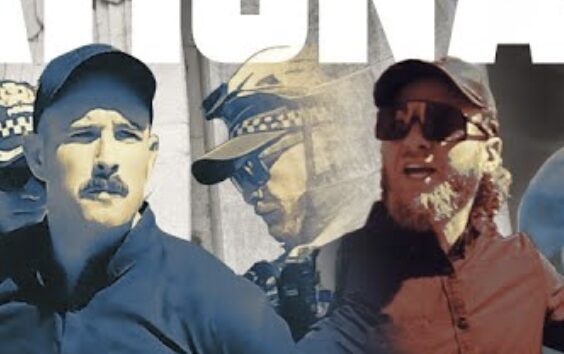
Earlier this year a group of patriots peacefully marched in Adelaide singing Waltzing Matilda on Australia Day – only to be shut down and arrested by the police. On the same day, there was an anti-Australia, antiwhite rally being held with chants of “Death to Australia” deemed perfectly legal.

The march made national news but the media was very dishonest about what happened and framed the peaceful Australian nationalists as terrorists, while those who were openly enemies of this nation were protected and celebrated.

Now the nationalists involved have released a documentary that tells their side of the story and contains some bombshell new revelations.

Watch the full documentary here:

Historically, nationalist and alternative media has always been very hit and miss on a technical level. Whether that be live streams with bad audio, or roughly edited documentaries often crudely cobbled together from archival material. So, we really didn’t know what to expect with this one.

Immediately, the film opens up with confident cutting and use of counterpunctal music. This wasn’t going to be framed as a depressing pity-party, but rather a jovial celebration of what it means to stand up and fight for one’s nation. Young men are dragged to the ground by police to an up-beat acoustic guitar melody. A montage of physical action and plot points express a uniquely Australian sense of humour.

How are men able to be so unfazed after such violence and injustice from the police and legal system? The documentary is structured in such a way to explain this. Thomas Sewell, who humorously describes himself to the camera as “the self appointed leader of White Australia” sends his boys on a ten kilometre run, only to then be followed by a mixed martial arts tournament on the same day. So this is a hardened group of young men ready to take on anything. An action-packed sequence of kickboxing peaks the first act before the film’s heroic mission begins.

From here we follow the group as they assemble on Australia Day, intercut with South Australia Police at a press conference expressing their intent to use the full force of the law and shut down any celebration of Australia Day that the patriots had in mind. The boys then assemble around a war memorial, singing Waltzing Matilda, which is intercut with historical footage of Australian troops marching and singing the same song in WW2, followed by Sewell attempting to give a speech before the police intervene and drag him away into a white van.

This is quite significant because of what is revealed in the closing credits of the film. After Sewell was taken into custody, a microphone he had been wearing picked up two officers talking about shooting the nationalist activists. From The Noticer:

In the recording, one officer appears to check whether his colleague’s bodycam was operating by asking “are you rolling?” and replies “okay good” after the second officer says “no”.

“I’m happy to shoot them,” the first cop then says.

“Happy to?” the second asks.

“I’m happy to shoot them,” the first officer repeats as voices can be heard singing Waltzing Matilda in the background.

“I wanna hammer these cunts. These guys… just need to be shot.”

It’s a revelation that puts everything in context. The regime is anti-Australian and the destruction of Australia is not some mistake or mismanagement – it’s by design and on-target.

We all remember the violence of tyrannical police during the Covid lockdowns. Police forces now have labour shortages that they struggle to fill because to be a policeman is to be a traitor to your own people. The nation was founded and built on the White Australia Policy and therefore the current power structure is opposed to the nation’s heritage, foundation and what it truly means to be Australian. It’s also funny that this film has bigger newsworthy bombshells than an entire 45-minute hit-piece attempt from earlier this year by ABC’s Four Corners.

The film is very well put together. Even with some haphazardly shot footage, it has a very refined edit that pushes this material to its full potential. There are various stylistic flourishes that keep it engaging. Joel Davis makes a rousing speech that is edited with electronic music and clever use of jump cutting to make it a rhythmic sequence. This incorporates meme-video language into a more traditional documentary, which I think was very effective and forward-thinking.

The film is obviously a propaganda piece for this nationalist group and it does a good job at showing the scope of the organisation. They were able to stage seminars with various speakers, physical marathons and kickboxing tournaments, followed by dominating the new cycle with an effective protest that exposed the anti-White regime that runs this country.

Arguments about optics and self-censorship are destroyed by Joel Davis’s seminar talk. He explains how leftists don’t run to the centre ground but keep marching left, which drags the centre of acceptable discourse with them. Joel argues it’s time to march in the other direction and drag the country right. This means being unapologetically right-wing and no more compromises. And when packaged in such a well-made documentary, which doesn’t pull its own punches, it’s hard to argue with Joel’s strategy.

The main thing I want to express about the filmmaking is how tight this edit is. Normally when watching something like this, I would expect to write down notes for edit changes and suggestions, but I really have none to give. This is as tight as a bow. It goes from deeply felt, back to humorous relief, to insight, to revelation without ever getting bogged down. Intuitive musical choices progress its narrative and emotion. Stylistic editing techniques create variation between the different sequences. Multiple elements are interwoven and cross-cut to create juxtaposition and a third entity.

Looking at this film, I believe they would have been editing from shortly after Australia Day right up until its premiere. And some credit should be given to the camera work. They had very good coverage, I’m sure some of this would have been shot on phones but that gave it dynamism and freshness. You can’t edit what you haven’t shot. The lack of sit-down interviews gave this a tactile, ever-moving quality that transcends the stagnation of Four Corners’ bigger budgeted yet inferior film.

The structure is great, with an amazing series of emotional crescendos culminating in a message from a WW2 widow who expresses pride in the men and donates $9,000 to assist political prisoner Stephen Wells. In fact, the combination of this and revelations that police openly expressed a desire to shoot these men may have led to Friday’s dropping of false charges and release of Wells, who was held in solitary confinement for four months. Wells was slapped with phony politically motivated charges of “fail to cease loiter”, and “display Nazi symbol” for a patch on his sleeve. But rather than sign bail conditions that would prevent him communicating with his comrades, he stood by his principles and in the process exposed the justice system as corrupt. His suffering was not in vain.

My only real criticism with the documentary is the title of the film. I understand it’s kind of staunch to just call it “Summer Nationals”, which I assume is in reference to the name of the event they are attending, like how the Scouts might have a “Winter Jamboree”, but something more targeted and attention grabbing would have served the film better.

There are various nationalist activist groups in the West who have produced their own media. I think it’s fair to say this documentary is a bit of a milestone and inspiration going forward in terms of video production. At its heart, this is an incredibly Australian film and made for a domestic audience that shares its sense of humour and cultural understanding. But international audiences will still get plenty from the patriotic spirit and bravery depicted in the film.

This is something every Australian should see. Not just every nationalist or patriot – but every Australian including radical leftists and foreigners. They will at least gain a better understanding of Australian nationalism and how the police treat political enemies. The left has had a pretty free-run with their protests for years, but the recent crack-down on anti-war and anti-Zionist rallies regarding genocide in Gaza has made a film like this more relevant to everyone. Many leftists are waking up not just to Zionism but global Jewish plutocracy and the penny is dropping. The simplistic days of left/right are over. The patriots shown in this film are arguably more socialist than the Greens. They just want things done in the national interest.

From Red Diaper to Red State: The Political Odyssey of David Horowitz

David Horowitz’s death on April 29, 2025 closes the chapter on a figure who embodied the neoconservative phenomenon: a Jewish intellectual who, like many of his generation, abandoned the Left when he perceived its ideals as incompatible with Jewish interests and American security.

Horowitz was born on January 10, 1939, in Forest Hills, Queens, New York, to Phil and Blanche Horowitz, both Jewish high school teachers and committed members of the Communist Party USA. His father taught English, and his mother taught stenography. Horowitz’s family background deeply shaped his early political outlook — his mother’s family had emigrated from Imperial Russia in the mid-19th century, while his father’s family fled Russia in 1905 during pogroms. In 1940, the family moved to the Long Island City section of Queens.

Growing up in a staunchly communist household, Horowitz was the quintessential “red diaper baby.” He attended Columbia University, where he earned his Bachelor of Arts degree in 1959, and later received a master’s degree in English literature from the University of California, Berkeley.

After completing his graduate studies, Horowitz moved to London in the mid-1960s to work for the Bertrand Russell Peace Foundation. There, he became involved in anti-war activism, helping to form the Vietnam Solidarity Campaign in 1966 alongside members of the Trotskyist International Marxist Group. During this period, he wrote The Free World Colossus: A Critique of American Foreign Policy in the Cold War, establishing himself as a voice in the New Left movement.

Horowitz returned to the United States in January 1968 and became co-editor of Ramparts magazine, an influential publication of the New Left based in California. During the early 1970s, he developed a close friendship with Huey P. Newton, founder of the Black Panther Party. Horowitz assisted the Panthers with their community initiatives, including raising funds for a school for “disadvantaged” children in Oakland.

The turning point in Horowitz’s political journey came in December 1974, when Betty Van Patter, a bookkeeper whom Horowitz had recommended to work for the Black Panthers, was found murdered in San Francisco Bay. Her body had been severely beaten, and Horowitz became convinced that members of the Black Panther Party were responsible for her death.

This tragedy profoundly traumatized Horowitz. According to Hugh Pearson, author of Shadow of the Panther: Huey Newton and the Price of Black Power in America, Horowitz “totally went berserk with regard to the left-liberal community” following Van Patter’s murder. The incident shattered his belief in the moral righteousness of the radical left and catalyzed his political transformation.

Increasingly disillusioned with left-wing politics through the late 1970s and early 1980s, Horowitz underwent a gradual but decisive shift to the right. In 1985, he publicly announced that he had voted for Ronald Reagan in the previous year’s presidential election. Along with his writing partner Peter Collier, Horowitz published an essay in The Washington Post titled “Lefties for Reagan,” formally declaring their break with the left. They wrote that voting for Reagan was “way of finally saying goodbye to all that… to the self-aggrandizing romance with corrupt Third Worldism; to the casual indulgence of Soviet totalitarianism; to the hypocritical and self-dramatizing anti- Americanism which is the New Left’s bequest to mainstream politics.”

Following his political conversion, Horowitz dedicated himself to challenging what he saw as the dangerous influence of the left in American culture and politics. In 1988, he founded the Center for the Study of Popular Culture (CSPC) in Los Angeles, which aimed to “establish a conservative presence in Hollywood and show how popular culture had become a political battleground.” The organization was later renamed the David Horowitz Freedom Center (DHFC) in 2006.

Horowitz chronicled his ideological journey in his 1996 memoir Radical Son: A Generational Odyssey, which became one of his most significant works. This deeply personal account detailed his disillusionment with the left and his embrace of conservative principles. It was quoted by Kevin MacDonald in Chapter 3 of The Culture of Critique illustrating the point that leftist Jews remained committed, ethnocentric Jews despite their declared internationalism:

David Horowitz (1997, 42) describes the world of his parents who had joined a “shul” run by the CPUSA in which Jewish holidays were given a political interpretation. Psychologically these people might as well have been in eighteenth-century Poland:

What my parents had done in joining the Communist Party and moving to Sunnyside was to return to the ghetto. There was the same shared private language, the same hermetically sealed universe, the same dual posturing revealing one face to the outer world and another to the tribe. More importantly, there was the same conviction of being marked for persecution and specially ordained, the sense of moral superiority toward the stronger and more numerous goyim outside. And there was the same fear of expulsion for heretical thoughts, which was the fear that riveted the chosen to the faith.

One of Horowitz’s primary focuses as a conservative activist was challenging what he perceived as liberal bias in American universities. He published The Professors: The 101 Most Dangerous Academics in America in 2006, criticizing professors he believed were engaging in indoctrination rather than education. He also created the “Academic Bill of Rights,” aimed at eliminating political bias in university hiring and grading practices.

Horowitz organized numerous campaigns on college campuses, including “Islamofascism Awareness Week” in 2007, which sought to alert students about what he viewed as the threat posed by radical Islam. These events often generated controversy and resistance from students and faculty.

After the September 11, 2001, terrorist attacks, Horowitz’s activism took on a new dimension. He became increasingly focused on what he called “the efforts of the radical left and its Islamist allies to destroy American values.” Horowitz pushed the envelope by advocating for racial and ethnic profiling of “potential terrorists-and that does mean Islamic and Palestinian terrorists.” He likely would have loved The Heritage Foundation’s Project Esther.

Horowitz, much like many of his peers in the largely Jewish neoconservative movement, was deeply affected by the 1967 Six-Day War and unsettled by the anti-Israeli rhetoric of Black nationalist groups in the 1960s and 1970s, steering him toward a strong pro-Israeli position. Though Horowitz publicly maintained that he was not a hardcore Zionist, his tendency to defend Israel at every opportunity suggests a deep alignment. In fact, he once argued, “If the Arabs disarm there will be peace, if the Jews disarm there will be a massacre,” contradicting his statement about being a lukewarm Zionist.

His stance on Israel became particularly pronounced after 9/11, as he increasingly claimed to view criticism of Israel as part of a broader anti-Western agenda. Horowitz became a fierce critic of Democrats who he claimed “empowered” Israel’s enemies, including “Iran, the Muslim Brotherhood, Hezbollah, ISIS and Hamas.” In 2016, he published a controversial essay in Breitbart News accusing conservative Jewish writer William Kristol and other “Never Trumpers” of trying “to weaken the only party that stands between the Jews and their annihilation, and between America and the forces intent on destroying her.” Kevin MacDonald in VDARE (2016):

One of the more spectacular examples of an MSM frenzy over supposed anti-Semitism: the reaction to the attack by David Horowitz against his fellow Jew Bill Kristolleader of a campaign to destroy Donald Trump [Bill Kristol: Republican Spoiler, Renegade JewMay 15, 2016] The headline, written by Horowitz, alluded to Kristol being Jewish.

As Jonathan S. Tobin [Email him] notes in Commentary,

[T]he real offense here is … his attempt to wrap him in the Star of David and to somehow brand his opponents as traitors to the pro-Israel cause. …

[H]is invocation of “America First” and the use of a term like “renegade Jew” in the headline (though not in the text of the article) seems to echo the smears of the pro-Trump alt right racists who have attacked conservative critics of the candidate with an avalanche of anti-Semitic invective.

[Breitbart’s ‘Renegade Jew’ DisgraceMay 16, 2016]

Horowitz’s offense was not simply criticizing Kristol’s campaign against Trump. Lots of people have done that without incurring the wrath of Commentary. And even saying that Kristol’s views are not good for Jews and Israel is commonplace:  MondoweissJ Street, and Mearsheimer and Walt in The Israel Lobby argue that neoconservatives and the Israel Lobby have a tragically mistaken view of Jewish and Israeli interests—also discussed in Charles Bloch’s and Steve Sailer’s VDARE posts.

The unforgivable offense: implying Kristol’s being a Jew had something to do with his opposition to Trump. After all, there would have been exactly zero upset if instead the headline was “Bill Kristol: Republican Spoiler, Renegade Republican.”

But putting ‘Jew’ in the headline was guaranteed to bring out immediate charges of anti-Semitism by the likes of Michelle Goldberg [Email her] in Slate :

To define someone as a ‘Renegade Jew’ in a column about scheming elites written for an audience full of white nationalists is to signal to the sewers. … A narrative is taking shape, an American Dolchstoßlegende that will blame a potential Trump loss on conniving Semites.

[Breitbart Calls Trump Foe “Renegade Jew.” This Is How Anti-Semitism Goes MainstreamMay 16, 2016]

Of course, we are supposed to engage in the fiction that the opinions of Bill Kristol et al. have nothing to do with being Jewish or what is good for Israel, but everything to do with their perception of what is good for America.

David Horowitz’s life trajectory from dedicated Marxist to conservative firebrand encapsulates much of the ideological turbulence of the latter half of the twentieth century and early twenty-first century. His dramatic political conversion, sparked by personal trauma and disillusionment, led him to become one of the most vocal critics of the movement he once championed.

However, Horowitz’s political career should not be viewed through an ideologically reductionist lens.  Mike Peinovich of The Right Stuff aptly observed that Horowitz was first and foremost a Jewish ethnic strategist with a history of changing his political positions to align with what he perceived as Jewish interests. And Jared Taylor pointed out Horowitz’s hypocrisy on identity politics:

Mr. Horowitz is simply wrong when he writes of “going back to the good old American ideal” of multi-racialism. I am certain that if all the prominent Americans I have quoted could rise from their graves, they would endorse the American Renaissance view of race and nation, and would be shocked at the idea of a multi-hued America in which we are to pretend race can be made not to matter. It is American Renaissance that is faithful to the original vision of America. Walt Whitman perhaps put it most succinctly when he wrote, “[I]s not America for the Whites? And is it not better so?” Yes, it is.

Mr. Horowitz deplores the idea that “we are all prisoners of identity politics,” implying that race and ethnicity are trivial matters we must work to overcome. But if that is so, why does the home page of FrontPageMag carry a perpetual appeal for contributions to “David’s Defense of Israel Campaign”? Why Israel rather than, say, Kurdistan or Tibet or Euskadi or Chechnya? Because Mr. Horowitz is Jewish. His commitment to Israel is an expression of precisely the kind of particularist identity he would deny to me and to other racially-conscious whites. He passionately supports a self-consciously Jewish state but calls it “surrendering to the multicultural miasma” when I work to return to a self-consciously white America. He supports an explicitly ethnic identity for Israel but says American must not be allowed to have one.

Not long before he was assassinated, Yitzhak Rabin told U.S. News and World Report that as Prime Minister of Israel he had worked to achieve many things, but what he cared about most was that Israel remain at least 90 percent Jewish. He recognized that the character of Israel would change in fundamental-and to him unacceptable-ways if the non-Jewish population increased beyond a small minority. Equally obviously, the character of the United States is changing as non-whites arrive in large numbers.

Throughout most of its history, white Americans took the Rabin view: that their country had a distinctly racial and ethnic core that was to be preserved at all costs. When Mr. Horowitz writes about the “good old American ideal,” that is what he should have in mind, not a historically inaccurate view that drapes a radical new course with trappings of false tradition.

Horowitz was a foundational figure in neoconservatism, but not as a defender of Western Civilization as some of his supporters like Turning Point founder Charlie Kirk have made him out to be. At the end of the day, Horowitz was an opportunist who shifted political stripes to serve Jewish and Israeli interests.
The way conservatives now praise him is unsettling, but it reveals a harsh truth: their movement owes its current form to him and his cadre of ex-Trotskyist Jews, who effectively turned American conservatism into a vehicle for Zionism. Horowitz’s lifework reveals that any nationalist movement lacking strong gatekeeping against Jewish influence is vulnerable to being co-opted and redirected to serve the interests of world Jewry much to the detriment of White interests.

The Abomination of Enslavement … Is At The Heart of Proud Black Culture

A meteor in the media. That’s what the proud Black woman Lydia Mugambe will be. The story of her conviction has flashed through the headlines and will shortly disappear forever. There will be no agonized analysis of her shocking crimes, no solemn intoning of stern conclusions. Not by leftists, that’s for sure. And why not? Because analyzing her crimes and drawing conclusions from them wouldn’t be good for leftism.

Lethal for Leftism

The truth isn’t good for leftism, you see. In fact, the truth is lethal for leftism, which is why Mugambe will be a meteor in the media. Her crimes remind me of this line in Nineteen Eighty-Four: “It was enough to blow the Party to atoms, if in some way it could have been published to the world and its significance made known.” The novel’s protagonist, Winston Smith, is thinking about a photograph that reveals how the Party’s power is based on a vast system of lies, censorship and illogic. Lydia Mugambe’s crimes reveal the same about leftism. That’s why she will be a meteor malefactor.

So who is she and what did she do? She’s a strong Black woman from Uganda and she committed one of the worst crimes in the world. She enslaved another human being. But it gets worse: her atrocious crime wasn’t the act of an errant individual, but obviously a settled part of her homeland’s culture. That’s right: in the proud Black nation of Uganda, slavery is shamelessly practised by strong Black women like Lydia Mugambe.

The unrepentant enslaver Lydia Mugambe in her judge’s wig (images from Daily Mail)

But it gets worse still. Lydia Mugambe isn’t just a Strong Black Woman — she’s a highly educated S.B.W., from the cream of Ugandan society. She’s a High Court Judge in Uganda and when she committed her appalling act of enslavement she was studying for a PhD in law at Oxford University. And three months after she was arrested for enslavement, she became a judge for the United Nations! But the worsening of her wickedness keeps coming. As a legal expert, Ms Mugambe was well aware that she couldn’t put a notice in the local paper: “SLAVE WANTED.” So she did the natural thing. It’s obviously natural for highly educated Strong Black Women from Uganda, that is. She sought the help of the Ugandan embassy and the Proud Black Man John Mugerwa, who was then the Deputy High Commissioner. And Mugerwa arranged for a young Black woman to be brought to Britain from Uganda in full knowledge that she was to be enslaved by Lydia Mugambe. Here are the depraved and deplorable details at the BBC website:

A United Nations judge has been jailed for six years and four months for forcing a woman to work as a domestic slave. Lydia Mugambe, 50, was studying for a doctorate in law at the University of Oxford when police discovered she had a young Ugandan woman at her home carrying out unpaid work as a maid and nanny.

Mugambe, who is also a High Court judge in Uganda, was jailed at Oxford Crown Court on Friday after she was found guilty of modern day slavery offences in March. In sentencing, Judge David Foxton told the defendant she “showed absolutely no remorse” for her actions and she had looked to “forcibly blame” the victim for what happened.

Mugambe fraudulently arranged a visa for the woman but it stipulated she would be paid to work as a private servant at the diplomatic residence of John Mugerwa, Uganda’s former deputy high commissioner based at the country’s embassy in London. Prosecutors said Mr Mugerwa sponsored the victim’s visa knowing she would actually work in servitude for Mugambe.  In return, Mugambe would provide him assistance in relation to a separate court case in Uganda in which he was a defendant, the court was told.

The trial heard Mugambe paid for the victim’s flight and picked her up from the airport — but the young woman then became a slave at the judge’s home in Kidlington, Oxfordshire. Mr Foxton described it as a “very sad case” as he outlined Mugambe’s legal accomplishments, including her work in the protection of human rights.

In a written statement, read to the court by prosecutor Caroline Haughey KC, the victim described living in “almost constant fear” due to Mugambe’s powerful standing in Uganda. The woman, who cannot be named for legal reasons, said she “can’t go back to Uganda” due to fear of what may happen to her and added that she may never see her mother again. […]

The Crown Prosecution Service authorised police to charge Mr Mugerwa with conspiracy but he had diplomatic immunity, which the Ugandan Government did not waive. Mugambe had denied forcing the young Ugandan woman to do household chores and said she “always” treated her with love, care and patience.

Ch Supt Ben Clark, of Thames Valley Police, said there was “no doubt” that Mugambe had known she was committing offences. […] A University of Oxford spokesperson said the institution was “appalled” by its student’s crimes. “The university is now commencing its own disciplinary process, which has the power to remove students convicted of serious criminal offences,” the spokesperson added. (“UN judge jailed for keeping housekeeper as slave,” BBC News, 2nd May 2025)

As you can see, the worsening of the wickedness continued in that news-report. The proud Black nation of Uganda refused to waive the diplomatic immunity of John Mugerwa, despite Mugerwa’s involvement in the abominable act of enslavement and his corrupt conspiracy with arch-enslaver Lydia Mugambe to evade justice in Uganda. So a highly disturbing question has to be asked. Do proud Black Ugandans not think slavery is a crime? And here’s the even more disturbing answer: No, they don’t. Obviously not. Slavery is obviously a settled part of Ugandan culture. And of Nigerian culture too. In my article “Destroy the Goy: The Metaphysics of Anti-White Hatred,” I discussed another pair of highly educated Black African enslavers, the obstetrician Emmanuel Edet and his wife Antan, “who kept a man in servitude for almost a quarter of a century after illegally bringing him to Britain.”

The deepest wound on the Black psyche

That was in 2015 and Emmanuel Edet soon became a meteor malefactor. His atrocious crimes flashed through the headlines and then disappeared forever. The same will happen to the atrocious crimes of Lydia Mugambe and for the same reason: because the truth is lethal to leftism. And the truth is certainly revealed by those two stories about highly educated African Blacks committing the abominable act of enslavement in Britain. Let’s “interrogate” what many righteous anti-racists regard as the central evil of human history, that is, the enslavement of African Blacks by European Whites. You might call it the worst patch of “racist vomit” splattered across the world by White supremacy and the deepest wound inflicted on the Black psyche by Whites. Logic dictates, therefore, that slavery must be deeply abhorrent to Black Africans, and particularly to those Black Africans who are educated enough to understand the true horror and depravity of the Atlantic slave-trade.

But reality laughs at logic. Highly educated Black Africans pretend to find slavery abhorrent only when they’re trying to guilt-trip Whites. At the same time, they routinely enslave their fellow Black Africans from the lower classes. And those Black enslavers take full advantage of the lying leftism that grants Blacks special privilege and endows Blacks with special virtue because they’ve allegedly suffered so much at hands of wicked Whites. Central to leftism’s indictment of wicked Whites is slavery, which leftists present as an unforgivable crime on an appalling scale committed by cruel and vicious Whites against gentle and virtuous Blacks. If they could, leftists would claim that only Whites practised slavery and only non-Whites suffered as slaves.

The toxic truth about Black culture

They can’t claim that, but they still present Whites as uniquely culpable for slavery and pretend that slavery was the all-powerful engine of Western success. It wasn’t and the only unique thing Whites ever did in relation to slavery is to make it illegal and abolish it. When Whites kept slaves, so did everyone else. And nobody regarded it as wrong. Christianity permits slavery, Judaism and Islam positively celebrate it. Slavery was practised in Africa long before Whites arrived and is still being practised there now. The toxic truth is this: The Abomination of Enslavement is at the Heart of Proud Black Culture in Africa. And when proud Black Africans come to the West, they bring their slave-culture with them. That’s why stories about highly educated Black Africans keeping slaves appear again and again across the West. You’ve seen two such stories from Britain. Now try America, where the Nigerian couple Chudy and Sandra Nsobundu were convicted of forcing “a Nigerian woman to work nearly 20 hours a day taking care of their home and five children and home without pay for two years.” In France, a Black girl called Henriette Akofa Siliadin was trafficked from Togo when she was fourteen. A leftist website goes on: “She was vulnerable and dependent on others. However, the people accompanying her took away her passport and made her work as an unpaid servant, all day long, seven days a week for over four years.” By “the people,” the leftist website means “other Blacks.” By “unpaid servant,” the leftist website means “slave.”

As I said: The Abomination of Enslavement is at the Heart of Proud Black Culture. But it’s also at the heart of proud Filipino culture. The late Filipino-American journalist Alex Tizon won widespread acclaim in 2017 for his essay “My Family’s Slave,” a moving and disturbing account of a woman who was exactly that: a slave to his family for fifty-six years. Just like Lydia Mugambe and Emmanuel Edet in Britain, Tizon’s parents — “[m]y father had a law degree, my mother was on her way to becoming a doctor” — were highly educated non-Whites who simultaneously enslaved a vulnerable woman and took advantage of the special privileges granted to non-Whites in the West because they have allegedly suffered so much at the hands of Whites. And just like Lydia Mugambe in Britain, Tizon’s parents were obviously following a settled custom of their non-White homeland. Tizon says that the enslaved woman, Eudocia Tomas Pulido, was “18 years old when my grandfather gave her to my mother as a gift.”

Omnia Ex Alea, Omnia Ex Albo

So slavery is at the heart of proud Filipino culture. That’s why, just like the crimes of Lydia Mugambe in Britain, the crimes of Tizon’s parents were “published to the world” but their significance was never “made known.” There was no agonized analysis by leftists and no stern conclusions were drawn about Filipino culture. After all, Filipinos are non-White, which means that, in leftist eyes, their culture is axiomatically virtuous and unimpeachable. In fact, these stories about non-Whites enslaving other non-Whites explode the two contradictory principles that lie at the heart of leftism: omnia ex alea and omnia ex albo (si mala). Those Latin phrases mean “everything from the dice” and “everything from the white man (if it’s bad).”

Black is Beautiful — except in Jewish Israel, where you will never see race-mixing propaganda like this

Omnia ex alea is the guiding principle of the Jewish scientist — and pseudo-scientist — Jared Diamond. He has done genuine science, but he was peddling pseudo-science in his best-selling book Guns, Germs and Steel (1997), which claims that the blind forces of biogeography account for the apparent over-achievement of Whites and under-achievement of Blacks. According to orthodox leftists like Jared Diamond, all humans are the same under the skin and capable of exactly the same high achievements in cognitively demanding fields like science, mathematics and technology. It’s just that the biogeographical dice rolled the right way in Europe and the wrong way in Africa. Whites in Europe had large mammals that were easy to domesticate, Blacks in Africa didn’t. Whites in horizontally aligned Europe could trade easily to east and west. Blacks in vertically aligned Africa couldn’t trade easily to north and south. And so on. That’s why, according to Diamond, Europe flourished and Africa foundered.

“The cancer of human history”

But at the same time as Diamond and his fellow leftists peddle omnia ex alea, “everything from the dice of history,” they also peddle omnia ex albo (si mala) — “everything from the white man (if it’s bad).” As the acclaimed Jewish intellectual Susan Sontag once put it:

If America is the culmination of Western white civilization, as everyone from the Left to the Right declares, then there must be something terribly wrong with Western white civilization. This is a painful truth; few of us want to go that far. … The truth is that Mozart, Pascal, Boolean algebra, Shakespeare, parliamentary government, baroque churches, Newton, the emancipation of women, Kant, Marx, Balanchine ballets, et al., don’t redeem what this particular civilization has wrought upon the world. The white race is the cancer of human history; it is the white race and it alone — its ideologies and inventions — which eradicates autonomous civilizations wherever it spreads, which has upset the ecological balance of the planet, which now threatens the very existence of life itself. [italics in original] (See “Susan Sontag’s Jewish World,” Kevin MacDonald, The Occidental Observer, 17th October 2017)

I disagree with the anti-White Jew Susan Sontag, of course. I don’t think the White race is the cancer of human history. If human history has a cancer, that cancer is Jewish ideology and the Jewish Culture of Critique that simultaneously — and self-refutingly — preaches the Absolute Equality of Humanity and the Innate Depravity of White Europeans. But those two principles are only self-refuting in the minds of those who believe in logic. Leftists like Sontag and Diamond don’t. Instead, they believe in doublethink, which Orwell defined as “hold[ing] simultaneously two opinions which [cancel] out, knowing them to be contradictory and believing in both of them.”

Not All Bioweapons Come From A Lab — if Black migration was good for the West, leftists wouldn’t want it



The story of Lydia Mugambe and her Black slave reveals the doublethink of the left on slavery and race relations. Mugambe is a proud Black woman who not merely enslaved another Black but “showed absolutely no remorse” for her abominable act of enslavement. Indeed, she tried to “forcibly blame” her victim. She is an entitled enslaver and she explodes the lies of leftism. That’s why she’ll also be a meteor malefactor, someone whose crimes flash through the headlines and disappear for ever, receiving no analysis and prompting no conclusions about proud Black culture. Except at hate-sites like the Occidental Observer and Unz Review, where we don’t believe in doublethink but in reality.

E. Michael Jones on Identity

There seems no reason to question E. Michael Jones’ sincerity. By current standards, he is brave, courteous, and he is willing to debate anyone. Few commentators have such a comprehensive understanding of the threats posed by Jewish supremacism, and fewer still discuss the issues in such an articulate and engaging way.

The problem arises with his understanding of identity as a means of resisting and eventually reforming Jewish-dominated power structures. To begin with, identity is a slippery concept. Identity can be imposed externally or constructed from within, and it can be based on immutable human traits, ideology, behavior, and any number of other factors. Identity can also be fleeting. Catholics can become atheists and vice versa. It should also be noted that people need not be schizophrenic to simultaneously hold multiple, and even conflicting identities.

It might be easier to simply discard the notion of identity when discussing solutions to Jewish supremacism. This would be a bad idea for the following reason. Jews have steadily increased their international dominance precisely because they identify as Jews. Jewish identity cannot be defined according to language spoken, religious practices observed, or even physical characteristics. Yet Jews create networks and collaborate based largely on identity. It follows that any movement that is to successfully counter Jewish power will need to develop its own identity or form some sort of coalition of existing identities. Given Jewish skillfulness at infiltration and divide-and-conquer strategies, one or two unified identities may achieve greater success in resisting Jewish power than a smattering of well-informed interest groups.

Jones argues that Catholicism is the only identity suited to this endeavor. His arguments in favor of Catholicism and against White identity are that 1) Whiteness is an artificially constructed identity; 2) individuals must decide upon whether they identify as White or Catholic because they can’t be both; 3) Catholicism affords critics of Jewish behavior a layer of protection against Jewish persecution.

Jones argues that Whiteness was imposed as an identity upon European indentured servants who provided labor in the Virginia colonies. The term ‘White’ was assigned to the European workers as a divide-and-conquer tactic, giving them a relatively higher status than the African slaves next to whom they toiled. Although this initial White identity may have been artificial, it has little bearing on current day Americans and, for example, Australians whose ancestors came from Europe.

Jones describes himself as bi-racial, meaning that he is German and Irish. This description may have resonated with denizens of American White ethnic neighborhoods prior to the ethnic cleansing of those neighborhoods in the 1960s. At present, however, most Americans who appear White have ancestors whose origins lie in disparate parts of Europe. It is therefore natural that, if they identify themselves according to race, they might say that they’re White rather than providing a (possibly inaccurate) list of the regions from which their ancestors came. This, incidentally, applies both to Whites who are proud of having European heritage and those who are ashamed of it. Perhaps if America were a White only country, no one would identify as White. If it were White only but still dominated by a tiny Jewish minority, its citizens might identify as gentiles. We have no way of knowing. What is important is that Whiteness is not a ‘category of the mind’ as Jones would have us believe. It is a category of reality simply because White people know who they are and can recognize each other—and because it is rooted in the evolutionary trajectory of the European peoples. To the extent that it is important, non-Whites can also recognize us as White, usually not as Irish or German or Italian, but as White. It is therefore irrelevant whether Whiteness is only 500 years old—as Jones asserts—or more than 20,000 years old.

There is little doubt that language and culture play an important role in identity, but languages, cultural practices, and cultural perspectives can be learned. Jones may describe himself as half German, but he acquired his knowledge of the German language and culture because he lived in Germany as an adult. He was not born German, but he was born White.

Jones claims that White identity is a trap set by Jewish interests and that Americans (and presumably other Whites) who identify as White are internalizing the commands of their oppressors. On this point, he is partially correct. Among some White nationalists, there is a tendency to view all non-Whites with disdain or hostility. Naturally, this might hamper universal efforts to combat Jewish supremacism. Whites are not the only adversely affected group. Arguably, meaningful change will not happen without the type of multi-cultural coalition that is incompatible with ardent White identitarianism.

But at some point, the issue of whether Whites are internalizing the commands of their oppressors becomes irrelevant. Prior to arriving on American shores, Blacks would have identified themselves as Fulani or Mandingo or any number of other ethnicities. None of these identities would have been useful to the American Black Power Movement of the 1960s, however. People can argue about the movement’s propriety, but there can be little doubt that it resulted in an increase in Black power. In the long run, Whites may have no choice but to identify as White, particularly in areas where they are outnumbered by hostile non-Whites and have no option to relocate. If, on the other hand, White identity can be normalized sooner rather than later, Jewish efforts at ethnic cleansing will become less successful and most Whites can look forward to a more secure future.

Before the Modern Period, most Western people’s identity was fixed at birth. These identities encompassed religion, sex, locale, language, vocation, social status, and so on. Urbanization and its concomitant social and geographic mobility have left a vacuum and people in industrialized countries, if they even contemplate identity, construct their own identities. In part due in part to Jewish denigration of Whiteness, many White Americans manufacture for themselves frivolous identities determined by their sexual practices, or the brand of motorcycle they favor, or the music they listen to. Jones argues that Catholic identity affords some protection against persecution by Jews. Certainly, in the past the Church often effectively prohibited predatory Jewish practices like usury. But with the rise of the nation-state and globalism, the Church has neither the power nor the will to dismantle Jewish power networks. If every White American were to convert to Catholicism tomorrow, there would still be a staggering amount of consciousness raising to do. A direct development of White identity based on recognition of collective White interests, and a shared understanding of how these interests are threatened, seems the most effective approach.

This is not to say that the Catholic Church and other churches have no role to play. Networks of White advocacy should build strength and legitimacy in all institutions. Jones’ assertion, however, that Catholicism is incompatible with White identity makes little sense. Scholars universally accept that people hold multiple and often conflicting identities. The issue of whether Catholic Church doctrine discourages White identity can be left to the Magisterium, but surely White identitarians won’t be excommunicated based on thought crime.

Many Whites now recognize and resent the ethnic cleansing, wealth extraction, denigration in academia and the popular culture, perversion of history, and other assaults their people have been subjected to. They also understand the source of these assaults. Jones may be correct that the Catholic Church provides protection. Moving forward, however, we shouldn’t need protection when we point out lying, cheating and stealing. It has yet to happen, but the time must come when the perpetrators are shamed for their behavior rather than truthtellers shamed for antisemitism.

Marcel Jouhandeau’s ULTIMA VERBA complete

Submitted as comments by Harald

WARNING

I have warned you not to publish these ultima verba until long after my death.

In my little cemetery, I am now safe from the Marchandeau law, the LICA and the killers of the Israeli secret services.

But you, the French of today, your days are numbered. These French days are steadily dwindling, and soon this country of mine, which was once yours, will join the Third World club.

It’s a question of time… it’s a question of Jews or not.

Remember to defend yourselves by all means against those who work to destroy you with their exacerbated racism, their demonic dream of world domination, and above all, never forget that their power only exists through our baseness, our futility and our cowardice.

(Thanks to my faithful friends)

Rueil, April 1972
Marcel Jouhandeau

ULTIMA VERBA

What I published before the war would be absolutely impossible in today’s advanced “democracy”.

National emblems have given way to the Star of David, and we are under its yoke. Already, at the turn of the century, Maurras asserted: “The Jew opens the door to the metèque.” As I predicted in 1938, the “victory” of 1945, i.e., the victory of the Jews, has transformed the Frenchman into a sort of bewildered chatterbox, game for all basenesses, all humiliations, all cowardice, applauding only the Jew, rejoicing only in his own death. Even the instinct for territory, the instinct for self-preservation, has disappeared.

The “Jewish Peril” of 1938 is now, in 1972, well and truly with us, and we’re all going to die from it.

From Christianity to the gas chambers, from Anne Frank’s diary to Chagall, this race has distinguished itself by its incredible imposture and its gift for demolishing non-Jewish souls and complexing them to death. It has to be said that the stupidity of white non-Jews is unfathomable.

Ever since the Diaspora (2,600 years ago), these hysterical people have never integrated into their host countries. And it’s they, the worst racists, who now have the nerve to make us digest millions of immigrants, by-products of over-birth, who hate us and infest France!!!! Cry havoc…!

Right now, this Talmudic spawn is preparing public opinion for an anti-Bolshevik crusade, and do you know why, my little ones? Quite simply because all Eastern European countries are viscerally anti-Semitic. Russians and Poles in particular.

The Bolshevik revolution, 95% Jewish, is no longer Jewish today, any more than it is socialist. The Jewish crusade with Aryan breasts is not over. Israel has set fire to the entire Middle East, and peace will only return after its total destruction, like Carthage.

Now that the Third Reich has become the Soviet Union, the danger of war is the same as in 1938, and for the same reason – the same “crime”:

Not to allow ourselves to be enslaved by the Jews.

HOW I BECAME AN ANTI-SEMITE
Article published in October 1936

At nineteen, when I left my home province, I didn’t know what a Jew was. In the nearly thirty years I’ve been living in Paris, I’ve met many Israelites from all walks of life, and I must confess that I’ve only found sympathy and friendship among them, and only once hostility, which had no effect on me.

So it wasn’t out of self-interest, envy or personal grudge that I came to regard the Jewish people as my country’s worst enemy, the enemy within. It was my patriotism, as dormant as it was, that suddenly alerted me.

I was at a friend’s house, maybe two years ago, when I saw a Jew X walk in, uninvited by the way, hiding behind someone and pretending he’d only come to meet me.

So X approaches me, flatters me (they’re very good at it) and thanks to this maneuver gets in, little by little lets me go and there he is in the foreground with his feet on the table, ham on his knees and up to his hair. X has a lot to say. On his return from America, he triumphantly brings back the good news that France has been banished from the world.

Not content with merely reporting this opinion, he approved of it, and added to it the further comment that, no matter how much he read and reread the history of our country, it was in vain, to his great regret, that he looked for a sympathetic figure, or even the slightest selflessness, a single act of generosity, even the shadow of greatness; that no doubt there was Napoleon, whom he alone admired, but unfortunately Napoleon wasn’t French.

I would have forgotten all about this adventure, had I not met young P. by chance a few weeks ago, and pointed to X, my fat Jew who was approaching, recalling before him with disgust what judgment this gentleman had dared to pass on our story. To my astonishment, young P., without hesitation, replied that he was sorry to upset me, but that he agreed with X, his master, I imagine.

The ugliness of French history made him blush, too, French as he was, and he didn’t even except Napoleon. On the other hand, he had a great admiration for X, he confessed, because X lived on a houseboat.

“As far as I’m concerned,” I replied, “X could live on the Vendôme column, but he wouldn’t interest me. If there’s a piece of bacon hanging in my cellar or attic, I don’t take any notice of it, not going to look for it unless it stinks and the house is full of it, so that I can shove it out the window.

Thus, at the same time as he exalts within himself, to the point of adoration, the esteem of his own blood, as he proves, as soon as one touches his race (he’ll make it clear), the Jew openly teaches the little Frenchman contempt for France, and the latter, docile, not only follows the lesson, he goes beyond it; he not only despises his homeland, he surrenders it to the contempt of the Jew.

Didn’t I hear another young Frenchman, not long ago, say to me sincerely, without wishing to taunt me: “You wouldn’t be proud, Monsieur, to be a Jew?”

Again, I think he would have liked to say, but I don’t know what modesty prevented him from daring: “You wouldn’t be prouder, would you, of being Jewish than French?”

No comment.

However, up until then my emotions had remained mediocre, when I happened to glance at La jeunesse d’un Clerc by the Jew Benda in the NRF (July-August 1936). Now, all things considered, I was obliged to note that Mr. Benda is not as far from X as we thought, and I deduced that Jewish patriotism is not only questionable, but suspect.

The passages I’m about to quote and comment on will prove it. Mr. Benda begins by talking about his ancestors: “And now,” he writes, “I suddenly find myself thinking about them, about my parents‘ parents and my parents’ parents. I see a succession of intelligent, hard-working, ironic Jews, friends of science, while almost everything around them languishes in superstition.”

We’re talking about our French grandfathers, whom Mr. Benda takes the liberty of scorning and humiliating in such an unabashed manner. Let’s lower our heads.

And Mr. Benda turns once again to exalt them at the expense of our own, to his forefathers “agents of human liberation on whom all parties of progress rely”. In truth,” he concludes, ”I’m ashamed to have come so late to feel so proud to be descended from such an elite.”

That’s all there is to it. They are the elite!

Later, a more important confession: “My parents’ patriotism will be of interest to the historian. It was, I believe, that of most French Jews of the time (after 1870), and perhaps even of those of today. My parents had a deep attachment to France (my father had stopped seeing a friend, X’s grandfather no doubt, who always spoke badly of it), but this attachment was above all intellectual: it hardly included any instinctive, carnal, irrational element.”

This is a very judicious analysis of patriotic sentiment, and highly instructive for us, because it explains precisely the fragility, inconsistency and non-existence of the Jew’s love for his adopted homeland.

By Mr. Benda’s own admission, the Jew’s patriotism will always lack what is essential to all love, which is that instinctive, carnal, irrational element (what is an attachment that interests only the intelligence and not the guts? ), which is why I will henceforth be justified in maintaining that it is a serious insult to France and the French to consider a Jew, whoever he may be, as a French citizen, and that it is one of the most profound inconsistencies of the French Revolution to have given Jews the right to live among us.

Mr. Benda continues: “Never did they (my parents), sing me the glory of Du Guesclin or Jean Bart or even Napoleon.”

From Saint-Louis and Joan of Arc, there was no danger, I mean, there would have been too much danger.

“Chauvinism,” he concludes (translate: true patriotism, the patriotism of the French who are not Jews), “seemed to them good for concierges. (Les concierges, c’est nous). What my father really loved in France was French civilization (civilization in general, but not France in particular), the great liberal tradition (he’s getting to that), the Revolution.”

I believe you! What Mr. Benda’s father loved in France was his own self-interest. If it weren’t for the Revolution, the Jews wouldn’t be oppressing France.

Because the Jews oppress us. Monsieur Benda is willing to explain, with his customary candor, how they came to do so. It’s like reading The Protocols of the Elders of Zion. The marvel is that, while the Jews reject the Protocols as apocryphal, Mr. Benda signs his book: “Since the modern state opened every door to us,” he admits, “we had to take advantage of this opportunity, which was finally offered to us, to prove that we were not the inferior race our detractors claimed, but on the contrary, a race of the first order in its working power and gifts. (It’s easy to see why). We had to strive for the top positions. What the entire Jewish bourgeoisie of the time held up as a model for its sons were the three Reinach brothers, who had just won every prize in the general competition. It was only natural that the Jews of the time were so keen to show who they were.”

They show it so well that they occupy all the top places today, indeed. High finance, industry, commerce, agriculture (wheat trafficking), French thought, the Sorbonne, all the Academies belong to them, and Monsieur Blum with all his Israelite sequel is in power. Monsieur Léon Blum is the true successor to Louis XVI. This is what the Revolution did for Israel. It made him King of France. And when Israel is King…

But the Jews don’t just oppress us, they hate us. I still quote Monsieur Benda (NRF, September 1936, p. 448): “Very attached to France, my parents were well aware that, even on my mother’s side, they had not been established in this country for more than three or four generations, and they would never have accepted the comicality of claiming to be part of the French tradition. It is properly (in what they have of universal, of superior to the accidents of time and place), that I learned to respect human virtues.”

So far, so plausible. We’re just a little surprised by so much ingenuity, so many accumulated blunders through which we can discern the very fabric of everything that Mr. Benda’s fellow creatures are so careful to remedy.

But where Mr. Benda unmasks himself a little more, a little too much, and suddenly becomes intolerable, is after confiding to us “his worship for values set in the eternal”, when he expresses to us “his hatred of those who salute them only in the historical.”

Hear that? Just that, his hatred, the hatred of this little Semitic clown, and you know who it’s going to? To you, to me, to us who have traditions and the strength to love and respect them. Although he claims to be a French citizen, not content to repudiate them on his own account, because they disturb not only his own beguiling idealism, but the aims of his race, Mr. Benda forbids us to love our traditions and respect them on pain of being hated by him. Because it has pleased Mr. Benda, as he claims, to get rid of his own, we are no longer free to keep ours, without exposing ourselves to his wrath, to the wrath of this foreign gnome, this intruder whose authority is due only to our patience.

I said foreigner, and indeed for my part I’ve always instinctively felt a thousand times closer to our German ex-enemies, for example, than to all that so-called French Jewish scum, and although I have no personal sympathy for Monsieur Hitler, Monsieur Blum inspires in me a far more profound repugnance.

At least I know where I stand on the Führer’s feelings towards us, and the Führer is at home and master of his house, whereas Blum, Benda and X are not from my house and they are at my house, and what’s stronger, Monsieur Blum is master of my house or about to become so again, when I’ve never known, and no European will ever know, what an Asian thinks (there’s grey and grey matter), and it’s here, and only here, on the logical level, which is only the other side of the physiological level, that the question of race arises and takes on its full importance.

Experience has constantly confirmed my feeling that the principle of identity, for example, does not have the same rigor for the sons of Shem as it does for us, that there is not for the Jew and for us the same distance between YES and NO. When my man says yes, it’s the opposite of no, but all the while the Jew is ironizing, and his smile alone fills the gap.

Is there only a nationalist polemicist by trade and half-Jewish to demand Herriot’s head in a public lecture, while clutching to her heart, like a talisman, the photograph of the Pasionaria, and is there only a Christian Jew who could boast (a Christian back home would never have even suspected it was possible), who could boast, I say, of fooling God every morning at communion. I can still hear him whistling in my ear: “And in the end (after all this pretending), God is fooled.”

No, we have nothing of these conjurers, and if they have succeeded in deceiving us up to this point, we are free to let ourselves be completely annihilated to allow them to further prove their excellence or to react.

As far as I’m concerned (and God knows I’ve been sensitive to their charms, from which I’ve had to defend myself with violence), as much as I’d be willing to escort them with palms and gifts, if they didn’t decide to return to Palestine, I vow here and now to report them to the vindictiveness of my people, as long as there’s a single one left in France who isn’t subject to a special status.

NOTE:

X has claimed since the publication of the above article that he had alluded before me, in condemning it, only to nineteenth-century France. Assuming that my memory has deceived me, which I deny, and that one can feel the deepest disgust for the governments that have led us for a hundred years, these governments are not the country.

The Jew, more than any other, should at least have the discretion to keep quiet on this matter, given that Jewish high finance and Jewish agitators share with Masonry the responsibility for our debacles.

Incidentally, an ethnographer writes to persuade me that we are all of mixed race. He must be worried about his own blood. I’m not worried about mine. All I have to do is look back at my grandparents, and in front of them, I am immediately aware of the something that I don’t know, something horrible for us, which accompanies every Israelite face, gesture and word. The difference is immediately perceptible, obvious, striking: what a paucity, if you don’t have this criterion!

One day, a long time ago, I put a famous Jewish poet face to face with my mother — a humble woman who didn’t know he was a Jew or what a Jew was. Well, the reaction was swift, by which I mean the instinctive repulsion he inspired in her and, as a new convert, when, in an attempt to gain admission, he took out his rosary, Franchise had turned her back on him. “You can tell she was born under the sign of Aries,” he confided. “She defends her door. And what a look she has!”

This is the truth. So I won’t complain that I’ve made as many enemies as there are Jews in France and as many friends as there are Jews in France. I’m only sorry to see how deep the evil is, “gangrene generalized” and “scabies with pleasure doesn’t itch”, as the saying goes.

Because he flatters the worst in us, the Jew triumphs over us. Fortunately, a few others with me retain the pure memory of a provincial corner that allows them to defy the virus. Lonely enough never to love what I love to my heart’s content, of all the fans and admirers I’ve lost, I care as much as the filth left behind by the athlete who’s just got out of the bath.