Featured Articles

Review of “The Forgotten Soldier” by Guy Sajer, Part 1 of 3

“Only the victors have stories to tell. We, the vanquished, were all cowards and weaklings by then, whose memories, fears, and enthusiasms should not be remembered.”

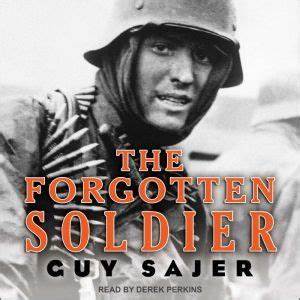
The Forgotten Soldier 
Guy Sajer
Editions Robert Laffont, 1967; translation copyright 1971 by Harper & Row, Publishers, Inc.
Audible edition

The other side was bitter beyond belief.

*         *         *         *

By the spring of 1945, Germany was reduced to a smoldering ruin. One of the most advanced countries in the world saw every one of its cities obliterated into rubble and fire. Basic infrastructure such as water, sewage, electricity, transportation, and communication all but disappeared. Starvation reigned for three years after the Allies occupied Germany in what can only be described as a punitive famine designed for German prisoners of war (POWs) and German civilians alike. The death toll for Germany as a proportion of her population was staggering. For a country of approximately fifty million in 1939, some five million men were killed during the war, and civilian deaths from Allied bombing are estimated at another half a million. Up to two million more were forced into murderous labor in the Soviet Union’s notorious archipelago of prison camps with only a tiny fraction ever returning home.
In the West, the Allied forces committed their form of genocide against German POWs at the little-acknowledged Rheinwiesenlager camps, in which German and Axis prisoners were held in conditions that rivaled the notorious Confederate prison camp at Andersonville. In what was a criminal violation of the Geneva Convention, General Eisenhower’s staff decided that German soldiers should not be classed as POWs, but under a new and fictitious designation of “disarmed enemy forces” (DEFs). As DEFs, rather than POWs, the men were deprived of the Geneva Convention’s protections — they were starved, denied medical attention, and even rudimentary shelter. Although the precise number will never be available, some estimates put one million German POW deaths in Allied post-war concentration camps. German women, especially in the east, suffered the greatest phenomenon of mass rape in history at the hands of the Red Army. Some estimates are that two million German women were raped repeatedly — and almost a quarter of a million died as a result. And it wasn’t simply the Soviets, the U.S. Army is alleged to have raped almost 200,000 German women. And all of this says nothing of another crime against humanity: the ethnic cleansing of Germans through the forced expulsion of some sixteen million ethnic Germans in the former eastern territories of Germany (lost during either the First or Second World War — Austria-Hungary, Estonia, Latvia, Lithuania, Poland, Russia, and Czechoslovakia).

Most of this is not known — or certainly ever talked about — by even those with a passing knowledge of World War II.

But all of this happened: what is shown cumulatively is that very few nations were destroyed to the extent that the German nation was destroyed during and after World War II. Wars often result in a terrible toll for the vanquished: what happened to Germany after World War II rivals almost anything in history. Nevertheless, what I have written would strike many as curious in the latter-day West; after all, who cares? Why would anybody bother with cataloging the suffering of Germans — especially after the Second World War? The implied but overwhelming sentiment is that if terrible things happened to German people during and after the war, Germany was egregiously culpable, and empathy should be our last concern. After all, they were “Nazis,” and the mere incantation of “Nazis” implicitly excuses any atrocity committed against Germany during or after the war. Popular albeit dubious books have been written such as Hitler’s Willing Executioners: Ordinary Germans and the Holocaust by Daniel Goldhagen, which argued in 1996 that the vast majority of ordinary Germans were “willing executioners” in the Holocaust because of a unique and virulent “eliminationist antisemitism” in German political culture. This type of sentiment is widely shared and widely disseminated such that the word “Nazi” has obtained a currency of almost demonic, sub-human proportions.

If this sounds like an idea alien to a Catholic ethos, it most certainly is.

To be interested or even empathetic to the enormous scale of German suffering is to invite suspicion that the humanizer must himself suffer from the same type of moral degeneracy as the Nazis themselves. Simply stated, taking stock of German wartime or post-wartime suffering — whether it be, for example, allied war crimes like the Dresden firebombing or the appalling treatment of German POWs by the Allied forces in the west or by “Uncle Joe” and the Soviet Union in the east — is verboten in polite Western company. Not, of course, as strictly verboten as questioning the scale or extent of the Holocaust, but verboten, nonetheless. For “conservatives” who now clutch their pearls at the excesses of contemporary “cancel culture,” the mirage of “free speech,” and the destruction of individuals for the espousal of unpopular or unconventional opinions, they do not seem to realize that “cancel culture” has been around for a very, very long time in the United States.

Alas, it doesn’t matter much to me anymore.

Germanic blood — along with that of the Celtic and Nordic peoples — courses through my veins. Far from being ashamed of it, I honor it. As I have gotten older — and less Americanist — I have come to appreciate my ancestry and the history of my people. The first principle of deracination is to uproot a man from his family and the communitarian aspect of his heritage — so, it follows, the first remedy against the deracinating impact of Americanism is to re-root me within my people and culture. For the sake of the obvious, such a reflowering of affection for a people and culture is not tantamount to a supremacist notion. My family and my heritage aren’t better than anyone else’s; it is just my own. Thus, I deny no man the right to glory in his heritage and ancestors, but I refuse to countenance those who would deny me the same. I do not have to justify the sympathy that I feel acutely for the plight of my extended kin, and yes, my kin are Europeans.

As a Catholic by spirit and a European by blood, it is enough for me to lament the horrors of World War II, which, like the First World War, was an unmitigated killing field for the people who made up Western Civilization — my birthright. I feel for the sufferers no matter where they lived or to what European nation they belonged. More to the point, as a Catholic, vengeance is not mine; I do not carry it against my enemy and I certain do not carry it against my kin. We all know that Germany lost and paid an horrific price in blood, soil, and reputation. And yet look at the dystopia which we have inherited. The Anglo-American world order of internationalist bankers, war profiteers, and industrialists won, and that order was imposed the world over. It is only now when the wretchedness and moral depravity at the heart of that order is being exposed are some — really a few — Americans waking up to a different narrative altogether. But here too the rabbit hole extends much deeper than we might imagine.

Much of what we “know” and believe about the Second World War is the overhang of grotesque anti-German propaganda manufactured in London, Washington, and Moscow during the war. It is hard to separate fact from fiction in this regard. Indeed, it is amazing how such propaganda can lose its palpable absurdity and morph over time into axiomatic “reality” — and a reality that cannot be questioned without suffering enormous consequences. The undeniable fact is that there are wide swaths of “history” that are morally beyond question, and which have obtained a quasi-religious status of an orthodoxy that can only be scrutinized if we are comfortable with the status of a secular heretic. What we must accept as unquestionable “fact” as it relates to German war crimes is therefore problematic on several levels. The issue is that even questioning the veracity, or the extent, of German war crimes is to expose oneself to the charge of “denialism,” as if critical scholarship itself that serves to find the truth is somehow dangerous. The problem becomes all the more acute when those who are defamed are in no position to rebut the absurdities because they are, well, dead. But then again much of what we know about most of U.S. history is so slanted that it borders on fabrication if it is not in fact a fabrication. It is incredible that most American “conservatives” still believe reflexively that Americans have always been the “good guys.” It is even more unbelievable for American Catholics to believe it. For my part, it is a childish naiveté and credulity that I find it more and more difficult to stomach the older I become. It is a testament to our brainwashing and conditioning that we lack even the rudiments of curiosity. At least since the Trump presidency, many Americans realize that the press and media are complete shills and liars. Seemingly the only good development in recent years has been the catastrophic loss of trust in American institutions of every variety. Such trust was always misplaced. Yes, the time will come for a reevaluation of everything that we were taught, but that time is not now — our cultural censors will not allow it, and the vast majority of our people are, to put it bluntly, too stupid to seek it.

Now, some eighty years after the war, I feel no incentive to continue moral leprosy attributed to Germany when I stare now into the abyss of the American leviathan. Indeed, I have never been more estranged from the country of my birth than I am today. Moreover, even if I contextualize it, the horror of Stalin’s Soviet Union was much worse than Hitler’s National Socialism. That sentiment alone puts me in a category of the grossly immoral — a thought criminal by any conventional standard. Even if I concede their equality (which I do not), the support of the United States and Great Britain enabled the U.S.S.R. to continue enslaving millions of Russians and enslaving millions more other Europeans after WWII. Where is the “Truth & Reconciliation” committee for those crimes? If all Germans are responsible for Nazism, who then is responsible for the murderous monstrosity of the Soviet Union? Where is their commensurate excommunication? Whatever Germany did — or was alleged to have done — she paid for it richly. To use a Yiddish expression that I learned from an Orthodox Jew, it is time for rachmones, which means four things in one: mercy, compassion, forgiveness, and empathy. Typically, rachmones is something Jews only afford to other Jews based upon ties of blood and faith; here, I do the same for those whom I am tied to by blood and faith.

*         *         *         *

When I was a young man, I raised my right hand and repeated the oath of enlistment to join the United States military. To preserve my obscurity, I will not belabor the details. That said, the act strangely stays fixed in my memory. It was not in a fit of patriotism that I did it although that played a small role. I was in the middle of college — home for Christmas break. At the time, and as mediated through a nineteen-year-old brain, I joined the military because, at least then, I wanted to become a history professor. My surmise was that having some facility and familiarity with the military and its culture would be helpful to that future career. The G.I. Bill would also help me finish college. I viewed myself as something akin to an academic observer of the military who would learn of it on-the-job, as it were. While I did not enlist to write a story, like George Plimpton’s Paper Lion, I joined to learn about the military more than to ever be in it — almost as if it were a sociological experiment. Only later, in the midst of it, did I realize how ridiculous that sentiment was, and only then did I think I should have joined because it was good in its own right.

My interest in history and my experience in the military, however, has never meant that I had an interest in the military or military life per se. Truth be told, the passions of my intellectual life have always vacillated between history, religion, politics, and philosophy. Stories of war for the sake of thinking about war held little appeal to me. As a boy at heart, bright, shiny metal things always grab my attention, so I occasionally find myself looking up pictures of armor, planes, tanks, jets, ramparts, or missiles but even this is ephemeral. Now, I have read seemingly hundreds of books on various wars, but I always read them in the context of movements of history, religion, and ideology. I have worn out all the titles I could find on the U.S. Civil War, WWI, and WWII. I have read book after book on the Crusades, the Reconquista, and other European wars. I have read Thucydides and Xenophon. I have read about Carthage and Actium. I have read about Malta and Lepanto. While some of them involve the unique suffering and trauma of being a warrior or a soldier, I never read them for that purpose. To put it bluntly, the “soldier’s story” genre of writing never interested me much, and neither did the strategy or tactics of war or the implements of war used. Indeed, I usually gloss over the pages of maps in such war books marked by arrows and troop movements.

My opinion of this genre, however, may change. In recently reading Guy Sajer’s memoir of a German soldier’s experience on the Russian front, The Forgotten Soldier, I must admit that I have found a book that moved me as few books of any genre have. It is as powerful as it is devastating — from start to finish — as anything that I have read, which is no small feat. When I take it all in, it is not the genre per se that makes this book what it is — no, it is a story of a soul subjected to suffering and deprivation that is almost incomprehensible coupled with an ability to communicate that suffering. As an inveterate reader, I say the following with some experience: sometimes a book “hits” a reader at a particular point in which the book was exactly what the reader wanted. Such moments in a reader’s life are relatively rare but the pure serendipity of finding something that you were looking for is similar to finding the pearl of great price. And, for whatever reason, I wanted to read this book. So, I realize that my praise of the book is flavored by the serendipitous time in which I read it. But all the same, I loved The Forgotten Soldier. Like any story, anguish is all too human and all too humanizing — in one way or another, it marks our time as fallen men. That type of story, which can take place in war but need not, is something if honestly presented by a sensitive soul that has the power to change us. But the reality is, however, that this is a consummate war book — and a war book that chronicles some of the most beastly modern warfare ever fought. And as the resting place for so many fallen comrades, it is a book that Sajer insists that we treat venerably as if we are walking hallowed literary ground. He tells us so bluntly in the beginning that this is no ordinary story:

Too many people learn about war with no inconvenience to themselves. They read about Verdun or Stalingrad without comprehension, sitting in a comfortable armchair, with their feet beside the fire, preparing to go about their business the next day, as usual. One should really read such accounts under compulsion, in discomfort, considering oneself fortunate not to be describing the events in a letter home, writing from a hole in the mud. One should read about war in the worst circumstances, when everything is going badly, remembering that the torments of peace are trivial, and not worth any white hairs. Nothing is really serious in the tranquility of peace; only an idiot could be really disturbed by a question of salary. One should read about war standing up, late at night, when one is tired, as I am writing about it now, at dawn, while my asthma attack wears off. And even now, in my sleepless exhaustion, how gentle and easy peace seems!

Truth be told, I understood from the beginning that Sajer was also no ordinary writer. But even if it is a book of death and war, a great book such as this one can be likened to a romance — a fit of love in a life otherwise ordinarily led. Such a book need not be a romance — all it needs to do is make us take stock of our lives and see the world through another’s eyes. If that is at least one test of a great book, The Forgotten Soldier is truly a great book. And I can say now that The Forgotten Soldier is a book that I will read again — and again — and that is something I can say of very few books.

*         *         *         *

The Forgotten Soldier is the memoir of Guy Sajer (pseudonym of Guy Mouminoux). It was written about twenty years after the war in a style that reads very much like a novel — Sajer reconstructs dialogue that it is difficult to imagine that he remembered with precision. Dates and places are often obscure — and it is implicit that the “fog of war” enveloped and excused his inability to tell something akin to a dispassionate narrative of his history in the Wehrmacht. His style of writing, perhaps in translation from French, can be repetitive at times, at least in terms of the frequent use of certain descriptors over and over again. That said, it has the feel of someone who was there, and I found authenticity in the arc of his descriptions. While some have accused Mouminoux of inventing The Forgotten Soldier out of whole cloth, the book never struck me as something that even hinted at fraud. The book indeed recounts so many near-misses of death — so many close encounters — that one is almost incredulous that anyone could have survived what he describes. Indeed, some critics of the book claim that it reads like the recounting of every soldier’s tale of woe in the east stitched together for drama and effect. To that I would respond the if someone survived the successive retreats from near the Volga to the Baltic Sea over three years, the account is more or less what I would expect. The incredulity is not in the account but that anyone survived. Moreover, the men that did survive would tell similar stories to what Sajer writes. The fact of their survival necessarily means that they were “lucky” compared with the hundreds of thousands who did not. The incredible nature of his survival then is not an argument against the book. We would not have had it otherwise.

Mouminoux was born in 1927 in Lorraine to a French father and German mother, whose maiden name was Sajer. He died in his mid-nineties in 2022 and found fame as a cartoonist and artist in France — and as a writer of The Forgotten Soldier. His mixed Alsatian ancestry looms large throughout the book. In 1942, as a young teenager, Mouminoux joined the Wehrmacht under his mother’s maiden name evidently to accentuate his German ancestry. In the beginning, he offers a glimpse of who he thought he was alongside portents of what was to follow:

Guy Sajer … who are you?

My parents were country people, born some hundreds of miles apart — a distance filled with difficulties, strange complexities, jumbled frontiers, and sentiments which were equivalent but untranslatable. I was produced by this alliance, straddling this delicate combination, with only one life to deal with its manifold problems. I was a child, but that is without significance.

The problems I had existed before I did, and I discovered them. Then there was the war, and I married it because there was nothing else when I reached the age of falling in love. I had to shoulder a brutally heavy burden. Suddenly there were two flags for me to honor, and two lines of defense — the Siegfried and the Maginot — and powerful external enemies. I entered the service, dreamed, and hoped. I also knew cold and fear in places never seen by Lilli Marlene. A day came when I should have died, and after that nothing seemed very important. So I have stayed as I am, without regret, separated from the normal human condition.

It was not clear to me whether he enlisted or was conscripted. What is clear is that he volunteered for the Luftwaffe but was not accepted. After his initial training, Sajer was sent to a logistics/transportation unit (the Rollbahn) to load and drive trucks bringing supplies to the front in southern Russia. In the Rollbahn, he met several other men who would become his close companions throughout the war. He chronicles the war from his training through the destruction of the German army in the East to his brief sojourn and surrender in the West. The three years he recounts, almost all of which take place in the East, are the most gut-wrenching account of the war that I have ever read. Even though the book is virtually an uninterrupted story of privation, death, suffering, and misery, I was crestfallen to leave Guy Sajer — and for me, the sorrow at finishing a book is one of the telltale signs of its quality and poignancy.

*         *         *         *

Part One (Autumn, 1942). The Forgotten Soldier starts in earnest with Sajer’s mission to supply the German front in Russia as a member of the Rollbahn. It seems clear, although unstated, that teenagers, older men, and disabled veterans were assigned to these logistics and supply support units at this point in the war. Sajer, as a teenager probably still baby-faced, was assigned to this unit. The dangerous trek of supplies and war matériel, which were shipped by train, truck, and beast of burden, was made over an incredible distance with the ultimate destination being the Sixth Army in Stalingrad. Most of the journey was made in the company of his new companions: Lensen, Olensheim, Neubach, and Hals, who spoke French.

The journey made during the late fall of 1942 into the early winter is itself a demonstration of the sheer logistical nightmare of what an invasion and occupation of a country the size of Russia meant. Warsaw to Stalingrad on the banks of the Volga River is more than 1,500 miles in distance — and this distance was traversed using 1940s diesel trucks on practically non-existent Soviet roads in cold that rivals the Artic circle. Sajer is candid in his view that he was not ready for the privations that the war was already imposing on him; he writes, “I can remember crying out between bursts of sobs: I’m too young to be a soldier.” The immensity of the logistical problems associated with just Sajer’s description of the small part he played in supplying troops along the far-flung Soviet front is a microcosm of why, even after success after success in the beginning, Germany’s defeat of the Soviet Union was always so precarious. The theme of the sheer and unforgiving expanse of Russia is played out over and over again throughout the book.

His unit faced considerable difficulty in managing to remain supplied and the transportation situation—grave to begin with—was seriously hampered by the freezing temperatures and constant snow. Temperatures that plummeted to twenty degrees below zero, diesel trucks that would not start, inadequate clothing and the accompanying frostbite, inadequate shelter, and wool gloves that became filled with holes from constant shoveling of snow were only part of the misery that was the Russian winter for the ill-prepared Sajer. He recounted the effect that the first dead body — a Soviet soldier — had on him on his initial trip east. The irony is not lost on the memoirist in Sajer — he would see many, many more. The soldiers suffered much from the cold and their freezing is a major preoccupation of this part. The Russian cold remained a thematic element throughout the book considering that Sajer went through three more winters before the end of the war, but the maddening cold is a constant refrain initially. It seems to me that the cold takes center stage early because it was Sajer’s first true enemy and he was ill-prepared to face it — later, combat, death, illness, exhaustion, and hunger would become enemies in a degree proportionate to the punishing cold. But here, it is one page after another of what, for example, a midnight watch is like in conditions of thirty-five degrees below zero.

Toward Stalingrad, Sajer’s traveled from Bialystok to Minsk, on to Kiev, and finally to Kharkiv. Surviving a few firefights, Sajer reached the eastern front to resupply fighting units only to learn that the Sixth German Army commanded by Field Marshall Paulus had been encircled and captured at Stalingrad. As if to anticipate what will come, Sajer foreshadowed the expected brutality that he can expect forthwith in the words of a desperate message from a trapped soldier in Stalingrad that a German officer reads to the assembled men as proof of German valor; it is:

We are the last seven survivors in this place. Four of us are wounded. We have been entrenched in the wreckage of the tractor factory for four days. We have not had any food for four days. I have just opened the last magazine for my automatic. In ten minutes the Bolsheviks will overrun us. Tell my father that I have done my duty, and that I shall know how to die. Long live Germany! Heil Hitler!’

Sajer recounted the horrors of the fighting that followed the fallout from the Wehrmacht’s defeat at Stalingrad and the first retreat from the Don. After Stalingrad, Sajer introduces a theme that will play a larger role as the book progresses and the German prospects deteriorated: namely, defeatism. As the war began to turn against Germany and the slow retreat westward was ordered, Sajer notes how a change occurred in the attitudes of German soldiers from staunch patriotism towards the will to survive regardless of ideologies and leaders. He notes after Stalingrad how the “older men were, generally speaking, defeatist, while the younger ones were determined to liberate their comrades,” probably because the younger soldiers had yet to witness the horrors of war.

There is an irony here that has application beyond Sajer’s observation; the young are almost always more instinctively heroic than the old — and the old cling to life much more tenaciously than the young. Sajer, as a very young man, exemplified anti-defeatism early on in the war, which was evident by his anger at an older soldier for feeling relieved about the surrender at Stalingrad, although his attitude later changed as he and his comrades became battle-hardened and battle-scarred veterans. It is not surprising to me that an older German soldier might have expressed relief at the prospect of not having to relieve Stalingrad with its building-to-building fighting — but it is cowardly all the same, i.e., better than a half million soldiers are annihilated than I face death to help them. Later the war would chasten his enthusiasm; Sajer said he and his comrades, fighting on the Second Dnieper Front against a superior Russian army, that they “no longer fought for Hitler, or National Socialism, or the Third Reich. … We fought from simple fear … for reasons which are perhaps shameful, but are, in the end, stronger than any doctrine.”

During this first retreat, Sajer’s first true friend in the army, Ernst Neubach, was killed by Soviet strafing in a truck driven by Sajer filled with seriously wounded men. If the first dead body witnessed by Sajer shocked him with almost morbid curiosity and wonder, this death, while far from the last, broke him. During this first retreat and Neubach’s death, we catch a glimpse of Soviet air superiority and the havoc that it wreaked over German supply lines. Part of the terror of the book is that the men looked to the sky with dread because the Soviet planes always meant death for some of them. The Luftwaffe, while almost always superior to the Soviet air force when it was available, was outnumbered by a factor of 10 by the time Sajer and his compatriots began their retreat from the environs of Stalingrad. Later in the war, the German planes would be outnumbered by a factor of 100 and the buzz of planes in the sky always portended death from above. Neubach’s death, which took place in Sajer’s arms, was awful. He refused to accept the death of his friend and stopped the convoy with manful moxie to demand that someone treat his mortally wounded friend. The men of the convoy, which had to make good time to simply survive were incredulous that one more dying German amid so many wounded and dying men (who suffered without any care) should stop their progress. The entire episode was a brutal juxtaposition of personal anguish with the general insensitivity to great suffering. In the end, Sajer’s will prevailed; his demands were met and Neubach’s body was “buried” in a shallow grave while Sajer looked on in stupefied disbelief. Even in the mortars and shells, in the cold and hunger, the war became real for Sajer through the death of a friend in his arms. The progression of the memoir is one devastating blow after another for Sajer and his companions. The account itself is a testament to the incredible limits of human suffering and the capacity for finding some reason — really any reason — to put one foot in front of the other in the face of truly horrendous circumstances.


Appendix: The Historical Context of The Forgotten Soldier.

Sajer’s account from 1942 to 1945 requires some historical context to appreciate his situation. The German Empire was cobbled together from varying German-speaking principalities and independent states under the leadership of Prussia in 1871. Coincidentally, Italy completed its national unification in the same year. The union of Germany was hastened by the stunning success of the Prussians in the Franco-Prussian War in 1870–71. In the final days of the war, with German success all but assured, the German union was proclaimed as the German Empire under the Prussian King Wilhelm I and Chancellor Otto von Bismarck. Except for Austria, almost all German speakers were united in a nation-state for the first time. Parenthetically, the word Reich is almost always translated into English as “empire,” but this definition, which has its imperial baggage, is not quite accurate. The word conveys meaning more akin to realm or domain — as in the Reich is the realm of the Germans. While Reich could be expansive and imperial, it need not be. The Treaty of Frankfurt that ended the Franco-Prussian War gave most of Alsace and parts of Lorraine, the Franco-German borderland between both countries, to Germany. It would remain under German sovereignty for the next fifty years until it was returned to France after the First World War. Alsace-Lorraine and its uniquely fused Franco-German character figure prominently in The Forgotten Soldier.

Without getting into the particulars of the causes of the First World War that began in August 1914, it is one of the few wars for which culpability is difficult to assign. For a war that ruined a continent (Europe) and destroyed a race (Europeans), it is disconcerting that such a war and carnage of untold proportions lacks a villain. It was simply a suicidal slaughter of epic proportions for no reason at all — yet the modern world as we know it was largely born in the aftermath of the First World War. Four empires ceased to exist and were carved up after the war (Russia, Germany, Austria-Hungary, and Ottoman) and many new sovereign countries were born out of their carcasses. Marxism-Leninism was first implemented at the level of a sovereign state in the husk of the former Russian Empire in the aftermath of the Bolshevik Revolution in 1917, which unleashed untold sorrows for the world. Even today, as it relates to the intersection of borders and ideology, the Ukrainian-Russian conflict has its antecedents in the aftermath of World War One.

After four years of bitter fighting, a staggering death toll (on all sides), the entry of the United States against Germany in 1917, and the mass starvation of the German population in which some half a million civilians died of hunger brought about by the British naval blockade, the German government capitulated to an armistice famously signed on the eleventh day of the eleventh month (11/11/1918) or what we now know as Veteran’s Day in the United States. Armistice Day, as it used to be known, concluded in the infamous Treaty of Versailles in which much of the German Empire was dismembered, impoverished, and degraded. For a country that surrendered without ever being occupied and without being at fault for the war in any meaningful sense, Versailles was viciously and stupidly one-sided.

To compare the borders of the German Empire to its borders today (or its borders after Versailles) is to see the sheer extent of diminution of the German state. Millions of Germans were left outside of the newly shrunken Germany in 1919 — and left in new sovereign countries such as Poland and Czechoslovakia. Prussia was carved up in particular. The cutting up of the German Empire to form new countries led to certain geographic anomalies: one of the larger German cities, the ancient port city of Danzig in East Prussia (now the Polish city of Gdansk), where some half million Germans lived as some 90% of its population, was cut off completely from the post-WWI German state and administered under Polish rule as a “free city-state.” To look at a map today is to see how far inside Poland Gdansk is — or, stated differently, how far Germany once extended. The famous “Sudetenland Crisis” in 1938, which concluded in the Munich Conference and Germany’s reabsorption of the Sudetenland (and its some three million ethnic Germans) from Czechoslovakia, was prompted by Versailles’s removal of those same Germans from the post-WWI German state. For a war that brought the world horrendous misery and destruction without sensible culpability, the grossly unfair obligations, terms, and national dismemberments of Versailles imposed by the victors (the Allied French, Germans, Americans, and Italians) at the expense of the vanquished (Germany, Austria-Hungry, and Ottomans) were, in hindsight, idiotic and immoral. If an honorable peace had been struck, there is little doubt that World War II would have never been fought.

Among many other reasons, Adolf Hitler’s rise to power is difficult to imagine without the humiliating specter of Versailles haunting Germany. Similarly, the rise of Marxism-Leninism in the Soviet Union and the threat that the Reds represented to Germany and other western European countries was another enormous factor as well. To make this point, it is worthwhile to revisit the party platform of the National Socialist German Workers’ Party (the “NSDAP” or “Nazis”) that eventually swept the Nazis into power. Like all political parties, the Nazis put forward a program based on values, grievances, and vision. To read it now — or at least parts of it — almost a century later is to understand its appeal. It is noteworthy that the first three and a subsequent one of that platform deal expressly with Versailles (1–3, 22).[1]

  • We demand the union of all Germans to form the Greater Germany on the basis of the people’s right to self-determination enjoyed by the nations.
  • We demand equality of rights for the German people in its dealings with other nations; and abolition of the peace treaties of Versailles and St. Germain.
  • We demand land and territory (colonies) for the sustenance of our people and colonization for our superfluous population.

….

  • We demand abolition of the mercenary troops and formation of a national army.

It is impossible to overstate the importance of the Treaty of Versailles in the rise of the Nazis in Germany. And from a foreign policy perspective, everything that Germany pursued during the interwar period after the accession of Adolf Hitler in 1933 involved the reversal of the injustice done to Germany at Versailles and the restoration of Germany on terms similar to any other country. It is important to note that many non-Germans agreed that Germany’s grievances were legitimate. What is often overlooked is the success by hook or crook of the Third Reich’s attempt to reconstitute the extent and domains of Germany following Versailles: the reoccupation and remilitarization of German territory in the Rhineland (March 1936); German annexation of Austria or Anschluss (March 1938); German annexation of the Sudetenland following the Munich Conference (September 1938); and the return of the former Prussian territory of Memelland (now Klaipėda) (March 1939). (The siege of Memel in late 1944 and early 1945 figures prominently in The Forgotten Soldier.)

However, it is worth noting that Hitler’s final attempt to reconstitute Germany from its dismemberment following World War One ultimately led to World War Two. The precipitating factor was a diplomatic crisis over Danzig. Point 13 of President Woodrow Wilson’s infamous “14 Points” demanded that: “[a]n independent Polish state should be erected which should include the territories inhabited by indisputably Polish populations, which should be assured a free and secure access to the sea, and whose political and economic independence and territorial integrity should be guaranteed by international covenant.” By “access to the sea,” Wilson meant that Danzig, a thoroughly German city, and its deep-water port, should be ceded to Poland after the war. During the post-war negotiations, British Prime Minister David Lloyd George opposed Poland’s demand to take Danzig because its population was almost exclusively German. In a compromise, the Great Powers agreed that Danzig would become a “Free City” that would belong to neither Germany nor Poland, but both would have special rights in the city. The interwar status of Danzig was never clear: no one could agree whether it was a sovereign state, a state without sovereignty, a protectorate of Poland, or a protectorate of the League of Nations. The loss of Danzig — the so-called “Amsterdam of the East” — significantly wounded Germany’s national pride during the interwar period. It is not an exaggeration to compare it to wrenching Venice from Italy, Calais from France, or Manchester from England. For more than a year before the outbreak of World War Two in September 1939, negotiations over returning Danzig to Germany continued in what can only be described as a haphazard way: the United Kingdom, France, Germany, and Poland navigated German demands and Polish refusals intermixed with threats of war and war guarantees.

Polish intransigence over Danzig proved its — and eventually Germany’s — catastrophic downfall. The invasion of Poland is inextricably tied to its refusal to return Danzig, an overwhelming German city both demographically and historically, to Germany. Considering the misery endured by the Poles and the Germans — and considering further that World War II was the deadliest military conflict in history with, by some estimates, some seventy million people perishing, was such intransigence worth it? While it is beyond absurd to blame Poland for World War II, I have often wondered if Poland knew her fate in defying what was to many at the time as reasonable German demands. If she knew that she would be smashed and occupied by the Soviets and Nazis and then subjected to almost fifty years of iron-fisted Soviet rule thereafter, would she have acted as defiantly over Danzig?

Given the cataclysm that was World War II, the anti-war phrase, “Why die for Danzig?, popularized on the eve of World War II in a Parisian newspaper, proved to be more than prophetic. It reflected a widespread view that Danzig, as a historically German city, ought to be returned to Germany, and, in any event, a dispute over Danzig ought not to serve as the impetus for World War II. Setting aside German colonies seized after WWI and some scattered Germans living throughout Poland, Danzig represented the last major enclave of Germans left outside of the Reich that was cut off as a result of Versailles. Perhaps Hitler would have made yet still more demands for Germany if Poland had capitulated on the question of Danzig’s return to the Reich, but we will never know.

*         *         *         *

World War II began on September 1, 1939, with the German invasion of Poland. Only ten days earlier, the Soviet Union and the Third Reich signed the German-Soviet Nonaggression Pact on August 23, 1939 — the public part of the pact provided for non-aggression between the powers; the non-public protocols divided up eastern Europe in Soviet and Nazi spheres of influence following the expected defeat of Poland. Two and a half weeks after the German invasion began from the West, the Soviets invaded Poland from the east on September 17, 1939, and the two powers essentially split the former country into two. Notably, France and the United Kingdom declared war on Germany for its invasion on September 3, 1939, but remained remarkably circumspect when the Soviets invaded Poland just weeks later. Without an eastern flank to worry about compliments of the German-Soviet Pact, Hitler took the step to launch the war without hesitation. In less than nine months following, Hitler would smash the Allied forces in the West in May 1940 — driving the British into a perilous and crushing retreat from Dunkirk and the French into a humiliating armistice after overrunning the country. By the summer of 1940, Hitler controlled or was allied with, virtually all of Western and Central Europe except the British Isles. The British, now fighting Germany alone, valiantly defended her home islands during the fall of 1940 in the Battle of Britain but continued to lose battles and ground to the Axis forces throughout the various theaters of the war. The success of the Germans pushed the British to the brink; had the war not broken out between the Germans and the Soviets during 1941 and had the Axis powers pivoted instead towards Persia and the lifeblood of oil for the British Empire, it is more than possible that Britain would have sued for peace given its perilous position. But Hitler’s monumental decision to invade the Soviet Union in June 1941 strengthened Churchill’s resolve to continue the fight now that Germany would be engaged on two fronts. More than that, Germany’s decision decided the fate of Europe — and the world — for generations to come.

But even the step to attack the U.S.S.R. taken by the Germans is little understood. As a sidebar, one book that describes the Soviet-German conflict in a way that is both convincing and controversial is The Chief Culprit: Stalin’s Grand Design to Start World War II by Viktor Suvorov, a former Soviet intelligence officer. Suvorov describes Operation Barbarossa as a preemptive defensive war by the Germans in response to an imminent invasion by the Soviets. Suvorov discredits the theory that Stalin was duped by Hitler or that the Soviet Union was a victim of Nazi aggression. Instead, he argues that Stalin neither feared Hitler nor mistakenly trusted him. He shows how Hitler’s intelligence services detected the Soviet Union’s massive preparations for war against Germany. This detection, he argues, led to Germany’s proactive war plan and the launch of an invasion of the Soviet Union. He argues that the reason the Soviets performed so poorly at the beginning of the war was because they were assembled, in mass with enormous numbers of troops and amounts of war material, on the Western border in preparation for an invasion. Hitler’s largely unexpected attack enveloped a massive force unprepared for a defensive war that was promptly encircled and annihilated. Suvorov goes so far as to claim that had the Germans not attacked and pushed the Soviets back as far as they did, all of Western Europe up to the Atlantic Ocean would have been behind the Iron Curtin.

Operation Barbarossa was the largest invasion force ever assembled and it initially demonstrated again the successes of the Wehrmacht and Luftwaffe — pushing the Soviets back to Moscow and Leningrad in the north and Stalingrad in the south. Belarus, Ukraine, and the Baltic countries were completely occupied by Axis forces. By the end of 1941, some 700,000 square miles of Soviet territory and almost six million Soviet POWs were in German hands. By the end of 1941, even with the American entry into World War II, a decisive German victory over the Soviet Union seemed not merely likely but almost certain.

For many reasons, not the least of which was the intoxicating spirit of victory and the opportunity to fight the menace of communism and the diabolical Soviet Union, the Wehrmacht in 1941 was an attractive prospect for young men throughout much of Western Europe — and hundreds of thousands of non-Germans joined and fought either in Wehrmacht or the Waffen SS. In addition, it is estimated that more than a million Soviet citizens fought in the German forces against the Soviet Union when allowed to escape the Soviet yoke. Parenthetically, the current crisis in Ukraine is, at least by some measures, a continuation of the resistance of the Western Ukrainians against the Russo-Soviets. Much as Vladimir Putin likes to point out, it is a fact that Stepan Bandera, leader of the Ukrainian nationalists during World War II, was a committed ally of the invading Germans and fought side-by-side with them against the Soviet Union. On January 22, 2010, Ukrainian President Viktor Yushchenko honored Stepan Bandera by posthumously bestowing on him the state honor, “Hero of Ukraine.” To describe Bandera as a blatant Nazi sympathizer is to put it mildly indeed.

Go to Part 2

[1] For those who are interested, Nos. 4–9 deal with immigration and citizenship and preserving citizenship to Germans alone; Nos. 10–18 deal with economic questions; Nos. 19–20 deal with education and children; Nos. 23–24 deal with the freedoms of religion and the press; and Nos. 21 and 25 address governmental and legal reforms.

Going Her Own Way: Review of Born Abroad: A Patriot’s Tale of Choice & Chance

bab500

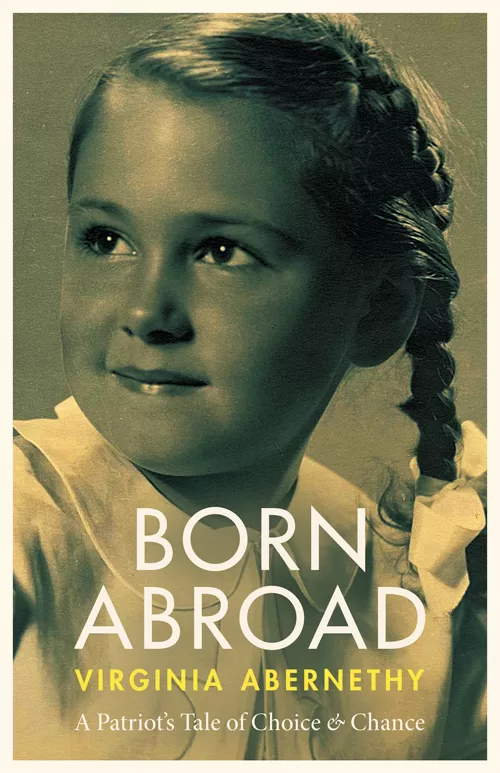
Born Abroad: A Patriot’s Tale of Choice & Chance
Virginia Abernethy
Arktos Media, 2023.

Reviewed by Nelson Rosit.

The first thing a reader will notice about Virginia Abernathy’s latest book[1] is the cover photo of a spunky eight-year-old with a bit of a Mona Lisa smile looking over to her right. That countenance gives some indication of the broad she was to become.

At age eighty-nine Abernethy writes, “I still want to enter the fray.” And in fact she has been in the fray for decades. The author describes herself as “cantankerous,” “ornery,” and a bit of a loner and outsider due in part to growing up abroad and in part to genetic influences.

The book is described as both an autobiography and a memoir. Not being an English major, I was not entirely sure of the distinction between the two. I learned that while both are nonfictional first-person accounts, memoirs are thematic, selective, subjective, and limited in scope. Autobiographies are said to be chronological, including the person’s entire life to that point, and strictly factual. Born Abroad does include themes, but according to author “writing a memoir is presumptuous,” so we’ll go with an autobiography.

Ms. Abernethy was named Virginia because her father was born in that state and identified with the Confederacy. She was born in Cuba, and her parents later moved to Argentina. They returned to the US when she was ten. The Riverdale School in New York and Wellesley College in Massachusetts followed. The day she graduated in 1955 she married a Harvard man and left for ranch life outside Sheridan, Wyoming.

Some of the old west still survived in Wyoming of the 1950s. Abernethy describes society of Sheridan as “the mink and manure set.” Ten years of western living produced four children, but “a life of small-town interlocking relationships” proved too constraining for the author. With her marriage unraveling she returned back east.

A rigorous graduate program at Harvard began in the fall of ’66, including reading assignments of a thousand pages a week plus courses in statistics. “Correlation at statistically significant level should not be taken to prove causality.”

After receiving her PhD Abernethy took a position at the Massachusetts Mental Health Center, Harvard’s research-oriented psychiatric teaching hospital. Among her projects was research into unwanted pregnancies. Heavily interwoven into her autobiography are the author’s views on political and social issues especially those dealing with human fertility and ecology. Regarding abortions, Abernethy believes in “a woman’s right to choose,” but as a practical political matter the issue should be left up to the states to decide, which appears to be the case at this writing. I have to agree with her that the Roe v. Wade ruling “caused conservatives to invest inordinate time, money, and energy into overturning the decision. The true cost, arguably, has been neglect of other issues that are of great moment to the future of the Republic.”

In 1975, with an eye for new horizons, Abernethy accepted a post as assistant professor in the Department of Psychiatry at Vanderbilt University School of Medicine. One issue of interest for the author has been medical ethics. There was a time when a “medical culture of secrecy” prevailed in the profession. It was common to withhold a patient’s diagnosis and prognosis. Speaking of diagnoses: during this time husband number two, still living up in Massachusetts, unfortunately developed terminal lung cancer.

Policies toward mental health were changing during the 1970s and 80s. Due in part to new pharmaceutical treatments, and in part a desire to provide care in a less restrictive environment, state mental hospitals began to close. Deinstitutionalization was supported by the Right as a cost-cutting measure, and by the Left as a civil rights issue. An unintended consequence has been a large number of mentally ill persons living on the streets, negatively impacting urban life. Abernethy concludes that “freedom sometimes appears to collide with good sense and kindness.”

Abernethy offers an interesting insight into the peer-review process. Research that receives positive peer reviews in academic journals has the cachet of scientific objectivity.  But the process can be manipulated by the editors of such publications by selecting reviewers who are either favorable or hostile to the researcher’s findings. This raises the larger issue, the legitimacy of vested authorities. Presently many of our established institutions — government, media, and academe — have become discredited. As a result, “scientific findings” are often suspect. “Too often politics rules science.” In fact, “so-called science can be a political construct.”

As mentioned, the author has long been interested in the relationships between human fertility, immigration, and the environment. Probably her first major challenge to intellectual orthodoxy was to dispute the widely accepted Demographic Transition Model (DTM). The DTM states that modernization — urbanization, reduced infant mortality, increased female education — will result in smaller family size. Abernethy countered with her Fertility Opportunity Hypotheses (FOH) which states that women have more children when they perceive that their economic prospects are improving, and have fewer children if they believe the economic future is bleak. The globalists view such a theory as detrimental to their agenda. The FOH suggests that “well-intended humanitarian actions are often counter-productive.”

Abernethy’s research finds evidence that mass immigration increases population growth in both the sending and receiving countries. So while birthrates globally are generally falling, except in sub-Saharan Africa, a falling birthrate does not necessarily mean a falling population because lower fertility rates “do not shrink a population as rapidly as high fertility rates fuel growth.” For the United States, massive legal and illegal immigration pushes population growth, and this has meant lower wages, higher cost of living, and a strain on the natural and social environment. Abernethy’s concerns center on the quality of life and sustainability of resources.

The author appears to be a race realist, but the issue of race is soft-pedaled in Born Abroad. The harsh reality is that population issues cannot be constructively dealt with unless racial differences are taken into account. Belgium and Haiti have approximately the same population and land area. The former is relatively prosperous and orderly with provisions to protect the natural environment. The latter is mired in poverty and chaos with extreme environmental degradation.

Abernethy retired from Vanderbilt in 1998, but has remained quite active, earning the ire of the scandal-ridden, self-appointed “watchdog” group the Southern Poverty Law Center (SPLC). She was one of the principals involved in the organization PAN, Protect Arizona Now that led the fight for Arizona Proposition 200. The proposition was designed to prevent illegal aliens from accessing welfare benefits and the voting booth. The measure passed in November 2004 with 56% of the vote. Part of the act was later invalidated by a federal court.

The author again came to the attention of the SPLC in 2012 when she ran as the vice-presidential candidate for the A3P, American Third Position party (now called the American Freedom Party).  She introduced Merlin Miller, the A3P’s presidential candidate, to the American Renaissance conference that year. Due to her activism, she made the honor roll, the SPLC’s list of: “One of the 30 most dangerous people in the United States.”

A student of political ideology would find Abernethy’s world view an eclectic mix of beliefs and values. She identifies as a conservative. Some might call her a classical liberal or a liberal conservative considering her lifestyle, her stand on abortion, and her involvement in feminist causes such as the WEAV group — Women’s Equity at Vanderbilt. She has been critical of Christianity for promoting unhealthy feelings of guilt, believing that reciprocity works better than altruism. There is a dash of libertarianism in the mix. “I merely claim my right to voluntary association.”

On the conventional conservative side, Abernethy supports the theory that mass immigration is a Democratic Party strategy to create a dependent class of Democratic voters. This is a safe partisan political argument that avoids ethnic issues. The Left’s main motivation for supporting massive immigration is to implement the Great Replacement. The Right sees the benefits in low-cost labor and increasing consumer bases. Another conservative bromide is assimilation. “So powerful is the United States’ ideal of liberty, freedom and opportunity that even our salad bowl of ethnicities and race was on its way to assimilation before the stagflation and divisiveness engendered by the Biden Administration.” What? Africans have been in America for four hundred years and remain a distinctly unassimilated group.

Though not a perfect description, Abernathy reminds me of what Wilmot Robertson, even back in the 1970s, called the “Old Believers”[2] — Americans who hang on to revered but outdated beliefs. The author still has “faith that a path back to our Republic, an environmentally sustainable and constitutional path, can be discovered.”

A few less sanguine thoughts do pop up in Born Abroad as well.  While Abernethy wants “[a] restoration of responsible individualism, law, order, the Republic, and the Constitution, ” such a “restoration may require a resort to authoritarianism.” In addition, the future political/social stability of the US hangs on the thread of continued prosperity. “Freedom is unlikely to thrive where diversity meets scarcity.”

Abernethy writes tha,t while her “years wind down” and she spends more time on leisure pursuits, including travel with husband number three, “one does not lay down the baton, or the pen too easily.” Judging from a couple of recent interviews she is still sharp as a tack, so we probably have not heard the last from her.


[1] Prof. Abernethy is the author of three previous books and numerous articles. Virginia Abernethy, The Vanishing American Dream: Immigration, Population, Debt Scarcity (2016) was reviewed in The Occidental Quarterly 17, no. 1 (Spring 2017): 109–119.

[2] Wilmot Robertson, The Dispossessed Majority, Cape Canaveral, Howard Allen Inc. 1976, 106-108.

The Music of the Moon: Re-Enchantment and the Biggest Crime in History

More money, more sex, more status, more possessions, more gratification. That’s how too many people in the modern world would answer one simple question: “What would you like in your life?” When I asked myself that question, I was surprised by speed and naturalness with which the answer came to me: I’d like more stars and more butterflies.

Stealing the sky

To put it another way, I’d like more enchantment. Stars and butterflies are beautiful, mysterious, spirit-lifting, thought-provoking, and seemingly oblivious to human beings. They exist for their own sake. And yet what would they be without us? One summer I saw a bright rainbow across a field of horses. The rainbow was beautiful, heart-lifting, awe-inspiring. But the horses had their heads down, grazing. Horses don’t gaze at rainbows. Or follow the flight of a butterfly. And when night falls, horses don’t lift their heads in awe to a clear, star-jewelled sky. Nothing in the animal kingdom does, except for human beings.

Stars and trees seen from Luhasoo bog in Estonia (image from Wikipedia)

But fewer and fewer humans gaze at the stars and watch butterflies today, because light pollution drowns the night sky and butterflies have collapsed in numbers. I would say that light pollution has been the biggest crime in history. After all, it has stolen the sky from millions of people across whole continents. Reversing that enormous theft should be a priority of any serious and sane government. A clear sight of the night sky wouldn’t just restore to us the awe and majesty of the stars and moon: it would re-connect us with those long generations of our ancestors who watched and wondered and worshiped. There’s wisdom in the night. And brain-shaking power. Ancient Greek had the beautiful adverb ἀστέροθεν, asterothen, meaning “from the stars.” It also had the awesome adjective ἀστροβρόντης, astrobrontēs, meaning “star-thundering” and used of the god Mithras.

Poisoned by modernity

Modernity has stolen those ancient astral awes and inspirations from us, staining the night with light. And it’s stripped the day of another ancient source of beauty and otherness: those winged wonders known as butterflies. Reading A Curious Boy (2021), the autobiography of the British scientist Richard Fortey (born 1946), I was lost in wonder and envy at this description: “Small tortoiseshell butterflies, whose caterpillars feed on the common nettle, made orange clouds at the edges of fields.” (p. 65) He’s writing about the 1950s and goes on to say that, because nettles are now common: “Small tortoiseshells should be everywhere. Instead, [their] population has fallen by three-quarters in thirty years. The word ‘baffling’ has been used in official reports.” (p. 66)

Small tortoiseshell butterfly on the concrete of a car-park, Dorset, England (image from Wikipedia)

More nettles, fewer butterflies — baffling! But it isn’t truly baffling. It’s a poisonous by-product of modernity, of the industrialization of farming and the countryside. And it’s an excellent example of what the great German sociologist Max Weber (1864–1920) called die Entzauberung der Welt — “the disenchantment of the world” that accompanied the industrial revolution and the rise of modern science. Ironically enough, the very word “disenchantment” is an example of what you might call the disenchantment of the English language. Entzauberung is pure German, but English lost its native ways of talking about magic and now uses French. And to my ear “dis-” is an ugly, bureaucratic prefix.

Re-enchant the familiar

So “disenchantment” is disenchanted. Which is appropriate enough. But if we had a native way of expressing the concept — “untivering” uses the same roots as the German — we wouldn’t know what we were missing. As John Lennon once sang: “You don’t know what you’ve got till you lose it.” When Richard Fortey was a boy in the 1950s, he perhaps wasn’t as enchanted by the actual sight of “orange clouds” of tortoiseshells as some of us, in the butterfly-bereft 2020s, can be by the mere thought of them. Similarly, do native speakers of German rejoice in the richness and rootedness of words like Entzauberung? No. Most of them don’t. It’s simply the word for that concept in German. And are they delighted by the consonant cluster that begins the word Zauber, pronounced tsow-ber and meaning “magic”? Again, no. But I’m not a native speaker of German and I love the ts- of Zauber, zeitig, zierlich, meaning “magic,” “timely,” “delicate.” It sounds to me like a little bell tinkling.

If you call that twee, then fine: I love the consonant cluster tw- in English too. Or I’ve learned to love it: we can re-enchant the familiar and learn to delight in what we once took for granted. If you don’t know the adjective twee, it means “excessively sentimental, pretty or coy.” It may come from a childish pronunciation of “sweet” (I like the consonant cluster sw- too). Winnie the Pooh (1924) is twee. You could even say it’s toxically twee, in the case of the Disney adaptation. But that book by Kenneth Graham (1859–1932) was an attempt at the re-enchantment of the world, at the reversal of the industrialization and urbanization that began to trample on the world in the Victorian era. Here’s another attempt at re-enchantment by a greater writer:

But where a passion yet unborn perhaps
Lay hidden as the music of the moon
Sleeps in the plain eggs of the nightingale. (“Aylmer’s Field” [1864])

That’s Tennyson (1809-92), who could conjure more with ten words than lesser writers can with ten thousand. I think Tolkien was a lesser writer. But a greater maker. And, born later, he saw even more clearly the harm done by the iron hooves of modernity. And by its glaring, glowing eyes. That’s why two things were so important to Tolkien: the trees trampled by the hooves and the stars banished by the eyes. Trees and stars are central to Lord of the Rings (1954–55), Tolkien’s flawed but literally fabulous attempt at the re-enchantment of literature:

Away high in the East swung Remmirath, the Netted Stars, and slowly above the mists red Borgil rose, glowing like a jewel of fire. Then by some shift of airs all the mist was drawn away like a veil, and there leaned up, as he climbed over the rim of the world, the Swordsman of the Sky, Menelvagor with his shining belt. The Elves all burst into song. Suddenly under the trees a fire sprang up with a red light.

‘Come!’ the Elves called to the hobbits. ‘Come! Now is the time for speech and merriment!’ (The Lord Of The Rings: The Fellowship of the Ring [1954], Book 1, chapter 3, “Three Is Company”)

Menelvagor is the real constellation Orion, perhaps the most easily recognizable star-shape and surely the most awesome. Tolkien has sharpened my appreciation of Orion with that singing phrase “Swordsman of the Sky.” But Tolkien was a Christian and also knew the power of a single star. When the magi came from the east in the Gospel of Matthew, they were following one astera, one star. And when it brought them to the birthplace of Jesus, “they rejoiced with exceeding great joy.” Was that Christian star an inspiration for a later passage in Lord of the Rings, when the overlooked and despised hobbits Frodo and Sam are starved and despairing amid the thorns and rocks of Mordor, poisoned realm of the Dark Lord Sauron? I think it must have been:

The land seemed full of creaking and cracking and sly noises, but there was no sound of voice or of foot. Far above the Ephel Dúath in the West the night-sky was still dim and pale. There, peeping among the cloud-wrack above a dark tor high up in the mountains, Sam saw a white star twinkle for a while. The beauty of it smote his heart, as he looked up out of the forsaken land, and hope returned to him. For like a shaft, clear and cold, the thought pierced him that in the end the Shadow was only a small and passing thing: there was light and high beauty for ever beyond its reach. (The Lord Of The Rings: The Return of the King [1955], Book 2, chapter 6, “Mount Doom”)

We can say the same of Clown World: it’s a small and passing thing. Its ugliness and evil will not endure. Starlight and the music of the moon will outshine and outsing the cacophoty and cacophony of modernity.

Ed Dutton Goes Back to School (With Evolutionary Psychology in his Satchel)

The Naked Classroom: The Evolutionary Psychology of Your Time at School
Edward Dutton
Jolly Heretic Publications, 2023

As a schoolboy, Ed Dutton decided he was a “humanities person.” He felt an immediate interest in the lives of his ancestors and the people around him, and so enjoyed learning about history and literature, which spoke to him of such things. Memories of eighth-grade lessons on stamens and pistils, on the other hand, still summon up feelings of “ennui and despair.” He couldn’t wait to turn sixteen so he would never have to take another science lesson again. How did such a child morph into a dissident evolutionary psychologist?

By discovering the relevance of science to all the things he was already interested in. History, for example, can be understood as Darwinian evolution in action:

Individuals and groups compete for power and resources under harsh Darwinian conditions and those who are best adapted to their environment survive. Computer models have shown that groups highest in “positive ethnocentrism” (in-group cooperation) and “negative ethnocentrism” (out-group hostility) dominate all other groups, all else being equal. Not only that, but people can pass on their genes indirectly and tend to favour people the more genetically similar they are to themselves. [This] makes sense of soldiers dying for their country or one ethnic group persecuting another. Why didn‘t we learn about this when we learnt about World War II?

Come to think of it, I have a pretty good notion why White British schoolchildren are not taught how outgroup hostility can help them prevail in the struggle for survival. But Dutton is certainly correct that teaching such things would make science lessons a whole lot more interesting—for all concerned.

Religion was another matter that excited the young Dutton’s curiosity. Churches were all over the place, and students prayed and sang hymns at school assemblies.

“Why are people religious?” I recall wondering, aged about 11. “Why do they tell us that Father Christmas isn‘t real, yet believe in a kind of invisible Father Christmas, who created the world?” Yes, I was that kind of child. Science classes could have explained to me that, in Darwinian terms, something is an adaptation if it is partly genetic, found in all cultures, [and] associated with mental and physical health and fertility. Religion is, therefore, an adaptation, and that is why otherwise perfectly rational people will believe it and engage in it. It is, in effect, an instinct, whereby a number of other instincts — following the leader, over-detecting agency [and] causation, the feeling of being watched (which makes you more pro-social), the feeling of being looked after (which guards against anxiety and despair) — are all selected for and, so, become bundled together.

Even math has aspects that make it relevant to the practicalities of our lives today; it teaches the student

to think logically, and this is vital to understanding the world and as a force against those who value power over reason. If somebody is forced to assert as true something which they know to be wrong — if they must assert that 2 + 2 = 5, for example — then they are humiliated; they have submitted to someone else‘s power. If Algebra and Trigonometry had been taught with these factors in mind, I would have had far more time for them.

In short, “Science is badly taught because it is not taught in a ‘based’ way, [i.e.,] with reference to fascinating, controversial yet accurate knowledge of the world, the kind of knowledge certain influential figures try to suppress.”

Dutton sees these powerful antiscientific authorities as driven by four psycho-social forces which amount to a version of Francis Bacon’s Four Idols of the Mind updated for the age of social media:

  • Low Decoupling Ability, or the inability to distinguish questions of fact from questions about what ought to be. A recent illustration is the furor which ensued when Richard Dawkins made the elementary point that practical objections to eugenic breeding do not mean such breeding would be ineffective.
  • Motivated Social Cognition, or the adoption of beliefs because they satisfy a psychological need.
  • Concept Creep, such as the expansion of the idea of what is harmful or violent (“silence is violence”). Also applies to the expansion of a concept such as “racism” to encompass the entire universe.
  • Catastrophization, or the extrapolation of disastrous conclusions from limited observations: e.g., the Third Reich will be reborn if “antiracist” activists suffer the slightest setback. (For some amusing recent examples of catastrophization in American politics, see here: link: https://www.youtube.com/watch?v=vjYOddl-CCA)

It does not matter how “progressive” the political preferences of a scientist may be: he will be viciously attacked by the anti-science brigade if he reports a finding contrary to their cherished world view. A recent illustration is the attack on

left-wing behavioural geneticist Kathryn Paige Harden who, in 2021, published The Genetic Lottery (Harden, 2021), a book that denounced all the “right” people, such as Charles Murray, and insisted that there was “zero evidence” for hereditarianism. Yet merely for talking about mainstream behavioural genetics, Harden was described in the Daily Beast as legitimizing “crypto-race science.” Behavioural genetics was described as “ethically abhorrent,” with the author suggesting that publishers “should refuse to participate” and need to recognize that the field is “actively harming people.”

But back to the classroom: every schoolboy notices that most of his teachers, especially in primary school, are women (in Dutton’s native Britain the figure is 85%). Evolutionary psychology could explain to them that

boys are attracted to jobs that involve systems and the manipulation of objects, and also status, because — being higher in testosterone — they are highly competitive: car mechanic, pilot, computer programmer and scientist. Girls massively migrate towards caring professions: general practitioners, social workers, nurses and, of course, primary school teachers. Even with academic subjects, you find this divide. Male doctors will be attracted by surgery; female doctors by psychiatry and paediatrics, in other words, caring about children or helping people talk through their psychological problems. When a profession becomes dominated by females, as has occurred with teaching [like academic psychology these days], it starts to be regarded as “women’s work” and, thus, of low status. This further repels men and the profession’s wages start to fall, making it even less prestigious.

In secondary school, the imbalance in favor of women teachers diminishes somewhat (27% of secondary teachers in Britain are men), but male teachers are heavily concentrated in certain subject areas such as math and science. Here, an evolutionary psychologist could explain to curious pupils that “the essence of science is systematizing and this is more attractive to the male mind,” and that “males are higher in spatial and mathematical intelligence,” which is necessary to the successful pursuit of science. Females, presumably because they are the ones who teach their children to speak, are higher in verbal intelligence.

And, of course, science had plenty to say (where permitted) about why East Asian students do so well in math, while Black students rarely excel outside of Phys Ed.

Even social class dynamics visible in the schoolroom can be illuminated, since there is an extent to which social classes are genetic clusters: “Experiments have found that people can correctly assess other people’s social class from facial clues to a greater degree than would be possible by chance.” The tendency for friendships to form within social classes rather than across them is an expression of inclusive fitness.

Playground bullying is a type of behavior that “can be found among non-human animals and in all human societies, and it is highly resistant to attempts to stamp it out. Accordingly, [it] may be an adaptation.” If so, “bullying must be partly heritable, it must elevate fertility and it must be associated with health.”

If bullying aided survival (and thus fertility) it would be elevated at times of want and this has been found in anthropological accounts of hunter-gatherer societies. Bullies are less likely to be picked on, less likely to be stressed and more likely to be healthy, and studies note direct evidence that bullies are healthier than those who are bullied, both physically and mentally.

Moreover, chicks dig bullies: male bullying implies status and dominance, physical prowess, social skill (not being the outcast oneself) and even intelligence (in the context of verbal bullying). For such reasons, Dutton is contemptuous of today’s anti-bullying campaigns, which are most likely to elevate the campaigners themselves into bullies over the rest of us.

Decades of pro-homosexualist propaganda seems to have had no effect on male adolescents, among whom “gay” remains the worst of insults: even math can be “gay” if a boy dislikes it enough. Might it not interest such youngsters to know why they have such strong negative feelings about homosexuality? Once again, evolutionary psychology has explanations. Here are just a few: homosexuality is maladaptive because no amount of homosexual behavior can ever have a reproductive payoff; it is an expression of developmental instability, indicating high mutational load and increased risk of mental instability; effeminate males may well be unreliable as defenders of the tribe; and homosexuals may be vectors of disease due to risky sexual practices.

Evolutionary psychology can also explain differences in male and female social behavior that are obvious even to children:

Males develop friendships in the context of a male band which fights other bands, and as a means of alliances to ascend the hierarchy of their own band. Female friendships are based around finding potential “alloparents” for their children or potential children. Such relationships must be close, as you are trusting these women with your babies; so females will cultivate a small number of intense, one-to-one friendships. The result of this system is that “new women on the scene” are not novel and interesting alliances in a large band that fights another band. They are dangerous rivals that may poach one’s carefully cultivated alloparent. As such, there is a degree to which all females that are not one of your potential alloparents are rivals and enemies, which can explain why bullying can be so nasty and spiteful among females.

While nasty, female bullying is less overt and physical than male bullying since females are both weaker and higher in anxiety. This is also why girls “play for status via covert methods. They virtue-signal, or attack the virtue of others, stressing their interest in ‘equality’ and ‘harm avoidance.’”

These are, of course, precisely the tactics of today’s “woke” left. If it has ever occurred to you that its methods are unmanly, you are onto something: the female (or effeminate male) bully avoids direct confrontation, engaging instead in “the adult equivalent of ‘telling the teacher’: complaining about a video online, calling the police, or some other act of brazen cowardice.” Dutton shares an illustrative personal anecdote:

In November 2021, I was in a bar in northern Finland [with some] members of Finland’s “Young Green League.” One was manifestly a man dressed as a woman. He hadn’t even made that much effort: he had stubble and extremely hairy arms. Nevertheless, he confidently used the women’s loo. Eventually, as he seemed quite friendly, I explained that my experience of people like them — the Greens, the Woke — was that they were unreasonable, aggressive, dogmatic, and could never brook any kind of disagreement.

“No, we’re not like that,” he chirpily replied.

“You mean you can have a calm, reasonable conversation about anything?”

“Yes, of course.”

“Okay, let’s talk about your autogynophilous transsexuality . . .”

At this, he recoiled, like a vampire presented with a crucifix, and hissed with a barely-suppressed glint of animal rage. I was then physically mobbed. They brought over their fat, tall, bearded friend to intimidate me into leaving the dance floor I was on.

“You have to go!” he declared.

No, I don’t,” I said. “This is a public bar.”

So he “told the teacher” – the landlord. I knew the landlord personally and he calmly appealed to me to please just stop talking to these people.

Of course, these are (disproportionately) the sort of people in charge of educating the rising generation in the West today, and making science class more interesting to the young Ed Duttons of the world is far down their list of priorities. If they do not adopt the program he suggests in The Naked Classroom, it is not for pedagogical reasons, but because they know they would soon have a revolution on their hands.

Blacks Unleashed: It’s Black Rapists All the Way Down

Got Blacks? Then you’ve also got bestial behavior. As the late great Larry Auster once said: “To import a black population into a previously all-white country is to consign a large number of whites in that country, year after year, generation after generation, to violent death at the hands of blacks.” Faced with that irrefutable truth, leftists across the West have worked tirelessly to import Blacks, privilege Blacks, and prevent effective policing of Black crime. In short, they’ve unleashed beasts on ordinary Whites.

Some women don’t matter

They’ve also worked to deny the reality of Black crime and to censor those who speak the truth about it. That’s why British Whites need to put leftists like Tony Blair and Barbara Roche on trial for crimes against humanity. Leftists like those knew exactly what would happen when they opened our borders to Blacks. And it has duly happened, year after year, generation after generation. In “Precious Jews, Worthless Whites,” I wrote about one bestial Black crime among many thousands: the torture, murder, and probable rape of an elderly and isolated White woman called Susan Hawkey by a Black male called Xyaire Howard.

There was no anguished commentary in the leftist media about Susan Hawkey’s death. Although leftists pretend to care about vulnerable women and male violence, in reality most of them care only about themselves and their own advantage. And it’s because they care about themselves that another bestial Black crime has slipped through the cordon sanitaire and provoked anguished commentary in the leftist media. Feminists at the Guardian don’t identify with elderly working-class White women in London any more than they identify with working-class White girls in Rotherham. But they do identify with the woman who was brazenly raped on the London underground by a “depraved” Black called Ryan Johnson. For example, as you read Gaby Hinsliff’s article about the rape in the Guardian, you can almost hear her saying to herself: “My God, this is serious — it could have been me!”

It was broad daylight, and there were other people in the tube carriage. She should have been safe.

She’d fallen asleep, missed her stop, and ended up at the end of the Piccadilly line. But still, on a weekend morning in a bustling city, she should have been safe. And yet, hauntingly, she wasn’t.

Last week, Ryan Johnston was sentenced to nine years in prison for raping a 20-year-old woman on the tube in front of a horrified French tourist and his young son, in a case the detective leading the investigation described as one of the most disturbing of his career. …

Something about this story, which unfolded in the space of just two tube stops, punches through all women’s comforting illusions about when and how we are safe. It has spread like wildfire through female WhatsApp groups, prompting questions about how on earth it could have happened: how could anyone not intervene in a rape unfolding in front of them? (If a woman can be raped in broad daylight on a train, there are tough questions for all of us, The Guardian, 15th December 2023)

Bestial Black Rapist #1: Ryan Johnson

The headline of the article claims that the rape raises “tough questions for all of us.” But the Guardian isn’t genuinely interested in raising tough questions, let alone in answering them. It would never allow a frank and honest discussion of Black criminality and its roots in Black genetics. Given a choice between admitting the uncomfortable reality of racial difference and maintaining the virtue-signaling fantasy of egalitarianism, no good leftist hesitates for a second. It’s fantasy every time. Gaby Hinsliff asks “how on earth” the rape could have happened, but she doesn’t want to hear the truth. And the truth is that it happened because leftists like her have imported Blacks and other non-Whites by the million while demonizing and censoring all those who warned about the inevitable consequences.

Bestial Black Rapist #2: Fiston Ngoy

The further truth is that crimes like that will continue to happen until leftists are removed from power and their non-White pets are sent back where they belong. But there’s also something sickly ironic in the leftist response to this rape. Even as they refuse to admit the truth about Black bestiality and their own collaboration with it, they’re providing further examples of both. Hinsliff says that “The whole thing stirs memories of a notorious attack on a woman on a train in Philadelphia in 2021. … a slowly unfolding horror that began with the attacker trying to strike up an unwanted conversation, then groping his victim, before finally progressing to rape.” Guess what? The rape was carried out by a Black called Fiston Ngoy, an illegal Congolese migrant who’d already committed sex crimes in America and who should have been deported in 2015.

A chain of bestial rapes

The Guardian didn’t mention Mr Ngoy’s Congolese origins, previous crimes or failed deportation in its own coverage of that rape in Philadelphia. But it did mention what it coyly called “the Kitty Genovese case.” Kitty Genovese was a White woman who was brutally raped and murdered in a public space in New York in 1964. That crime is still famous because it allegedly demonstrated the “bystander effect” and how city-life makes us reluctant to intervene in crimes.

Bestial Black Rapist #3: Winston Moseley

In fact, it didn’t show that at all. But it did show something else that the leftist media never want to talk about: the bestiality of Blackness. Surprise, surprise — that public rape was committed by a Black called Winston Moseley, who did so while his victim was dying from the stab-wounds he’d inflicted on her. So there’s a chain of bestial rapes in public spaces: London, Philadelphia, New York. And the rapes were all committed by Blacks. I’m reminded of a story about the great White psychologist and philosopher William James (1842-1910), who was supposedly told by a little old lady that the earth rested on the back of a giant turtle:

“If your theory is correct, madam,” he asked, “what does this turtle stand on?”

“You’re a very clever man, Mr. James, and that’s a very good question,” replied the little old lady, “but I have an answer to it. And it is this: The first turtle stands on the back of a second, far larger, turtle, who stands directly under him.”

“But what does this second turtle stand on?” persisted James patiently.

To this the little old lady crowed triumphantly: “It’s no use, Mr. James — it’s turtles all the way down.” (See “Turtles all the way down” at Infogalactic)

In the three bestial rapes, it’s Blacks all the way down. And super soaraway sub-Saharans like those will continue to plumb the depths of depravity in White nations until they become sub-Saharan not only in genetics but in geography too. In other words, Blacks have to go back to sub-Saharan Africa. They’ll continue to commit bestial crimes in the Motherland, of course, but that’s a problem Blacks have to fix for themselves.

Cheer words and boo words

It is useful when considering politics, including racial politics and sexual politics, to be aware of cheer words and boo words. As an example of a cheer word, the philosopher Jamie Whyte gives “justice”, where “what it means is not perfectly clear but, whatever someone takes it to mean, he will think it’s a good thing”.[1] Boo words are the opposite of cheer words, an example being “racism”. What this means is not entirely clear, but whatever it is, it’s bad.[2]

The sort of meaning that is unclear in cheer words and boo words is what the linguist Geoffrey Leech calls conceptual meaning, which is meaning as we normally think of it: that which tells us what a word denotes. It contrasts with various other sorts of meaning, including what Leech calls affective meaning, which expresses the speaker’s attitude to what is being talked about.[3] It is characteristic of cheer words and boo words that while their conceptual meanings are elusive and weak, their affective meanings — positive for cheer words and negative for boo words — are evident and strong, so strong in many cases as to overwhelm their conceptual meanings. Thus even if one were to specify, no matter how carefully and laboriously, a concept of racism that made racism excusable, one would not get far using the word in this sense, which would be defeated by the word’s negative affective meaning. This is as certain as it is that no matter how one defined justice, any argument saying that this was something a society could have too much of would fail because of the word’s positive affective meaning. The tendency of cheer words and boo words to elicit a cheer or a boo is built into them, and there is nothing anyone can do about it.

It follows that cheer and boo words are of little use in rational conversation unless their conceptual meanings are specified — and, for practical purposes, specified in such a way as to line up with their affective meanings. Otherwise it will be impossible for anyone to be sure, or at least for everyone to agree, what is being discussed, while their affective meanings will arouse emotions not necessarily grounded in any conceptual material that might have been conveyed. If you want to be understood, it is better to use words with known and accepted conceptual meanings. If you do not want to be understood, on the other hand, but wish to befuddle and mislead, perhaps because you are a politician or a demagogue, you will find cheer words and boo words just the ticket. They enable you to gain support without saying anything or to get your audience to cry out against things you have not identified.

As Geoffrey Leech puts it: “the greatest dangers to intelligent communication come with cases where the affective meaning becomes a major part of, if not the whole of, the message”.[4] Therefore statements such as that one intends to promote justice or stands firm against racism in all its forms, which we hear all the time, are not in the business of intelligent communication. They are in effect tautologies, saying little more than that the speaker favours the good and is against the bad.[5]

Cheer words and boo words do not necessarily just exist but can be created. This involves minimising a word’s conceptual meaning and maximising its affective meaning, but it can only be done by a meaning maker, such as a parent vis à vis a child or the mass media vis à vis a society. We can trace the process whereby the media, over a period of fifty years, turned the word “racism” from denoting a degree of aversion to people of other races, which is pretty much a human universal, into the worst of sins, which can ruin a person’s life if detected in them while being hard or impossible to define.

Minimising the word’s conceptual meaning occurred almost automatically, by a process known as concept creep.[6] If it is bad to be averse to people purely because of their race, as might be generally accepted, and if one sees oneself as the nation’s moral legislator, as the media see themselves, one will be tempted to apply the word to anything that can be done regarding race of which one disapproves, from where one will proceed to apply it to anything else regarding race that one wants to stop people doing. Eventually the word will denote so many different things, some the opposites of others, such as treating people differently by race and failing to do so, that it might as well mean nothing.

Maximising a word’s affective meaning is accomplished by modelling the desired reaction to it. Thus commentators, when mentioning something they want people to deplore, act as though anyone would be scandalised that such a thing might be done, thereby telling their audience that it would be wrong to do it. When people start being punished for offending, as when a White character in a soap opera is shunned for mocking something said by a Black character, or when a White contributor to a discussion is hissed at by the rest of the studio audience for expressing concerns about the behaviour of Black youth, the viewing audience sees that the offence is serious. This goes on without the media needing at any point to explain what is supposed to be wrong with the behaviour being condemned. Reason doesn’t come into it as they shepherd the public into the desired moral position.

To sum up the process of making a word a cheer or boo word, it is essentially a matter of creating a conditioned reflex. By multiplying the word’s conceptual meanings to the point of disappearance and making its affective meaning massively predominant, the meaning maker causes us to associate its mere sound with the idea of goodness or badness, and so we feel joyful anticipation or disapproval and revulsion as the case may be. In doing these things the meaning maker follows Ivan Pavlov, who conditioned his dogs to associate the sound of a bell with the idea of being fed, which made them salivate. We end up reacting to the stimulus automatically, our thinking minds playing no part.

The case of an expression like “anti-Semitism” is slightly different in that this has a determinate conceptual meaning, which it wears on its face. As long as we ignore the fact that Arabs are Semites too, we can see that it means being against or disliking Jews. To make “anti-Semitism” a boo word it was therefore necessary to concentrate mainly on maximising its affective meaning, which is to say conditioning us to see disliking Jews as bad, in contrast to disliking the French or Germans, say, which we could continue to do with impunity. This again was accomplished by modelling, not by reason, as can be confirmed by reflecting that we have never heard an argument to say why disliking Jews is bad: that is, unless you call it an argument to suggest should this sentiment arise in us it would mean that we wanted to exterminate the race, for having misgivings about the behaviour of Jews, we have been encouraged to believe, would be equivalent to commissioning the construction of gas chambers.

Thus the media place Jews in a special class simply by acting as though they were in one, and we pick the idea up. It is the same back-to-front process as with “racism”, whereby we accept that something is bad because we see it disapproved of rather than disapproving of it because we think it is bad: a process that can occur because we accept the authority of the media or other meaning maker. Once “anti-Semitism” is established as a boo word, it is too late to enquire what Jews have done to deserve their special status. How dare one ask the question when Jews are such special people?

According to a count of all the words used in books published between 1960 and 2019, “anti-Semitism” is top dog among racial boo words, coming far ahead even of “racism”, let alone such comparatively paltry failings as xenophobia and White supremacy.[7] So while racism in general is bad, this particular variety of it is gigantically bad, which might have something to do with the fact that the mass media and publishing industry are largely owned by Jews.

As the gold standard of racial badness, and indeed of all possible badness, anti-Semitism acts as the measure of other offences, so that it is asked, for example, whether anti-Zionism is anti-Semitism. People have gone on demonstrations holding placards saying that it is not. If they are mistaken, then anti-Zionism is a no-no, whereas if they are correct it is OK. What can never be doubted is that anti-Semitism is as bad as bad can be.

Since the expression has a determinate conceptual meaning, it behooves Jews to make this as comprehensive as possible. The more it covers, the more we can be condemned for doing and hence the more we can be controlled, not just by Jews but by others on their behalf. Thus in 2016 the International Holocaust Remembrance Alliance (IHRA) produced a document defining the offence. This document, which shows that it is not for nothing that Jews are known for being clever with words, justifies a digression.[8]

It starts by quoting the Stockholm Declaration of 1972, which presupposed that humanity was still scarred by anti-Semitism and stated that the international community had a solemn responsibility to fight this evil. The scars presumably still existing 44 years later, or seventy-odd years after the event the IHRA exists to remember, the suggestion is that the countries of the world still have this responsibility. Thus the IHRA seeks to get the rest of the world to side with Jews against their enemies.

The document describes its definition of anti-Semitism as only a working one, yet its authors wanted governments and other bodies to sign up to it in its presumably provisional form. The bodies duly complied, including the British government, which adopted the definition promptly, followed eventually by the Labour party, both of which therefore committed themselves to a form of words that might avowedly change at a later date.[9]

According to the oft-cited definition, anti-Semitism is “a certain perception of Jews, which may be expressed as hatred toward Jews”. What perception this might be the document does not say. What does it mean by hatred? Again it doesn’t say, so we can suppose that hatred could be a strong aversion, such as some people feel for cabbage, or perhaps a tendency to disagree with Jews, as when those who disagree with transgender activists are said to hate transgenders. Then again it could be the sort of thing that makes one embark on a programme of genocide. All the definition really says is that anti-Semitism is an unspecified perception.

To fill out this rather minimal concept, the document provides examples of anti-Semitism, the first being “the targeting of the state of Israel”. It concedes, however, that criticising Israel isn’t necessarily anti-Semitic. If the criticism is “similar to that levelled against any other country”, it can be legitimate. In other words, as long as Israel behaves no worse than other countries, it can be criticised, but if it goes further, the excess must pass without comment.

Rather than considering whether anti-Semitism might be provoked by things Jews do, the document describes it as a tool used by presumably appalling people to accomplish further ends, such as charging Jews with conspiring to harm humanity. Anti-Semitism is also, according to the document, “often used to blame Jews for ‘why things go wrong’”. The implication that one has a perception or emotion for a purpose, intending to “use” it, rather than perceptions and emotions just arising, supports the idea that having them can make one guilty.

The document reifies anti-Semitism, seeing it as something that goes round doing things. For example, anti-Semitism “employs sinister stereotypes and negative character traits”. Naughty anti-Semitism! How could it employ negative character traits when the Jewish character, as is well known, has no flaws?

Other examples include alleging that Jews control the media, which is a “mendacious”, “dehumanising” and “demonising” idea and moreover a “myth” and “stereotype”. This verbal outburst rather suggests that Jews do control the media, or why would the IHRA protest so excessively that they do not? To see how excessive the protest is, one might ask how it can be mendacious, dehumanising or demonising to say that somebody controls something.

It would also be anti-Semitic, according to the document, to deny the fact, scope or mechanisms of the holocaust, which again might raise the question of how well the official version of this event could withstand impartial investigation. Otherwise, why try to deter such investigation? Also we know that in practice not only denying these aspects of the holocaust would be regarded as anti-Semitic but also merely questioning them. On top of this it would be anti-Semitic, says the IHRA, to accuse Jews of exaggerating the holocaust, which means that it can be anti-Semitic to state what appears to be a plain fact, for Jews still make their six-million claim more than thirty years after the number killed at Auschwitz alone was officially reduced by almost three million.[10]

Nor must we say that Jews are more loyal to Israel than to the other countries in which they may live. American Jews, that is, are no more loyal to Israel than they are to America, which may be doubted in view of the passionate comments made by such American Jews as Ben Shapiro about Israel’s conflict with the Palestinians.

Scrutiny of the IHRA’s document thus perhaps reveals more about Jews than it does about their critics, making one wonder whether Joseph Sobran was not right to say that an anti-Semite is not someone who dislikes Jews so much as it is someone Jews don’t like.

Especially notable about the document is the fact that at no point does it explain in any reasonable fashion what is wrong with disliking Jews. For example, if it is anti-Semitic to say that Jews control the media, so what? What is wrong with saying that Jews control the media? Attempting to justify the idea that this is bad in terms of dehumanisation and so forth is silly. The document defines a boo word purely on the strength of the fact that it is already a boo word, relying on our existing conditioning to make us accept that we mustn’t do whatever it describes as anti-Semitic.

Coming out of the digression, we can note that when a word has enough conceptual meaning for different opinions to be possible as to whether what it denotes is good or bad, it can be a cheer or boo word for some but not for others. Thus “equality” is a cheer word for many. No one who advocates something in the name of equality needs to say equality in what respect or even necessarily equality between what or whom to raise a cheer from such people. The mere word, with no referent attached to it, is enough. But those who find variety the spice of life or are aware of the horrors that have been wrought by history’s equalisers have less time for equality. This difference of opinion is possible because when all is said and done we know what “equality” means conceptually, namely sameness, and opinions differ as to whether this is desirable. The difference of opinion is also made possible by the fact that the media have yet to complete the process of making “equality” a universal cheer word, at which point every last person will be a mindless devotee of this supposedly glorious ideal.

The power of cheer words and boo words to affect our thinking is illustrated by the word “freedom”. Being a cheer word, this is used in the most preposterous ways, which we unthinkingly accept. Rousseau’s statement that man is born free yet everywhere is in chains strikes many people as a profound truth, yet what could possibly be less free than a new-born baby, which is utterly dependent on its mother? “Free at last!” is something everyone wants to be able to cry, yet who really wants to be free? About the most appealing thing a woman can say to a man is that she is his, to do with as he wills. She doesn’t want to be free but will be only too happy if he takes her on, makes all the difficult decisions and takes responsibility for all the disasters. Every day we see how women value freedom less than security, nor are men necessarily that fond of it. Who wants to go to work and be allowed to do as he likes? One wants a boss to deprive one of that freedom and tell one what to do. Yet another fact that shows how limited can be the attractions of freedom is that in America many emancipated slaves returned to their erstwhile owners asking to be taken back.[11] The idea that we innately and always love freedom is a delusion, created in part by the word’s cheer factor.

The conclusion of this discussion must be that it is good to be aware of how we have been conditioned to react in certain ways to certain words. This awareness is needed if we are to undo the conditioning and think. We should also be aware that the media and other meaning makers are at this moment trying to condition us or to intensify our existing conditioning. Their goal is to put our minds out of action. We shouldn’t let them.


[1] Jamie Whyte, 2005, A Load of Blair, London: Corvo, p. 48. Jamie Whyte calls cheer words hooray words.

[2] The categories of cheer words and boo words overlap with those called purr words and snarl words by S. I. Hayakawa in Language in Thought and Action (1949). “Democratic”, for example, is both a cheer word and a purr word. “Fascist” is both a boo word and a snarl word.

[3] Geoffrey Leech, 1981 (1974), Semantics: the Study of Meaning, 2nd. ed. Harmondsworth: Penguin, p. 15.

[4] Ibid., p. 45.

[5] Note incidentally that the formulation “racism in all its forms” seeks to evade not one but many tasks of definition.

[6] Nick Haslam et al, 2020, “Harm inflation: making sense of concept creep”, European Review of Social Psychology, Vol. 31, No. 1.

[7] American Renaissance, Dec. 1st 2023, “Words the Left Uses Against Us”, https://www.bitchute.com/video/jCgn8FVzkN29/.

[8] The original document no longer seems to be available online. The text and some illustrative examples can be found at https://www.holocaustremembrance.com/resources/working-definitions-charters/working-definition-antiSemitism.

[9] The Labour party adopted the definition two years after the Conservatives “after a long struggle against a fierce campaign in its favour” (Morgan Jones, Sept. 4th 2019, “Labour’s Fictitious Anti-Semitism Problem”, https://www.unz.com/article/labours-fictitious-anti-Semitism-problem/).

[10] In 1990 a plaque at Auschwitz stating that four million people were killed there was replaced by one reducing the figure to 1.1 million.

[11] In “The day freedom came” (1901), Booker T. Washington described the gloom that descended on many former slaves when they realised that they would now have to provide for themselves. Gradually, he reported, the older ones began to go back to the “big house” to have whispered conversations as to their future (included by Christopher Ricks and William A. Vance in The Faber Book of America, 1994, London: Faber and Faber, pp. 198-99).

The Day of the Extinguisher

During this year’s Hanukkah celebrations in the Polish Sejm, the image of a known Jewish supremacist rabbi was put on display, eliciting an intervention from the country’s most famous monarchist MP.

Polish MP thwarts Hanukkah celebration in Parliament

For nearly two decades, the Polish Sejm has been host to Hanukkah celebrations. The country has a small Jewish minority, with roughly two thousand individuals declaring adherence to the Jewish faith. This year, the celebration featured a portrait of former Chabad Lubavitch leader Menachem Mendel Schneerson, an infamous rabbi known for the following statements:
  • “Slavs, and among them Russians, are the most unbending people in the world. Slavs are unbending as a result of their psychological and intellectual abilities, created by many generations of ancestors. It is impossible to alter these genes. Slav, Russian, can be destroyed, but never conquered. That is why this seed is subject to liquidation, and, at first, a sharp reduction in their numbers.”
  • “A non-Jew’s entire reality is only vanity… the entire creation of a non-Jew is only for the sake of the Jew.”
  • “Souls of non-Jews come entirely from the female part of the Satanic sphere. For this reason souls of non-Jews are called evil, not good, and are created without [divine] knowledge.”

A response to this travesty came in the form of an intervention from Konfederacja MP Grzegorz Braun, leader of the monarchist party Konfederacja Korony Polskiej (Confederation of the Polish Crown). Using a fire extinguisher, he interrupted the ceremony by extinguishing all the candles in a spectacular fashion.

Video of the action:


More Video:

https://x.com/UltraPatriot44/status/1734737673477071307?s=20

https://x.com/KeithWoodsYT/status/1734728257277165852?s=20

While performing this action, he was assaulted by a Jewish woman, later revealed to be Magdalena Gudzińska-Adamczyk — an epidemiologist involved in the promotion of the COVID vaccine. It bears mentioning that such an attack on a Member of Parliament is a criminal offense.

Braun then elaborated on his reasoning before his fellow MPs, explaining that there could be no place for “racist, wild, Talmudic cults” in the Sejm of the Republic of Poland. He pointed out that he was merely restoring normality and balance in the face of “Satanic, Talmudic racist triumphalism” and challenged all those gathered to a theological debate in order to prove the validity of his claim. It was at this time that Speaker Szymon Hołownia responded to this statement by accusing Braun of “insulting followers of other religions.” After a brief response from the MP, who repeated his challenge, Hołownia chose to have Braun removed from the room rather than address his arguments and informed him that he would face prosecution.

Up until this moment, the monarchist leader has been attacked by politicians of all factions with the exception of his own. Hołownia is threatening to attempt to deprive Konfederacja MP Krzysztof Bosak of his position as Deputy Speaker of the Sejm if the party does not throw Braun out, effectively holding the nationalist MP’s seat hostage until the party pays a ransom in the form of acquiescence to the narrative and will of the country’s oikophobic liberal elites. The Presidium of the Sejm has additionally chosen to deprive Braun of his parliamentary salary for six months and half his parliamentary allowance for three months — the maximum punishment they were able to impose.

An unofficial fundraiser in support of the MP gathered over 12,000 zł within less than an hour, followed by another one by Korona which gathered 90,000 zł in just a few short hours. Due to pressure from left-wing activists, fundraising website zrzutka.pl shut the initiative down.

Przemysław Wipler, rumored to be the de facto puppet master in Konfederacja’s leadership, has condemned his fellow MP’s actions, followed by Konfederacja co-leader Sławomir Mentzen declaring much the same. The party’s leadership also chose to ban Braun from delivering speeches in the Sejm for an indefinite period — a punishment all of his fellow Korona MPs voted against.

If you want to support the activities of Grzegorz Braun, please make a donation directly to the account of the Osuchowa Foundation:

ACCOUNT NO.: 21 1020 1664 0000 3702 0669 4675

PAYMENT TITLE: “darowizna na cele statutowe, działalność  Grzegorza Brauna”

Sources

https://stat.gov.pl/obszary-tematyczne/inne-opracowania/wyznania-religijne/wyznania-religijne-w-polsce-2019-2021,5,3.html

https://www.sejm.gov.pl/sejm9.nsf/komunikat.xsp?documentId=41EC637A334362C1C125891D00595351

https://wiadomosci.onet.pl/kraj/janusz-korwin-mikke-nowa-partia-nie-bede-jeszcze-podawal-nazwy/gzj9ngd

https://muslimskeptic.com/2023/10/23/spiritual-mentor-ben-shapiro/

https://twitter.com/KONFEDERACJA_/status/1734629552930885831

https://twitter.com/Wlodek_Skalik/status/1734700819461681457

https://twitter.com/Wlodek_Skalik/status/1734643448475533451

https://twitter.com/Wlodek_Skalik/status/1734634371879969276

https://twitter.com/GrzegorzBraun_/status/1734609103992053910

Subscribe to Arktos Journal